ISSUES CONCERNING THE EDUCATION AND INTEGRATION OF BLIND STUDENTS IN ALBANIA
Zhaneta Muça
Faculty of Social Sciences, Tirana, Albania
Abstract
This study aims to assess the current realistic view of education of blind students in Albania at each schooling stage, including the role and importance of typhlo- technique support during the learning process, the improvement of teaching methodology and curricula defining its inclusion to school program and specific subjects as an integral part of same formative process, factors affecting their education and measures to be undertaken for the improvement of the blind student’s education.
The scientific viewpoint is the submission of the ideas and solutions for each of the issues raised, the objective assessment of the actual situation as well as the careful examination of the historical facts affecting this process so far, in order to better understand the latest developments in this field. Since the beginning, it is important to emphasize that the range of the issues concerning the education of blind students are specific, because the vision loss constitutes a very special restriction within the framework of disabilities.
Key words: blind students, inclusive education, typhlo-technique, blindness perception
1. INTRODUCTION
This study deals with prominent issues of education and integration of blind students in the Albanian society, difficulties encountered in their education, estimating that the treatment and solution forms for the educational issues is determined in a considerable degree their future and daily life integration.
This study is specifically concentrated on the issues of education of blind students in Albania. This is the reason why related literature is so restricted. An incredible range of literature exists on typhlology and its components, but the specific field of this paper requested verification of the concepts in this literature and analysis of the reality of blind students in Albania through such conceptual structures. During the last 20 years, the radical social-economic changes have brought on the agenda the need for new concepts, a new attitude in this field, briefly an extended reform, which should efficiently and contemporary must respond to the overall social-economic reform of the country, its dynamism in the development of the society.
Education of the blind students has been and still remains very successful in the most developed countries. For the sake of truth, education of blind students in Albania has been successful compared to the education rate of other disabilities, even though the education of blind students still encounters major difficulties. Their nature is various, related and affecting all aspects of the blinds educational system. Among the main issues treated are those regarding the public opinion conception on the needs, opportunities and capacities in the education of the blind.
Bias and underestimation of blind children constitute one of the most concerning issues for them. This bias becomes obviously problematic for them especially in admission to public educational institutions. This issue is diminishing gradually in inverse proportion with the development and emancipation of the Albanian society. Even though admitted to public institutions, blind students face a series of other challenges. One of these challenges is obviously conditioned by their college’s opinion. This opinion in most cases is conducted by teachers. The blind student facing a fine and gross motor development affected by disability restrictions is very sensitive toward other’s opinion. So a negative or positive bias inhibits or stimulates him in his efforts to learn. One of the issues
constantly encountered is establishment of relationships of the blind student to its surrounding environment, defined by the personal characteristic of each blind student. A major factor is the teacher’s attitude toward the blind student. A fair attitude without bias and encouraging one creates a suitable environment for the blind student. Blind students are faced with inevitable and objective difficulties, and the most prominent one is proper contact to the reading texts. The lack of accessible text in Braille and audio constitutes the major practical difficulty, as their availability provides blind students with autonomy and independence also in having access to the information and knowledge’s.
The science of typhlology through typhlo- technique has provided them with an excellent support giving also autonomy in certain areas and in other full independence. For blind students in our country this kind of technique is less tangible. The blind adult in its daily reality faces continuous discrimination starting from the obvious violation of their rights specifically in the field of education and socialization, which continues with barriers to acceptance in mainstream education, the creation of social and natural environments not meeting their requests and needs. Their problems and challenges continue even after the university graduations. They are not welcomed in the Labour market. The support for further intellectual development is still weak. The government and society still fail to properly assess the consequences brought about by full vision loss.
The ascertainment that inclusion of the blinds in the mainstream educational system as result of the pressure to be educated even though special conditions do not exist, without any special support has established deliberately a very positive experience. This experience, mostly shown in western countries has gained its civilization during the last 20 years and emphasized the fact that its development was different to that imposed by the Albanian reality for the blind students. So it is intended to give a clear report between continuing education in special institutions by determining the types and levels of existence of these institutions and when blind student can be ready to be included in the mainstream education. This paper presents some recommendations how can and should blind student’s problems be treated. This paper emphasizes the policy core and solutions provided to blind students and the need for drafting a special strategy for their education.
2. METHODOLOGY
The study used methods of collecting, analyzing and processing information obtained through questionnaires on issues of education and blind student’s socialization, evaluation of educational achievement aiming to their integration into society. The opinions of the educators and that of the teachers of blind students and as well as sighted people regarding their attitude toward blind people, estimating the proportion existing between education and integration, estimating the social perception especially on blind students and of blind students on the whole, evaluation of the positive implications of education and integration in different aspects of the social environment, evaluation of mutual relationships between blind students and their surrounding environment and as well as their mutual perception, studies of the materials referred to in the archive documents and other bibliographies by analyzing the trend and advancements of blind students through years until a later stage of accomplishment which is employment and establishment of a family. Nearly 90 percent of this paper is based on special archive materials, in recorded reports and protocols, in issuing orders, regulations and decisions of the relevant institutions as well as laws and sub- legal acts. Among the materials there has been investigated the Laws of the Albanian Parliament concerning the blind students, regulations of the Ministry of Education and Science, Decisions of the Council of Ministries for Blind students, Decisions of the Ministry of Education and Science on special education, normative provisions on special education, national strategies on the education and disable categories giving way to and making the reforms possible and necessary for the education of the blind students through the course of years. There have been investigated archive materials of “The Institute of Blind Students” and “Institute of students with Hearing Impairments”, archive materials of the Albanian Blind Association and as well those from the “National Center on Blind Rehabilitation” etc.
One such study has led to the identification of policy that is pursued, pursued currently in the field and in anticipation of the policy to be pursued in the future; the literature on the education of the blind of other European countries; manuscripts of different teachers who have worked with the blind. The study of literature, including documentary has taken time due to the fact that Albania does not have a written literature in this field. The work done with documentary materials is focused on archival research in the “The Institute of Blind Students” and “Institute of students with Hearing Impairments”.
3. PERCEPTION ON BLINDNESS
When it comes to blindness everyone perceives it according to experience and level of knowledge in the social and natural field. In fact, blindness is a phenomenon associated with medical and social field too. In the case of perception as a social phenomenon it is estimated by the consequences to its carriers, but in this case perception is two folded ones. On the one hand it is the carrier who has its own judgment on blindness by first observed as a medical phenomenon, related to the malfunction of the sense of sight, and secondly as a social phenomenon related to the degree or lack of social integration. Non carriers when trying to perceive blindness as social or natural phenomenon conceive it in an episodic way, because is impossible that in the same time to imagine an infinite number of events or human phenomena that can occur in a few seconds, minutes, hours, months or years. Restriction brought about by blindness is expanded in all social activities and natural environments. It is often said that the face of human beings serves as a mirror in which you can clearly distinguish some characteristics and features. Lack of its perception puts the blind students in incapability of having access to information or doing in right manner the evaluation of interpersonal contact simply in what he/ she knows or what is said in a loud voice. This restriction affects the field of education for these categories of students.
4. THE BEGININGS AND INCREASING LEVELS OF EDUCATION OF THE BLIND STUDENTS
The beginnings of the education of the blind in Albania were associated primarily with efforts to teach Braille and secondly with their involvement in the schools of arts, the music trades as instrumentalists or singers (Koprenska, 1994). Methods with lower technology to write Braille, comparable to those writing with pencils or pen were typing every single dots of the Braille system with a stylus and slate. (Braille Authority of North America, 2006). For the first time in Albania, according to non -official data, the Braille system started to be used sporadically in 1941. When interviewed on 2006 Mr. Koprenska confirmed that Braille was introduced by an Albanian student, who had finished the university studies for piano in Athens. Braille was mainly used for fulfilling the requirements of the blinds in their education, to take notes and transcription of different subjects in a brief way, as a diary, as correspondence to other students or people within the country or abroad (Zgjani, 2004). This was also used as a literature study for those who knew any foreign language. After Second World War until 1960, the educational and cultural exchanges were directed by former Soviet Countries and as a consequence the attitude toward blind students was affected by the expansion of these connection related to this field. Blind students sent to study there were mainly included in the professional education especially studies for piano, accordion and wind instruments. These students had not attended primary or secondary school being seven years of education at that time. (SHVSH, 2005). A great number of blind students exercised the profession of the instrumentalist or that of a singer. There was a general perception of the people accepting that blind students are capable in the field of music and as a consequence their education in this field did not constitute any problems. (Çule, 1994). Meanwhile blind students had become more persistent to be better integrated in education and in many cases they managed to convince the authorities of the schools and were provided with certificates equally to other students and not only being listeners in class lessons. (SHVSH, 2004). There are evidences which shed light and clarify the introduction of the first Braille typewriter in Albania in 1959 used by blind students in the city of Korça.
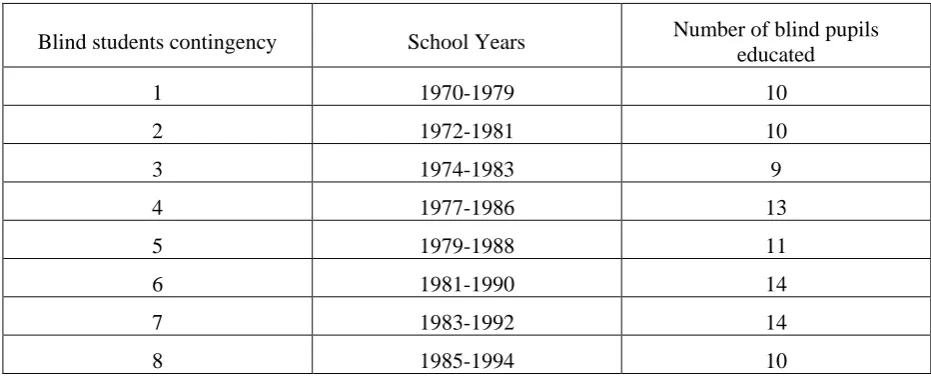
Through DCM (Decisions of Council of Ministries), No. 160, dated 29 April 1963, the Albanian government decided on the opening of the first Institute for the special education of two categories of people with disabilities respectively of blind and deaf- mute students. November 5th 1963 (Kabashi, 1994) marked the historical opening of the first “Institute for deaf, dumb and blind people”. The first ABC book in Braille and the mathematic book illustrated with pictures were prepared by specialists bringing their experience by eastern countries. The first Braille textbooks started to be typed by the teachers themselves delivering them to the students through special topics or chapters. The activity of this institution began with the opening of two classes, one for blind students and the other for deaf and dumb ones. The admission criteria to be included were that students should be blind, without other disability restrictions. The same criteria were applied to inclusion of deaf and dumb students. Among the major objectives finding implementation at that time was supplying of blind students with the necessary volume of knowledge’s pursuant to secondary mainstream education level (Kabashi, 1994), up to primary educational level. Even though it was entitled an Institution and had an educational system of nine years, in reality was an eight – year school by making this concept doubtful, due to the fact that there was an increased importance on professional and special education. The beginnings of the activity of this institute had its own difficulties due to lack of experience, teaching aids etc. The inclusion of blind pupils in mainstream schools and after the opening of the “Institute of the Blind and deaf”, continued to remain constant, being resized in later years in secondary education and higher education. The educational program developed in the institute was that of normal primary and secondary schools. Changes from one contingency of blind students to another moved to a positive progression, resulted in the achievements made by the second contingency of blind students.
Blind students contingency School Years Number of blind pupils educated
1 1970-1979 10
2 1972-1981 10
3 1974-1983 9
4 1977-1986 13
5 1979-1988 11
6 1981-1990 14
7 1983-1992 14
8 1985-1994 10
Table 1.1 Groups of the blind students educated during 1970-1994
As years went by, there were a growing number of blind students in this institute and at the same time there was an increase of the problems arising. The economic crisis that involved Albania especially during the ‘80s brought as a consequence restriction of typhlo-technique equipments. Since the opening of the institute until 1985-1986,the usage of Braille system was restricted, mainly applied at the Institute, used especially by blinds for their educational process. From 1986-1998there was a decrease of the usage of the Braille system in Albania. This came as a result of the lack of written literature in Braille. It comes also as an insufficient effort to raise awareness among parents about the Braille importance and role beyond the simple fact of reading and writing for blind students; as a lack of effective training for pedagogical staff dealing with this social category. After the 1990 the Braille writing system did not have an efficient application by the blind people as at that time there was an increase in the number of the electronic devices for recording, making them more useful for blind users during their daily activities. The lack of funds and a professional Braille Embosser for the
“Institute of blind students” and was an extreme shock to the usage of the Braille system, thus resulting in lack of publications of the school curricula’s even the simplest ones were limited in numbers. A series of Braille courses were initiated in some regions of Albania , where can it be mentioned Tirana in 1995, Vlora in 1996, Malësia e Madhe in 1999, Shkodra in 2004, Lezha in 2005, Saranda in 2004 (SHVSH 2004). A new era has started with the production of the school curricula’s in Braille for the “Institute of Blind Students” in 1996. With the operation of this production line started begins to be printed Braille school textbooks. At this year at the “Institute of Blind Students” came a new device called "thermoform" that serves to produce figures in relief (three-dimensional). Another line of Braille production started in 2002 which have been made possibleby NRCB, aiming not only helping “Institute of blind students” supplying with school curricula’s in Braille but as well as with production of the artistic books in Braille as a new innovation in this field.
Blind students contingency School Years Number of blind pupils educated
11 1986-1995 11
12 1987-1996 8
13 1988-1997 8
14 1989-1998 7
15 1991-2000 11
16 1992-2001 8
17 1993-2002 9
18 1994-2003 12
19 1995-2004 9
20 1996-2005 9
Table 1.2 Contingents of blind students educated from 1986- 2005 (Institute of blind students, paper no 208, 2006)
0 10 20 30 40 50 60 70 80
% of visually impairmentt
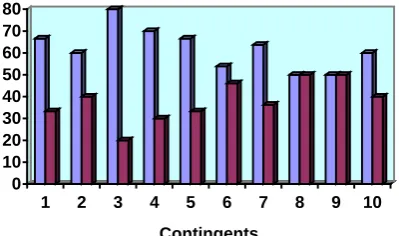
1 2 3 4 5 6 7 8 9 10 Contingents
Blind students
Partially sighted students
Fig 1.1 Sighted visus of blind students from 1963-1994
0 20 40 60 80 100
% gender balance
11 12 13 14 15 16 17 18 19 20
Contingents
% female % male
Fig 1.2 The gender proportion for the contingent of blind students from 1963-1994
In this institute there was a great variety of students regarding their origins, gender and sight visus.
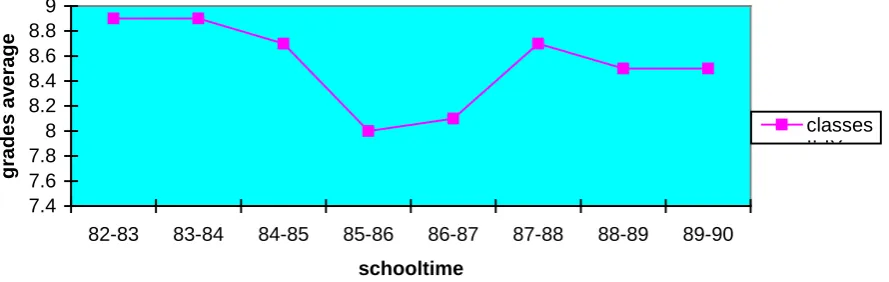
Their attempts to achieve good results during the educational process have been continuous.
7.4 7.6 7.8 8 8.2 8.4 8.6 8.8 9
82-83 83-84 84-85 85-86 86-87 87-88 88-89 89-90
schooltime
g
rad
es aver
ag
e
classes II IX
Figure 1.3 The qualitative performance of the blind students. (Class II-IX) 1982-1990
Contingents’
Living place
Rural Origin (%) Urban Origin (%)
1 22.2 77.8
2 50 50
3 70 30
4 100 0
5 77.8 22.2
6 92.3 7.7
7 72.8 27.2
8 72 28
9 57.6 42.4
10 60 40
TOTAL 67.4 32.6
Table 1.3: Classification of the blind students during 1963-1994, according to their origin of of residence (DEMOGRAPHIC DISTRIBUTION)
0 20 40 60 80 100
%
1 2 3 4 5 6 7 8 9 10
Contigents
Rural districts origin
Urban districts origin
Fig 1.4. The classification of the blind students according to their residence origin.
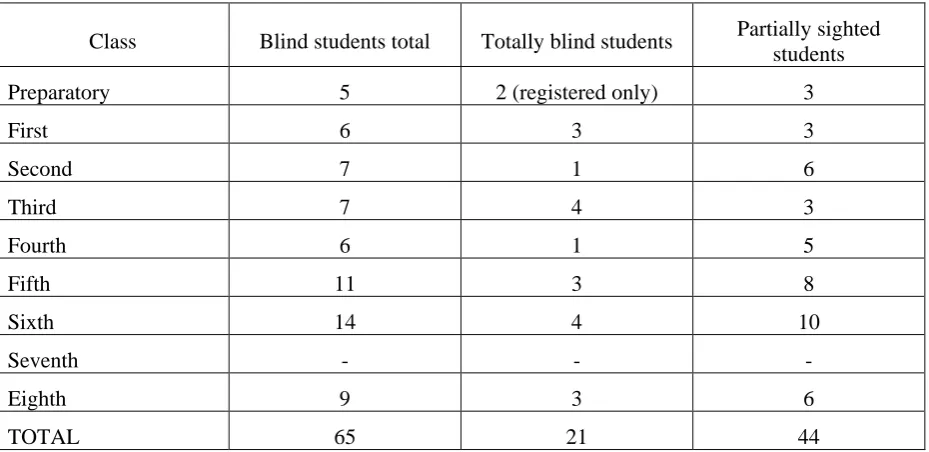
According to databases for the academic year 2005-2006, (Mrs. Kapedani, 2006 pers. comm., June 2006) comes out that actual situation of the blind students with regard to classes was as the following table:
Class Blind students total Totally blind students Partially sighted students
Preparatory 5 2 (registered only) 3
First 6 3 3
Second 7 1 6
Third 7 4 3
Fourth 6 1 5
Fifth 11 3 8
Sixth 14 4 10
Seventh - - -
Eighth 9 3 6
TOTAL 65 21 44
Table 1.4. School attendance in the “Institute of blind students” for the school year 2005-2006.
From 21 totally blind students, approximately 28.5 percent of them had absolute difficulty in the perception of the micro and macro-environment. The pedagogical staff consisted of 14 teachers and 7 assistant teachers. The whole staff of the institute was of 41 people. The pedagogical staff consisted of 10 sighted teachers and 4 visually impaired teachers. During 2006-2007 the institute was attended by 58 blind students. According to data’s in 34 localities of Albania, it was reported that 35 blind students have attended studies in the general public secondary schools in 11 localities of the country. The
academic school year 2007-2008, coincides with changes in the educational system, where again there were no students who had completed “Institute of Blind Students”.
5. DIFFICULTIES ARISING FROM EXCLUSION FROM EDUCATION
Given the eligibility criteria and objectives of the "Institute of Blind Students," it is noted that in this institution are accepted only blind student without other disability restrictions. Today at the Institute of Blind Students "Ramazan Kabashi", the first steps have been made for inclusion in the education of blind children with additional disabilities such as mental, but still does not have a program with clearly defined objectives, still their status remain not stable with the necessary legal provisions and acts. Although the number of blind and deaf is extremely limited, (there are 3 or 4 cases). Actually they are never treated in any educational institution. Outside the inclusion process are those blind people which average age is higher to be admitted in the educational institutions.
6. BLIND STUDENTS IN THE PRE- UNIVERSITY STUDIES
Blind students after completing compulsory education at the “Institute of Blind Students” or in any other mainstream school came in challenge of: to continue further education or not. There are more than 30 years when the first contingent of blind students came out of the “Institute of Blind Students”, began the path of integration into mainstream education . This additional to the fact that they have no other option to choose. Until 1990 the blind have largely followed the mainstream or artistic high schools. It was later expanded and their admission was conceived in high school. They were given the opportunity to attend foreign language, pedagogical, technological high schools, etc. During the academic year 2003-2004, blind students enrollment in professional high schools were as following: 33.3 percent were females, 66.6 percent were males, while the favorite areas were approximately 55.5 percent in Hotels and Tourism management, 33.3 percent in Artistic Lyceum, 11.1 percent in foreign languages. For the academic school year 2004-2005, the diversity of the most favorite professional areas were as following (SHVSH, 2006):
40 percent of the trend attending foreign languages, 30 percent in artistic lyceum , 20 percent in general high schools and 10 percent Hotels and Tourism management. From these 40 percent were females and 60 percent were blind males. For the academic school year 2005-2006, the pre- university studies were attended 100 percent by those blind students who had finished their former studies in the “Institute of blind students”. 55.5 percent of them were males and 44.5 percent females. They were mainly integrated in the following directions:
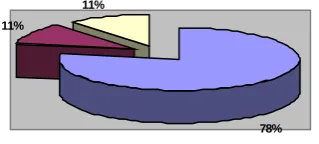
Approximately 77.8 percent have attended the Foreign Languages High School and 11.1 percent musical schools and nearly 11.1 percent in Hotels and Tourism management. Nearly 55.5 percent attended their studies in the general high schools and professional schools in Tirana and nearly 22.2 percent in Elbasan and 22.3 percent in Gjirokastra.
Most frequented education profiles during 2005-2006
78% 11%
11%
Foreign languages Hotels- Tourism Artistic Lyceum
Fig 1.5
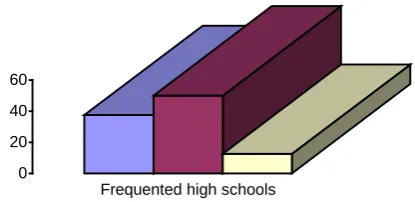
Requests of the blind students to attend high schools for the academic year 2006-2007, continue with the same rhythm as before, where at least all students finish primary and secondary educational level in the “Institute of blind students” express their interest and desire to advance their education in high schools. The major directions of the education of blind students in high schools were as following: Approximately 50 percent were females and 50 percent were males, 100 percent of them started their studies in high schools in Tirana where 55 percent in High School “Jordan Misja”, 12.5 percent in Hotels and Tourism management and 37.5 percent in the Foreign Languages High School “Asim Vokshi”.
0 20 40 60
Frequented high schools
Foreign languages
Artistic Lyceum
Hotels- Tourism
Fig 1.6 Educational trends mostly attended in 2006-2007
Meanwhile, according to the data recorded by the ABA branches in Albania, within this specific year nearly 19 blind students have attended the general high schools in regions such as Berat, Elbasan, Fier, Përmet, Pogradec, Shkodra, Tropoja, Tirana and Vlora. During the academic year 2007-2008 requests were lower in number due to the fact that there have not been other students finishing the Institute of blind students “Ramazan Kabashi”. According to the archived requests, it is reported that there were only 3 blind students attending the professional and mainstream educational system. The academic year 2008-2009, coincides with changes in the educational system, where it is noted that there were not blind students finishing the studies in the “Institute of blind students”.
7. BLIND STUDENTS IN UNIVERSITIES
From researches it results that 1978, was the year when the first blind student was admitted in University. Due to the fact that this case was a successful one, finishing the studies with excellent results, it served as an experience for admission of other students, firstly in this faculty, in the branch of philosophy and later in other faculties as well in branches of pedagogy, mathematics-physics, language and literature. In the 90s it became a massive phenomenon, but is held back by applying contests. For the academic year 2005-2006 blind students restarted attending their university studies after an interruption since 2001. From these 84.6 percent were males and 15.4 percent females. 69.2 percent attended their studies in Tirana University, 15.3 percent in the University of Shkodra and 15.3 percent in the University of Gjrokastra. Approximately 23 percent attended their studies in the Academy of Fine Arts, 38.4 percent attended branches of the faculty of social sciences, and 15.3 percent attended branches of the faculty of foreign languages and 23 percent pedagogy branches.
Distribution of attendance according universities during academic year 2005-2006.
70% 15%
15%
U.Tiranë U.Shkodë U.Gjirokastër
Fig 1.7
During the academic year 2006-2007, blind students attending studies within or abroad were nearly 40, from whom 55 percent were totally blind and 45 were partially sighted. The selections of the branches were various as well as their distribution.
Distribution of attendance according universities during academic year 2006-2007
15%
21%
3% 50%
3% 5% 3%
U. Vlorë U. Elbasan U. Prishtinë U. Tiranë U.Korçë U. Gjirokastër U.Pejë
Fig 1.8
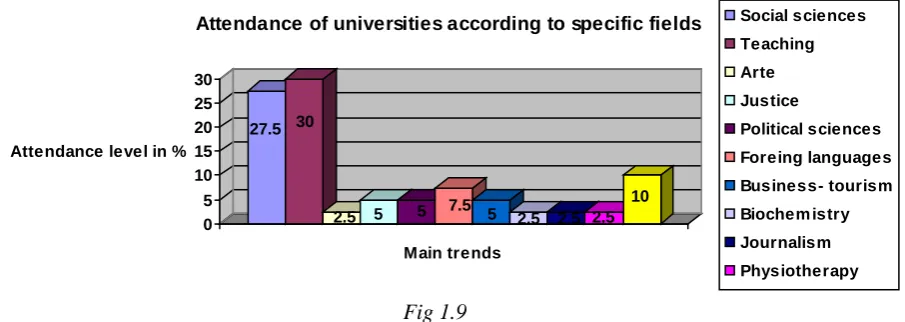
Preferences according to the branches were in accordance to the desires and expectations that blind students and their relatives have for the future, to expand the chances for better integration, through employment in a certain profession. The branches most attended are related to social sciences.
27.5 30
2.5 5 5 7.5 5 2.5 2.5 2.5 10 0
5 10 15 20 25 30
Attendance level in %
Main trends
Attendance of universities according to specific fields Social sciences
Teaching Arte Justice
Political sciences Foreing languages Business- tourism Biochem istry Journalism Physiotherapy
Fig 1.9
8. EVOLUTION OF THE LEGISLATION ON THE EDUCATION OF THE BLIND
STUDENTS
The political attitude toward the education of blind people is clearly determined in the laws and legal by-laws issued from time to time. For the first time in Albania their treatment started with DCM
No.160, April 1963 coinciding with the opening of the “Institute of the Deaf, dumb and blind people”. The functioning of the “Institute of the blind students” was made possible with DCM 115, dated 3 April 1992. The most serious attitude toward special education is initiated with legal determinations of Law No. 7952, dated 21.6.1995. It is important to emphasize this moment, as for the first time, special education is considered as integral part of the public education system by being called public special education. This law dedicates a special chapter to special education; determine its duties, kind etc. This clearly determined who might be considered as student with disability, by considering as such “those children or young people, who represent specific functional-anatomic features, which may be those with disabilities of mental, physical, sensory or organic nature”. In fact the lack of clear juridical definitions has created several barriers time after time. Thus as an example, a student with additional disabilities, apart from being blind can encounter challenges in finding the institutions which can treat him. Through these by-legal acts, the government has chosen forms of developments and adoption of the special education by accepting integrated special education and special education of specialized institutions (Law7952, article 57/2). In cases of the educations of blind students, this system is realized in both forms. It turns out that the education in special institutions is possible up to the compulsory level (secondary level), while further education of the blind student’s advances in the normal public institutions. The law guarantees a special financial support for the blind student (Law 8098, article 8). It is time to be legally solved through law or other legal by-laws the typhlo -technical support which can enable blind student to equally access on information. In the juridical- constitutional aspect this is resolved since the moment we accept equal chances, but in practice it still remains an obligation for state institutions. In all legislative frameworks for special education exists a positive spirit to support this education, however, by a careful observation it is clear that its practical effects are not those expected. There are often unnecessary restrictions such as; age of admission of the students or interruption of studies, lack of definitions for pre-school education, lack of definitions for the education of students with multiple disabilities.
9. ISSUES ON EDUCATION FOR THE BLIND 9.1 Concretization through other senses
It is now accepted that 90 percent of the information is gained through the vision sense and only 10 percent from the other four remaining senses. All the other senses cannot ensure any information equal for the brain (E. Bishop PhD, 1998). Among the four senses, apart from vision, the most important sense for the blind is the hearing, than the touch, smell and taste. As a starting mental process is recognition of the object during the first and direct contact with them. Recognition is the process of distinguishing and generalizing features and characteristics of objects surrounding us, based on reproduction of the traces and previous impressions under the influence of outside stimuli. “In the first stage of recognition process- expresses I.P.Seçenov-, complicated phenomena of the external world is divided into separate components such as color, shape, size, movement, sound, weight, severity, etc. At the same time with division of the objects in parts, synthesis is realized, in other words the union and mixture of the specific components and features in whole parts. In young blind children, the sphere of direct experience is restricted thus resulting in generalizing process narrowly and restricted to only self- experiences compared to experiences had by an adult blind person. In blind children considering the fact that there exists a considerable restriction of experience, a special attention is given to concretization of the words. Descriptions by means of words; knowledge gained from books; descriptions of the phenomena provided by the teachers are intertwined with the direct sensory recognition enabling them to better comprehend the world around. Through interviews with blind students, they express that the most special thing in comprehending the concepts, data, and information given during one class is by being in contact with, touching, tactile process making it more concrete.
9.2 Typhlotechnique
The most important role of typhlo- technique for the blind is enhancement of the chances toward autonomy, through usage of these equipments during the acquisition process. Blind students through
typhlo- technique can achieve their individual’s aims in educational aspects and enabling further developments of their abilities and chances. The XXI century is considered as the century of technological advances. This is also valuable for the developments of typhlo- technique as well. Usage of typhlo- technique devices in the “Institute of blind students”, starting from the simplest one and up to the most difficult ones, like slate and stylus, Braille typewriter, calculators with voice synthesizers, special computer programs for blinds “Jaws”, play a vital role for the efficient integration of the blind people in the educational system and as a consequence in achieving satisfactory results. According to the opinions of blind students on these devices, they express that these are an integral part of their daily life activities; such as in a match of football game the usage of the bell ball; even in a chess play the usage of special chess pieces; even in a class the usage of slate and stylus. For visually impaired students, computers with voice synthesizers with special programs for the blinds enable them to the same facilities compared to those created by the computer to sighted students. Their absences create gaps in the framework of assimilating of the knowledge by the blind students. From the surveys conducted for those students attending studies in the “Institute of blind students”, it result that 42 percent of the respondents admit that the quality of the school equipment, school texts is good while 23 percent admit that they do not possess such equipment. Based on the social-economic conditions of our country it is obligation of the Ministry of Education and Sports, Ministry of Finance and Ministry of Labour, Social Welfare and Youth to create chances in order for blind students to own their own didactic and teaching materials and special devices enabling them in a better educational process. 9.3 Technology of information usage by the blind
Blind people have the right to gain information equally to other citizens. They can access to information in different ways: from cassettes or CD, Braille or electronic documents such as electronic documents, through internet or printed materials, in enlarged writing style etc. Not all formats are suitable for the blind. Access to information is vital and essential to ensure them in being an integral part of society and not to be excluded from important sectors of social life, economic and cultural aspects etc. “Everyone shall have the right to freedom of expression; this right shall include freedom to seek, receive and impart information and ideas of all kinds, regard less of borders, either orally, in writing or in print, in the form of art, or through any other media of his choice”, (International Convention on Civil and Political rights, Article 19/2). The governmental institutions should develop strategies to make services of information and documents available even for social groups like blind people. Braille, information in cassettes, enlarged printed materials and other special technologies should be used to ensure access in written information archived for them (Standard Regulations of the UN, rule 5/b, 1993). Access to information is the major challenge for the blind people. As it is already recognized form the principle of sensory compensation, the only possibility for them is exercises of the other senses, where the hearing (auditory) sense plays the major role, but also not leaving behind the other senses such as touch, smell and taste. In the educational process of the blind, there was and still remains a priority the technology and methodology used in accessing information. This is the reason why the curricula of the special institutions of the visually impaired students are enriched with special disciplines. A special attention is given since the first steps to the sense of touch, closely connected with concretization of the objects of macro-environment in miniature. The process of pictures in relief recognition is another way of accessing information. Blind people, especially those with total vision loss, face a lot of difficulties in recognition of the pictures in relief, especially when these pictures are unknown beforehand through the concrete tactile process. We can conclude that one of the main methods of gaining information is observation of the micro and macro- environment through touch. It is important to emphasize the role and concept gained by the meaningful words and phrases as sourceof information. It is considered generally that people think that the mathematic subject and especially geometry must be very difficult to blind Rather, when they are passionate about a subject it becomes a much simpler subject than students with normal eyesight. From interviews of some blind students of Institute of Blind Students show that they have very simple geometry, conceived by three basic elements, plan, point, line.
9.4 Usage of the methods and approaches in the framework of the curricula
Another challenge which must be faced by the educational policies with regard to the education of the blind is the application of the programs in this institution. The attitude toward programs is directly connected to basic objectives of education and their schooling process. Since the foundation of the “Institute of Deaf, Dumb and Blind students”, were applied full programs in volume and quality compared to those of the mainstream education. Actually in the “Institute of blind students”, instead of the subject of dactylography is developed another subject entitled “Information on Computer and Technology”. In the individual aspect, the musical subject Solfezh (musical theoretical part) for grades V-VIII is attended twice a week. From the preparatory classes up to the eight grade students perform a subject called “Orientation”. Apart from the subject of musical education that takes place in schools just as that for sighted students it take place a subject consisting in practicing music with all musical instruments since the first grade of the school. The subject of curricular activities is attended in the first, second and sixth grade. The subject of figurative art is attended with one teaching class more than those for sighted students. During the last years there are enabled some facilities in participation to competitions for high schools final exams and attendance of university studies as for instance: “Blind student taking part in mature exam, after their test is hand out will be separated in a more suitable environment and helped out, by determining a reliable person, reading the questions to them and organizing the completion of the answers given orally by the blind students in the exam paper. In this way it is enabled the recording of the answers”, (MED Regulation, 2008) by misusing unfairly the concept for participation ensured by the Ministry of Education and Sports, neglecting the fact that to the blind candidate was not given the equal chance in competition, by not ensuring and accessing the paper exam either in Braille or audio. In the “Institute of Blind Student” are studied all basic and essential subjects for the general developments and trainings of human beings. The Curriculum Plan in this institute provides individual and collective classes in order to determinate and correct the knowledge’s gaps in 1-4 Grades students (as an hour for speech development for spatial orientation, improving handmade works etc). (MES Direction No.16, 2003, Direction No. 18, 2005) 9.5 Methods of encouragement and motivation
In order to achieve a far more qualitative acquisition, blind people need to be motivated in a specific and concrete way. Of course in the basic principles of pedagogy is evaluated in a special manner the individual personality, but in the case of blind students, individuality bears a more concrete notion, even more specific. This is due to the fact that in shaping the individual personality, blindness plays a major role. Its consequences are certainly different and are closely related to the degree of vision impairment; with the age in which impairment happened, etc. The method and level of motivation is closely related with the level of difficulty faced by the blind student during the acquisition process. One of the problems is instability of emotional state. Equally to sighted people, the blind student faces minimal and optimal situations, pessimistic and optimistic ones, but the frequency of instability in the latter ones is greater, The teacher is required continuously to consider the instability of emotive situation, by guiding the blind person toward a positive and optimistic side. At this point the efficiency of thinking and acting can rise significantly. Although belief or disbelief is related in itself to the emotional state it still required to distinguish different qualities in everyone's character composition. According to the nature, type of blindness and its consequences, the blind can occasionally confront slack of simple information which can hinder the concept assimilation. Facing these difficulties, blind students hold their attitudes and case after case, their willingness and inner strength to advance in things, which also helps them in discovering of such requests. In this case, the teacher plays a very important role. Among the most effective methods is to create opportunities to put into efficiency other senses, especially touch. Bringing the macro world in miniature; the materialization of phenomena’s; development of all viable methods and especially experimentation are among the most successful methods to assist them in the learning process. Obviously laboratories have a tremendous role. The application of modern typhlo- techniques into them greatly facilitates and enriches the teaching methodology.
9.6 Organizational Structure of a teaching class and its importance
The teaching classes have the same value as for the sighted students as well as visually impaired ones. Even though, there exist an essential distinction in organizational patterns and that of the methodology used during a teaching class. Related to this issue, there were interviewed some teachers of the “Institute of Blind Students” but as well teacher of professional high schools which have not attended so much by blind students. It resulted that core issues education are similar for blind students and sighted ones, but despite of this fact, to analyze their characteristics and problems, there are noted peculiarities. According to the Russian author I.P.Seçenov, concretization is highly important in retaining and storage of information. Lack of it risks the acquisition process to be converted into in an insignificant monologue, where reproduction of the sounds and words are in closed circuit through ear and mouth. The teachers of the “Institute of Blind Students” conclude that they consider the emotional aspect in blind students as a way of reaction toward the natural and social environment surrounding them. Organization of the teaching class with blind students is loaded with individual tasks. This is the reason why the number of the students per class is not higher than ten students in a class. The organization of the teaching class depends on the kind of discipline and age of the blind student, etc. As a summary of what was mentioned here and above, the teaching methodology used in the class takes a great value and special importance for the blind students affecting highly its acquisition process.
10. CONCLUSION
The historic background of the education of blind is a consequence of the socio-political, economic, cultural circumstances of the time. The blind educational process might have had another positive destiny, if this process would have started at the same time with neighboring countries. Another obstacle for a qualitative development was lack and unavailability of information for blind student’s achievements in other countries. While the process of the blind education was advancing in neighboring countries, in Albania this process was not even considered as one of the serious social issues of education to be dealt with. Estimating the historic data, efforts of the blind people to be educated, it is clearly testified their willingness and desire to acquire knowledge and to be better integrated in the social life. The spread and usage of the special writing system Braille in Albania was a necessity in obtaining information, to enhance ways and means of communication, to fell independent and more accomplished in their lives. In its beginnings Braille was mainly used by blind people who had finished their studies in the Institute of Blind Students or even in normal high schools and universities as well. Based on the historic records of the results achieved by blind student’s results that since their early beginnings blind students’ education was good, this confirms the fact that the development of this field was more dependent on their efforts and results than the reality circumstances being offered to them. The professional training had a positive impact for them. It breaks the taboo on their capabilities, and as a result of which it enhanced their self-esteem. Nevertheless, results in this direction were positive and encouraging, but these experimental methods of professional preparation and training were transitory due to objective reasons. Ascertained on the basis of literature studied was stated that until the 80s of XX century blind students have been fully provided with Braille books within optimal standards, which were lost in the early years of democratic political system and was not achieved any more until 2007 when the NCBR completed "Institute of Blind Students," with texts in Braille. This led to higher results in school during these years.
Currently, it results that orientation in blind student education was mainly focused in the education of blind without other pathologies. Concerning the fact of other blind children affected by other disabilities, without any doubt we can declare that educational policies in this direction do not exist and unfortunately, in today’s XXI century, these children are not subject of any kind of education. Consequently, these blind students are completely abandoned in their own destiny, by simply benefiting some social-economic benefits. These benefits are not efficient at all, even in the simplest level of body management or the micro-environment. It is time to be deal with the issues of blind students with multiple disabilities. It is necessary to draft special programs aiming the physical
rehabilitation, up to the possible level, to enable them to enhance their self-care activities, to accomplish the minimal vital process and as well be integrated in simple process of manual Labour. It is obvious that the solution of these problems is not an easy task but it is unjustifiable their neglecting. In the educational process, it is noted differentiation between blind students and partially sighted students. There exist a lot of common occurrences but there are also essential distinctions. Unfortunately respective educational institutions still did not understand the difference between blind and partially sighted students which are quite significant; the minimum fact is that they work with different texts where the first ones use textbooks in Braille and the latter texts with enlarged characters. According to data analyzed above are observed deficiencies in the full vocational training for the blind. If blind people choose to interrupt their further education, it begins a complete deceleration of their activities being confined within the walls of their houses. It happens in such a way because there is no possibility for a good vocational training for them through courses or other forms and, consequently, the issue of employment is far from reality.
If taken into account the real situation in Albania it can be noticed several problems, among which the most important is a distribution of the blind in different fields of studies, deficiencies in special education, inclusion in schools or branches, which have limited chances to offer opportunities to be employed according to their professional skills and abilities. There exists a lack of institutions, specialists, and typhologist or typhlo- technician. The full reformation of the legislation is directed by specific issues of the education of blind; improving the quality of learning for blind students and the attitude toward them firstly requires a better management and use of all existing resources including financial, institutional and secondly to minimize as much as possible problems in terms of their education. One of the prominent issues is lack of preschool education process and the so called preparatory class functioning in the “Institute of Blind Students” which does not fully accomplish its objective in preschool education teaching process. It is now obvious that the educational issues are closely connected as a chain starting from the early ages and lack of it during the starting point are reflected in its continuity. It is observed from concrete observations that students of the first grade of primary level start their journey in the educational process with serious problems. Children admitted in the “Institute of Blind Students” are blind ones, without additional disabilities. It is an urgent requirement the establishment of the institutions for treating blind children with additional disabilities. There are chances and possibilities for these children to be educated and rehabilitated up to the level of self- care activities, by being also included in social and cultural life, even with a minimum of education. One of the major problems faced by blind today is complete in existence of vocational training institutions. The blind have sufficient skills to gain a valuable professional education and to be able to participate in the Labour market. These institutions can achieve to educate blind people in three levels;
The first level enables them in manual works, by engaging as working forces or production experts. The second level is related to services where blind people can be trained to work as call-center agents, physiotherapists, secretary or dactyl-graphics.
The third level is that of university studies like all sighted people, fulfilled from years before.
11. REFERENCES
Dispozita normative për arsimin parauniversitar, viti shkollor 2002-2003, neni 57 e në vijim.
“Analizë e simestrit të parë të vitit shkollor 1994-1995 të proçesit mësimor-edukativ”. Mbledhje e Këshillit Pedagogjik dt 13.2.1995, (dorëshkrim).
“Analizë simestrale mbi disa probleme psiko-pedagogjike që kanë përshkruar fazat e mësimdhënies dhe të edukimit të nxënësve të këtij Instituti”.Raport i mbledhjes së Këshillit Pedagogjik të Institutit të Nxënësve që nuk shikojnë, dt 7.2.1994, (dorëshkrim).
“Edukimi muzikor i të verbërve, një ndër elementët e rëndësishëm në edukimin e përgjithshëm të tyre”.Henrieta Çule, dt 5.12.1994(dorëshkrim).
“Infants and Toddlers with Visual Impairments” by Virginia E. Bishop, Ph.D,1998
“Kërkesat bashkëkohore janë një garanci e mirë për rezultate sa më pozitive në proçesin mësimor dhe edukativ”, analizë e punës një vjeçare për vitin shkollor 1994-1995 të proçesit mësimor-edukativ, dt 27.6.1995, (dorëshkrim)
“Paketë informative mbi rregullat standarte të Kombeve të Bashkuara”.Tiranë 2001, Pregatitur nga FSHDPAK,mbështetur nga OXFAM-GB.
“Për një mësimdhënie sa më me cilësi dhe me kërkesa rigorozisht të përcaktuara”.Mbledhje e Këshillit Pedagogjik të “Institutit të Nxënësve që nuk shikojnë”,dt 20.1.1998,(dorëshkrim).
“Professions accessible to the blind”. Report presented in Bolzano (Italy) on April 23rd 2003,by Philipe Chazal, President of the Commission for the rehabilitation, professional training and employment, of the European Union of the Blind .
“Program i Qendrës Kombëtare të Rehabilitimit të të Verbërve”,miratuar me Vendim të Bordit Drejtues dt 7.7.2001.
“Rregullore e brendshme e konviktit të Institutit të nxënësve që nuk shikojnë”.Drejtori i Institutit të Nxënësve që nuk shikojnë,viti 1994, (shtypshkrim).
“Rregullore për Zhvillimin e provimeve të Maturës Shtetërore në Republikën e Shqipërisë”, dt 1.02.2008, Ministria e Arsimit dhe Shkencës.
“Rruga 30 vjeçare e punës mësimore-edukative me nxënësit e verbër dhe rezultatet e saj”.Ramazan Kabashi, Drejtor i Institutit të fëmijëve që nuk shikojnë, dt 5.3.1994, (dorëshkrim).
“Strategjia Kombëtare e personave me aftësi të kufizuar”, miratuar me Vendimin e Këshillit të Ministrave dt 7.1.2005.
“Strategjia Kombëtare e zhvillimit të arsimit parauniversitar 2004-2015”, miratuar nga Vendimi i Këshillit të Ministrave nr 538, dt 12.8.2004.
“Të synojmë për një cilësi më të mirë në proçesin mësimor-edukativ , duke përdorur teknika dhe metoda sa më bashkëkohore në këtë proçes. Analizë e semstrit të parë të vitit 1996-1997”.Mbledhje e Këshillit Pedagogjik të Institutit të Nxënësve që nuk shikojnë”, dt 31.1.1997, (dorëshkrim).
“The investigation of visual and touch perception of normally sighted and visually impaired children”, Dr. Romanas Kaffemanas,Siauliai University, Lithuania.
“The Use of the Braille Slate and Stylus”, a Position Statement of the Braille Authority of North America, adopted December 2006
Kushtetuta e Republikës së Shqipërisë. Botim i Qendrës së Publikimeve Zyrtare. Mars 2005.
Ligj 8098, dt 28.3.1996, “Për statusin e të verbërit”, i Kuvendit Popullor të Republikës së Shqipërisë. Ligj nr 7952, dt 21.6.1995 i Kuvendit të Republikës së Shqipërisë, (ndryshuar me ligj 8387, dt 30.7.1998), “Për sistemin arsimor parauniversitar”.
Ligj nr 8872, dt 29.3.2002, i Kuvendit Popullor të Republikës së Shqipërisë, “Për arsimin dhe formimin profesional në Republikën e Shqipërisë”.
Presentation F. Boe and A. Lamant,17-18 September 1998 – Helsinki – Finland.Education and Development of the Touch for Visually Impaired. Documents in reliefs (DIR): Creation and Use of pedagogical methods.
Udhëzim nr 7, dt 28.4.2005, i Ministrisë së Arsimit dhe Shkencës, Drejtoria e Zhvillimit të Kurrikulës, “Për përfundimin e vitit shkollor 2004-2005 dhe për zhvillimin e provimeve të lirimit, të pjekurisë dhe provimeve përfundimtare në sistemin e arsimit parauniversitar”.
Udhëzim, nr 16, dt 29.08.2003, i Ministrisë së Arsimit dhe të Shkencës, Kabineti, “Për zbatimin e planeve, programve dhe teksteve mësimore për arsimin parashkollor, tetëvjeçar dhe të mesëm”, për vitin shkollor 2003-2004.
Udhëzim, nr 18, dt 30. 08 .2005 i Ministrisë së Arsimit dhe Shkencës, Kabineti, “Për zbatimin e planeve, programeve dhe teksteve mësimore të arsimit parauniversitar në vitin shkollor 2005-2006”. Vendim i Këshillit të Ministrave nr 277, dt 18.6.1997, “Për zbatimin e statusit të të verbërit”.