Open Access
Research
Adding a quadrivalent human papillomavirus vaccine to the UK
cervical cancer screening programme: A cost-effectiveness analysis
Shalini L Kulasingam*
1, Steve Benard
2, Ruanne V Barnabas
3,4,
Nathalie Largeron
2and Evan R Myers
1Address: 1Dept. of Obstetrics and Gynecology, Duke University, Durham, NC 27705, USA, 2sanofi pasteur MSD, Lyon, 69007, France, 3Cancer
Epidemiology Unit, University of Oxford, Oxford, OX3 7LF, UK and 4HIV Vaccines Trials Network, Fred Hutchinson Research Center, Seattle, WA,
USA
Email: Shalini L Kulasingam* - [email protected]; Steve Benard - [email protected];
Ruanne V Barnabas - [email protected]; Nathalie Largeron - [email protected]; Evan R Myers - [email protected] * Corresponding author
Abstract
Background: We assessed the cost-effectiveness of adding a quadrivalent (6/11/16/18) human papillomavirus (HPV) vaccine to the current screening programme in the UK compared to screening alone.
Methods: A Markov model of the natural history of HPV infection incorporating screening and vaccination was developed. A vaccine that prevents 98% of HPV 6, 11, 16 and 18-associated disease, with a lifetime duration and 85% coverage, in conjunction with current screening was considered.
Results: Vaccination with screening, compared to screening alone, was associated with an incremental cost-effectiveness ratio of £21,059 per quality adjusted life year (QALY) and £34,687 per life year saved (LYS). More than 400 cases of cervical cancer, 6700 cases of cervical intraepithelial neoplasia and 4750 cases of genital warts could be avoided per 100,000 vaccinated girls. Results were sensitive to assumptions about the need for a booster, the duration of vaccine efficacy and discount rate.
Conclusion: These analyses suggest that adding a quadrivalent HPV vaccine to current screening in the UK could be a cost-effective method for further reducing the burden of cervical cancer.
Background
Despite a well-organised screening programme in the UK, and a marked decrease in cervical cancer incidence since 1988, there were 3,181 new cervical cancer cases and 1,529 deaths reported in 2002. In 2003, the National Health Service Cervical Screening Programme modified its recommendations by increasing the age to begin screening from 20 years to 25 years combined with a more
frequent screening interval (every 3 years in women aged 25 to 49 years and 5 years for women between 50 and 64).
Invasive carcinoma of the cervix is preceded by premalig-nant lesions. These precancerous lesions are defined as cervical intraepithelial neoplasia (CIN), and classified as low grade (CIN 1) or high grade (CIN 2 or CIN 3) accord-ing to severity. Prevention of cervical cancer has been based on early detection of these precancerous lesions
Published: 15 February 2008
Cost Effectiveness and Resource Allocation 2008, 6:4 doi:10.1186/1478-7547-6-4
Received: 10 July 2007 Accepted: 15 February 2008
This article is available from: http://www.resource-allocation.com/content/6/1/4
© 2008 Kulasingam et al; licensee BioMed Central Ltd.
using conventional Pap smear tests or, more recently, liq-uid-based cytology (LBC) tests. However, with the knowl-edge that infection with oncogenic human papillomavirus (HPV) is necessary for the development of cervical cancer [1], alternative methods, beside the Pap smear are being researched to improve cervical cancer pre-vention. In 2006, the first prophylactic quadrivalent HPV recombinant vaccine (HPV types 6,11,16,18) (Gardasil®,
Merck, Sharpe and Dohme (MSD), Whitehouse Station, New Jersey, USA) has been granted a marketing authorisa-tion in the European Union [2]. This vaccine is indicated for the prevention of high grade cervical dysplasia (CIN 2/ 3), cervical carcinoma, high grade vulvar dysplastic lesions (VIN 2/3) and external genital warts causally related to HPV types 6, 11, 16 and 18. More recently, the European Commission has granted a marketing authori-sation for a second cervical cancer vaccine (Cervarix, Glax-oSmithKline Biologicals s.a., Rixensart, Belgium) that is indicated for the prevention of precancerous cervical lesions (high-grade cervical intraepithelial neoplasia [CIN] grades 2 and 3) and cervical cancer causally related to human papillomavirus (HPV) types 16 and 18 [3]. Although the UK Health Minister has recommended the use of the HPV vaccine for girls aged 12–13 and catch-up for girls aged up to 19 years, a decision has not yet been made regarding which vaccine to use in the National Immunization program [4].
The quadrivalent vaccine showed >90% efficacy in pre-venting pre-cancerous high grade lesions due to these two HPV types [5,6]. This vaccine presents an opportunity to further reduce cancer incidence and mortality.
Genital warts are the most common sexually transmitted infection in the UK. In 2004, 79,678 first attack cases of genital warts were reported in Genitourinary Medicine (GUM) clinics [7]. Of these, 47% were diagnosed in women and 53% in men. Current methods for treating warts include therapies such as cryotherapy, electrocau-tery, podophyllotoxin and imiquimod. However, up to 40% of patients experience a recurrence of genital warts post-treatment [8]. The psychological impact of warts can be high; both men and women report feelings of embar-rassment and depression [9]. Over 90% of genital warts are attributable to infection with HPV types 6 and 11 [10]. Results from a Phase III trial of a quadrivalent vaccine that includes HPV types 6 and 11, in addition to the oncogenic HPV types 16 and 18, showed that vaccination prevented >90% of warts [11].
We examined the potential effectiveness and cost-effec-tiveness of a quadrivalent vaccine targeted at HPV types 6, 11, 16 and 18, administered to a cohort of girls aged 12 through a school-based vaccination programme in
con-junction with the current screening programme in the UK over a lifetime period.
Methods
We adapted a previously published and validated state-transition Markov model of HPV infection and cervical cancer [12,13] to estimate total lifetime costs, life expect-ancy and incremental cost-effectiveness ratios (ICERs) associated with different screening strategies either alone or in combination with vaccination to prevent HPV types 6, 11, 16 and 18 in the UK. Estimates and ranges used in the model for the natural history are presented in Table 1. Briefly, the model simulates a cohort of women at age 12 and follows them until age 85 years. Movement through the health states of the model (i.e. HPV infection, CIN 1, CIN 2, CIN 3, Cancer [Stages I–IV]) over time is based on yearly transition probabilities derived from the literature. Women who are infected with HPV can have their infec-tion clear, progress, or persist. For those women whose infections persist, the majority is assumed to develop CIN 1 but a minority is assumed to develop CIN 2 directly; these rates are age-dependant. Women who develop CIN 1, CIN 2, or CIN 3 can have their disease progress, regress, or persist. Women with cancer (stages I, II, III, IV) can have their cancer detected during screening or if they present to a health care provider based on symptoms. Women who do not have their disease detected can progress to the next stage, remain in the same stage, or die of cervical cancer. Each year, women also face an age-spe-cific risk of dying from other causes.
Table 1: Annual transition probabilities for the natural history model
Parameters Age Transition
probability
Time period
References
Normal
Uninfected to Cervical HPV infection (HPV incidence)
10–12 0.0000 12 months Calibrated from Canfell et al17
13 0.0100 12 months
14 0.0300 12 months
15 0.0400 12 months
16 0.0460 12 months
17 0.0700 12 months
18 0.0700 12 months
19 0.1700 12 months
20–21 0.2000 12 months
22 0.1200 12 months
23 0.1100 12 months
24–29 0.0850 12 months
30–33 0.0320 12 months
34–49 0.0170 12 months
50+ 0.0095 12 months
HPV infected state
Progression from HPV infection to SIL – all risk HPV 0.0959 12 months Canfell et al17
Percentage CIN 2 among SIL 0.1350 12 months Calibrated based on Myers et al12 and Canfell et al17
Regression of CIN 1 to normal from HPV infection 12–24 0.7000 18 months Calibrated based on Myers et al12 and Canfell et al17
25–29 0.5000 18 months
30–39 0.4000 18 months
40–49 0.2700 18 months
50+ 0.1000 18 months
CIN 1 Canfell et al17
Progression from CIN 1 to CIN 2 – all risk HPV 16–34 0.0297 12 months
35+ 0.1485 12 months
Progression from CIN 1 to CIN 3 – all risk HPV 0.0301 12 months
Regression to HPV infected state – all risk HPV 16–34 0.2248 12 months
35+ 0.1124 12 months
Proportion regressing to normal 0.9000 12 months
CIN 2 Canfell et al17
Progression from CIN 2 to CIN 3 16–34 0.0389 12 months
35–44 0.0797 12 months
45+ 0.1062 12 months
Regression from CIN 2 to CIN 1 0.2430 12 months
Regression from CIN 2 to uninfected or HPV infections
0.1901 12 months
Proportion regressing directly to normal 0.9000 12 months
CIN 3 Canfell et al17
Regression CIN 3 to CIN 1 – all risk HPV 0.0000 12 months
Regression from CIN 3 to CIN 2 – all risk HPV 0.0135 12 months
CIN 3 to uninfected or HPV infection 16–44 0.0135 12 months
45+ 0.0100 12 months
Proportion CIN 3 regressing directly to uninfected 0.5000 12 months
Proportion CIN 3 progressing to FIGO I cancer 0.0127 12 months
Cervical cancer Myers et al12
FIGO 1
Progression rates 0.9000 48 months
Probability of symptoms 0.1850 12 months
FIGO 2
Progression rates 0.9000 36 months
women with symptomatic warts would receive treatment and that treatment was 100% effective.
For the base case, women aged 25 to 49 years were assumed to be screened every 3 years; women aged 50 to 64 years were screened every 5 years consistent with cur-rent National Guidelines [22]. Differences in screening coverage by age were modelled using estimates from the Government Statistical Service (2003). Estimates for the sensitivity and specificity of conventional cytology and liquid cytology tests were based on published data [23,24] and UK specific data [25], with separate estimates of sen-sitivity used for CIN 1/CIN 2 and CIN 3. Fifty percent of women were assumed to be screened with LBC and the rest were assumed to be screened with conventional Pap smears for the base case. Ten percent of women were esti-mated to have inadequate Pap smear screening results and were assumed to undergo repeat screening [26]. Women with normal Pap smear results were assumed to return to regular screening. Women with Atypical Squamous Cells with Unknown Significance (ASCUS) or Low grade Squa-mous Intraepithelial Lesion (LSIL) Pap smear results were assumed to undergo repeat screening, with women referred to colposcopy based on two repeat borderline
results. Women with ≥ High grade Squamous Intraepithe-lial Lesion (HSIL) were assumed to be referred directly to colposcopy. Colposcopy and biopsy were assumed to have 90% sensitivity for detection of CIN [27]. Treatment of CIN was assumed to be 100% effective. Twenty percent of women with CIN 1 were assumed to be treated: this proportion is consistent with the recommendation that confirmed CIN 1 lesions are monitored via colposcopy rather than treated [17]. The proportion of women treated for CIN 2 and 3 was assumed to be 90% [17]. Screening and treatment parameters are presented in Table 2.
Vaccination to prevent infection with HPV types 6, 11, 16 and 18 was assumed to be 98% effective, using the recent results from the FUTURE II trial to determine efficacy of the vaccine in preventing CIN 2–3 [6]. We conservatively assumed the same efficacy for genital warts [5], but varied this assumption widely in sensitivity analyses. The vaccine was assumed to be administered to girls aged 12 years through a school-based programme. To date, there is evi-dence of a 5-year duration of vaccine efficacy [28]. We assumed a lifetime duration of efficacy for the base case consistent with a recently published analysis of the impact of an HPV 16–18 vaccine on cervical cancer in the UK [29]
FIGO 3
Progression rates 0.9000 15 months
Probability of symptoms 0.7500 12 months
FIGO 4
Probability of symptoms 0.8000 12 months
Annual probability of survival after diagnosis, FIGO 1 Cancer Research UK 21
1 Year survival 0.977 12 months
2 Year survival 0.978 12 months
3 Year survival 0.963 12 months
4 Year survival 0.988 12 months
5 Year survival 0.988 12 months
Annual probability of survival after diagnosis, FIGO 2
1 Year survival 0.830 12 months
2 Year survival 0.835 12 months
3 Year survival 0.755 12 months
4 Year survival 0.870 12 months
5 Year survival 0.899 12 months
Annual probability of survival after diagnosis, FIGO 3
1 Year survival 0.590 12 months
2 Year survival 0.693 12 months
3 Year survival 0.778 12 months
4 Year survival 0.928 12 months
5 Year survival 0.963 12 months
Annual probability of survival after diagnosis, FIGO 4
1 Year survival 0.523 12 months
2 Year survival 0.782 12 months
3 Year survival 0.721 12 months
4 Year survival 0.925 12 months
5 Year survival 0.956 12 months
as well as other analyses [30] but varied this assumption widely in sensitivity analyses. Use of a booster, assumed to be administered 10 years after the initial vaccine (i.e., at age 22), to achieve a lifetime duration of efficacy was examined in a sensitivity analysis [31]. Vaccine coverage was 85% for the base case based on coverage rates reported for the hepatitis B vaccine in the UK through a school programme [32]. Since women can be infected with multiple HPV types, and these other types can poten-tially cause replacement CIN and cancer, we examined
this possibility in sensitivity analyses, assuming that 10 percent of women were coinfected with other high-risk HPV types [33].
We modelled a reduction of approximately 35% for CIN 1, 55% for CIN 2 and 3 and 70% for cervical cancer (all stages). This reflects the percentage of cervical cancer and CIN 1–3 attributable to HPV types 6, 11, 16 and 18 [34,35]. Moreover, we assumed that 90% of warts were attributable to infection with HPV types 6 and 11 [10]. We
Table 2: Screening, vaccine and cost parameters
Parameters Base case Ranges References
Screening characteristics
Screening interval 3 years in ages 25–49 years and 5 years
in ages 50–64 years
NHS cervical screening programme 22
Coverage rates of target groups by age (2003)
25–29 74.0% NHS cervical screening programme 22
30–34 81.0%
35–39 83.7%
40–44 84.0%
45–49 83.8%
50–54 83.2%
55–59 81.4%
60–64 77.3%
Inadequate pap smear results 10% 5% – 20%
Pap Sensitivity for CIN 1/2 Pap sensitivity for CIN 1/2 (LBC)
61% 51% – 80% Nanda et al23and Karnon et al25
Pap Sensitivity for CIN 3 Pap Sensitivity for CIN 3 (LBC)
65% 65% – 90% Nanda et al23 and Karnon et al25
Pap Specificity for no CIN Pap Specificity for no CIN (LBC)
95.7% 90% – 99% Nanda et al25 and Kulasingam et al24
Colposcopy/Biopsy Sensitivity 90% 88% – 100% Mitchell et al27
Colposcopy/Biopsy Specificity 100% 65% – 100% Kulasingam et al24 and Karnon et al25
Vaccine characteristics
Vaccine efficacy for all 6, 11, 16, 18 HPV types
98% 85% – 100% Villa et al5 and Future II 6
Duration of efficacy Lifetime From 10 years to lifetime Olsson et al 28 and Villa et al42
Vaccine coverage 85% 50%–90% Trotter et al31 and Bramley et al32
Booster coverage 50% Trotter et al31
Costs
Pap smear £23.7 £18 – £30 Brown et al 26
Curtis et al38
Colposcopy (with or without biopsy) £141.69 £113 – £170
Knife cone biopsy of cervix uteri £290.64 £232 – £349
CIN 1, CIN 2, CIN 3 £313.14 £250 – £376
FIGO I £12,142 £9,714 – £14,570 Curtis et al38 and Wolstenholme et
al37
FIGO II £22,061 £17,649 – £26,473
FIGO III £21,785 £17,428 – £26,142
FIGO IV £23,402 £18,722 – £28,082
Genital warts £215.73 £172 – £259 Brown et al26 and Curtis et al38
Vaccine cost/dose £75 £70 – £80
Administration cost/dose £ 3.4 £0 – £12 Trotter et al31
Booster cost/dose £75
Administration cost for booster £10 Curtis et al38
Discount rates
Costs 3.5% 0 – 5%
modelled the impact of the vaccine as a direct reduction in CIN rather than developing a type-specific model to account for reductions in HPV type-specific infection, tak-ing into account type-specific progression and regression through the different CIN and cancer states similar to Goldie et al. [36].
Costs for screening, diagnosis and treatment for cervical cancer as well as for diagnosing and treating warts were obtained from previously published studies [37,38] and are presented in Table 2. The costs were inflated to 2005 £ using the Hospital and Community Services pay and prices index [38]. While the NHS price of the vaccine is £80.50, a volume-based discount will be applied for any vaccination programme. For the purposes of this analysis, we have assumed a cost per dose for the vaccine of £75 was used but varied from £70 to £80 in sensitivity analy-ses. The cost for administration was assumed to be £3.40 per dose for the base case, but varied up to £12 in sensitiv-ity analyses. Only direct costs were included in the analy-ses, assuming a National Health System (NHS) perspective.
Utilities for calculating quality-adjusted life expectancy were based on ongoing studies and are summarized in Table 3[39,40]. Time with disease was based on expert opinion (Dr Barnabas, personal communication, 2005). The utility value for those surviving cervical cancer was assumed to be 1.0
Health outcomes and costs are discounted at 3.5% annu-ally for the base case. Results are presented as average life-time costs, average life-expectancy, life year saved (LYS), Quality adjusted life year (QALY) and incremental cost-effectiveness ratios (ICERs). Strategies that were more costly and less effective, or less cost-effective than adjacent strategies were considered "dominated."
Results
Validation of the model
The predicted age-specific annual incidence of invasive cervical cancer in the UK population is similar to the
observed data in the UK (Figure 1). The model predicts a lifetime risk of cancer in the absence of screening, for women aged 20 to 79 years, of 2.0% and 0.71% with screening, which are similar to estimates from a previ-ously published modelling study that examined the impact of changes in recommendations to the UK screen-ing programme [17]. The distribution for FIGO stages pre-dicted by the model is similar to data reported by Bjorge et al. [20] (Stage I: 56%, Stage II: 29%, Stage III: 12%, Stage IV: 3%).
Clinical outcomes
When vaccination is added to screening, under base case assumptions, the lifetime risk of cancer is reduced from 0.71 to 0.29%. Considering a cohort of 100,000 women in the UK, the model estimates that around 418 cervical cancers, 127 deaths, 2,554 CIN 1, 1,683 CIN 2, 2,479 CIN 3 and 4,798 genital warts could be avoided (Table 4).
Economic outcomes
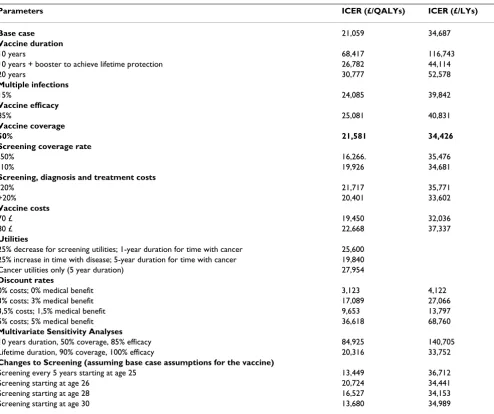
Compared to no screening or vaccination (natural his-tory), screening only is associated with an ICER of £11,156 per QALY. Compared to screening, vaccination combined with screening had an incremental cost-effec-tiveness ratio (ICER) of £21,059 per QALY and £34,687 per LYS (Figure 2 and Table 5).
As shown in Table 5, results were sensitive to the assump-tion used for the duraassump-tion of efficacy. If a 10 year duraassump-tion of vaccine efficacy is assumed, the ICER for screening and vaccination compared to screening only would be £68,417 per QALY (£116,743 per LY). If a booster was needed to achieve lifetime protection, the ICER was £26,782 per QALY (£44,114 per LY) under the assump-tion that the booster was given at age 22 and coverage at that age was 50%. Results were moderately sensitive to time with an abnormality with ICERs for screening and vaccination compared to screening only ranging from £19,840 (for a 25% increase in the length of time with abnormality) to £25,699 (for a 25% decrease in the length of time) when screening, diagnosis and cancer were var-ied. Results were very sensitive to the discount rate
consid-Table 3: Utility scores
Parameters Utility Time with Disease Ranges References
Screening Pap 0.98 1 months 2 weeks – 2 months Myers et al39 and Insinga et al40
ASCUS pap 0.94 1 month 2 weeks-2 months
>= LSIL pap 0.91 2 months 1–4 months
Warts 0.91 2 months 1–4 months
CIN 1 0.91 0.96 2 months 10 months 2–4 months 0–10 months
CIN 2–3 0.87 2 months 1–4 months
FIGO I 0.76 5 years 1–5 years
FIGO II 0.67 5 years 1–5 years
FIGO III 0.67 5 years 1–5 years
ered for benefits: varying discount rates from 3,5% for medical benefits (base case) to 1,5% would decrease the ICER to £9,653 per QALY.
Varying the costs for screening, diagnosis and treatment (Table 2) over a wide range, as well as varying the cost of the vaccine between £70 and £80 had a moderate impact on the cost-effectiveness of screening and vaccination compared to screening only.
In multi-variable sensitivity analyses, we used a best and worst case scenario to determine the possible bounds for key aspects of the vaccine (duration, coverage and effi-cacy). As shown, a combination of lower coverage, lower efficacy and short duration has an important effect on the ICER of vaccination and screening compared to screening only.
Finally, as shown, the vaccine remains cost effective (with QALYs as the outcome) if the age of screening can be delayed or a less frequent screening interval used.
Discussion
These results suggest that adding vaccination to the cur-rent screening programme in the UK, to prevent infection with HPV types 6, 11, 16 and 18 is potentially cost-effec-tive. The key parameters that affect this conclusion are the duration of vaccine efficacy and whether a booster is needed to achieve a duration that is sufficiently long to provide protection during the years of peak HPV inci-dence (modelled as a lifetime duration for this analysis). Our findings are consistent with previous analyses per-formed in the US that show that duration affects the cost-effectiveness of screening and vaccination compared to screening only [24,30]. However, in contrast to these
anal-Observed and predicted incidence of invasive cervical cancer in the UK
Figure 1
Observed and predicted incidence of invasive cervical cancer in the UK. UK statistics. Cancer registration in England, 2002.
UK
0 5 10 15 20
0-10 10-1 5
15-2 0
20-2 5
25-3 0
30-3 5
35-4 0
40-4 5
45-5 0
50
-5555-6060-6565-7070-7575-8080-85
Age
C
er
v
ic
al
c
a
n
c
er
i
n
c
id
en
c
e
p
e
r
100,
000 p
er
y
ear
sim ul ated
observed
Table 4: Estimated cases of cervical cancer, cervical cancer deaths, cervical intraepithelial neoplasia grade 1 (CIN 1), grade 2 (CIN 2), grade 3 (CIN 3) and genital warts cases per 100 000 women who are screened, or vaccinated and screened over a lifetime
Cervical cancer cases
Deaths from cervical cancer
CIN 3 cases detected
CIN 2 cases detected
CIN 1 cases detected
Genital warts cases
Screening only 715 218 5325 3906 12453 7147
Screening and vaccination
297 91 2846 2223 9899 2349
Case avoided 418 127 2479 1683 2554 4798
yses, our results suggest that a vaccination programme added to screening in the UK would be cost-effective with-out the need to change screening interval and/or the age of first screen. In the UK, screening is started at a later age, and a less frequent screening interval is used, compared to the US. The current UK strategy thus avoids the increased costs associated with detecting HPV-related changes, espe-cially in younger women, that are more likely to regress.
To date, all cost-effectiveness analyses of HPV vaccination show that duration of efficacy will be a key to determining how cost-effective the vaccine will be. The need for a long duration of vaccine efficacy is consistent with our under-standing of the natural history of HPV infection: progres-sion to cervical cancer can take more than 10 years [41]. Currently, there is approximately 5 years of data of vaccine duration [42]. Long term monitoring of women currently participating in the vaccine trial will be needed to deter-mine if and when a booster should be given. If a booster is needed our analyses show that the coverage achieved with a booster will affect the overall cost-effectiveness of vaccination and screening compared to screening only. One possible solution for increasing booster coverage beyond the 50% we modelled is if vaccination could be administered during the cervical cancer screening visit.
We did not use a quadrivalent type-specific model for this analysis. There is a need for population-based data that accounts for the distribution of these specific types within CIN from the UK. In addition, data on the impact of the vaccine on the overall reduction in CIN (as opposed to the type-specific reduction in CIN reported to date) due to these specific types, in previously unexposed girls, is also needed, to confirm the pooled estimates reported in the literature. Work is currently underway to refine existing models, including the one used here, to more accurately
reflect the expected type-specific reduction in CIN and cancer when girls are vaccinated using data from the UK (Dr R. Barnabas, personal communication, 2007).
The use of QALYs is important since it allows us to incor-porate, among other things, feelings of anxiety and embarrassment due to abnormal Pap test results as well as genital warts. However, the utilities used were derived from a study conducted among college-aged students in the US [39]. Although utilities derived from a UK popula-tion as well as a study of time spent in a given health state would more accurately reflect the morbidity associated with cancer, CIN and warts, this information has yet to be published. Results from the sensitivity analysis show that duration of symptoms has only a modest influence on the results.
Our model is conservative in that it does not take into account the impact of the vaccine on herd immunity. Prior analyses in the US with transmission models that accounted for herd immunity effects [43,44] suggest that the ICER for vaccination and screening compared to screening only would be much more attractive, even if the vaccine was only given to girls. In future analyses, we will also need to determine whether vaccinating boys in addi-tion to girls will be cost-effective, taking into account the potential benefit of the HPV 6 and 11 component of the vaccine in preventing genital warts in men.
Although the vaccine has recently been approved for use in the UK, its use is not mandatory [4]. In addition, there has been no decision made on the choice of vaccine (Cer-varix or Gardasil). As such, patients and payers will have to decide whether the cost of the vaccine represents value for money. To the extent that one vaccine has a higher cost than the other, and is not covered by a national program, vaccine coverage will differ from what we have modeled. Our analyses suggest that although there has not been a move to change screening to offset the costs of adding a vaccination program, one potential benefit of the vaccine that may make it more attractive for both patients and payers, is if eventually, a successful vaccination program allows women to be screened less frequently. As shown, depending on the characteristics of the vaccine, the age and/or frequency of screening may be delayed and still be cost-effective.
Other limitations include lack of a probabilistic sensitivity analysis and the fact that the model provides a conserva-tive estimate of the true value of a quadrivalent HPV vac-cine targeted at HPV types 6, 11, 16 and 18, in terms of health benefits as it does not take into consideration the potential reduction of adenocarcinoma, vulvar and vagi-nal intraepithelial neoplasia, vulval and vagivagi-nal cancers, as well as laryngeal papillomatosis associated with the
Efficiency curve comparing a strategy of screening only to a strategy of vaccination plus screening
Figure 2
Efficiency curve comparing a strategy of screening only to a strategy of vaccination plus screening.
25.84 25.845 25.85 25.855 25.86 25.865 25.87
0 50 100 150 200 250 300 350 Discounted Lifetime Costs, £
Screening Only Screening and Vaccination
D
iscou
nte
d Life
E
x
pe
cta
n
cy ,
Y
e
a
vaccine HPV types [45]. In terms of the latter, the benefits of a quadrivalent vaccine are to some extent underesti-mated in this analysis. In terms of the former, although one study to date has conducted a probabilistic sensitivity analysis to determine credible intervals for the natural his-tory component of the model [46], there is a lack of infor-mation to determine the appropriate distributions for use in models this complex. As such, this analysis used trian-gular distributions, although these have well known limi-tations. This highlights the need for epidemiologic studies to include information on the distributions as well as point estimates and confidence intervals.
Conclusion
In conclusion, our results suggest that adding a quadriva-lent vaccine to the current screening programme in the UK
is potentially cost-effective. In order to more accurately quantify the effect that the vaccine will have, future mod-els will need to account for the actual reduction in CIN and cancer based on data from the vaccine trials con-ducted in the UK, as well as to incorporate herd immunity effects.
Competing interests
For this project, Dr. Kulasingam and Dr Myers have been supported by a grant from SP-MSD. Dr. Kulasingam and Dr Myers have been supported by grants from Merck and CSL-Australia. Dr. Kulasingam has been a consultant for SP-MSD and CSL-New Zealand. Nathalie Largeron is an employee of SP-MSD. Steve Bernard is a former employee of SP-MSD. Dr. Ruanne Barnabas has been a consultant for SP-MSD.
Table 5: One-way sensitivity analyses comparing cervical cancer screening only and cervical cancer screening associated with a quadrivalent HPV vaccination programme
Parameters ICER (£/QALYs) ICER (£/LYs)
Base case 21,059 34,687
Vaccine duration
10 years 68,417 116,743
10 years + booster to achieve lifetime protection 26,782 44,114
20 years 30,777 52,578
Multiple infections
15% 24,085 39,842
Vaccine efficacy
85% 25,081 40,831
Vaccine coverage
50% 21,581 34,426
Screening coverage rate
-50% 16,266. 35,476
-10% 19,926 34,681
Screening, diagnosis and treatment costs
-20% 21,717 35,771
+20% 20,401 33,602
Vaccine costs
70 £ 19,450 32,036
80 £ 22,668 37,337
Utilities
25% decrease for screening utilities; 1-year duration for time with cancer 25,600
25% increase in time with disease; 5-year duration for time with cancer 19,840
Cancer utilities only (5 year duration) 27,954
Discount rates
0% costs; 0% medical benefit 3,123 4,122
3% costs; 3% medical benefit 17,089 27,066
3,5% costs; 1,5% medical benefit 9,653 13,797
5% costs; 5% medical benefit 36,618 68,760
Multivariate Sensitivity Analyses
10 years duration, 50% coverage, 85% efficacy 84,925 140,705
Lifetime duration, 90% coverage, 100% efficacy 20,316 33,752
Changes to Screening (assuming base case assumptions for the vaccine)
Screening every 5 years starting at age 25 13,449 36,712
Screening starting at age 26 20,724 34,441
Screening starting at age 28 16,527 34,153
Screening starting at age 30 13,680 34,989
Authors' contributions
SLK was responsible for the adaptation of a previously developed model used for this analysis, the analysis of the data, interpretation of results and drafting of the manu-script. SB was responsible for providing data and review-ing the manuscript. RVB was responsible for providreview-ing data and reviewing the manuscript. NL was responsible for providing data, reviewing the manuscript and provid-ing independent confirmation of the cost-effectiveness results. EM was responsible for developing the original model used for this analysis, providing supervision for the conduct of the study and reviewing the manuscript. All authors have read and approved the final manuscript.
References
1. Walboomers JM, Jacobs MV, Manos MM, Bosch FX, Kummer JA, Shah KV, Snijders PJ, Peto J, Meijer CJ, Munoz N: Human papillomavirus is a necessary cause of invasive cervical cancer worldwide. J Pathol 1999, 189(1):12-19.
2. (EMEA) EMA: European Public Assessment Report (EPAR) for Gardasil. 2006.
3. (EMEA) EMA: European Public Assessment Report (EPAR) for Cervarix. 2007.
4. (National) DH: HPV vaccine recommended for NHS immuni-sation programme. 2007.
5. Villa LL, Costa RL, Petta CA, Andrade RP, Ault KA, Giuliano AR, Wheeler CM, Koutsky LA, Malm C, Lehtinen M, Skjeldestad FE, Ols-son SE, Steinwall M, Brown DR, Kurman RJ, Ronnett BM, Stoler MH, Ferenczy A, Harper DM, Tamms GM, Yu J, Lupinacci L, Railkar R, Tad-deo FJ, Jansen KU, Esser MT, Sings HL, Saah AJ, Barr E: Prophylactic quadrivalent human papillomavirus (types 6, 11, 16, and 18) L1 virus-like particle vaccine in young women: a randomised double-blind placebo-controlled multicentre phase II effi-cacy trial. Lancet Oncol 2005, 6(5):271-278.
6. Future II: Quadrivalent vaccine against human papillomavirus to prevent high-grade cervical lesions. N Engl J Med 2007,
356(19):1915-1927.
7. Health Protection Agency: Diagnoses and Rates of Selected STIs Seen at GUM Clinics, United Kingdom: 2000 - 2004. National, Regional and Strategic Health Authority Summary Tables. 2005.
8. O'Mahony C: Genital warts: current and future management options. Am J Clin Dermatol 2005, 6(4):239-243.
9. Maw RD, Reitano M, Roy M: An international survey of patients with genital warts: perceptions regarding treatment and impact on lifestyle. Int J STD AIDS 1998, 9(10):571-578. 10. Greer CE, Wheeler CM, Ladner MB, Beutner K, Coyne MY, Liang H,
Langenberg A, Yen TS, Ralston R: Human papillomavirus (HPV) type distribution and serological response to HPV type 6 virus-like particles in patients with genital warts. J Clin Micro-biol 1995, 33(8):2058-2063.
11. Garland SM, Hernandez-Avila M, Wheeler CM, Perez G, Harper DM, Leodolter S, Tang GW, Ferris DG, Steben M, Bryan J, Taddeo FJ, Railkar R, Esser MT, Sings HL, Nelson M, Boslego J, Sattler C, Barr E, Koutsky LA: Quadrivalent vaccine against human papillomavi-rus to prevent anogenital diseases. N Engl J Med 2007,
356(19):1928-1943.
12. Myers ER, McCrory DC, Nanda K, Bastian L, Matchar DB: Mathe-matical model for the natural history of human papillomavi-rus infection and cervical carcinogenesis. Am J Epidemiol 2000,
151(12):1158-1171.
13. McCrory DC, Matchar DB, Bastian L: Evaluation of Cervical Cytology. In Evid Rep Technol Assess Agency for Healthcare Quality and Research; 1999.
14. Melkert PW, Hopman E, van den Brule AJ, Risse EK, van Diest PJ, Ble-ker OP, Helmerhorst T, Schipper ME, Meijer CJ, Walboomers JM:
Prevalence of HPV in cytomorphologically normal cervical smears, as determined by the polymerase chain reaction, is age-dependent. Int J Cancer 1993, 53(6):919-923.
15. Schiffman M, Kjaer SK: Chapter 2: Natural history of anogenital human papillomavirus infection and neoplasia. J Natl Cancer Inst Monogr 2003:14-19.
16. Office for National Statistics: Cancer statistics registrations: Registrations of cancer diagnosed in 2002, England. Series
2005, MB1(33):.
17. Canfell K, Barnabas R, Patnick J, Beral V: The predicted effect of changes in cervical screening practice in the UK: results from a modelling study. Br J Cancer 2004, 91(3):530-536. 18. Office for National Statistics: Mortality statistics: Review of the
Register General on deaths by cause, sex and age, in England and Wales, 2002. 2003 .
19. Redburn JC, Murphy MF: Hysterectomy prevalence and
adjusted cervical and uterine cancer rates in England and Wales. Bjog 2001, 108(4):388-395.
20. Bjorge T, Thoresen SO, Skare GB: Incidence, survival and mor-tality in cervical cancer in Norway, 1956-1990. Eur J Cancer
1993, 29A(16):2291-2297.
21. Cancer Research UK: Cervical cancer survival statistics. 2004 . 22. NHS Cancer Screening Programmes: NHS Cervical Screening
Programme. 2005.
23. Nanda K, McCrory DC, Myers ER, Bastian LA, Hasselblad V, Hickey JD, Matchar DB: Accuracy of the Papanicolaou test in screen-ing for and follow-up of cervical cytologic abnormalities: a systematic review. Ann Intern Med 2000, 132(10):810-819. 24. Kulasingam SL, Myers ER: Potential health and economic impact
of adding a human papillomavirus vaccine to screening pro-grams. Jama 2003, 290(6):781-789.
25. Karnon J, Peters J, Platt J, Chilcott J, McGoogan E, Brewer N: Liquid-based cytology in cervical screening: an updated rapid and systematic review and economic analysis. Health Technol Assess
2004, 8(20):iii, 1-78.
26. Brown RE, Breugelmans JG, Theodoratou D, Benard S: Costs of detection and treatment of cervical cancer, cervical dyspla-sia and genital warts in the UK. Curr Med Res Opin 2006,
22(4):663-670.
27. Mitchell MF, Schottenfeld D, Tortolero-Luna G, Cantor SB, Richards-Kortum R: Colposcopy for the diagnosis of squamous intraep-ithelial lesions: a meta-analysis. Obstet Gynecol 1998,
91(4):626-631.
28. Olsson SE, Villa LL, Costa RL, Petta CA, Andrade RP, Malm C, Iversen OE, Hoye J, Steinwall M, Riis-Johannessen G, Andersson-Ellstrom A, Elfgren K, von Krogh G, Lehtinen M, Paavonen J, Tamms GM, Giacoletti K, Lupinacci L, Esser MT, Vuocolo SC, Saah AJ, Barr E:
Induction of immune memory following administration of a prophylactic quadrivalent human papillomavirus (HPV) types 6/11/16/18 L1 virus-like particle (VLP) vaccine. Vaccine
2007, 25(26):4931-4939.
29. Kohli M, Ferko N, Martin A, Franco EL, Jenkins D, Gallivan S, Sherlaw-Johnson C, Drummond M: Estimating the long-term impact of a prophylactic human papillomavirus 16/18 vaccine on the burden of cervical cancer in the UK. Br J Cancer 2007,
96(1):143-150.
30. Goldie SJ, Kim JJ, Wright TC: Cost-effectiveness of human papil-lomavirus DNA testing for cervical cancer screening in women aged 30 years or more. Obstet Gynecol 2004,
103(4):619-631.
31. Trotter CL, Edmunds WJ: Modelling cost effectiveness of meningococcal serogroup C conjugate vaccination cam-paign in England and Wales. Bmj 2002, 324(7341):809. 32. Bramley JC, Wallace LA, Ahmed S: Universal hepatitis B
vaccina-tion of UK adolescents: a feasibility and acceptability study. Commun Dis Public Health 2002, 5:318 – 320.
33. Clifford GM, Gallus S, Herrero R, Munoz N, Snijders PJ, Vaccarella S, Anh PT, Ferreccio C, Hieu NT, Matos E, Molano M, Rajkumar R, Ronco G, de Sanjose S, Shin HR, Sukvirach S, Thomas JO, Tunsakul S, Meijer CJ, Franceschi S: Worldwide distribution of human pap-illomavirus types in cytologically normal women in the Inter-national Agency for Research on Cancer HPV prevalence surveys: a pooled analysis. Lancet 2005, 366(9490):991-998. 34. Clifford GM, Rana RK, Franceschi S, Smith JS, Gough G, Pimenta JM:
Human papillomavirus genotype distribution in low-grade cervical lesions: comparison by geographic region and with cervical cancer. Cancer Epidemiol Biomarkers Prev 2005,
Publish with BioMed Central and every scientist can read your work free of charge "BioMed Central will be the most significant development for disseminating the results of biomedical researc h in our lifetime."
Sir Paul Nurse, Cancer Research UK
Your research papers will be:
available free of charge to the entire biomedical community
peer reviewed and published immediately upon acceptance
cited in PubMed and archived on PubMed Central
yours — you keep the copyright
Submit your manuscript here:
http://www.biomedcentral.com/info/publishing_adv.asp
BioMedcentral
35. Clifford GM, Smith JS, Aguado T, Franceschi S: Comparison of HPV type distribution in high-grade cervical lesions and cervical cancer: a meta-analysis. Br J Cancer 2003, 89(1):101-105. 36. Goldie SJ, Grima D, Kohli M, Wright TC, Weinstein M, Franco E: A
comprehensive natural history model of HPV infection and cervical cancer to estimate the clinical impact of a prophy-lactic HPV-16/18 vaccine. Int J Cancer 2003, 106(6):896-904. 37. Wolstenholme JL, Whynes DK: Stage-specific treatment costs
for cervical cancer in the United Kingdom. Eur J Cancer 1998,
34(12):1889-1893.
38. Curtis L, Netten A: Unit costs of health and social care 2005.
Edited by: PSSRU . University of Kent (United Kingdom) ; 2005. 39. Myers ER, Green S, Lipkus I: Patient preferences for health
states related to HPV infection: visual analogue scales vs time trade-off elicitation. In International HPV Meeting, Mexico City, Mexico ; 2004.
40. Insinga RP, Glass AG, Myers ER, Rush BB: Abnormal Outcomes Following Cervical Cancer Screening: Event Duration and Health Utility Loss. Medical Decision Making 2007, 27:414-422. 41. Parkin DM: The epidemiological basis for evaluating screening
policies. In New developments in cervical cancer screening and prevention. Oxford (United Kingdom) , Blackwell Science ltd; 1997.
42. Villa LL, Costa RL, Petta CA, Andrade RP, Paavonen J, Iversen OE, Olsson SE, Hoye J, Steinwall M, Riis-Johannessen G, Andersson-Ell-strom A, Elfgren K, Krogh G, Lehtinen M, Malm C, Tamms GM, Giacoletti K, Lupinacci L, Railkar R, Taddeo FJ, Bryan J, Esser MT, Sings HL, Saah AJ, Barr E: High sustained efficacy of a prophylac-tic quadrivalent human papillomavirus types 6/11/16/18 L1 virus-like particle vaccine through 5 years of follow-up. Br J Cancer 2006, 95(11):1459-1466.
43. Dasbach EJ, Elbasha EH, Insinga RP: Mathematical models for pre-dicting the epidemiologic and economic impact of vaccina-tion against human papillomavirus infecvaccina-tion and disease. Epidemiol Rev 2006, 28:88-100.
44. Elbasha EH, Dasbach EJ, Insinga RP: Model for assessing human papillomavirus vaccination strategies. Emerg Infect Dis 2007,
13(1):28-41.
45. Parkin DM, Bray F: Chapter 2: The burden of HPV-related can-cers. Vaccine 2006, 24 Suppl 3:S11-25.