R E S E A R C H A R T I C L E
Open Access
Healthcare professionals
’
acceptance of BelRAI, a
web-based system enabling person-centred
recording and data sharing across care settings
with interRAI instruments: a UTAUT analysis
Dirk Vanneste
1*, Bram Vermeulen
1and Anja Declercq
2Abstract
Background:Healthcare and social care environments are increasingly confronted with older persons with long-term care needs. Consequently, the need for integrated and coordinated assessment systems increases. In Belgium, feasibility studies have been conducted on the implementation and use of interRAI instruments offering opportunities to improve continuity and quality of care. However, the development and implementation of information technology to support a shared dataset is a difficult and gradual process. We explore the applicability of the UTAUT theoretical model in the BelRAI healthcare project to analyse the acceptance of the BelRAI web application by healthcare professionals in home care, nursing home care and acute hospital care for older people with disabilities.
Methods:A structured questionnaire containing items based on constructs validated in the original UTAUT study was distributed to 661 Flemish caregivers. We performed a complete case analysis using data from 282 questionnaires to obtain information regarding the effects of performance expectancy (PE), effort expectancy (EE), social influence (SI), facilitating conditions (FC), anxiety (ANX), self-efficacy (SE) and attitude towards using technology (ATUT) on behavioural intention (BI) to use the BelRAI web application.
Results:The values of the internal consistency evaluation of each construct demonstrated adequate reliability of the survey instrument. Convergent and discriminant validity were established. However, the items of the ATUT construct cross-loaded on PE. FC proved to have the most significant influence on BI to use BelRAI, followed by SE. Other constructs (PE, EE, SI, ANX, ATUT) had no significant influence on BI. The‘direct effects only’model explained 30.8% of the variance in BI to use BelRAI.
Conclusions:Critical factors in stimulating the behavioural intention to use new technology are good-quality software, interoperability and compatibility with other information systems, easy access to computers, training facilities, built-in and online help and ongoing IT support. These findings can be used by policy makers to maximise the acceptance and the success of new technology. For researchers, the conclusions of the original UTAUT study with regards to the item and scale construction should not be copied blindly across different information systems. A bottom-up approach is preferred when building upon the UTAUT model.
Keywords:BelRAI, InterRAI, Older people, Person-centred, Computerisation, Data sharing, Integrated care, UTAUT, Technology acceptance, SEM, PLS
* Correspondence:[email protected] 1
Elderly Care Research Unit at LUCAS, KU Leuven, Kapucijnenvoer 39, 3000 Leuven, Belgium
Full list of author information is available at the end of the article
Background
The 21st century is the century of the‘ageing population’. In Belgium (population 2011: 11 million), there are now 1.88 million people aged 65 and older which equals 17% of the population [1]. In 2020, they will be 2.22 million, which is plus 20%. Over the next 10 years the number of people over 80 will grow to nearly 578,500, compared with 479,000 in 2011 [2].
As people live longer, healthcare environments are in-creasingly confronted with older persons, characterised by chronic conditions and/or comorbidities necessitating long-term care [3-6] and rising costs. There is also a substantial shift away from institutional caregiving. This evolution increases the complexity of caregiving since multiple service providers are delivering care to individuals [3,7,8]. The need to receive support from multiple ser-vice providers has important implications for persons with complex care needs [9].
As these people transfer between settings, accurate communication and sharing of crucial information is fundamental in providing high quality care [10]. A lack of information (transfer) can result in errors [11], in-creased assessment burden, and frustration among care recipients and their supporting network [12]. Deficient information transfer or communication can result in un-coordinated care, adverse events and iatrogenic compli-cations influencing morbidity, mortality and hospital outcomes [10,11]. It appears that clinical information systems that typically have been designed to support sin-gle service providers in one setting no longer meet the necessary requirements [8].
As people migrate through this maze of healthcare pro-viders, the need for integrated and coordinated assessment systems providing comparable information increases [13], as does the need for service provisions that overcome bar-riers [3,8,14-16]. The importance of good communication in healthcare environments [17] to enable person-centred care and increase safety cannot be emphasised enough. Collected data must be available and useful to those who have to decide at the personal, clinical, managerial, and public policy levels [3,18]. In complex healthcare and so-cial care systems in which people with the same needs might receive different services in different sectors and in which changes in one subsystem might affect other sub-systems, thinking at the system level is crucial. To this end, it is necessary to have an integrated, standardised and computerised collection of information in a language that is clear and understandable to all users [3,8,19,20].
The interRAI suite of instruments [21] addresses the changing strengths, preferences and needs of vulnerable people rather than the organisation which provides ser-vices at a single point in time [6,8]. This ‘third gener-ation’multi-domain suite of compatible instruments has the potential to transfer and share high quality
person-centred information and to compare people, services and outcomes across settings [12,22-26].
Although these instruments provide opportunities to improve continuity of care, as well as efficiency and quality of care [27-37], they cannot reach their full potential with paper-based recording only. Paper-based recording has se-vere limitations: it is applicable only to slow, manual pro-cessing, it is difficult to share, it may lack information concerning the history of treatment, it is centred upon in-stitutional boundaries, it is vulnerable to errors, it lacks interoperability with other information systems and its in-formation may not be presented in ways relevant to spe-cific care contexts [38]. Moreover, the complex algorithms of the interRAI suite of instruments that generate decision support outcomes and guidelines are highly dependent on automation.
These problems can only be addressed by the use of computer-based information technologies [8,19]. Informa-tion technology (IT) is already being used to prevent hu-man error in healthcare and to improve patient care outcomes worldwide. In 2000, the Institute of Medicine in Washington DC recommended increasing efforts to in-corporate information technology into the delivery of pa-tient care [39].
In Belgium, web-based software has been developed to support the use of the interRAI instruments in different settings and in different languagesa. This software has been tested and evaluated. As, to our knowledge, there is no evidence of a fully computerised set of interRAI suite instruments throughout the whole world, this research can be considered innovative.
resources and the professional demands that come with such a change. In addition, the ICT professionals need to have a grasp of what is actually happening and needed in care practice.
With all this in mind, caregivers will not necessarily accept a (new) health information system and use it in daily practice [16,44]. Information technology that is not used, or is only partly used, cannot reasonably be expected to contribute to improving the quality of care. On the contrary, it can be an extra burden or cause other problems [45]. It is clear that the impact of such a change could be a contributing factor leading to an organisational crisis, causing conflict among professional groups. It is therefore crucial to understand how aspects of real-world activities relate to one another [41] and to clarify what the influen-cing factors are of the acceptance of and the use or failure of the information system.
In this paper we explore the applicability of the uni-fied theory of acceptance and use of technology (UTAUT) theoretical model in the BelRAI healthcare project in analysing the acceptance of the BelRAI web application by healthcare professionals in three Belgian care settings (home care, nursing home care and acute hospital care for older people with disabilities). This will help to broaden our understanding of the develop-ment and impledevelop-mentation of healthcare information systems.
The unified theory of acceptance and use of technology
Information technologies permeate all aspects of hu-man life and today’s organisations, having an increasing importance [46]. With respect to understanding individ-ual acceptance of new information technologies or systems, it is not surprising that prior research was mainly focused on sociological and psychological factors [45-48]. Understanding and clarifying the drivers influ-encing the acceptance and the use or failure of informa-tion systems (IS) has always been a long-term issue in technology and IS research [49]. To promote a unified view of user acceptance and in an effort to identify the most significant influences, Venkatesh et al. [46] reviewed and compared the following behavioural models (evolved models not included): social cognitive theory (SCT) [50], theory of reasoned action (TRA) [51], theory of planned behaviour (TPB) [52,53], model of PC utilization (MPCU) [54], technology acceptance model (TAM) [49], combined TAM and TPB (C-TAM-TPB) [55], innovation diffusion theory (IDT) [56] and motivational model (MM) [57]. Each of these models has the intention to use technology or the actual use of technology as the dependent variable whereby the variance in user intentions is explained between 17% and 53% [46].
By integrating the conceptual and empirical similar-ities of these eight models, UTAUT explains up to 70%
of the variance in intention to use technology and about 50% of the variance in technology use [46]. This makes UTAUT an interesting starting point from which to understand technology or system acceptance.
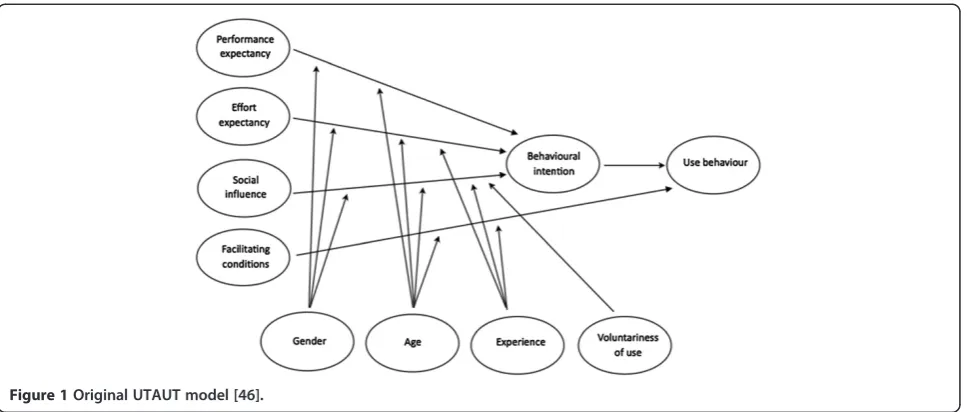
According to Venkatesh et al. [46], UTAUT (Figure 1) in-cludes three direct determinants of behavioural intention to use a system:
performance expectancy (PE) defined as the degree to which an individual believes that using the system will help him or her to achieve increases in job performance. Performance expectancy proves to be a significant determinant of behavioural intention, moderated by gender and age such that the effect is strongest for younger men;
effort expectancy (EE) defined as the degree of ease associated with the use of the system. It was found that the effect of effort expectancy on behavioural intention is moderated by gender and age such that the effect is strongest for older women in the early stages of experience with the system;
social influence (SI) defined as the degree to which an individual perceives that important others believe he or she should use the new system. It was found that the effect of social influence on behavioural intention is moderated by gender, age, experience and voluntariness such that the effect is strongest for older women in early stages of experience in mandatory contexts.
UTAUT contains also two direct determinants of use behaviour:
facilitating conditions (FC) defined as the degree to which an individual believes that an organisational and a technical infrastructure exists to support use of the system. It was found that the effect of facilitating conditions on use behaviour or system use is moderated by age and experience such that the effect is strongest for older workers in later stages of experience;
behavioural intention (BI) is not defined explicitly but consistent with the underlying theory for all of the intention models, Venkatesh et al. [46] have found that behavioural intention has a significant positive influence on use behaviour or system use. They state:‘The role of intention as a predictor of behaviour (e.g., usage) is critical and has been well-established in IS and the reference disciplines.’
Methods
Research model and hypotheses
UTAUT was originally developed outside of the health-care context. We built upon this framework to comple-ment prior research on technology acceptance and use [45,48,58,59] by exploring the applicability of the UTAUT model in the context of the BelRAI healthcare project. The study has the following characteristics.
Firstly, as there are no reliable indicators available on ac-tual use of the BelRAI web application (e.g., archival system logs providing information on duration of use, number of features used, frequency of use of each feature,…), the em-phasis of the study is on understanding which determinants influence behavioural intention to use the system. Conse-quently, we could not test the influence of facilitating con-ditions on actual usage.
Secondly, organisational contexts can increase or de-crease the variation in phenomena and result in relation-ships fluctuating from stronger to weaker, positive to negative, significant to non-significant [60,61]. Consistent with this, healthcare professionals might respond differ-ently than people in other types of organisations.
Previous research in different healthcare settings [45,62-64] mentioned that performance expectancy or related con-structs strongly influence behavioural intention. The uptake of technologies that was perceived as advantageous (financially, or with respect to time-saving and greater job satisfaction) was more straightforward for clinicians, nurses or other healthcare professionals. Following this logic, we believe that performance expectancy will have an influence on behavioural intention in this study context (H1, Table 1).
Wills et al. [45] and de Veer et al. [63] found that an easy-to-use technology enhanced the uptake of a new system among caregivers. Hence, we expect that effort
expectancy will have an influence on behavioural intention (H2).
Consistent with Venkatesh et al. [46], Wills et al. [45] found that social influence constructs also became signifi-cant in mandatory healthcare settings particularly among women in early stages of experience. This research is con-ducted in a mandatory setting with mostly female care-givers. We suggest that social influence will have an impact on behavioural intention (H3).
De Veer et al. [63] suggested that the acceptance of a new technology by nurses was influenced by facilitating characteristics. Chau et al. [64] found that constructs re-lated to facilitating conditions influenced behavioural intention in healthcare settings. Therefore, we have reason to suspect that facilitating conditions will have an influ-ence on behavioural intention to use the BelRAI web ap-plication (H4).
Anxiety (ANX), self-efficacy (SE) and attitude towards using technology (ATUT) are determinants in their
Figure 1Original UTAUT model [46].
Table 1 Hypotheses
H1 Performance expectancy will influence
behavioural intention to use BelRAI.
H2 Effort expectancy will influence
behavioural intention to use BelRAI.
H3 Social influence will influence behavioural
intention to use BelRAI.
H4 Facilitating conditions will influence behavioural
intention to use BelRAI.
H5 Anxiety will influence behavioural
intention to use BelRAI.
H6 Self-efficacy will influence behavioural
intention to use BelRAI.
H7 Attitude towards using technology will
original models. Based on SCT, anxiety is defined as evok-ing anxious or emotional reactions when it comes to usevok-ing a system, and self-efficacy is defined as judgement of one’s own ability to use a system. Based on TRA, ATUT is de-fined as an individual’s overall affective reaction to using a system. Having no direct effect on behavioural intention, ANX, SE and ATUT were dropped in Venkatesh’s study [46]. However, we thought it would be valuable to re-examine the influence of these constructs on behavioural intention in the BelRAI healthcare setting (H5, H6, H7).
Thirdly, as we have not examined the potential moder-ating roles of age, gender, experience with the system and voluntariness, we have restricted our study to direct effects only. Moreover, Venkatesh et al. [58] found that a more parsimonious version of UTAUT, with only age as a moderator, performs better in explaining behavioural intention among doctors in a hospital setting.
Settings and context
The study focuses on data derived from the BelRAI feasibility project integrating home care (interRAI home care assessment instrument [65]), residential or nursing home care (interRAI long-term care facility assessment instrument [66]) and acute hospital care (interRAI acute care assessment instrument [67]) for (frail) older people [68]. We have also included data of a study about the ef-fects of innovative home care projects (alternatives or add-ons to the standard home care services) in Flanders (Belgium) using the interRAI home care assessment in-strument [69].
Participants
The participants are a heterogeneous group of Flemish licensed or qualified caregivers (nurses, physical pists, occupational therapists, speech-language thera-pists, dieticians, podiatrists, social workers, physicians, psychologists, dentists, pharmacists). They were all using the BelRAI web application for interRAI assessments for the duration of the project in their own (home, residen-tial or acute hospital) care setting on a mandatory basis. All the participants attended training sessions custo-mised to their specific needs and all persons who followed a training session were asked to participate in this study.
Questionnaire
A Flemish-Dutch translation of a structured questionnaire for data collection was used, containing items based on constructs validated in the original UTAUT study [46]. Re-sults from an earlier study have shown that the UTAUT tool is‘robust enough to withstand translation and to be used cross-culturally, outside its original country and language of origin’[70]. The original English version of the UTAUT tool was translated independently into a
Flemish-Dutch (official language of the Northern region of Belgium) version by a qualified (licensed) translator on an item-by-item basis using the back-translation process. Thereafter, two bilingual speakers carefully reviewed the translation ensuring that meaning and nuance were not lost and remained as true to the original as possible [71]. Changes only relate to the name of the system used.
The questionnaire items related to the UTAUT con-structsb were measured by means of a 1 to 7-point Likert agreement scale ranging from “Strongly disagree” to “Strongly agree”. Effort expectancy is reverse coded so that high effort expectancy suggests high ease of use [46].
In the questionnaire additional information such as age and gender was also collected.
Data collection
The questionnaire and a cover letter were designed using QuestionPro [72] and made available to the participants on the web at one point in time. The participants were invited by email. To maximise the response rate and re-duce non-response, non-responders were sent a reminder requesting participation one week after the initial-mail-out and again after three weeks [73].
Ethical considerations
As this study occurred without patient involvement, no approval by an ethics committee was required in Belgium. Participants were assured response anonymity.
Data analysis
Theoretical concepts such as attitudes, intentions and preferences, also known as latent variables, factors or con-structs, cannot be observed or measured directly [74,75]. Constructs are measured indirectly through indicators (observable, measurable or manifest variables such as an item on a questionnaire) designed to elicit responses re-lated to a construct [76]. Scaling techniques have been de-veloped to study the complexity inside a system and to derive information on constructs from indicators. How-ever, to overcome limitations of the first generation regression-based approaches, more and more researchers started using structural equation modelling (SEM) as an alternative [77].
popular one among social science researchers) and the variance-based or components-based approach (e.g. partial least squares a.k.a. PLS being widely used in performing information systems research) [45,46,48,58,59,76,77,80]. Covariance-based SEM examines all possible specified and unspecified covariances in the model. PLS only examines the explicitly stated covariances in the model [76] and fo-cuses on maximising the variance of the dependent vari-ables which are explained by the independent ones [77].
The PLS path modelling approach was reported in the original UTAUT study [46] as having minimal demands on sample size, measurement scales and residual or underlying data distributions [81,82].
Like any SEM, PLS refers to two inter-related models [76,78]: a measurement or outer model describing the constructs (latent variables) that make up the model and the relationships between the constructs and their indi-cators (manifest variables) and a structural or inner model describing the causal relationships among these constructs [74,79].
Specifically, for PLS, the generated weights and load-ings are outer model parameter estimates, while the path coefficients are inner model parameter estimates.
To evaluate the measurement model, PLS performs a confirmatory factor analysis (CFA) by testing the mandatory [75] reliability and construct validity (fac-torial validity of the constructs). Reliability relates to the measurement within constructs and is thus inde-pendent of the status within other constructs; con-struct validity relates to the measurement between constructs [75,80].
The evaluation of the internal consistency of constructs (ICR) (e.g. Cronbach’s alpha (CA) to test the unidimen-sionality of a set of questionnaire items measuring the ex-tent to which all the variables are related to each other) is one technique to assess reliability. Moreover, PLS analysis provides other coefficients attesting to the reliability of the survey instrument such as composite reliability (CR) and average variance extracted (AVE) for each construct. As a rule of thumb the cut-off for (CA) is 0.70 [83,84]. The rec-ommended respective thresholds for CR and AVE are 0.70 and 0.50 [85].
To establish construct validity [75], PLS examines con-vergent and discriminant validity of the scale estimating how well a variable measures what it is intended to meas-ure [45] or how well the measmeas-urement items relate to the constructs [80].
Convergent validity is established when each measure-ment item of the model loads with a t-value above 1.96 (rejecting the null hypothesis of no effect) on its latent construct meaning that each measurement item corre-lates strongly with its theoretical pre-specified construct. The p-value of this t-value should be significant at least at the 0.05 alpha protection level [80].
Discriminant validity is established under two condi-tions: 1) the correlation of the latent variable scores with the measurement items needs to show an appropriate pat-tern of loadings, one in which the measurement items load highly (> 0.70) on their theoretically assigned con-struct and weakly (< 0.30) on other concon-structs (cross load-ings); 2) establishing discriminant validity in PLS also requires an appropriate AVE analysis [75,80]. With the lat-est version of PLS-Graph 03.00 build 1126 of 2003, AVEs are generated automatically using bootstrapping as a re-sampling procedure. The AVE measures the variance cap-tured by a latent construct being the shared (or explained) variance. The square root of AVE of each construct should be much larger than its variance shared with any of the other constructs in the model and should be at least 0.50. Conceptually, it is equivalent to saying that the correlation between the construct and its measurement items should be larger than its correlation with the other constructs [45,76,80].
Having established reliability, convergent and discrimin-ant validity of the constructs, the next step is to test the structural model for the hypothesised paths. To evaluate the structural model, PLS estimates path coefficients for each hypothesised path using bootstrapping, a non-parametric technique for assessing the precision of the PLS estimates [81,86]. The corresponding t-values suggest significance of the coefficients (t-values > 1.96, significance level p < 0.05) [80]. To ascertain how well the model fits the hypothesised relationship, PLS generates the square of the correlation coefficient (R2) for each dependent con-struct in the model. Similar to regression analysis, R2 is interpreted as the percentage of shared (or explained) vari-ance and thus represents the proportion of varivari-ance in the dependent constructs which can be explained by the inde-pendent ones [45,77].
We ran PLS-Graph ©, a software package which ap-plies PLS [74,81,86] for SEM. Statistical analysis system (SAS) 9.3 © was used for descriptive analysis and cre-ation of PLS-Graph data files.
Results
Sample characteristics
Of the 661 invitations to take part in the study, 601 ques-tionnaires were viewed by the persons invited and 421 were started. 282 respondents fully completed the ques-tionnaire. 216 of them (76.60%) were female. 69 (24.47%) were between the ages of 20–29, 85 (30.14%) between 30– 39, 68 (24.11%) between 40–49 and 60 (21.28%) were older than 50. 80.14% of the participants had been using the new BelRAI application for more than 4 months; 70.21% had been using the technology for more than 7 months.
The measurement model
To evaluate the measurement model, PLS tests the reli-ability and the construct validity. Relireli-ability relates to the measurement within constructs. Construct validity relates to the measurement between constructs [75,80].
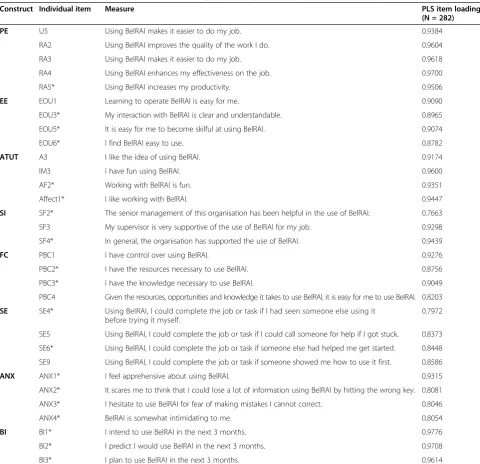
As in the original study of Venkatesh et al. [46], for prac-tical analyprac-tical reasons the constructs were operationalised by using the highest-loading itemsc from each of the re-spective scales (Table 2). Given this specific healthcare
situation, these items did not always accord with the highest-loading items used to measure the core constructs in the original UTAUT: only the items with an asterisk were selected for inclusion in the final UTAUT model in the study of Venkatesh et al. [46].
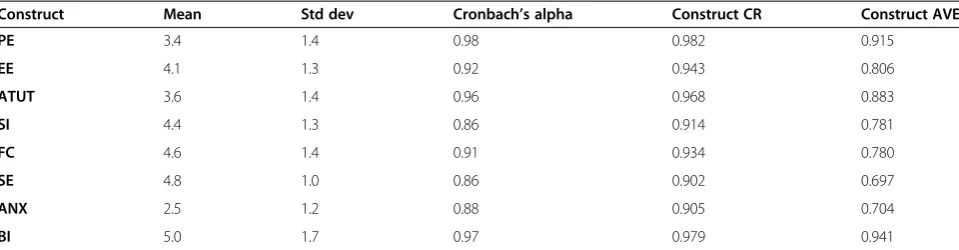
Table 3 summarizes the results for the items comprising our model. As an evaluation of the internal consistency reliability (ICR) of each construct, the values for Cron-bach’s alpha (CA) exceed 0.70 the minimal cut-off as
Table 2 The measurement model: individual loadings of the highest-loading items in this study
Construct Individual item Measure PLS item loading
(N = 282)
PE U5 Using BelRAI makes it easier to do my job. 0.9384
RA2 Using BelRAI improves the quality of the work I do. 0.9604
RA3 Using BelRAI makes it easier to do my job. 0.9618
RA4 Using BelRAI enhances my effectiveness on the job. 0.9700
RA5* Using BelRAI increases my productivity. 0.9506
EE EOU1 Learning to operate BelRAI is easy for me. 0.9090
EOU3* My interaction with BelRAI is clear and understandable. 0.8965
EOU5* It is easy for me to become skilful at using BelRAI. 0.9074
EOU6* I find BelRAI easy to use. 0.8782
ATUT A3 I like the idea of using BelRAI. 0.9174
IM3 I have fun using BelRAI. 0.9600
AF2* Working with BelRAI is fun. 0.9351
Affect1* I like working with BelRAI. 0.9447
SI SF2* The senior management of this organisation has been helpful in the use of BelRAI. 0.7663
SF3 My supervisor is very supportive of the use of BelRAI for my job. 0.9298
SF4* In general, the organisation has supported the use of BelRAI. 0.9439
FC PBC1 I have control over using BelRAI. 0.9276
PBC2* I have the resources necessary to use BelRAI. 0.8756
PBC3* I have the knowledge necessary to use BelRAI. 0.9049
PBC4 Given the resources, opportunities and knowledge it takes to use BelRAI, it is easy for me to use BelRAI. 0.8203
SE SE4* Using BelRAI, I could complete the job or task if I had seen someone else using it before trying it myself.
0.7972
SE5 Using BelRAI, I could complete the job or task if I could call someone for help if I got stuck. 0.8373
SE6* Using BelRAI, I could complete the job or task if someone else had helped me get started. 0.8448
SE9 Using BelRAI, I could complete the job or task if someone showed me how to use it first. 0.8586
ANX ANX1* I feel apprehensive about using BelRAI. 0.9315
ANX2* It scares me to think that I could lose a lot of information using BelRAI by hitting the wrong key. 0.8081
ANX3* I hesitate to use BelRAI for fear of making mistakes I cannot correct. 0.8046
ANX4* BelRAI is somewhat intimidating to me. 0.8054
BI BI1* I intend to use BelRAI in the next 3 months. 0.9776
BI2* I predict I would use BelRAI in the next 3 months. 0.9708
BI3* I plan to use BelRAI in the next 3 months. 0.9614
PE: Performance expectancy; EE: Effort expectancy; ATUT: Attitude towards using technology; SI: Social influence; FC: Facilitating conditions; SE: Self-efficacy; ANX: Anxiety; BI: Behavioural intention.
recommended by Nunnally [83] and Nunnally et al. [84]. PLS analysis also provides average variance extracted (AVE) and composite reliability (CR). For each construct, AVE exceeds 0.50 and CR exceeds 0.70, which are the rec-ommended thresholds by Fornell et al. [85]. These values denote adequate reliability of the survey instrument.
To establish construct validity, PLS examines convergent and discriminant validity of the scale. In this study, each measurement item of the model loads with a t-value above 1.96 on its latent construct. This indicates that each measurement item correlates strongly with its theoretical pre-specified construct. The p-values of the t-values are all significant at the 0.001 alpha protection level, so convergent validity is confirmedd. Discriminant validity is established because: 1) the correlation of the latent variable scores with the measurement items shows an appropriate pattern of loadings; the measurement items have high loadings (> 0.70) on their theoretically assigned construct and low loadings (< 0.30) on other constructs. However, the items of the attitude towards using technology construct cross-loaded on PE; 2) the square root of AVEeof each construct (represented by the diagonal values in bold) is significantly higher than the correlations between con-structs (represented by the off-diagonal values) in the adjoining columns and rows of Table 4.
The structural model
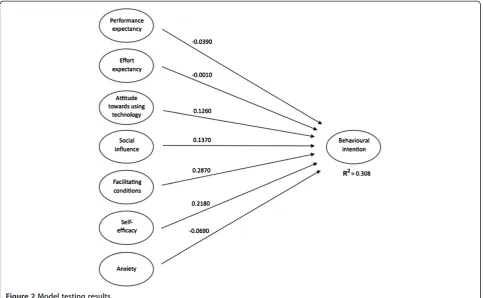
To test the structural model, PLS estimates path coeffi-cients for each hypothesised path using bootstrapping (100 samples). Path coefficients for each hypothesised path are shown in Table 5 together with the corresponding t-valuesf.
Facilitating conditions proved to have the most signifi-cant influence on behavioural intention to use BelRAI, followed by self-efficacy. The other constructs have no significant influence on behavioural intention.
Hypothesis 1 is not supported since performance ex-pectancy or the degree to which an individual believes that using the system will help him or her to achieve increases
in job performance has no significant influence on behav-ioural intention (t-value = 0.3947, p-value = 0.69).
In the same manner, hypothesis 2 is not supported since neither effort expectancy nor the degree of ease associated with the use of the system has a significant relationship with behavioural intention (t-value = 0.0131, p-value = 0.99).
In parallel with this there is no significant connection between social influence (the degree to which an individ-ual perceives that important others believe he or she should use the new system) and behavioural intention (t-value > 1.8268, p-value = 0.07) hence not consistent with hypothesis 3.
In accordance with hypothesis 4, facilitating conditions (the degree to which an individual believes that an organ-isational and a technical infrastructure exists to support use) have a positive effect on behavioural intention to use BelRAI (t-value = 3.6666, p-value = 0.00). This is in con-trast with the findings of Venkatesh et al. [46]. They state that facilitating conditions have no significant influence on behavioural intention in the presence of effort expectancy.
Hypothesis 5 is not supported since anxiety described as evoking anxious or emotional reactions when it comes to using a system has no significant influence on behavioural intention (t-value = 1.3671, p-value = 0.17). This affirms the removal of anxiety from the final UTAUT model [46].
Self-efficacy or the judgement of one’s ability to use a system has a positive effect on behavioural intention (t-value = 3.1904, p-value = 0.00), hence hypothesis 6 is supported. This is all the more noteworthy since self-efficacy was dropped from the final UTAUT model in the original study [46].
Finally, hypothesis 7 is not supported since attitude to-wards using new technology defined as an individual’s overall affective reaction to using a system has no signifi-cant influence on behavioural intention (t-value = 1.4945, p-value = 0.14). This affirms the removal of attitude from the final UTAUT model [46].
To ascertain how well the model fits the hypothesised relationship, PLS generates the square of the correlation
Table 3 The measurement model: reliability results
Construct Mean Std dev Cronbach’s alpha Construct CR Construct AVE
PE 3.4 1.4 0.98 0.982 0.915
EE 4.1 1.3 0.92 0.943 0.806
ATUT 3.6 1.4 0.96 0.968 0.883
SI 4.4 1.3 0.86 0.914 0.781
FC 4.6 1.4 0.91 0.934 0.780
SE 4.8 1.0 0.86 0.902 0.697
ANX 2.5 1.2 0.88 0.905 0.704
BI 5.0 1.7 0.97 0.979 0.941
In accordance with the study of Venkatesh et al. [46] we operationalised the constructs in our UTAUT model by using the highest-loading items from each of the respective scales.
coefficient (R2) for the dependent variable behavioural intention in the model. The R2 value for behavioural intention (0.308) indicates that the ‘direct effects only’ model explains 30.8% of the variance in behavioural intention to use BelRAI (Figure 2).
Discussion
This paper describes a study concerning the utilisation of the UTAUT model to provide an explanation on pro-fessional caregivers’acceptance of the BelRAI web appli-cation. Given the fact that UTAUT was originally developed outside the healthcare context, we built upon this framework to complement prior related research on technology acceptance and use [45,48,58,59] by explor-ing the applicability of the UTAUT model in the specific BelRAI healthcare project - home care, residential care and acute hospital care for older and disabled people.
This study shows that performance expectancy, effort expectancy and social influence do not have a significant influence on behavioural intention as shown in the ori-ginal UTAUT study [46] and other related research on technology acceptance and use [45,48,58,59]. However, behavioural intention is influenced by facilitating condi-tions associated with the presence of the resources and the knowledge required to use the system, the degree of compatibility of the new system with other systems in use and the availability of assistance in the case of sys-tem difficulties. Similarly, self-efficacy associated with the possibility to complete a task using the new information system with only the built-in help facility, having the pos-sibility to call someone for help and having enough time
to practice, has a significant influence on behavioural intention to use the BelRAI web application.
These results seem to be in line with the findings by Declercq et al. [68]. Inadequate computer equipment (hardware, software, internet connection) causes frustra-tion among users, is counterproductive, and constitutes significant barriers to accepting the new technology. At the same time it is important to achieve the right balance between confidentiality and accessibility. The BelRAI web application meets the requirements set by the Belgian Commission for the Protection of Privacy, and the privacy and security standards have been positively evaluated by the users. However, rigid security regulations also result in access procedures that are complex and time-consuming, as a result of which they negatively influence the applica-tion’s user-friendliness. Occasionally, when it is possible to get around the security measures (by exchanging the eIDs, for instance), a result will be reached that is opposite to the one intended.
In any case, there is need for high quality education, both internally and externally. The expectations for exter-nal education and support can strongly depend on the context or setting. In one setting there might be a need for practical education, whereas in another a rather theoret-ical training might be appropriate. In an initial phase the training can be organised per setting, so that each setting gets specific information based on its needs. During a sub-sequent phase, the training groups can be composed ra-ther heterogeneously in order to put an emphasis on the interaction and collaboration between different settings. This is particularly appreciated by home care caregivers
Table 4 The measurement model: inter-construct correlation matrix with square root of AVE of each construct
PE EE ATUT SI FC SE ANX BI
PE 0.957
EE 0.499 0.898
ATUT 0.795 0.536 0.940
SI 0.280 0.394 0.314 0.778
FC 0.160 0.606 0.240 0.495 0.883
SE 0.033 0.272 0.169 0.215 0.276 0.835
ANX −0.189 −0.387 −0.256 −0.201 −0.390 −0.203 0.839
BI 0.165 0.361 0.261 0.368 0.466 0.361 −0.277 0.970
Off-diagonal values represent correlations between constructs. Diagonal values (bold) are the square root of AVE of each construct.
Discriminant validity is confirmed if diagonal values are significantly higher than off-diagonal values.
Table 5 The structural model: path coefficients, t-values and p-values
PE EE ATUT* SI FC SE* ANX* BI
Path coefficient −0.0390 −0.0010 0.1260 0.1370 0.2870 0.2180 −0.0690 0.0000
t-value 0.3947 0.0131 1.4945 1.8268 3.6666 3.1904 1.3671 0.000
p-value 0.69 0.99 0.14 0.07 0.00 0.00 0.17 1.00
since they hardly get in touch with other caregivers active in both home care and other care settings. Also, the pe-riods in between different training phases should be long enough in order to enable caregivers to acquire experience and give feedback. The group sizes and the number of teachers must be in tune with one another so that teachers can adopt a problem-solving approach. The internal train-ing sessions, organised by the organisations themselves, should be very practical. For an organisation, it is appro-priate to appoint a reference person who can hold the pos-ition of internal trainer and act as a contact person. Assigning some staff members to work on the project can facilitate a full-time follow-up and implementation. The learning period does not end after the final training ses-sion. In order to be able to fluently use new technological tools, each caregiver should pass through a post-training learning process. Moreover, each caregiver should be given the opportunity to gain sufficient experience in a variety of situations. In addition to the technological aspect, the con-tent (assessment) as such constitutes an indispensable part of the learning process. Frequent and intensive exercises are required in order to have good command of all appli-cations. However, frequent staff changes can seriously dis-turb the learning process.
Time is an important resource. In practice, a high work-load, a lack of personnel, high client turnover, and the presence of acute problems (acute hospitals) turn out to
be significant barriers standing in the way of implementing new information technology. In order to improve efficiency and avoid an increased workload, the degree of integration of existing information technology (e.g., electronic patient records) with new technologies is decisive in the success of implementation. It is in everyone’s interest that everything can happen in a user-friendly and safe way, without tech-nical failures and with a minimum of intermediate steps. Integrated technology leads to fewer difficulties and will be accepted and used more rapidly.
During the implementation of new technologies, it is also important for active caregivers not to feel alone, but rather to feel supported in times of doubt by the care team, the (middle) management and other caregivers in-volved. Other factors that can contribute to a successful implementation are a help desk, a wiki website, and the possibility of being able to work in a quiet environment. Moreover, the collaboration process can be influenced by the physical proximity of various disciplines: people working within the same organisation collaborate more easily than people employed at different sites.
Although the use of the BelRAI application was mandatory, it is plausible that the behavioural intention of professionals is influenced by the short-term nature of this project. Simulating mandatory use of new infor-mation technology in a public healthcare setting is not straightforward. Therefore, since the future professional
value of BelRAI is not guaranteed, performance expectancy may not have influenced behavioural intention. Similarly, effort expectancy may not have a significant relationship with behavioural intention because people tend not to exert great effort during a pilot project. Social influence may not have an impact on behavioural intention because of a differ-ence in attitude between caregivers and typical technology users. Future study designs should disentangle these effects inside the UTAUT framework to understand user accept-ance in the context of a permanent implementation. The measurement of behavioural intention to use new infor-mation technology could be expanded to take into ac-count the emotional disposition of professional caregivers. Ultimately, when new information technology is imple-mented on a large scale, professionals should be looking forward to using it.
Conclusions
The practical implications of this research are that good-quality software, interoperability and compatibility with other information systems, easy access to computers, a degree of computer literacy, training facilities, built-in and online help and ongoing IT support are critical in-fluencing factors in stimulating the behavioural intention to use new technology. These findings can be used by policy makers to maximise the acceptance and the suc-cess of new technology initiatives.
For researchers, this study indicates that a bottom-up approach should be preferred when building upon the UTAUT model. The conclusions of the original UTAUT study [46] with regards to the item and scale construction should not be copied blindly across dif-ferent information systems. In the specific context of BelRAI, self-efficacy is an important influencing fac-tor of behavioural intention while this facfac-tor is not retained in the original study.
Our elaboration of the UTAUT model is limited since no information is available about the actual use of the BelRAI web application. Other research should encom-pass variables that relate to actual use (e.g. frequency and duration) in order to investigate the influence of behavioural intention. In this research it is not possible to gain insight into non-response bias and to know who is cooperative and who is not. It is likely that respon-dents who did not complete the survey have a more negative attitude towards new technology. Future re-search should provide insight into the characteristics of the entire study population. Future research should also take into account experience with the system in a longitudinal evaluation and examine the effects of age, gender, healthcare context, profession, computer liter-acy and specific training sessions not only related to be-havioural intention but also to actual usage of the system. To better understand healthcare professionals’
acceptance of BelRAI, more research is needed to gen-eralise the findings of this feasibility project to a future, broad implementation.
Endnotes a
Since 2006, different government-funded feasibility stud-ies concerning the implementation of interRAI assessment instruments at a national level were carried out by an inter-university team of the KU Leuven (Elderly Care Research Unit at LUCAS& Center for Health Services and Nursing Research) and the Université de Liège (Département des Sciences de la Santé Publique) [68,87-91].
b
85 questionnaire items related to the UTAUT constructs were measured: Performance expectancy (PE), 24 items; Ef-fort expectancy (EE), 10 items; Attitude towards using tech-nology (ATUT), 14 items; Social influence (SI), 9 items; Facilitating conditions (FC), 11 items; Self-efficacy (SE), 10 items; Anxiety (ANX), 4 items; Behavioural intention (BI), 3 items.
c
Selection based on item loadings is consistent with recommendations in the psychometric literature [84].
“This approach favours building a homogenous instru-ment with high internal consistency but could sacrifice content validity by narrowing domain coverage” – items from some of the models not being represented in some of the core constructs [46].
d
The p-value of this t-value should be significant at the 0.05 alpha protection level [80].
e
By the latest version of PLS-Graph 03.00 build 1126 of 2003 AVEs are generated automatically using bootstrap-ping as a resampling procedure. The AVE measures the variance captured by a latent construct being the shared (or explained) variance. The square root of AVE of each construct should be much larger than its variance shared with any of the other constructs in the model and should be at least 0.50. Conceptually, it is equivalent to saying that the correlation between the construct and its meas-urement items should be larger than its correlation with the other constructs [45,76,80].
f
The corresponding t-values suggest significance of the coefficients (t-values > 1.96, significance level p < 0.05) [80]. PLS generates the square of the correlation coeffi-cient (R2) for each dependent construct in the model. R2is interpreted as the percentage of shared (or explained) vari-ance and thus represents the proportion of varivari-ance in the dependent constructs which can be explained by the inde-pendent ones [45,77].
Abbreviations
conditions; BI: Behavioural intention; ANX: Anxiety; SE: Self-efficacy; ATUT: Attitude towards using technology; SEM: Structural equation modelling; LISREL: Linear structural relations; PLS: Partial least squares; SAS: Statistical analysis system; ICR: Internal consistency reliability; CA: Cronbach’s alpha; AVE: Average variance extracted; CR: Composite reliability; Std Dev: Standard deviation.
Competing interests
The authors declare that they have no competing interests.
Authors’contributions
VD, VB and DA are involved in the study design and critically reviewed and approved the final manuscript. VD drafted the manuscript. All authors read and approved the final manuscript.
Acknowledgements
The authors gratefully acknowledge the contributions made by the caregivers and researchers participating in the BelRAI project and the innovative care projects in Belgium. We also acknowledge Prof. Dr. Viswanath Venkatesh for allowing us to use the UTAUT model and Prof. Dr. Wynne W. Chin for the PLS-Graph software. Special thanks go to Jurgen Berden, Bert Paepen and the Pyxima team for their extensive contributions to the development of the BelRAI web application, to Johanna de Almeida Mello for her assistance with regard to the output algorithms and to Sarah Vanneste for translating and revising the questionnaire.
Author details
1Elderly Care Research Unit at LUCAS, KU Leuven, Kapucijnenvoer 39, 3000 Leuven, Belgium.2Elderly Care Research Unit at LUCAS and Center for Sociological Research, KU Leuven, Kapucijnenvoer 39, 3000 Leuven, Belgium.
Received: 22 January 2013 Accepted: 15 November 2013 Published: 27 November 2013
References
1. Statistics Belgium.[http://statbel.fgov.be/nl/statistieken/cijfers/bevolking/ structuur/leeftijdgeslacht/belgie/]
2. Statistics Belgium.[http://statbel.fgov.be/nl/statistieken/cijfers/bevolking/ vooruitzichten/]
3. Kane RL, Kane RA:Assessment in long-term care.Annual Reviews Public Health2000,3:659–686.
4. Bergman H, Béland F, Karunananthan S, Hummel S, Hogan D, Wolfson C: Développement d’un cadre de travail pour comprendre et étudier la fragilité: pour l‘initiative canadienne sur la fragilité et le vieillissement.
Gerontol Soc2004,2(109):15–19.
5. Bergman H, Ferrucci L, Guralnik J, Hogan DB, Hummel S, Karunananthan S, Wolfson C:Frailty: an emerging research and clinical paradigm - issues and controversies.J Gerontol A Biol Sci Med Sci2007,62(7):731–737. 6. Bernabei R, Landi F, Onder G, Liperoti R, Gambassi G:Second and third
generation assessment instruments: the birth of standardization in geriatric care.J Gerontol A Biol Sci Med Sci2008,63A(3):308–313. 7. Plsek PE, Greenhalgh T:Complexity science: the challenge of complexity
in health care.Br Med J2001,323:625–628.
8. Gray LC, Berg K, Fries BE, Henrard J-C, Hirdes JP, Steel K, Morris JN:Sharing clinical information across care settings: the birth of an integrated assessment system.BMC Health Serv Res2009,9:71.
9. Coleman EA, Boult C:Improving the quality of transitional care for persons with complex care needs.J Am Geriatr Soc2003,51(4):556–557. 10. LaMantia MA, Scheunemann LP, Viera AJ, Busby-Whitehead J, Hanson LC: Interventions to improve transitional care between nursing homes and hospitals: a systematic review.J Am Geriatr Soc2010,58(4):777–782. 11. Coleman EA, Berenson RA:Lost in transition: challenges and
opportunities for improving the quality of transitional care.
Annals Internal Medicine2004,141(7):533–536.
12. Hirdes JP, Ljunggren G, Morris JN, Frijters DHM, Finne-Soveri H, Gray LC, Björkgren M, Gilgen R:Reliability of the interRAI suite of assessment instruments: a 12-country study of an integrated health information system.BMC Health Serv Res2008,8:277.
13. Hirdes JP, Fries BE, Morris JN, Steel K, Mor V, Frijters DHM:Integrated health information systems based on the RAI/MDS series of instruments.
Healthc Manage Forum1999,12(4):30–40.
14. Wolfson M, Alvarez R:Towards integrated coherent health information systems for performance monitoring: the Canadian experience.In
Measuring UP: improving health system performance in OECD Countries.
Edited by Smith P. OECD Publications Service Paris France; 2012:133–155. 15. Leichsenring K:Integrated care for older people in Europe: latest trends
and perceptions.Int J Integr Care2012,12:10–13.
16. Gaskin S, Georgiou A, Barton D, Westbrook J:Examining the role of information exchange in residential aged care work practices - a survey of residential aged care facilities.BMC Geriatr2012,12:40.
17. Communication from the Commission to the Council, the European Parliament, the European Economic and Social Committee and the Committee of the Regions.[http://eur-lex.europa.eu/smartapi/cgi/sga_doc? smartapi!celexplus!prod!
DocNumber&lg=en&type_doc=COMfinal&an_doc=2004&nu_doc=356] 18. Implementing the Resident Assessment Instrument: Case studies of
policymaking for long-term care in eight countries.[http://www.milbank. org/publications/milbank-reports]
19. Haux R, Ammenwerth E, Herzog W, Knaup P:Health care in the information society: a prognosis for the year 2013.Int J Med Inform2002, 66:3–21.
20. Bayegan E:Knowledge representation for relevance ranking of patient-record contents in primary-care situations, PhD thesis. Norwegian University of Science and Technology, Department of Computer and Information Science; 2002.
21. interRAI.[http://www.interrai.org]
22. Dosa D, Bowers B, Gifford DR:Critical review of resident assessment protocols.J Am Geriatr Soc2006,54(4):659–666.
23. Carpenter GI:Accuracy, validity and reliability in assessment and in evaluation of services for older people: the role of the interRAI MDS assessment system.Age Ageing2006,35(4):327–329.
24. Fries BE, Morris JN, Bernabei R, Finne-Soveri H, Hirdes JP:Rethinking the resident assessment protocols.J Am Geriatr Soc2007,55:1139–1140. 25. Onder G, Carpenter GI, Finne-Soveri H, Gindin J, Frijters DHM, Henrard J-C,
Nikolaus T, Topinkova E, Tosato M, Liperoti R, Landi F, Bernabei R:Assessment of nursing home residents in Europe: the services and health for elderly in long term care (SHELTER) study.BMC Health Serv Res2012,12:5.
26. Identifying and maintaining quality of long term care: an international case study of the interRAI assessment system for the OECD, Expert group meeting on long-term care. DELSA/HEA (2012)30. Paris; 2012.
27. Ikegami N, Igarashi C, Takagi Y, Kato T, Mor V:The impact of the minimum data Set and resident assessment instrument on the quality of care plans in Japan.Canadian Journal of Quality in Health Care1997, 14(3):23–28.
28. Fries BE, Hawes C, Morris JN, Phillips CD, Mor V, Park PS:Effect of the national resident assessment instrument on selected health conditions and problems.J Am Geriatr Soc1997,45(8):994–1001.
29. Phillips CD, Morris JN, Hawes C, Fries BE, Mor V, Nennstiel M, Iannacchione V:Association of the resident assessment instrument (RAI) with changes in function, cognition and psychosocial status.J Am Geriatr Soc1997, 45(8):986–993.
30. Phillips CD, Zimmerman DR, Bernabei R, Jonsson PV:Using the resident assessment instrument for quality enhancement in nursing homes.
Age Ageing1997,26(2):77–81.
31. Mor V, Intrator O, Fries BE, Phillips CD, Teno J, Hiris J, Hawes C, Morris J: Changes in hospitalization associated with introducing the resident assessment instrument.J Am Geriatr Soc1997,45(8):1002–1010. 32. Achterberg WP, Van Campen C, Pot AM, Kerkstra A, Ribbe MW:Effects of
the resident assessment instrument on the care process and health outcomes in nursing homes: a review of the literature.Scand J Rehabil Med1999,31(3):131–137.
33. Achterberg WP, Holtkamp CCM, Kerkstra A, Pot AM, Ooms ME, Ribbe MW: Improvements in the quality of co-ordination of nursing care following implementation of the resident assessment instrument in Dutch nursing homes.J Adv Nurs2001,35(2):268–275.
34. Landi F, Tua E, Onder G, Carrara B, Sgadari A, Rinaldi C, Gambassi G, Lattanzio F, Bernabei R:Minimum data set for home care: a valid instrument to assess frail older people living in the community.Med Care
2000,38(12):1184–1190.
36. Zimmerman DR:Improving nursing home quality of care through outcomes data: the MDS quality indicators.Int J Geriatr Psychiatry2003, 18(3):250–257.
37. Boorsma M, Frijters DHM, Knol DL, Ribbe ME, Nijpels G, VanHout HPJ: Effects of multidisciplinary integrated care on quality of care in residential care facilities for elderly people: a cluster randomized trial.
Can Med Assoc J2011,183(11):E724–E732.
38. Currie W, Finnegan D:Integrating healthcare with information and communications technology.Abingdon: Radcliffe Publishing Ltd; 2009. 39. Kowitlawakul Y:The technology acceptance model: predicting nurses’
intention to use telemedicine technology (eICU).Comput Inform Nurs
2011,29(7):411–418.
40. Watson R:European Union leads way on e-health but obstacles remain.
Br Med J2010,341:c5195.
41. Genuardi P:User adoption of information technology: implications for application development research, PhD thesis. Georgetown University; 2004. 42. Al-Azmi SF, Al-Enezi N, Chowdhury RI:Users’attitudes to an electronic
medical record system and its correlates: a multivariate analysis.
Health Inf Manag J2009,38(2):33–40.
43. Boorsma M, Langedijk E, Frijters DHM, Nijpels G, Elfring T, van Hout HPJ: Implementation of geriatric assessment and decision support residential care homes: facilitating and impeding factors.
BMC Health Serv Res2013,13:8.
44. Yu P, Li H, Gagnon MP:Health IT acceptance factors in long-term care facilities: a cross-sectional survey.Int J Med Inform2009,78(4):219–229. 45. Wills MJ, El-Gayar OF, Bennett D:Examining healthcare professionals’
accept-ance of electronic medical records using UTAUT.Inf Syst2008,IX(2):396–401. 46. Venkatesh V, Morris MG, Davis GB, Davis FD:User acceptance of information
technology: toward a unified view.MIS Q2003,27(3):425–478.
47. Venkatesh V, Morris MG:Why don’t men ever stop to ask for directions? gender, social influence, and their role in technology acceptance and usage behavior.MIS Q2000,24(1):115–139.
48. Venkatesh V, Zhang X:Unified theory of acceptance and Use of technology: U.S. vs. China.J Glob Inf Technol Manag2010,13(1):5–27. 49. Davis FD:Perceived usefulness, perceived ease of use, and user
acceptance of information technology.MIS Q1989,13(3):319–340. 50. Bandura A:Social foundations of thought and action: a social cognitive
theory.New Jersey: Prentice Hall; 1986.
51. Fishbein M, Ajzen I:Belief, attitude, intention and behavior: an introduction to theory and research.Reading: Addison-Wesley; 1975.
52. Ajzen I:The theory of planned behavior.Organ Behav Hum Decis Process
1991,50(2):179–211.
53. Taylor S, Todd PA:Understanding information technology usage: a test of competing models.Inf Syst Res1995,6(4):144–176.
54. Thompson RL, Higgins CA, Howell JM:Personal computing: toward a conceptual model of utilization.MIS Q1991,15(1):124–143.
55. Taylor S, Todd PA:Assessing IT usage: the role of prior experience.MIS Q
1995,19(2):561–570.
56. Rogers E:Diffusion of innovations.New York: Free Press; 1995.
57. Davis FD, Bagozzi RP, Warshaw PR:Extrinsic and intrinsic motivation to use computers in the workplace.J Appl Soc Psychol1992,22(14):1111–1132. 58. Venkatesh V, Sykes TA, Zhang X:‘Just what the doctor ordered’: a
revised UTAUT for EMR system adoption and use by doctors.
System Sciences2011:1–10.
59. Brown SA, Dennis AR, Venkatesh V:Predicting collaboration technology use: integrating technology adoption and collaboration research.
J Manag Inf Syst2010,27(2):9–53.
60. Johns G:The essential impact of content on organizational behavior.
Acad Manage Rev2006,31(2):386–408.
61. Griffin MA:Specifying organizational contexts: systematic links between contexts and processes in organizational behavior.J Organ Behav2007,28:859–863.
62. Duyck P, Pynoo B, Devolder P, Voet T, Adang L, Vercruysse J:User acceptance of a picture archiving and communication system.
Methods Inf Med2008:149–156.
63. de Veer AJE, Fleuren MAH, Bekkema N, Francke AL:Successful implementation of new technologies in nursing care: a questionnaire survey of nurse-users.BMC Med Inform Decis Mak2011,11:67. 64. Chau PYK, Hu PJ-H:Investigating healthcare professionals’decisions to
accept telemedicine technology: an empirical test of competing theories.Information & Management2002,39(4):297–311.
65. Morris JN, Fries BE, Bernabei R, Steel K, Ikegami N, Carpenter I, Gilgen R, DuPasquier J-N, Frijters D, Henrard J-C, Hirdes JP, Belleville-Taylor P:interRAI home care (version 09): assessment manual: users guide for the interRAI HC assessment form.InterRAI; 2006.
66. Morris JN, Belleville-Taylor P, Fries BE, Hawes C, Murphy K, Mor V, None-maker S, Phillips CD:InterRAI long-term care facility (version 09).InterRAI: Guide for use of the interRAI LTCF assessment form; 2006.
67. Gray L, Berg K, Bernabei R, Blasco S, Carpenter GI, Finne-Soveri H, Fries BE, Hirdes JP, Jonsson P, Morris JN, Murphy K, Steel K, Nonemaker S, Rabinowitz T, Topinkova E:Training manual and resource guide: interRAI acute care: guide for use of the interRAI AC assessment form (version 09).InterRAI; 2006. 68. Declercq A, Flamaing J, Gosset C, Milisen K, Moons P, Collard J, Delye S,
Devriendt E, Gillain N, Londot A, Van Eenoo L, Vanneste D, Vesentini L, Wellens N:BelRAI VI–wetenschappelijk onderzoek met betrekking tot de pilootprojecten voor het transmuraal gebruik van het BelRAI-instrument.Brussel: FOD Volksgezondheid, Veiligheid van de Voedselketen en Leefmilieu; 2011. 69. De Almeida MJ, Van Durme T, Macq J, Declercq A:Interventions to delay
institutionalization of frail older persons: design of a longitudinal study in the home care setting.BMC Public Health2012,12:1.
70. Oshlyansky L, Cairns P, Thimbleby H:Validating the unified theory of acceptance and Use of technology (UTAUT) tool cross-culturally, Proceedings of the 21st British HCI group annual conference on people and computers: HCI…but not as we know it: volume 2;Swinton. British Computer Society Swinton UK; 2007:83–86.
71. Guillemin F, Bombardier C, Beaton D:Cross-cultural adaptation of health-related quality of life measures: literature review and proposed guidelines.J Clin Epidemiol1993,46(12):1417–1432.
72. QuestionPro.[http://www.questionpro.com]
73. Dillman DA:The design and administration of mail surveys.Annu Rev Sociol1991,17:225–249.
74. Chin WW:PLS-graph users’guide: version 3.0.In Edited by Chin WW. ; 2001. 75. Straub D, Boudreau M-C, Gefen D:Validation guidelines for IS positivist
research.Commun Assoc Inf Syst2004,14:380–426.
76. Gefen D, Straub DW, Boudreau M-C:Structural equation modeling and regres-sion: guidelines for research practice.Commun Assoc Inf Syst2000,4:1–79. 77. Haenlein M, Kaplan AM:A beginner’s guide to partial least squares
analysis.Underst Stat2004,3(4):283–297.
78. Chin WW, Marcolin BL, Newsted PR:A partial least squares latent variable modeling approach for measuring interaction effects: results from a Monte Carlo simulation study and voice mail emotion/adoption study.In
Proceedings of the international conference on information systems: 16–18 december 1996; Cleveland, Ohio.Edited by DeGross JI, Jarvenpaa S, Srinivasan A.; 1996:21–41.
79. Vinzi VE, Trinchera L, Amato S:PLS path modeling: from foundations to recent developments and open issues for model assessment and improvement. InHandbook of partial least squares.Edited by Vinzi E, Chin WW, Henseler J, Wang H. Berlin, Heidelberg: Springer handbooks; 2010:47–83. 80. Gefen D, Straub D:A practical guide to factorial validity using PLS-graph:
tutorial and annotated example.Commun Assoc Inf Syst2005,16:91–109. 81. Chin WW:Frequently asked questions - partial least squares & PLS-graph.
http://disc-nt.cba.uh.edu/chin/plsfaq/plsfaq.htm.
82. Kuechler WL, McLeod A, Simkin MG:Why don’t more students major in IS?Decis Sci J Innov Educ2009,7(2):463–488.
83. Nunnally JC:Psychometric theory.2nd edition. New York: McGraw-Hill; 1978. 84. Nunnally JC, Bernstein IH:Psychometric theory.3rd edition. New York:
McGraw-Hill; 1994.
85. Fornell C, Larcker DF:Evaluating structural equation models with unobservable variables and measurement error.J Mark Res1981, 18(1):39–50.
86. Chin WW:The partial least squares approach for structural equation modeling. InModern methods for business research.Edited by Marcoulides GA. New York: Lawrence Erlbaum Associates; 1998:295–336.
87. Declercq A, Gosset C, Wellens N, Collard J, Filee D, Londot A, Polome L, Sprenghetti N, Moons P, Milisen K, Van Audenhove C:Actie-onderzoeknaar het gebruik van het RAI-instrument in de geriatrische dagziekenhuizen, de rust- en verzorgingstehuizen, de dagcentra en de geïntegreerde diensten voor de thuiszorg.Brussel: FOD Volksgezondheid, Veiligheid van de Voedselketen en Leefmilieu; 2007.
Haalbaarheid van de RAI-methode in België.Brussel: FOD Volksgezondheid, Veiligheid van de Voedselketen en Leefmilieu; 2008.
89. Declercq A, Gosset C, Paepen B, De Almeida Mello J, Vanneste D, Detroyer E, Spruytte N, De Vliegher K, Berden J, Degey S, Philippet C, Tancredi A, Lepère C, Renard F, Gillain N, Van Audenhove C:Actieproject BelRAI III: Haalbaarheid van de RAI-methode in België.Brussel: FOD Volksgezondheid, Veiligheid van de Voedselketen en Leefmilieu; 2009.
90. Declercq A, Gosset C, Milisen K, Moons P, Flamaing J, Vesentini L, Vanneste D, Roovers S, Grevendonck L, Van Eenoo L, De Almeida Mello J, Wellens N, Devriendt E, Deschodt M, Delye S, Renard F, Grauwels N, Collard J, Londot J, Tancredi A, Gillain N, Berden J, Paepen B, Vanbockryck F:BelRAI 2010 - Tussen-tijds rapport.Brussel: FOD Volksgezondheid, Veiligheid van de Voedselketen en Leefmilieu; 2010.
91. Declercq A, Gosset C, De Almeida Mello J, Detroyer E, Spruytte N, Vanneste D, Vesentini L, Grevendonck L, Roovers S, Paepen B, Berden J, Collard J, Grauwels N, Londot A, Lepère C, Michel J, Renard F, Schumacher I, Tancredi A, Gillain N, Wellens N, Milisen K, Moons P, Van Audenhove C:BelRAI IV: actie-onderzoek ter voorbereiding van de implementatie van de RAI-methode in België.Brussel: FOD Volksgezondheid, Veiligheid van de Voedselketen en Leefmilieu; 2010.
doi:10.1186/1472-6947-13-129
Cite this article as:Vannesteet al.:Healthcare professionals’acceptance of BelRAI, a web-based system enabling person-centred recording and data sharing across care settings with interRAI instruments: a UTAUT analysis. BMC Medical Informatics and Decision Making201313:129.
Submit your next manuscript to BioMed Central and take full advantage of:
• Convenient online submission
• Thorough peer review
• No space constraints or color figure charges
• Immediate publication on acceptance
• Inclusion in PubMed, CAS, Scopus and Google Scholar
• Research which is freely available for redistribution