R E S E A R C H A R T I C L E
Open Access
Influence of social support on cognitive change
and mortality in old age: results from the
prospective multicentre cohort study AgeCoDe
Marion Eisele
1*, Thomas Zimmermann
1, Mirjam Köhler
1, Birgitt Wiese
2, Kathrin Heser
3, Franziska Tebarth
3,
Dagmar Weeg
4, Julia Olbrich
4, Michael Pentzek
5, Angela Fuchs
5, Siegfried Weyerer
6, Jochen Werle
6, Hanna Leicht
7,
Hans-Helmut König
7, Melanie Luppa
8, Steffi Riedel-Heller
8, Wolfgang Maier
3,9and Martin Scherer
1, for
the AgeCoDe Study Group
Abstract
Background:Social support has been suggested to positively influence cognition and mortality in old age. However, this suggestion has been questioned due to inconsistent operationalisations of social support among studies and the small number of longitudinal studies available. This study aims to investigate the influence of perceived social support, understood as the emotional component of social support, on cognition and mortality in old age as part of a prospective longitudinal multicentre study in Germany.
Methods:A national subsample of 2,367 primary care patients was assessed twice over an observation period of 18 months regarding the influence of social support on cognitive function and mortality. Perceived social support was assessed using the 14-item version of the FSozU, which is a standardised and validated questionnaire of social support. Cognition was tested by the neuropsychological test battery of the Structured Interview for the Diagnosis of Dementia (SIDAM). The influence of perceived support on cognitive change was analysed by multivariate ANCOVA; mortality was analysed by multivariate logistic and cox regression.
Results:Sample cognitive change (N = 1,869): Mean age was 82.4 years (SD 3.3) at the beginning of the
observation period, 65.9% were female, mean cognition was 49 (SD 4.4) in the SIDAM. Over the observation period cognitive function declined in 47.2% by a mean of 3.4 points. Sample mortality (N = 2,367): Mean age was 82.5 years (SD 3.4), 65.7% were female and 185 patients died during the observation period. Perceived social support showed no longitudinal association with cognitive change (F = 2.235; p = 0.135) and mortality (p = 0.332; CI 0.829-1.743).
Conclusions:Perceived social support did not influence cognition and mortality over an 18 months observation period. However, previous studies using different operationalisations of social support and longer observation periods indicate that such an influence may exist. This influence is rather small and the result of complex
interaction mechanisms between different components of social support; the emotional component seems to have no or only a limited effect. Further research is needed to describe the complex interactions between components of social support. Longer observation periods are necessary and standardised operationalisations of social support should be applied.
* Correspondence: [email protected]
1Department of Primary Medical Care, Center for Psychosocial Medicine,
University Medical Center Hamburg-Eppendorf, Martinistraße 52, 20246 Hamburg, Germany
Full list of author information is available at the end of the article
Background
Social support is known to have a beneficial effect on phy-sical and mental health in old age [1-3]. Several studies revealed an association between a lack of social network and mortality [4,5]. Results regarding the influence of social support on cognition in old age are less consistent. The reason for this is that definitions of social support vary considerably across studies and that operationalisa-tions are not standardised: while some definioperationalisa-tions consider structural aspects of social networks such as size [6], or focus on emotional components such as the availability of a good friend with whom to talk [7], others include both social network and emotional components [8-12].
Understood as the number of social relationships of an individual, social support has been found to influence cog-nitive change and dementia in old age. Several studies show that individuals with less relationships have a higher risk for cognitive decline and dementia than those with more social relations [8,10,11], and that the risk for cogni-tive decline decreases with an increase in the number of personal contacts [8,9]. Even though evidence for an influ-ence prevails, Seeman and colleagues found no influinflu-ence of the number of relationships on cognition [12]. However, the operationalisation of structural aspects of social net-works is limited since the number of persons a study parti-cipant has contact with is not necessarily related to the amount of social support he perceives.
Studies focusing on emotional aspects of social support instead of, or in addition to, structural aspects of social networks are less consistent in their findings. Zunzunegui and colleagues and Béland and colleagues investigated the influence of membership of a social group on cognition. They found that persons who belonged to any kind of social group showed less cognitive decline in old age. This effect increases with age [8,13]. Findings regarding emo-tional support, understood as having the feeling that there is someone to rely on if needed, are most inconsistent. While cross-sectional studies revealed an association between the presence of a“significant other”and cognition [7,14], only one of three longitudinal studies [9,10,12] reported a positive influence of the perceived sufficiency of support received on cognition [12].
In summary, the influence of social support on cogni-tion remains unclear. Evidence is strongest for a positive influence of large personal social networks and a high frequency of contacts with persons in these networks. However, studies regarding the influence of emotional components of social support on cognition vary in study design, outcomes and operationalisations employed. Especially longitudinal studies vary considerably in their results. Even among studies with comparable outcomes it still remains unclear which particular aspects of social support influence cognition: Does social support impact
on cognition through emotional benefits such as stress reduction, or rather through an increased level of physi-cal and cognitive activation due to a large number of friends?
The aim of this study was to investigate the longitudinal impact of the emotional component of social support on cognitive change. We defined emotional support as sub-jectively perceived support, which is independent from actually received support and structural aspects of social networks and as such excludes influences of increased physical and cognitive activation on cognition. Perceived social support was operationalised using a standardised instrument. Mortality was investigated as a second end-point, since severe cognitive decline may result in demen-tia and finally death.
Methods
Design
This study is part of the German prospective longitudinal multicentre study on Ageing, Cognition and Dementia in Primary Care Patients (AgeCoDe), established to investi-gate risk factors for dementia. The AgeCoDe cohort comprises of primary care patients aged 75 years and older. Trained interviewers (psychologists and physicians) visited the patients at home for baseline assessment as well as three follow-up assessments every 18 months. General practitioners were asked to fill out a question-naire about their patients’health status at each time of assessment. Because perceived social support was assessed for the first time in follow-up 2, all data analysed in this study refer to follow-up 2 and 3.
Ethics
The study was conducted in accordance with the Helsinki declaration and has been approved by the local ethics boards of all participating centres (reference numbers: 050/02 [University of Bonn], 2079 [Faculty of Medicine, University of Düsseldorf], OB/08/02 [Hamburg Medical Association], 143/2002 [Faculty of Medicine, University of Leipzig], 0226.4 [Medical Ethics Commission II, University of Heidelberg at the University Medical Center of Man-nheim], 713/02 [Faculty of Medicine, Technical University of Munich]. All participants gave written informed con-sent prior to study entry.
Sample
least one consultation with the general practitioner within the last 12 months. All participants had to be regular patients of the respective primary care practices. Exclusion criteria were residence in a nursing home, consultations by home visit only, severe illness fatal within three months (according to the general practi-tioner’s opinion), insufficient ability to speak German, deafness, blindness and an insufficient ability to consent. A total of 3,327 primary care patients were included in the AgeCoDe cohort and participated in the baseline assessment. Follow-up assessments were conducted at 18 months intervals. This study assesses the data of fol-low-up 2 (FU2) and folfol-low-up 3 (FU3) which were per-formed 3 and 4.5 years after baseline assessment, respectively.
Sample mortality
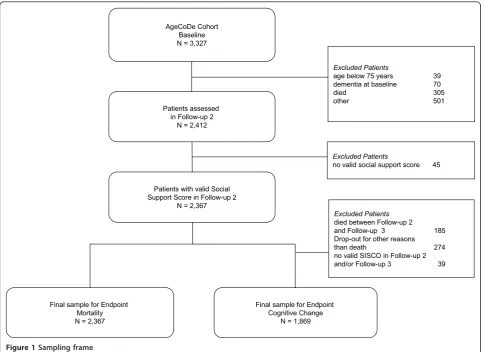
At FU2, 2,412 of 3,327 patients initially enrolled at base-line were assessed. Patients not assessed at FU2 were excluded for the following reasons: 39 patients were younger than 75 years at baseline, 70 patients had a diag-nosis of dementia at baseline, 305 patients died and 501 patients dropped out for other reasons. All patients assessed at FU2 were required to have a valid social sup-port score (no more than 3 out of 14 missing items), which was met by 2,367 patients (out of 2,412 patients; 98.1% [see Figure 1]).
Sample cognitive change
To investigate the influence of perceived support on cog-nitive change, patients were additionally required to sur-vive until FU3 and to have a valid score for cognition at FU2 as well as FU3. This applied to 1,869 patients, which is 77.5% of all patients assessed at FU2 (see Figure 1).
Operationalisation of social support
This study investigates perceived social support, as the emotional component of social support, operationalised using the 14-item short form of the questionnaire for social support (FSozU K-14) by Fydrich and colleagues [15]. This instrument measures perceived social support independently of actually received support. Examples of the 14 items are:“I have a very close person, on whose help I can always count”,“I know several people, with who I enjoy to spend time with”,“When needed I have no trou-ble to borrow things from my neighbours”and“I have friends/family members who take the time and definitely listen to me, when I need to talk”.
The 5-item Likert scale was adapted for the assessment of elderly patients with probable cognitive impairment to include yes/no answers, according to the suggestion by Kelsey and colleagues [16]. For analysis, a sum score was calculated ranging from 0-14 with high scores indicating a high level of perceived social support.
The distribution was left-skewed and, therefore, nor-mal distribution could not be taken for granted. For that
reason the score was dichotomised. The cut-off point was chosen at the elbow of the distribution at 11.5 points. This allowed expedient differentiation in regard to context and, at the same time, ensured a group size sufficient for statistical analysis (low social support 24.8%, N = 587; high social support 75.2%, N = 1,780).
Because physical and cognitive activation stimulated by social contacts can also influence cognition, we included both factors as potential confounders. Physical activity was defined as performing at least one physical activity at least twice a week (e.g. riding a bicycle, taking longer walks, hiking, swimming, etc.). Cognitive activity was defined as being at least twice a week engaged in at least one of the following activities: reading, writing, sol-ving crossword puzzles and memory training.
Cognitive function
Cognitive function was assessed by the neuropsychological test battery of the Structured Interview for the Diagnosis of Dementia of the Alzheimer type, Multi-infarct Demen-tia and DemenDemen-tia of other Aetiology according to DSM-III-R, DSM-IV and ICD-10 (SIDAM) [17]. The SIDAM Score (SISCO) was calculated from the 55-item neuropsy-chological test battery. Cognitive change within the obser-vation period of 18 months was measured by calculating the difference between the SISCO at FU3 and at FU2. The Mini Mental Status Test (MMST) is included in SIDAM [18]; scores were calculated accordingly.
Mortality
If a patient could not be reached by mail and phone to schedule the next assessment, a contact person (usually spouse, children, other relatives or the general practi-tioner) was phoned. In case of death the contact person was asked to provide the date of death.
Health status
illness was included in the analysis. Cardiovascular illness was defined as the number of cardiovascular conditions a patient has. The following cardiovascular conditions were assessed: hypertension, arrhythmia, coronary heart dis-ease, myocardial infarction, peripheral artery occlusive disease, stenosis of precerebral arteries, transient cerebral ischaemic attack and cerebral infarction. Alcohol misuse/ abuse was measured by the judgement of the general practitioner.
Psychosocial factors
Information regarding marital status, engagement in social groups (e.g. local community, church), smoking behaviour and sensory impairment were assessed by patient interviews. The instrumental activities of daily living (IADL) were assessed by the Instrumental Activ-ities of Daily Living Scale by Lawton and Broady [20]. Depression was assessed using the 15-item short form of the Geriatric Depression Scale [21]. Social status was measured in terms of education according to the CAS-MIN classification [22].
For patients with a MMST score below 25, all infor-mation obtained through patient interviews was
double-checked for accuracy by a close relative or, if not avail-able, by nursing staff or the general practitioner.
Statistical analysis
All statistical analyses were performed with SPSS version 16.0. Multifactorial ANCOVA was applied to analyse the influence of social support on cognitive change con-trolled for confounders. The set of confounding variables regarding cognitive change in old age was selected based on literature research and included the following con-founders: age [7,13,14]; gender [23,24]; education [7,25]; cognitive function at FU2 [26]; sensory impairment (Bas-suk, Glass, 1999) [10]; health status in terms of number of physical co-morbidities, number of medications taken and self-rated health status [13,14]; physical activity [27-29]; cardiovascular illness and alcohol abuse [30]; depression [31]; diabetes mellitus, smoking behaviour, Body Mass Index [30]; cognitive activity [32,33]; instru-mental activities of daily living [7]; engagement in social groups [8,13,14]; as well as interaction effects between age and gender [8] and between age and engagement in social groups [13,14]. Results were double-checked with other sets of confounding variables. Cognitive and AgeCoDe Cohort
Baseline N = 3,327
Patients assessed in Follow-up 2
N = 2,412
Patients with valid Social Support Score in Follow-up 2
N = 2,367
Final sample for Endpoint Mortality N = 2,367
Final sample for Endpoint Cognitive Change
N = 1,869
Excluded Patients died between Follow-up 2 and Follow-up 3 185 Drop-out for other reasons than death 274 no valid SISCO in Follow-up 2 and/or Follow-up 3 39 Excluded Patients
no valid social support score 45 Excluded Patients
age below 75 years 39 dementia at baseline 70
died 305
other 501
physical activity were included in the set of confounding variables in addition to social support, because they are potentially effective components of social support. The research question focuses on the influence of perceived social support on cognitive change. The examination of the confounding factors was not the objective. Therefore, superfluous variables without significant influence were excluded from the model by backward selection.
Multifactorial cox and logistic regression models were calculated to analyse the impact of perceived social sup-port on mortality and survival time controlled for con-founding variables. The set of concon-founding variables was selected based on literature research. Confounding vari-ables influencing cognition in old age were included as well, because severe cognitive decline may result in dementia and reduce survival time. The set contained the following confounders in addition to the set of confound-ing variables for cognitive change: marital status [10,34]; social stratum (by education) [35]; as well as interaction effects between gender and marital status [34] and between engagement in social groups and gender [8]. Phy-sical and cognitive activity were included for a detailed investigation of potentially effective components of social support. The final model was selected by forward as well as backward selection and was double-checked with other sets of variables.
Results
Cognitive change
Of 1,869 patients eligible for analysis regarding cognitive change, 65.9% were female and 34.1% male. The mean age at FU2 was 82.4 years (SD 3.3, range 79-95). This subsam-ple was smaller than the samsubsam-ple analysed regarding mor-tality since all patients who died or dropped out for any other reasons between FU2 and FU3 were excluded (see Figure 1). Mean cognitive function was 49 (SD 4.4) out of 55 possible points in the SISCO. In total, cognition declined in 47.2% of the patients by a mean of -3.4 (SD 3.4) points in the SISCO and cognition improved in 38.2% of the patients by a mean of 2.3 (SD 1.6) points.
Patients assessed at FU2 but not included in the sam-ple for cognitive change were somewhat older (mean age 83.2 years (SD 3.8), T = 4.617; p = 0.000), more likely to be female (66.1%,c2= 0.007; df = 1; p = 0.932) and had worse cognitive function at FU2 (46.0; SD 7.9) points in the SISCO, T = -8.310; p = 0.000) than included patients.
Of all patients eligible for analysis, 24% had low and 76% had high perceived social support. Cross sectional analyses revealed an association between perceived sup-port and cognitive function at FU2 (T = -2,564; p = 0.011). The longitudinal influence of social support was analysed by investigating cognitive change between FU2 and FU3.
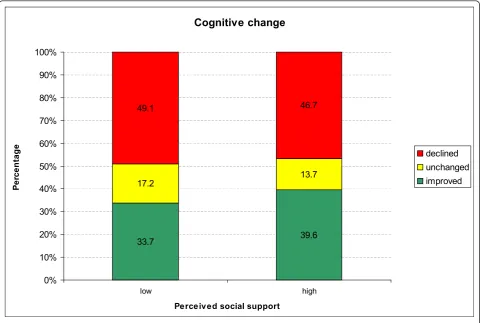
Figure 2 shows cognitive change in relation to high and low social support. Both groups differ regarding the per-centage of patients whose cognitive function declined, stayed unchanged, or improved (c2= 6.361; df = 2; p = 0.042). In both groups, cognitive function slightly declined between FU2 and FU3 (high social support -0.6; SD = 3.5 and low social support -1.0; SD = 4.2). The decline was significantly higher in the group with low social support (T = -2.058; p = 0.048).
The final model of the multivariate ANCOVA (Model 1) is displayed in Table 1. To determine whether the inclu-sion of physical and cognitive activity as possible influen-cing factors of social support changes the influence of perceived support in the final model, the final model was additionally calculated including both factors (see Model 2 in Table 1). In both models, perceived social support did not have a significant influence on cognitive change over the observation period of 18 months (Model 1: p = 0.135; Model 2: p = 0.146). Cognitive change was significantly influenced by gender, age, impaired ability to walk, instru-mental activities of daily living, cognitive function at the beginning of the observation period and Body Mass Index. Physical and cognitive activity had no significant influence.
Mortality and survival time
Of 2,367 patients eligible for analysis regarding mortality, 65.7% were female and 34.3% male. The mean age at FU2 was 82.5 years (SD 3.4, range 77-101 years). Mean cogni-tive function was 48.6 (SD 4.8) out of 55 points in the SISCO.
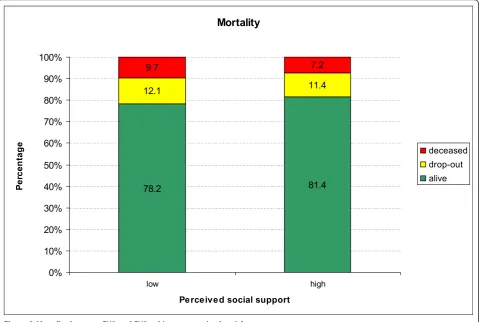
Of all patients, 24.8% had low and 75.2% had high per-ceived social support. During the 18 months observation period, 185 patients (7.8%) died and N = 1,908 (80.6%) survived. A total of N = 274 patients (11.6%) dropped out between FU2 and FU3 for other reasons than death. Figure 3 shows the percentage of mortality in patients with high and low perceived social support. The percen-tage of survivors is significantly higher in the group with high perceived social support (c2 = 3,899; df = 1; p = 0.049).
Patients excluded at FU2 for the lack of a valid social support score were mostly female (82.2%,c2= 5.400; df = 1; p = 0.020), were slightly older (mean age 84.2; SD 4.4) years, T = 2.587; p = 0.013) and performed worse in cogni-tive testing (32.5; SD 15.6) points in the SISCO, T = -5.906; p = 0.000).
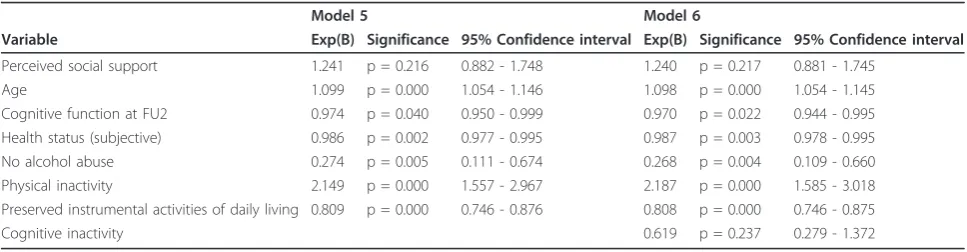
impaired instrumental activities of daily living. The same factors were found to significantly influence survival time (see Table 3). Regular cognitive activity had no significant influence on mortality (see Table 2 Model 4) and survival time (see Table 3 Model 6). The same factors were found to significantly influence mortality and survival time if selected by backward selection.
Discussion
Main results
The aim of this study was to investigate the longitudinal impact of perceived social support on cognitive change and mortality in old age. Perceived social support, understood as the emotional component of social sup-port, was not found to significantly influence cognitive
Cognitive change
39.6 33.7
13.7 17.2
46.7 49.1
0% 10% 20% 30% 40% 50% 60% 70% 80% 90% 100%
low high
Perceived social support
Pe
rc
e
n
ta
g
e
declined unchanged improved
Figure 2Cognitive change subject to perceived social support.
Table 1 Final models for the endpoint cognitive change (ANCOVA, backward selection)
Model 1 Model 2
Variable F-ratio Significance F-ratio Significance
Constant 0.125 p = 0.724 0.159 p = 0.690
Perceived social support 2.235 p = 0.135 2.114 p = 0.146
Gender 29.596 p = 0.000 29.584 p = 0.000
Age 5.747 p = 0.017 5.746 p = 0.017
Impaired ability to walk 3.398 p = 0.017 3.102 p = 0.026
Instrumental activities of daily living 51.832 p = 0.000 51.973 p = 0.000
Cognitive function at FU2 5.841 p = 0.016 5.497 p = 0.019
Body Mass Index 13.523 p = 0.000 13.796 p = 0.000
Cognitive inactivity 1.013 p = 0.314
Physical inactivity 0.516 p = 0.473
change, mortality and survival time over the 18 months observation period.
So far, the mechanisms of how social support may act as a protective factor remain unclear. This is mainly due to inconsistent operationalisations applied among stu-dies reporting an association between social support and cognition. Three mechanisms are conceivable to account for the effect of social support on cognition: 1. physical
activation through living a socially active lifestyle (e.g. leaving the house more often to meet friends), 2. cogni-tive stimulation through social interaction, and 3. posi-tive emotions caused by perceived social support, which may decrease stress levels.
This study focused on three aspects of social support in order to investigate which of these components, if any, influence cognitive change: perceived social support
Mortality
81.4 78.2
11.4 12.1
7.2 9.7
0% 10% 20% 30% 40% 50% 60% 70% 80% 90% 100%
low high
Perceived social support
Pe
rc
e
n
ta
g
e
deceased drop-out alive
Figure 3Mortality between FU2 and FU3 subject to perceived social support.
Table 2 Final models for the endpoint mortality (logistic regression, forward selection)
Model 3 Model 4
Variable Odds
Ratio
Significance 95% Confidence interval
Odds Ratio
Significance 95% Confidence interval
Constant 0.002 p = 0.006 0.003 p = 0.008
Perceived social support 1.202 p = 0.332 0.829 - 1.743 1.212 p = 0.312 0.835 - 1.757
Age 1.109 p = 0.000 1.059 - 1.161 1.106 p = 0.000 1.056 - 1.158
Cognitive function at FU2 0.968 p = 0.038 0.939 - 0.998 0.966 p = 0.030 0.937 - 0.997
Health status (subjective) 0.987 p = 0.004 0.978 - 0.996 0.987 p = 0.006 0.978 - 0.996
No alcohol abuse 0.252 p = 0.010 0.088 - 0.715 0.244 p = 0.008 0.086 - 0.695
Physical inactivity 2.183 p = 0.000 1.548 - 3.079 2.226 p = 0.000 1.580 - 3.138
Preserved instrumental activities of daily living
0.790 p = 0.000 0.722 - 0.864 0.790 p = 0.000 0.723 - 0.864
Cognitive inactivity 0.666 p = 0.362 0.278 - 1.597
as the emotional component of social support, and phy-sical as well as cognitive activity as factors that possibly act through activation. Our results indicate that none of the three components had a significant influence on cognitive change over the 18 months observation period. Only physical activity was found to influence mortality and survival time.
Strengths and limitations
This study was performed on a large subsample of the AgeCoDe cohort. The mean age of participants was 82 years. A large number of variables was available to con-trol the influence of social support on cognitive change and mortality for confounders. Particular strengths of this study are the high quality of data and the high level of quality assurance. Data were collected in face-to-face patient interviews. All information provided by patients with impaired cognitive function (MMST < 25) was dou-ble-checked for accuracy by their spouse, relatives, nur-sing staff or the general practitioner. If a patient could not be reached by mail and phone to schedule the next assessment, a contact person (usually spouse, children, other relatives or the general practitioner) was phoned. In case of death the contact person was asked to provide the date of death. Social support was assessed by a vali-dated instrument, the FSozU-K14 by Fydrich and collea-gues [15], in patient interviews. The mean cognitive function of patients was 48.6 (SD 4.8) out of 55 points in the SISCO at the time of assessment of perceived social support. Since the cut-off value for early-stage dementia in the assessed age group is 36 points [36], we assume that patients were able to provide accurate answers to the social support items.
The assessed sample is unique in presenting data regard-ing the influence of social support on cognition and mor-tality for the 80+ age group. However, at the same time, the mean age of 82 years of participants limits compari-sons to other studies focusing on younger age groups. It has been suggested that the influence of social support changes with increasing age. Béland and colleagues report
that a cross-sectional association between social support and cognition exists until the age of 80 years but disap-pears beyond the age of 80 [13]. This effect needs further investigation. Patients with significantly worse cognition had to be excluded from analyses because no social sup-port score was available. However, all models were con-trolled for cognitive performance at the beginning of the observation period and, therefore, influence of perceived support was measured independently from this.
Further limitations of this study are the observation period and the mortality rate among the 80+ years age group. Compared to other studies, the 18 months obser-vation period is rather short. As a result, small effects of social support on cognition may not have been detect-able. In our subsample, the death rate of 7.8% is relatively low compared to the drop-out rate of 11.6%. We there-fore considered survival time in addition to mortality itself to make results more reliable.
Co-morbidity was assessed by the number of existing co-morbidities and the number of medications taken per patient, rather than by specific illnesses. In addition, we included the subjective health status in the statistical model. Subjective health status has been shown to be a valuable predictor of mortality, with similar predictive power to co-morbidity scores [37].
One last limitation of this study is the skewed distribu-tion of the social support score. The score did not ade-quately differentiate among patients with a high social support score and, as a result, we dichotomised the score. However, we additionally performed all analyses with the original social support score (not displayed). The results were consistent with the findings presented in this article.
Comparison with literature
Cognitive change
We identified a cross-sectional and a longitudinal uni-variate association between perceived social support and cognitive change. This association could not be found in the multifactorial longitudinal model. Longitudinally, perceived social support was influenced by age, gender, Table 3 Final models for the endpoint survival time (cox regression, forward selection)
Model 5 Model 6
Variable Exp(B) Significance 95% Confidence interval Exp(B) Significance 95% Confidence interval
Perceived social support 1.241 p = 0.216 0.882 - 1.748 1.240 p = 0.217 0.881 - 1.745
Age 1.099 p = 0.000 1.054 - 1.146 1.098 p = 0.000 1.054 - 1.145
Cognitive function at FU2 0.974 p = 0.040 0.950 - 0.999 0.970 p = 0.022 0.944 - 0.995
Health status (subjective) 0.986 p = 0.002 0.977 - 0.995 0.987 p = 0.003 0.978 - 0.995
No alcohol abuse 0.274 p = 0.005 0.111 - 0.674 0.268 p = 0.004 0.109 - 0.660
Physical inactivity 2.149 p = 0.000 1.557 - 2.967 2.187 p = 0.000 1.585 - 3.018
Preserved instrumental activities of daily living 0.809 p = 0.000 0.746 - 0.876 0.808 p = 0.000 0.746 - 0.875
Cognitive inactivity 0.619 p = 0.237 0.279 - 1.372
impaired ability to walk, instrumental activities of daily living, Body Mass Index and cognitive function at the beginning of the observation period. These findings are consistent with previous studies [7,10,13,24,26,30].
Seeman and colleagues [12] used a definition of social support similar to our own ("How often do you feel loved by family/friends? How often are family/friends/your part-ner ready to listen if you need to speak about problems?”). They found a significant influence of emotional support on cognitive change over an observation period of 7.5 years among patients aged 70-79 years (mean age 74 years at baseline). However, the cognitive change measured was deemed rather small by the authors. The results of the lin-ear regression showed no significant predictive value of emotional support (p = 0.07) when controlled for further social network and support characteristics as well as socio-demographic variables. Only after reducing the model by eliminating all other social components, emotional sup-port yielded a significant p-value (p = 0.05, b = 1.2) and an explained variance of 0.3%. In total, evidence for the impact of emotional support on cognitive change in this study is weak. In view of both the explained variance of 0.3% and the significantly longer observation period (com-pared to our study), it does not surprise that we did not find a significant influence of emotional support in our study. A second longitudinal study by Bassuk et al. investi-gated the influence of the emotional component of social support over 12 years among a younger sample (65+ years) [10]. The emotional component of social support had no significant influence on cognitive change. By con-trast, when controlled for adequacy of emotional support, lack of social integration did have a significant negative influence. The authors concluded that the influence of social network size does not act via the emotional compo-nent of social support. This conclusion is consistent with our results. A third longitudinal study by Green and col-leagues revealed a negative effect of emotional support and frequency of social contacts on cognitive change [23]. The authors concluded that social support does not have an influence on cognitive change, but that cognitive change influences social support. This association could not be confirmed by our study. Possible reasons are the significantly longer observation period (10 years vs. 18 months in our study) and the considerably lower mean age of study participants (47 years vs. 82.5 years in our study).
In summary, our study did not reveal a positive influ-ence of perceived social support (as the emotional com-ponent of social support) on cognitive change in old age. This may be due to the short observation period of 18 months, or else it may not be the emotional compo-nent but other aspects of social support that influence cognition.
Mortality
Univariate models showed an association between per-ceived social support and mortality as well as survival time. In multifactorial models this association was no longer significant. Longitudinally, mortality and survival time were both influenced by higher age, lower cognitive function at the beginning of the observation period, lower subjective health status, alcohol abuse, little physical activ-ity and impaired instrumental activities of daily living. These results confirm findings from previous studies [35,38-41].
A longitudinal study by Rodriguez-Laso and colleagues [42] investigated the influence of emotional support on mortality over an observation period of 6 years. The mean age of the sample was 71 years. Emotional support was defined as the feeling of being loved/accepted and the feel-ing that other people listen if there is a need to talk about something. They did not find a significant influence of emotional support on cognition. The presence of a“ signif-icant other”reduced the mortality risk by 25%. Marriage did not significantly influence mortality. In contrast, Bau-mann found marriage to be a protective factor in men in a study among patients aged 55-75 years over an observa-tion period of 5 years [34]. In our study, neither perceived support nor married status had a significant influence on mortality and survival time, which may be due to the higher mean age of our sample and the shorter observa-tion period.
Possible mechanisms
enough to measure the positive effects of mental stimulation.
(2) The stress hypothesis focuses on the emotional com-ponent of social support. Perceived social support is assumed to lead to a positive image and better self-esteem. This may buffer stress in anxiety provoking situa-tions which have been related to Alzheimer’s disease [44]. An increased glucocorticoid production, as observed in maladaptive reactions to stress, has been shown to cause hippocampal damage which leads to impaired learning and memory function. This hypothesis could explain the protective effect of perceived support for cognitive decline independent of increased levels of social activation. Our results do not support this hypothesis. However, as stated above, in patients showing cognitive decline during our observation period, brain damage may not have been severe enough to detect a possible effect.
(3) The third hypothesis assumes that large social net-works stimulate physical activity, which decreases the risk of cardiovascular events. Vascular diseases as well as vascular risk factors are involved in the pathogenesis and progression of Alzheimer’s dementia [45,46]. This hypothesis could explain why the emotional component of social support may be ineffective if investigated inde-pendently of social activity, while social network size, as a proxy for activity levels, has a positive effect. We found neither the emotional component of social support, nor physical activity to have an influence on cognitive change over 18 months, but we did identify an influence of phy-sical activity on mortality. A longer observation period and more marked differences in cognitive change may be necessary to investigate this hypothesis further.
Implications for practice
For practice, the findings of this study implicate that per-ceived social support as a stand-alone factor is insufficient to protect against cognitive decline and mortality in old age. A protective effect may be true for physical and cogni-tive activity in social contexts. However, this study only focused the influence of social support on cognitive change and mortality. We did not assess the potentially important impact of social support on health status, qual-ity of life and depression in old age patients. Loneliness, understood as a lack of social support, is known to be one of the major challenges in the oldest old and should be addressed in practice. Therefore, social interaction and social integration still should be encouraged in old age.
Implications for future research
In sum, the results of previous studies are inconsistent. While some studies found a protective effect of social support on cognitive change and mortality, others did not. In the present study, multivariate models did not reveal a protective effect of perceived social support,
although a significant effect was found in bivariate ana-lysis. Physical and cognitive activity as potentially effec-tive components of social support could not be shown to have a protective effect on cognitive change, either. Only physical activity had a significant influence on mortality in the multifactorial models, but this effect seems to be independent of the presence or absence of perceived social support. The possible mechanisms of how social support acts on a biological level discussed all refer to dementia. As a result, the cognitive changes investigated in this study may not have been severe enough to allow final conclusions regarding the dis-cussed hypotheses. An influence of social support on cognitive change and mortality through the different components: emotional support, cognitive and physical activity, cannot be explained independently of social context in this sample of patients aged 80 years and over. If existent, the influence of social support on cog-nition and mortality seems to be more complex.
Future research should address the different compo-nents of social support (physical and cognitive activity should be assessed within a social context) as well as more complex models of social support. The effective compo-nents of social support need to be identified before well-directed intervention studies are planned. Patients over the age of 80 years should be given special attention in future studies. Previous research indicates that the effect of the emotional component of social support on cogni-tion is rather small. To investigate this effect further, longer observation periods are needed.
Conclusion
This study did not find a positive influence of perceived social support on cognition and mortality among patients aged 80 years and older.
Previous studies using different operationalisations of social support suggest that an influence of social support on cognitive change may exist. However, the effect may be rather small and is most likely caused by complex mechanisms of interaction between the different compo-nents of social support. The emotional component of social support seems to have no or only a limited contri-bution to this effect. To describe the complex interac-tions between social support and cognition and to plan well-directed intervention studies, more detailed research is needed. Future studies should seek to determine which components of social support have a relevant influence on cognition in old age. To achieve this, long observation periods are necessary and standardised operationalisa-tions should be applied.
Abbreviations
FU2: Follow-up 2; FU3: Follow-up 3; MMST: Mini mental status test; SIDAM: Neuropsychological test battery of the structured interview for the diagnosis of dementia; SISCO: Score of the neuropsychological test battery of the structured interview for the diagnosis of dementia.
Acknowledgements
Members of the AgeCoDe Study Group
Principal Investigators*: Wolfgang Maier, Martin Scherer
Heinz-Harald Abholz, Cadja Bachmann, Horst Bickel, Wolfgang Blank, Hendrik van den Bussche, Sandra Eifflaender-Gorfer, Marion Eisele, Annette Ernst, Angela Fuchs, Kathrin Heser, Frank Jessen, Hanna Kaduszkiewicz, Teresa Kaufeler, Mirjam Köhler, Hans-Helmut König, Alexander Koppara, Carolin Lange, Hanna Leicht, Tobias Luck, Melanie Luppa, Manfred Mayer, Edelgard Mösch, Julia Olbrich, Michael Pentzek, Jana Prokein, Anna Schumacher, Steffi Riedel-Heller, Janine Stein, Susanne Steinmann, Franziska Tebarth, Michael Wagner, Klaus Weckbecker, Dagmar Weeg, Jochen Werle, Siegfried Weyerer, Birgitt Wiese, Steffen Wolfsgruber, Thomas Zimmermann.
*Hendrik van den Bussche (2002-2011)
We want to thank both all participating patients and their general practitioners for their good collaboration.
GPs participating at the time of Follow-up V:
Bonn:Claudia Adrian, Hanna Liese, Inge Bürfent, Johann von Aswege,
Wolf-Dietrich Honig, Peter Gülle, Heribert Schützendorf, Elisabeth Benz, Annemarie Straimer, Arndt Uhlenbrock, Klaus-Michael Werner, Maria Göbel-Schlatholt, Hans-Jürgen Kaschell, Klaus Weckbecker, Theodor Alfen, Markus
Stahlschmidt, Klaus Fischer, Wolf-Rüdiger Weisbach, Martin Tschoke, Jürgen Dorn, Helmut Menke, Erik Sievert, Ulrich Kröckert, Gabriele Salingré, Christian Mörchen, Peter Raab, Angela Baszenski, Clärli Loth, Christian Knaak, Peter Hötte, Jörg Pieper, Dirk Wassermann, Hans Josef Leyendecker, Gerhard Gohde, Barbara Simons, Achim Brünger, Uwe Petersen, Heike Wahl, Rainer Tewes, Doris Junghans-Kullmann, Angela Grimm-Kraft, Harald Bohnau, Ursula Pinsdorf, Thomas Busch, Gisela Keller, Susanne Fuchs-Römer, Wolfgang Beisel;
Düsseldorf:Birgitt Richter-Polynice, Florinela Cupsa, Roland Matthias
Unkelbach, Gerhard Schiller, Barbara Damanakis, Michael Frenkel, Klaus-Wolfgang Ebeling, Pauline Berger, Kurt Gillhausen, Uwe Hellmessen, Helga Hümmerich, Hans-Christian Heede, Boguslaw- Marian Kormann, Wolfgang Josef Peters, Ulrich Schott, Dirk Matzies, Andre Schumacher, Tim Oliver Flettner, Winfried Thraen, Harald Siegmund, Claus Levacher, Tim Blankenstein, Eliane Lamborelle, Ralf Hollstein, Edna Hoffmann, Ingeborg Ghane, Regine Claß, Stefan-Wolfgang Meier, Leo W. Moers, Udo Wundram, Klaus Schmitt, Rastin Missghian, Karin Spallek und Christiane Schlösser;
Hamburg:Kathrin Groß, Winfried Bouché, Ursula Linn, Gundula Bormann,
Gerhard Schulze, Klaus Stelter, Heike Gatermann, Doris Fischer-Radizi, Otto-Peter Witt, Stefanie Kavka, Günther Klötzl, Karl-Christian Münter, Michael Baumhöfener, Maren Oberländer, Cornelia Schiewe, Jörg Hufnagel, Anne-Marei Kressel, Michael Kebschull, Christine Wagner, Fridolin Burkhardt, Martina Hase, Matthias Büttner, Karl-Heinz Houcken, Christiane Zebidi, Johann Bröhan, Christiane Russ, Frank Bethge, Gisela Rughase-Block, Margret Lorenzen, Arne Elsen, Lerke Stiller, Angelika Giovanopoulos, Daniela Korte, Ursula Jedicke, Rosemarie Müller-Mette, Andrea Richter, Sanna Rauhala-Parrey, Constantin Zoras, Gabriele Pfeil-Woltmann, Annett Knöppel-Frenz, Martin Kaiser, Johannes Bruns, Joachim Homann, Georg Gorgon, Niklas Middendorf, Kay Menschke, Hans Heiner Stöver, Hans H. Bayer, Rüdiger Quandt, Gisela Rughase-Block, Hans-Michael Köllner, Enno Strohbehn, ThomasHaller, Nadine Jesse, Martin Domsch, Marcus Dahlke;
Leipzig:Thomas Lipp, Ina Lipp, Martina Amm, Horst Bauer, Gabriele
Rauchmaul, Hans Jochen Ebert, Angelika Gabriel-Müller, Hans-Christian Taut, Hella Voß, Ute Mühlmann, Holger Schmidt, Gabi Müller, Eva Hager, Bettina Tunze, Barbara Bräutigam, Thomas Paschke, Heinz-Michael Assmann, Ina Schmalbruch, Gunter Kässner, Iris Pförtzsch, Brigitte Ernst-Brennecke, Uwe Rahnefeld, Petra Striegler, Marga Gierth, Anselm Krügel, Margret Boehm, Dagmar Harnisch, Simone Kornisch-Koch, Birgit Höne, Lutz Schönherr, Frank Hambsch, Katrin Meitsch, Britta Krägelin-Nobahar, Cornelia Herzig, Astrid Georgi, Erhard Schwarzmann, Gerd Schinagl, Ulrike Pehnke, Mohammed Dayab, Sabine Müller, Jörg-Friedrich Onnasch, Michael Brosig, Dorothea Frydetzki, Uwe Abschke, Volkmar Sperling, Ulrich Gläser, Frank Lebuser, Detlef Hagert;
Mannheim:Gerhard Arnold, Viet-Harold Bauer, Hartwig Becker, Hermine
Becker, Werner Besier, Hanna Böttcher-Schmidt, Susanne Füllgraf-Horst, Enikö Göry, Hartmut Grella, Hans Heinrich Grimm, Petra Heck, Werner Hemler, Eric
Henn, Violetta Löb, Grid Maaßen-Kalweit, Manfred Mayer, Hubertus Mühlig, Arndt Müller, Gerhard Orlovius, Helmut Perleberg, Brigitte Radon, Helmut Renz, Carsten Rieder, Michael Rosen, Georg Scheer, Michael Schilp, Angela Schmid, Matthias Schneider, Christian Schneider, Rüdiger Stahl, Christian Uhle, Jürgen Wachter, Necla Weihs, Brigitte Weingärtner, Monika Werner, Hans- Georg Willhauck, Eberhard Wochele, Bernhard Wolfram;
München:Andreas Hofmann, Eugen Allwein, Helmut Ruile, Andreas Koeppel,
Peter Dick, Karl-Friedrich Holtz, Gabriel Schmidt, Lutz-Ingo Fischer, Johann Thaller, Guntram Bloß, Franz Kreuzer, Günther Holthausen, Karl Ludwig Maier, Walter Krebs, Christoph Mohr, Heinz Koschine, Richard Ellersdorfer, Michael Speth, Maria Kleinhans, Panagiota Koutsouva-Sack, Gabriele Staudinger, Johann Eiber, Stephan Thiel, Cornelia Gold, Andrea Nalbach, Kai Reichert, Markus Rückgauer, Martin Neef, Viktor Fleischmann, Natalija Mayer, Andreas Spiegl, Fritz Renner, Eva Weishappel-Ketisch, Thomas Kochems, Hartmut Hunger, Marianne Hofbeck, Alfred Neumeier, Elfriede Goldhofer, Thomas Bommer, Reinhold Vollmuth, Klaus Lanzinger, Simone Bustami-Löber, Ramona Pauli, Jutta Lindner, Gerlinde Brandt, Otto Hohentanner, Rosita Urban-Hüttner, Peter Porz, Bernd Zimmerhackl, Barbara Naumann, Margarete Vach, Alexander Hallwachs, Claudia Haseke, Andreas Ploch, Paula Bürkle-Grasse, Monika Swobodnik, Corina Tröger, Detlev Jost, Roman Steinhuber, Renate Narr, Gabriele Nehmann-Hörwick, Christiane Eder, Helmut Pillin, Frank Loth, Beate Rücker, Nicola Fritz, Michael Rafferzeder, Dietmar Zirpel. GPs who participated at baseline:
Bonn:Heinz-Peter Romberg, Hanna Liese, Inge Bürfent, Johann von Aswege,
Wolf-Dietrich Honig, Peter Gülle, Heribert Schützendorf, Manfred Marx, Annemarie Straimer, Arndt Uhlenbrock, Klaus-Michael Werner, Maria Göbel-Schlatholt, Eberhard Prechtel, Hans-Jürgen Kaschell, Klaus Weckbecker, Theodor Alfen, Jörg Eimers-Kleene, Klaus Fischer, Wolf-Rüdiger Weisbach, Martin Tschoke;
Düsseldorf:Birgitt Richter-Polynice, Michael Fliedner, Binjamin Hodgson,
Florinela Cupsa, Werner Hamkens, Roland Matthias Unkelbach, Gerhard Schiller, Barbara Damanakis, Angela Ackermann, Michael Frenkel, Klaus-Wolfgang Ebeling, Bernhard Hoff, Michael Kirsch, Vladimir Miasnikov, Pauline Berger, Kurt Gillhausen, Uwe Hellmessen, Helga Hümmerich, Hans-Christian Heede, Boguslaw-Marian Kormann, Dieter Lüttringhaus, Wolfgang Josef Peters, Ulrich Schott, Dirk Matzies, Andre Schumacher, Tim Oliver Flettner, Winfried Thraen, Clemens Wirtz, Harald Siegmund;
Hamburg:Kathrin Groß, Bernd-Uwe Krug, Petra Hütter, Dietrich Lau, Gundula
Bormann, Ursula Schröder-Höch, Wolfgang Herzog, Klaus Weidner, Doris Fischer-Radizi, Otto-Peter Witt, Stefanie Kavka, Günther Klötzl, Ljudmila Titova, Andrea Moritz;
Leipzig:Thomas Lipp, Ina Lipp, Martina Amm, Horst Bauer, Gabriele
Rauchmaul, Hans Jochen Ebert, Angelika Gabriel-Müller, Hans-Christian Taut, Hella Voß, Ute Mühlmann, Holger Schmidt, Gabi Müller, Eva Hager, Bettina Tunze, Barbara Bräutigam, Sabine Ziehbold, Thomas Paschke, Heinz-Michael Assmann, Ina Schmalbruch, Gunter Kässner;
Mannheim:Gerhard Arnold, Viet-Harold Bauer, Werner Besier, Hanna
Böttcher-Schmidt, Hartmut Grella, Ingrid Ludwig, Manfred Mayer, Arndt Müller, Adolf Noky, Gerhard Orlovius, Helmut Perleberg, Carsten Rieder, Michael Rosen, Georg Scheer, Michael Schilp, Gerhard Kunzendorf, Matthias Schneider, Jürgen Wachter, Brigitte Weingärtner, Hans- Georg Willhauck;
München:Helga Herbst, Andreas Hofmann, Eugen Allwein, Helmut Ruile,
Andreas Koeppel, Peter Friedrich, Hans-Georg Kirchner, Elke Kirchner, Luitpold Knauer, Peter Dick, Karl-Friedrich Holtz, Elmar Schmid, Gabriel Schmidt, Lutz-Ingo Fischer, Johann Thaller, Guntram Bloß, Franz Kreuzer, Ulf Kahmann, Günther Holthausen, Karl Ludwig Maier, Walter Krebs, Christoph Mohr, Heinz Koschine, Richard Ellersdorfer, Michael Speth.
GPs who used to participate in the study:
Bonn:Heinz-Peter Romberg, Eberhard Prechtel, Manfred Marx, Jörg
Eimers-Kleene, Paul Reich, Eberhard Stahl, Reinhold Lunow, Klaus Undritz, Bernd Voss, Achim Spreer, Oliver Brenig, Bernhard G. Müller, Ralf Eich, Angelika Vossel, Dieter Leggewie, Angelika Schmidt, Nahid Aghdai-Heuser, Lutz Witten, Michael Igel;
Düsseldorf:Michael Fliedner, Benjamin Hodgson, Werner Hamkens, Angela
Ackermann, Bernhard Hoff, Michael Kirsch, Vladimir Miasnikov, Dieter Lüttringhaus, Clemens Wirtz, Rolf Opitz, Jürgen Bausch, Dirk Mecking, Friederike Ganßauge, Elmar Peters, Alfons Wester;
Hamburg:Werner Petersen, Martin Daase, Martin Rüsing, Christoph von
Brühl, Hans-Heiner Stöver, Harald Deest, Margret Ackermann-Körner, Dieter Reinstorff, Christamaria Schlüter, Henrik Heinrichs, Ole Dankwarth, Michael Böse, Ulricke Ryll, Reinhard Bauer, Dieter Möltgen, Sven Schnakenbeck, Karin Beckmann, Annegret Callsen, Ewa Schiewe, Holger Gehm, Volker Lambert, Karin Hinkel-Reineke, Carl-Otto Stolzenbach, Peter Berdin, Friedhelm Windler;
Leipzig:Sabine Ziehbold, Sabine Weidnitzer, Erika Rosenkranz, Norbert
Letzien, Doris Klossek, Martin Liebsch, Andrea Zwicker, Ulrike Hantel, Monika Pilz, Volker Kirschner, Rainer Arnold, Ulrich Poser;
Mannheim:Wolfgang Barthel, Fritz Blechinger, Marcus Fähnle, Reiner Walter
Fritz, Susanne Jünemann, Gabriele Kirsch, Jürgen Kulinna, Gerhard
Kunzendorf, Andreas Legner-Görke, Christa Lehr, Wolfgang Meer, Adolf Noky, Christina Panzer, Achim Raabe, Helga Schmidt-Back, Ralf Schürmann, Hans-Günter Stieglitz, Marie-Luise von der Heide;
München:Helga Herbst, Peter Friedrich, Hans-Georg Kirchner, Elke Kirchner,
Luitpold Knauer, Elmar Schmid, Ulf Kahmann, Jörg Kastner, Ulrike Janssen, Albert Standl, Clemens Göttl, Marianne Franze, Gerhard Moser, Almut Blümm, Petra Weber, Wolfgang Poetsch, Heinrich Puppe, Thomas Bommer, Gerd Specht, Leonard Badmann, May Leveringhaus, Michael Posern, Andreas Ploch, Ralph Potkowski, Christiane Eder, Michael Schwandner, Rudolf Weigert, Christoph Huber.
Funding
This study/publication is part of the German Research Network on Dementia (KND) and the German Research Network on Degenerative Dementia (KNDD) and was funded by the German Federal Ministry of Education and Research (grants KND: 01GI0102, 01GI0420, 01GI0422, 01GI0423, 01GI0429, 01GI0431, 01GI0433, 01GI0434; grants KNDD: 01GI0710, 01GI0711, 01GI0712, 01GI0713, 01GI0714, 01GI0715, 01GI0716, 01ET1006B).
Author details
1Department of Primary Medical Care, Center for Psychosocial Medicine,
University Medical Center Hamburg-Eppendorf, Martinistraße 52, 20246 Hamburg, Germany.2Institute for Biometrics, Hannover Medical School,
Carl-Neuberg-Str. 1, 30623 Hannover, Germany.3Department of Psychiatry,
University of Bonn, Sigmund-Freud-Straße 25, 53105 Bonn, Germany.
4Department of Psychiatry, Technical University of Munich, 81675 Munich,
Germany.5Department of General Practice, Medical Faculty, University of Dusseldorf, 40225 Dusseldorf, Germany.6Central Institute of Mental Health,
Postfach 122120, 68072 Mannheim, Germany.7Department of Medical Sociology and Health Economics, University Medical Center Hamburg-Eppendorf, Martinistraße 52, 20146 Hamburg, Germany.8Institute of Social
Medicine, Occupational Health and Public Health, University of Leipzig, Philipp-Rosenthal-Straße 55, 04103 Leipzig, Germany.9DZNE, German Center
for Neurodegenerative Diseases, Holbeinstraße 13-15, 53175 Bonn, Germany.
Authors’contributions
ME has made substantial contributions to conception and design, analysed and interpreted the data and drafted the manuscript. BW has made substantial contributions to conception and design, contributed to the analyses and data interpretation and critically revised the manuscript. SW, SRH, HL, HHK, and WM have made substantial contributions to conception and design and critically revised the manuscript. TZ, MK, KH, FT, DW, JO, MP, AF, JW and ML carried out patient assessments and critically revised the manuscript. MS was involved in data interpretation and the process of drafting the manuscript and critically revised the manuscript. All authors read and approved the final manuscript.
Competing interests
The authors declare that they have no competing interests.
Received: 20 July 2011 Accepted: 20 March 2012 Published: 20 March 2012
References
1. Krause N, Liang J, Gu S:Financial strain, received support, anticipated support, and depressive symptoms in the People’s Republic of China.
Psychol Aging1998,13:58-68.
2. Shyu Y-IL, Tang W-R, Tsai W-C, Liang J, Chen M-C:Emotional support levels can predict physical functioning and health related quality of life among elderly Taiwanese with hip fractures.Osteoporos Int2006,
17:501-506.
3. Seeman TE:Social ties and health: the benefits of social integration.Ann
Epidemiol1996,6:442-451.
4. Dalgard OS, Lund Håheim L:Psychosocial risk factors and mortality: a prospective study with special focus on social support, social participation, and locus of control in Norway.J Epidemiol Community
Health1998,52:476-481.
5. Sugisawa H, Liang J, Liu X:Social networks, social support, and mortality among older people in Japan.J Gerontol1994,49:S3-S13.
6. Bennett DA, Schneider JA, Tang Y, Arnold SE, Wilson RS:The effect of social networks on the relation between Alzheimer’s disease pathology and level of cognitive function in old people: a longitudinal cohort study.Lancet Neurol2006,5:406-412.
7. Yeh S-CJ, Liu Y-Y:Influence of social support on cognitive function in the elderly.BMC Health Serv Res2003,3:9.
8. Zunzunegui M-V, Alvarado BE, Del Ser T, Otero A:Social networks, social integration, and social engagement determine cognitive decline in community-dwelling spanish older adults.J Gerontol B Psychol Sci Soc Sci 2003,58:S93-S100.
9. Crooks VC, Lubben J, Petitti DB, Little D, Chiu V:Social network, cognitive function, and dementia incidence among elderly women.Am J Public
Health2008,98:1221-1227.
10. Bassuk SS, Glass TA, Berkman LF:Social disengagement and incident cognitive decline in community- dwelling elderly persons.Ann Intern Med1999,131:165-173.
11. Fratiglioni L, Wang H-X, Ericsson K, Maytan M, Winblad B:Influence of social network on occurrence of dementia: a community-based longitudinal study.Lancet2000,355:1315-1319.
12. Seeman TE, Lusignolo TM, Albert M, Berkman L:Social relationships, social support, and patterns of cognitive aging in healthy, high-functioning older adults: MacArthur studies of successful aging.Health Psychol2001,
20:243-255.
13. Béland F, Zunzunegui M-V, Alvarado B, Otero A, Del Ser T:Trajectories of cognitive decline and social relations.J Gerontol B Psychol Sci Soc Sci 2005,60:P320-P330.
14. Krueger KR, Wilson RS, Kamenetsky JM, Barnes LL, Bienias JL, Bennett DA:
Social engagement and cognitive function in old age.Exp Aging Res 2009,35:45-60.
15. Fydrich T, Sommer G, Tydecks S, Brähler E:Fragebogen zur sozialen Unterstützung (F-SozU): Normierung der Kurzform (K-14) [Social Support Questionnaire (F-SozU): Standardization of short form (K-14)].Z Med
Psychol2009,18:43-48.
16. Kelsey JL, O’Brien LA, Grisso JA, Hoffman S:Issues in carrying out epidemiologic research in the elderly.Am J Epidemiol1989,130:857-866. 17. Zaudig M, Mittelhammer J, Hiller W, Pauls A, Thora C, Morinigo A,
Mombour W:SIDAM-A structured interview for the diagnosis of dementia of the Alzheimer type, multi-infarct dementia and dementias of other aetiology according to ICD-10 and DSM-III-R.Psychol Med1991,
21:225-236.
18. Folstein MF, Folstein SE, McHugh PR:Mini-mental state”. A practical method for grading the cognitive state of patients for the clinician.J
Psychiatr Res1975,12:189-198.
19. Schulenburg von der, Claes C, Uber A, Greiner W:Die deutsche Version des EuroQoL Fragebogens [The German Version of the EuroQol Questionnaire].Z f Gesundheitswiss1998,6:3-20.
20. Lawton MP, Brody EM:Assessment of older people: self-maintaining and instrumental activities of daily living.Gerontologist1969,9:179-186. 21. Burke WJ, Roccaforte WH, Wengel SP:The short form of the geriatric
depression scale: a comparison with the 30-item form.J Geriatr Psychiatry
Neurol1991,4:173-178.
22. Brauns H, Steinmann S:Educational reform in France, West-Germany and the United Kingdom.ZUMA-Nachrichten1999,44:7-44.
23. Green AF, Rebok G, Lyketsos CG:Influence of social network
characteristics on cognition and functional status with aging.Int J Geriatr
Psychiatry2008,23:972-978.
24. Hughes TF, Andel R, Small BJ, Borenstein AR, Mortimer JA:The association between social resources and cognitive change in older adults: evidence from the Charlotte County healthy aging study.J Gerontol B Psychol Sci
Soc Sci2008,63:P241-P244.
26. Barnes LL, Mendes CFde Leon, Wilson RS, Bienias JL, Evans DA:Social resources and cognitive decline in a population of older African Americans and whites.Neurology2004,63:2322-2326.
27. Carmelli D, Swan GE, LaRue A, Eslinger PJ:Correlates of change in cognitive function in survivors from the Western Collaborative Group Study.Neuroepidemiology1997,16:285-295.
28. Yaffe K, Barnes D, Nevitt M, Lui LY, Covinsky K:A prospective study of physical activity and cognitive decline in elderly women: women who walk.Arch Intern Med2001,161:1703-1708.
29. Lindsay J, Laurin D, Verreault R, Hébert R, Helliwell B, Hill GB, McDowell I:
Risk factors for Alzheimer’s disease: a prospective analysis from the Canadian Study of Health and Aging.Am J Epidemiol2002,156:445-453. 30. Weyerer S:AltersdemenzBerlin: Robert Koch Institut; 2005.
31. Rosenberg PB, Mielke MM, Xue Q-L, Carlson MC:Depressive symptoms predict incident cognitive impairment in cognitive healthy older women.Am J Geriatr Psychiatry2010,18:204-211.
32. Wilson RS, Mendes De Leon CF, Barnes LL, Schneider JA, Bienias JL, Evans DA, Bennett DA:Participation in cognitively stimulating activities and risk of incident Alzheimer disease.JAMA2002,287:742-748. 33. Wang H-X, Karp A, Winblad B, Fratiglioni L:Late-life engagement in social
and leisure activities is associated with a decreased risk of dementia: a longitudinal study from the Kungsholmen project.Am J Epidemiol2002,
155:1081-1087.
34. Baumann A, Filipiak B, Stieber J, Löwel H:Family status and social integration as predictors of mortality: a 5-year follow-up study of 55- to 74-year-old men and women in the Augsburg area.Z Gerontol Geriatr 1998,31:184-192.
35. Hoffmann E, Schelhase T, Mennung S:Lebenserwartung und
Sterbegeschehen.InGesundheit und Krankheit im Alter.Edited by: Böhm K. Berlin: Robert Koch Institut; 2009:92-104.
36. Busse A, Aurich C, Zaudig M, Riedel-Heller S, Matschinger H, Angermeyer MC:Alters- und bildungsspezifische Normierung des kognitiven Tests des SIDAM [Age- and education-specific reference values for the cognitive test of the SIDAM].Z Gerontol Geriat2002,
35:565-574.
37. Idler EL, Benyamini Y:Self-rated health and mortality: a review of twenty-seven community studies.J Health Soc Behav1997,38:21-37.
38. Cesari M, Onder G, Zamboni V, Manini T, Shorr R, Russo A, Bernabei R, Pahor M, Landi F:Physical function and self-rated health status as predictors of mortality: results from longitudinal analysis in the ilSIRENTE study.BMC Geriatr2008,8:34.
39. Obisesan T, Gillum R:Cognitive function, social integration and mortality in a U.S. national cohort study of older adults.BMC Geriatr2009,9:33. 40. Rott C, Wozinak D:Warum leben manche länger?InGerontopsychologie:
Grundlagen und klinische Aspekte zur Psychologie des Alterns..2 edition.
Edited by: Oswald W. Wien: Springer; 2008:213-236.
41. Hrobonova E, Breeze E, Fletcher AE:Higher levels and intensity of physical activity are associated with reduced mortality among community dwelling older people.J Aging Res2011,7:651931.
42. Rodriguez-Laso A, Zunzunegui M, Otero A:The effect of social relationships on survival in elderly residents of a Southern European community: a cohort study.BMC Geriatr2007,7:19.
43. Fratiglioni L, Paillard-Borg S, Winblad B:An active and socially integrated lifestyle in late life might protect against dementia.Lancet Neurol2004,
3:343-353.
44. Wilson RS, Evans DA, Bienias JL, Mendes CFde Leon, Schneider JA, Bennett DA:Proneness to psychological distress is associated with risk of Alzheimer’s disease.Neurology2003,61:1479-1485.
45. Kivipelto M, Helkala EL, Laakso MP, Hänninen T, Hallikainen M, Alhainen K, Soininen H, Tuomilehto J, Nissinen A:Midlife vascular risk factors and Alzheimer’s disease in later life: longitudinal, population based study. BMJ2001,322:1447-1451.
46. Skoog I, Gustafson D:Hypertension and related factors in the etiology of Alzheimer’s disease.Ann NY Acad Sci2002,977:29-36.
Pre-publication history
The pre-publication history for this paper can be accessed here: http://www.biomedcentral.com/1471-2318/12/9/prepub
doi:10.1186/1471-2318-12-9
Cite this article as:Eiseleet al.:Influence of social support on cognitive change and mortality in old age: results from the prospective multicentre cohort study AgeCoDe.BMC Geriatrics201212:9.
Submit your next manuscript to BioMed Central and take full advantage of:
• Convenient online submission
• Thorough peer review
• No space constraints or color figure charges
• Immediate publication on acceptance
• Inclusion in PubMed, CAS, Scopus and Google Scholar
• Research which is freely available for redistribution