Education in Medicine Journal (ISSN 2180-1932) © www.saifulbahri.com/eimj | e32
ORIGINAL ARTICLE
Faculty Development: DOPS as Workplace-Based Assessment
Shahid Hassan
Department of Medical Education/ORL-HNS, School of Medical Sciences, Universiti Sains Malaysia
Abstract
Background: In order to achieve the desired performance of graduates a number of traditional evaluation exercises have been practiced to assess their competence as medical students. Many of these assessments are done in a controlled environment and mostly reflect on tests of competence than performance. Mini-CEX or direct observed procedural skills (DOPS) are the real performance-based assessment of clinical skills. Increased opportunity for observation and just-in-time feedback from the role model superiors produce a positive educational impact on students learning. This also provides trainees with formative assessment to monitor their learning objectives. However, to implement assessment strategies with Mini-CEX or DOPS needs to develop institution’s clear policy for a different teaching and learning culture of workplace based assessment. It also needs to develop user friendly rating form, checklist, elaboration of clinical competence and its attributes and procedural guidelines for practice. A precise role of these tools in the assessment of postgraduate program must be established before practicing them to evaluate and monitor trainee’s progress.
Objective: To determine DOPS for its acceptability and feasibility as a method of formative assessment of clinical skills in postgraduate program of Otolaryngology and Head-Neck Surgery.
Method: A total of 25 trainees were assessed for DOPS by 8 supervisors in this 12-weeks pilot study. A faculty development program for faculty members and trainees was run for DOPS. Trainees were advised to undertake at least one DOPS encounter out of 42 shortlisted procedures. Assessors were asked to mark trainees by completing a rating form using a checklist developed for each procedure. Trainees and assessors were asked to endorse their opinion on feasibility and acceptance of DOPS for practice of formative assessment in future. Data was analyzed to determine feasibility and acceptability of DOPS in assessment program.
Result: Faculty development and trainees orientation in DOPS were found satisfactory for its acceptance and feasible for its practice. Trainees were mostly assessed in outpatient clinical setting. Majority reported higher rating of satisfaction by assessors and trainees. Among clinical skills higher rating was received in procedural skills performed by the senior trainees.
Conclusion: DOPS was found feasible for practice of formative assessment of trainees in postgraduate program of Otolaryngology and Head-Neck Surgery in School of Medical Sciences (SMS) at Universiti Sains Malaysia (USM). It was well accepted by the trainees to help monitor their quality of procedural skills as self-directed learning.
Education in Medicine Journal (ISSN 2180-1932) © www.saifulbahri.com/eimj | e33 Introduction
Training in medicine traditionally follows an apprenticeship model after the graduation and this has long being practiced. Formal assessment in medical education mostly is testing of knowledge with clinical and practical skills as components of those formal examinations.
The assessment of clinical
performance in medicine is important but
challenging.
Historically,
assessments
have been implicit, unstandardised, and
based on holistic or subjective judgments
in the apprenticeship model (1).
Recent
reforms
in
postgraduate
medical
education have brought new systems for
the assessmen
t of competence and performance, workplace-based assessment (WPBA) isone of these systems
(2).Assessment of performance at workplace in medicine has been informal, anecdotal and rarely documented. Knowledge-based assessment is well established and practiced with major investment in infrastructure and resources of institution, either denying or being less focused towards the workplace-based assessments (WPBA) in their setup. Performance-based training in postgraduate medicine needs suitable new assessment methods as quality improvement model to promote excellence in practice. Postgraduate medical training as apprenticeship learning has more opportunity to assess trainees in the workplace simply because, workplace based assessment is an “assessment of what doctors actually do in practice” (3). Introducing WPBA takes time, resources and requires change in culture acceptable to faculty members. Although many forms of assessment can be used to show a doctor’s knowledge of competence, there is evidence that competence does not reliably predict performance in clinical practice and one major advantage of workplace-based
assessment is its ability to evaluate performance in context (4)
Assessment is inseparable from learning and so is the relationship between educational supervisor and the trainee. Primary purpose of WPBA is to promote learning and this relationship (6). Efforts of WPBA are to develop common standard and common processes as assessment instrument employed at workplace. Workplace based instrument aims at identifying areas for improvement of formative assessment. A recently published guideline for the implementation of workplace-based assessment emphasizes the importance of using such tools as assessments for learning rather than solely as assessments of learning (5). WPBA as innovative assessment must be well cleared for its purpose to both trainees and assessors. Institution need to have a clear plan to approach and develop WPBA, which is perceived well and acceptable to majority faculty members. Trained and multiple assessors with multiple encounters are needed to judge the procedures. All assessors must be trained to improve the standard of WPBA delivery. Role of supervisors must be well defined in term of clinical supervisor and educational supervisor (6). Training excellence must be recognized and rewarded to encourage faculty for their positive efforts.
Education in Medicine Journal (ISSN 2180-1932) © www.saifulbahri.com/eimj | e34 assessment of competence. Procedure
though vary with the specialty and level of expertise of the trainees, each discipline select the number of required procedures essential to be performed by the trainees. Assessor and trainee mutually agree that encounter to be assessed and the patient must be informed and consented for encounter to be assessed. Time for DOPS encounter varies with type of procedure and normally 15 minutes are allocated for observing one procedure. Each encounter is followed by feedback to suggest improvement and this should take 20%-30% of observation time (8). Global rating of 1-9 observed for primary procedural skills. Associated components of clinical procedure also observe trainees performance in communication skills, attitude towards patient and their organizational skills as pre-procedure analgesia and post- pre-procedure management.
DOPS is relatively new instrument and there is limited published data on utility. However, as a variation on the Mini-CEX study showing the validity of Mini-CEX may apply to DOPS as well (9). DOPS result like Mini-CEX can be generalized and considered reliable with generalisability coefficient 0.89 provided a trainee is observed for each procedure by three assessors for two encounters each to achieve adequate reliability (6). High face validity is reported due to real clinical encounter while good construct validity is established through senior trainees scoring high (8). DOPS can be used as generic assessment tool for procedural skills and the procedure specific form may also be developed as check list. Items may vary from 10-12 with a 4-9 point scale as feasible (6). Reliable with good constraint validity DOPS is recommended for assessment of surgical training program such as ENT (10). Individual DOPS assessment however, should not be a guarantee for independent practice (6). Instrument will be more reliable with multiple observations and multiple observers. Feedback like in Mini-CEX is the important
feature of DOPS however, quality of feedback directly depend on assessor’s expertise and time provided for feedback. Only 40% trainee found feedback from DOPS helpful and this reflects on lack of assessors training and time available for assessment (11). DOPS as an observation of clinical procedures performed by trainees is more objective and structured assessment of procedural skills. DOPS is feasible to adopt and is reliable and valid with multiple observations and multiple observers as assessors. Institutions need to have a clear plan for development of WPBA in general and DOPS in particular to achieve good level of acceptance of this approach by the faculty. However, DOPS cannot be used for complex surgical procedures due to time constraints of assessment. Increased opportunity for observation and immediate feedback from the trained supervisors produces a positive educational impact on resident’s learning. Demonstration of growth in various procedural skills compared through scores of evaluation performed periodically in training supports the validity of this method. A pilot study on DOPS showed evidence for construct validity as more senior trainees received higher scores (8)
Material and Methods
Education in Medicine Journal (ISSN 2180-1932) © www.saifulbahri.com/eimj | e35 Introducing DOPS to faculty and trainees, the
study aimed at evaluating DOPS for its feasibility and acceptability. After the faculty development every trainee was advised to undertake at least one DOPS encounter out of the shortlisted procedures that was later developed to comprise of 42 skills procedures representing all 4 sub-specialties. Assessors using a rating form with global rating score of 1-9 and a checklist for each procedure marked the trainees for their performance, which was declared to be component of their formative assessment. Trainees were assessed both in outpatient clinical setting and operation theater. At the end of the procedure trainees and assessors were asked to give their opinion by direct endorsement for feasibility and acceptability of DOPS for the future practice of formative assessment on a rating scale of 1-9 to decide on DOPS as a workplace-based measurement tool to be employed in 4 years program of Master’s of Otolaryngology and Head-Neck Surgery. Besides, assessors were also requested to develop checklists of procedures shortlisted for DOPS during this 12 weeks study period. Data was analyzed to determine supervisors and trainees willingness to adopt DOPS besides, Mini-CEX as one of the component measurement tools in future formative assessment program of postgraduate medical education in SMS, USM. How do we do it?
Example below demonstrates the steps of DOPS performed as an office procedure (see figures 1 and 2)
1. A number of required core procedures essential to be performed by trainees are selected (see appendix A)
2. A procedure specific rating form (see appendix B) and checklist (see appendix C) for the observers are prepared.
3. Assessor and trainee mutually agree for encounter to be assessed.
4. Patient is informed and consented for
encounter to be assessed.
5. Time for DOPS encounter normally set is 15 minutes followed by feedback as 20% -30% of observation time to suggest the improvement in procedural skills required
6. Global rating of 1-9 observed for primary procedural skill (see appendix B).
7. Associated components of a primary clinical procedure also observed include communication skills, approach to patient, pre-procedure analgesia and post- procedure management.
8. To make instrument reliable multiple observations and multiple observers essentially are ensured.
9. High face/construct validities make DOPS a reliable instrument for assessing skills is established from the literature (8).
10. One or two peers were also allowed in each encounter as a modification to classical method in order to expose the candidates to DOPS before actually undertaking the encounter.
Result
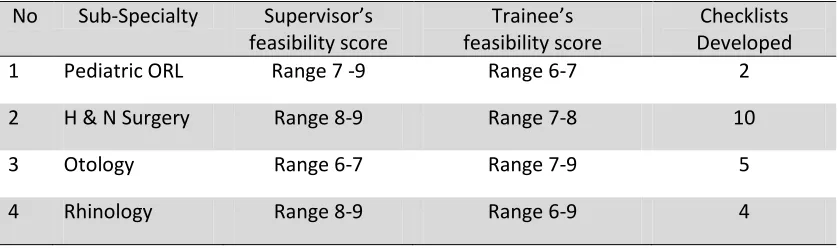
25 trainees and 8 faculty members from 4 subspecialties of ORL-HNS discipline participated in this study (see table 1). Faculty development and trainees orientation in DOPS were found acceptable (see table 2) and feasible (see table 3) by majority of the participants for its adoption in practice of formative assessment of the postgraduate trainees in ORL-HNS training.
Education in Medicine Journal (ISSN 2180-1932) © www.saifulbahri.com/eimj | e36 Figure 1: Illustrating the real steps of DOPS performed as an office procedure in a surgical skill of taking biopsy from the nose and observed by a checklist and marked by a rating form by an assessor. Note a peer observing the procedure.
Figure 2: Illustrating the further steps of DOPS observed by a checklist to provide feedback on performance by demonstration of one of the steps and after procedure assurance of
Education in Medicine Journal (ISSN 2180-1932) © www.saifulbahri.com/eimj | e37 Table 1: Number of trainees versus supervisors and their sub-specialty developed for DOPS
Table 2: Supervisor’s versus trainee’s level of satisfaction and the trainees reported mean score
Table 3: Range of supervisor’s versus trainee’s feasibility scores and the number prepared checklists as per sub-specialty.
Trainees trained with DOPS (Total No 25)
No of Subspecialties (Total = 4)
Supervisors trained with DOPS (Total No 12)
Year Numbers No Sub-specialty Sub-specialty Numbers
I 7 1 Otology Otology 1
II 5 2 Rhinology Rhinology 2
III 5 3 HNS HNS 4
IV 2 4 Pediatric ORL Pediatric. ORL 1
No Sub-Specialty Supervisor’s level of satisfaction
Trainee’s level of satisfaction
Year of training Vs. mean scores
1 Pediatric ORL Range 6 -9 Range 6-8 Year I - 6.5
2 H & N Surgery Range 8-9 Range 8-9 Year II- 7.2
3 Otology Range 7-9 Range 7-9 Year III- 7.5
4 Rhinology Range 8-9 Range 8-9 Year IV- 8.5
No Sub-Specialty Supervisor’s feasibility score
Trainee’s feasibility score
Checklists Developed
1 Pediatric ORL Range 7 -9 Range 6-7 2
2 H & N Surgery Range 8-9 Range 7-8 10
3 Otology Range 6-7 Range 7-9 5
Education in Medicine Journal (ISSN 2180-1932) © www.saifulbahri.com/eimj | e38
Discussion
Most of the traditional assessments e.g. OSCE, long and short cases with simulated or standardized patients or for that matter real patients are all done in a controlled environment (12). A workplace-based assessment (WPBA) as direct observed procedural skills (DOPS) is within the scope of practice for formative assessment however, its implementation necessarily needs consent and consensus of faculty, educators and hierarchy of the institution. Assessment should move from use of numerical value to standard-expected in procedural skills to gathering of qualitative information in decision-making. However, the WPBA instrument designed must be reliable, valid and feasible within the resources available in clinical practice (4). Instrument must be consistent with training program and attributes of different specialties. DOPS is performed in a real clinical situation. Increased opportunity for observation and just-in-time feedback from the supervising role models in DOPS produces positive educational impact on student’s learning. This also provides trainees with formative assessment to monitor their learning objectives (4). However, to implement assessment strategies in DOPS, institution needs to develop clear policy for a different teaching and learning culture of workplace based assessment. It also needs to develop user friendly rating form and the checklist, elaboration of clinical competence and its attributes (see appendices A, B and C), procedural guidelines for practice and the precise role of these tools in assessment of the postgraduate program practiced to evaluate and monitor trainee’s progress (13). Evidence-based aspect of this study on faculty development for DOPS is the 21 checklists of various procedural skills developed out of 42 core clinical procedures (see appendix A) identified by the teaching faculty of Department of Otolaryngology and Head-Neck Surgery .
DOPS as a WPBA is time constraint evaluation of trainee’s performance designed to assess some minor to medium practical skills often those performed as office procedures. Less complex surgical procedures in clinic, ward,
emergency or routine operation theater setting is the preferably chosen task for work place based assessment. More complex time consuming surgical procedures are not feasible for evaluation through WPBA as a time-bar procedures. Other alternate methods for assessment of complex surgical procedures should be explored. Protocol to develop DOPS must follow the general principles of any WPBA as under.
A DOPS rating form should be established with consensus of clinical faculty, educators and hierarchy of the institution (13). Educational and the clinical supervisor’s role as teacher development in program must clearly be defined (6). Process of DOPS as a WPBA should intend to be trainee-led and trainees should rather be allowed to fix the time of undertaking DOPS. ORL-HNS Discipline practices DOPS with this freedom for trainees who are advised to practice the procedure several times before approaching the clinical supervisor to assess them. Adequate observation time must be allowed to complete the assessment effectively and quality feedback process must be ensured with each DOPS to stimulate a change in practice.
Education in Medicine Journal (ISSN 2180-1932) © www.saifulbahri.com/eimj | e39
year out of 42 core procedural skills to complete 28 DOPS encounters in 4 years of Master of Surgery Program in ORL-HNS. Procedures were allowed to be repeated with the previous or a new supervisor if more feedback or feedback with a different assessor is desired. The core procedural skills are distributed over five subspecialties and general otolaryngology (see appendix A).
DOPS practiced in ORL-HNS Discipline were subjected to certain modifications to optimize learning from this assessment, experienced as part of educational strategy. However, these adjustments were in keeping with principles of learning and teaching. These modifications were brought to enhance the educational impact of postgraduate learning environment in School of Medical Sciences at Universiti Sains Malaysia.
First modification practiced is the mandatory probing questions to be asked on skills encompassing indications, anatomy, pathophysiology and complications of procedure as a test of theoretical knowledge and its application to help assess the overall performance of the trainee in a particular practical skill. Second modification was to allow one or two peers to attend the encounter of DOPS. Presence of a second trainee in encounter helps to inculcate the culture of peer learning among the students by observing the peer’s performance and giving feedback to each other at their mutual convenience. We found that learning through mutual observation is relaxing, promptly acceptable and friendly among peers and it also provides opportunities for feedback. Third modification was to invite patient’s feedback immediately after the encounter in which patient’s trained for this role were available. However to do that one must ensure that patient is adequately educated and can easily be trained for a quick feedback on trainee’s communication skills (introducing himself to patient and taking his or her consent for the procedure), patient’s comfort (care taken to avoid pain or distress during the procedure) and trainee’s confidence (organization and adequate clinical skill in
patient’s opinion) while procedure was performed. We found patient’s feedback as authentic, realistic and relevant to judge trainee’s organizational efficiency, humanistic qualities and professionalism gauging his overall competence.
Fourth modification was to allow the demonstration of competence by trainees in DOPS rather, using simulation techniques in special situations where performance based techniques with real patients were less likely to be achieved on time however, and such assessments were performed in workplace. This is to compensate for real WPBA of some of those procedural skills difficult to achieve in postgraduate training in practice. Learning and assessing through simulated and standardized patients (SP) helps a trainee in building his confidence for subsequent handling of real patients. Training with SP is not only relaxing but it also allows mistakes and repetition of skills as many times as it may occur. It adds to trainee’s experience prior to a real encounter. However, we must not forget the fact that DOPS is the assessment of performance in a real life clinical situation.
Conclusion
Education in Medicine Journal (ISSN 2180-1932) © www.saifulbahri.com/eimj | e40
of measurement tools in a standard – setting strategy that values qualitative information in decision-making of postgraduate medical education assessment.
References
1. Van der Vleuten CPM. The assessment of professional competence: development, research and practical implications. Adv Health Sci Educ 1996; 1:41-67.
2. Scheele F, Teunissen P, Van Luijk S, Heineman E, Fluit L, Mulder H, et al. Introducing competency based postgraduate medical education in the Netherlands. Med Teach 2008; 30:248-53.
3. Swanwick T, Chana N. Workplace-based assessment. Br J Hosp Med (Lond) 2009; 70:290-3.
4. Miller A, Archer J., Impact of workplace based assessment on doctors’ education and performance: a systematic review. BMJ 2010; 341: c5064 doi: 10.1136/bmj.c5064
5. General Medical Council, Academy of Medical Royal Colleges. Workplace based assessment: a guide for implementation. 2010.
702-14.
www.gmc-uk.org/Workplace_Based_Assessment.
6. General Medical Council, Academy of Royal Medical Colleges. Improving Assessment in Clinical and Procedural Skills: Direct Observation of Procedural Skills: 2009; 26-27.
www.aomrc.org.uk/Improving Assessment.
7. Wragg A, Wade W, Fuller G, Cowan G, Mills P. Assessing the performance of specialist registrars. Clinical Medicine 2003; 3(2): 131-134.
8. Wilkinson JR, Crossley JGM, Wragg A, Mills P, Cowan G, Wade W. Implementing workplace-based assessment across the medical specialties in the United Kingdom. Med Educ 2008; 42(4):364-373.
9. Goff BA, Lentz GM, Lee D, Houmard B, Mandel LS. Development of an objective structured assessment of technical skills for obstetric and gynecology residents. acogjnl 2000; 96(1): 146-150.
10. Roberson DW, Kentala E, Forbes P. Development and validation of an objective instrument to measure surgical performance at tonsillectomy. Laryngoscope 2005; 115(12): 2127-2137.
11. Smith D, Riley S, Kazmierczak A, Aitken M, Paice E, Le Rolland P. National Survey of Trainees 2007. Postgraduate Medical Education and Training Board 2008 Available on line: URL:http: //www.pmetb.org.uk/fileadmin/user/QA/Trainee_Surv ey/National_Survey_of_Trainees_2007_ Summary. Report_20080723-Final.pdf.
12. Rennie SC, Mossey PA, Crosby JR. Structured clinical operative tests: assessing invasive practical procedures. Med Educ 2001; 35: 1066–1090.
13. Hassan S. Clinical skills authentic learning with workplace-based assessments. Kota Bharu: SARANA Publishing, 2009.
Corresponding Author: Associate Professor Dr Shahid Hassan, Medical Education/ Otorhinolaryngology Department, School of Medical Sciences, Universiti Sains Malaysia, Kubang Kerian, 16150 Kota Bharu, Kelantan, Malaysia.
Email: [email protected], [email protected]
Education in Medicine Journal (ISSN 2180-1932) © www.saifulbahri.com/eimj | e41
Appendix A: Core procedural skills identified by ORL-HNS faculty for the DOPS evaluation of postgraduates in Master’s of Surgery in Otolaryngology-Head & Neck Surgery. Out of these a checklist of 21 procedures were developed during the 12 weeks faculty development program in DOPS.
Note: Keeping patient’s safety in view procedures are labeled for performance of trainees for level of their training in postgraduate program of Master’s of Surgery in Otolaryngology-Head & Neck Surgery as follows: 1. For year III and IV trainees only, 2. For year II and above only, 3. For any level of training.
NO PROCEDURAL SKILLS NO PROCEDURAL SKILLS
1 Tuning fork test 22 Incision drainage quinsy 2 Aural toilet by syringing 23 Incision drainage abscess neck 3 Mastoid dressing 24 Lymph node excision biopsy 4 Myringotomy/insertion of grummet 25 Incision biopsy of a neck mass 5 Removal foreign body ear 26 Post nasal space biopsy for NPC 6 Pure tone audiometry 27 Excision thyroglossal duct cyst 7 Impedance audiometry 28 Esophagoscopy
8 Removal foreign body nose 29 Indirect laryngoscopy (IDL)
9 Posterior rhinoscopy 30 Rigid endoscopic examination of larynx
10 Nasopharyngoscopy 31 Stroboscopy
11 Intranasal biopsy of mass nose 32 Direct laryngoscopy (DL) / biopsy 12 Sub-mucous diathermy of turbinate 33 Bronchoscopy
13 Anterior nasal packing 34 Insertion of nasogastric tube 14 Posterior nasal packing 35 E. T. Intubation/extubation
15 Antrum washout 36 Tracheostomy as elective procedure 16 Intra nasal pollectomy 37 Fine needle aspiration cytology 17 Reducing fracture nasal bone 38 Tissue for frozen section microscopy 18 Nasal smear cytology 39 Drawing venous blood
Education in Medicine Journal (ISSN 2180-1932) © www.saifulbahri.com/eimj | e42
Appendix B: Direct observation of procedural skills (DOPS) rating form developed for the assessment of ORL-HNS practical skills, modified from GMC ST Version used in Anaesthesia.
Personal Data Date: Pleas complete the questions using sign Trainee’s Name
Matric Number Year of training Year / Phase
Assessor’s Name
Assessor’s training Face to face Read guidelines Course Web/CD Assessor’s Position Professor Associate Professor Senior Lecturer Procedure Taking a biopsy from the nose as an office procedure
Clinical Setting O.P. Clinic A & E Ward Theater Skills Center
Case Category Scheduled Urgent Emergency Simulated
Number of times DOPS observed by assessor 0 1 2-5 5-10
Number of times procedure performed by trainee 0 1-4 5-9 > 9 Please grade the
following areas of performance
Unsatisfactory Borderline Satisfactory Superior Excellent
1 2 3 4 5 6 7 8 9
1. Has knowledge of indications and relevant anatomy 2. Takes the informed consent
3. Demonstrates the preoperative measures 4. Observe the aseptic measures 5. Hass awareness about the situation 6. Demonstrates technical skill 7. Seeks the help where appropriate 8. Demonstrate post procedure
9. Communication skills
10. Demonstrates patient care
Education in Medicine Journal (ISSN 2180-1932) © www.saifulbahri.com/eimj | e43
Appendix C: Checklist developed for individual procedure is essential for standardized rating of DOPS. Space provided in this form to record strengths and weaknesses can also be used separate than the checklist here.
Time taken for observation _____ minutes Time taken for feedback ______ minutes
Trainee’s satisfaction with DOPS Not at all
1 2 3 4 5 6 7 8 9
High 10 Assessor’s satisfaction with DOPS Not at all
1 2 3 4 5 6 7 8 9
High 10
Assessor’s signature Trainee’s
signature
Please record areas of strengths and weaknesses as well as suggestions to improve
No Checklist of procedure stated in rating form to assess trainee’s performance
1 Introducing yourself to patient, giving the information about the procedure and taking consent to obtain the biopsy from nose under local anesthesia
2 Wearing on the gloves, examining the nose alternatively with 00 and 300 rigid endoscope
for any anatomical variation and nature of lesion. Possible site for biopsy is also decided at this point.
3 Placing the cotton wicks soaked in cocain in middle meatus around the lesion after explaining the step to patient and waiting for 3-5 minutes before taking the biopsy 4 Introducing a sterile punched forceps along with 00 endoscope the site on lesion earlier
selected for biopsy is reachedand held with the punched forceps and pulled the tissue with a jerk and immediately placed in a bottle containing formalin solution. One more attempt after reassuring the patient made to obtain another bite with sufficient tissue for histopathology. Cover place over the bottle immediately and labeled before sending to lab.
5 Patient is informed once again about the completion of procedure and inquiring for any pain before taking permission to reexamine the nose and the site of biopsy for possibility of any bleeding.