USING INTUITIVE JUDGMENT IN QUALITATIVE
CONTENT ANALYSIS: IMPLICATIONS FOR RESEARCH
IN VARIETIES OF ENGLISH
Rita A. R. Ramakrishna
Universiti Sains Malaysia
ABSTRACT
The main aim of this paper is to illustrate the use of qualitative content analysis in categorising nativised features in fictional narratives written by local writers. The different stages involved in dealing with the linguistic data retrieved are described to show how the qualitative approach is valuable and advantageous in doing research in language studies. Data coding, in particular, indicates that a qualitative take on the researched subject is as feasible and effective when compared to other common forms of narratives such as (interview) transcripts, diary entries, and historical/personal narratives. The paper also reflects on the ways intuitive judgment can be considered in deciding the different aspects of methodological concerns. Because the study is conducted by someone from ‘inside’ the speech community, the researcher becomes more acquainted with the data. Subsequently, the different perspective complements issues of authenticity and acceptability as the categorised forms and functions are viewed more meaningfully as they would in naturalistic settings and domains. The final data sets of the study underpin that, as a tool in a qualitative research, the use of intuitive judgment flags influential and reflexive connections between the researcher and the narratives in lending greater significance to the interpretation of findings.
Keywords: Content analysis; Fictional narratives; Intuitive judgment; Malaysian English; Varieties of English.
1. INTRODUCTION
Marshall (1996, p. 522) points out that quantitative approach is useful to find answers to the more “mechanistic ‘what’ questions” and in contrast, qualitative approach is most useful in understanding the “humanistic ‘why?’ and ‘how?’” questions. Quantitative and qualitative methods, by comparison, differ based on several aspects. Quantitatively, the position of the researcher is more neutral and thus, the results of the study can be generalised to a larger population. Qualitatively, the researcher is an integral part of research process, thus making the results of the study more transferable (Marshall, 1996, p. 524).
Whilst Elliott (2005) accentuates that studies involving narratives within the fields of sociolinguistics and literary studies provide grounds for researchers to develop new ways and devices in studying their data, Spencer, Ritchie and O’Connor (2003) mention that there no clear cut differences between contexts of interpretation in qualitative approaches. Nonetheless, the traditions of these approaches and individual studies often indicate cross-boundaries situations. They point out that in content analysis, the aims are to identify themes in the content and context of the selected documents and the frequency of their occurrences. According to Cohen, Manion
and Morrison (2005, p. 164), appropriate categories and units of analysis in content analysis are identified to reflect the researched documents and the research questions. These categories consist of the main content areas and are usually determined after initial data inspection. Kothari (2008, p. 110) writes that at a “simple level”, content analysis may look at the features of documentary materials (such as books, magazines and newspapers) that can be identified whereas, at a “subtle level”, the analysis may include studies on attitude towards certain topics.
In this paper, the study mainly sets out to document the distinctive features of Malaysian variety of English in selected short fictional narratives written by local writers in English. Subsequently, it also aims to examine the morphosyntactic functions of these features at both the lexis and syntactic levels. The quantitative method in this study was secondary since it was used mostly in determining sample size and initial data sets. The qualitative method, on the contrary, was primary because it was employed in dealing with various stages of data coding involving the fictional texts.
2. INTUITIVE JUDGMENT IN LANGUAGE STUDIES
Although not much have been documented on the use of intuitive judgment in researching data involving nativised fictional narratives, it is believed that artistic approaches enclose greater perspectives in understanding the use of forms in relation to the intended meanings, as governed by the social, cultural and political settings of the written texts. This is because “when the content to be conveyed requires that the reader vicariously participates in a social situation context, the writer […] attempts to create a form that makes such participation possible” (Eisner, 1981, p. 8-9). It is also claimed that meanings and experiences of the people who function in the cultural web one studies are other significant criteria in artistic approaches to research. In doing so, one may infer for cues by putting himself or herself into the life of another and experiencing what the person is experiencing. The researcher is thus provided with a better understanding of the content as the major source of data as this kind of approach revolves around the researcher himself or herself. Despite other formal instrumentation used in the research, he or she provides an essential source of data based on his or her experiences in what it is he or she is dealing with. Eisner (1981, p. 8) asserts that for an interpretation to have a valid socially shared meaning, features of social life such as balance and context, are several elements that must be considered. Similarly, Elliott (2005) believes that “an awareness of the narrative structures that are commonly used within a culture can be helpful to inform an analysis that goes beyond ostensible content of an account” (p. 13)
misconceptions about the actual nature of intuitions. They state that “… so long as a person’s inclination to judge a certain morph-phonemic string to be well-informed is immediate and untutored…[n]o introspectionist protocols are required by the grammarian from his or her native-speaker informant, only a judgment of grammaticalness” (Cohen & Le Page, 1981, p. 26).
According to Gass (2001), because the native speakers’ intuitions need no appeal to sense or mathematical proof in providing grammatical evidence, most researches within linguistics have traditionally used acceptability judgments as a methodology in gathering data. She maintains that in the field of Second Language Acquisition, for example, the use of acceptability judgments is considered with certain recognition of difficulties involved. Carroll, Bever and Pollack (1981) discuss that linguistic intuitions exist in two systematic types. At one end, linguistic intuitions can be “basic and primitive manifestations” of speakers’ shared grammatical knowledge, while at the other end, linguistic intuitions are “complex behavioural performances that can be properly understood and adequately interpreted only by a comprehensive analysis” (Carroll et al., 1981, p. 380). In their research on the non-uniqueness of linguistic intuitions, they report that systematic manipulation of subtle intuitions is possible as the respondents were found to employ intuitional strategies in organising their introspective linguistic percept.
To this extent, it can be said that introspective approaches can lend different outlooks to research, especially when one is dealing with literary texts. Based on these points, the researcher put to use her membership as a native speaker of the Malaysian speech community to shed more meaningful and significant explanation to the data studied through her use of intuitive judgment. The introspective-oriented point of view is essential because the distinct varietal features investigated revealed many valuable insights about the forms and meanings of the Malaysian variety of English
in context, particularly the ones found in the data.
3. METHODOLOGY
The discussion in the following sections is arranged in two main parts: Corpus Collection and Data Selection. These are fundamental in order to establish the main frame of the study in dealing with the linguistic data examined in the sample collected.
3.1.Corpus Collection
As a larger sample would be more representative of the overall number of data investigated, the target corpus comprised not only collections of short fictions written originally in English, but also those translated from other languages into English, namely from Malay, Chinese and Tamil. The initial sampling frame of the study, not confined to writers’ gender, ethnic background, age and location, was updated several times until a more complete frame was compiled. This further helped to determine the sampling methods to be used in the study as Milroy and Gordon (2003, p. 25-26) point out that in many early sociolinguistic studies of urban speech, representativeness in studying linguistic usage in a highly diverse population can be achieved by avoiding bias in the sample. When a list of more detailed criteria was incorporated, the final sampling frame then featured considerations and limitations which then situated the scope of the study. In total, the corpus collection in this study was narrowed down to 57 anthologies and collections of fictional narratives written by Malaysians in English.
3.2.Data Selection
It is essential to note at this point that the selection of data was tailored for the present methodological needs of this study. To describe the nativised variety of Malaysian English (MalE henceforth) in the fictional narratives, the extent to which particular items and varietal marking occur as recognised by a reader with a native speaker’s background was used so that informed judgments were made during data selection. As mentioned earlier in the paper, the use of non- native variety of English in the data was done by referring to the linguistic intuition of the researcher as a member of the Malaysian speech community. This was because the literary nature of the data collected allowed the approach to this study to include not only linguistic access, but also intuitive ones. Moreover, scientific approaches were considered not appropriate to encompass the entire frame of methodology for it was known that the fictional narratives were embedded with contextual elements that could influence the readers’ interpretation of the texts.
Yet, to add objectivity and to ensure more practical grounds for identifying the markers of MalE in the data, the method by observing the different usage of typefaces or prints found in each fictional narrative was used. Whilst nativised or non-English grammatical structures and/or words were most usually marked in italics, another kind of typeface found in the varietally marked words and phrases was the use of footnotes. Other typefaces referred to were the use of glossary lists (mostly provided at the end of the respective anthologies), glosses and circumlocutions.
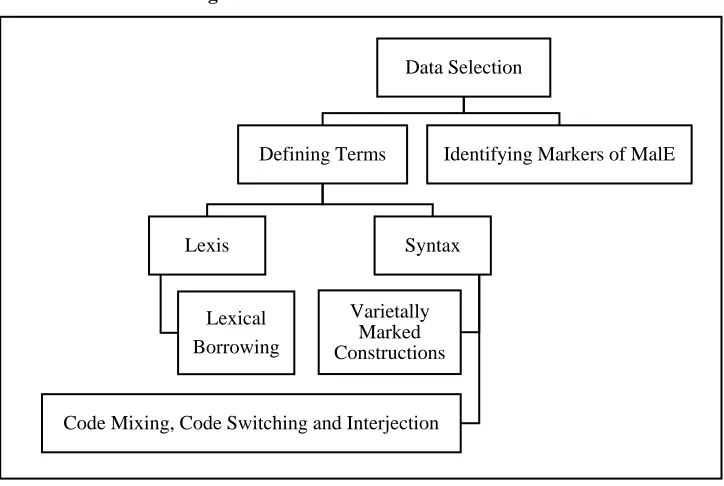
languages in this study despite the use of other Asian and European languages found in the nativised fictional narratives during initial data selection stage. Figure 1 outlines the steps involved in identifying and selecting data for coding purposes in this study.
Figure 1: Overview of Data Selection
The data in this study thus went through the recognition process before the classification stage took place. In narrowing down of the salient structural features of MalE in the selected sample of fictional narratives, a series of data coding was conducted for the purpose of qualitative data analysis.
4. DATA CODING AND DATA ANALYSIS
A close and careful study of all data was regarded as crucial in the study; therefore, coding started with assigning and distributing the codes to tag all data retrieved from the sample data before they were triangulated. To cater to the needs of the study, the point of saturation in this stage was achieved after all data were recorded according to their respective elided or/and inserted marked features characterising MalE. In sum, the data in this study went through five stages of data coding before data triangulation took place.
According to Cresswell (2002, p. 266), coding involves the stages of “… segmenting and labelling text to form descriptions and broad themes in the data”. He states that the inductive process of coding starts with identification of text segments (such as bracketing) and allocating a code word or phrase that provides the meaning of the respective text segment. In Data Coding Stage 1, a set of codes was used to assign the instances of borrowed words, phrases and sentences that were not
Data Selection
Defining Terms
Lexis
Lexical Borrowing
Syntax
Varietally Marked Constructions
Code Mixing, Code Switching and Interjection
features of Standard English found in the sample fictional narratives. All data were saved in soft copies and then printed out on note cards. One note card consisted of one type of data in which each was numbered and colour-coded for reference purposes. Additionally, all note cards were tagged with numbers that respectively located them with their corresponding page number from which they were taken from. However, for the purpose of this study, text segments were described in a single (or more) word phrase(s) to refer to a single code (for a broad segment or a sub-segment of data) rather than in sentences or paragraphs.
Next, each card was studied for its nativised syntactic, morphological and semantic elements and features. In Data Coding Stage 2, the researcher developed and expanded descriptions of each segment for every notecard examined. The descriptions of the various coded items found in the sample fictional narratives were keyed in to record the possible morphosyntactic structures in which they occurred. In particular, this stage of coding revolved around categorisation of broad linguistic segments as outlined in the guideline of definitions (during Data Selection). These segments, Lexical Borrowing, Varietally Marked Constructions and Code Mixing and Code Switching, formed the three broad segments in Data Coding Stage 2. Likewise, items that did not belong to any of these three segments were moved to Miscellaneous, a new sub-segment created under Varietally Marked Constructions. At the end of the second stage coding, a total of 113 descriptions from all segments were recorded.
Data Coding Stage 3 took place when each broad segment was studied. As an illustration, in the
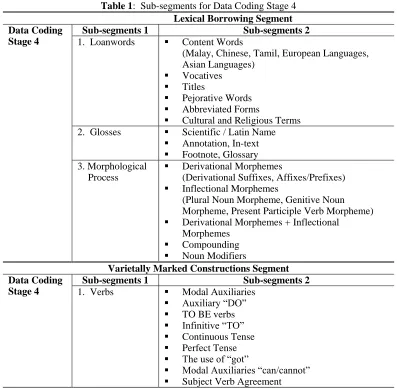
Lexical Borrowing Segment, there were 2200 entries recorded based on the descriptions of the notecards classified as instances of borrowed words. Each card was again studied and coded into sub-segments. By examining and revising each description for any overlaps and redundancy, emerging patterns or themes for each broad segment and their respective sub-segments were developed. In Stage 2, the coding of the sub-segments was labelled as Sub-segment 1. To further illustrate, the themes that emerged based on the descriptions of all items recorded in Sub-segment 1 for Lexical Borrowing were Borrowing from Malay, Chinese, Tamil, European Languages, Asian Languages; Glosses; Vocatives; Lexical Items in Transitional Phase; Word Classes; Morphosyntactics; Affixation; Borrowing for Titles; Reduplication; Borrowing of Pejorative Words; Reduction; Borrowing of Cultural and Religious Words and Borrowing from Regional Dialects.
Table 1: Sub-segments for Data Coding Stage 4 Lexical Borrowing Segment Data Coding
Stage 4
Sub-segments 1 Sub-segments 2
1. Loanwords ▪ Content Words
(Malay, Chinese, Tamil, European Languages, Asian Languages)
▪ Vocatives
▪ Titles
▪ Pejorative Words
▪ Abbreviated Forms
▪ Cultural and Religious Terms 2. Glosses ▪ Scientific / Latin Name
▪ Annotation, In-text
▪ Footnote, Glossary 3. Morphological
Process
▪ Derivational Morphemes
(Derivational Suffixes, Affixes/Prefixes)
▪ Inflectional Morphemes
(Plural Noun Morpheme, Genitive Noun Morpheme, Present Participle Verb Morpheme)
▪ Derivational Morphemes + Inflectional Morphemes
▪ Compounding
▪ Noun Modifiers
Varietally Marked Constructions Segment Data Coding
Stage 4
Sub-segments 1 Sub-segments 2
1. Verbs ▪ Modal Auxiliaries
▪ Auxiliary “DO”
▪ TO BE verbs
▪ Infinitive “TO”
▪ Continuous Tense
▪ Perfect Tense
▪ The use of “got”
▪ Modal Auxiliaries “can/cannot”
▪ Subject Verb Agreement
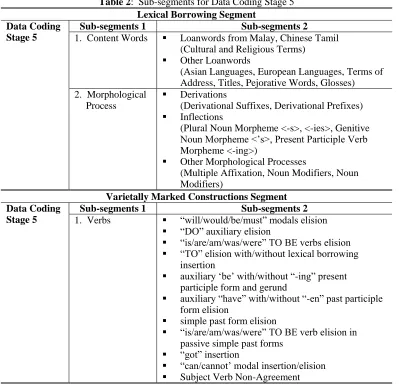
For Data Coding Stage 5, all items in Sub-segments 2 (Data Coding Stage 4) were further coded to determine the degree of varietal specificity that writers employed through the use of nativised English. Coding at this level aimed to develop the existing emerging themes into more comprehensive lexical/morphological, semantic, syntactic and discoursal explanations. As such, with several existing sub-segments collapsed and new ones added, the redistributed elements were described more thoroughly. For example, the items in Sub-segments 1 (Lexical Borrowing
Segment in Data Coding 4) were collapsed into only two sub-segments: Content Words and
Table 2: Sub-segments for Data Coding Stage 5 Lexical Borrowing Segment
Data Coding Stage 5
Sub-segments 1 Sub-segments 2
1. Content Words ▪ Loanwords from Malay, Chinese Tamil (Cultural and Religious Terms)
▪ Other Loanwords
(Asian Languages, European Languages, Terms of Address, Titles, Pejorative Words, Glosses) 2. Morphological
Process
▪ Derivations
(Derivational Suffixes, Derivational Prefixes)
▪ Inflections
(Plural Noun Morpheme <-s>, <-ies>, Genitive Noun Morpheme <’s>, Present Participle Verb Morpheme <-ing>)
▪ Other Morphological Processes
(Multiple Affixation, Noun Modifiers, Noun Modifiers)
Varietally Marked Constructions Segment Data Coding
Stage 5
Sub-segments 1 Sub-segments 2
1. Verbs ▪ “will/would/be/must” modals elision
▪ “DO” auxiliary elision
▪ “is/are/am/was/were” TO BE verbs elision
▪ “TO” elision with/without lexical borrowing insertion
▪ auxiliary ‘be’ with/without “-ing” present participle form and gerund
▪ auxiliary “have” with/without “-en” past participle form elision
▪ simple past form elision
▪ “is/are/am/was/were” TO BE verb elision in passive simple past forms
▪ “got” insertion
▪ “can/cannot’ modal insertion/elision
▪ Subject Verb Non-Agreement
5. DATA TRIANGULATION
The final stage of methodology and procedure in this study involved three steps of data triangulation. Throughout all the stages of data coding, the researcher’s intuitive linguistic knowledge as a Malaysian became the primary source not only for early data recognition, but also for data categorisation by refining the major and minor themes developed for the study. At every stage of data coding, the researcher went through the extracts and eliminated instances of any repeated or overlapping codes. This formed Data Triangulation Stage 1 and at the end of the coding stages, it was found that there were an overall of 2148 borrowed lexical items identified from the Lexical Borrowing Segment while 700 documented extracts were derived from the
Varietally Marked Constructions Segment. Another 214 instances were categorised under the Code Mixing and Code Switching Segment.
Even though most data in the study clearly indicated marked borrowings and switchings from Malay, Chinese and Tamil, Data Triangulation Stage 2 included all data sets in the three broad segments. In particular, sentence constructions that were possible in Standard English and other varieties of English such as American English, Australian English and Hispanic English were ruled out by a trained linguist who is a native speaker of English. Wray, Trott and Bloomer (1998) point out that the risk of missing some details from the data can be reduced by “… getting [someone] who does not use that variety to [read] your data and check your assumptions”. Therefore, as in the other segments, conflicting and unclear data were then excluded during this data triangulation stage. In other words, data found to be ambiguous and varying as identified by the native English speaker were taken out and this resulted in a new set of revised data. The triangulation carried out at this stage resulted in a total of 621 extracts with varietally marked constructions. 201 instances involving code mixing and code switching were also finalised together with 2130 examples of borrowed lexical items.
For the purpose of analysis, all examples of varietally marked constructions cited in the study were provided with possible reconstructions. These reconstructions were proposed as they had the closest structures to the original ones and were also triangulated by the native speaker linguist in Data Triangulation Stage 2. Nevertheless, it is beyond the scope of this paper to include detailed discussions of the findings of the study.
6. IMPLICATIONS FOR RESEARCH IN VARIETIES OF ENGLISH
The use of qualitative approach in this study implies that a systematic methodological aspect in data coding and triangulation can be beneficial in analysing language variation in written fictional narratives, particularly postcolonial ones. Neuman (2007) and Rubin and Babbie (2011) claim that content analysis allows the researcher to do cross-comparisons between texts and analyse them using quantitative techniques. They state that the approach can elicit objective quantitative results about the texts due to the systematic sampling and coding procedures. After going through three stages of triangulation, all data in the study were analysed based on the themes emerged during the respective coding stages. These emerging themes are useful indicators in guiding the discussion of findings based on the research objectives and due to this reason, the qualitative content analysis is given more emphasis rather than the quantitative one.
Because the writings were taken from edited anthologies and collections of fictional narratives, the emerging themes derived from the qualitative approach also effectively substantiate that the lexical, syntactic and discoursal features of MalE observed in the study have considerably developed in their forms and functions due to the linguistic repertoire of the writers in various domains. The data coded thus provide valuable insights into the growing patterns of nativised forms and the possible morphosyntactic structures of the matrix language in which they are embedded into. Due to the qualitative nature of the study, the use of linguistic intuition has allowed the researcher, as a Malaysian, to discuss the findings based on the points of view of someone from ‘inside’ the speech community. Consequently, this brings a different perspective to the study because the different forms and functions are viewed more meaningfully as they would in daily communications that are mostly defined by local contexts and cultures. Significantly, such analyses of contents are less confined, hence making them more informed and more credible.
7. CONCLUSION
All data in this study went through a twofold process - recognition and classification. The choice in determining appropriate methodology for a study is guided by the research questions rather than the preference of the researcher. For this reason, the research design selected aims to ensure greater significance in encompassing the textual as well as the contextual richness of data under study. The qualitative procedures used are found to be a viable one as it provides an intense, yet a meaningful approach in doing content analysis, particularly one that involves written fictional narratives within the field of (socio)linguistics or language studies. By looking closely at the steps undertaken at every stage of the methodology, it can be seen that the framework constructed highlights a more meaningful data analysis based on the emerging themes or categories rather than a set of pre-determined ones. This suggests that the methodology undertaken can be further explicated for studies involving other nativised varieties of English in written documents, especially when coding procedure(s) can be challenging.
ACKNOWLEDGEMENT
This paper is one of the outcomes from the project “Linguistic Appropriation and Nativisation in Contact Literatures: The Malaysian Experience” (304/PHUMANITI/6313049), a research grant funded by Universiti Sains Malaysia.
REFERENCES
Carroll, J. M., Bever, T. G., & Pollack, C. R. (1981). The non-uniqueness of linguistic intuitions. Language, 57(2), 368-383.
Chomsky, N. (1965). Aspects of the theory of syntax. Cambridge, MA.: MIT Press. Cohen, L. J., & Le Page, R. B. (1981). Some remarks on the nature of linguistic theory and discussion. Philosophical Transactions of the Royal Society of London Series B,
Biological Sciences, The Psychological Mechanisms of Language, 295(1077), 235-243. Cohen, L., Manion, L., & Morrison, K. (2005). Research methods in education (fifth
edition). London: Taylor & Francis.
Cress well, J. W. (2002). Educational research: planning, conducting and evaluating
quantitative and qualitative research. Upper Saddle River, New Jersey: Pearson/Merrill Prentice Hall.
Eisner, E. W. (1981). On the difference between scientific and artistic approaches to qualitative research. Educational Researcher, 10(4),5-9.
Elliott, J. (2005). Using narrative in social research (qualitative and quantitative approaches). Great Britain: Sage Publications.
Gass, S. M. (2001). Innovations in second language research methods. Annual Review of Applied Linguistics, 21, 221-232.
Kachru, B. B. (1990). The alchemy of English: the spread, functions, and models of non-native Englishes (Illini Books Edition). Urbana and Chicago: University of Illinois Press. Kothari, C. R. (2008). Research methodology (methods & techniques). New Age International (P)
Limited, Publishers: New Delhi.
Marshall, M. N. (1996). Sampling for qualitative research. Family Practice,13(6), 522-525. Milroy, L. & Gordon, M. (2003). Sociolinguistics: method and interpretation. United Kingdom:
Blackwell Publishing Ltd.
Neuman, W. L. (2007). The basics of social research (qualitative and quantitative approaches). Boston: Pearson Education, Inc.
Pavlenko, A. (2008). Narrative analysis. In W. Li & Moyer, M. G. (Eds.). The Blackwell guide to research methods in bilingualism and multilingualism (pp. 311-325). United States of America: Blackwell Publishing Ltd.
Rubin, A., & Babbie, E. R. (2011). Research methods for social work. United States of America: Brooks/Cole Cengage Learning.
Spencer, L., Ritchie, J., & O’Connor, W. (2003). Analysis: Practices, Principles and Processes. In J. Ritchie & Lewis, J. (Eds). Qualitative research practice (pp. 199-218). Thousand Oaks, California: Sage Publications Ltd.