HOW APPROPRIATE IS THE BALANCED
SCORECARD AS AN INTERNAL
REPORTING FRAMEWORK?
Paul MountcastleNoel Yahanpath
Eastern Institute of Technology Napier, New Zealand
ABSTRACT
The Balanced Scorecard (BSC) remains a popular strategic management tool. This tool has also been successfully applied in the healthcare industry
aside from various business fields. However, the use of BSC in New Zealand
lacks evidence, thus requiring further research into the applicability of this tool in the country, especially when the Hawke’s Bay District Health Board (HB DHB) sought to improve its internal reporting framework. In this case, we investigated whether BSC could be applied by HB DHB in pursuing its objective. Given the lack of an international standard for healthcare BSC design, we developed a framework that comprised the appropriate perspectives to meet the needs and internal reporting requirements of HB DHB. BSC was eventually proven suitable for this application, and
the framework of Marr (2015) was identified as a suitable framework for
such an application. While remaining to the original design of Kaplan and
Norton, the framework has been modified to fit the needs of HB DHB by
changing the customer perspective to community and by adopting Marr’s
positioning of the financial perspective along with three other perspectives to reflect the importance of both financial constraints and objectives to the
whole operation.
Keywords: balanced scorecard, internal reporting framework, health services, strategic management
___________________________________________________________________________________________________
ARTICLE INFO
INTRODUCTION
In 2013, the Hawke’s Bay District Health Board (HB DHB) sought to improve its internal reporting framework by adopting the Balanced Scorecard (BSC). International evidence shows a high level of BSC adoption in various businesses (Marr, n.d. cites results from studies by both the Gartner Group and Bain & Co to support his claim that “more than half of major companies in the US, Europe and Asia are using balanced scorecard approaches”). The application of BSC has also been documented
in healthcare organizations (Zelman, Pink, and Matthias, 2003, cited in
McDonald, 2012) with great success (Al Sawalqa, 2011, Meliones, 2001, cited in McDonald, 2012). However, the following question remains: is BSC
appropriate for a healthcare provider in New Zealand? This study seeks to
answer this question and proposes an appropriate framework.
The present situation in New Zealand is greatly similar to that in Ontario,
Canada, during the 1990s when the country was pressured to increase
its efficiency amid health funding constraints. As a solution, the health providers in Ontario adopted the BSC, thus marking the first time that this tool was adopted in the healthcare industry (Zelman, Pink, and Matthias,
2003, Baker and Pink, 1995).
Given the lack of research on BSC use within the New Zealand healthcare sector (with Northcott and France (2005) being one of the very few studies on this matter), we distributed questionnaires to senior finance managers of five DHBs in the country to determine whether they used BSC and whether they benefitted from such a tool.
After determining that BSC was being applied as an internal reporting
framework in a New Zealand DHB, we evaluated the possible structures
that would be suitable for this application. As BSC use greatly varies
across countries, we ensured that the BSC structure of HB DHB satisfied
its requirements. Given the capabilities and resource limitations of the organization, we decided that a model that follows the original BSC design
of Kaplan and Norton would be most appropriate for HB DHB. Given the
limited research in this area, general business principles should be coupled
with the HB DHB plan and the New Zealand health objectives to generate
interviewed to determine the different reporting requirements at each seniority level within the DHB structure.
This research contributes to the literature on BSC use within the healthcare
industry by specifically examining the applicability of BSC as a management reporting tool in New Zealand. Moreover, by examining the design of the
report framework, this research contributes to the literature on existing and potential BSC frameworks and hopes to intensify the current debates on a healthcare BSC design.
BACKGROUND
HB DHB is one of the 20 organizations that provide health services in
New Zealand. These publicly funded public organizations are responsible
for the health outcomes in their respective geographical areas, with HB DHB covering the Hawke’s Bay province and the Chatham Islands. These DHBs are responsible for achieving the various health objectives set by the Ministry of Health.
These DHBs were implemented through a statute in 2002 to replace the previous Hospital Board structure and to provide and fund health services in their respective districts (Ministry of Health, 2013). To this end, these organizations oversee and fund the general publics (GPs) in their regions through primary healthcare organizations (PHOs), therapists, laboratories, pharmacists, radiologists, and non-government organizations, such as Maori healthcare providers, mental health providers, and residential care providers. Disability support services and some other health services are funded and purchased nationally by the Ministry of Health (Ministry of Health, 2013). HB DHB operates two public hospitals, with the main hospital located in Hastings and a smaller hospital located in Wairoa. They also operate three
health centers in Napier, Central HB, and Chatham Islands (HB DHB
Annual Plan, 2013/14).
providers in Hawke’s Bay, while 24% will be allocated to the acquisition of specialized care services from other DHBs that cannot be provided locally (HB DHB Annual Plan, 2013/14).
However, these DHBs face several challenges. First, their reporting requires input from both internal and external sources. Second, these organizations are required to incorporate the data from the abovementioned service providers into their performance measures. Third, their external reporting
must instantaneously address the objectives identified in their annual plans
and statements of intent. Fourth, these organizations are required to regularly
submit non-financial reports to the Ministry of Health.
Northcott and France (2005) examine a BSC for New Zealand hospitals
that was developed as an external reporting requirement for the Ministry of Health in 2000. This BSC contains four perspectives and the following 16
measures (four for each perspective): financial (returns on funds employed,
operating margin to revenue, revenue to net funds employed, and debt to
debt plus equity ratio), process and efficiency (resource utilization ratio,
performance to contract, inpatient average length of stay, patient admission rate, and percentage of eligible elective day case surgeries), patient and quality (overall satisfaction of patients, hospital-acquired bloodstream infections, emergency triage times, and percentage of resolved/closed complaints), and organizational health and learning (voluntary staff turnover, staff stability rate, sick leave rate, and workplace injuries).
The fact that external reporting is based on a BSC framework suggests that a similar framework must be implemented for internal reporting needs to align
the internal measures with the external ones. Northcott and France (2005)
identify 30 key performance measures outside this BSC, among which 20 are related to activities, 7 are related to outcomes, 2 are related to workforce,
and 1 is related to finance. They also identify conflict in the reporting
requirements between hospitals and DHBs that prevent BSC from meeting its aim of “supporting health-sector accountability and management.” The
existence of other performance measures in New Zealand indicates that
DHBs are responsible for the health outcomes outside hospitals.
treatment, increased immunization, more effective assistance for smokers to quit, and additional heart and diabetes checks (Ministry of Health, 2013).
METHOD
We conducted an extensive review of the literature on BSC use in the healthcare industry. Although BSC use has been extensively studied internationally, only a few studies have investigated the application of BSC
in the New Zealand healthcare sector. Therefore, we collected data from
international and domestic research on the healthcare industry and general BSC application.
Given the limited studies on BSC use in the New Zealand healthcare
industry, we developed a questionnaire to obtain quantitative and qualitative
responses to questions on the use of and the perceived benefits of using
BSC within DHBs. These questionnaires were sent through email to senior
finance managers in five DHBs (25% of the total). Four of these DHBs had
sizes and scopes similar to those of the HB DHB (Hutt Valley, Waikato,
Wellington, and Bay of Plenty), while the fifth DHB (Canterbury DHB)
was recently commended by the Auditor General for its reporting standards.
Four staff members from HB DHB with different levels of seniority were interviewed to determine the different information requirements within their organization, to determine the strengths and weaknesses of its existing reporting standards, and to identify the information needs of employees.
LITERATURE REVIEW
The literature review was performed from the perspectives of
healthcare-industry-specific and general BSC studies conducted domestically and
internationally. A higher weighting of importance was placed on healthcare industry research because of the major differences between the commercial
application of BSC and that in which finance is more of a constraint than
At an international level, Pineno (2002); Ghani, Said and Laswad (2010)
identify the following benefits that BSC use could provide to businesses:
1. Promoting the active formulation and implementation of organizational strategies;
2. Updating and increasing the visibility of organizational strategies; 3. Improving communication within the organization;
4. Aligning divisional or individual goals with the goals and strategies of an organization;
5. Aligning annual or short-term operating plans with long-term strategies; and
6. Aligning performance evaluation measurement with long-term strategies.
Many studies find that individual companies have achieved success by
implementing BSC. For instance, Christesen (2008) cites examples from
Kaplan and Norton (2006), and Lawson, Stratton, and Hatch (2003) report that “Almost two-thirds of the survey respondents agreed that significant benefits had been realized from using a scorecard system such as a reduction
in overheads of 25% in three years.”
From a national perspective, Blundell, Sayers, and Shanahan, (2003) find that only four studies investigated BSC use in New Zealand. By investigating 40 NZSE companies, they find that 61% and 65% of these companies used BSC in New Zealand at the corporate and divisional levels, respectively.
Some similarities are also observed between the objectives of business
and non-profit healthcare. According to Pineno (2002), “The objective for
the organization is to maximize the margin between the revenue generated by a product’s or service’s value package and the costs of supplying it.” However, the inapplicability of this argument in both commercial and
non-commercial sectors is difficult to validate.
When looking for a suitable internal reporting framework for a healthcare provider, one can easily see that BSC meets all the requirements even
though this tool is originally developed for businesses (Kaplan and Norton, 1992, cited in Zelman, Pink, and Matthias, 2003). First, BSC measures both non-financial and financial outputs, which are very important because
However, the balance makes this instrument ideal for the healthcare sector.
By considering four perspectives, this tool fairly reflects both the high-level measurements (financial and customer/community) and the underlying
drivers (internal process and learning and growth). The suitability of BSC as a management tool for the healthcare sector is reinforced when compared with the healthcare value chain, as proposed by Schultz (2010).
The five links in this chain are aligned with the four perspectives of BSC:
high employee satisfaction (learning and growth), high internal quality (internal process), high external quality and high patient/MD satisfaction and loyalty (customer/community), and increased revenue, lower cost, and
better margin (financial). Chow, Ganulin, Haddad, and Williamson (1998)
note that “well-designed measures aid in communicating the organization’s goals and strategies for obtaining those goals, motivate actions congruent with these goals and strategies, and give feedback and guidance about progress toward these goals,” thus indicating how BSC can evolve into a powerful management tool. According to Greiling (2010), “Inamdar and Kaplan see a high potential for the balanced scorecard in healthcare provider organisations in general.”
BSC was originally developed by Robert Kaplan and David Norton in 1992
to provide a more holistic approach to management; their original design
placed the financial perspective at the top a hierarchy of perspectives that
include the customer, internal process, and learning and growth perspectives
(Kaplan and Norton, 1992). This hierarchical structure reflected their
argument that achieving each of these perspective levels would feed upward through the hierarchy and would eventually result in the achievement of
financial objectives.
In the following decade, BSC was changed from a measurement system to a strategic management system (Inamdar, Kaplan, and Reynolds, 2002).
This change indicated that organizations finally realized the benefits of this
the staff members of the organization are involved in patient (particularly hospital) activities that involve a relatively small number of administrators. An increased complexity may lead to an imbalance in this area and may prove to be counter-productive.
BSC was introduced in healthcare for the first time in Canada in 1999; the
application of this model was used by the University of Toronto as the basis
for a model in its 1999 Hospital Report (Zelman, Blazer, Gower, Bumgarner, and Cancilla, 1999). Since then, BSC usage has increased significantly, with many studies citing the adoption of this tool (Marr, 2015, Zelman, Pink,
and Matthias, 2003; Ghani, Said and Laswad, 2010) and the improved
performance of firms as a result of its implementation (Al Sawalqa, 2011,
Meliones, 2001).
BSC has been significantly adapted to suit different healthcare applications (Northcott and France, 2005, Woodward, Manuel, and Goel, 2004). Up
to eight perspectives have been included in frameworks, and various perspectives have been used in practice (Gurd and Gao, 2008).
The implementation of this tool in Ontario involved the following perspectives:
1. Financial performance and condition (financial);
2. Patient satisfaction (customer);
3. System integration and change (innovation and learning); and 4. Clinical utilization and outcomes (internal business processes).
After establishing the suitability of BSC in the healthcare industry, we tested
whether this international success sufficiently validates the suitability of
this tool for the HB DHB. Given the lack of research on the application of
this tool in the New Zealand healthcare industry, we tested whether BSC
FINDINGS
To test whether BSC could provide a suitable reporting framework for HB
DHB and benefit the organization, we investigated the use of BSC within the DHBs in New Zealand by developing and distributing a questionnaire.
The questionnaire was distributed to the respondents through email, and the respondents were asked to provide quantitative and qualitative responses to several statements, including three questions about BSC use within
their organizations. The respondents held senior finance positions within five other DHBs. The rationale for selecting these respondents has been
explained earlier in this report. These respondents were asked to indicate the use of BSC within their organizations and to provide their views on the
two possible benefits of BSC use as follows:
1. My organization uses the Balanced Scorecard as a management reporting tool.
2. If so, I find this tool beneficial in understanding the performance of
my organization.
3. If so, this tool helps my organization achieve its overall objectives.
The respondents were asked to respond to these three statements using a seven-point Likert scale as follows:
0 = not applicable 1 = very strongly disagree 2 = strongly disagree 3 = disagree
4 = neutral 5 = agree
6 = strongly agree 7 = very strongly agree
They were also asked to provide qualitative feedback in the comments section of the questionnaire. All respondents provided comments that added value to the quantitative responses. The other questions sought to elicit responses about the use of activity-based costing, activity-based management, and databases. Some of these responses provided insights into the framework design.
The responses to question one indicated that four of the five DHBs used
The qualitative responses about BSC use included the following:
“The Balanced Scorecard is fully used in the Provider Arm and in highly abbreviated performance dashboards elsewhere” (respondent 1).
“We have a well-rounded reporting mechanism that focuses on the vision and strategy of the DHB as a whole” (respondent 2).
“We have used Balanced Scorecards for some time. We are trying to align the scorecards to the different levels of the organization. They have gotten out of sync as different areas tweak measures for their own use. These scorecards are key tools in reporting to our board” (respondent 4).
“We use a modified Balanced Scorecard approach that helps us
understand the performance of our organization. However, the direct link between the strategy and the objectives of the organization is
not yet fully visible because the strategy is not well defined. Given
that DHBs tend to have a wide range of activities and objectives, it is
difficult to use a Balanced Scorecard to reflect all of their objectives”
(respondent 5).
As indicated in their responses to the other two questions, the four respondents from BSC-using organizations strongly agreed that their BSC use enhanced their understanding of the performance of their organization (average 6.00) and helped their organization achieve its objectives (average 5.75).
The statement, “My organization has a single database for both internal and external reporting purposes,” yielded an average response of 3.20, which indicated the disagreement of the respondents (response = 5, n = 1; response = 4, n = 1; response = 3, n = 1; response = 2, n = 2). When developing this statement, we assumed that internal and external reporting was aligned to allow both internal and external objectives to be linked and communicated throughout various organizations. The respondents
indicated otherwise, consistent with the findings of Zelman, Pink, and
information systems should be developed resulted in poor data warehousing and multiple information systems. Moreover, internal reporting for DHBs relies on data from internal sources and external service providers. At this stage of development, each healthcare provider maintains its own records, thus indicating that HB DHB also deals with multiple sources of raw data. This problem must be addressed when introducing a new internal reporting framework.
Four staff members from HB DHB with different seniority levels were also interviewed to determine the different reporting requirements within their organization and to identify the strengths and weaknesses of their present reporting standards.
The following observations were collected from the interviews:
First, as expected, the reporting requirements varied at different seniority levels within the organization, with the higher levels demanding highly aggregated data, whereas the lower levels demanding operational data, such as staff availability and usage, case statistics, and medicine and treatment information.
Second, a gap in information sharing was observed between external providers and hospital operations. This gap was particularly noticeable between hospital and general practitioners that could be attributed to privacy
laws and professional standards. For instance, doctor/patient confidentiality
prevents the communication of vital information between GPs and hospital staff. Timmins and Ham (2013) refer to the improvements in Christchurch DHB, particularly its electronic shared care record view as follows: “It is not yet a full electronic health record, rather a portal that draws on existing hospital, GP and other data to provide a very full summary care record that, compared to what is available in many other parts of the world, is still pretty rich.” Moreover, both the questionnaire respondents and interviewees indicated that one of the major problems in their reporting was that their data were not contained within a single database as too many different entities were involved in the healthcare industry of a region.
Third, the HB DHB staff members argued that despite the availability of
The organization also had no structure, as reports were provided by position and responsibility. This arrangement indicated that the most appropriate reports for individual staff needs heavily depended on the quality of the individual’s contacts in IT services. An interviewee stated that she obtained one of the most useful reports she ever received through a chance comment that was made by another staff member. Another interviewee indicated that many other suitable reports were available in the organization, but she was unaware of their existence (“I don’t know what I don’t know”).
BSC DESIGN
Unlike in business in which the tool has undergone several evolutions over
generations, BSC has been modified, often significantly, for use in the
healthcare sector. Several perspectives (up to eight as reported by Gurd and Gao, 2008) with varying labels have been used to satisfy distinct applications
(in the case of Ontario, the perspectives of financial performance, patient
satisfaction, clinical utilization and outcomes, and systems integration
and change have been used) (Zelman, Pink, and Matthias, 2003). These
authors identify quality of care, outcomes, and access as perspectives that are commonly added to the BSCs for healthcare organizations.
Hypothesizing that “the” BSC is suitable for implementation in the
healthcare sector is difficult because “In healthcare, the BSC scorecard
appears more diverse than in other sectors” (Gurd and Gao, 2008). Therefore, if we hypothesize that BSC provides the most appropriate model upon which the internal reporting framework of HB DHB can be based, then what is the most appropriate BSC model? To avoid confusion, one must
look at options for the BSC design and develop a model that will reflect the individual needs of HB DHB while considering the findings of Zelman,
Pink, and Matthias (2003), which show that the BSC for the healthcare sector must accommodate the needs of many organizations. Given the constraints mentioned earlier in this paper, we follow the original model of Kaplan and
Norton as much as possible.
enable trend analysis among other feedback. This demand reflected their
preference for a dashboard than detailed data.
By contrast, hospital managers demanded for additional operational
information and were highly concerned about functional information flows, including sharing patient information, staffing matters, and operational data.
Therefore, when developing a BSC for a mental health unit, Coop (2006)
divides the tool into four quadrants, namely, financial, clinical quality,
productivity and learning, and organizational health.
At the highest level, the DHB is required to report externally to the
Ministry of Health on specific objectives, and the progress toward these
objectives must be communicated throughout the organization. These external objectives revolve around health outcomes (customer—or as we
prefer—community) and financial matters (Gurd and Gao (2008) provide an interesting debate on the use of community as a perspective). Northcott and France (2005) agree that adequate financial performance is more of a
means than an end to the provision of hospital services. Therefore, these
two areas are identified as the high-level perspectives for this model. This structure is consistent with the vision of Kaplan and Norton for a healthcare BSC that places the customer perspective at the top level (Northcott and France, 2005, citing Kaplan and Norton, 2001). Giving equal weighting to the customer and the financial perspectives is not a new trend as suggested
by Chan and Ho (2000), who investigated the situation in Canada (Gurd and Gao, 2008). Walker and Dunn (2006) mentioned a similar structure in which these two perspectives are positioned next to each other.
The underlying performance in these areas involves the internal process (how
and how efficiently) and the learning and growth (by whom) perspectives.
BSC has the ability to tie the objectives and measures in the four quadrants together. Therefore, the staff members at all levels of the organization can readily see the high-level outcomes from their achievement of lower-level
objectives. Similar to many publicly funded healthcare models, the financial
perspective obviously constrains the other three perspectives, which in turn
After determining the importance of the financial perspective, we must
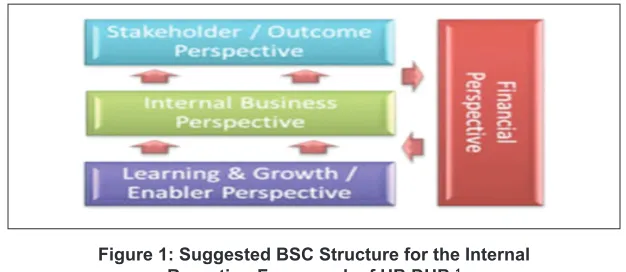
develop a model that is similar to that proposed by Marr (2015). In this
model, the financial perspective is positioned vertically along with the
other three perspectives, with the customer perspective (community) at the top and the internal processes and learning and growth perspectives at the bottom (see Diagram 1). This arrangement not only indicates that health outcomes (within the community perspective) are the principal output but
also recognizes the importance of setting and achieving financial budgets
to the organizations. Anecdotal evidence suggests that budget is the most
important factor in the operation of DHBs in New Zealand.
In the interviews, the HB DHB staff members mentioned that BSCs were developed for all levels of the organization and that these tools contained many operational (internal process and learning and growth) perspectives
while maintaining a financial focus. This arrangement ensures that the effect of achieving non-financial objectives on both the budget and financial
objectives is not overlooked at all levels within the organization. Moreover, this arrangement establishes a sense of connection between staff members of various seniority levels and the higher-level objectives. The idea that all staff members are headed toward the same goal is not new. Gunaratne and Plessis (2007) believe that “…in setting goals the overall business objectives should be articulated and transformed into individual and team goals,” while Boswell (2000) contends that “ensuring that employees are knowledgeable of and behaving in alignment with the organization’s strategic direction is of utmost importance, as organizations rely more and more on employees to contribute to the strategic goals.” By analyzing hospital performance
data from the New Zealand Treasury, Northcott and France (2005) reveal
a “concerning increase in the average cost-per-unit of measured activity,” which indicates that an activity factor should be included in the framework.
This suggestion is consistent with the findings of Lawson, Stratton, and
Hatch (2003), who argue that “Activity-based costing is a key element of
a scorecard implementation.” Recent events in New Zealand, including the
Christchurch earthquake in 2011, have shown that DHB service demands are externally generated and are beyond the control of the management. Hutt DHB recently experienced a budget blowout resulting from the unexpectedly high numbers of complex and costly treatments (stuff.co.nz, accessed 11 February 2014), while HB DHB faced budget pressures from the increasing
The interview responses of the HB DHB staff members have reinforced the potential usefulness of BSC. As expected, the less senior staff members required operational information that would typically populate the learning and growth perspective and particularly the internal process perspective.
They also identified activity as an important driver in their planning and
reporting performance, thus reinforcing the assertion that an activity factor must be included in the framework.
Reviewing the possible variations in the Kaplan and Norton hierarchy
requires a focus on causality to determine the suitability of different models. Marr (2015) proposed three variations that replace the customer perspective
with stakeholder/outcome in the BSC design of Kaplan and Norton. The financial perspective is simply repositioned to the bottom of the hierarchy
in one of these variations and directly below the stakeholder/outcome perspective in another. In both cases, the stakeholder/outcome perspective assumes the top position in the hierarchy.
The third design of Marr retains the three perspectives (stakeholder/outcome,
internal business, and learning and growth) in a hierarchy, with the financial
perspective positioned vertically alongside these three perspectives (see
Diagram 1). This model reflects the reality in the healthcare industry with
a high level of reporting, including stakeholder/outcomes (although the
term community seems more relevant) and financial. This model reflects the importance of community health outcomes and financial budget in the operations of DHBs within New Zealand.
Figure 1: Suggested BSC Structure for the Internal Reporting Framework of HB DHB.1
Positioning the financial perspective alongside all the other perspectives reflects that all perspectives contribute to the overall financial outcome,
while the financial perspective constrains all the other perspectives. Therefore, a two-way relationship is established in the hierarchy.
CONCLUSION
In any organizational change, the implementation of a BSC reporting system must be carefully managed. “Proper planning of an implementation process can reduce the likelihood of failure and help prevent other undesirable consequences such as reduced employee morale” (Self and Schraeder, 2009, cited in Ray, 2011). To this end, the initial implementation must be at a senior management level because the need for change is mostly
identified at this level. The implementation must then be extended to board
reporting and to other areas within the organization that supports a more robust reporting system. Given that the roll-out is accepted throughout the organization, the implementation may be extended to other departments and external providers to ensure total commitment and congruence throughout the organization and its constituent parts.
Around 80% of our respondents report that they are using BSC within their
organizations. They benefit from their BSC use, consistent with international
evidence. Therefore, BSC is a suitable model on which an internal reporting framework for HB DHB can be based. The study also suggests the most suitable BSC applications for HB DHB. The resulting structure remains loyal
to the original model of Kaplan and Norton. This structure recognizes the
many forms of BSC, which has been applied to many different applications internationally. This study can stimulate further debates on the design of BSCs for the healthcare industry. This debate may be extended beyond the
boundaries of New Zealand. The resultant preferred option is based largely
on the work of Marr and draws extensively from management theory.
The final model reflects the best practice while recognizing the priorities in the healthcare environment of New Zealand and maintaining realistic
interactions among various perspectives. More importantly, this model utilizes the existing resources and capabilities of HB DHB for manageability.
three perspectives in the model, is emphasized both as a reporting measure and as an input constraint to the other perspectives. This structure ensures
that the progress toward financial objectives is reported at all levels of the
organization, emphasizes the importance of budget in the decision making and performance reporting at all levels, and reminds the organizational staff
members about their financial constraints and objectives.
Renaming the customer perspective as community reflects the high-level
responsibility of DHBs to this group. Although a community may easily be extended to include all stakeholders, most stakeholders act as representatives of the community, particularly members of the government (i.e., Minister of Health) and, indirectly, government departments. Therefore, the term “community” covers these groups adequately. Therefore, as one of the high-level tiers in the hierarchy, the choice of the community has more authority than that of the customer.
Overall, the recommended structure for this BSC framework can effectively satisfy the needs of and the internal reporting requirements of HB DHB. As an extension, this structure also provides a manageable framework that may act as a template for any other DHB that aims to implement a more cohesive internal reporting framework. This framework is also relevant to
similar healthcare structures that would like to refine their internal reporting
processes.
REFERENCES
Al Sawalqa, F. (2011). The Changing Role of Management Accounting:
Assessment of the Impact of Financial and Non-Financial Performance
Measures Usage on Organizational Performance in Jordan. Retrieved from http://researchrepository.murdoch.edu.au /4518/2/02Whole.pdf.
Ayoup, H., Omar, N.H. & Rahman, I.K.A. (2012). Implementation of
Balance Scorecard (BSC) in a Malaysian GLCS Perceptions of Middle
Managers. Asia-Pasific Management Accounting Journal, 7(2), 99-123.
Blundell, B., Sayers, H., & Shanahan, Y. (2003). The adoption and use of the
balanced scorecard in New Zealand: A survey of the top 40 companies.
Pacific Accounting Review, 15(1), 49-74.
Boswell, W. R. (2000). Aligning employees with the organization’s strategic
objectives: Out of “line of sight,” out of mind. (Order No. 9967512,
Cornell University). ProQuest Dissertations and Theses, 248-248 p.
Chow, C. W., Ganulin, D., Haddad, K., & Williamson, J. (1998). The balanced scorecard: A potent tool for energizing and focusing healthcare organization management. Journal of Healthcare Management, 43(3), 263-280.
Christesen, D. A. (2008). The impact of balanced scorecard usage on
organization performance. (Order No. 3302302, University of
Minnesota). ProQuest Dissertations and Theses, 109-n/a. Retrieved from http://search.proquest.com/docview/304595608?accountid=39646. (304595608).
Coop, C. F. (2006). Balancing the balanced scorecard for a New Zealand
mental health service. Australian Health Review, 30(2), 174-180.
Ghani, E.K., Said, J., & Laswad, F. (2010). Does Balance Scorecard Adoption Affect Service Quality? A Study of Malaysian Local Authorities. International Journal of Managerial and Financial Accounting 2(3), 256-274.
Greiling, D. (2010). Balanced scorecard implementation in german
non-profit organisations. International Journal of Productivity and
Performance Management, 59(6), 534-554.
Gunaratne, K. A., & Plessis, A. J. d. (2007). Performance Management System: A Powerful Tool to Achieve Organizational Goals. Journal of
Global Business and Technology, 3(1), 17-28.
Gurd, B., & Gao, T. (2008). Lives in the balance: An analysis of the balanced scorecard (BSC) in healthcare organizations. International Journal of
Hawke’s Bay District Health Board. 2013/14 Annual Plan & Statement of Intent 2013-2016. Retrieved from http://www.hawkesbay.health.nz/
file/fileid/47547.
Inamdar, N., Kaplan, R. S., & Reynolds, K. (2002). Applying the balanced
scorecard in healthcare provider organizations / practitioner’s response. Journal of Healthcare Management, 47(3), 179-195.
Joyce, D. (2014, March 1). Patients swamping hospital. Napier Mail.
Kaplan, R. S. and Norton, D. P., (1992). “The Balanced Scorecard-Measures
That Drive Performance,” Harvard Business Review, 70(1), 71-79.
Lawson, R., Stratton, W., & Hatch, T. (2003). The benefits of a scorecard system: A new North American study explains how balanced scorecard
users get their money’s worth. CMA Management, 77(4), 24-26.
McDonald, B. (2012). A Review of the Use of the Balanced Scorecard in Healthcare. Retrieved from http://www.bmcdconsulting.com/
index_htm_files/Review%20of%20the%20Use% 20of% 20the%20
Balanced%20Scorecard%20in%20Healthcare%20BMcD.pdf.
Marr, B. (2015). What is a Balanced Scorecard? Retrieved from www. apinstitute.com/ Balanced%20Scorecard.html.
Ministry of Health. 2013, November 19. About the Health Targets.
Retrieved from
http://www.health.govt.nz/new-zealand-health-system/health-targets/about-health-targets ?mega=NZ%20health%20
system&title=2013/14%20health%20targets.
Northcott, D., & France, N. (2005). The balanced scorecard in New Zealand
health sector performance management: Dissemination to diffusion.
Australian Accounting Review 15(3), 34-46.
Ray, P. A. (2011). Management of change to ensure is success: A longitudinal
study. (Order No. 3485542, TUI University). ProQuest Dissertations
and Theses, 178-n/a. Retrieved from http://search.proquest.com/docvi ew/903974975?accountid=39646. (903974975).
Schultz, B. (2010, February 26). Merging Six Sigma and the Balanced Scorecard. Retrieved from http://www.isixsigma.com/methodology/ balanced-scorecard/merging-six-sigma-and-balanced-scorecard.
Stuff.co.nz. (2014, February 11). High-cost cases help push DHB over budget. Retrieved from www.stuff.co.nz/national/health.
Timmins, N., and Ham, C. (2013). The quest for integrated health and social care: A case study in Canterbury, New Zealand. Retrieved from
http://www.cdhb.govt.nz/What-We-Do/Projects-Initiatives/kings-fund/
Documents/Quest-for-integrated-health-final-low-res.pdf.
Walker, K. B., & Dunn, L. M. (2006). Improving Hospital Performance and Productivity with The Balanced Scorecard. Academy of Health Care
Management Journal, 2, 85-110.
Woodward, G., Manuel, D., Goel V. (2004). Developing a Balanced Scorecard for Public Health. Retrieved from http://www.ices.on.ca/~/ media/Files/Atlases-Reports/2004/Developing-a-balanced-scorecard-for-public-health/Full%20report.ashx.
Zelman, W. N., Blazer, D., Gower, J. M., Bumgarner, P. O. & Cancilla,
L. M. (1999). Issues for academic health centers to consider before implementing a balanced-scorecard effort. Academic Medicine, 74(12), 1269-1277.
Zelman, W. N., Pink, G. H., & Matthias, C. B. (2003). Use of the balanced