© Universiti Tun Hussein Onn Malaysia Publisher’s Office
IJIE
Journal homepage: http://penerbit.uthm.edu.my/ojs/index.php/ijie
The International
Journal of
Integrated
Engineering
ISSN : 2229-838X e-ISSN : 2600-7916
Wild Goats Optimization Approach for Capacitor Placement
Problem
Hamid Teimourzadeh
1, Behnam Mohammadi-Ivatloo
1, Ali Farzamnia
2*1Faculty of Electrical and Computer Engineering, University of Tabriz, Tabriz, Iran
2Faculty of Engineering, Universiti Malaysia Sabah, Kota Kinabalu, Sabah, Malaysia
*Corresponding Author
DOI: https://doi.org/10.30880/ijie.2019.11.04.004
Received 19 April 2019; Accepted 8 July 2019; Available online 5 September 2019
1. Introduction
Compensation capacitors have been usually utilized to manage reactive power return in radial/mesh distribution systems as well as diminishing power losses and enhancing network voltage profile [1-3]. The benefits of capacitor strongly depend on the optimal placing and sizing. Radial operating structure of network is established in order to decrease the losses of the system while meeting the system operating constrictions. Maximizing these advantages could be fulfilled by making use of capacitors. Non-linearity and expansive size of the capacitor placement issue make the global optimum result as well troublesome to find. Therefore because of the great capability of evolutionary methods to manage a huge number of variables without any reduction, they are so suitable applications on expansive optimization issues which have been utilized within the CP, too. Utilization of these methods can be so useful in gaining better optimum points but maybe assurance of global optimum point cannot be ensured by these strategies. Several algorithms have been introduced in order to solve the CP problem. In [4], Simulated Annealing-like, modified PSO (SA–PSO) algorithm has been proposed to solve the capacitor placement problem. A computer software has been developed in [5] for resolving the optimum size and location of a shunt capacitor. In [6], interactive bi-objective programming with the precious trade-off method has been used to solve the scheduling and capacitor placement problem. Limaçon inspired spider monkey optimization approach has been utilized to find the near-optimal sie and location of capacitor in [7]. VLCI approach based on hybrid PSOGSA optimization method has been displayed to solve the CP problem in [8]. In [9], ant colony algorithm has been employed to solve the CP problem in which at first by sensitivity analysis the candidate points are defined and after that optimal size and location of capacitors are achieved by applying the ant colony algorithm. An accelerated particle swarm optimization approach has been utilized in [10] to allocate optimal location of capacitors along radial distribution. In [11] for finding the optimal size and location of the capacitors in a
Abstract: This paper deals with Capacitor Placement (CP) issue. The topic is an optimization problem including
two types of variables: capacitor location as an integer variable, capacitor size as a continuous one. To cope with this problem, a new approach entitled Wild Goats Algorithm (WGA) is used. WGA is a new heuristic approach which has been proved recently. In this paper, WGA is successfully implemented to the CP problem with the objective of total loss reduction. Power flow criteria as well as operation constraints are all together accommodated in the process of optimization. Two various scenarios at three load levels are also recognized to cover all possible conditions. The validity of the WGA approach in handling CP problem is assured by testifying it on IEEE 33-bus and 69-bus test systems.
distribution network, a newly generated algorithm, called crow search algorithm (CSA), is introduced. A novel hybrid alghorithm has been introduced for optimal CP problem in [12].
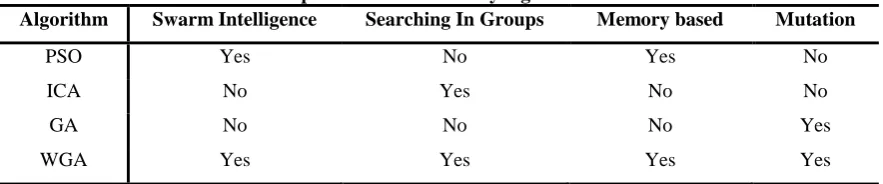
Furthermore [13] is presented teaching learning based optimization algorithm (TLBO) to solve optimal capacitor placement problem. In [13] CP problem is considered with two various objectives of minimizing total cost and power loss. Some other works have considered extra constraints or objectives such as voltage improvement and energy loss reduction besides the CP issues principal problems. In [14] bacteria foraging (BF) algorithm has been used as an optimization device for solving the CP problem which considered peak power cost decreasing, voltage improvement and energy loss reduction as the objective functions. To solve the CP problem that includes resonance constraints the authors have introduced an extremal optimization method in [15]. In [16] the holy genetic algorithm is introduced for simultaneous fixed/switched capacitor banks and allocation of DG units and network reconfiguration in distribution systems considering various load levels. In recent years, power system utilizations have advanced from a recent and prevailing optimization algorithm known as Wild Goats Algorithm (WGA). WGA has been recently presented in [17]. In Table 1 the WGA algorithm is compared with plenty of popular heuristic methods in terms of fundamental directors of evolutionary algorithms.
Table 1- comparison of evolutionary algorithm characteristics.
Algorithm Swarm Intelligence Searching In Groups Memory based Mutation
PSO Yes No Yes No
ICA No Yes No No
GA No No No Yes
WGA Yes Yes Yes Yes
According to the table I, the WGA algorithm is a completely general method. This paper considered WGA Method in order to solve power system CP problems. The CP is a nonlinear, non-convex optimization problem. Every well-known heuristic method has some individual features. Meanwhile, some of these predominant features can be categorized as: mutation, swarm intelligence, memory based, and searching in groups. Mutation is the individual feature of GA which also considered in WGA. PSO algorithm is firmly based on Swarm intelligence and also it’s a perfectly memory based algorithm, both are considered in WGA. Searching in groups is another challenging and perfectly effective feature which is considered in ICA, this also considered in WGA. Also complete and well-sorted detail about WGA would found in [17]. As it obvious, WGA is a really powerful algorithm and this is the acceptable reason to consider this algorithm for complex non-linear and non-convex problems like CP.
The principal purpose of this paper is the whole active and reactive losses minimization of distribution system. The suggested method is testified on well-known 33-bus and 69-bus test systems. Simulation studies are carried out for two different scenarios in three load levels. Based on the comparison studies and simulations, the performance of the suggested approach could be concluded.
The residue of the paper is formed as follows: in Section 2, the CP problem and WGA formulation is discussed. In section 3 simulation studies are represented. Eventually, section 4 gathers the contributions and findings of the paper.
2.
Problem formulation
2.1
Capacitor placement
Capacitor location and its rating is a vital factor which affects distribution system losses. Eventually, optimal capacitor sizing and siting from planning point of view could help minimizing system total losses. In this paper, CP issue is defined as a mathematical model to minimize total active and reactive losses of distribution system. Therefore, the problem could be expressed as follows:
2 2
1 2
1 1
:
L L
i i i i
i i
Min Z
r I
x I
(1)where, Z is the objective function and L is the total number of branches. ri , xi and Ii are the resistance, reactance
and current of ith branch, respectively. 1
and 2 are the weighting coefficients of active and reactive power losses, respectively. It should be noted that the power flow equations should be considered as constraints. Also, the operational constraints should be satisfied, as following:
min max
n n n
max
i i
S
S
(3)where, Vn is voltage magnitude of nth bus and Si is apparent power of ith branch. max
n
V and Vnmin are the upper
and lower limits of voltage magnitude. Finally, Simax is upper limit of apparent power flow in ith branch. Moreover,
capacitor rating constraint should be considered as follows:
min max
, , ,
C i C i C i
Q
Q
Q
(4)where, QC i, is the scheduled active power for ith capacitor. max ,
C i
Q and QC imin, are the upper and lower borders of active power for ith capacitor.
In this work, two variables are regarded as the optimization variables: - The location of capacitor units as integer variable.
- Rating of capacitor units as continuous variable.
2.2
Wild goats algorithm
Like other evolutionary algorithms, WGA have a set of variables which initializes all population members. wg is a solution for the problem and related to each wild goat. Consider N to be the dimension of the problem. Then:
1 1 wg
i i , i ,N
i ,....,N
wg
x ,....,x
(5)Also, Nwg is the number of WGs.
After initializing the population members, f should evaluate. It supposes that f is the objective function of the problem. Wild goats evaluate respect to their objective function.
1
1 wg
i i , i ,N
i ,....,N
f ( wg )
f
x ,..., x
(6)From the objective function, the results have a big variation range and they aren’t a proper tool for comparing wgs’ values with each other. Therefore, here W is defined as a weight for each wg in order to introduce the quality of each wg.
1 wg i i j i N i i j jf wg
min f wg
W
exp
N
f wg
min f wg
(7)W is the weight of each wg and the range of w is between 0 and 1. So, the value of optimal wg is equal to unit and it has the optimal value of the objective function.
wgs movements are highly dependent on three components: 1) its movement vector 2) its best possible, 3) number of followers of its group.
The current position of each wg at the iteration t+1 can be obtained from bellows formula:
1
1
1
wg
i i i
i ,....,N
wg t
wg t
v t
(8)The groups of wild goats can see the other groups of WGs, exactly when they climbing of the mountains. This time they share the experiments with others and the group with higher weight could attract the other groups’ followers.
1
1
Gi
i
i
i
N
l j
j G
G
W t
W t
W
t
N
(9)
Weight of the group leaders is
i
l
W t , and
i
G
W t is the weight of the ith group.
3.
Simulation studies
The simulation researches are performed by employing the WGA algorithm on the 33 and 69-node distribution standard networks. This study is implemented on MATLAB 7.6 in 2.5 GHz, i7, personal computer. In this paper, the values of weighting coefficients are assumed to be 1. The threshold amount of power flow study is considered to be 0.005. Moreover, the group size is 25 and the highest quantity of iterations is set to 200. The lower and upper voltage limits are fixed as Vmin = 0.9 p.u and Vmax = 1 p.u. For the given systems the maximum number of placed capacitors is confined to three units. In order to confirm the efficiency of the WGA approach, two various scenarios at three different load levels have been envisaged. The load levels include: 1) 0.5 (light), 2) 1.0 (nominal), and 3) 1.6 (heavy) p.u.
The first scenario studies the base case, in which no capacitor installation has been performed. The second scenario investigates capacitor problem.
3.1
33-bus test system
The system information of 33-bus test system are adopted from [18]. The single line diagram associated with this system is depicted in Fig. 1 which includes five tie lines and 32 sectionalizing switches.
Fig. 1- The single line diagram of 33-bus test system[18]
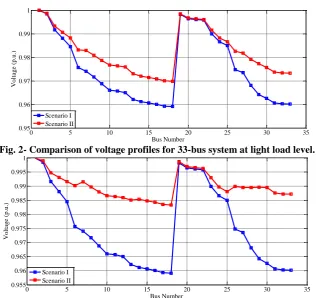
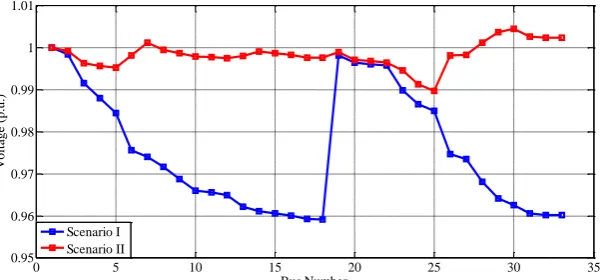
respectively. The voltage profile of the system, for both scenarios, at the heavy, nominal and light load states are analyzed and depicted in Figs. 2-4, respectively. According to Figs. 2-4, for all load levels, the voltage profile has been developed in comparison with the base case. In this section, in order to confirm the superior efficiency of the WGA algorithm, the performance of WGA algorithm is compared with the results of particle swarm optimization algorithm (PSO). The comparison results for all scenarios are reported in Table 2. According to Table 2, the efficiency of the WGA in comparison with PSO algorithm could be concluded for all scenarios.
0 5 10 15 20 25 30 35
0.95 0.96 0.97 0.98 0.99 1
Bus Number
V
ol
ta
ge
(p.u.
)
Scenario I Scenario II
Fig. 2- Comparison of voltage profiles for 33-bus system at light load level.
0 5 10 15 20 25 30 35
0.955 0.96 0.965 0.97 0.975 0.98 0.985 0.99 0.995 1
Bus Number
V
ol
ta
ge
(p.u.
)
Scenario I Scenario II
Fig. 3- Comparison of voltage profiles for 33-bus system at normal load level. Table 2 - Performance of WGA method on 33-bus system at different load levels.
Scenario Item
Load Level
Light (0.5) Normal (1) Heavy (1.6)
Base Case Scenario I
Open switches 33-34-35-36-37 33-34-35-36-37 33-34-35-36-37
Active Loss(kW) 47.26 203.80 577.23
Reactive Loss (kVAr) 31.34 134.88 383.76
Objective Function 78.61 338.68 960.99
V worst (p.u.) 0.9591 0.9171 0.8625
Method Method Method
WGA PSO WGA PSO WGA PSO
Scenario II
Open switches 33-34-35-36-37 33-34-35-36-37 33-34-35-36-37 33-34-35-36-37 33-34-35-36-37 33-34-35-36-37
Cap. size (MVAr)
0 5 10 15 20 25 30 35 0.95
0.96 0.97 0.98 0.99 1 1.01
Bus Number
V
ol
ta
ge
(p.u.
)
Scenario I Scenario II
Fig. 4- Comparison of voltage profiles for 33-bus system at heavy load level.
3.2
69-bus test system
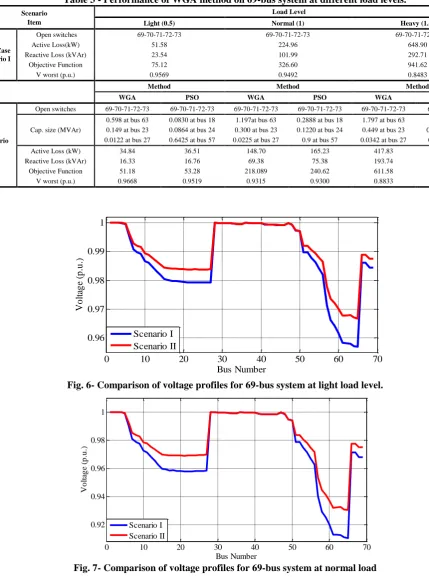
The single line diagram associated with this system is depicted in Fig. 5 which includes 69 nodes and 73 branches with 68 sectionalizing switches and 5 tie switches [19]. The system data is taken from [20]. The total reactive and active loads of the system are 2.69 MVAr and 3.80 MW, respectively. Similar to the pervious case, for 69 bus test system, two scenarios at three load levels are studied. The results concerning to 69-bus test system are presented in Table 3.
Fig. 5- The single line diagram of 69-bus test system[20]
0 10 20 30 40 50 60 70 0.96
0.97 0.98 0.99 1
Bus Number
V
o
lt
ag
e
(p
.u
.)
Scenario I Scenario II
Fig. 6- Comparison of voltage profiles for 69-bus system at light load level.
0 10 20 30 40 50 60 70
0.92 0.94 0.96 0.98 1
Bus Number
V
o
lt
ag
e
(p
.u
.)
Scenario I Scenario II
Fig. 7- Comparison of voltage profiles for 69-bus system at normal load Table 3 - Performance of WGA method on 69-bus system at different load levels.
Scenario Item
Load Level
Light (0.5) Normal (1) Heavy (1.6)
Base Case Scenario I
Open switches 69-70-71-72-73 69-70-71-72-73 69-70-71-72-73
Active Loss(kW) 51.58 224.96 648.90
Reactive Loss (kVAr) 23.54 101.99 292.71
Objective Function 75.12 326.60 941.62
V worst (p.u.) 0.9569 0.9492 0.8483
Method Method Method
WGA PSO WGA PSO WGA PSO
Scenario II
Open switches 69-70-71-72-73 69-70-71-72-73 69-70-71-72-73 69-70-71-72-73 69-70-71-72-73 69-70-71-72-73
Cap. size (MVAr)
0 10 20 30 40 50 60 70 0.8
0.85 0.9 0.95 1
Bus Number
V
ol
ta
ge
(p.u.
)
Scenario I Scenario II
Fig. 8- Comparison of voltage profiles for 69-bus system at heavy load level.
4.
Conclusion
In this paper, a methodology for optimal capacitor placement has been presented. The WGA method has been employed to manage the problem. The principal objective of the paper is to minimize the total active and reactive power losses considering different load levels. The WGA method is examined on 33 and 69- test systems. Capacitor placement method has limited capability for loss reduction. The obtained results related to the scenario II (capacitor installation) results in lower power losses and improving the voltage profile. The association of WGA approach was very efficient considering the obtained comparative results with the PSO algorithm. According to the results of simulation studies, it could be concluded that, capacitor placement could be efficient for loss reduction in distribution systems. In the other words, when both operation issues such as loss reduction and planning issues such as capacitor placement are taken into account concurrently, handling operation concerns could be more efficient.
Acknowledgement
The authors appreciate those who contributed to make this research successful. This research is under support of Center for Research and Innovation (PPI) and Faculty of Engineering, Universiti Malaysia Sabah (UMS).
References
[1] C.-F. Chang, "Reconfiguration and capacitor placement for loss reduction of distribution systems by ant colony search algorithm," IEEE Trans. Power Syst., vol. 23, pp. 1747-1755, 2008.
[2] S. Golshannavaz, "Optimal simultaneous siting and sizing of DGs and capacitors considering reconfiguration in smart automated distribution systems," Journal of Intelligent & Fuzzy Systems, vol. 27, pp. 1719-1729, 2014.
[3] S. Golshannavaz and S. Afsharnia, "Exploring the effects of adaptive reactive support capabilities by DGs in optimal operational scheduling of smart active distribution networks," Journal of Intelligent & Fuzzy Systems,
vol. 28, pp. 1699-1711, 2015.
[4] C.-C. Kuo, "Capacitor placement and scheduling using interactive bi-objective programming with valuable trade off approach," Energy Conversion and Management, vol. 50, pp. 995-1003, 2009.
[5] S. Tripathy and M. Haridas, "A novel computer software for calculating optimum location and ratings of a shunt capacitor for loss reduction in distribution feeders," Energy conversion and management, vol. 35, pp. 151-158, 1994.
[6] Y. M. Shuaib, M. S. Kalavathi, and C. C. A. Rajan, "Optimal capacitor placement in radial distribution system using Gravitational Search Algorithm," Int. J. Electr. Power Energy Syst., vol. 64, pp. 384-397, 2015.
[7] A. Sharma, H. Sharma, A. Bhargava, N. Sharma, and J. C. Bansal, "Optimal placement and sizing of capacitor using limaçon inspired spider monkey optimization algorithm," Memetic Computing, vol. 9, pp. 311-331, 2017.
[8] M. A. Tolba, A. A. Z. Diab, V. N. Tulsky, and A. Y. Abdelaziz, "VLCI approach for optimal capacitors allocation in distribution networks based on hybrid PSOGSA optimization algorithm," Neural Computing and Applications, pp. 1-18, 2018.
[10] A. A. El-Fergany and A. Y. Abdelaziz, "Efficient heuristic-based approach for multi-objective capacitor allocation in radial distribution networks," IET Generation, Transmission & Distribution, vol. 8, pp. 70-80, 2014.
[11] A. Askarzadeh, "Capacitor placement in distribution systems for power loss reduction and voltage improvement: a new methodology," IET Generation, Transmission & Distribution, vol. 10, pp. 3631-3638, 2016.
[12] A. Shefaei, M. Vahid-Pakdel, and B. Mohammadi-Ivatloo, "Application of a hybrid evolutionary algorithm on reactive power compensation problem of distribution network," Computers & Electrical Engineering, vol. 72, pp. 125-136, 2018.
[13] S. Sultana and P. K. Roy, "Optimal capacitor placement in radial distribution systems using teaching learning based optimization," International Journal of Electrical Power & Energy Systems, vol. 54, pp. 387-398, 2014. [14] S. Tabatabaei and B. Vahidi, "Bacterial foraging solution based fuzzy logic decision for optimal capacitor
allocation in radial distribution system," Electric Power Systems Research, vol. 81, pp. 1045-1050, 2011. [15] A. R. Gonçalves, C. Cavelucci, and F. J. Von Zuben, "An Extremal Optimization approach to parallel
resonance constrained capacitor placement problem," arXiv preprint arXiv:1701.09046, 2017.
[16] D. Esmaeili, K. Zare, B. Mohammadi-Ivatloo, and S. Nojavan, "Simultaneous Optimal Network Reconfiguration, DG and Fixed/Switched Capacitor Banks Placement in Distribution Systems using Dedicated Genetic Algorithm," Majlesi Journal of Electrical Engineering, vol. 9, pp. 31-41, 2015.
[17] A. Shefaei and B. Mohammadi-Ivatloo, "Wild Goats Algorithm: An Evolutionary Algorithm to Solve the Real-World Optimization Problems," IEEE Transactions on Industrial Informatics, vol. 14, pp. 2951-2961, 2018.
[18] M. E. Baran and F. F. Wu, "Network reconfiguration in distribution systems for loss reduction and load balancing," IEEE Trans. Power Del., vol. 4, pp. 1401-1407, 1989.
[19] Z. Li, X. Chen, K. Yu, Y. Sun, and H. Liu, "A hybrid particle swarm optimization approach for distribution network reconfiguration problem," in Power and Energy Soc. Gen. Meeting-Conversion and Delivery of Electrical Energy, 2008, pp. 1-7.
[20] J. Savier and D. Das, "Impact of network reconfiguration on loss allocation of radial distribution systems,"
![Fig. 1- The single line diagram of 33-bus test system[18]](https://thumb-us.123doks.com/thumbv2/123dok_us/8435267.1699265/4.595.156.458.384.589/fig-the-single-line-diagram-bus-test-system.webp)