INTERNATIONALJOURNAL OFINTEGRATEDENGINEERINGVOL. 11 NO. 7 (2019) 90-94
© Universiti Tun Hussein Onn Malaysia Publisher’s Office
IJIE
Journal homepage:http://penerbit.uthm.edu.my/ojs/index.php/ijie
ISSN : 2229-838X e-ISSN : 2600-7916
The International
Journal of
Integrated
Engineering
Composition and Type of a Binder Effects on the Stainless
Steel Foam Microstructure Prepared by Sponge Replication
Method
Fazimah Mat Noor*,
Muhamad Iqbar Abu Bakar, Zaleha Mohamad, Al
Emran Ismail, Maznan Ismon, Sufizar Ahmad, Azzura Ismail, Hanani Abd
Wahab, Nor Mazlana Main, Shahmir Hayyan Sanusi
Faculty of Mechanical and Manufacturing Engineering, Universiti Tun Hussein Onn Malaysia, Batu Pahat, Johor , 86400, MALAYSIA
*Corresponding Author
DOI: https://doi.org/10.30880/ijie.2019.11.07.12
Received 09 October 2019; Accepted 25 October 2019; Available online 15 November 2019
Abstract:Biomaterials with a porous structure are beneficial for a wide range of medical engineering applications such as filtration, bone replacement and implant development. Stainless Steel 316L (SS316L) foam has been fabricated by foam replication method at different SS316L powder composition which is 60 wt%, 65 wt%, and 70 wt%. The binders used were Polyethylene Glycol (PEG), Carboxymethyl Cellulose (CMC) and Polyvinyl Alcohol (PVA), while distilled water was used as a solvent. The effects of using different composition of SS36L powd er, binders and sintering time to the SS316L foam properties was studied. The materials were mixed by using a mechanical stirrer at 250 rpm for 1 hour. Polyurethane foam (PU) which was used as a sacrificial template was dipped into the SS316L slurry until fully coated. The coated samples were then dried in a drying oven within 24 hours before being sintered in an argon gas environment at 1200C. The samples were characterized to observe the microstructure of the SS316L foam produced. As expected, the viscosity of the SS316L slurry was increased as the SS316L composition increases. The viscosity of SS316L slurry prepared by using PVA as a binder is higher than the SS316L slurry prepared with CMC and PEG as binder. The SS316L foam produced consisted of a larg e volume of open and interconnected pores especially at higher SS316L composition.
Keywords:SS316L powder, SS316L foam, medical engineering, stainless steel, PVA
1. Introduction
Metal foams with open and interconnected pores are very attractive for a wide range of application. For example, like a catalytic converter in the automotive industry, heat insulator for industrial furnace and in biomedical as a bone implant [1]. Metal foam with an open pore structure could be produced by using several fabrication methods including of space holder method, replication method, combustion synthesis, vapour deposition and rapid prototyping [2][3]. Among all the methods, sponge replication method has been proved capable to produce foam with an open and interconnected pore that is similar to the cancellous bone structure [4].
The fabrication of stainless steel foams from the stainless steel slurry is not straightforward. There are many parameters involved during the slurry preparation including the materials’ composition, the mixing methods, types of binders and types of solvents used that affects the slurry’s viscosity. It is essential to produce a stainless slurry with appropriate stability and viscosity especially when using sponge replication method to fabricate the foam. Only at certain slurry viscosity, complete impregnation of the stainless steel slurry onto the PU foam template could be achieved. It is very challenging to produce stainless steel slurry with low viscosity at high solid content. Slurry with
*Corresponding author: [email protected]
Fazimah MN et al., Int. J. of Integrated Engineering Vol. 11 No. 7 (2019) p. 90-94
91
low viscosity is required to allow the slurry easily penetrate into the PU foam pores, while high solid content is needed to improve the mechanical stability during the sintering [5].
PEG, CMC and PVA are among the most used binder to prepare metal and ceramic slurries. This binder is preferred because it is cheaper, environmentally friendly, and also has a better solubility [6]. M. Tange et al. [7] used three different compositions of PVA as a binder which were 1 wt.%, 1.5 wt.% and 2 wt.% to produce titanium foam by sponge replication method. They found that the optimum PVA composition was 1.5 wt.%. In other work, Titanium scaffold has been produced by a group of researcher from the National Engineering Research Center for Biomaterials, Sichuan University, China [4] using the same fabrication method and 5 wt% PVA. Titanium scaffolds with open and interconnected porous structure were obtained after optimizing several processing parameters including the viscosities of Titanium slurries. In this work, the composition of binder is based on the author’s previous work [8] since porous SS316L was successfully fabricated using sponge replication method with 5wt.% PEG/CMC. Therefore, this work is conducted to study the potential of PVA as a binder compared to the CMC/PEG in the fabrication of stainless steel foam.
2. Experimental procedure
The stainless steel powder, binders and solvent were mixed by using a mechanical stirrer for 1 hour at 250 rpm speed. The composition of the stainless steel powder was varied from 55 wt% to 75 wt%, while the binder’s composition was remaining at 5 wt%, and the balance is the distilled water. The slurry viscosity was measured by using Vibro-viscometer. After that, PU foam was immersed in the prepared stainless steel slurry for about 10 minutes. The coated PU foam was then manually pressed to remove the excessive slurry. The immersion and removal steps were repeated three times to ensure that the PU foam was fully coated with the stainless steel slurry. The coated PU foam was dried in the drying oven within 24 hours at 80C before sintered at temperature of 1200C in argon gas environment. The microstructure and pore size of the stainless steel foam produced was observed by using optical microscope.
3. Result and discussion
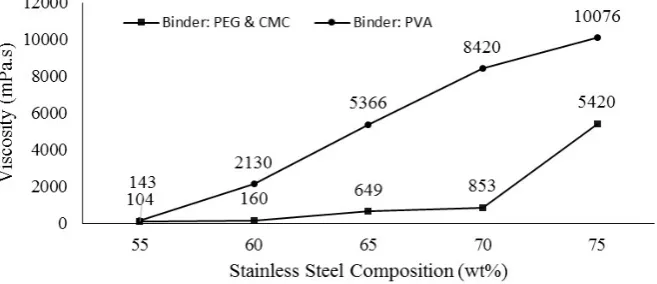
Figure 1 shows the average viscosity of the stainless steel slurry with five different compositions of stainless steel using a different type of binder. The viscosity directly increases as the stainless steel composition is increased for both type of binders. Stainless steel slurry with 75 wt. % stainless steel composition show the highest viscosity which are 10076 mPa.s and 5420 mPa.s for samples prepared with PEG/CMC and PVA as binder respectively. The viscosity of the stainless steel slurry produced by using PVA as a binder is significantly higher than the slurry prepared with PEG/CMC as a binder. With the same binder and stainless steel composition, the slurry with PVA binder presents the highest viscosity. It has been reported that the differences in viscosity resulted from the different densities and viscosities of binders [9][10]. The density of PEG, CMC and PVA are 1.08 gꞏcm-3, 0.51 gꞏcm-3 and 1.21 gꞏcm-3, respectively.
Fig.1 - The slurry viscosity against stainless steel composition using the different binder
A
verag
e
P
or
e
S
iz
e
(
m)
Closed pores
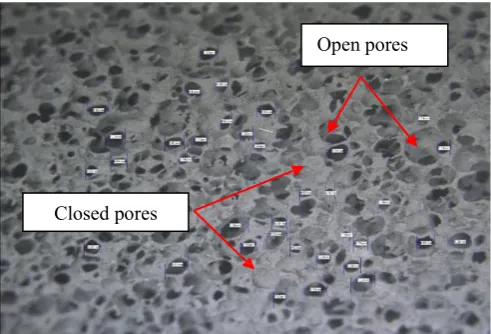
Fig. 2- Microstructure of stainless steel foam produced by the sponge replication method
The effect of using a different type of binder on the average pore sizes of the stainless steel foam is shown in Figure 3. The result shows that the pore size is not only affected by the type of binder used but also depends on the stainless steel composition [11]. Using the PVA as a binder has led to the formation of larger pore size compared to PEG/CMC. The pore size of the stainless steel foam prepared by using PEG/CMC as a binder is in the range of 164.16 to 310.34 micronmeters, whereas for stainless steel foam prepared by using PVA as a binder, the pore size is in the range of 516.19 to 733.26 micronmeters. The pore size is increased as the stainless steel composition increase. This is because, as the stainless steel composition increase, the slurry viscosity also increases. Therefore, the amount of the slurry stays adhered onto the PU foam template also increase and produce thicker struts. These struts will not easily collapse during the pyrolysis and sintering process. As a result, the stainless steel foam produced will have larger pore size. The pore size, pore shape and pore distribution are very important since the mechanical properties, corrosion resistance and biological properties of the foam is highly depends on the pore characteristics [12][13][14]. Certain pore size is also required for application such as for biomedical implant. The optimum pore size for biomedical implant is in the range of 100 to 500 micronmeters [13][15]. While the pores interconnection is crucial for blood and nutrition transportation within the bone structure and to allow for bone ingrowth [16].
800 PEG/CMC as a binder682.14 733.26
600
400
516.19 599
257.24 310.34 200 164.16 207.56
0
60 65 70 75
Stainless Steel Composition (wt%)
Fig. 3 - The average pore size of stainless steel foam prepared by using a different type of binder and stainless steel composition
Fazimah MN et al., Int. J. of Integrated Engineering Vol. 11 No. 7 (2019) p. 90-94
93
Generally, it is difficult to completely remove the excess slurry if the slurry viscosity is too high. In fact, it can lead t o the blockage of the foam pores which can be seen clearly in Figure 4(h) [3]. The optical images also show that the pore distribution of the stainless steel foam prepared with using PEG/CMC as binder is more homogenous than the pore distribution of the stainless steel foam prepared by using PVA as a binder. Based on the microstructure, the be st stainless steel compositions are 60 wt.% and 65 wt.% for stainless steel foam prepared by using PEG/CMC as a binder, and 60 wt.% for stainless steel foam prepared by using PVA as a binder. This is because, these samples highly consisted of open and interconnected pores with homogenous pore distribution.
(a)
(e)
(b)
(f)
Open pores
Closed pores
(c)
(g)
Open pores
Closed pores
(d)
(h)
Fig. 4 - Optical images of the stainless steel foam prepared by using PEG/CMC as a binder at different stainless steel composition of (a) 55 wt%, (b) 60 wt%, (c) 65 wt.%, (d) 70 wt. %, while for stainless steel foam prepared by using PVA as a binder at different stainless steel composition of (e) 55 wt%, (f) 60 wt%, (g) 65 wt.%, (h) 70 wt. %.
4. Conclusion
PEG/CMC as a binder. However, the slurry viscosity maybe reduced if the composition of the PVA added into the slurry is lower than 5 wt%. Therefore, in the future work, it is recommended that the PVA composition could be reduced below than 5 wt%.
Acknowledgement
The authors would like to thank Universiti Tun Hussein Onn Malaysia (UTHM) for financial support through the research grant of Multi-discipline Research (MDR) H502.
References
[1] P. Quadbeck, K. Kümmel, R. Hauser, G. Standke, J. Adler, G. Stephani. (2010). Open cell metal foams-application-oriented structure and material selection, in: Proceeding Cell Mat, 238-279.
[2] G. Ryan, A. Pandit, and D. P. Apatsidis.(2006). Fabrication methods of porous metals for use in orthopaedic applications. Biomaterials, 27, 13, 2651–2670.
[3] S. Ahmad and N. Muhamad. (2011). Optimisation of sintering factors of titanium foams using Taguchi method. International Journal of Integrated Engineering, 0, 1–6.
[4] C. Wang, H. Chen, X. Zhu, Z. Xiao, K. Zhang, and X. Zhang. (2017). An improved polymeric sponge replication method for biomedical porous titanium scaffolds. Materials Science and Engineering: C, 70, 1192– 1199.
[5] E. Cunningham, N. Dunne, G. Walker, and F. Buchanan. (2009). Proceedings of the Institution of Mechanical Engineers , Part H : Journal of Engineering in Medicine, 223, 727–737.
[6] R. Wang, L. Feng, W. Yang, Y. Zhang, Y. Zhang, W. Bai, B. Liu, W. Zhang, Y. Chuan, Z. Zheng and H. Guan. (2017). Effect of Different Binders on the Electrochemical Performance of Metal Oxide Anode for Lithium-Ion Batteries, Nanoscale Research Letters, 12:575, 1–11.
[7] M. Tange, A. Manonukul, and P. Srikudvien. (2015). The effects of the organic template and thickening agent on structure and mechanical properties of titanium foam fabricated by replica impregnation method . Materials Science and Engineering A, 641, 54–61.
[8] F. M. Noor, K. R. Jamaludin, and S. Ahmad. (2017). Physical and Mechanical Characteristics of Porous SS316L for Biomedical Implant. Solid State Phenomena, 268, 374–378.
[9] Z. Ertuan, K. Fantao, C. Yanfei, C. Ruirun, and C. Yuyong. (2012). Characterization of zirconia-based slurries with different binders for titanium investment casting. China Foundry, 9(2), 125-130.
[10] Shaffie, E., Ahmad, J., Arshad, A. K., Putra Jaya, R., Mohamad Rais, N., & Shafii, M. A. (2019). Relationship Between Rheological Properties of Nano Polymer Modified Asphalt Binder and Permanent Deformation of Asphalt Mixture. International Journal of Integrated Engineering, 11(6), 244-253.
[11] Ahmad Shahar, M. L., Abdul Rais, S. A., Abd. Wahid, M. H., Che Idris, I. H., Mazalan, M., Ahmad, M. F., & Norizan, M. N. (2012). The preliminary studies on preparation and characterization of bulk nanoporous zinc as a laser target candidate to generate soft x-ray. International Journal of Integrated Engineering, 4(3), 54-58 [12] G. He, P. Liu, and Q. Tan. (2012) . Porous titanium materials with entangled wire structure for load-bearing
biomedical applications. Journal of the mechanical behavior of biomedical materials, 5, no. 1, 16– 31. [13] J.L. Xu, L.Z. Bao, A.H. Liu, X.F. Jin, J.M. Luo, Z.C. Zhong,and Y.F. Zheng. (2015). Effect of pore sizes on
the microstructure and properties of the biomedical porous NiTi alloys prepared by microwave sintering. Journal of Alloys and Compounds, 645, 137–142.
[14] Y. Qi, K. G. Contreras, H. Do Jung, H. E. Kim, R. Lapovok, and Y. Estrin. (2016). Ultrafine-grained porous titanium and porous titanium/magnesium composites fabricated by space holder-enabled severe plastic deformation. Materials Science and Engineering C, 59, 754–765.
[15] H. Shen and L. C. Brinson. (2011). A numerical investigation of porous titanium as orthopedic implant material. Mechanics of Materials, 43(8), 420–430.