Original Research Article
Assessment of the knowledge and practices regarding standard
precaution among nursing staff at a tertiary care hospital of
Raipur city, Chhattisgarh
Ritu Rochwani
1, Mini Sharma
2*
INTRODUCTION
Standard precautions," as defined by Centre for Disease Control and Prevention (CDC), are a set of precautions designed to prevent transmission of human immunodeficiency virus (HIV), hepatitis B virus (HBV), and other blood borne pathogens when providing first aid or health care through blood and other body fuilds.1 The term “standard precautions” is replacing “universal precautions”, as it expands the coverage of universal precautions by recognizing that any body fluid may
contain contagious and harmful microorganisms.2 Standard precautions apply to blood, semen, vaginal secretions, cerebrospinal, synovial, pleural, peritoneal, pericardial, and amniotic fluids. Standard precautions do not apply to faces, nasal secretions, sputum, sweat, tears, urine, and vomitus unless they contain visible blood. In addition, standard precautions do not apply to saliva except when visibly contaminated with blood or in the dental setting where blood contamination of saliva is predictable.1 As per WHO, about 3 million health care workers experience percutaneous exposures to blood
ABSTRACT
Background: Nurses as healthcare providers obliged to protect herself and patients against infections. Therefore, nurses should have knowledge and strict adherence to standard precautions. Hence, this study was undertaken to assess the knowledge and practices of nursing staff regarding standard precautions. Aims and objectives of the study were to assess the knowledge of nursing staff regarding standard precaution and to observe the practices of nursing staff regarding standard precaution.
Methods: This was a cross sectional study conducted among staff nurses working in Bhim Rao Ambedkar Memorial Hospital, Raipur, and Chhattisgarh, from January to March 2017 among 100 staff nurses. Pretested predesigned semi-structured questionnaires were used. Data collected were entered in Microsoft excel sheet. The statistical analysis was done by using epi info 7. Frequencies and percentage were presented for categorical variables.
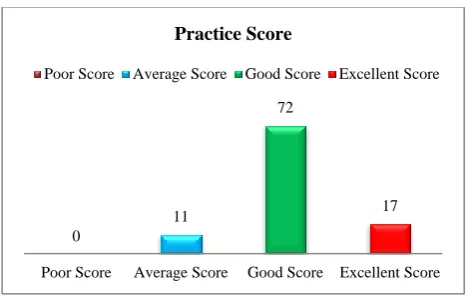
Results: The overall knowledge regarding standard precaution were excellent (>75% score) in 8% nurses. Good knowledge (50 to 75%) in 83% and average (25 to 50%) in 9%. The Practises regarding standard precautions among the nurses were good in 72%, excellent in 17% and average in 11%.
Conclusions: Based on the findings of the present study, it can be concluded that in spite of having good knowledge regarding standard precaution among the nurses, practices were not to up to the mark.
Keywords: Standard precautions, Nurses, Knowledge and practices
Department of Community Medicine, 1East Point College of Medical Sciences and Research Centre, Bangalore, Karnataka, 2Pt. Jawahar lal Nehru Memorial medical college Raipur, Chhattisgarh, India
Received: 02 January 2019 Revised: 14 February 2019 Accepted: 15 February 2019
*Correspondence: Dr. Mini Sharma,
E-mail: [email protected]
Copyright: © the author(s), publisher and licensee Medip Academy. This is an open-access article distributed under the terms of the Creative Commons Attribution Non-Commercial License, which permits unrestricted non-commercial use, distribution, and reproduction in any medium, provided the original work is properly cited.
borne pathogens each year; two million of those to HBV, 0.9 million to HCV and 1,70,000 to HIV. These injuries may result in 15,000 HCV, 70,000 HBV and 1,000 HIV infections. More than 90% of these infections occur in developing countries.3 The fact that blood and other body fluids from patients are becoming increasingly hazardous to healthcare providers; it has become a great concern for the public as well as for the healthcare providers all over the world. Therefore, standard precautions are vital measures that have been adopted to help prevent healthcare providers from being occupationally infected as well as reduce hospital-acquired infection. These infections are prevented if proper standard precautions which encompasses a wide range of steps are observed by health care providers consistently in their day to day clinical work to reduce the risk of exposure to blood and body fluids to protect self, patients and co-workers from infections.4-14 In order to protect from the infections there are four important practices recommended in standard precaution are hand washing, use of protective barriers to prevent direct contact, safe handling and disposal of sharps and safe decontamination of instruments and other contaminated instruments.6 Studies done previously reported that nurses are the commonest health care providers who are being exposed to infection.8,11 Therefore, the present study was undertaken with the objectives, to assess the knowledge and practices of nursing staff regarding standard precautions.
METHODS
The present study was a descriptive cross sectional study conducted among 100 staff nurses posted in casualty, medical, surgical, orthopedic, obestratic and gynaecology and peadiatrics units (wards) of Bhim Rao Ambedkar Memorial Hospital, Raipur, Chhattisgarh, India from January 2017 to March 2017.
The Study was started after obtaining permission from the concerned authorities of the hospital. Purposive sampling technique was used to select the sample for this study. Pretested predesigned semi-structured questionnaires were used for data collection after obtaining their consent, which consisted of 52-items regarding knowledge and practices of standard precautions. By using self-administered questionnaire data was collected from the nursing staff present at the time of data collection and willing to participate in the study. Furthermore, nursing staff posted in operation theatre and outpatient department were excluded from our study.
The questionnaire consisted of three parts. Part one consisted of general information of nursing staff including age, sex, and duration of service.
Part two consisted of 21questions related to knowledge regarding Standard precautions. For scoring the knowledge of each participant one score was allocated to each correct answer and zero to the incorrect answer. Scores of less than 25% were considered poor knowledge
and 25 to 50% were considered as average knowledge and 50 to 75% were considered as good knowledge however, scores of above 75% were considered as very good knowledge.
Part three was designed to evaluate practices of standard precautions. This part included 31 questions related to the use of protective devices, disposal of sharps, disposal of waste, decontamination of spills/used articles, and prevention of infection from person to person. For scoring the practices of each participant one score was allocated to each correct practices and zero to incorrectly, incompletely and not done practices. Scores of less than 25% were considered poor practice and 25 to 50% were considered as average practice and 50 to 75% were considered as good practice however, scores of above 75% were considered as very good practice.
Data collected were entered in Microsoft excel sheet. The statistical analysis was done by using epi info 7. Frequencies and percentage were presented for categorical variables.
RESULTS
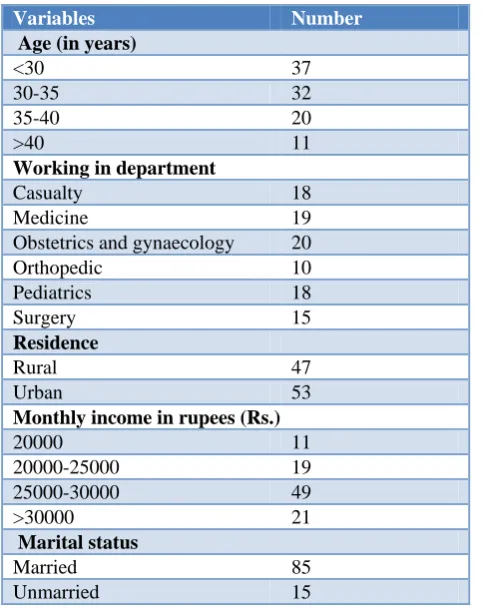
From the total 100 nurses, the mean age was 33 years (range 25-44 years). 37% nurses were in the age group of <30 years, followed by 32%, 20%, 11% were in the age group of 30-35, 35-40, >40 years. 47% nurses belonging to urban area and 53% were belonging to rural area. Most of nurses 49% had income less than Rs 25000-30000 per month. Majority of the nurses (85%) were married and rest 15% were unmarried (Table 1).
Ninety three per cent nurses were aware about standard precaution in which 73% of the study subjects were correctly described steps included in standard precaution. About 81% nurses admitted that standard precaution should be applied to all persons regardless of their infectious status. Similarly, 94% correctly explain that aim of standard precaution is to protect themselves and others from infection. About 34% nursed said that standard precaution should be applied to patients with not only HIV and hepatitis but also other blood born and body fluid infections.
About 52% nurses said that isolation is necessary for patients with blood borne infections. Ninety four per cent nurses agreed that hand washing is necessary before handling an invasive device and 64% nurses were aware about gloves should be change between patients. Nearly half of the nurses 48% knew that used needle should be recapped after giving injection. Only 52% nurses mentioned about personal protective equipment i.e. gloves, gown, goggles, mask and apron.
Table 1: Socio-demographic profile of study subjects (n=100).
Variables Number
Age (in years)
<30 37
30-35 32
35-40 20
>40 11
Working in department
Casualty 18
Medicine 19
Obstetrics and gynaecology 20
Orthopedic 10
Pediatrics 18
Surgery 15
Residence
Rural 47
Urban 53
Monthly income in rupees (Rs.)
20000 11
20000-25000 19
25000-30000 49
>30000 21
Marital status
Married 85
Unmarried 15
Furthermore, 68%, 21% and 12% nurses had knowledge regarding application of standard precaution in situations that might lead to contact with saliva, sweat and tears and feces, urine, vomitus are not infectious unless contaminated with blood or body fluids.
Sixty five per cent nurses didn’t know how to disinfect soiled linen and 27% didn’t know how to clean blood spillage on floor. In response to question related to knowledge of segregation of biomedical waste, 79% nurses did not know proper segregation of biomedical waste. About 29% nurses did not know that any reporting protocol for standard precaution in hospital available or not. Majority of nurses 62% had gotten training regarding standard precaution (Table 2).
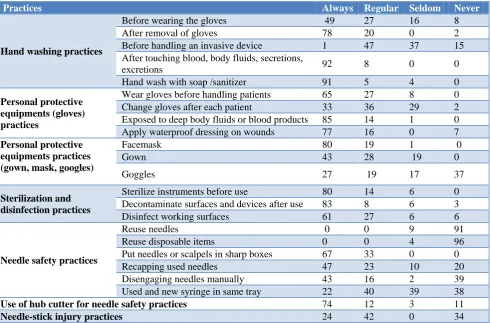
Majority of the nurses 49%, 78%, 47% and 92% were always perform hand washing before wearing the gloves, after removal of gloves, before handling an invasive device and after touching blood, body fluids, secretions, excretions, respectively. On the other hand, 91% always wash their hands with soap and water or use sanitizer after any direct contact with patients.
Similarly, 65%, 33 %, 85% and 77% nurses always wear gloves before handling patients, change gloves after each patient, before exposed to deep body fluids and products or blood and cover their wound(s) or lesion(s) with waterproof dressing before caring of patients respectively.
Table 2: Knowledge regarding standard precautions (n=100).
Knowledge regarding standard precaution Correct Incorrect
Steps included in standard precaution 73 27
Standard precaution should be applied to all persons 81 19
Aim of standard precaution 94 6
Standard precaution applied to patients with HIV and hepatitis only 66 34
Risk of improper use of standard precaution 79 21
Isolation is not necessary for patients with blood borne infections 48 52
Hand washing is necessary before handling an invasive device 94 6
Changing gloves between patients 64 36
Knowledge regarding recapping of used needles after giving an injection 48 52
Knowledge of personal protective equipment 52 48
Knowledge regarding importance of segregation of waste, appropriate cleaning of reusable equipments
1) Segregation of waste 100 0
2) Reusable equipment 100 0
3) Hand wash 94 6
Knowledge regarding application of standard precaution in situations that might lead to contact with sweat and tears urine or feces, vomitus, saliva
Saliva 32 68
Sweat and tears 79 21
Feces, urine, vomitus 88 12
Knowledge of disinfection of soiled linen and process of cleaning of blood spillage
1) Know about disinfection of soiled linen 35 65
2) Know about cleaning of blood spillage on floor 73 27
3) Segregation of biomedical waste 21 79
Majority of nurses (80%) were frequently wear a disposable facemask whenever there is a possibility of a splash or splatter and 43% nurses wear a gown if soiling with blood or deep body fluids is likely to happen. Only 27% nurses always wear eye shield/goggles when you are being exposed to the splashing of bloody discharge/fluid but 37% of the nurses never used goggles whenever
blood and body fluid splash was likely. About 80% nurses sterilize instruments before use and 83% decontaminate surfaces and devices after use. More than half (61%) nurses frequently disinfect working surface as when necessary. Furthermore, 91% never reuse needles and blades or disposable items and 96% nurses never reuse disposable items.
Table 3: Practices regarding standard precautions (n=100).
Practices Always Regular Seldom Never
Hand washing practices
Before wearing the gloves 49 27 16 8
After removal of gloves 78 20 0 2
Before handling an invasive device 1 47 37 15 After touching blood, body fluids, secretions,
excretions 92 8 0 0
Hand wash with soap /sanitizer 91 5 4 0
Personal protective equipments (gloves) practices
Wear gloves before handling patients 65 27 8 0 Change gloves after each patient 33 36 29 2 Exposed to deep body fluids or blood products 85 14 1 0 Apply waterproof dressing on wounds 77 16 0 7 Personal protective
equipments practices (gown, mask, googles)
Facemask 80 19 1 0
Gown 43 28 19 0
Goggles 27 19 17 37
Sterilization and disinfection practices
Sterilize instruments before use 80 14 6 0 Decontaminate surfaces and devices after use 83 8 6 3
Disinfect working surfaces 61 27 6 6
Needle safety practices
Reuse needles 0 0 9 91
Reuse disposable items 0 0 4 96
Put needles or scalpels in sharp boxes 67 33 0 0
Recapping used needles 47 23 10 20
Disengaging needles manually 43 16 2 39
Used and new syringe in same tray 22 40 39 38
Use of hub cutter for needle safety practices 74 12 3 11
Needle-stick injury practices 24 42 0 34
About 67% nurses always put needles or scalpels in sharp boxes. Seventy four per cent nurses said that they always cut used needle in hub cutter immediately. Only 14% nurses told that they have not enough time to cut needle immediately because of work load.
Sixty six per cent nurses reported a needle stick injury (NSI) at least once in the last twelve months. Majority of the nurses (80%) admitted to recapping used needles, while 61% reported the practice of disengaging needles manually from the syringe. Similarly, 62% nurses admitted that they keep used and new syringe in same tray during putting injections to patients in ward.
Moreover, only 61% nurses have taken vaccination against hepatitis B virus. But only 9% had completely vaccinated (Table 3).
Overall knowledge and practices regarding standard precaution it was found that 83%, 8% and 9% nurses were having good knowledge, excellent knowledge and
average knowledge, respectively (Figure 1). In the same way, 72%, 17% and 11% nurses were practicing good practices, excellent practices and average practices regarding standard precautions, respectively (Figure 2).
Figure 1: Overall knowledge of nurses regarding standard precautions.
0%
9%
83% 8%
Knowledge Score
Figure 2: Overall practice of nurses regarding standard precautions.
DISCUSSION
This study has attempted to assess the knowledge and practice of nurses regarding standard precautions. Complete knowledge and practices regarding standard precautions can play important roles in preventing infections. As revealed from the current study, majority of the nurses belonged to <30 years which was a similar to a study done by Fayaz et al, in which majority of the nurses belonged to age group of 25-35 years.8 Similarly, study done by Solanky et al showed that majority of the nurses belonged to 21 to 25 years.6
In this study, majority of the nurses were having good knowledge regarding standard precautions .This results is in contrast with the findings of Mudedla et al in a study carried out among HCWs in Nizam’s institute of medical sciences, Hyderabad, showed that most of the nurses had inadequate knowledge regarding standard precautions.4 In a another study done by Fayaz et al and Solanky et al also showed that the HCW and nurses were having inadequate knowledge regarding standard precautions.8,6
In our study, only 62% nurses were trained in standard precautions. Few of them had attended any workshop or training in infection control in the last two years and almost all of the respondents admit training needs on infection control and express willingness to attend such trainings if organized. The findings were comparable to the study done by Solanky et alin which 59.09% nurses had received proper training of universal precautions.6 In present study, 66% of the nurses reported a needle stick injury (NSI) at least once in the last twelve months in which recapping of used needles was the reason for needle stick injury. In a study done by Solanky et al and Punia et alshowed that 38.64% nurses and 17.2% of the HCWs had experienced needle stick injury in the previous one year respectively.6,10
In our study, 80% nurses always recapping used needles, while 61% reported the practice of disengaging needles
manually from the syringe. Similarly, in the study done by Punia et al in south India showed that 59.3% of the respondents always recapping used needles, while another 30% reported the practice of disengaging needles manually from the syringe.10
In another study carried out among HCWs in Nigeria by Aniwada et al reported that 60.9% HCWs handle needles appropriately.7
In this study, the commonly used personal protective equipments were gloves, and mask. Gown caps and goggles were not commonly used. Similar finding were observed in other studies also.6,7
In our study, 65% nurses didn’t know how to disinfect soiled linen and 27% didn’t know how to clean blood spillage on floor. This finding is very similar to study done by Solanky et al in which 51.14% didn’t know how to disinfect soiled linen and 53.41% didn’t know how to clean blood spillage floor.6
As Government of India issued notification in March 2016 about bio medical waste rules 2016 according to its proper guidelines should be followed by who generate, collect, receive, store, transport, treat, dispose or handle bio medical waste.15
In our study, 79% of the nurses did not know proper segregation of biomedical waste. However, in a study done by Solanky et al observed that most of the nurses knew proper segregation of biomedical waste.6
By realizing that hand washing is the single most important means of preventing the spread of infection, in the present study, almost all nursing staff always perform hand washing after touching blood, body fluids, secretions, and excretions, in our study, 91% nurses always wash their hands with soap and water or sometimes use sanitizer, 96% wear gloves, 91% not reuse needles and blades, 96% do not reuse disposable items. When this study compared with study done in Kabul, Afganistan reported that 92.6% respondent wearing gloves, and 88.6% washing hands while working.8 In the present study, majority of the study subjects were practicing good practices regarding standard precautions. Study done among nurses in Palestinian hospitals reported that >90% nurses were practicing good practices regarding standard precautions.16
CONCLUSION
This study has an attempt to highlight the issues that are to be addressed with regard to standard precautions. From the present study, it can be concluded that majority of the nurses were having good knowledge and practices regarding standard precautions but not up to the mark hence the present study recommended that there should
0
11
72
17
Poor Score Average Score Good Score Excellent Score
Practice Score
be training sessions regarding all aspects of standard precaution at regular intervals.
Recommendations
Information about standard precaution can be spread in the form of posters in different wards. Proper immunization of healthcare workers against HBV should be done. Emphasizing the importance of practices of standard precautions in continuing in-service educational programs in the hospitals. Regular demonstration classes should be included for gaining skill in standard precaution.
Limitations
The study was done in a small sample size therefore it would not be possible to generalize at the country level. Moreover, no standardized tools were available; therefore, we prepared a tool for the study. Practice of standard precaution in this study was assessed by interview methods, which might differ from the actual level of practices properly assessed by observations.
ACKNOWLEDGEMENTS
The authors would like to express their gratitude to the hospital administered of Dr. BRAM hospital and faculties of department of Community Medicine, Pt. J.N.M Medical College, Raipur, Chhattisgarh. Authors also appreciated and acknowledge all the nursing staff for their support and cooperation in conducting the study.
Funding: No funding sources Conflict of interest: None declared
Ethical approval: The study was approved by the Institutional Ethics Committee
REFERENCES
1. Universal Precautions for Prevention of Transmission of HIVand Other Blood borne Infections Fact Sheet. Available at: http://www.cdc.gov/ncidod/dhqp/bp_universal_prec autions.html. Accessed on 2 December 2018. 2. Amoran OE, Onwube OO. Infection Control and
Practice of Standard Precautions Among Healthcare Workers in Northern Nigeria. J Glob Infect Dis. 2013;5(4):156-63.
3. Health care worker safety. World Health Organization 2003. Rev.1 WHO/EHT/03.11. Available at: www.injectionsafety.org. Accessed on 8 December 2018.
4. Mudedla S, Tej WL, Reddy KT, Sowribala. A study on knowledge and awareness of standard precautions among health care workers at Nizam’s institute of medical sciences Hyderabad. J National Accreditation Board for Hospitals & Healthcare Providers. 2014;1(2):34-8.
5. Osagie SOB, Adeyemo FO, Onasoga OA. The knowledge and practice of universal precautions amongst midwives in Central Hospital, Benin City. J Public Health Epidemiol. 2015;7(11):331-6. 6. Solanky P, Baria H, Nerulkar A, Chavda N.
Knowledge and practice of universal precautions among nursing staff at a tertiary care hospital in South Gujarat, India. Int J Community Med Public Health. 2016;3(9):2373-6.
7. Aniwada EC, Onwasigwe C. Safety Precaution; Knowledge, Attitude, Practice and Sociodemographic Determinants among Health Care Workers at Primary Health Care Level in Enugu State, Nigeria. IJTDH. 2016;16(4):1-13. 8. Fayaz H, Higuchi M, Hirosawa T, Sarker MAB,
Djabbarova Z, Hamajima N. Knowledge and practice of universal precautions among health care workers in four national hospitals in Kabul, Afghanistan. Infect Dev Ctries. 2014;4(8):535-42. 9. Kaur R, Kaur B, Walia I. Knowledge, Attitude and
Practice regarding Universal Precautions among Nursing Students. Nursing Midwifery Res J. 2008;4(4):115-7.
10. Punia S, Nair S, Shetty RS. Health Care Workers and Standard Precautions: Perceptions and Determinants of Compliance in the Emergency and Trauma Triage of a Tertiary Care Hospital in South India. Int Schol Res Notices. 2014:1-5.
11. Kale M, Gholap M, Shinde M. Knowledge and Practices of Universal Precautions among Basic B.Sc. Nursing Students. Int J Science and Research. 2014;3(6):1862-70.
12. Singh SP, Kumar A, Gupta P, Gupta M, Singh P, Shrivastava S. Incompliance in use of universal precautions as a safety measure in emergency department. Int Surg J. 2016;3(2):858-61.
13. Kotwal A, Taneja DK. Health Care Workers and Universal Precautions: Perceptions and Determinants of Non-compliance. Ind J Com Med. 2010;35(4):526–8.
14. Wu S, Li L, Wu Z, Cao H, Lin C, Yan Z, et al. Universal Precautions in the Era of HIV/AIDS Perception of Health Service Providers in Yunnan, China. AIDS Behav. 2008;12(5):806–14.
15. Bio medical waste rules 2016. Issued by Government of India ministry of environment, forest and climate change. New Delhi, 28 March
2016. Available at:
mpcb.gov.in/biomedical/pdf/BMW_Rules_2016.pd. Accessed on 8 December 2018.
16. Fashafsheh I, Ayed A, Eqtait F, Harazneh L. Knowledge and Practice of Nursing Staff towards Infection Control Measures in the Palestinian Hospitals. J Education and Practice. 2015;6(4):79-90.
Cite this article as: Rochwani R, Sharma M.