Original Research Article
An assessment of facilities and services at anganwadi centers
under the integrated child development service scheme
in urban area of Kathua district, Jammu and Kashmir
Anuj Kapoor, Kamna Singh*
INTRODUCTION
Integrated child development service scheme (ICDS), launched on 2nd October 1975, represents one of the world’s largest and the most unique programs for early childhood development.1 ICDS provides a package of integrated services which includes supplementary nutrition (SN), immunization, health check-up, referral services and non-formal pre-school education (NFPSE) delivered through designated anganwadi centers (AWCs).2 The beneficiaries are children up to 6 years, adolescent, girls, pregnant and lactating women, and
women in the age group of 15-44 years. The beneficiaries of ICDS are to a large extent identical with those under the maternal and child health program.The program is executed through dedicated cadre of female workers named anganwadi workers (AWWs), who are chosen from the local community and given 4 months training in health, nutrition and child-care. The performance of the ICDS program is to a great extent dependent on the profile of the key functionary, the anganwadi worker (AWW) her qualification, experience, skill, attitude, training, etc.3 Anganwadi worker is also assisted by a helper who helps in executing routine activities at AWC.
ABSTRACT
Background: The integrated childhood development services (ICDS) scheme, launched on 2nd November 1975 is India’s foremost program imparting comprehensive and cost-effective services for children and maternal health through designated anganwadi centers (AWCs). AWCs deliver services right at the doorsteps of the beneficiaries to ensure their maximum participation.
Methods: This was a cross sectional descriptive study conducted in 37 AWCs of the urban area in Kathua district from March to May 2019. A checklist was used to assess the physical infrastructure of AWC and logistics available.
Results: A total of 37 AWCs were visited. Majority of the AWCs (94.5%) were running in a rented building and had only room. and 86.4% have pucca type of center. Almost half (51.3%) of the anganwadi workers had >10 years of experience. 32.4% of the AWWs received education up to 12th standard. Weighing machines were available in 89.1% of the centers whereas Salter weighing machine was present only in 23 centers.
Conclusions: Present case study unveils deficiencies in infrastructure and logistics at the centers. Emphasis should be given to strengthen the basic infrastructure of AWCs which would further help in delivering quality services to the beneficiaries.
Keywords: Anganwadi centers, Anganwadi workers, ICDS
Department of Community Medicine, Government Medical College, Kathua, Jammu & Kashmir, India
Received: 11 October 2019
Revised: 18 November 2019
Accepted: 20 November 2019
*Correspondence:
Dr. Kamna Singh,
E-mail: [email protected]
Copyright: © the author(s), publisher and licensee Medip Academy. This is an open-access article distributed under the terms of the Creative Commons Attribution Non-Commercial License, which permits unrestricted non-commercial use, distribution, and reproduction in any medium, provided the original work is properly cited.
Currently, the ICDS scheme stands with strength of 12.41 lakh AWCs.4 AWCs delivers services right at the doorsteps of the beneficiaries to ensure their maximum participation.5 Thus, for the attainment of ICDS scheme goals, each anganwadi center needs to be equipped with adequate infrastructure, functional equipment, tools and drugs. This study was conducted to assess the facilities and services available at the AWCs.
METHODS
This was a facility based, observational, descriptive study conducted in cross sectional design in 37 AWC of the urban area in Kathua district from March 2019 to May 2019. Permission for conducting the study was taken from concerned authorities. All the AWCs of the Urban areas were identified and each center was visited on a pre-informed fixed day. A checklist was used to assess the physical infrastructure of AWC (as observed by the researcher) and logistics (as perceived by the AWW) and a pre designed, pre-tested, structured, schedule was used
to elicit the socio demographic profile, years of service, training profile and different activities of AWWs.
The collected data was entered in Microsoft Excel, coding of the variables was done and thereby interpretation and analysis of the collected data was done by using appropriate statistical methods.
RESULTS
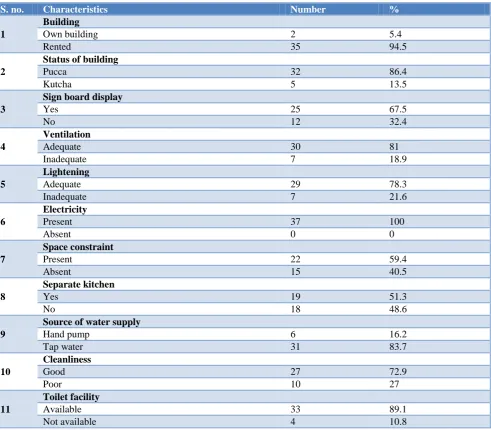
A total of 37 AWCs were visited. Majority of the AWCs (94.5%) were running in a rented building and had only room. and 86.4% have pucca type of center. Almost all the centers were running only in one room. Sign boards were displayed in 67.5% of the centers. About 40.5% of the centers had adequate outdoor space. Separate kitchen was present only in 51.3% of the centers. Majority (83.7%) AWCs were receiving water supply from tap. Separate kitchen were present in half (51.3%) of the centers and cleanliness of the centers was satisfactory. Electricity supply was present in all the centers (Table 1).
Table 1: Physical and infrastructure characteristics of the AWCs.
S. no. Characteristics Number %
1
Building
Own building 2 5.4
Rented 35 94.5
2
Status of building
Pucca 32 86.4
Kutcha 5 13.5
3
Sign board display
Yes 25 67.5
No 12 32.4
4
Ventilation
Adequate 30 81
Inadequate 7 18.9
5
Lightening
Adequate 29 78.3
Inadequate 7 21.6
6
Electricity
Present 37 100
Absent 0 0
7
Space constraint
Present 22 59.4
Absent 15 40.5
8
Separate kitchen
Yes 19 51.3
No 18 48.6
9
Source of water supply
Hand pump 6 16.2
Tap water 31 83.7
10
Cleanliness
Good 27 72.9
Poor 10 27
11
Toilet facility
Available 33 89.1
S. no. Characteristics Number %
12
Cleanliness of toilet
Clean 25 67.5
Dirty 12 32.4
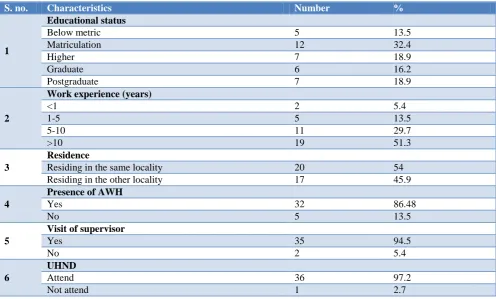
Table 2: Characteristics of AWWs in different AWCs.
S. no. Characteristics Number %
1
Educational status
Below metric 5 13.5
Matriculation 12 32.4
Higher 7 18.9
Graduate 6 16.2
Postgraduate 7 18.9
2
Work experience (years)
<1 2 5.4
1-5 5 13.5
5-10 11 29.7
>10 19 51.3
3
Residence
Residing in the same locality 20 54
Residing in the other locality 17 45.9
4
Presence of AWH
Yes 32 86.48
No 5 13.5
5
Visit of supervisor
Yes 35 94.5
No 2 5.4
6
UHND
Attend 36 97.2
Not attend 1 2.7
Table 3: Logistics available at AWCS.
S. no Logistics Number %
1
Weighing machine
Present 33 89.1
Absent 4 10.8
Salter weighing machine 23 62.1
2
Growth charts
Present 28 75.6
Absent 9 24.3
3
IEC Material
Present 32 86.4
Absent 5 13.5
4
Toys
Present 28 75.6
Absen 9 24.3
5
Books
Present 11 29.7
Absent 26 70.2
6
Registers
Regularly updated 35 94.5
Not updated regularly 2 5.4
7
Medicines
Adequate 2 5.4
Almost half (51.3%) of the AWWs had >10 years of experience. 32.4% of the AWWs received education up to 12th standard. More than half of the AWWs (54%) were residing in the same locality as that of the center. Anganwadi helpers were present in 32 out of the 37 centers. Almost all the AWWs (97.2%) regularly attends urban health nutrition day (UHND) (Table 2).
Weighing machines were available in 89.1% of the centers whereas Salter weighing machine was present only in 29 centers. Medicines were inadequate in almost all the AWCs. Logistics like chairs, tables, growth charts and toys were adequate in more than 50% of AWCs (Table 3).
DISCUSSION
AWCs under the ICDS were formulated to enhance the health, nutrition and learning opportunities of infants, young children and their mothers, especially targeted for the poor and deprived. This study aimed to assess the adequacy of the infrastructure, facilities, equipment and drugs in the AWCs, largely looking at the basic infrastructure and services that should be available. Space constrain was present in almost half of the total AWCs evaluated. An appraisal of ICDS done in 2006 also reported that 36% of anganwadis in urban areas lacked adequate indoor space.6 A study done in Chandauli district of Uttar Pradesh reported that none of the 20 AWCs had adequate indoor or outdoor space.7 Toilet facilities were present in 89.1% of the centers. However there were no separate toilets for girls and boys. In study by Malik et al 20% of the AWCs lacked a toilet, while the study by Thakare et al found that 56% of AWCs lacked a toilet facility.4,8 Half of the AWWs (51.3%) had more than 10 years of working experience. Rathore et al reported that 66.7% AWW had work experience of more than 10 years while 25.9% AWW had experience of 5-10 years.9 In our study, most of the AWWs had received only induction training and only very few of them (29.2%) had received refresher training Proper training of AWWs improves the performance.10
Thus, more emphasis should be given on orientation training and skill training of AWW in WHO growth standards and mother and child health. Weighing machines were found to be present in 89.1% of the center, whereas working salter weighing machine was available in 62.1% centers. A study conducted in West Bengal reported that in 30% of the AWCs the weighing scales were either out of order or were kept in safe custody and not used.11 Another study done in Madhya Pradesh reported that only 72% of the studied centers were having Salter weighing machine, only 66% centers were having adult weighing machines and only 58% centers were having growth registers.12 major limitation of the study was that assessment of knowledge and practices of AWWs at these facilities were not undertaken.
CONCLUSION
This study has conducted a comprehensive assessment of all the services and facilities and it was found that the performance of AWCs and AWWs still needs improvement. Emphasis should be given to strengthen the basic infrastructure of AWCs which would further help in delivering quality services to the beneficiaries. Also there should be regular trainings of the AWWs.
Funding: No funding sources Conflict of interest: None declared Ethical approval: Not required
REFERENCES
1. Three Decades of ICDS - An Appraisal. National Institute of Public Cooperation and Child Development (NIPCCD), 2006.
2. Gangbar J, Rajan P, Gayithri K. Integrated child development services in india- a sub-national review. Institute for Social and Economic Change, India Working Paper. 2014;318.
3. Thakare MM, Kuril BM, Doibale MK, Goel NK. Knowledge of Anganwadi workers and their problems in an urban ICDS block. J Med Coll Chandigarh. 2011;1:15-9.
4. Malik A, Bhilwar M, Rustagi N, Taneja DK. An assessment of facilities and services at Anganwadi centers under the Integrated Child Development Service scheme in Northeast District of Delhi, India. Int J Quality Health Care. 2015:27(3):201-6. 5. National consultation to review the existing
guidelines in ICDS scheme in the field of health and nutrition. Indian Pediatr 2001; 38:721-31.
6. National Institute of Public Cooperation and Child Development. Three decades of ICDS: an appraisal. New Delhi: National Institute of Public Cooperation and Child Development, 2006.
7. Forum for Creche and Child Care Services. A micro study of the status of the young child—a block level study in Chandauli district of UP; 2005: 20.
8. Thakare M, Kuril BM, Doible MK, Goel NK. A study of functioning of Anganwadi centers of urban ICDS block of Aurangabad city. Indian J Prev Soc Med. 2011;42:253-8.
9. Rathore MS, Vohra R, Sharma BN, Chaudhary RC, Bhardwaj SL, Vohra A. Evaluation of integrated child development services program in rajasthan, India. Int J Adv Med Health Res. 2015;2:95-101. 10. Haldar A, Ray S, Biswas R, Biswas B, Mukherjee
D. Effectiveness of training on infant feeding practices among community influencers in a rural area of West Bengal. Indian J Public Health. 2001;45:51-6.
12. Samvad V, Sanket. Right to Food Campaign Madhya Pradesh Support Group-Moribund ICDS. Bhopal: Centre for Budget Studies, 2009.