Key Generation using Ternary Tree based Group Key Generation for
Data Encryption and Classification
Nikita Gupta1 and Amit Saxena2
1, 2 Department of CSE, Truba Institute of Engineering & Information Technology, Bhopal, India
1
[email protected], [email protected] ABSTRACT
Here in this paper a new and efficient technique for the Cohort of Keys using Tree based Algorithm is proposed for the Sharing of Data in Secure manner. The Key Group Procedure is implemented for the Sharing of Data where Data Owner who needs to send Data is first Encrypted Information using Tree grounded Key Group and then when Data is received at the other end it is decrypted and Classify as Normal or Abnormal Packet. The Planned Practise realized provides Privacy from various attacks as well as provides less computational and Communication Cost.
Keywords: Tree based Key Generation, AES, User Revocation, Entropy, Network Security, Group Key Establishment.
1. INTRODUCTION
As data in Cloud is dynamic, static auditing is not an adequate amount of cloud environment. A dynamic auditing is required to authenticate the data integrity of the dynamic data. But as data are self-motivated in cloud, it is not uncomplicated to have an auditing competently. Server can put into effect replay attack and counterfeit attack to fail the auditing procedure. The dynamic procedures consist of alteration, insertion and deletion. Whenever you like dynamic operation is achieved the owner sends to bring up to date message to the auditor characterizing the index number of that message. The auditor updates the table. The message m and the tag are reinstated by the new message and tag in message modification. The new message m and new tag are inserted in insertion operation. The message m and tag are deleted from the index table and all the entries below the deleted message move upwards. After performing updates in the table, the auditor conducts the data integrity test for the keep informed data. Auditor sends the consequence to the owner and he deletes the local copy of keep informed data.
As the quantity of cloud provider‟s enlarges, deciding a trusted service became deadly. The auditing method is essential to make your mind up the cloud integrity concerns. There are dissimilar checking assembly recommended in cloud calculating. But most of them are
motionless in situation and they are put into experienced by cloud earners.
Fig.1. Dynamic TPA System
the workers, and it delivers the rational way for the workers to checkered the rationality of information in the cloud. On the whole, permitting community reviewing amenities plays a energetic role in starting cloud budget, where by workers need way to evaluate to jeopardy and gain confidence in the mist [1]. Public reviewing in calculation to user delivers the outside party to authenticate the exactness of deposited statistics against the outdoor occurrences. However these schemes [2], [3], [4] don„t contain the confidentiality fortification of the information. It is a main drawback which touch the refuge of the procedures in cloud calculating.
1.1 Third Gathering Auditor
The third festivity auditor (TPA), who has proficiency and competences that fog users do not have and is important to evaluate the cloud stowage provision refuge on behalf of the user upon demand. Operators trust on the CS for mist information stowage and conservation. They may also vigorously cooperate with the CS to admittance and apprise their deposited information for several submission determinations [5]. The manipulators may alternative to TPA for guaranteeing the stowing sanctuary of their subcontracted statistics, while hopeful to keep their figures sequestered from TPA.
We deliberate the reality of a semi-trusted CS as does. Namely, in greatest of time it performs appropriately and does not diverge from the agreed etiquette implementation [6] [7]. Though, throughout on condition that the cloud information stowage grounded amenities, for their own benefits the CS might neglect to keep or deliberately delete rarely accessed data files which belong to ordinary cloud users.
1.2 Group Key Establishment
In general, GKE protocols present multiple phases
1. Initialization: It defines the environment of the protocol: the parameters, the space of all possible keys and any other prerequisites.
2. Users Registration: It assigns group membership to users. Depending on the scenario, after registration, a user may for example share a secret key (or password) with a trusted group authority or may generate a certified long-lived public-private key pair for later signing purposes.
3. Execution: It describes the cryptographic algorithm, including the performed computations and the exchanged messages. It frequently entails of multiple rounds of communication between principals.
4. Key Computation: It explicit the key computation formulas or algorithms performed by a party to derive the key from the knowledge he gained after the Execution Phase. It is sometimes integrated within a round of the execution phase.
5. Key Confirmation: It confirms that all the intended members actually own the key and no other except
them does. Although it is an optional phase, it is usually performed for security reasons.
1.3 Informal Security Requirements
A GKE protocol should satisfy a set of properties, which we informally recall next. Key confidentiality (also called key privacy, key secrecy or non-disclosure) [8], [9] guarantees that it is (computationally) infeasible for an adversary to calculate the collection key. The stronger notion of known key security assures that key confidentiality is maintained even if the attacker somehow manages to obtain group keys of previous sessions.
Backward secrecy [10] conserves the privacy of future keys regardless the adversary's actions in the past sessions. Congruently, advancing secrecy [10] executes that the challenger movements in forthcoming runs of the procedure do not negotiation the confidentiality of preceding assembly solutions (i.e. a key remnants protected in the forthcoming). Key selection must satisfy specific properties. Key freshness requires that the collection key has certainly not been used before. The related concept of key independence imposes that no correlation exists between keys from different sessions; this means that (cooperation between) authorized participants to distinct sessions of the protocol cannot disclose session keys they are unauthorized for. In addition, key randomness warrants key in-distinguish ability from a random number and hence key unpredictability. Two other important security requirements regarding the key value exist: key integrity which attests that no adversary can modify the group key and key consistency, which prevents different players to accept different keys.
participants to the protocol have actually computed the group key and no one else except them have.
2. LITERATURE SURVEY
The Author planned a new agenda architecture for the Key Generation on Pairwise Independent Networks [15]. The two main components i.e. resident key cohort and comprehensive key dissemination is implemented. Local Key Generation is used for Point-to-point foundation coding with side material from which diagram can be raised and comprehensive key propagation is used to deliver various Secrete Keys. Complex Algorithm for key generation and hence take more computational time. K. Kalaivani, K. Renugadevi, Nithya also planned a new outline for the Pairwise Sovereign System using Key Cohort Procedure [16]. Here an Efficient Two Secrete Key generation for low complexity using local key generation and global propagation is proposed which provides better performance. Complex Algorithm for key generation and hence take more computational time. SirinNitinawarat, Chunxuan Ye, Alexander Barg planned a new and efficient technique for the Secrete Key Group for a Pairwise Autonomous System Model [17]. The unbiased is to engender a undisclosed key collective by a given subcategory of terminuses at the principal rate probable, with the collaboration of any outstanding terminuses. A (single-letter) formula for clandestine important volume brings out a ordinary assembly amongst the problematic of underground key group and a combinatorial problematic of greatest stuffing of Steiner trees in an related multigraph. High Storage Cost and Inefficient key generation.
Peng Xu, Zhinguo Ding, Xuchu Dai implemented a private key capacity based Cooperative Pairwie Independent Network [18]. In this broadside associated foundations pragmatic by every pair of terminuses are self-determining of those foundations pragmatic by any other pair of mortal. All the termini can transfer with each other over a communal conduit which is also experimental by Eve quietly. The detached is to produce a isolated key amongst Alice and Bob under the help of the M communicates; such a isolated key desires to be dwindling not only from Eve but also from separate relays instantaneously. High storage capacity for secrete keys is required.
3. PROPOSED METHODOLOGY
Here the proposed code is grounded on the notion of entropy variation.
The proposed code implements for three types of data packets.
1. Normal Message data 2. Media file
3. KDDCUP 99 dataset
The flow of methodology starts with pre-shared authentication between sender and local router. The main aim of using the concept of pre-shared is the detection of un-authorized user at the local router so that no data is send to the server side. The key is shared between a number of users and local router and each time a user needs to send the data to the server it needs to be authenticated on the local router. If it is valid user the it can send data to the server through local router which includes message, media or dataset. The next phase of the codes contains detection of abnormal data send by the user using the concept of entropy variation. The data when send by the normal user the entropy is less whiles it increases for the abnormal data.
For the calculation of data contains which type of attack J48 classification tree is generated through which rules are generated and hence we can identify the type of attack.
3.1 Generation of Rules from the dataset
Here the rules are generated based on decision tree using J48.
The proposed procedure includes the following set of steps for the detection of interruptions in the dataset.
1. Initially set up a network with no. of sender of local routers between them and preshared key between them which needs to be exchanged for authentication.
2. For „N‟ number of packets send from source „S‟ to Destination „D‟.
******************************************** Rule-1
******************************************** if (logged_in) equals '1' then
packet flow is "Normal"
******************************************** Rule-2
******************************************** if (logged_in) equals '0' then
if (src_bytes) > '240' then
packet contains "Smurf" Attack
******************************************** Rule-3
******************************************** if (logged_in) equals '0' then
if (src_bytes) <= '240' then
if (dst_host_serror_rate) <= '0.5' then
Packet contains "nmap" attack
else if (dst_host_serror_rate) > '0.5' then
3. The local router „R‟ checks the authenticity of the Source „S‟.
Algorithm for Key Generation using Ternary Tree Based Group Key Generation
1. Let total no of node is n. so we divide them in a sub-group of 3-nodes.if total no of node is not multiple of 3 then remaining node form a group (it may contain 1 or 2 node).we given each group a unique integer as ID.
2. In each group we randomly choose any one node as GC (group controller).It further communicate to other GC to compute final Group Key.
Then each sub-group computes their Group Key as following: Let it G1(group 1, 1 is id).it contains 3 nodes, these are N11,N12,N13 .N11 choose a random no a1 and compute a1P.Then it sends it to N12. Now N12 choose another random integer a2 and computes a1a2P and
a2P.Then it sends to N13.Now N13 calculates indicate arbitrary no a3 and subtracts a3P, a2a3P and a1a2a3P.It preserve a1a2a3P as clandestine Significant and other 2 conducts to the N11.Now N11computes a1a3P and
a1a2a3P.sends a1a3P to N12 and it will figures
a1a2a3P. After this each GC come forward for further computation. They again form a group of 3 member and compute shared key as previous. In this way when final key is computed then each final group member send this key to their sub-ordinate group member as message encrypted by their previous generated shared key. After receiving message each user decrypt it using their previous computed shared key. Common key computation with-in a sub-group (3 nodes).
Fig. 2. Common key computation with-in a sub-group
4. If Source is valid user then entropy of the communication can be subtracted by the other router „R2‟.
Algorithm for Entropy variation
a. If „N‟ number of packets send from „R‟ „R2.
b. Repeat for all packets „pkt‟ c. En=calculate_entropy(„pkt‟)
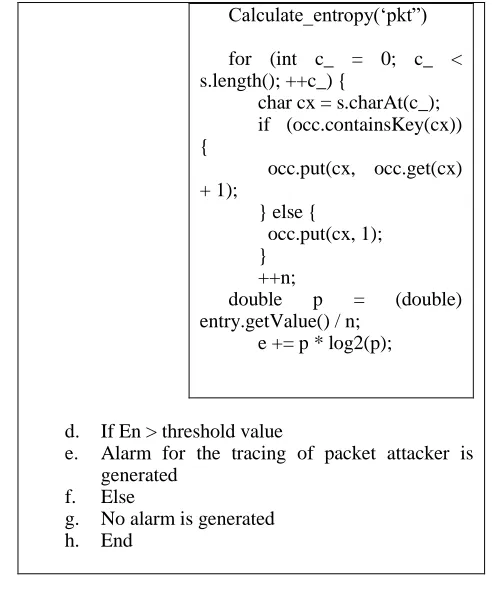
Pseudo Code for Entropy Variation
Calculate_entropy(„pkt”)
for (int c_ = 0; c_ < s.length(); ++c_) {
char cx = s.charAt(c_); if (occ.containsKey(cx)) {
occ.put(cx, occ.get(cx) + 1);
} else { occ.put(cx, 1); }
++n;
double p = (double) entry.getValue() / n;
e += p * log2(p);
d. If En > threshold value
e. Alarm for the tracing of packet attacker is generated
f. Else
g. No alarm is generated h. End
4. RESULT ANALYSIS
4.1 Security Analysis
4.1.1 Replay Attack
It is a type of bout in which the victim applies a random unique key again and again since the key breaks. But replay attack is prevented by the proposed methodology since token key gets destroys after a particular time stamp.
4.1.2 Man in the middle attack
This type of attack mainly occurs when a sender sends data to the receiver and during the transmission of message third party attacks in between and access data in an un-authorized manner.
4.1.3 Brute force attack
4.1.4 Dictionary attack
A dictionary attack is another type of password guessing attack which uses a dictionary of common words to identify the user‟s password. In our proposed method we used master key as a password so there are no common word in this password that means there are no chance of the dictionary attack.
4.1.5 Confidentiality
Confidentiality means that when a sender want to send a message or data to the receiver then the message can be read by only that particular receiver not by the other .For Example one party may to show his key to the other party and the other one may try to attack the other party then this time using OTPK, the session is for a limiting time and the generating of master key is randomly and it gets destroyed each time.
4.1.6 Authentication
Authentication means receiver must be insure that the message cannot be alter or edit after sending by the sender. This property is making sure that the signature verification must be done by both the parties also by the TTP. When we perform contract signing between two parties then the authentication is very important.
Table 1: Other additional security analysis
Security Parameter Prevented by proposed technique
Insider attack YES
Password impersonation YES
Password guessing attack
YES
Outsider attack YES
Denning sacho attack YES
Public verifiability YES
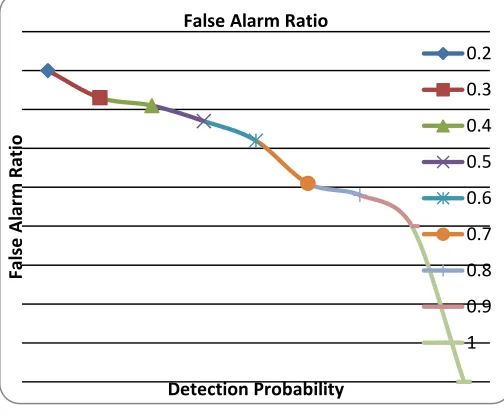
Fig. 3. Analysis of False Alarm Ratio
Table 3 shows, the storage judgment of the planned scheme with the relevant user authentication based on smart card, which shows our proposed scheme is reduced burden on the server, because the Server has stored less storage.
Table 3: storage judgment of the planned scheme
Storage/ scheme Our scheme
Data Owner 520 bits
Receiver 64 bits
The Table shown below is the analysis and comparison of number of keys generated at the encryption and decryption on the basis of number of users available in the group.
Fal
se
A
lar
m
R
atio
Detection Probability False Alarm Ratio
0.2
0.3
0.4
0.5
0.6
0.7
0.8
0.9
Table 4: Analysis of Number of Keys Generated
No. of Keys Generated
No. of
Groups
Existing Work
Proposed Work
1 (1,4) N*(1,1)
2 (2,5) N*(1,1)
3 (3,6) N*(1,1)
4 (4,7) N*(1,1)
5 (5,8) N*(1,1)
6 (6,9) N*(1,1)
7 (7,10) N*(1,1)
8 (8,11) N*(1,1)
9 (9,12) N*(1,1)
10 (10,13) N*(1,1)
5. CONCLUSION
The Planned procedure realized here for the Effectual Sharing of Data using Tree based Key Generation provides effective Computational and Communication cost as well as provides more security in comparison to other Frameworks implemented for Key Generation over Pairwise Independent Networks. The Methodology not only generates efficient Keys but also classifies Normal and Attacked Packets in the Network based on the rules generated using Decision Tree.
REFERENCES
[1] M. Armbrust et al., “Above the Clouds: A Berkeley View of Cloud Computing,” Univ. California, Berkeley, Tech. Rep. UCBEECS-2009-28, Feb. 2009. [2] Amazon.com, ―Amazon s3 Availability Event:
July 20, 2008,‖ July 2008; http://status.aws.amazon.com/s3-20080720.html [3] M. Arrington, ―Gmail Disaster: Reports of Mass
Email Deletions,” Dec. 2006;
[4] T. Ristenpart et al., “Hey, You, Get Off of My Cloud: Exploring Information Leakage in Third-Party Compute Clouds,” Proc. 16th ACM Conf. Computer and Communications Security, ACM Press, 2009, pp. 199–212.
[5] Maithili Narasimha and Gene Tsudik. DSAC: integrity for outsourced databases with signature aggregation and chaining. Technical report, 2005.
[6] Joseph, Randy Katz, Above the Clouds: A Berkeley View of Cloud Computing, University of California Electrical Engineering & Computer Science, February 10th, 2009.
[7] Patel, Chandrakant D., Shah, Amip J., “Cost Model for Planning, Development, and Operation of a Data Center,” Internet Systems and Storage Laboratory, HP Laboratories, Palo Alto, June 9, 2005.
[8] Alfin Abraham, “An Abuse-Free Optimistic Contract Signing Protocol with Multiple TTPs”, IJCA Special Issue on “Computational Science – New Dimensions & Perspectives” NCCSE, 2011.
[9] Giuseppe Ateniese, “Efficient Verifiable Encryption (and Fair Exchange) of Digital Signatures”, Proceedings of the 6th ACM conference on Computer and communications security, pp. 138 – 146, ACM 1999.
[10] Guilin Wang. “An Abuse-Free Fair Contract-Signing Protocol Based on the RSA Signature”, IEEE Transactions On Information Forensics And Security, Vol. 5, No. 1, March 2010.
[11] F. Bao, G. Wang, J. Zhou, and H. Zhu, “Analysis and improvement of Micali‟s fair contract signing protocol,” in Proc. ACISP‟04, vol. 3108, LNCS, pp. 176–187, Springer-Verlag, 2004.
[12] J. Garay, M. Jakobsson, and P. MacKenzie, “Abuse-free optimistic contract signing,” in Proc. CRYPTO‟99, vol. 1666, LNCS, pp. 449 – 466, Springer-Verlag, 1999.
[13] N. Asokan, V. Shoup, and M. Waidner, “Optimistic fair exchange of digital signatures,” IEEE J. Sel. Areas Commun., vol. 18, no. 4, pp. 591–606, Apr.2000. [14] Guilin Wang. “An Abuse-Free Fair Contract-Signing
Protocol Based on the RSA Signature”, IEEE Transactions On Information Forensics And Security, Vol. 5, No. 1, March 2010.
[15] Lifeng Lai, Siu-Wai Ho,” Key Generation Algorithms for Pairwise Independent Networks Based on Graphical Models”, IEEE Transactions on Information Theory, 2015.
[16] K. Kalaivani, K. Renugadevi, Nithya,” Pairwise Independent Network using Key Generation Algorithm”, IOSR Journal of Computer Engineering, 2016.
[17] Sirin Nitinawarat, Chunxuan Ye, Alexander Barg,” Secrete Key Generation for a Pairwise Independent Network Model”, IEEE Transactions on Information Theory, 2010.