Available online at http://jddtonline.info REVIW ARTICLE
PROCESS VALIDATION IN PHARMACEUTICAL INDUSTRY: AN OVERVIEW
*Sharma Sumeet, Singh Gurpreet
Department of Pharmaceutics, Rayat Institute of Pharmacy, Rayat and Bahra Campus, Railmajra, Distt. Nawanshahar, Near Ropar, Punjab, India
*Corresponding Author’s Email ID: [email protected]
INTRODUCTION
Validation is an integral part of quality assurance; it involves the systematic study of systems, facilities and processes aimed at determining whether they perform their intended functions adequately and consistently as specified. A validated process is one which has been demonstrated to provide a high degree of assurance that uniform batches will be produced that meet the required specifications and has therefore been formally approved. Validation in itself does not improve processes but confirms that the processes have been properly developed and are under control.3
USFDA defines validation as: “Validation isestablishing documented evidence whichprovides a high degree of assurance that aspecific process will consistently produce aproductmeetingits pre-determinedspecifications and quality characteristics. According to European commission: Validation isdefined as “Action providing in accordance withthe principles of GMP, that any procedure, process, equipment, material, activity or systemactually lead to the expected results.10
Process validation establishes the flexibility andconstraints in the manufacturing process controls in the attainment of desirable attributes in the drug product while preventing undesirable properties. This is an important concept, since it serves to support the underlying definition of validation, which is a systematic approach to identifying, measuring, evaluating, documenting, and re-evaluating a series of critical steps in the manufacturing process that require control to ensure a reproducible final product.9
A successful validation program depends upon information and knowledge from product and process development. This knowledge and understanding is the basis for establishing an approach to control of the manufacturing process that results in products with the desired quality attributes. Manufacturers should:
•Understand the sources of variation •Detect the presence and degree of variation
•Understand the impact of variation on the process and ultimately on product attributes
•Control the variation in a manner commensurate with the risk it represents to the process and product7
TYPES OF VALIDATION
Prospective validation
The objective of the prospective validation is to prove or demonstrate that the process will work in accordance with validation protocol prepared for the pilot production trials. Prospective validation should normally be completed prior to the distribution and sale of the medicinal product. In Prospective Validation, the validation protocol is executed before the process is put into commercial use. During the product development phase the production process should be broken down into individual steps. Each step should be evaluated on the basis of experience or theoretical considerations to determine the critical parameters that may affect the quality of the finished product. A series ofexperiments should be designed to determine the criticality of these factors. Each experiment should be planned and documented fully in an authorized protocol.11
Concurrent validation
It is aprocess where current production batches are used to monitor processing parameters. It gives of the present batch being studied, and offers limited assurance regarding consistency of quality from batch to batch. Concurrent Validation means establishing documented evidence a process does what it is supposed to based on data generated during actual implementation of the process. Concurrent validation may be the practical approach under certain circumstances. It is important in these cases when ABSTRACT
Quality cannot be adequately assured by in-process and finished inspections and testingbut it should be built in to the manufacturing process. These processes should be controlled in order that thefinished product meets all quality specificationsValidation is one of the important steps in achieving and maintaining the quality of the finalproduct. If each step of production process is validated we can assure that the final product isof the best quality. Validation of the individual steps of the processes is called the processvalidation. Different dosage forms have different validation protocols. Quality is always an imperative prerequisite when we consider any product. Therefore, drugs must be manufactured to the highest quality levels. Process Validation is one of the important steps in achieving and maintaining the quality of finalproduct. It gives a higher degree of assurance.
the systems and equipment to be used have been fully validated previously.
Retrospective validation
Conducted fir a product already being marked, and is based on extensive data accumulated over several lots and over time. Retrospective Validation may be usedfor older products which were not validated by the fabricator at the time that they were first marketed, and which is now to be validated to confirm to the requirements of division 2, Part C of the Regulation to be Food and Drugs Act. Retrospective Validation is only acceptable for well established detailed processes and will be Inappropriate where there have recent changes in the formulation of the products, operatingprocedures, equipment and facility.
Revalidation
Re-validation is usually performed to the confirmation of initial validation for a Periodic review. Re-validation provides the evidence that changes in a process and /or the process environment that are introduced do not adversely affect process characteristics and product quality. Documentation requirements will be the same as for the initial validation of the process. Re-validation becomes necessary in certain situations.11
PROCESS VALIDATION
Process Validation is “Establishing documented evidence which provides a high degree of assurance that a specific process will consistently produce a product meeting its pre-determined specifications and quality attributes. Process validation involves a series of activities taking place over the lifecycle of the product and process. Thisguidance describes process validation activities in three stages.
Stage 1 – Process Design: The commercial manufacturing process is defined during this stage based on knowledge gained through development and scale-up activities.
Stage 2 – Process Qualification: During this stage, the process design is evaluated to determine if the process is capable of reproducible commercial manufacturing.
Stage 3 – Continued Process Verification: Ongoing assurance is gained during routine production that the process remains in a state of control.
A successful validation program depends upon information and knowledge from product and process development. This knowledge and understanding is the basis for establishing an approach to control of the manufacturing process that results in products with the desired quality attributes. Manufacturers should.
Understand the sources of variation
Detect the presence and degree of variation
Understand the impact of variation on the process and ultimately on product attributes.
Control the variation in a manner commensurate with the risk it represents to the process and product.
Each manufacturer should judge whether it has gained sufficient understanding to provide a high degree of assurance in its manufacturing process to justify commercial distribution of theproduct. Focusing exclusively on qualification efforts without also
understanding the manufacturing process and associated variations may not lead to adequate assurance of quality. After establishing and confirming the process, manufacturers must maintain the process in a state of control over the life of the process, even as materials, equipment, production environment, personnel, and manufacturing procedures change.6
GENERAL CONSIDERATIONS FOR PROCESS VALIDATION
In all stages of the product lifecycle, good project management and good archiving that capture scientific knowledge will make the process validation program more effective and efficient. The following practices should ensure uniform collection and assessment of information about the process and enhance the accessibility of such information later in the product lifecycle.
An integrated team approach to process validation that includes expertise from a variety of disciplines (e.g., process engineering, industrial pharmacy, analytical chemistry, manufacturing, and quality assurance). Project plans, along with the full support of senior management, are essential elements for success.
Throughout the product lifecycle, various studies can be initiated to discover, observe, correlate, or confirm information about the product and process
All studies should be planned and conducted according to sound scientific principles, appropriately documented, and approved in accordance with the established procedure appropriate for the stage of the lifecycle.
Many products are single-source or involve complicated manufacturing processes. Homogeneity within a batch and consistency between batches are goals of process validation activities. Validation offers assurance that a process is reasonably protected against sources of variability that could affect production output, cause supply problems, and negatively affect public health.
The terms attribute(s) (e.g., quality, product, component) and parameter(s) (e.g., process, operating, and equipment) are not categorized with respect to criticalityin this guidance.19
TYPES OF PROCESS VALIDATION
Prospective ProcessValidation
In prospective process validation, an experimental plan called the validation protocolis executed (following completion of the qualification trials) before theprocess is put into commercial use. Most validation efforts require some degreeof prospective experimentation to generate validation support data. This particulartype of process validation is normally carried out in connection with theintroduction of new drug products and their manufacturing processes.
Concurrent Process Validation
and data sources disclosed in the section on retrospective validation.
Retrospective Process Validation
The retrospective validation option is chosen for established products whose manufacturing processes are considered stable and when on the basis of economic considerations alone and resource limitations, prospective validation programs cannot be justified. Prior to undertaking retrospective validation, wherein the numerical in-process and/or end-product test data of historic production batches are subjected to statistical analysis, the equipment, facilities and subsystemsused in connection with the manufacturing process must be qualified in conformance with CGMP requirements.
Process Re-Validation:
Required when there is a change in any of the critical process parameters, formulation, primary packaging components, raw material fabricator, major equipment or premises. Failure to meet product and process specifications in batches would also require process re-validation.12
BASIC PRNCIPLE FOR PROCESS VALIDATION
The basic principle for validation may be stated as follows:
Installation Qualification (IQ): establishing byobjective evidence that all key aspects of the process equipment and ancillary system installation adhere to the manufacturer’s approved specification and that the recommendation of the supplier of the equipment are suitably considered.
IQ considerations are:
• Equipment design features (i.e. material ofconstruction cleanability, etc.)
• Installation conditions (wiring, utility,functionality, etc.) • Calibration, preventative maintenance,cleaning schedules.
• Safety features.
• Supplier documentation, prints, drawingsand manuals. • Software documented.
• Spare parts list.
• Environmental conditions (such as cleanroom requirements, temperature, andhumidity).
Operational Qualification (OQ): Establishing byobjective evidence process control limits andaction levels which result in product those allpredetermined requirements.
OQ considerations include:
• Process control limits (time, temperature, pressure, line speed, setup conditions, etc.)
• Software parameters. • Raw material specifications • Process operating procedures. • Material handling requirements. • Process change control.
• Training.
• Short term stability and capability of theprocess, (latitude studies or control charts).
• Potential failure modes, action levels andworst-case conditions.
• The use of statistically valid techniques suchas screening experiments to optimize theprocess can be used during this phase.
Performance Qualification (PQ): establishingby objective evidence that the process, underanticipated conditions, consistently produces aproduct which meets all predetermined requirements.
PQ considerations include:
• Actual product and process parameters andprocedures established in OQ.
• Acceptability of the product.
• Assurance of process capability asestablished in OQ. • Process repeatability, long term processstability.
Re -Qualification: Modification to, or relocationof equipment should follow satisfactory reviewand authorization of the documented changeproposal through the change control procedure.This formal review should include considerationof re-qualification of the equipment. Minorchanges or changes having no direct impact onfinal or in-process product quality should behandled through the documentation system ofthe preventive maintenance program.16,17
VALIDATION TEAM
A multidisciplinary team is primarily responsible for conducting and supervising validation studies. Personnel qualified by training and experience in a relevant discipline may conduct such studies. The working party would usually include the following staff members such as;
Head of quality assurance.
Head of engineering.
Validation manager.
Production manager.
Specialist validation discipline: all areas.
The validation team must be
Prepare the site validation master plan with the specific requirements as per the company policy.
Meet regularly, In accordance with a defined schedule, to discuss the progress and compliance with the validation plan and schedule.
Determine the systems / equipment to be qualified / validated and the extent of validation to be carried out.
Determine the frequency of validation.
Prepare and evaluate the suitability of the protocols.
Verify the adequacy of the tests used for proving that the objectives are achieved.
Assurance of progress in terms of validation plan and schedule 13.
DOCUMENTATION
Documentation at each stage of the process validation lifecycle is essential for effective communication in complex, lengthy, and multidisciplinary projects. Documentation is important so that knowledge gained about a product and process is accessible and comprehensible to others involved in each stage of the lifecycle. Information transparency and accessibility are fundamental tenets of the scientific method. They are also essential to enabling organizational units responsible and accountable for the process to make informed, science-based decisions that ultimately support the release of a product to commerce8.
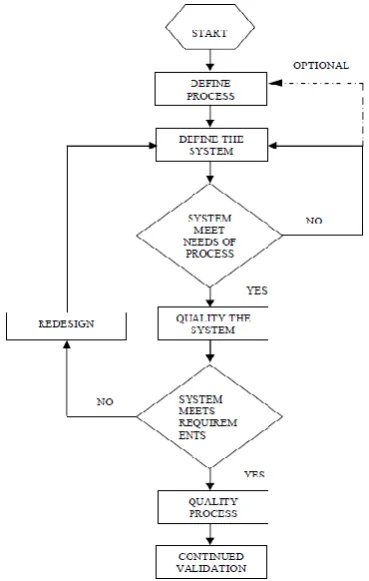
VALIDATION LIFE CYCLE
Validation is a continuing and evolving process. The validation process whichextends from the very basic to a very broadtheological and methodical investigation if how the system and processes perform. Its scope encompasses documentation revision control, training and maintenance of the system and process. Evidence of validation should be seen at the corporate level, and be reflected in the management structure. Validation is a method for building and maintaining quality14.
Figure 1: Validation Life Cycle
VALIDATION PROTOCOL
A written plan of actions stating how process validation will be conducted, it will specify who will conduct the various tasks and define testing parameters, sampling plans, testing methods and specifications, will specify product characteristics, and equipment to be used. It must be specify the minimum number of batches to be used for
validation studies, it must specify the acceptance criteria and who will sign \ approve \ disapprove the conclusions derived from such a scientific study. The validation protocol should contain the following elements,
Short description of the process.
Summary of critical processing steps to be investigated.
In process, finished product specification for release.
Sampling plans.
Departmental responsibility.
Proposed timetable.
Approval of protocol15.
VALIDATION MASTER PLAN
The validation master plan should provide an overview of the entire validation operation, itsorganizational structure, its content and planning.The main elements of it being the list/inventory of the items to be validated and the planning schedule. All validation activitiesrelating to critical technical operations, relevant to product and process controls within a firmshould be included in the validation master plan. It should comprise all prospective, concurrent and retrospective validations as well as revalidation.
The Validation Master Plan should be a summary document and should therefore be brief, concise and clear. It should not repeat information documented elsewhere but should refer toexisting documents such as policy documents, SOP’s and validation protocols and reports. • The format and content should include:
• Introduction: validation policy, scope, location and schedule.
• Organizational structure: personnel responsibilities. • Plant/process/product description: rational for inclusions or exclusions and extent of validation.
• Specific process considerations that are critical and those requiring extra attention.
• Key acceptance criteria. • Documentation format.
• Reference to the required SOPs.
• Time plans of each validation project andsub-project. • List of products/ processes/ systems to bevalidated, summarized in a matrix format, validation approach. • Re-validation activities, actual status and future planning15.
THE VALIDATION REPORT
A written report should be available after completion of the validation, if found acceptable it should be approved and authorized. The report should include at least the following
Title and objective of study.
Reference to protocol.
Details of material.
Equipment.
Programes and cycles used.
Details of procedures and test methods.
Recommendations on the limit and criteria to be applied on future basis.18
IMPORTANCE OF PROCESS VALIDATION
Assurance of Quality
Validation is an extension of the concepts of quality assurance since close control of theprocess is necessary to assure product quality and it is not possible to control a processproperly without thorough knowledge of the capabilities of that process without validatedand controlled processes, it is impossible to produce quality products consistently. Endproduct testing, in the absence of validation, gives little assurance of quality for varietyreasons, among which are.
1. Very limited sample size.
2. The limited number of tests performed on a sample. For example, it is impractical to test for all potential impurities or contaminants.
3. The limited sensitivity of the test.
Process Optimization
The optimization of a process for maximum efficiency, while maintaining quality standards, is a consequence of validation. Literal meaning of word to optimize is “To make as effective, perfect or useful as possible”. The optimization of the facility, equipment, systems, and processes results in a product that meets quality requirements at the lowest cost.
Reduction of quality costs
Quality costs are divided in to four categories. They are:
a) Preventive costs.
b) Appraisal costs.
c) Internal failure costs.
d) External failure costs.
e.g. of internal failure costs: Any validated and controlled process will result in fewerinternal failures like;
Fewer rejects
Reworks
Re-tests
Re-inspection4
CONCLUSION
Validation has been proven assurance for the process efficiency and sturdiness and it is the full-fledged quality attributing tool for the pharmaceutical industries. Validation is the commonest word in the areas of drug development, manufacturing and specification of finished products. It also renders reduction in the cost linked with process monitoring, sampling and testing. Apart from all the consistency and reliability of a validated process to produce a quality product is the very important for an industry. Finally it can be concluded that process validation is a key element in the quality assurance of pharmaceutical product as the end product testing is not sufficient to assure the quality of finished product.
REFRENCES
1. Guidelines on General Principles of Process Validation, Division of Manufacturing and Product Quality, CDER, FDA, Rockville, Maryland (May 1987).
2. Current Good Manufacturing Practices in Manufacture, Processing, Packing and Holding of Human and Veterinary Drugs, Federal Register 43(190), 45085 and 45086, September 1978.
3. Committee on Specifications for Pharmaceutical Preparations. Good Manufacturing Practices for Pharmaceutical Products. WHO Technical Report Series no. 82. Geneva: World Health Organization, 1992, pp 14-79.
4. Patel VB, Rathwa MR, Patel K. Studies in prospective process validation ofcimetidine tablet dosage form. Int J Res Pharm Biomed Sci, 2011; 2(4): 1823-1836.
5. FDA/ICH, (CDER and CBER), Q9 Quality Risk Management, guidance for industry, June 2006.
6. FDA/ICH, (CDER and CBER), Q7 Good Manufacturing
Practice for Active Pharmaceutical Ingredients, guidance for industry, August 2001.
7. FDA/Global Harmonization Task Force (GHTF; medical devices), Quality Management Systems – Process Validation, edition 2, guidance, January 2004.
8. Nash RA and Berry IR. Pharmaceutical Process Validation., second edition, Marcel Dekker inc., 167-188,200-202,205. 9. European medicines agency. Guideline on Process Validation
(Draft), Geneva, Switzerland; 2012:10-11.
10. Guidelines for Process Validation of Pharmaceutical Dosage Forms, Drug Sector Saudi Food & Drug Authority, Kingdom of Saudi Arabia.5‐14.
11. Kiffer,R.G, J. Pharma. sic. tec., 1995, 44, 5, p.249.
12. Kumar NL, MoorthyDG, Kumar RS, Sekaran CS. An overview
of pharmaceutical validation: quality assurance view point, 2011; 1(4): 1003-1014.
13. Agalloco J. The validation life cycle. J ParenterSci Technol. 1993; 47(3):142-147.
14. Satyabratajena, Arjun G, Anil kumarravipati N V, SatishkumarD,Vinod K R, David banji . Industrial Process Validation of SolidDosage Forms–An Overview International Journal of Pharmaceutical Sciences reviw and rsearch. 2010, 4(2).
15. Guidelines for Process Validation of Pharmaceutical Dosage Form – Saudi Food & Drug Authority; Version 2; February, 1992.
16. Kathiresan K, Moorthi C, Prathyusha Y, Gade B. R, Reddy B. K, Manavalan R, ; An overview of pharmaceutical validation; Research Journal of Pharmaceutical, Biological and Chemical Sciences; ISSN: 0975-8585; October – December 2010; RJPBCS 1(4); 1026.
17. Validation Master Plan Installation and Operational Qualification – Pharmaceutical Inspection Convention; Pharmaceutical Inspection Co-Operation Scheme; PI 006 – 2; July, 2004.
18. Good manufacturing practices for pharmaceutical products, WHO expert. Committee on specification for pharmaceutical prepration, 32andreport, WHO technical report series no.823, WHO, Geneva, 1992,14-96.
19. This concept is discussed in more detail in FDA’s guidance for industry, Quality Systems Approach to Pharmaceutical Current
Good Manufacturing Practice