The battle of the e-textbook: libraries’ role in
facilitating student acceptance and use of
e-textbooks
Melanie Wiese
1and Giselle du Plessis
2[email protected] and [email protected]
Received: 15 October 2014 Accepted: 25 January 2015
The objective of this study was to investigate students’ acceptance and use of e-textbooks to enable libraries to make more informed decisions about their e-book collections. The data were collected in a classroom situation, surveying students who had been exposed to e-textbooks. A self-completion questionnaire was used and 254 usable questionnaires were received. The results showed that most students would prefer to have both a printed textbook and an e-textbook. Although almost half of the respondents indicated that they would prefer it if the library were to buy more e-textbooks, the others did not see a need for this option or they did not care. However, only 44% of respondents indicated that they knew how to access the electronic collection in the library. It was, furthermore, a matter of concern that 82% of the respondents never, or rarely, made use of e-textbooks from the library. The results suggest that e-textbooks are not perceived as more useful than print textbooks. It is up to universities, and more specifically libraries as distributors of information, to take the lead in developing policies, processes, and strategies to deal with e-textbooks, and to manage this electronic challenge successfully.
Keywords: Technology Acceptance Model, TAM, e-books, e-textbooks, students, libraries
1 Introduction
Something we once loved, and love now, in the shape of a book. Maybe e-books are going to take over, one day, but not until those whiz kids in Silicon Valley invent a way to bend the corners, fold the spine, yellow the pages, add a coffee ring or two and allow the plastic tablet to fall open at a favourite page.
Russel T. Davies in The Hitchhikers Guide to the Galaxy (Adams, 2009).
The advent of the internet brought about a new technological era, forcing libraries to adapt their services to a completely new set of user expectations shaped by emerging technologies. The growth of e-books, and the introduction of such projects as Google Books, forever changed the landscape for libraries. According to the Online Community Library
Centre’s (OCLC) Perceptions of Libraries report (2010: 15), the battle of e-resources and services has intensified over the
last five years. The report found that the library brand is still considered to be “books”; a stronger perception in 2010 even
than in 2005. As new consumer devices, technologies and online services become available, consumers’ perception of
libraries as “books” has solidified, thus making it increasingly difficult to position libraries as relevant in the online, internet era. The same has proven to be true for academic libraries in particular.
Many academic publishing companies have entered the e-book market (Wu & Chen 2011: 294); however e-books are yet to achieve extensive distribution across the globe (Shin 2011: 262). The youth of today, having grown up in an environment where they encountered and were continuously exposed to new technologies (Weisberg 2011: 189), were initially expected to use e-books in a way that would render print books obsolete (Gregory 2008: 267). However, unlike other new technologies which have taken over from older methods, e-books have, to some extent, failed to “take off” as they were predicted to do in a technologically advanced society (Soules 2008 in De Oliveira 2012). This slow acceptance of the e-book, and more specifically (for the sake of this paper) academic e-books in the form of e-textbooks, could be due to the limited number of available academic e-books , a lack of awareness of e-books, as well as a number of other factors (Muir & Hawes 2013: 1).
In the academic context, e-books have started to make an appearance in some university libraries, resulting in libraries adjusting and expanding their budgets in order to include e-books (Wu & Chen 2011: 294). Although e-books have now been around for more than ten years (Cassidy, Martinez & Shen 2012: 327), they are yet to take their rightful place in the academic context as electronic journals have done (Muir & Hawes 2013: 1; Kahn & Underwood 2013: 10). However, despite this, some universities have started decreasing the size of print collections in order to make way for electronic collections (Wu & Chen, 2011: 294) and academic e-books, and specifically e-textbooks, are thus becoming an essential component in university library collections (Strother et al. 2009: 1361). The OCLC posed the question: “Will the
‘books brand perception’ shift as libraries increase their investments in and advertising of electronic information and electronic books?” (OCLC 2010: 20).
Students, especially those in more developed countries, have embraced technology; as a result, academic e-books have become increasingly popular among these students, due to the perceived convenience that e-books offer (Elias, Phillips & Luechtefeld 2012: 262). But in many developing countries such as South Africa this is not necessarily the case. In order to adopt the use of e-textbooks successfully, universities, as well as other academic institutions, need to provide students with the necessary resources and instructors to use them (Sun, Flores & Tanguma 2012: 63). The resources which are necessary to enable students to use e-textbooks include e-readers or e-book reading devices. Examples include the desktop computer, iPad, Amazon Kindle, the Sony e-Reader Touch, Personal Digital Assistants (PDA), as well as mobile telephones (Weisberg 2011: 191; Wu & Chen 2011: 295). However, more importantly, students need to perceive textbooks as useful; and herein lies the problem. There are mixed feelings among students on the use of e-books in an academic setting, as students still prefer to use traditional printed e-books (Gregory 2008: 266).
Although publishers, academics and libraries are not sure about the future and the possible effect of e-books, they are increasingly becoming aware that e-books warrant more attention and investigation (Vassiliou & Rowley 2008). Some research has been done about e-books in an academic setting (Gregory 2008; Folb, Wessels & Czechowski 2011; Nicholas & Lewis 2008; Shin 2011; Sun, Flores & Tanguma 2012) but several unanswered questions still remain, especially in the South African context. For example, why is the uptake of e-books, and specifically e-textbooks, so slow? What is the role of university libraries in the e-book debate? Why do computer-savvy Generation Y students still prefer the ‘old’ technology of printed textbooks? This paper attempts to shed light on some of these questions and, by doing so, contribute to the local research available on this topic.
2 E-books in an academic setting
Although electronic journals have established themselves as much-needed resources, the same cannot be said for e-books. Gregory (2008: 269) found that students’ main reasons for using e-books were “research, followed by homework assignments or reference”. Students indicated that they “read small portions of text on screen combined with printing portions of digital text needed and do not spend long periods of time reading from a computer screen, opting instead to read from printouts” (Gregory 2008: 270). Appleton in Gregory (2008: 268) found that “students used e-books in a manner similar to journals by randomly accessing segments of text rather than … [reading] sequentially”. Thus, students use e-books in the same way as they do e-journals, indicating a “use not read” approach. Furthermore, there is still confusion
over the definition of an e-book (Tedd 2005). The Jisc report Promoting the uptake of E-Books in Higher and Further
Education (2003) highlights that a source of confusion, and therefore a barrier to the uptake of e-books within the academic context, is the lack of an adequate definition. Armstrong et al. (2002) defines an e-book as
any piece of electronic text regardless of size or composition (a digital object), but excluding journal publications, made available electronically (or optically) for any device (handheld or desk-bound) that includes a screen.
Vassiliou and Rowley (2008) propose a two-part definition:
An e-book is a digital object with textual and/or other content, which arises as a result of integrating
the familiar concept of a book with features that can be provided in an electronic environment …
e-books, typically have in-use features such search and cross reference functions, hypertext links, bookmarks, annotations, highlights, multimedia.
Various kinds of academic e-books are available such as textbooks, reference materials such as dictionaries, scholarly monographs; directories, technical reports, working papers, conference papers and proceedings, official publications, trade literature and theses (Armstrong and Lonsdale 2003). However, in many research studies conducted in an academic setting, it is evident on closer inspection that, although authors refer to ‘e-books’ their investigations have
mainly been around ‘e-books in a classroom setting’ – in other words, e-textbooks. For the remainder of this paper,
therefore, the term ‘academic e-book’ refers to all academic e-books used by students (listed by Armstrong and Lonsdale 2003), including textbooks, while the term textbook’ refers specifically to prescribed material for a specific course or ‘e-books in a classroom setting’. Although this study also investigated perceptions about academic e-‘e-books in general, the research focuses specifically on e-textbooks.
3 The e-textbook dilemma
There is a wealth of international literature that supports the fact that the majority of students today still prefer to use print books rather than e-books in an academic setting (Wu & Chen 2011; Sun, Flores & Tanguma 2012; Muir & Hawes 2013; Cassidy, Martinez & Shen 2012; Gregory 2008; Elias, Phillips & Luechtefeld 2012; Abdullah & Gibb 2008). Some students have clearly indicated that they prefer using print books, because they perceive e-books as hard to navigate, despite the ‘anywhere-and-anytime’ access that e-books supposedly offer (Gregory 2008: 267). Students are also reluctant to use academic e-books, because some of the emotional elements are missing from the e-book experience, which are more immediately apparent in the use of print books (Shin 2011: 261). Weisberg (2011) reports that over time students’ attitudes and behaviours will become more receptive to using e-books. The preference for print textbooks may thus be a reflection of their familiarity, rather than their actual experiences, with either print books or e-books (Sun, Flores & Tanguma 2012: 65). Research has shown that students have found searching for academic e-books much easier and faster than searching for print books and that they also have not experienced any major difficulties while using e-books (Wu & Chen 2011: 301).
However, there are a number of factors that could influence the preference for either print or electronic books. These factors are not limited to, but include: the fact that some students may be distance students; the field of study that students are enrolled in; accessibility of print versions; the accessibility of textbooks in class; and the cost of e-textbooks compared with print books (Abdullah & Gibb 2008; Gregory 2008: 268; Cassidy, Martinez & Shen 2012: 328; Wu & Chen 2011: 299). Textbooks amount to a significant portion of university costs, and with the cost of print books rising with each new edition that is published, price becomes an important issue (Elias, Phillips & Luechtefeld 2012: 262). In a study conducted in the United States of America, it was found that seven out of ten students have stopped buying textbooks because of their cost. Eighty-one percent of all students have also reported being negatively affected by new editions of textbooks that limited the resale value of their used textbooks or prevented them from buying a used textbook at a reduced price (Redden 2011: 23).
The increase in print book prices has resulted in e-textbooks gaining increasing popularity among students (Elias, Phillips & Luechtefeld 2012: 262). E-textbooks are sometimes less expensive than print books; and encouraging the use of e-textbooks could provide a certain level of relief to students from increasing academic expenses (Sun, Flores & Tanguma 2012: 65). According to Elias, Phillips & Luechtefeld 2012 (2012: 262), “many e-textbooks can be obtained by buying a lifetime download or by renting the e-textbook for a period of 180 to 360 days”. However, it is also important to take note of the impact of e-textbooks on the used textbook market, as e-textbooks cannot be resold after use. On the other hand, e-textbooks are not always cheaper than print books. Jantz (2002) argues that most academic e-books have the same price as print books; and this could further prevent students from buying e-textbooks.
Despite the increase in the cost of print books, cost is not necessarily the only deciding factor for students who have started using e-textbooks. With the use of e-textbooks comes the need to have the required electronic device on which to be able to view such an e-textbook (Sun, Flores & Tanguma 2012: 68; Elias, Phillips & Luechtefeld 2012: 265). The need for such devices is often a deciding factor in the matter (Sun, Flores & Tanguma 2012: 68; Elias, Phillips & Luechtefeld 2012: 265). Furthermore, research has indicated that in-class accessibility to e-textbooks, rather than their cost, determines whether a student would be interested in purchasing a hard copy, or not (Sun, Flores & Tanguma 2012: 68).
4 E-textbooks as a technological innovation
It might be useful to look at diffusion theory and the Technology Acceptance Model (TAM) to try to understand the possible underlying reasons for the slow uptake of e-textbooks. The diffusion theory proposes that the relative advantage, compatibility, complexity, trialability and observability of a new technology (such as e-textbooks), might affect the speed of its diffusion (Dillon & Morris 1996). Although each characteristic on its own might be insufficient to influence the rate of diffusion, the combination of these characteristic could influence the diffusion process. Diffusion studies have shown that innovations with advantages that are compatible with existing practices and beliefs, that are low in complexity, easy to use or easy to try out, and with visible benefits, would lead to a more extensive and faster diffusion than an innovation with the opposite characteristics (Dillon & Morris 1996: 3).
It is important to take note of the extent to which the use of technology diffuses across organisational processes and
becomes an integral part of the tasks associated with that process – also known as assimilation (Fichman & Kemerer
technology could be overcome if the user thinks that the technology would be useful (Chau 1996: 185). The Online Education Database (OEDb) report (2012) found that students prefer online learning courses instead of attending a traditional university due to convenience, comfort and affordability. These advantages could also be the key to the use of and preference for e-books in an academic setting.
5 Libraries and e-book collections
The distribution of information has primarily been done by libraries (Cassidy, Martinez & Shen 2012: 326). Therefore, the undertaking to improve access to information has brought libraries and librarians into the domain of e-books (Cassidy, Martinez & Shen 2012: 326). Libraries are said to be early adopters of e-books, and have been increasing their intake of academic e-books over the years (Gregory 2008: 267; Cassidy, Martinez & Shen 2012: 326). In order to allow for this increase in e-books, some libraries have been reducing their budget for print books, and have started diminishing their current print collections (Wu & Chen 2011: 305). The reverse is also true: many academic librarians are selecting e-books for their collections, but the constraints within some institutions cause them to continue to depend and focus largely on their print collection. Librarians handle information differently, and many have accepted e-books as a vital part of their libraries. Due to budget constraints in some institutions, however, librarians have had to use free e-books to add value to the electronic resources at their institutions. Libraries should not underestimate the importance of print collections to their students and should offer a combination of academic print and e-books (Gregory 2008: 271). As such, although librarians may prefer not to buy duplicate titles, it is sometimes preferable, whether in the same, or in different mediums (Wu & Chen 2011: 304). According to Gibbons in Gregory (2008), evidence has shown that including e-book titles in a library’s catalogue leads to increased use of the collection as a whole.
As librarians and academics are confronted with decisions to buy or prescribe electronic textbooks, a growing need exists for more clarity on student perception and use of e-textbooks to enable better-informed decisions. According to Kahn and Underwood (2013), there are several reasons some librarians object to the introduction of e-books to their libraries. Some of these are that the e-book threatens the library’s role as an archive; they hold the view that library users do not want e-books; privacy concerns (e-book use can be tracked); not being in control of title selections; and the re-allocation of funds to e-books implying a smaller print collection, to name but a few. The e-book format could become more expensive for libraries to purchase, as some e-book formats require specialised software and hardware (Kahn & Underwood 2013: 15). Hamaker (2011) adds several other challenges of e-books, such as ownership disputes, licensing issues, and the difficulty of developing an e-reserve system, often needed in an academic setting. These challenges contribute to the debate around whether or not libraries should in fact be suppliers of books, and specifically e-textbooks. Hamaker (2011) argues that “most e-books do not meet the long-term requirements of many libraries and their users for access, pricing, utility, and preservation” and the question should be asked if and how libraries should supply e-books.
A Malaysian study found that as many as 50% of students became aware of the academic e-book service at their library via the library’s website, while about 17% were referred to e-books by their lecturers, fellow students (13%), and
the librarians themselves (13%) (Ismail & Zainab 2005): thus, emphasising the importance of a library’s website to
promote e-textbook collections and ultimately encourage e-textbook use by students. Shelburne (2009: 59-72) reported that students often do not use academic e-books simply because they do not know how to find them, especially in a library collection. Gregory (2008: 267) found that students who came across e-books while using the library’s online catalogue were reluctant to use them.
As mentioned before, the majority of students still prefer to use print books rather than e-textbooks. It is partly the responsibility of the librarian to attempt to change this. E-books offer library staff and students certain advantages, such as the fact that they can be read on a computer monitor or mobile devices, and sometimes offer the option of printing certain sections for further reading or studying (Wu & Chen 2011: 295). Rosy (2002: 228) argues that e-books not only support the mission and vision of libraries but are also an efficient way to store and organise information, given space limitations. In addition, e-textbooks can provide users with up-to-date content and full-time availability. In this sense, libraries are changing from being simply storerooms to becoming information portals which provide access to, among other things, e-books and other electronic resources (Connaway, 2003: 13-18). As has been discussed, e-textbooks have many advantages. In order for readers to make full use of these advantages, libraries need to keep up with the changes in society, as well as those of students, and to organise their book collections in such a manner that would render e-textbooks helpful and readily accessible. The introduction of the e-textbook was intended to be an alternative to print textbooks. However, due to libraries reducing their print collections in certain subjects, students have had no other choice but to turn to e-books (Gregory 2008: 269; Wu & Chen 2011: 303). Therefore, although e-textbooks are not necessarily preferred over print books, they are frequently the only available option for students.
Although several international studies have investigated the use of academic e-books (e-textbooks, in the context of this study) and the preferences of students, none could report conclusive results. Limited South African research is available on this topic. Being approached by a South African university library for some insight into e-book preferences was the impetus for this study.
6 Research questions
The objective of this study was to investigate undergraduate students’ perceptions and use of e-textbooks in order for
Do students use print textbooks?
Do students prefer print or e-textbooks?
What is the role of price in buying a textbook?
How easy is it to use e-textbooks?
Which features are important when selecting an e-textbook?
What could be done to improve the ease-of-use and the usefulness of e-textbooks in an academic setting?
What role do librarians need to play in the e-textbook dilemma?
7 Research methodology
Although a quantitative research design was used, qualitative input – in the form of discussions with university librarians – were helpful to provide a better understanding of the context as well as serving as input for the questionnaire design. Second-year students registered at the University of Pretoria for Marketing Management during 2013 constituted the target population of this study. These students were the only group of students exposed to e-textbooks during the first and second semesters of the programme. The students purchased a printed version of the textbook, but also had free access to the electronic version via the library or the publisher. This group of students, therefore, had the opportunity to use an e-textbook for the course at no additional cost. A census approach was taken as the entire second-year class was targeted, but the sample only included students who actually attended class and who voluntarily completed the survey, thus suggesting a non-probability, convenience sampling method. The key characteristics of the sample were that the majority (77%) of respondents were in the 19-21 age group, while the remainder were 22-26 years old (23%). Students from five faculties were reflected in the sample, with Economic and Management Sciences contributing 58%, Humanities 24%, and Natural and Agriculture Sciences, 15%. Marketing is a subject presented in the Economic and Management Sciences Faculty but which allows students from other faculties to enrol. The sample consisted of 31% (seventy-eight) males and 69% (176) females. Furthermore, the majority of the respondents were Whites (71%), followed by Africans (25%); while the ‘other’ group represented 4% of the sample, and consisted of Asian, Coloured and Indian respondents. A survey approach was used to collect the data in a classroom situation by using a self-completion questionnaire. The questionnaire consisted of demographic questions, such as gender, age, faculty/study, discipline, and race, as well as questions to determine students’ access to various electronic devices, their perceptions, and their use of textbooks and e-textbooks. Students’ perceptions of e-textbooks were measured by using the five-point Likert scale (De Oliveira 2012: 536), with scale-point labels ranging from 1 (Strongly disagree) to 5 (Strongly agree). The questions and statements used to determine e-textbook usage were similar to those of Muir and Hawes (2013: 260), with regards to their approach to measuring the use of e-textbooks. The importance of various e-textbook features was measured on a five-point Likert scale, ranging from 1 (Not at all important) to 5 (Extremely important), as identified from previous research (Cassidy, Martinez & Shen 2012; De Oliveira 2012; Elias, Phillips & Luechtefeld 2012; Strother et al. 2009). The questionnaire was pre-tested to ensure the clarity of the questions; minor adjustments were subsequently made to the wording of some questions, in order to reflect a more South African context. No incentives were provided, and participation was completely voluntary. As this study was descriptive in nature, mainly descriptive analysis was used, such as frequencies and mean values, to address the research questions.
8 The findings
The findings of the study are presented below.
8.1 Print textbook usage
In order to provide context to the use of e-textbooks, it is important to know, firstly, whether students take their print textbooks to class and, secondly, how they use them. It is positive to note that the majority of students (75%) indicated that they usually take their print textbooks to class. Only 5% indicated that they never take their books to class, while 20% indicated that they sometimes take their print textbooks to class. The weight of the print book was given as one important reason for not taking it to class. Other students felt that they did not need their textbooks in class. A relatively small number of respondents (8%) indicated that they did not have a print textbook: that they shared one with a friend, due to the cost involved, or that they use the electronic textbook. It is also important to understand students’ use of printed textbooks once they have completed the course, in order to provide the necessary context to understand the used textbook market. Almost 80% of students indicated that they sell their textbooks at the end of the year. Thus, the used textbook market could be influenced if e-textbooks only were to be used in this course. The impact of e-textbooks on student income should therefore be considered.
8.2 Electronic vs print textbooks
8.3 The role of price in the textbook dilemma
When students were confronted with various scenarios regarding prices and textbooks and were questioned about their possible behaviour in these scenarios, the following transpired: almost half of the sample (47%) indicated that, if given the choice of a new print textbook, a hand print textbook and an e-textbook, they would prefer to buy the second-hand print textbook at a cheaper price; while 28% indicated that they would buy an e-textbook if it were 10-15% less expensive that a new print textbook. Only 24% indicated that they would buy a new print textbook at the regular price. It would seem as if students are price-sensitive; and perhaps the price of an e-textbook, rather than its functionalities, could be the deciding factor between buying a print textbook (new or second-hand) and an e-textbook. This finding seems to be in agreement with the argument that the increase in print book prices could have resulted in e-textbooks gaining popularity among students (Elias, Phillips & Luechtefeld 2012: 262). The price sensitivity around textbooks is further evidenced by the fact that almost 85% of students indicated that, if the price of the e-textbook was included in their class fees, and they were to receive it for ‘free’ when registering for the course, they would be willing to use it. Only 15% indicated that they would not use the e-textbook and would still prefer a print textbook, suggesting that a minority exists for whom price or cost is not the ultimately deciding factor and who are possibly swayed by other factors such as the familiarity or ease-of-use of printed books.
8.4 Ease of use of e-textbooks
Together with an e-textbook comes the need to have the required electronic device on which to read it. The majority of the students had access to smartphones (85%) and/or have their own laptops (83%). 76% have access to university computer laboratories, 55% have access to desktops, and 41% have access to an iPad, or another type of tablet. It is thus evident that access to an electronic device is not a major barrier to using e-textbooks. The majority (97%) of students are computer literate: 61% indicated their computer literacy as average or expert (36%), and only 3% classified themselves as ‘novices’ when faced with technology. However, students interviewed agreed that they find it easier to study from a printed book. Although students do not lack computer skills or access, it seems as if ‘ease-of-use’ (as part of the TAM model) could still be a possible obstacle in the diffusion of e-textbooks. It might not be that students find it difficult to use e-textbooks but they find it easier to use print textbooks. Therefore, although some international studies report that students generally do not experience any major difficulties in the use of e-books (Wu & Chen 2011: 301) the results need to be compare to the ease-of-use of print textbooks.
8.5 Important features of e-textbooks
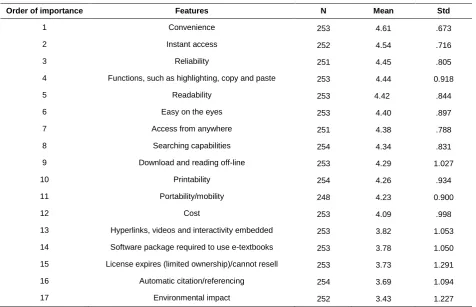
It is important for publishers, academics and librarians to know which features students consider to be important when buying or using e-textbooks. The features that the respondents regard as being important (ranked from the most important to the least important) are presented in Table 1.
Table 1 Importance of e-textbook features
Order of importance Features N Mean Std
1 Convenience 253 4.61 .673
2 Instant access 252 4.54 .716
3 Reliability 251 4.45 .805
4 Functions, such as highlighting, copy and paste 253 4.44 0.918
5 Readability 253 4.42 .844
6 Easy on the eyes 253 4.40 .897
7 Access from anywhere 251 4.38 .788
8 Searching capabilities 254 4.34 .831
9 Download and reading off-line 253 4.29 1.027
10 Printability 254 4.26 .934
11 Portability/mobility 248 4.23 0.900
12 Cost 253 4.09 .998
13 Hyperlinks, videos and interactivity embedded 253 3.82 1.053
14 Software package required to use e-textbooks 253 3.78 1.050
15 License expires (limited ownership)/cannot resell 253 3.73 1.291
16 Automatic citation/referencing 254 3.69 1.094
It is evident that convenience, access and reliability are the three most important features of e-textbooks for students. It is interesting to note that technical aspects, such as software packages needed and licensing are not as important. Furthermore, interactivity – an e-book feature that one would think might be the major advantage of e-textbooks – ranks only thirteen out of seventeen. Perhaps students do not yet realise the benefits of the interactivity e-books could offer, as it is something they still need to experience. The fact that functions such as copy, paste and highlighting ranked highly might suggest that these activities are ones that assist study and the completion of assignments. It is interesting that, although portability was indicated as one of the main reasons print textbooks are not taken to class, the importance of e-textbook portability ranked only eleventh. The positive environmental impact of e-e-textbooks is the least important feature for students.
8.6 Improving the ease-of-use and usefulness of e-textbooks
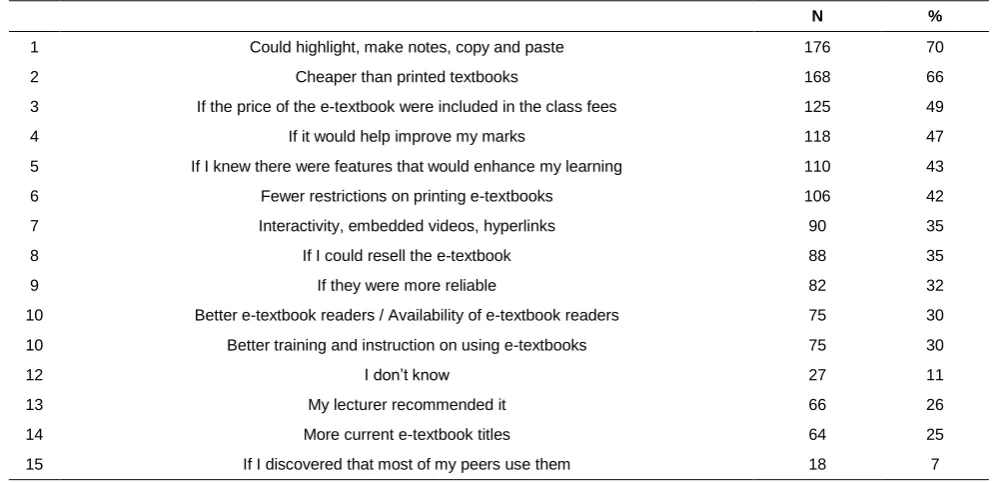
As usefulness and ease-of-use are both important aspects of the diffusion process according to the TAM model, respondents were asked to indicate what would make e-textbooks easier to use or more useful in their area of study. The results are reflected in Table 2.
Table 2 Improving ease-of-use and the usefulness of e-textbooks
N %
1 Could highlight, make notes, copy and paste 176 70
2 Cheaper than printed textbooks 168 66
3 If the price of the e-textbook were included in the class fees 125 49
4 If it would help improve my marks 118 47
5 If I knew there were features that would enhance my learning 110 43
6 Fewer restrictions on printing e-textbooks 106 42
7 Interactivity, embedded videos, hyperlinks 90 35
8 If I could resell the e-textbook 88 35
9 If they were more reliable 82 32
10 Better e-textbook readers / Availability of e-textbook readers 75 30
10 Better training and instruction on using e-textbooks 75 30
12 I don’t know 27 11
13 My lecturer recommended it 66 26
14 More current e-textbook titles 64 25
15 If I discovered that most of my peers use them 18 7
Note Students could choose more than one option
It is evident from Table 2, that features that assist with studying and the completion of assignments are those that students are looking for. These features would also improve the usefulness of e-textbooks. However, one should also consider the importance of the ‘copy-and-paste’ functionality of e-books. This feature could be used as a shortcut for students to complete their assignments, signalling the importance of educating students on intellectual property, and
particularly plagiarism, when using e-textbooks. Features that assist students to study – and the fact that 47% of the
students think using e-textbooks could help them to improve their marks – relates well to two of the characteristics that
could speed up the diffusion process: relative advantage and observability. Price issues are confirmed as almost half of the respondents indicated that they would use the e-textbook if its cost were included in their fees and 66% stated that they would use the e-textbook if it were cheaper than the print version. Currently it seems that reference group influences from friends or from opinion leaders, such as lecturers, were not very strong as only 26% and 7 % respectively, stated that they would use the electronic option if it were recommended.
8.7 E-textbooks and the library
African librarians is that Folb, Wessels and Czechowski (2011: 218) reported that 35% of students surveyed in the USA were also not aware that their university had an e-book collection. Thus, this problem could be considered to be more common, rather than one confined to one specific university.
9 Discussion and institutional implications
It is evident that if publishers, universities, librarians or academics want students to make (more) use of e-textbooks in a university’s library or in general, they would have to shape, influence and motivate this behaviour in order to enhance the assimilation process. Universities need to implement initiatives across the various faculties and support the staff to enhance the process. University management needs to determine how the university should position itself for a future with e-books in general, but more specifically e-textbooks, and what skills would be required of IT, libraries and lecturers. A major consideration in the e-textbook debate is the issue of price. E-textbooks should be more affordable. E-textbooks typically cost about the same as printed textbooks but they might expire at the end of the semester, and they frequently come with restrictions on printing. These issues negatively impact on the used-textbook market, thus, limiting the appeal of e-textbook use. Universities and libraries need to negotiate better pricing structures for e-textbooks in order to improve the attractiveness of e-textbooks as a viable option for students. Could open access to e-textbooks perhaps increase their usage? Open access texts could solve many of the problems of e-textbooks, such as limited access and restrictions on printing and downloading. Morris-Babb and Henderson (2012), however, warn that open access does not mean no cost. Thus, open access might not ultimately be the solution to the cost problem of textbooks.
Applying the TAM model, students apparently do not find using e-textbooks as easy or as comfortable as using print books, neither do they find them more useful. As a result, there has been a slow diffusion of the e-textbook. The focus therefore needs to be both on the ease of use and on the perceived usefulness of this innovation. E-textbooks are not just the electronic version of printed books; they also provide students with an interactive platform from which to engage in learning. These advantages need to be emphasised in order to ensure that students realise the usefulness of
e-textbooks. Students need to be convinced that e-textbooks are useful in enhancing their studying process – and,
ultimately, in improving their marks.
Diffusion studies have shown that innovations affording advantages, compatibility with existing practice and beliefs, low complexity, potential trialability, and observable gains would make diffusion faster and more extensive. These findings, coupled with those of this study, highlight the importance of lecturers and librarians referring students to and encouraging them to make use of textbooks. A library with an textbook collection could increase the trialability of e-textbooks as there is no or low risk and no additional cost involved for students to try out the e-collection. By educating students about the special features of e-textbooks, such as interactivity, and by highlighting these options, librarians and lecturers could enhance students’ learning experiences (advantages) and ultimately their marks (observable gains), and thus ensure a faster diffusion of e-textbooks in the academic setting. It is important for librarians to take note of trial results, as merely expanding the e-collection would not help much, unless students are made aware of what is available and shown how to access it. Herein lies the role of librarians: they should not only educate students around use, but also market their e-collections via their webpages, information and orientation sessions for first-year students, brochures or campus-wide email announcements. Librarians need to take into consideration that their marketing strategies should focus on promoting academic e-books more effectively on their websites, ensuring that students know about them and how to access them, ensuring that the usage patterns of students and faculty are better understood. It is also important that library communications and websites reflect the online environment by using terms and words that are associated with the online, interactive context of e-books. Students love libraries but do not necessarily associate them with technology (OCLC 2010). Libraries need to position themselves as places that provide current information in an easily accessible format (e-books) as well as technology at students’ fingertips to allow work to be done quickly, conveniently and easily. Libraries must also play a proactive role in educating students on issues such as intellectual property and especially plagiarism. It is important that a university has a clear interpretation of, and policy concerning, copyright and the interpretation of digital content.
10 Conclusion
Publishers and universities alike need to be aware of the role of price in the possible acceptance of e-textbooks, and the possibility that more affordable e-textbooks could provide a relief for students against increasing academic costs. Emphasis needs to be placed on the perceived usefulness of e-textbooks, indicating how their use could enhance a student’s productivity. Lecturers need to include e-textbooks in their courses, as well as class discussions, in order to increase student involvement in learning. The moment students perceive an e-textbook as possibly being more helpful than a print textbook, they would be more likely to use it on a regular basis.
advantage and, if libraries are not engaging with e-books, users may turn elsewhere, increasingly thinking of the library as a place they love but do not use.
No study is without its limitations and the non-probability sample in a single context is a limitation in this study. Future research is needed to determine the effect of e-textbooks on students’ learning activities and performances as well as students’ user habits before e-textbooks can be considered a viable alternative to the printed textbook. The open access solution to e-textbooks also warrants further exploration.
References
Abdullah, N. and Gibb, F. 2008. Students’ attitudes towards e-textbooks in a Scottish higher education institute: part 2:
analysis of e-textbook usage. Library Review, 57(9): 676-689.
Adams, D. 2009. The Hitchhikers Guide to the Galaxy. Pan MacMillan.
Appleton, L. 2004. The use of electronic books in midwivery education: the student perspective. Health Information and
Libraries Journal, 21(4): 245-52.
Bennett, L. and Landoni, M. 2005. E-books in academic libraries. The Electronic Library, 23 (1): 9-16.
Cassidy, E.D., Martinez, M. and Shen, L. 2012. Not in love, or not in the know? Graduate student and faculty use (and
non-use) of e-textbooks. Journal of Academic Librarianship, 38(6): 326-332.
Chau, P.Y.K. 1996. An empirical assessment of a modified technology-acceptance model. Journal of Management
Information Systems, 13: 185-204.
Connaway, L. S. 2003. Electronic books (e-books): current trends and future directions. [Electronic version]. DESIDOC
Bulletin of InformationTechnology, 23(1): 13-18.
Davis, F.D., Bagozzi, R.P. and Warshaw, P.R. 1989. User acceptance of computer technology: a comparison of two
theoretical models. Management Science, 35: 982-1003.
De Oliveira, S. M. 2012. E-textbooks usage by students at Andrews University: a study of attitudes, perceptions and
behaviours. Library Management, 33(8): 536-560.
Dillon, A. and Morris, M.G. 1996. User acceptance of new information technology: theories and models. In Annual Review
of Information Science and Technology. M. Williams, Ed. Medford NJ: Information Today. 3-32.
Elias, E.C., Phillips, D.C. and Luechtefeld, M.E. 2012. E-books in the classroom: a survey of students and faculty at a
school of pharmacy. Pharmacy Teaching and Learning, 4: 262-266.
Fichman, R. and Kemerer, C. 1999. The illusory diffusion of innovation: an examination of assimilation gaps. Information
Systems Research, September: 255-275.
Folb, B.L., Wessels, C.B. and Czechowski, L.J. 2011. Clinical and academic use of electronic and print books: the Health
Sciences Library System e-book study at the University of Pittsburgh. Journal of the Medical Library Association,
99(3): 218-228.
Gregory, C.L. 2008. “But I want a real book”: an investigation of undergraduates’ usage and attitudes toward electronic
books. Reference and User Services Quarterly, 47(3): 266-273.
Hamaker, C. 2011. E-books on fire: controversies surrounding e-books in Libraries. IET Inspect, 19(10): 20-22. [Online].
http://www.infotoday.com/searcher/dec11/Hamaker.shtml.
Ismail, R. and Zanaib, A.N. 2005. The pattern of e-books use amongst undergraduate students in Malaysia: a case of to
know is to use. Malaysian Journal of Library and Information Sciences, 10(2): 1-23.
Jantz, R. 2002. E-books and new library service models: an analysis of the impact of e-book technology on academic
libraries. ITAL: Information Technology and Libraries. [Online].
http://news.ala.org/ala/lita/litapublications/ital/2002jantz.cfm.
Jisc. 2003. Promoting the uptake of e-books in Higher and Further Education. [Online].
http://observatory.jiscebooks.org/files/2011/01/Promoting-the-uptake-of-ebooks.pdf (16 January 2016).
Kahn, M. and Underwood, P.G. Issues related to the adoption of e-books in academic libraries: a literature review. South
African Journal of Library and Information Science, 79(2): 10-17.
Morris-Babb, M. and Henderson, S. 2012. An experiment in open-access textbook publishing: changing the world one
textbook at a time. Journal of Scholarly Publishing, 43(2): 148-155.
Muir, L. and Hawes, G. 2013. The case for e-textbook literacy: undergraduate students’ experience with e-textbooks for
course work. Journal of Academic Librarianship, 39(3): 260-274.
Nicholas, A. and Lewis, J. 2008. Millennial attitudes toward books and e-books. Faculty and Staff - Articles & Papers.
Paper 26. [Online]. http://digitalcommons.salve.edu/fac_staff_pub/26.
OCLC. 2010. Perceptions of Libraries 2010. [Online].
http://www.oclc.org/content/dam/oclc/reports/2010perceptions/2010perceptions_all_singlepage.pdf.
Open Education Database (OEDb). 2012. Ten advantages to taking online classes. [Online]. http://oedb.org/ilibrarian/10-advantages-to-taking-online-classes/.
Redden, M. 2011. Seven in ten students have skipped buying a textbook because of its cost, survey finds. The Chronicle
of Higher Education. 23 August. [Online]. http://chronicle.com/article/7-in-10-Students-Have-Skipped/128785/.
Rosy, R. L. 2002. E-textbooks for libraries and patrons: two years of experience. Liber Quarterly, 12 (2): 228-233.
[Online]. http://liber.library.uu.nl/index.php/lq/article/view/7686.
Shelburne, W. A. 2009. E-book usage in an academic library: user attitudes and behavior. Library Collections,
Shin, D. 2011. Understanding e-textbook users: uses and gratification expectancy model. New Media & Society, 13(2): 260-278.
Strother, E. A., Brunet, D.P., Bates, M. L. and Gallo, J. R. 2009. Dental students’ attitudes towards digital textbooks.
Journal of Dental Education, 73(12): 1361-1365.
Sun, J., Flores, J. and Tanguma, J. 2012. E-textbooks and students’ learning experiences. Journal of Innovation
Education, 10(1): 63-77.
Van de Ven, A. 1986. Central problems in the management of innovations. Management Science, 32(5): 590-607.
Vassiliou, M. and Rowley, J. 2008. Progressing the definition of “e-book”. Library Hi Tech, 26(4): 355-368.
Weisberg, M. 2011. Students’ attitudes and behaviours towards digital textbooks. Pub Res Q, 27(2): 188-196.
Woody, W.D., Daniel, D.B. and Baker C.A. 2010. E-books or textbooks: students prefer textbooks. Computers &
Education, 55(3): 945-948.
Wu, M. and Chen, S. 2011. Graduate students’ usage of and attitudes towards e-textbooks: experiences from Taiwan.