Original Research Article
Sociodemographic and cultural determinants of seeking family planning
knowledge and practice among a Sudanese community
Samia S. Abdulmageed
1*, Mustafa Khidir Elnimeiri
2INTRODUCTION
Pregnancy related health consequences remained a part of public health concern, which has to be considered for women in Sudan.1 Family planning as mentioned by the United Nations is the first pillar for safe motherhood.2 As stated by the World Health organization (WHO) “Family planning: allows people to attain their desired number of children and determine the spacing of pregnancies. It is
achieved through use of contraceptive methods and the treatment of infertility”.3
In spite of the reduction in maternal mortality rate since 1990, still about one woman every two minutes die due to pregnancy related causes.2 About 214 million women in the reproductive age in the developing countries who need to prevent and plan for their pregnancy are not using methods of modern contraceptives. By avoiding
ABSTRACT
Background: About 214 million women in the reproductive age in the developing countries who need to prevent and plan for their pregnancy are not using methods of modern contraceptives. The aim of this study was to investigate the socio-demographic and cultural elements that inform the health-seeking behavior towards family planning among Sudanese women in Sharq-Alneel locality in the Sudan-Africa. Furthermore, the study aimed to identify individuals within Sudanese families, who predominantly interfered with the decision of the women in using of contraceptives for family planning.
Methods: A cross-sectional community based study was conducted in September-2017 to February-2018 using structured questionnaire to 576 Sudanese women age of 15-49 years from 4 administrative units. A multistage cluster sampling technique was adopted. Binary and multinomial logistic regression models were used to analyze the results using SPSS version 22.
Results: Women respondents were (57.1%), and (42.9%) from rural and urban areas respectively. Women (89.3%) of respondents were married for more than five years. A 381 (66%) women respondents were not using contraception at the time of the study. Women in rural areas were 0.9 less likely to obtain information from other sources than from PHC. There was significant association (p<0.001) between women’s educational level and awareness about
contraception.
Conclusions: Women use of contraception in Sharq-Alneel was low. Barrier to contraception use for majority of women was that they believe their healths are at risk for using modern contraceptives. There was also high prevalence of respondents’ husbands refused the use of contraceptives.
Keywords: Sudanese women, Sharq-Alneel locality, Family planning, Contraception, Rural and urban women, Health-seeking behavior
1
Department of Community Health Nursing, Faculty of Nursing Sciences, 2Department of Community Medicine, Al Neelain University, Khartoum, Sudan
Received: 01 July 2018
Revised: 17 July 2018
Accepted: 18 July 2018
*Correspondence:
Dr. Samia S. Abdulmageed,
E-mail: [email protected]
Copyright: © the author(s), publisher and licensee Medip Academy. This is an open-access article distributed under the terms of the Creative Commons Attribution Non-Commercial License, which permits unrestricted non-commercial use, distribution, and reproduction in any medium, provided the original work is properly cited.
unintended pregnancy, contraception hinders deaths of children and mothers.1 Sub-Saharan African women have experienced the highest percentage of unmet reproductive health needs. West Africa is reported as the poorest country because of maternal and reproductive health safety. 74% of women were deprived of the awareness regarding modern contraception. Moreover, religion, social parity, culture, and gendered interest have also added against family planning interventions among the females.4 It was revealed that Anglican and Roman Catholic women are more prone to seek their health care as compared to other religions. It was also found that women living in urban areas seek for medical care more than those living in rural areas. Nigeria was reported to have the lowest level of family planning use, and it was indicated that only 58% of women visited clinic at least once in the whole course of their pregnancy.5
The financial status and gender related characteristics greatly influence the reproductive health of females. A theory was formulated to explain the fertility as an aspect of so-called new-home economics approach. This approach proposed that the value of time increases as a result of investment in human capital. On the basis of household income hypothesis it is identified that the fertility rate is likely to increase as the income rises. The rise in income also increases the desire for goods that further competes with the family resources depending on the number of children.6 Moreover, women associated with activities that generate income have greater access to the contraceptives, which decreases the chances of conception. The women who are involved in decision making tend to have higher age during marriage, reduced use of contraceptives, and access to abortion as a safety measure for sake of their health.6
Several studies investigated that the educational level and age at marriage are directly associated. For instance, the higher the educational level, the higher would be the age of individuals at marriage. The gender power has a great influence on the decision making regarding intercourse, use of contraceptives, and pregnancy. A higher level of illiteracy is being found among the Sudanese women, with a significant decrease in a number of school enrollments for girls. Husband’s education has been associated to play a critical role in promoting the family planning setups. The low literacy of husbands has burdened the rate of maternal morbidity and mortality in Sudan. Due to the decreased literacy levels, early marriages, and decreased reproductive health education, the worst scenario of reproductive health in Sudan has been observed.7
The regulatory morality policy usually lacks direct economic component. For instance, the racial and ethnic composition, state ideology, and the urbanization have a great impact on the health seeking behavior of women. Similarly, the restriction against abortion is observed as an aspect of regulatory morality policy. Before 1973, it was believed that the socioeconomic factors had no impact on the legalization of abortion. Furthermore, very little research has been performed to determine the
differential aspects of the state restriction for getting access to contraception. Specifically the services of family planning are often perceived as conservative as it encourages moral decay and promiscuity. Subsequently, it is believed that the family planning services is directly associated with the decreased rate of abortion.8
Guidelines related to health services of female students needs to be established to communicate about the information related to women’s health. The traditional methods of contraception were undermining because of some barriers that included the liability, policy, and controversy concerns. A study suggested that a guideline is required for the use of contraceptives, for examining pelvis, and for pregnancy testing. It should be made necessary that all the female students, seeking for information related to sexual and reproductive health, should receive consistent and comprehensive education about the health seeking behavior.9,10
The urban areas are regarded by substantial need of modern contraceptive procedures. Women usually fear the bleeding and pain as a result of induced abortion. It is still not distinguished to women that sterilization and oral pills are other methods for contraception. Similarly, women lack the knowledge about the use of injectable contraceptives, condoms, and other safe methods. The healthcare providers have not acknowledged women about the reaction of contraceptive drugs in the body; therefore, the women have not achieved a proper understanding related to the use of contraceptives. Due to lack of detailed and adequate information about the modern procedures of contraception, women usually face fear to use the modern procedures.11 The use of contraceptives plays a major role to prevent unplanned pregnancy; however, women reported about changing contraceptive methods due to side effects related to use of contraceptives. The major side effects of using contraceptives included heavy and irregular bleeding, mood swings, weight issues, skin related issues, decreased libido, and headaches. Healthcare provider needs to discuss the issues related to the use of contraceptives, and allow women to choose any contraceptive method accordingly.12
The use of contraceptives is acceptable in Islam only if the method does not cause any harm to the health of mother. Islam permits abortion only if the pregnancy may cause harm to the mother, otherwise abortion is not permitted.6
The increased maternal death rates in Sudan recommend gaps in reaching and quality of maternal healthcare services. The family planning policy makers are responsible for the avoidance of pregnancy in a younger age and maintain a proper gap between two pregnancies.1 Therefore a broad spectrum of family planning procedures should be implied in order to accommodate different individuals. The health care providers must be well trained for the application of intrauterine devices. The tertiary health care facilities provided by the policy makers, which should be updated with a course of time. This requires a refresher course of the clinical staff.13
METHODS
This is a community based cross-sectional study, conducted in Sharq-Alneel locality in Khartoum State in the Sudan from September 2017 to February 2018. The locality is divided into sixteen Administrative Units (AUs), has ten rural area and six urban areas. The AUs were selected randomly using computerized digital system.14 A proportional sample size of clusters and thereafter households were derived from each cluster. Cochran’s sample size formula was used as described for categorical variables.15,16 Design effect of cluster sampling of 1.5 was used.17 Using this formula, the sample size was determined as 384*1.5. A total of 576 women were selected by using multistage cluster sampling technique. Women were then allocated following the rule of proportional to the size of households in each cluster. All Sudanese married women in the fertile age of 15-49 years old, all sought reproductive health services from their residence area health facility, who live in Sharq-Alneel locality for at least one complete gestational period at the time of the data collection were requested to participate in the study. Using face-to-face interview with structured questionnaire developed by the researchers.
Data were analyzed using the Statistical Package for Social Sciences (SPSS) version 22. Results were expressed in terms of odd's ratio (OR) and confidence interval (CI).
Association between background characteristics and social profile of family planning (FP), were measured using χ2‑test and level of statistical significance was assumed to be p<0.05 and where the value of a cell was observed to be less than 5, Fischer’s exact (F) test was used. Following test of significance where p<0.05, multinomial logistic regression was used to estimate determinants of family planning practices.
RESULTS
Majority of women respondents 381 (66%) were not using contraceptives, while only 194 (34%) were using contraceptives (Figure 2).
Figure 1: Proportion of women respondents in residence area (n=576).
Figure 2: Current use of contraception among women respondents (n=575).
The knowledge about contraception methods was taken more frequent from the primary healthcare center )PHC( by 266 (46.1%) of women respondents (Figure 3).
Figure 3: Source of knowledge of respondents regarding family planning.
Women who reported obtaining their contraceptive method from their locality health center were 92 (41.8%). While twenty seven percent of women met their own needs of contraception from the pharmacy by direct purchase. Women respondents whose husbands refused for them to use any contraception were 140 (65.4%) of the total women who did not use contraception. Husbands who refused to use condom as contraception were 116 (20.2%) (Table 1).
57.1
42.9 Rural
Urban
194
381
Yes
No
46.1
38.5
12.5
2.9
PHC Home Prints &
media
Others
Propo
Table 1: Healthcare seeking-behaviors of respondents towards family planning practice.
Healthcare seeking-behaviors Frequency %
The source for getting the method of contraception
Public locality health center 92 41.8 Private health center 18 8.2 TBA (traditional birth
attendant) 39 17.7
Pharmacy 60 27.3
Friends/relative 11 5
The reasons for not using contraception
Want to get children 53 24.8 Husband refuse 140 65.4 It causes health problems 21 9.8
Opinion regarding the use of condom
Useful 87 15.1
Don't prefer it 265 46.2 Husband refuse to use it 116 20.2
Has no idea 107 18.5
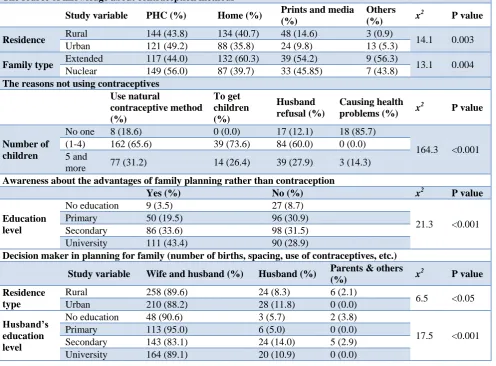
The association between the source of knowledge about the methods of different contraception and residence type of women was significant (p=0.003). Urban women utilizing the healthcare centers for getting the knowledge about contraception was (49.2%) while rural women (43.8%). Association between family type and women seeking behavior for the source of knowledge about contraception was significant (p=0.004). Women from nuclear families were 149 (56%) sought knowledge from healthcare centers, while women from extended families were 117 (44%) did. Decision making for spacing between children, use of contraception and others was significantly different across the two-residence type (rural/urban). Women and their husbands were sharing the decision in planning for family (number of births, spacing, use of contraceptives, etc.) in rural families were 258 (89.6%). A significant association between the level of education of husbands and decision making for the women respondents in family planning, spacing, and other use of reproductive healthcare was shown to be (p<0.001) (Table 2).
Table 2: The relationship between women’s characteristics and seeking family planning knowledge and practices.
The source of knowledge about contraception methods
Study variable PHC (%) Home (%) Prints and media (%)
Others (%) x
2
P value
Residence Rural 144 (43.8) 134 (40.7) 48 (14.6) 3 (0.9) 14.1 0.003 Urban 121 (49.2) 88 (35.8) 24 (9.8) 13 (5.3)
Family type Extended 117 (44.0) 132 (60.3) 39 (54.2) 9 (56.3) 13.1 0.004 Nuclear 149 (56.0) 87 (39.7) 33 (45.85) 7 (43.8)
The reasons not using contraceptives
Use natural
contraceptive method (%)
To get children (%)
Husband refusal (%)
Causing health problems (%) x
2
P value
Number of children
No one 8 (18.6) 0 (0.0) 17 (12.1) 18 (85.7)
164.3 <0.001 (1-4) 162 (65.6) 39 (73.6) 84 (60.0) 0 (0.0)
5 and
more 77 (31.2) 14 (26.4) 39 (27.9) 3 (14.3)
Awareness about the advantages of family planning rather than contraception
Yes (%) No (%) x2 P value
Education level
No education 9 (3.5) 27 (8.7)
21.3 <0.001 Primary 50 (19.5) 96 (30.9)
Secondary 86 (33.6) 98 (31.5) University 111 (43.4) 90 (28.9)
Decision maker in planning for family (number of births, spacing, use of contraceptives, etc.) Study variable Wife and husband (%) Husband (%) Parents & others
(%) x
2
P value Residence
type
Rural 258 (89.6) 24 (8.3) 6 (2.1)
6.5 <0.05 Urban 210 (88.2) 28 (11.8) 0 (0.0)
Husband’s education level
No education 48 (90.6) 3 (5.7) 2 (3.8)
17.5 <0.001 Primary 113 (95.0) 6 (5.0) 0 (0.0)
Secondary 143 (83.1) 24 (14.0) 5 (2.9) University 164 (89.1) 20 (10.9) 0 (0.0)
Home (family members) Prints & media Others
OR 95% CI P value OR 95% CI P value OR 95% CI P value Residence
Rural 1.3 (0.8-2.1) 0.273 1.53 (9.80-2.97) 0.201 0.1 (0.0-0.6) 0.006*
Urban reference Age
≤ 20yrs 8.6 (2.5-2.9) 0.001* 1.938 (0.468-8.03) 0.361
21-33yrs 5.0 (2.0-2.3) 0.001* 0.678 (0.250-1.84) 0.446
34-44yrs 1.5 (0.6-3.6) 0.385 0.516 (0.200-1.34) 0.173
Above 44 yrs reference Having children
Yes 0.9 (0.4-1.7) 0.706 0.682 (0.305-1.52) 0.352 0.6 (0.1- 4.1) 0.605
No reference Type of home
Own 1.2 (0.4-3.1) 0.765 0.903 (0.140-5.84) 0.915 0.6 (0.1-5.6) 0.676
Rent 1.6 (0.6-4.4) 0.366 0.757 (0.103-5.56) 0.784 0.5 (0.0-5.2) 0.556
House guard reference Education
No education 6.6 (2.6-7.2) 0.000* 0.291 (0.046-1.86) 0.191
Primary 2.7 (1.6-4.7) 0.000* 0.250 (0.103-0.608) 0.002*
Secondary 1.0 (0.6-1.6) 0.928 0.360 (0.188-0.691) 0.002*
University reference
*Significant at 5% significant level
Table 4: Determinants of family planning regarding who takes the decision for planning for the family.
Wife and husband Husband
OR 95%CI P value OR 95%CI P value Family type
Extended 3.0 (0.5-19.0) 0.252 4.5 (0.7-30.9) 0.126 Nuclear Reference
Type of house
Rent 3.46 (0.90-3.32) 0.070 0.74 (0.74-0.74) 0.613
Other Reference
Education
Secondary 0.81 (0.14-4.58) 0.814 1.328 (0.20-8.65) 0.767 University Reference
In multivariate analysis and after controlling for other factors, those in rural areas were found to be 0.9 less likely to obtain information from other sources than from PHC. While those who were below 20 years and between 21-33 years of age were found to be 8.6 and 5.0 times more likely to obtain information from home than from PHC. Extended families obtained information from home and were 2.1 times more likely while nuclear families are 1.8 more likely. Women respondents who had no education were 6.6, and those with primary education 2.7 times more likely to obtain information from home compared to health center as a source of information. Women who attended primary and secondary education were found to be 75% and 64% less likely to obtain information from prints and media compared to health center (Table 3).
Multinomial logistic regression analysis showed insignificantly different in terms of who had decision
making on family planning in the family within family types, housing type, and educational level of women. Unadjusted odds ratio for the family planning decision-maker (Table 4).
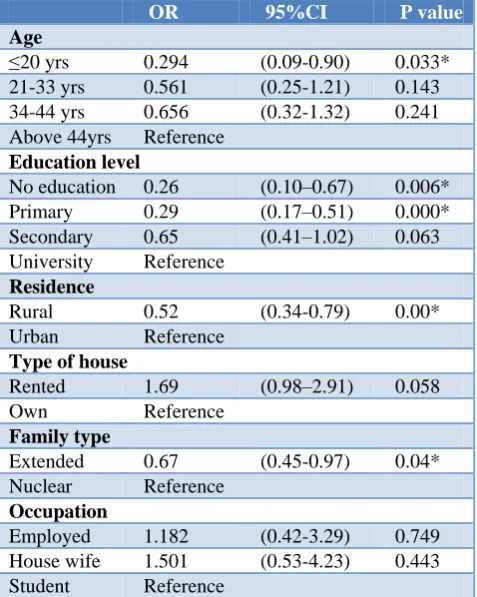
on determining other advantages of family planning over contraception (Table 5).
Table 5: Determinants of other family planning advantages over contraception.
OR 95%CI P value
Age
≤20 yrs 0.294 (0.09-0.90) 0.033* 21-33 yrs 0.561 (0.25-1.21) 0.143 34-44 yrs 0.656 (0.32-1.32) 0.241 Above 44yrs Reference
Education level
No education 0.26 (0.10–0.67) 0.006* Primary 0.29 (0.17–0.51) 0.000* Secondary 0.65 (0.41–1.02) 0.063 University Reference
Residence
Rural 0.52 (0.34-0.79) 0.00* Urban Reference
Type of house
Rented 1.69 (0.98–2.91) 0.058 Own Reference
Family type
Extended 0.67 (0.45-0.97) 0.04* Nuclear Reference
Occupation
Employed 1.182 (0.42-3.29) 0.749 House wife 1.501 (0.53-4.23) 0.443 Student Reference
*Significant at 95% significance level.
DISCUSSION
This study has aimed to conduct an investigation into the socio-demographic and cultural elements that inform the health-seeking behavior towards family planning among Sudanese women in Sharq-Alneel. Furthermore, the study aimed to identify individuals within Sudanese families, who predominantly interfered with the decision of the women in using of contraceptives for family planning. Women of Sharq-Alneel locality showed weak awareness about contraceptives and family planning rather than very few they stated. Rogers and Earnest in their study discussed the lack of awareness pertaining to reproductive health-seeking among migrant Sudanese communities in Australia. This knowledge extended to awareness about sexual and reproductive health, use of contraceptives and the role of familial elements in influencing the role of those women to seek reproductive healthcare. The study utilized a wider age range pertaining to the participants as compared to the present study; specifically, 18 to 55 years old women were recruited.18
A significant relationship was noted between the age of the participants and the duration of their marriages,
whereby women’s ages and the duration of marriage were negatively correlated. Similar trends were seen in recent studies that highlighted increases in women’s age to a primary factor contributing to high divorce rates.19 The present study demonstrated a significant relationship between the type of residence and the number of children for the respondents. Specifically, women residing in rural settings were seen to have a significantly greater number of children as compared to those respondents who resided in urban areas. These results may be in line with a previous study, which addressed the lack of awareness of rural residents with regard to undertaking appropriate family planning measures.20 Furthermore, a significant association was seen between the type of residence and the monthly financial income of the female respondents. Specifically, respondents with lower income levels were seen to mostly reside in rural settings. The association between low income levels and rural residences in Sudan was previously addressed.21
The study results showed that the respondents mainly sought healthcare-oriented information regarding family planning from their primary healthcare center (PHC). These respondents stood at 46.1% of the study population. As noted by the results, a relatively greater proportion of the respondents reported that they did not use contraceptives. Quantitatively, 66% of the participants reported their lack of contraceptive usage; whereas, 34% of the respondents reported that they utilized contraceptives. The causal factors attributed to these low percentages were primarily rooted in the refusal of husbands to utilize contraceptives (65.4%). The refusal of husbands to actively participate in contraceptive usage was highlighted in previous studies which had evaluated the presence of family planning in Sudan.22,23 Furthermore, the primary reason due to which condoms were not used was attributed to the respondent’s lack of preference (46.1%). Only 15.1% of the respondents regarded condoms to be useful in family planning and gave it significant importance.
Similar results were observed in additional studies which indicated that there was a very low level of condom usage in Sudan, due to lack of awareness regarding its significance.24 Other factors; due to which there was a lack of contraceptive use, were attributed to the desire of the respondents to have children (24.8%) in addition to fear that contraceptive use was linked to health concerns (9.8%). Similar studies noted that there was a significant lack of modern contraceptive use among sub-Saharan African communities due to a gap in knowledge regarding their proper use and fear pertaining to health concerns.25 Therefore, it is clear that there is a significant lack of knowledge and awareness regarding appropriate use of contraceptives in Sudan and other African communities.
made possible for the rural communities within Sudan. It is of additional importance that the refusal of husbands to use contraceptives be greatly addressed, since this is a significant cause for concern.
Additionally, the results highlighted that there was a stark difference between the use of contraceptives employed by women from rural family settings and those from urban ones. Specifically, 57.2% of the rural respondents did not engage in contraceptive usage, whereas, 42.8% of the urban respondents did not utilize contraceptives. However, these results were seen to contrast with those attained by a previous study, which highlighted the lack of difference in postpartum contraceptive usage based on rural and urban locations.26 Nevertheless, the results are in line with a study which indicated that a higher level of contraceptive usage was noted in urban communities as compared to rural ones.27 Therefore, further investigation is necessary in this regard, so that an appropriate conclusion may be reached.
With regard to the sources of knowledge regarding contraceptive use, both rural and urban respondents predominantly sought knowledge from their PHCs. Following this, the both rural and urban respondents sought information from their homes and consecutively, from print and media sources. However, based on extended and nuclear family settings, it was seen that most of the respondents within the extended setting sought information from their homes. Respondents from nuclear families mostly referred to PHCs for their knowledge. The significance of the relationship between the type of family setting and the health-seeking attitudes of women was highlighted in an additional study.28 Therefore, the results of this study affirm the relationship between the type of family and family planning attitudes, as indicated by previous studies.
The results indicated that there was a lack of knowledge pertaining to the appropriate use of contraceptives even among those respondents that aimed to carry out family planning. This was indicated by the high number of respondents who relied on natural contraceptive methods to prevent pregnancies. To this end, previous studies have highlighted the ineffectiveness of using natural contraception methods with regard to preventing cases of pregnancies.29,30 It is essential that Sudanese communities therefore be equipped with adequate knowledge pertaining to the proper use of contraceptives and be notified about the ineffectiveness of natural contraceptive methods for preventing pregnancies.
The study also investigated the association between the level of education attained by these respondents and their awareness regarding the advantages of family planning as opposed to contraception. The results of the study indicated that women who had received university level educations were more aware in this context as compared to respondents who had attained primary or secondary levels of education, in addition to those who had received
no prior education in any form. It was additionally seen that women who had received higher levels of education were less prone to refer to print and media sources and sought information from more authentic sources such as PHCs. Therefore, a significant and directly proportional relationship may be seen between the level of education attained by the respondents and their level of awareness regarding family planning.
Similar results may be noted in previous studies that indicated the presence of a significant association between the level of education attained by a woman and awareness of family planning.31 The study further highlighted that the most effective way to reduce the rates of unplanned pregnancies stemmed from educating women and promoting gender equality in this regard. It is also noticed that barrier to contraception use for majority of women was that they believe their health are at risk for using modern contraceptives. Furthermore, the power of the media should be harnessed for disseminating authentic and reliable information about appropriate contraceptive usage and overall family planning.32 The study additionally investigated the relationship between the husbands’ level of education and their role as decision makers with regard to family planning. This was inclusive of items such as the number of births, spacing between the births and use of contraceptives. It was also seen that women in rural families were sharing the decision for family planning with their husbands in a majority of cases, as compared to those women in urban settings. Furthermore, there was a significant association between the level of education attained by the husbands and their awareness regarding the significance of family planning. These results were seen to be strongly in line with those affirmed the role of education to be a primary factor influencing the awareness levels of husbands about family planning.33
Since this study has noted an extremely high prevalence of respondents whose husbands refused the use of contraceptives, it is essential that appropriate educational programs be conducted to inform them in this context. Such programs were conducted on a sample population in Ethiopia, whereby it was seen that the male respondents were more willing to adopt family planning measures as compared to before the interventions took place.34 Therefore, the use of educational interventions may have a strong relevance in positively influencing the attitudes and perceptions of husbands in this regard. It is required also to conduct a study to determine the reasons for not accepting contraceptives use among women’s husbands in Sharq-Alneel locality.
ACKNOWLEDGEMENTS
Great appreciation to Dr. Ahlam Azahrani for reviewing the questionnaire in its final version.
Conflict of interest: None declared
Ethical approval: The study was approved by the Central Institutional Review Board of Alneelain University, the State Ministry of Health of Sudan and the Primary Healthcare Administration Office in Sharq-Alneel Locality-Sudan
REFERENCES
1. Abdel-Tawab N, El-Rabbat M. Maternal and neonatal health services in SUDAN: results of a situation analysis. Project Brief. Population Council. 2010.
2. United Nations Population Fund (UNFPA). Maternal Health. Available at: https://www.unfpa. org/maternal-health. Accessed on 9 June 2018. 3. World Health organization. Fact sheet:
Family-planning/Contraception, 2018. Available at: http://www.who.int/en/news-room/factsheets/detail/ family-planning-contraception. Accessed on 9 June 2018.
4. Ayanore MA, Pavlova M, Groot W. Unmet reproductive health needs among women in some West African countries: a systematic review of outcome measures and determinants. Reproductive Health. 2016;13(1):5.
5. Uchechukwu C, Mary U, Allison E, Chinasa A, Adanna C. Assessment of Maternal Health Seeking Behavior and Service Utilization among Women of Reproductive Age in South-Eastern, Nigeria. Scientific Rev. 2015;1(3):64-73.
6. Sunil TS. Reproductive Health in Yemen: A Theoretical Approach (Doctoral dissertation, University of North Texas). 2002.
7. Ali AAA, Okud A. Factors affecting unmet need for family planning in Eastern Sudan. BMC Public Health. 2013;13(1):1.
8. Finer LB. The consistency and the determinants of reproductive health policy in the American States. 1999.
9. Mowson RE. Reproductive Health Seeking Behaviors among Female University Students: An Action Oriented Exploratory Study. 2015.
10. Hay PE, Kerry SR, Normansell R, Horner PJ, Reid F, Kerry SM, et al. Which sexually active young female students are most at risk of pelvic inflammatory disease? A prospective study. Sexually transmitted infections. 2016;92(1):63-6. 11. Islam M, Montgomery M, Taneja S. Urban health
and care-seeking behavior: a case study of slums in India and the Philippines. Final report. 2008. 12. Wigginton B, Harris ML, Loxton D, Lucke JC. A
qualitative analysis of women’s explanations for changing contraception: the importance of non-contraceptive effects. J Family Planning Reprod Health Care. 2016;42(4):256-62.
13. Roudi-Fahimi F, Ashford L, Khalil K. Advancing research to inform reproductive health policies: the Middle East and North Africa. 2008.
14. Random.Org. Random Integer Generator, 2018. Available at: https://www.random.org/integers/. Accessed 20 February 2017.
15. Cochran WG. Sampling techniques (3rd ed.). New York: John Wiley & Sons. 1977.
16. Baretlett HE, Kotrlik JW, Higgins CC. Organizational Research: Determining Appropriate Sample Size in Survey Research. Information Technology, Learning, Performance Jl. 2001;19(1):43-50.
17. Yeshewas A, Zelalem BM, Gizachew AT. Postpartum contraceptive use in Gondar town, Northwest Ethiopia: a community based cross-sectional study. BMC Women's Health. 2015;15:19. 18. Rogers C, Earnest J. Sexual and reproductive health communication among Sudanese and Eritrean women: an exploratory study from Brisbane, Australia. Culture, Health Sexuality. 2015;17(2):223-36.
19. Rotz D. Why have divorce rates fallen? the role of women’s age at marriage. J Human Resources. 2016;51(4):961-1002.
20. Chambers R. Rural development: Putting the last first. Routledge; 2014.
21. Abdelatti H, Elhadary Y, Samat N. Addressing Poverty in Sudan and Malaysia: A Story of Success and Constraints. J Sustainable Develop. 2016;9(2):206.
22. Abdalla AAA, Ahmmed EH. Evaluate Use and Barriers to Accessing Family Planning Services among Reproductive Age Women in the White Nile, Rural Districts, Sudan. Health Sci J. 2017;11(6):531.
23. Metusela C, Ussher J, Perz J, Hawkey A, Morrow M, Narchal R, et al. “In My Culture, We Don’t Know Anything About That”: Sexual and Reproductive Health of Migrant and Refugee Women. Int J Behavioral Med. 2017;24(6):836-45. 24. Ebrahim NB, Davis S, Tomaka J. Psychosocial
determinants of intention to use condoms among Somali and Ethiopian immigrants in the US. Psychol Health Med. 2017;22(5):611-7.
25. Ackerson K, Zielinski R. Factors influencing use of family planning in women living in crisis affected areas of Sub-Saharan Africa: A review of the literature. Midwifery. 2017;54:35-60.
26. Starr KA, Martins SL, Watson S, Gilliam ML. Postpartum contraception use by urban/rural status: an analysis of the Michigan pregnancy risk assessment monitoring system data. Women’s Health Issues. 2015;25(6):622-7.
27. Garenne, M. Trends in marriage and contraception in sub-Saharan Africa: a longitudinal perspective on factors of fertility decline. 2014.
29. Murshid NS, Ely GE. Does the Use of Unreliable Contraceptive Methods Increase the Number of Abortions? Results from a National Survey of Women in the United States. Social work in public health. 2018: 1-18.
30. Husain Z, Dutta M. Behavioural Contraception Methods. In Fertility Control in a Risk Society. Springer, New Delhi; 2017: 1-18.
31. Jiang L, Hardee K. Women’s education, family planning, or both? Application of multistate demographic projections in India. Int J Population Res. 2014:940509:9.
32. Jacobs J, Marino M, Edelman A, Jensen J, Darney B. Mass media exposure and modern contraceptive use among married West African adolescents. The Eur J Contracept Reprod Health Care. 2017: 1-11.
33. Kamruzzaman M, Hakim MA. Family planning practices among married women attending primary health care centers in Bangladesh. Int J Bioinfo Biomed Eng. 2015;1(3):251-5.
34. Tilahun T, Coene G, Temmerman M, Degomme O. Couple based family planning education: changes in male involvement and contraceptive use among married couples in Jimma Zone, Ethiopia. BMC Public Health. 2015;15(1):682.