Rukshani D et al. Int J Community Med Public Health. 2018 Jul;5(7):2705-2713
http://www.ijcmph.com pISSN 2394-6032 | eISSN 2394-6040
Original Research Article
Factors associated with quality of life among cancer patients
in Sri Lanka
Dilka Rukshani
1, Pabasara Kahandawala
1. Kasun Jayawardana
1, Dilan Karunarathne
1,
Lahiru S. Galgamuwa
2*, Chandima Kumara
1, Charuni Gamage
3INTRODUCTION
Cancer is one of the commonest causes for the disability worldwide. It is estimated that 14.1 million new cases and 8.2 million deaths are reported annually.1 The mortality rates of cancer patients are increasing annually and more than 60% of deaths reported in developing countries.2 People of all aged are affected to cancers
particularly the risk of developing cancer is increased with elderly people.2
The quality of life (QOL) is a multidimensional measure that includes physical, psychological, social and the environmental effect of an illness and its treatment of chronic, incurable patients.3 Several studies reported that restriction of physical activities, dietary restrictions and significant change of general lifestyle and relationship
ABSTRACT
Background: Quality of life (QOL) is individuals’ perception of their position in life in the context of the culture and
value systems in which they live and in relation to their goals, expectations, standards and concerns. It is an effective modern method of early identification of chronic incurable disease patients. This study was designed to determine the level and the possible contributory factors of quality of life in heterogeneous groups of cancer patients in Sri Lanka.
Methods: This study was conducted at National Cancer Institute of Sri Lanka. WHOQOL-BREF questionnaire was
used to assess QOL of cancer patients. Multivariate linear regression model was used to evaluate the associations of demographic variables, clinical characteristics, and social support status with the quality of life measures.
Results: 167 of cancer patients were participated. The mean overall QOL score was 53.07±SD 12.68. Higher QOL
was associated with patients who were married, higher educated, employed, had good family support and longer duration of illness. Significantly lower QOL was found in those who involved on radiotherapy treatments and feeling alone. Marital status, education status, comorbidity, family support and feeling alone were identified as predictors for QOL among the study group.
Conclusions: The overall QOL score was considerably low in our study. Continuous family support and good
education may significantly improve the QOL of cancer patients. Psychosocial and awareness programs to the family members and neighbours should be implemented to enhance the quality of life of cancer patients.
Keywords: Quality of life, Cancer patients, Sri Lanka
1
Department of Nursing, 2Department of Basic Sciences, Faculty of Allied Health Sciences, General Sir John Kotelawala Defence University, Sri Lanka
3Faculty of Medicine, General Sir John Kotelawala Defence University, Sri Lanka
Received: 27 April 2018
Revised: 05 May 2018
Accepted: 08 May 2018
*Correspondence:
Dr. Lahiru S. Galgamuwa, E-mail: [email protected]
Copyright: © the author(s), publisher and licensee Medip Academy. This is an open-access article distributed under
the terms of the Creative Commons Attribution Non-Commercial License, which permits unrestricted non-commercial use, distribution, and reproduction in any medium, provided the original work is properly cited.
with families and friends influence the QOL of cancer patients.4 It fulfills the gap between hopes, expectation and the experiences of individuals and provides good quality of life in many aspects of life. The data related to quality of life is very important for future treatment modifications and for the supportive care and the rehabilitation.
In Sri Lanka, more than 50,000 cancer patients were diagnosed from 2007 to 2012. According to health statistics, males are more vulnerable to cancers than females. Although considerable number of patients was treated with advanced treatments, the mortality rate is increasing annually. In Sri Lanka, the overall crude cancer incidence rate (CR) was 31.6 per 100,000 populations in 1985 and it has been increase into 540 per 100,000 populations in 2014.
Assessment of QOL and its contributing factors are important in the management of cancer patients because early identification may help to implement appropriate intervention to those with poor QOL. However, studies on the determinants of QOL among cancer patients in Sri Lanka are very scarce. Therefore, the objectives of the current study were to determine the association between QOL of heterogeneous groups of cancer patients with socio demographic variables, clinical and family support characteristics.
METHODS
Study design and selection of participants
A descriptive cross sectional study was carried out at the National Cancer Institute of Sri Lanka from May to September 2016. The sample size was calculated using a formula of n=z2£2/d2. It was estimated that the quality of life score of a previous study was 39.6 in bronchus and lung cancer patients in Sri Lanka.5 95% confidence interval and 6 points of the accepted amount of the absolute error were also taken to calculate the sample size. The minimum sample size was calculated as 167. All patient aged above 18 years participated regularly for the clinics at the National Cancer Institute of Sri Lanka were enlisted. Then out of total patients who were subjected to treatments (Radiotherapy / Chemotherapy), 167 were selected by the simple random sampling method for the study. Patients who have been diagnosed having cancer with less than 6 months from the date of study, inward patients, subjected to surgery during last three months patients aged less than 18 years coming to the clinics and those who were unable to complete the self-administered questionnaires were excluded from this study.
Data collection
Before the commencement of the study, objectives and the implications of the research were explained to the participants with the help of medical authorities. All patients were informed that the participation was
voluntary and could withdraw any time from the study. Informed written consents for participation were obtained from all the participants. Details on socio demographic and psychological support were obtained from each patient using an interviewer administrative questionnaire. The clinical records were used to gather data on related details on cancers.
Study instruments
The quality of life was measured using WHOQOL- BREF scale. WHOQOL-BREF is a self-administered generic questionnaire which is consisting 26 items. It is a modification form of WHOQOL–100 and can be used for wide range of clinical and cultural settings.6 WHOQOL-BREF has 4 domains. Those are physical health, psychological, social and environment. In addition, two items on overall quality of life and general health facet are not included any of the previous domains. Therefore they were used to constitute the "general facet on health and QOL" in the present study.
Participants responded to 26 items on a 5-point likert scale with numbers referring to 1=never, 2=occasionally, 3=sometimes, 4=frequently, or 5=always. The final value of each domain was converted to transformation score scale ranging from 0 to 100. Mean value of the transformation scores of each domain was calculated. In addition, subject’s satisfaction was defined as the level of positive appreciation for each domain. A high score for each functional scale represented better QOL.
Internal consistency reliability for each domain was highly reliable (Cronbach’s alpha was 0.91) and overall functional index were acceptable (item-total correlations >0.40).
Statistical analysis
All data were entered into the Microsoft EXCEL software and were transferred into SPSS version 17 statistical analysis (SPSS, Chicago, IL, USA). Demographic, clinical factors and social support characteristics were précised using frequencies and percentages for categorical variables, and means and their standard deviations (SDs) for continuous variables. Chi square test was used to association between socio-demographic characteristics between groups of cancer patients. Summary scores were generated by organizing the items of the WHOQOL BREF into four domains. One-way ANOVA was used to analyze mean differences of QOL in four cancer groups. Cronbach’s alpha was used to estimate the reliability of a psychometric test in statistic.
facet on health and QOL. P value less than 0.05 was considered as statically significant.
RESULTS
Socio-demographic characteristics
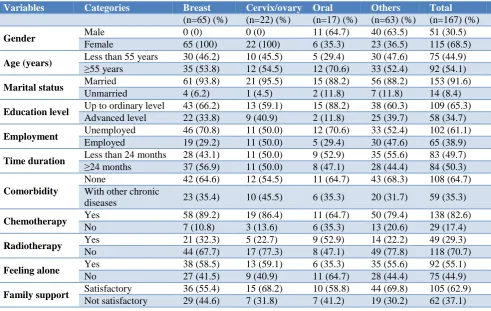
A total of 167 cancer patients with the mean age of 63.33 (±0.67) years were participated. The age range of the study participants was 18–83 years and the majority of them were females (67.7%). Of them, 65 (38.9%) had breast cancers, 22 (13.2%) had cancers in female reproductive system (cervical or ovarian cancers) and 17 (10.2%) had oral cancers. In addition, patients with cancers in respiratory, gastro intestinal, lymphatic, cardio vascular, brain and nervous, urinary systems, thyroid and prostate glands were included for the study and all of these were merged as other cancer patients because of the small number of patients for each type of cancer was found. Figure 1 shows the highest number of patients was in the 55–72 age group and the lowest number of patients were in 73–90 age group. The patients were
predominantly married (91.6%), unemployed (61.1%) and had up to secondary level education (65.3%). In addition, majority of them were more than 55 years (55.1%) and has subjected to chemotherapy treatments (82.6%) (Table 1).
Figure 1: Age and gender distribution of study participants.
Table 1: Socio-demographic and clinical characteristics of patient.
Variables Categories Breast Cervix/ovary Oral Others Total
(n=65) (%) (n=22) (%) (n=17) (%) (n=63) (%) (n=167) (%)
Gender Male 0 (0) 0 (0) 11 (64.7) 40 (63.5) 51 (30.5)
Female 65 (100) 22 (100) 6 (35.3) 23 (36.5) 115 (68.5)
Age (years) Less than 55 years 30 (46.2) 10 (45.5) 5 (29.4) 30 (47.6) 75 (44.9)
≥55 years 35 (53.8) 12 (54.5) 12 (70.6) 33 (52.4) 92 (54.1)
Marital status Married 61 (93.8) 21 (95.5) 15 (88.2) 56 (88.2) 153 (91.6)
Unmarried 4 (6.2) 1 (4.5) 2 (11.8) 7 (11.8) 14 (8.4)
Education level Up to ordinary level 43 (66.2) 13 (59.1) 15 (88.2) 38 (60.3) 109 (65.3)
Advanced level 22 (33.8) 9 (40.9) 2 (11.8) 25 (39.7) 58 (34.7)
Employment Unemployed 46 (70.8) 11 (50.0) 12 (70.6) 33 (52.4) 102 (61.1)
Employed 19 (29.2) 11 (50.0) 5 (29.4) 30 (47.6) 65 (38.9)
Time duration Less than 24 months 28 (43.1) 11 (50.0) 9 (52.9) 35 (55.6) 83 (49.7)
≥24 months 37 (56.9) 11 (50.0) 8 (47.1) 28 (44.4) 84 (50.3)
Comorbidity
None 42 (64.6) 12 (54.5) 11 (64.7) 43 (68.3) 108 (64.7)
With other chronic
diseases 23 (35.4) 10 (45.5) 6 (35.3) 20 (31.7) 59 (35.3)
Chemotherapy Yes 58 (89.2) 19 (86.4) 11 (64.7) 50 (79.4) 138 (82.6)
No 7 (10.8) 3 (13.6) 6 (35.3) 13 (20.6) 29 (17.4)
Radiotherapy Yes 21 (32.3) 5 (22.7) 9 (52.9) 14 (22.2) 49 (29.3)
No 44 (67.7) 17 (77.3) 8 (47.1) 49 (77.8) 118 (70.7)
Feeling alone Yes 38 (58.5) 13 (59.1) 6 (35.3) 35 (55.6) 92 (55.1)
No 27 (41.5) 9 (40.9) 11 (64.7) 28 (44.4) 75 (44.9)
Family support Satisfactory 36 (55.4) 15 (68.2) 10 (58.8) 44 (69.8) 105 (62.9)
Not satisfactory 29 (44.6) 7 (31.8) 7 (41.2) 19 (30.2) 62 (37.1)
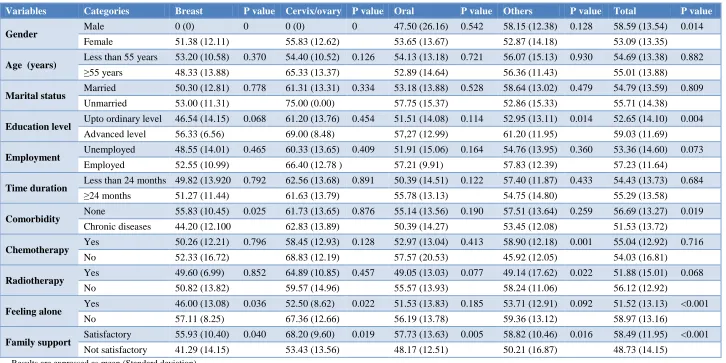
The mean overall QOL score of study participants was 53.07±SD 12.68 (range 18–82). Table 2 shows the associations between QOL scores of heterogeneous groups of cancer patients and possible determinant factors. The overall score was out of 100. Approximately 45% of the study participants scored less than 50. Patients who were employed and had higher education backgrounds show higher QOL in every type of study
Table 2: Association between QOL with demographic and clinical parameters.
Variables Categories Breast P value Cervix/ovary P value Oral P value Others P value Total P value
Gender Male 0 (0) 0 0 (0) 0 47.50 (26.16) 0.542 58.15 (12.38) 0.128 58.59 (13.54) 0.014
Female 51.38 (12.11) 55.83 (12.62) 53.65 (13.67) 52.87 (14.18) 53.09 (13.35)
Age (years) Less than 55 years 53.20 (10.58) 0.370 54.40 (10.52) 0.126 54.13 (13.18) 0.721 56.07 (15.13) 0.930 54.69 (13.38) 0.882
≥55 years 48.33 (13.88) 65.33 (13.37) 52.89 (14.64) 56.36 (11.43) 55.01 (13.88)
Marital status Married 50.30 (12.81) 0.778 61.31 (13.31) 0.334 53.18 (13.88) 0.528 58.64 (13.02) 0.479 54.79 (13.59) 0.809
Unmarried 53.00 (11.31) 75.00 (0.00) 57.75 (15.37) 52.86 (15.33) 55.71 (14.38)
Education level Upto ordinary level 46.54 (14.15) 0.068 61.20 (13.76) 0.454 51.51 (14.08) 0.114 52.95 (13.11) 0.014 52.65 (14.10) 0.004
Advanced level 56.33 (6.56) 69.00 (8.48) 57,27 (12.99) 61.20 (11.95) 59.03 (11.69)
Employment Unemployed 48.55 (14.01) 0.465 60.33 (13.65) 0.409 51.91 (15.06) 0.164 54.76 (13.95) 0.360 53.36 (14.60) 0.073
Employed 52.55 (10.99) 66.40 (12.78 ) 57.21 (9.91) 57.83 (12.39) 57.23 (11.64)
Time duration Less than 24 months 49.82 (13.920 0.792 62.56 (13.68) 0.891 50.39 (14.51) 0.122 57.40 (11.87) 0.433 54.43 (13.73) 0.684
≥24 months 51.27 (11.44) 61.63 (13.79) 55.78 (13.13) 54.75 (14.80) 55.29 (13.58)
Comorbidity None 55.83 (10.45) 0.025 61.73 (13.65) 0.876 55.14 (13.56) 0.190 57.51 (13.64) 0.259 56.69 (13.27) 0.019
Chronic diseases 44.20 (12.100 62.83 (13.89) 50.39 (14.27) 53.45 (12.08) 51.53 (13.72)
Chemotherapy Yes 50.26 (12.21) 0.796 58.45 (12.93) 0.128 52.97 (13.04) 0.413 58.90 (12.18) 0.001 55.04 (12.92) 0.716
No 52.33 (16.72) 68.83 (12.19) 57.57 (20.53) 45.92 (12.05) 54.03 (16.81)
Radiotherapy Yes 49.60 (6.99) 0.852 64.89 (10.85) 0.457 49.05 (13.03) 0.077 49.14 (17.62) 0.022 51.88 (15.01) 0.068
No 50.82 (13.82) 59.57 (14.96) 55.57 (13.93) 58.24 (11.06) 56.12 (12.92)
Feeling alone Yes 46.00 (13.08) 0.036 52.50 (8.62) 0.022 51.53 (13.83) 0.185 53.71 (12.91) 0.092 51.52 (13.13) <0.001
No 57.11 (8.25) 67.36 (12.66) 56.19 (13.78) 59.36 (13.12) 58.97 (13.16)
Family support Satisfactory 55.93 (10.40) 0.040 68.20 (9.60) 0.019 57.73 (13.63) 0.005 58.82 (10.46) 0.016 58.49 (11.95) <0.001
Not satisfactory 41.29 (14.15) 53.43 (13.56) 48.17 (12.51) 50.21 (16.87) 48.73 (14.15)
Differences in QOL domain scores between the groups
Psychological health domain shows the highest QOL among all patients groups. When comparison of patients groups, patients with breast cancers shows highest QOL In all the domains while those with cancers in female
reproductive system (cervical or ovarian cancers) shows lowest QOL. In addition, patients with cancers related to the female reproductive system shows had significantly lower scores than of the domain of Psychological health than other groups. However, there was no any significant association of other domains was found between these groups (Table 3).
Table 3: Differences in QOL domain scores for patient.
QOL domains Breast (n=65) Cervix/ovary Oral (n=17) Others (n=63) P value
(n=22)
Physical health 55.65 (14.42) 49.00 (12.38) 50.70 (10.99) 49.30 (12.46) 0.260
Psychological health 66.29 (15.73) 54.32 (21.30) 59.00 (17.13) 65.13 (15.46) 0.025
Social relationships 68.12 (14.88) 50.00 (21.71) 54.33 (21.24) 56.24 (24.34) 0.075
Environment 57.88 (18.39) 48.18 (15.13) 48.80 (17.03) 53.65 (15.36) 0.100
General facet on health & QOL 3.26 (0.93) 3.20 (0.92) 3.12 (0.91) 3.08 (0.95) 0.883
Results are expressed as mean (Standard deviation).
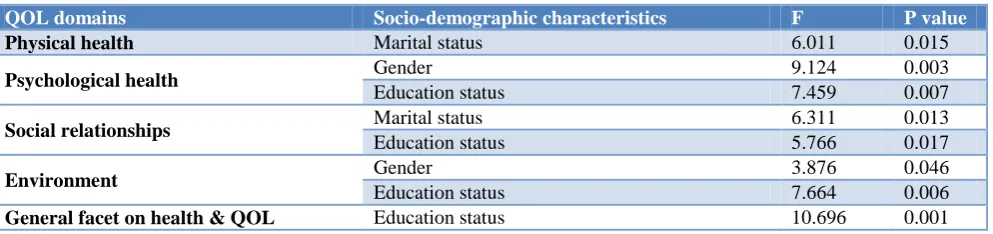
Table 4: Association of socio-demographics with QOL: significant covariates of QOL in ANCOVA.
QOL domains Socio-demographic characteristics F P value
Physical health Marital status 6.011 0.015
Psychological health Gender 9.124 0.003
Education status 7.459 0.007
Social relationships Marital status 6.311 0.013
Education status 5.766 0.017
Environment Gender 3.876 0.046
Education status 7.664 0.006
General facet on health & QOL Education status 10.696 0.001
Association of socio-demographic variables with QOL domain scores
A one-way analysis of covariance (ANCOVA) was used to analysis of covariance of socio-demographic variables with QOL domain. All the socio-demographic variables were simultaneously entered in ANCOVA as covariates, and QOL domain scores as dependent variables. We found that the significant covariates for patients were marital status, gender and education of the patient. The pattern that emerged was that, higher QOL of scores for patients were associated with patient being married male patients and having attained high school education (Table 4).
Association of clinical variables with QOL domain scores
The duration of illness was not significantly correlated with the entire patient's QOL domain scores. Interestingly, patients with cancers more than 24 moths had higher QOL in the domains of social relationships and environment while high QOL of the domain of psychological health shows among patients with cancers less than 24 months. However, no any significant associations were found between these groups.
Cancer patients who were not suffering with other chronic diseases psychological health and general facet on health & QOL had significantly higher QOL compared to the patients had chronic diseases. However, no significant association was found between the comorbidities of the patient and other domain of QOL. While there were no significant differences in QOL domain scores between those currently on chemotherapy and those not on chemotherapy (p>0.05), the patients on radiotherapy tended to have higher scores than those not on radiotherapy. However, only psychological health domain reached significance. In all the domains, the patients who felt not alone had much significantly higher scores than those who felt alone (p<0.05) except General facet on health & QOL. In addition, there is a significant association between supports of the family members with all types of domains QOL except physical health (Table 5).
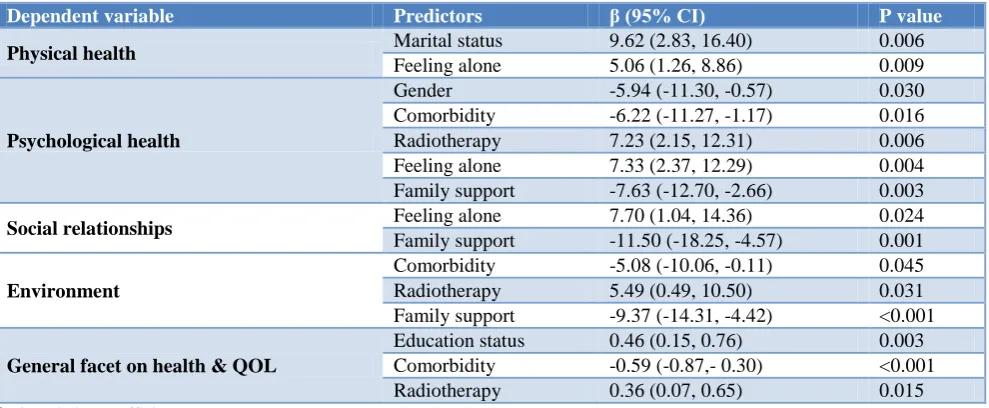
Predictors of patients' QOL
relationships. Meanwhile, family support was negatively affected for psychological health, social relationships and environment. Comorbidity and radiotherapy treatments were predictors for psychological health and environment
domains and general facet on health & QOL. In addition, marital status, gender and education status were identified for QOL in some domains (Table 6).
Table 5: Relationship of cancer related data of the patient with QOL domain scores.
Variables Categories Physical health Psychological
health
Social
relationships Environment
General facet on health & QOL
Time duration
<24 months 50.43 (12.31) 62.29 (16.52) 55.14 (22.73) 49.87 (17.52) 3.17 (0.89)
≥24 months 50.55 (12.09) 60.55 (18.25) 57.04 (21.70) 53.05 (15.45) 3.10 (0.99)
P value 0.952 0.519 0.583 0.215 0.617
Comorbidity
None 51.64 (12.30) 63.88 (15.78) 58.12 (21.99) 53.25 (16.66) 3.33 (0.89)
Chronic
diseases 48.45 (11.73) 57.02 (19.28) 52.48 (22.22) 48.28 (15.96) 2.77 (0.93)
P value 0.105 0.014 0.115 0.062 < 0.001
Chemotherapy
Yes 52.62 (13.92) 63.62 (17.81) 50.24 (26.34) 49.62 (20.01) 3.09 (0.93)
No 50.04 (11.77) 60.95 (17.32) 57.33 (21.10) 51.86 (15.77) 3.33 (1.00)
P value 0.301 0.454 0.118 0.510 0.220
Radiotherapy
Yes 48.98 (12.06) 56.70 (19.03) 52.83 (21.54) 47.85 (18.37) 2.94 (0.96)
No 51.33 (12.14) 63.46 (16.38) 57.09 (22.44) 53.12 (15.58) 3.21 (0.93)
P value 0.247 0.020 0.251 0.058 0.098
Feeling alone
Yes 48.45 (11.07) 57.59 (17.33) 51.41 (21.79) 48.65 (16.08) 3.07 (0.88)
No 53.00 (13.02) 66.11 (16.37) 61.84 (21.41) 54.92 (16.54) 3.21 (1.01)
P value 0.016 0.001 0.002 0.014 0.315
Family support
Satisfactory 53.81 (12.51) 65.27 (15.14) 61.19 (15.47) 55.70 (13.80) 3.24 (0.83) Not
satisfactory 48.25 (11.30) 54.89 (19.04) 47.47 (17.43) 44.29 (12.34) 2.94 (0.83)
P value 0.048 < 0.001 < 0.001 < 0.001 0.048
Results are expressed as mean (Standard deviation).
Table 6: Predictors of QOL of patients.
Dependent variable Predictors β (95% CI) P value
Physical health Marital status 9.62 (2.83, 16.40) 0.006
Feeling alone 5.06 (1.26, 8.86) 0.009
Psychological health
Gender -5.94 (-11.30, -0.57) 0.030
Comorbidity -6.22 (-11.27, -1.17) 0.016
Radiotherapy 7.23 (2.15, 12.31) 0.006
Feeling alone 7.33 (2.37, 12.29) 0.004
Family support -7.63 (-12.70, -2.66) 0.003
Social relationships Feeling alone 7.70 (1.04, 14.36) 0.024
Family support -11.50 (-18.25, -4.57) 0.001
Environment
Comorbidity -5.08 (-10.06, -0.11) 0.045
Radiotherapy 5.49 (0.49, 10.50) 0.031
Family support -9.37 (-14.31, -4.42) <0.001
General facet on health & QOL
Education status 0.46 (0.15, 0.76) 0.003
Comorbidity -0.59 (-0.87,- 0.30) <0.001
Radiotherapy 0.36 (0.07, 0.65) 0.015
β- Correlation coefficient.
DISCUSSION
This study suggests that cancers significantly affect for QOL of people. In the present study, patients who were male, married, higher educated and employed patients
prompt treatment, access to comprehensive rehabilitation and counseling programs which might be helpful to im-prove QOL cancer patients. Our results are inconsistent with several studies reported that the education is significantly associated with QOL.7
Psychological aspects of males are higher than females. The reasons for having low QOL in women might be related to the ability to overcome issues in a better manner as a result of having a wider social environment and self-confidence after identifying the cancer condition.
Employed people have financial support for diagnosis and treatments for diseases through governmental or other supporting mechanisms. Therefore, they have less worry about financial constraint and significantly improve their quality of life. Furthermore, it is important to counsel them to continue their jobs to avoid unemployment after identifying the cancer condition. Additional economic burden for treatments may cause family problems and relationship issues which may negatively influence for QOL.
This study shows that the presence of comorbidities in cancer patients has been negatively associated with patients’ health outcomes. They have adverse outcomes along their cancer treatment such as radiation therapy and these treatments may adversely influence for other diseases suffering from these patients and their health related quality of life.
In the present study, we assessed how family support affects to the QOL in cancer patients via two areas. These are loneliness of the patients and supports from the family. The QOL was significantly low in patients who “felt alone”. Therefore, it is important to identify the individuals who feel alone and not satisfactory family health and refer them to the counseling programs. Majority of patients had very much attention from their family. In the present study, we found that there is a significant association between attention of the family members and QOL which is similar to previous studies in Sri Lanka.5 Majority of caregivers of cancer patients are their close relations and may help to improve QOL of cancer patients and a key component of a management and care of cancer survivors. This is the issue for high QOL of psychological health. But most of caregivers don’t have a time to improve patient’s physical health and social and environmental relationships. This may be a major reason for negative effect for those domains in cancer patients.
When considering the type of cancers, worst QOL were reported among patients having cancers in female reproductive system. Reproductive concerns, particularly about fertility, can be a source of anxiety and negatively affect for quality of life of many cancer patients.8 Specific supportive care interventions and counseling programs for patients and their family, friends or support groups might help to enhance quality of life in this
population. On the other hand, breast cancer patients showed the highest QOL compared to other patient groups. Similarly Ahn et al reported that breast cancer patients had better social and psychological impact and lower physical functioning with increasing age.9
Physical domain shows the lowest QOL scores among our study participants. Most cancer survivors have suffered from significant work-related disabilities which may affect work performance, resulting in low income or turn-out from the job, causing further increase in distress. In Sri Lanka, it is less known how cultural factors such as beliefs about cancer affect the patients psychologically. Discrepancies in accessibility of health care system to different sectors of population hinder early detection of cancer and also prevent getting proper treatment. As a result, cancer patients may develop higher levels of fear and anxiety when they are diagnosed with a cancer. Similarly lower QOL among women with cervical cancers was associated with lower physical performance scores in South Africa.10
The scores on psychological health and social relationships of the study participants were comparatively better. Social supports effect on psychosocial well-being and physical activity levels by multidimensional supportive network with social ties and with other people who provide support for the patients.11 This is one of the reasons of high QOL outcomes showed among employed people because they have strong social relationships compared to unemployed people. In the present study, we found that family support was significantly associated with improved psychological, social and environment quality of life of cancer patients.
The extent to which QOL of cancer patients depends on the time elapsed since initial treatment; with an increase in the extent of the disease, a decrease in the QOL was observed. This study found that the higher QOL was associated with patients had a long history of duration of illness. Several studies have been reported that the lowest QOL was shown among cancer patients who were newly diagnosed.12 This study revealed that longer survival of patients could be experiencing more cancer specific concerns. Numerous studies found that a better QOL measure is associated with longer survival of patients with various types of cancer and those who are successfully treated and become experienced in managing social and psychological problems, leading to improvement in QOL.13 In addition, socioeconomic burden also contributes to psychological distress. Chandwani et al had revealed that failure in early detection and interventions lead to elevated levels of distress with a negative impact on cancer outcomes, cancer therapies, survival and disease progression resulting a decrease in patients' quality of life, and increase in care costs.14
Advanced stage cancer patients also usually accompany with more pain, more stress and worse quality of life. Our finding found that radiotherapy has a negative impact on QOL. Radiotherapy is more painful than chemotherapy and surgery and has higher perceived stress and greater depression. Our study found that those who participating radiotherapy treatments had low QOL. De Graeff et al also revealed significant deterioration in the scores for physical, psychological and social functioning in patients who were undergoing radiotherapy treatments.15 Our study found that the scores for fatigue, pain, insomnia, and appetite loss remained high, whereas those for nausea/vomiting and dyspnea were significantly improved were improved after radiotherapy. Therefore, our suggestion is that patients receiving radiotherapy could be considered as vulnerable subpopulation for greater risk of poor QOL.
Majority of patients have received chemotherapy in this study sample and higher (better) scores of quality of life measures was associated with patients receiving chemotherapy. Chemotherapy has less side effects and risk for secondary cancers compare to radiotherapy. Similarly several studies reported that chemotherapy may improve the QOL in cancer patients.16 The results of our study indicate that chemotherapy treatments might play an important role to improve the QOL in cancer patients.
The present study demonstrates that income, social support and treatment for cancers have significant impact on quality of life. These findings provide a scientific basis to develop a comprehensive program that incorporates these factors, especially social support, to improve the QOL of cancer patients. Families living with cancer patients with, single, less educated, not formally employed and recently diagnosed need education and support to enhance psychosocial and physical aspects of patients. The findings are important to improve cancer care programs about quality of life of patients in Sri Lanka. Future research should focus on the effectiveness of treatments and co-morbidity on their QOL with aging.
CONCLUSION
The overall QOL score was considerably low in our study. Continuous family support and good education may significantly improve the QOL of cancer patients. Psychosocial and awareness programs to the family members and neighbors should be implemented to enhance the quality of life of cancer patients. Providing education and information about cancer and its management for both patients and care givers are important to enhance their caregiving role.
ACKNOWLEDGEMENTS
We would like to express our deepest gratitude to patients who participated voluntary in this study. Our sincere thanks also go to the staff of the Department of Nursing, General Sir John Kotelawala Defence University for their
continuous support. Finally, we would like to extend special thanks to Prof. K.G. Somasiri, Department of Physiology, Faculty of Medicine, University of Ruhuna, Sri Lanka for sharing his knowledge and giving us a validated questionnaires to accomplish this research fruitfully.
Funding: No funding sources Conflict of interest: None declared
Ethical approval: The study was approved by the Institutional Ethics Committee, Faculty of Medicine, General Sir John Kotelawala Defence University, Sri Lanka. Permission was obtained from Director of the National Cancer Institute of Sri Lanka to conduct the study
REFERENCES
1. Ferlay J, Soerjomataram I, Dikshit R, Eser S, Mathers C, Rebelo M, et al. Cancer incidence and mortality worldwide: sources, methods and major patterns in GLOBOCAN 2012. Int J Cancer. 2015;136(5):359-86.
2. White MC, Holman DM, Boehm JE, Peipins LA, Grossman M, Henley SJ. Age and Cancer Risk: A Potentially Modifiable Relationship. Am J Prevent Med. 2014;46(3):7–15.
3. Taechaboonsermsak P, Kaewkungwal J,
Singhasivanon P, Fungladda W, Wilailak S. Causal relationship between health promoting behavior and quality of life in cervical cancer patients undergoing radiotherapy. Southeast Asian J Trop Med Public Health. 2005;36:1568-75.
4. Penson R, Cella D, Wenzel L. Quality of life in ovarian cancer. J Repro Med. 2005;50:407-16. 5. Jayasekara H, Rajapaksa LC, Aaronson NK. Quality
of life in cancer patients in South Asia: psychometric properties of the Sinhala version of the EORTC QLQ-C30 in cancer patients with heterogeneous diagnoses. Quality of Life Res. 2008;17:783-91.
6. Skevington SM, Lotfy M, O' Connell KA. The WHOQOL group: The World Health Organization's
WHOQOL–Bref quality of life assessment:
psychometric properties and results of the international field trial. A report from the WHOQOL group. Quality of life Res. 2004;13:299-310.
7. Park BW, Hwang SY. Depression and coping in breast cancer patients. J Breast Cancer. 2009;12:199-209.
8. Søgaard M, Thomsen RW, Bossen KS, Sorensen HT, Norgaard M. The impact of comorbidity on cancer survival: A review. J Clin Epidemiol. 2013;5(1):3-29.
9. Ahn SH, Park BW, Noh DY, Nam SJ, Lee ES, Lee
10. Nair MG. Quality of life in cancer of the cervix patients. Int Clin Psychopharmacol. 2000;15(3):47-9.
11. Baker F, Denniston M, Smith T, West MM. Adult cancer survivors: how are they faring? Cancer. 2005;104(11):2565–76.
12. Saegrow SHealth, quality of life and cancer. Int Nursing Rev. 2005;52:233-40.
13. Neyt M, Albrecht J. The long-term evolution of quality of life for disease-free breast cancer survivors: a comparative study in Belgium. J Psychosoc Oncol. 2006;24:89-123.
14. Chandwani KD, Ryan JL, Peppone LJ. Cancer-related Stress and complementary andalternative medicine: a review. Evidence-Based Complement Alternative Med. 2012;979213:15.
15. De Graeff A, de Leeuw JRJ, Ros WJG, Hordijk GJ, Blijham GH, Winnubst JAM. Long-term quality of life of patients with head and neck cancer. Laryngoscope. 2000;110(1):98–106.
16. Guyatt G, Feeny DH, Patrick DL. Measuring health-related quality of life. Ann Inter Med. 1993;118:622–9.
Cite this article as: Rukshani D, Kahandawala P,