Original Research Article
Effect of profession collaboration training to malnutrition knowledge
among health worker in South Sulawesi, Indonesia
Risnah
1,2*, Veni Hadju
3, Ida L. Maria
4, Werna Nontji
5, Imam Sofingi
6, Yurniati
7INTRODUCTION
Collaboration is a mutually beneficial relationship between two or more organizations to achieve a goals.1 Collaboration is a common term used to describe the cooperation between health professions.2 Complex health problems require solutions that involving all health professions.3 Treatment efforts are conducted with
preventive and promote without ignoring the curative and rehabilitative approach.4
Professional collaboration allows participants to achieve better results to serve larger groups of people.2 Working together becomes very important for individuals to achieve professional perspectives, teamwork and clients.5 Professional collaboration has a positive effect on patient satisfaction, reducing uncertainty, and improving hospital
ABSTRACT
Background: Malnutrition in children is a complex health problem that involves all health profession for handling it. Profession collaboration training is expected to increase the knowledge of health workers about profession collaboration on the malnutrition handling. The study aim was to assess the changing of profession collaboration knowledge on the malnutrition handling cases before and after training among health worker in Jeneponto district.
Methods: We used Quasi experiment design with pre-test and post-test control group design in this study. The treatment group was given a module and training, while the control group was only given a module. Sampling technique was stratified random sampling. The knowledge measurement was conducted on baseline (pre-test), after training (post-test 1), and a month after training (post-test 2).
Results: Friedman test showed that there was difference knowledge average about malnutrition before and after training in treatment group (p=0.006) and control group (p=0.006). In Wilcoxon analysis shows that there was a change of knowledge on before and after intervention (p=0.010) and knowledge on before and a month after intervention (p=0.013) in the treatment group. In Mann Whitney analysis shown that there was difference of knowledge between treatment group and control group (p=0.025) on pretest. But, there were no difference knowledge between treatment group and control group on post 1 (p=0.768) and post 2 (p = 0.206).
Conclusions: Health education by training increased knowledge level about profession collaborassion on the malnutrition among health workers in Jeneponto district.
Keywords: Professional collaboration training, Malnutrition, Health worker
1Doctor Program, Faculty of Public Health, Hasanuddin University, 2Departement of Nurse, Faculty of Medicine and
Health Sciences, State Islamic University of Alauddin, Makassar, Indonesia
3
Department of Nutrition, 4Department of Epidemiology, Faculty of Public Health, Hasanuddin University, Makassar,
Indonesia; 5Hasanuddin University Hospital, Makassar, Indonesia
6Primary Health Care of Binamu City, Jeneponto, Makassar, Indonesia 7
Faculty of Public Health, Hasanuddin University, Makassar, Indonesia Makassar, Indonesia
Received: 25 May 2018
Revised: 09 June 2018
Accepted: 11 June 2018
*Correspondence:
Dr. Risnah,
E-mail: [email protected]
Copyright: © the author(s), publisher and licensee Medip Academy. This is an open-access article distributed under the terms of the Creative Commons Attribution Non-Commercial License, which permits unrestricted non-commercial use, distribution, and reproduction in any medium, provided the original work is properly cited.
management.6 Professional collaborative practices are critical to improving health outcomes.7 The dimensions of workforce performance are availability, competence, responsiveness, productivity.8
The consequences of ineffective teamwork are patients experiencing redundant procedures, miscommunication, and lack of coordination in the services.9 One of patients complaining for ineffective teamwork are repeated information from different health workers.10 World Health Organization (WHO) stated that many health systems in every country implement fragmented health services. Those health services are ultimately incapable of solving health problems in those country.11
Nutritional problems are caused by various complex factors. Studies were conducted by many institutions shown various determinants of nutritional problems related to socio-cultural communities in each region.12 One of the problems that caused poor nutrition status is not maximal growth and development of children. Handling nutritional problems is required cross-sectorial collaboration.12
Globally, 45% of mortality among children under 5 years is caused by malnutrition.13 In Indonesia, there were 8 million children an inadequate growth up (one in three have problems).14 Provincial health office of South Sulawesi reported that Jeneponto district is one of five districts with high malnutrition cases (26.4%).15 Child mortality due to malnutrition is quite high and infant mortality rate (IMR) annually also increased by 10 per 1,000 live births in 2014 and 12 per 1,000 live births by 2015.16
Cross-sectorial cooperation becomes an important part for the success of health program, especially the prevention of malnutrition in children. The study aim was to see knowledge of profession collaboration on the handling of malnutrition cases before and after intervention.
METHODS
Quasi Experiment by study design pre-test and post-test with Control Group Design was conducted on health worker of primary health care in Jeneponto district. There were 20 participant for each group. The treatment group, participant got training of profession collaboration and a module, while the control group was only provided a module. This study was conducted at December 2017-March 2018. The knowledge level about profession collaboration on the malnutrition was measured before the intervention (pretest), after the intervention (posttest 1), and a month after the intervention (posttest 2).
Stratified random sampling was conducted to determine the sample based on strata or position of subject in the community.18,19 there were six primary health care (PHC) involved in this study, they are Bonto Matene PHC,
Arungkeke PHC, Togo-togo PHC, Binamu PHC, Tamalatea PHC, and Bontoramba PHC. Those PHC are representative of coastal areas, mountains and urban areas.
RESULTS
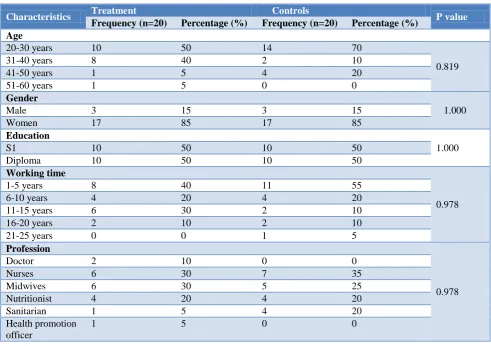
Table 1 Shown that characteristic of age (p=0.819), gender (p=1.000), education level (p=1.000), working time (p=0.978), and profession (p=0.978) were no difference between treatment group and control group (p value >0.05).
Table 2 shows that there were difference of knowledge before and after getting profession collaboration training at treatment group. In treatment group, mean of knowledge increased from 3.45 on pretest, 4.10 on posttest 1, and 4.45 post-test 2. Then, Wilcoxon analysis is done to know the difference of knowledge average in each measurement.
Table 3 shows that there were significant difference knowledge about profession collaboration on the malnutrition in the treatment group on pretest and posttest 1 (p=0.010) and knowledge on pretest and posttest 2. In the control group, there were difference knowledge of profession collaboration on the malnutrition. Knowledge about profession collaboration on the malnutrition increased from 4.05 on pretest, 4.15 on posttest 1, and 4.65 on post-2. Friedman analysis shown that there was
significant difference knowledge of profession
collaboration on the malnutrition before and after getting health education in module term.
Table 4 shown that there was no difference knowledge of profession collaboration on the malnutrition before and after getting information by a module (p=0.527), but there was significant difference knowledge about profession collaboration on the malnutrition between pretest and posttest 2 (p=0.023) and knowledge between posttest 1 to posttest 2 (p=0.019).
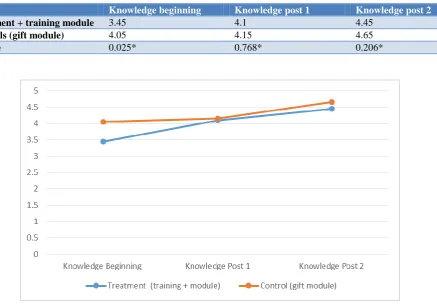
Table 5 also shown that average of knowledge about profession collaboration on the malnutrition was lower in the treatment group (4.1) than control group (4.15). Mann Whitney analysis shown that there was no significant
difference knowledge level about profession
collaboration on the malnutrition between treatment group and control group (0.768).
group. The difference of knowledge about profession collaboration on the malnutrition pre and post
intervention was shown in the Figure 1.
Table 1: Analysis of health worker characteristics in Jeneponto district.
Characteristics Treatment Controls P value
Frequency (n=20) Percentage (%) Frequency (n=20) Percentage (%) Age
20-30 years 10 50 14 70
0.819
31-40 years 8 40 2 10
41-50 years 1 5 4 20
51-60 years 1 5 0 0
Gender
1.000
Male 3 15 3 15
Women 17 85 17 85
Education
1.000
S1 10 50 10 50
Diploma 10 50 10 50
Working time
0.978
1-5 years 8 40 11 55
6-10 years 4 20 4 20
11-15 years 6 30 2 10
16-20 years 2 10 2 10
21-25 years 0 0 1 5
Profession
0.978
Doctor 2 10 0 0
Nurses 6 30 7 35
Midwives 6 30 5 25
Nutritionist 4 20 4 20
Sanitarian 1 5 4 20
Health promotion officer
1 5 0 0
Table 2: Average of Knowledge about profession collaboration on the malnutrition between treatment groups and control group before and after intervention in Jeneponto district.
Group Knowledge beginning Knowledge post 1 Knowledge post 2 Δ P value
Treatment + training module
3.45 4.1 4.45 1 0.006*
Controls (gift module)
4.05 4.15 4.65 0.60 0.006*
Table 3: Wilcoxon analysis about significant change of knowledge before and after intervention in treatment group at Jeneponto district.
Measurement N P
Knowledge pre-test & knowledge post 1 20 0.010
Knowledge pre-test & knowledge post 2 20 0.013
Knowledge post 1 & knowledge post 2 20 0.138
Table 4: Wilcoxon analysis about significant change of knowledge before and after intervention in control group at Jeneponto district.
Measurement N P
The initial knowledge & knowledge post 1 20 0.527
The initial knowledge & knowledge post 2 20 0.023
Table 5: Differences of knowledge about professional collaboration on the malnutrition between treatment group and control group.
Group Knowledge beginning Knowledge post 1 Knowledge post 2
Treatment + training module 3.45 4.1 4.45
Controls (gift module) 4.05 4.15 4.65
P value 0.025* 0.768* 0.206*
Figure 1: Average changes good knowledge about malnutrition, pre post intervention on treatment groups and control.
DISCUSSION
Characteristic of participant shown that most of participants in both groups had an age interval of 20-30 years. Most of participants are female in both group and 50% of participants are bachelor. Most of participants have working time of 1–5 years.
In Friedman analysis shown that there was significant difference average of knowledge about profession collaboration on the malnutrition in the treatment group before and after intervention. The part of knowledge changing were knowledge at pre-test to post-test 1 and knowledge at pre-test to post-test 2. In control group, there was also significant difference average of knowledge about profession collaboration on the malnutrition among health worker after got a module.
The part of knowledge changing were knowledge at pre-test to post-pre-test 2 and knowledge at post-pre-test 1 to post-pre-test 2.
Mann Whitney analysis shown that there was significant difference average of knowledge between treatment group and control group at pre-test. Early shows the value of 0.025 which means that there is a difference between average means treatment groups and control groups. But,
there were no significant difference average of knowledge between treatment group and control group at post-test 1 and post-test 2.
Nutrition problems occur in each cycle of human life, started since in the womb (fetus), baby, children, mature and elderly. The first two years of life period is a critical period because at that time there was a very rapid growth. This condition is very important that we know as 1000 first day of life program.20 One of program to support pregnant woman from government are delivery insurance.21
Child nutritional status can be known by using the
guidelines of nutritional status determination.22
Nutritional problems in the children is a public health. The causing factors of nutrition problem is a multi-factor regarding. So, malnutrition approach and managements must involve all sectors related it.23
causes of nutritional problems, especially malnutrition that occurs in children as a whole by health workers.
Knowledge in constructivist concepts is a person's cognitive construction of the object, experience, and environment. Health education is correlates with understanding of adequate health and behavior to be better when knowledge is also higher.27,28 Knowledge is a continuous form that reorganizes every time because of new insights.28
Knowledge in constructivist concepts is a person's cognitive construction of the object, experience, and environment. Health education is correlates with understanding of adequate health and behavior to be better when knowledge is also higher.27,28 Knowledge is a continuous form that reorganizes every time because of new insights.28 Moreover, information is one of the factors that support knowledge.29,30
Collaboration is a term commonly used in research,
clinical practice, and health professional
education.2 Working inter-professional is not a new concept. Working in a professional collaboration has many benefits and challenges to integrate the workforce of each profession, particularly in health sciences.5 In this
research, a good understanding of profession
collaboration has been owned by the health officers.
Currently, cross-sectoral collaboration has been done in the handling of malnutrition cases. However, such cooperation activities still require social support so that it
can be implemented maximally. Professional
collaboration requires the involvement of various parties such as health services, head of primary health care, head of sub-district, Village Head, cadre, and public figure. The involvement of the child's parents and the support of the surveillance officer becomes important and of concern at the moment. Previous research has suggested that a collaboration between one or more public institutions is directly involved in a formal collective decision-making process
In the malnutrition cases, concrete forms of collaboration across health professions have been implemented but still require social support to be sustainable. The social support is the health officer, the clinic head, head of sub-district, village head, cadre, and public figure. Moreover, the involvement of parents, children, and support surveillance officers become important attention. This is in accordance with the definition of collaboration that collaboration is cooperation between one or more public institutions directly involved in the process of collective decision-making formally.31
Various forms of collaboration have been conducted in health services in the community. This study reveals that there have been many activities in the form of collaboration across the profession of daily health services. These activities are home visits, known as
ammutuli, to monitor firsthand the condition of children with known malnutrition. Ammuntuli as one of the superior program of midwives, referral system between health professions, and posyandu activities in the community. This is in line with a Dutch study demonstrating that cooperation between village midwives and obstetricians has also been evaluated as both sectors are part of a starting point that needs to be improved in care cooperation. This shows the difference in the
intensity of cooperation between health care
professionals.1
CONCLUSION
Health education in the training form increased the knowledge level of profession collaboration on the malnutrition among health worker in Jeneponto district. There was significant difference of knowledge level about professional collaboration on the malnutrition before and after intervention among health worker at primary health care.
Recommendations
This result study suggests to conduct training activities in a sustainable and programmed to improve the quality of health services, particularly handling malnutrition cases.
ACKNOWLEDGEMENTS
We would like to thank district health office of Jeneponto, Primary health care Arungkeke, Togo-Togo, Matene, Tamalatea, Binamu, and Bontoramba. As well as the informants and all parties who have helped the implementation of this study.
Funding: No funding sources Conflict of interest: None declared
Ethical approval: The study was approved by the Institutional Ethics Committee
REFERENCES
1. Posthumus A, Schölmerich V, Waelput A, et al.
Bridging between professionals in perinatal care: toward shared care in the Netherlands. Maternal and Child Health J. 2013;17(10):1981-9.
2. Green ACTION, Johnson CD. Interprofessional
collaboration in research, education, and clinical practice: working together for a better future. J Chiropractic Education. 2015;29(1):1-10.
3. Indonesia KKR. The strategic plan of the Ministry of Health of the year 2015-2019. 2015.
4. Sumarni S. The role of the Community Health
Scholars in 1000 HPK Rescue Movement to reduce stunting and maternal mortality rate. The Seminar & Community Health National Saresehan. 2015: 20-30.
5. Borst J. interprofessional collaboration: an
6. San Martin-Rodriguez L, D'Amour D, Leduc N. Outcomes of interprofessional collaboration for hospitalized cancer variability. Cancer nursing. 2008;31(2):18-27.
7. Bainbridge mcculloch P, Louise Nasmith M, Wood
V. Competencies for interprofessional collaboration. J Physical Therapy Education. 2010;24(1):6.
8. Organization WH. Working together for health: the
World health report 2006: policy briefs. 2006.
9. Grumbach K, Bodenheimer T. Can health care
teams receiving complain primary care practice? The Juma. 2004;291(10):1246-51.
10. Greiner AC, Knebel E. The Institute of Medicine Committee on the Health Professions Education Summit. Health professions education: A bridge to quality. Washington, DC: National Academy Press; 2003.
11. The World Health Organization. Framework for
Action on Interprofessional Education &
Collaborative Practice. 2010: 64.
12. UNICEF. A summary of the study of the health of mothers and children. 2012.
13. Black RE, Victora CG, Walker SP, Bhutta ZA,
Christian P, de Onis M, et al. maternal and child undernutrition and overweight in low-income and
middle-income countries. Lancet.
2013;382(9890):427-51.
14. Rc base. RISKESDAS 2013. The research and
development of the Ministry of Health of the Republic of Indonesia. 2013.
15. Provincial health office of South Sulawesi. Health Profile of South Sulawesi. 2015.
16. District Health Office of Jeneponto. Report on the
implementation of nutrition surveillance at
Jeneponto district level. 2015.
17. Kabupaten Jeneponto Council. Nutrition
Surveillance implementation reports Jeneponto Regency level. 2015.
18. Afiyanti Y, Rachmawati INS. Qualitative research methodology in nursing research. Jakarta: King Grafindo. 2014.
19. Nursalam. Nursing Science Research Methodology.
Jakarta, Salemba Medika. 2013.
20. Thaha RM, Maria IL. An Intervention Study on
Antenatal Class Plus for the Improvement of
Healthy Pregnancy and Safe Childbirth in Gowa
Regency, Indonesia. Pakistan J Nutrition.
2015;14(12):674..
21. Maria IL, Hamzah A. The implementation of the birth Warranty Program (Jampersal) In District health office Buol. Health Policy Admin J Indonesia. 2013;2(02).
22. Hadju V. The determination of the nutritional status. Public Health faculty of the University of Hasanuddin Makassar. 1997.
23. DN Supariasa d. Assessment of nutritional status. EGC medical book publisher. 2002.
24. Susanty M, Kartika M, Hadju V, Alharini Sa. The relationship of breast feeding patterns and MP of breast milk with malnutrition in children be 6-24 months in Kelurahan Pannampu Makassar. Nutrition Media Indonesian society. 2012;1(2):97-103.
25. Ida Leida M, Thaha RR, Ansariadi Ansariadi.
Exclusive Breastfeeding Determinan by Ibu
Multipara in Jeneponto Regency. 2016.
26. Renyoet BS, Hadju V, Rochimiwati S. Foster
pattern relationship with genesis stunting children age 6-23 months in coastal regions Tallo Sub City of Makassar. Nutrients J Science (PA-NSC). 2012:1-13.
27. Notoatmodjo. Health promotion, Theory and
applications. Copyright Rineka, Jakarta. 2010.
28. Chen GD, Huang CN, YS, Lew-Ting CY. Patient
perception of understanding health education and instructions has moderating effect on glycemic control. BMC Public Health. 2014;14(1):979.
29. Suliha. Health education in nursing. Medical books,
EGC, 2002. 2002.
30. Notoatmodjo S. Education and Prioritising Health. Jakarta: Rineka Copyright; 2007.
31. Ansell C, Gash A. Collaborative governance in
theory and practice. J Public Administration Res Theory. 2008;18(4):543-71.