Original Research Article
A study on out of pocket expenditure among the urology patients
covered under health schemes in a teaching hospital
Safiyath Asheela
1, Ghulam Jeelani Qadiri
1, Nagaraj Shet
1*, Prajna Sharma
2INTRODUCTION
Health is one of the most important components of an effective poverty reduction strategy, since health can increase productivity and household income, while poor health is likely to reduce output. Improvements of the health can provide poor households with the opportunity to escape poverty.1 However, use of health services is sometimes associated with out-of-pocket (OOP) payments and it is the primary means of financing healthcare.2 Now-a-days, healthcare costs are rising at a
rate faster than any previous time because of increased aging population, more prevalence of chronic diseases such as urology disorders, and availability of more technically sophisticated costly treatments. Families meet almost 62 % of their health expenses out of their own pockets, placing considerable financial burden on poor households, often pushing them deeper into poverty.3
Urology disorders occur from the earliest stages in development through the end of life, it is any congenital or acquired dysfunction of urinary system. Many are
ABSTRACT
Background: Health is one of the most important components of an effective poverty reduction strategy. However,
use of health services is sometimes associated with out-of-pocket (OOP) payments. Urology disorders are often chronic and affect individuals not by shortening survival, but by impairing quality of life hence posing a substantial economic impact for patients. A well-planned health finance systems protects population against the financial risks of ill-health. This study addressed concerns over high levels of out-of-pocket payments even by those who have insurance coverage.
Methods: Descriptive study was conducted among 160 patients admitted in Urology Department who are covered
under various health schemes for the duration of 6 months.
Results: Of the 160 study participants studied, 129 (80.62%) were males, 37 (23.13%), 64 (40%) were illiterates and
most of the families 127 (79.38%) were from rural area. Various health schemes availed were, 120 (75%) Arogya Karnataka, 8 (11.25%) RBSY Kerala and 6 (3.75%) Sampoorna Suraksha. Expenses other than medical included home care assistance, adaptations to home and cost of parallel treatment. The main source for out of pocket expenditure was borrowing money from relatives or friends 70 (43.8%), self-finance 46 (28.7%) and selling valuables 28 (17.5%). Prevalence of catastrophic health expenditure in our study was 8.75%.
Conclusions: The government should increase the public health spending to reduce the out of pocket expenditure by
the families and the public must be educated about the availability of insurance scheme and their efficient/optimum utilization.
Keywords: Urology, Health insurance, Out of pocket expenditure, Catastrophic expenditure
1
Department of Hospital Administration, Yenepoya Medical College, 2Department of Community Medicine, Kanachur Institute of Medical Sciences, Deralakatte, Mangalore, Karnataka, India
Received: 21 May 2019
Revised: 11 July 2019
Accepted: 12 July 2019
*Correspondence: Dr. Nagaraj Shet,
E-mail: [email protected]
Copyright: © the author(s), publisher and licensee Medip Academy. This is an open-access article distributed under
the terms of the Creative Commons Attribution Non-Commercial License, which permits unrestricted non-commercial use, distribution, and reproduction in any medium, provided the original work is properly cited.
chronic and affect individuals not by shortening survival, but by impairing quality of life. The economic impact of urological diseases is often substantial for patients and families, employers, payers and society.4 As per the health policy (2017), 58% of patients with urological disorder have health schemes. Urology being an area where the cost of treatment is high, most of the patients has to make out-of-pocket (OOP) expenses to meet healthcare-associated costs in the form of co-payment even in the presence of Health Schemes.5
OOP payments are the sum of all payments by patients for outpatient and inpatient health services which are not reimbursed by patient’s health insurance company.6
This also includes food, accommodation, test for diagnosis, revisit, consultation fee, by-standers, drugs, communication, transportation and other additional informal payment.5
A well-planned health finance systems protects population against the financial risks of ill-health.7 According to ILO Health insurance is insurance that covers the whole or a part of the risk of a person incurring medical expenses, spreading the risk over a large number of persons. The "insured" is the owner of the health insurance policy or the person with the health insurance coverage.5 The direct medical expenses are those that are incurred by sick individuals and their families in obtaining treatment.8 The indirect out of pocket expenditures are families who have to devote significant time and resources to look after sick family-members or who suffer significant income losses which in turn reduces the ability of the family to perform their work. Lost labour time due to illness often means household capacity to earn income is reduced at a time when it needs additional money to pay for treatment resulting as opportunity cost.9
The share of OOP health payments in total health expenditures and the subsequent Catastrophic Health Expenditures (CHEs) are the 2 important factors that should be taken into account while planning and designing health policies. Too much reliance on OOP payments prevents countries from reaching universal health coverage (UHC). Utilization of prepayment schemes, such as health insurance, can reduce OOP payments and decrease the risk of CHE.6
Health care finance in developing and low income countries is still predominantly based on OOP payments, due to the lack of prepayment mechanisms like insurance. Health care financing has been a problem due to increase demand for health services and rising health care cost and low coverage of the National Health Insurance Scheme.10 The impact of health care financing systems on the welfare of households, particularly poor households is mainly regarded as an important issue encountered by policy makers when developing healthcare systems and insurance mechanisms.
This study is taken to understand about the opportunity cost and how household is being pushed into poverty or forced into deeper poverty when faced with substantial medical expenses and co-payments. The current address concerns over high levels of out-of-pocket payments even by those who have insurance coverage as a means of financial protection.
METHODS
Descriptive study was conducted in the Urology Department of Yenepoya Medical College Hospital, Deralakkatte. Data was collected from the 160 patients and patient families for the duration of 6 months i.e., from September 2018 to February 2019 in Urology department who are covered under various health schemes.
Inclusion criteria
Families of the patient admitted in urology department covered under health schemes. Those who consent to participate in the study.
Exclusion criteria
Those excluded who were not willing to participate in the study.
The OOP expenditure including the co-payment borne by the patients covered under various Health Scheme was determined by reviewing the records maintained in Account and Billing Section, Third Party Administration (TPA). The information was supplemented by interviewing with a semi-structured questionnaire.
Opportunity cost was found out from the information collected by conducting interview with the patients covered under health schemes by using a semi-structured questionnaire. The information was supplemented by the records maintained by patients were ever available who are covered under the Health Schemes admitted in the Urology department shall be done using a semi-structured questionnaire.
OOP payments are defined as direct payment made by the individual to health care provider at the time of service use. These comprises of expenses for medical care including food, accommodation, test for diagnosis, revisit, consultation fee, bystanders, drugs, communication, transportation and other additional informal payment. It also includes deductibles, coinsurance and copayment for covered services plus all cost for services that are not covered under the health scheme taken by the patients and are not reimbursed by insurance.
of illness is that which imposes cost burden due to income of patient/bystander, alternate use of money, unemployment due to medical condition that result in insufficiency of money to meet the treatment cost, thereby forcing people to borrow, mortgage and sell their asset for treatment.
Statistical analysis
The collected data was entered in the Microsoft excel and analyzed using SPSS software. The quantitative data was summarized using mean and standard deviation. The frequencies were drawn and percentage was calculated to assess the out of pocket expenditure and opportunity cost borne by the patients in the urology department.
RESULTS
Socio-demographic characteristics of study participants
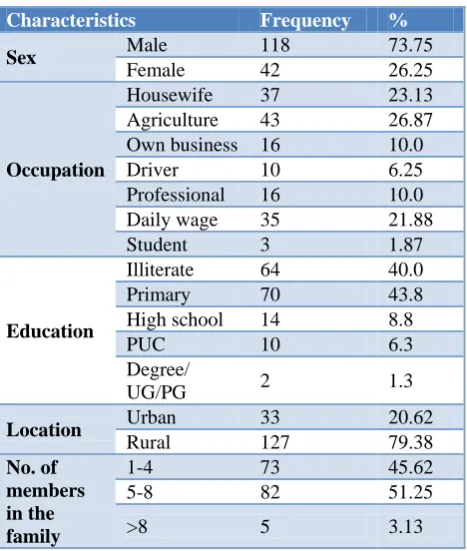
Of the 160 study participants studied, 129 (80.62%) were males, 37 (23.13%) were house-wives, 3 (1.87%) were students, 64 (40%) were illiterates and only 10 (6.3%) and 2 (1.3%) had completed pre university and degree level education respectively.
Most of the families 127 (79.38%) were from rural area, 82 (51.25%) had 5 to 8 family members, 73 (45.62%) of the families had 1 to 4 members and only 5 (3.13%) had more than 8 members in the family (Table 1).
Table 1:Distribution of the study participants based on their socio demographic characteristic.
Characteristics Frequency %
Sex Male 118 73.75
Female 42 26.25
Occupation
Housewife 37 23.13 Agriculture 43 26.87 Own business 16 10.0
Driver 10 6.25
Professional 16 10.0 Daily wage 35 21.88
Student 3 1.87
Education
Illiterate 64 40.0 Primary 70 43.8 High school 14 8.8
PUC 10 6.3
Degree/
UG/PG 2 1.3
Location Urban 33 20.62
Rural 127 79.38
No. of members in the family
1-4 73 45.62
5-8 82 51.25
>8 5 3.13
Table 2:Distribution of the study participants based on health insurance schemes available, premium paid
and its coverage (n=160).
Health insurance
Frequency N (%)
Premiu m paid per month
Coverage
Arogya Karnataka
118 (73.75) 0 1,50,000
2 (1.25) 0 50,000
RBSY
Kerala 18 (11.25) 30 30000
Sampoorna
Suraksha 6 (3.75) 83 30,000
LIC
2 (1.25) 200 15000
8 (5) 250 30000
2 (1.25) 1000 70000
Other private insurances
2 (1.25) 600 45000
Table 3:Distribution of study participants based on their employment status before hospitalization.
Employment status of
study participants Frequency %
Employed before
hospitalization (n=160)
Yes 120 75.0
No 40 25.0
Earning per month (n=120)
<2500 12 10
2500-6000 100 83.33
6001-10000 4 3.33
10001-15000 2 1.67 >15000 2 1.67 Salary
deducted (n=120)
Yes 116 96.67
No 4 3.33
Money deducted (n= 116)
<2500 40 34.48
2500-6000 62 53.45
6001-10000 6 5.17
10001-15000 2 1.72 >15000 6 5.17
Out of pocket expenditure borne by the patients covered
under various Health Schemes admitted in Urology Department
The remaining 2 (1.25%) who had Arogya Karnataka has APL card and were covered up to Rs. 50,000 with no premium. All insurances provided in patient benefits. Eighteen (11.25%) of the study participants who had RBSY Kerala covered up to Rs. 30000 with a premium of Rs. 30 per month. Sampoorna Suraksha was subscribed by 6 (3.75%) of them and were covered up to 30,000. With a premium of Rs. 200 paid per month 2 (1.25%) of them who had subscribed with LIC were covered up to Rs. 15,000, 8 (5%) of them who had paid a premium of Rs. 3000 per annum were covered up to Rs. 30,000 by LIC. 2 (1.25%) of them were covered up to Rs. 70,000 by LIC with a premium of Rs. 3000 per 3 months. Two (1.25%) of them who subscribed private insurance were covered up to Rs. 45,000 with a premium of Rs. 600 per month (Table 2).
Table 4:Distribution of study participants based on the occupation of their by stander.
Employment status of the by
stander Frequency %
By stander took time off work (n=160)
Yes 116 78.8
No 44 21.3
Salary deducted (n=160)
Yes 113 70.63
No 47 29.37
Money deducted (in Rs.
(n=113)
<2500 41 34.48 2500-6000 66 53.45 6001-10000 2 5.17 >15000 4 5.17
Table 5:Distribution of study participants based on the ability to work after discharge.
Employment status of the study participants after discharge
Frequency %
Able to work after
discharge (n=120)
Yes 4 3.33
No 116 96.67
Options of earning if not working (n=116)
Depend on
children 108 93.10 Pension 2 1.73 Send wife to
work 6 5.17
Table 6: Distribution of study participants based on the source for out of pocket expenditure.
Finance source Frequency %
Self-finance 46 28.7
Relatives/ friends 70 43.8
Loan from NGO 6 3.7
Money lenders 4 2.5
Agriculture loan 4 2.5
Kumbashree loan 2 1.3
Sold valuables 28 17.5
Total 160 100
Of the 160 study participants, 120 (75%) were employed before hospitalization of which only 2 (1.67%) had a monthly salary of >Rs. 15000, 2 (1.67%) had a salary of Rs. 10001-15000 and most of them 100 (83.33%) received a salary of Rs. 2500-6000.
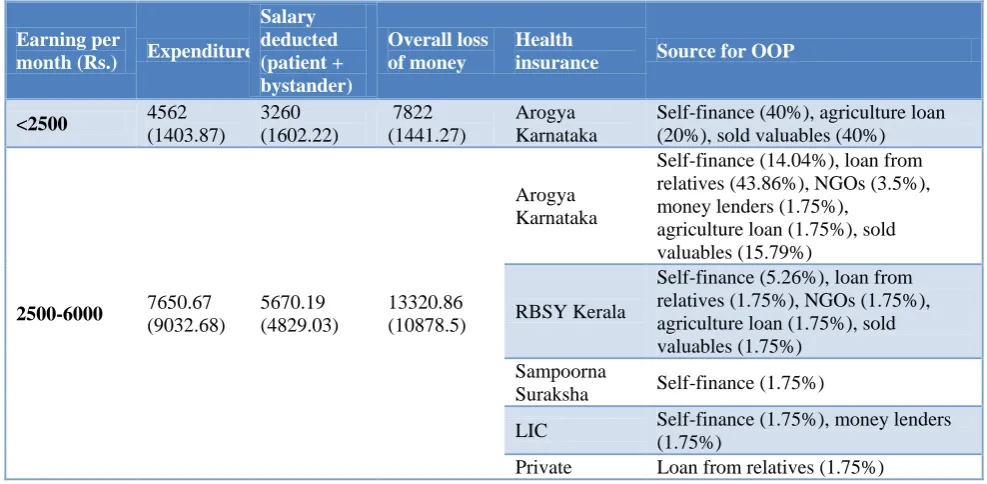
Table 7: Summary of the financial burden and the source for the extra expenses of the study participants.
Earning per
month (Rs.) Expenditure
Salary deducted (patient + bystander)
Overall loss of money
Health
insurance Source for OOP
<2500 4562
(1403.87)
3260 (1602.22)
7822 (1441.27)
Arogya Karnataka
Self-finance (40%), agriculture loan (20%), sold valuables (40%)
2500-6000 7650.67
(9032.68)
5670.19 (4829.03)
13320.86 (10878.5)
Arogya Karnataka
Self-finance (14.04%), loan from relatives (43.86%), NGOs (3.5%), money lenders (1.75%),
agriculture loan (1.75%), sold valuables (15.79%)
RBSY Kerala
Self-finance (5.26%), loan from relatives (1.75%), NGOs (1.75%), agriculture loan (1.75%), sold valuables (1.75%)
Sampoorna
Suraksha Self-finance (1.75%)
LIC Self-finance (1.75%), money lenders
(1.75%)
Earning per
month (Rs.) Expenditure
Salary deducted (patient + bystander)
Overall loss of money
Health
insurance Source for OOP
6000-10000 5942.25
(2415.74)
8458.33 (6664.18)
14400.58 (7036.43)
Arogya Karnatak
Self-finance (25%), loan from relatives (25%), sold valuables (8.3%)
RBSY Kerala Self-finance (8.3%),
Loan from relatives (16.67%) Sampoorna
Suraksha
Self-finance (8.3%)
LIC Self-finance (8.3%)
10000-15000 5750
(2054.0)
7500 (5457.25)
13250.66
(6456.7) LIC
Self-financing (50%), loan from friends (50%)
>15000 9678
(3277.01)
10200 (10266.45)
19878 (12423.71)
Arogya Karnatak
Self-finance (20%), sold valuables (20%) Sampoorna
Suraksha Loan from relatives (20%)
LIC Loan from relatives (40%)
Table 8:Opportunistic cost of patients admitted in Urology Department.
Expenditure Mean S.D.
Food 1165.19 890.658
Test for diagnosis 2245.75 2143.073
Pharmacy 1086.67 1229.028
Transportation 2346.79 2014.661
Revisit 30.00 0.000
Any adaptations to your home such as a ramp, stair lift, changes to the bathroom etc.
3900.00 2518.730
Additional costs due to (parallel) treatment sought by other providers
5568.26 10146.697
Additional informal
payments 594.00 743.075
Home-care assistance 5042.50 5724.428
Any other 299.15 766.021
Table 9:Distribution of study participants based on the prevalence of catastrophic expenditure.
Catastrophic expenditure Frequency %
Yes 14 8.75
No 146 91.25
Total 160 100
Salary was deducted during their absence from work in 116 (96.67%) of them of whom 6 (5.17%) had a loss of >Rs. 15000, Rs. 2500-6000 was deducted from 62 (53.45%) of them and 40 (34.48%) of them had a loss of less than Rs. 2500 (Table 3).
All of the study participants were accompanied by a by stander. Among them 116 (78.8%) had to take time off
from their work out of which 113 (70.63%) had deduction in their salary and 47 (29.37%) of them either did not work or did not take any leave or their salary was not deducted. Only 4 (3.33%) of them who were employed before hospitalization were able to work even after discharge. Others either depended on their children 108 (93.10%), on their pension 2 (1.73%) or sent their wife for work 6 (5.17%) (Table 4 and 5).
The main source for out of pocket expenditure was borrowing money from relatives or friends 70 (43.8%), self-finance 46 (28.7%) and selling valuables 28 (17.5%) Other sources were loan from NGOs 6 (3.7%), money lenders 4 (2.5%), agricultural loan 4 (2.5%) and Kumbashree loan 2 (1.3%) (Table 6).
Table 7 summarizes the amount of money lost by the study participant due to their illness in spite of having health insurance and the source for out of pocket expenditure; the study participants were divided based on their earning per month.
Other expenses were mainly due to home care assistance needed, adaptations to home and cost of parallel treatment which accounted to Rs. 3000-6000. Food, diagnostic tests, medication and transportation accounted for Rs. 1000-3000. Less than Rs. 1000 was spent on revisit charges, informal payments and others. In our study, out of 160 study participants 14 of them had catastrophic health expenditure and hence its prevalence was 8.75% (Table 8 and 9).
DISCUSSION
and 20.62% were from urban area. In a similar study done by Nandi et al in 2017 in Mumbai 53.4% were males and 46.6% were females.11 But the study population in this study was mainly from rural area 81.9% and only 18.1% were from urban area. In another study done by Narayanan et al in Kerala in 2018 only 31.2% were males and 72.3% were females.12 In a study done by Aregbeshola et al in 2018 in Nigeria 50.9% were males, 49.1% were females.13 Most were from rural area (74.1%) and 25.9% were from urban area.
In our study 23.13% were house wives, 1.87% were students and the remaining 75% were employed. Of 160, 40% were illiterates, 43.8% of them had primary education, 8.8% had high school education and only 7.6% had education of pre-university and above. In a study done by Harish et al in 2018 in Mandya 29% were illiterate, 28% primary education, 22% high school education and 21% had pre university and above education.14 In a study done by Aregbeshola et al46.6% were illiterates, 31.7% had primary education, 16.7% had high school education and 5.1% had education of pre-university and above.13
In our study, the average number of members in family was 4.68 and was similar to the study done by Narayanan et al were it was 5.12 In the same study the average number of days in hospital was 6 days which was less compared to our study were the average number of days in hospital was 14 days. The mean annual household income in the above study was Rs. 6044.43 compared to Rs. 83,205 in our study.
In our study the mean (SD) out of pocket expenditure of the study participants was Rs. 13,538.7 (10,240.29) while in a study done by Harish et al the direct health expenditure was found to be a median of Rs. 15,000 and in a study done by Narayanan et al the mean out of pocket expenditure was Rs. 1787.48.12 In the later study the average number of days in hospital was less compared to our study and hence may be the reason for less out of pocket expenditure.
In our study the mean (SD) amount spent on food when hospitalized was Rs1165.19 (890.66), for transportation Rs 2346.79 (2014.66) and for diagnostic tests Rs. 2245.75 (2143.07). In a study done by Harish et al the study participants spent a mean amount of Rs 750 for transportation and Rs 1500 for food.14 While in a study done by Narayanan et al the study participants spent Rs. 370 per hospitalization, by stander expenses were Rs. 732 and Rs. 715 was spent for diagnostic tests.
In our study the main source of out of pocket expenditure was borrowing money from relatives or friends 43.8%, self-finance 28.7% and selling valuables 17.5%. In study done by Nandi et al, the main source was savings (82%), borrowing (16%) and selling valuables (0.2%).11
When prevalence of catastrophic health expenditure was seen our study showed that 8.75% of them had catastrophic health expenditure. Study done by Nandi et al showed the prevalence of catastrophic health expenditure was 35.5%.11 In another study done by Narayanan et al a very high prevalence of catastrophic health expenditure was seen and was around 76%.12 This could be explained by the fact that 72.3% of their study participants were unemployed and the mean annual household income in their study was much less compared to our study as mentioned above.
CONCLUSION
Families faced financial burden even after being covered under health insurance. This shows the drawbacks in the health insurances available. Parallel cost can be cut down to reduce the catastrophic expenditure.
Recommendations
The government should increase the public health spending to reduce the economic burden on households and to reduce the OOP expenditure. Better availability of drugs and diagnostics in public sector are likely to yield results. There is a need to re-orient and strengthen the health policies towards the provision of healthcare and timely monitoring and evaluation of these policies for yielding effective results. Increasing the ceiling for the amount of insurance coverage and including measures to prevent non-medical expenditures might help in protecting the people from the financial risk. Public must be educated about the availability of insurance scheme and their efficient/optimum utilization.
Funding: No funding sources Conflict of interest: None declared
Ethical approval: The study was approved by the Institutional Ethics Committee
REFERENCES
1. Kaul I, Conceiçao P, Goulven KL, Mendoza RU. Providing Global Public Goods, Managing Globalization. 1st ed. Oxford Scholarship; 2003: 26. Available at www.undp.org/globalpublicgoods /globalization/toc.html. Accessed 10 April 2019. 2. World Health Organization. Report of the
commission on Macroeconomics and Health. Geneva: World Health Organization; 2001. 3. McIntyre D, Thiede M, Dahlgren G, Whitehead M.
What are the economic consequences for households of illness and of paying for health care in low- and middle-income country contexts?. Soc Sci Med. 2006;62(4):858-65.
4. Miller DC, Saigal CS, Litwin MS. The demographic burden of urologic diseases in America. Urol Clin North Am. 2009;36(1):11-27. 5. Peters DH, Yazbeck AS, Sharma RR, Ramana
systems for India’s poor: Findings, analysis and options. Health, nutrition and population series. Washington, DC: World Bank group; 2002;1: 24124.
6. Tolla MT, Norheim OF, Verguet S, Bekele A, Amenu K, Abdisa SG, et al. Out-of-pocket expenditures for prevention and treatment of cardiovascular disease in general and specialised cardiac hospitals in Addis Ababa, Ethiopia: a cross-sectional cohort study. BMJ Glob Health. 2017;2(2):e000280.
7. World Health Organization. The World Health Report 2000: Health Systems: Improving Performance. Geneva: World Health Organization; 2000.
8. Sri Lanka Institute for Health Policy Colombo, Paper for Discussion 1st May 2013. Burden of Malaria and other Infectious Diseases in the Asia and Pacific Region Prepared for Regional Malaria Financing Task Force, APLMA.
9. Russell S. The economic burden of illness for households in developing Countries: a review of studies focusing on malaria, tuberculosis, and human immunodeficiency virus/acquired Immunodeficiency syndrome. Am J Trop Med Hyg. 2004;71(2):147-55.
10. Molla AA, Chi C, Mondaca ALN. Predictors of high out-of-pocket healthcare expenditure: an analysis using Bangladesh household income and
expenditure survey. 2010. BMC Health Serv Res. 2017;17(1):94.
11. Nandi S, Schneider H, Dixit P. Hospital utilization and out of pocket expenditure in public and private sectors under the universal government health insurance scheme in Chhattisgarh State, India: Lessons for universal health coverage. PLoS ONE. 2017;12(11):e0187904.
12. Narayanan N, Kodali PB. Out of pocket health expenditure and catastrophic health expenditure among the beneficiaries of comprehensive health insurance scheme in Kerala. Int J Health Sci Res. 2018;8(9):207-14.
13. Aregbeshola BS, Khan SM. Out-of-pocket payments, catastrophic health expenditure and poverty among households in Nigeria 2010. Int J Health Policy Manag. 2018;7(9):798-806.
14. Harish BR, Siddalingappa H, Bharath J. Health insurance coverage and healthcare expenditure pattern in rural Mandya, Karnataka. Int J Community Med Public Health. 2018;5(4):1519-23.
Cite this article as: Asheela S, Qadiri GJ, Shet N, Sharma P. A study on out of pocket