Gender and Entrepreneurial Process: Analysing the Gender
Gap Through Theoretical Lens
Diani Asmae
University Of Sidi Mohamed Ben Abdellah Fèz (Morocco)
Aligod Salwa
University Of Sidi Mohamed Ben Abdellah Fèz (Morocco)
Abstract
Being a significant component of the contemporary business world, entrepreneurship is considered as a key element of economic growth worldwide, especially in developing countries. Accordingly, the equal participation of both male and female citizens in entrepreneurial activities is critically important. However, women in most countries start ventures at a lower rate than men (GEM, 2018). In addition, many studies show significant differences between male and female entrepreneurs in launching and managing entrepreneurial ventures.The reasons behind those disparities are still understudied. This paper consists of a comprehensive review of literature on gender and entrepreneurship, it identifies the factors that promote or inhibit female entrepreneurship initiatives and try to shed light on the gender gap in the entrepreneurship process. To address these concerns, we use the theoretical framework of the feminist theory and that of the entrepreneurship process approach to structure our literature review.
Keywords: Entrepreneurial Process, Gender Gap, Feminist Theories, Review
1. INTRODUCTION
By the start of the twenty-first century, entrepreneurship has become a burgeoning research field worldwide. It is considered as a source of economic development, innovation and growth which developed researcher’s interest and made it an important issue on the agendas of economists and politicians in most countries (Banón and Esteban-Lloret, 2016). However, from a gender perspective, entrepreneurship does not allow equal participation of both male and female citizens(Kelley et al., 2016).
Indeed, the Global Entrepreneurship Monitor (GEM) program shows that women in most countries are starting ventures at a lower rate than men. They are managing only one-third of formel economy enterprises around the world, and the majority of those operating in developing economies are very small businesses with limited growth potential (OIT, 2016).According to the report of the GEM (2018-2019), the gender gap in entrepreneurship is undeniable. Figure 1 shows that the percentage of women involved in starting a business venture (Female TEA1) in most economies of the study sample are far lower than Male TEA. In Morocco,a developing country, for example, while Male TEA is 9.2% of adult male population, FemaleTEA is only 4.3% which ranks Morocco in the 44th position out of the 49 studied economies.
Figure 1: Gender Distribution of TEA
Source: GEM Report (2018-2019), p.21
1
Beyond the under-representation of women in companies of all sizes, through history, entrepreneurship has always been a gendered phenomenon in favour of men (Rouse, Treanor and Fleck, 2013) based on the assumption that an entrepreneur is naturally a man. In order to understand and face the ongoing gender gap, research on gender and entrepreneurship have received and continue to receive considerable attention among academic communities, public policy makers and research funding institutions (Luiz et al., 2019). However,a large part of scholarly work on gender and entrepreneurship focus particularly on women’s entrepreneurship rather than including both male and female entrepreneurs in a comparative perspective.They use sometimes inappropriate or gender-biased measures (Bruin, Brush and Welter, 2007) and include female-male comparative studies in which women’s subordinate role is consistently highlighted (Ahl, 2006) which restrict the field’s development. Additionally, according to Greene et al., (2003), in their meta-analysis of the literature, 94% of the papers in the field are empirical and lack of a rigorous theoretical framework. To deal with this situation and to help respond to the perceived gap in the literature, there are increasingly strong calls for scholars to take their research in new directions(Ahl, 2006; Ahl and Nelson, 2010; Hughes et al., 2012) and especially to use feminist approaches (Henry, Foss and Ahl, 2016).
In response to those calls, many researchers have followed the feminist perspective, in particular, Ahl and Marlow, (2012),Muntean and Ozkazanc-Pan, (2015) and others; but there is still much to be done(Sullivan and Meek, 2012). Thus, through this paper, we aim to contribute to fill the gap mentioned above by using feminist perspectives in conjunction with the entrepreneurial process paradigm in order to answer the following research question: Which factors promote or inhibit female in comparison with male entrepreneurship in each stage of the entrepreneurial process?
Rather than being a single event, entrepreneurship is a process (Guzman and Kacperczyk, 2018).As such, The objective of this study is twofold. First, to review the existing factors that affect the female/male entrepreneurship using social and liberal feminist theories. Second, to organize the literature within anentrepreneurship process model, so as to demonstratein which stage of the process the gender gap is more explicit.
The following sections present the approaches mobilized in the literature review, the methodology and the research findings.
2. NEW APPROACHES FOR THE STUDY OF GENDER AND ENTREPRENEURSHIP
Throughout our literature review on gender and entrepreneurship, we focused on identifying the limits of previous reviews and using innovative theoretical framework in order to advance the field. Thus, we use two main approaches in the current paper. The first is the feminist approach, that aims to understand the implications and consequences of the gender on various phenomena (in this case entrepreneurship). The second is the process-based approach of entrepreneurship which does not reduce entrepreneurship to the restrictive sense of business creation (Verstraete and Fayolle, 2005).
2.1 Feminist frameworkto the study of gender and entrepreneurship
The gender concept is theoretically complex and is usually confused with sex, this is the reason why most research on gender and entrepreneurship focus mainly on women entrepreneurship without integrating their male counterparts. It is particularly important to clarify the difference between the two concepts. While sex is a biological concept related to the physiology and anatomy that divides humans into women and men (Giddens, 2006), gender is a social construct that regards social practices and representations associated with feminity or masculinity(Ahl, 2007). Accordingly, the feminist thinking movement states that there are inequalities in society that disadvantage women in relation to men and these inequalities need to be corrected(Fischer, Reuber and Dyke, 1993). While existing studies of women entrepreneurs often compare women with men without considering how gender and gender relations impact the very concepts and ideas of entrepreneurship (Muntean and Ozkazanc-Pan, 2015), deploying a feminist framework will help to understand the “gender gap” in entrepreneurship. Thus, we borrowed from feminist literature two perspectives that constitute the major categories of feminist thought (Fischer, Reuber and Dyke, 1993),in order to structure our literature review and provide an answer to our research question. These two feminist theoretical lenses are, the Liberal feminism and, the social feminism.
2.1.1 The liberal feminist theory
Unger and Crawford (1996), expose the liberal perspective by pointing out the similarities between men and women and the belief that, in the same contexts, they will act similarly. As a result, men and women do not differ in their rationality, but they behave differently because they don’t have access to the same opportunities(Fischer, Reuber and Dyke, 1993).
significantly contributed to the adoption of laws and policies prohibiting different forms of discrimination in the areas of education, employment, and wages.
The application of the liberal perspective to the sphere of entrepreneurship advocates for equal opportunity to women as for men and assume that the removal of institutional and legal barriers will enable both male and female entrepreneurs to achieve equitable entrepreneurial outcomes (Muntean and Ozkazanc-Pan, 2015). It states that women entrepreneurs are particularly disadvantaged compared to men because of overt discrimination and/or systemic factors that deprive them of vital resources such as education and work experience (Fischer, Reuber and Dyke, 1993). Therefore, it is hypothesized that firms created by women underperform compared to those created by men because of the aforementioned discrimination (Watson, 2010). Women entrepreneurs also face barriers in access to funding, work experience and networks (Brindley, 2005).
2.1.2 The social feminist theory
The social feminist theory takes its origins from diverse theories, ranging from social learning theory to psychoanalysis(Bristor and Fischer, 2002). It shows that there are differences between males and females experiences from the earliest moments of life that result in fundamentally different visions of the world.This perspective is completely opposed to liberal feminism. Women and men are not considered to be essentially the same (Bristor and Fischer, 2002). Rather than emphasizing the different opportunities encountered by men and women, the Social Feminist theory focuses on the life-long socialization of men and women. It defends the idea that ‘due to differences in early and ongoing socialization, women and men do differ inherently. However, it also suggests that ‘this does not mean women are inferior to men, as women may develop different but equally effective traits’ (Fischer, Reuber and Dyke, 1993).Morris et al., (2006) support this perspective and provide that socialization throughout life leads to differences between men and women. Consequently, Social Feminists request a revision of the predominant social structures in order to allow men and women to participate in a wider range of roles and eradicate the subordination of women due to traditional roles (Bristor and Fischer, 2002).
In terms of entrepreneurship, the application of the social perspective recognizes that women entrepreneurs may adopt different but equally effective approaches in business compared to male entrepreneurs (Watson, 2010). In fact, women and men entrepreneurs can identify different opportunities according to the different human capital they have, but that does not undervalue opportunities developed by women (DeTienne and Chandler, 2007).
In sum, liberal and social feminist theories differ fundamentally in their way of interpreting the differences between men and women. While social feminists say that men and women are different, liberal feminists emphasize they are essentially the same. Based on this, the two perspectives cannot be reconciled. However, considered together, their explanations for women's situations, seem richer and more complete than what each theory can offer alone. Thus, to better understand the female and male experience in the entrepreneurial field, an analysis based on the two theoretical perspectives advanced seems to be relevant and necessary.
2.2 Entrepreneurial process approach
Entrepreneurship approaches differ according to the questions that have guided research in the entrepreneurship field. Starting from the last two centuries, entrepreneurship refers to a functional approach used mainly in the economic field (what). Then, in the 1950s, entrepreneurship had moved to an individual approach used primarily in psychology and sociology (why and who).Currently, entrepreneurship research focuses more on a process-based approach used mainly todevelop management sciences or organizational theories (how) (Omrane, Fayolle and Zeribi-BenSlimane, 2015).
In fact, the processual approach in entrepreneurship exists since the pioneering work of Jean-Baptiste-Say.He emphasized that an entrepreneur must first acquire knowledge, gather the means necessary for the production and finally preside over its execution (Say, 1815).However, it’s only since the early 1990s that research in entrepreneurship has changed orientation to focus more on the entrepreneurial process. Indeed, many entrepreneurship scholars state that it is reductive to limit the study of entrepreneurship to personal traits or behaviours and it seems rather interesting to engage new research orientations that consider the dynamic and processual aspect of the field.
2.2.1 Stages of the entrepreneurial process
the significance of the entrepreneurial process and have attempted to formalize and model its different stages.The following table summarizes most ofthe entrepreneurial process models developed in the literature.
Table1: Entrepreneurial Process Models
Authors Entrepreneurial process stages
Shapero and Sokol (1982)
Negative displacement or positive pull Perception of desirability
Perception of feasibility Company formation Gibb and Ritchie (1982)
Moore(1986)2
Innovation Triggering Event Implementation Growth
Learned (1992)3
Propensity to create Intention to create Structuring of information Decision
Krueger (1993)
Entrepreneurial Experiences: Breadth and Positiveness Perceived Desirability
Perceived Feasibility Entrepreneurial Intentions Propensity to Act
Bruyat (1993)
The process trigger Engagement and action
Survival and business development
Bhave (1994)
Opportunity stage
Technology setup and organization creation stage Exchange stage
Shane and Venkataraman (2000)
The Existence of Entrepreneurial Opportunities The Discovery of Entrepreneurial Opportunities The Decision to Exploit Entrepreneurial Opportunities
Tounès (2003)
Entrepreneurial propensity Entrepreneurial intent Decision to create a business Entrepreneurial Act
Shook, Priem, and McGee (2003)
Entrepreneurial intent
Opportunity search and discovery
Decision to exploit by new venture creation Opportunity exploitation activities
Filion, Borges and Simard (2006)
Initiation Preparation Start-up Consolidation
Baron and Henry (2010)
Entrepreneurial motivation
Entrepreneurial opportunity recognition Acquiring essential entrepreneurial resources Entrepreneurial success/ performance
Hanage, Davies and Scott (2014)
Entrepreneurial Intent Potential for success Business Planning Start-up
Operation Exit Source: Compiled by authors
Although the entrepreneurial process models presented above differ in their composition and in the number of phases they include, they do have important common elements for new venture creation. For example, the entrepreneurial intent stage was developed since the pioneering work of Gibb and Ritchie (1982), Krueger (1993),and is still crucial in recently built models, especially that of Tounès (2003) and Shook et al., (2003).The entrepreneurial propensity, motivation or trigger are also presented in many models. In this paper,
2
Cited by Bygrave, (2011) 3
we have chosen to structure the literature review on gender and entrepreneurship within Tounès’s model simply because it appears generic and realistic. The next section provides detailed information on the chosen model in order to justify our choice.
2.2.2 Tounes’s model of the entrepreneurial process
According to Tounès (2003), while the descriptive approach of entrepreneurship seeks to understand the role of the entrepreneur in the economy and society, and the behavioural approach explains the actions and behaviours of the entrepreneurs by situating them in their specific contexts, the process approach aims to analyze in a temporal and contingent perspective, the personal and environmental variables that promote or inhibit entrepreneurship, entrepreneurial actions and behaviours. Based on the entrepreneurial event model of Shapero and Sokol (1982) which is a reference framework in entrepreneurship and Ajzen's theory of planned behaviour (Ajzen,1991), Tounès formalized the entrepreneurial process by emphasizing four important stages: Propensity, Intent, decision and act (Figure 2).
Figure 2 : Tounes’s model of entrepreneurial process
Source: adapted from (Tounès, 2003, p. 47)
The first phase of the entrepreneurial process is entrepreneurial propensity. It is defined as an inclination, a tendency to engage an entrepreneurial adventure. It is a combination of psychological characteristics and professional experiences and can be influenced by family, relatives and other internal or external factors (Tounès, 2003).
The second stage is the entrepreneurial intent, it’s considered as the key that leads to the action and to the effective creation of a business (Ajzen, 1991). the entrepreneurial intent differs from the entrepreneurial propensity because of the existence of formalized idea or business project, and personal commitment (time, money and energy) in the process of starting a business(Tounès, 2003). In order to achieve the entrepreneurial act, the intention can be transformed into a decision which leads to the 3rd stage of the entrepreneurial process. The difference between the two concepts is essentially related to the finalization of the idea and the business plan in all its extremely complicated details and the mobilization of all required resources (human, financial and social capital)(Tounès, 2003).
The last stage presented by Tounès is the entrepreneurial act. It refers to physical venture creation and the start of the activity through the achievement of the first products or services(Diamane and Koubaa, 2016). We qualify Tounes’s model as realistic and generic because in addition to the phases presented, it highlighted the possibility of abandoning the entrepreneurial process before reaching the venture creation which is very common especially in the Moroccan context where the entrepreneurial intention is 39.8% compared to the TEA which is only 6.7% in 2018 (GEM, 2018).
3. METHODOLOGY
Based on Williams's (2018) article that summarised the book of Onwuegbuzie and Frels (2015) which presents the 7 steps of acomprehensive literature review (CLR), our methodology consists of three generic activities :
• Identifying the topic of research
Both author’s field of interest is entrepreneurship. Thus, the publication of the GEM reports, that regularly points the gender gap and the intention-action gap between men and women worldwide caught their attention and leads them to the present research question.
• Research launch
The literature review was done gradually by first doing separated research on each keyword, then by combining gender and entrepreneurship, gender and entrepreneurial process and finally gender and each
Entrepreneurial Propensity
Entrepreneurial Intent
Decision to create
Entrepreneurial Act
Pursue or Abort
(Choices made on the basis of personal or situational influences)
Entrepreneurial Apritudes
stage of the process on different search engines and scientific databases such as google scholar, emerald insight, Cairn, etc. The research was conducted in both languages English and French.
• Organizing, analyzing and synthesising information
Articles, reports, and theses collected necessarily included at least one of the keywords in their title and/orin their abstract and were organized through the bibliographic management software Mendeley.
The advancement of the research review has refined our research question in terms of the gap raised by previous literature reviews and led to the findings presented in the following section.
4. FINDINGS AND DISCUSSION
Traditionally, entrepreneurship had always been considered as a male activity and even if in recent years there had been a trend for change, the gender gap in entrepreneurship is still faced in most countries (Only six of 49 economies surveyed by GEM in 2018 show roughly equal TEA rates between women and men). Is that because women do not have access to the same opportunities as men (Liberal Perspective)? Or because of the early and ongoing differences in the socialization process (social perspective)? are there any gender-specific barriers and opportunities? If so, at which stage of the entrepreneurial process do they occur?
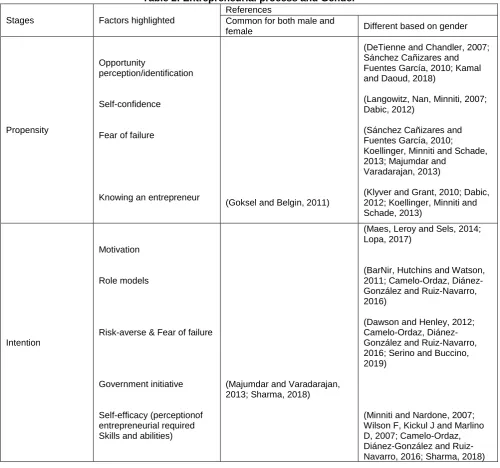
In order to offer an in-depth view of the gender gap in entrepreneurship, but without claiming to be exhaustive, our results are listed in the table below.
Table 2: Entrepreneurial process and Gender
Stages Factors highlighted
References
Common for both male and
female Different based on gender
Propensity
Opportunity
perception/identification
Self-confidence
Fear of failure
Knowing an entrepreneur
(Goksel and Belgin, 2011)
(DeTienne and Chandler, 2007; Sánchez Cañizares and Fuentes García, 2010; Kamal and Daoud, 2018)
(Langowitz, Nan, Minniti, 2007; Dabic, 2012)
(Sánchez Cañizares and Fuentes García, 2010;
Koellinger, Minniti and Schade, 2013; Majumdar and
Varadarajan, 2013)
(Klyver and Grant, 2010; Dabic, 2012; Koellinger, Minniti and Schade, 2013)
Intention
Motivation
Role models
Risk-averse & Fear of failure
Government initiative
Self-efficacy (perceptionof entrepreneurial required Skills and abilities)
(Majumdar and Varadarajan, 2013; Sharma, 2018)
(Maes, Leroy and Sels, 2014; Lopa, 2017)
(BarNir, Hutchins and Watson, 2011; Camelo-Ordaz, Diánez-González and Ruiz-Navarro, 2016)
(Dawson and Henley, 2012; Camelo-Ordaz, Diánez-González and Ruiz-Navarro, 2016; Serino and Buccino, 2019)
Stages Factors highlighted
References
Common for both male and
female Different based on gender
Decision
Human capital
Social capital
Financial capital
(Foss, 2010; Watson, 2011)
(Arenius and Autio, 2006; Hill, Leitch and Harrison, 2006; Carter, Shaw, 2007)
(Orser, Riding and Manley, 2006; Coleman, 2007; Fairlie and Robb, 2009; Shaw et al., 2009)
(Verheul and Thurik, 2001; Drakopoulou Dodd and Patra, 2002; Klyver and Grant, 2010; Fielden and Hunt, 2011; Shaw, 2011)
(Coleman, 2000; Coleman and Robb, 2009; Bellucci, Borisov and Zazzaro, 2010; North, Baldock and Ekanem, 2010; Kalafatoglu and Mendoza, 2017)
Action
Administrative formalities
Entrepreneurial support
Nature of the project
Events
(Bernard, Moign and Nicolaï, 2013)
(Badia, Brunet and Kertudo, 2013)
(Badia, Brunet and Kertudo, 2013; Bernard, Moign and Nicolaï, 2013)
(Hayat, 2012; Badia, Brunet and Kertudo, 2013)
Source: Compiled by authors
Thus, table 2 summarizes the large body of literature on gender and entrepreneurship by identifying the most highlighted factors that influence female in comparison with male entrepreneurial processes. These findings can be analysed through the feminist theoretical framework.
From a social feminist perspective, we note that the gender gap in the early stages of the entrepreneurial process, especially, the entrepreneurial propensity and intention, are generally, but not always, due to socialisation differences. Indeed, women tend to perceive naturally themselves in a less favourable light than men (Langowitz, Nan, Minniti, 2007; Dabic, 2012). Moreover, women demonstrate a great fear of failure (Koellinger, Minniti and Schade, 2013), and are less likely to be acquainted with an entrepreneur (Klyver and Grant, 2010; Koellinger, Minniti and Schade, 2013) which prevent them from perceiving equal opportunities as men do (Sánchez Cañizares and Fuentes García, 2010; Kamal and Daoud, 2018). These concerns reduce women’s propensity to start a business (Koellinger, Minniti and Schade, 2013). Additionally, Detienne and Chandler argue that ‘the differences between male and female experiences and socialization processes allow them to develop unique human capital which in turn impacts opportunity identification’ (DeTienne and Chandler, 2007, p. 368). However in the Turkish context, Goksel and Belgin (2011) state that there are no entrepreneurial propensity differences between men and women, those with entrepreneurial families and those without.
entrepreneurial abilities restrict women’s attitudes toward entrepreneurship (Yordanova and Tarrazon, 2010; Camelo-Ordaz, Diánez-González and Ruiz-Navarro, 2016). In addition, women have fewer role models which undermine their entrepreneurial self-efficacy and, ultimately their entrepreneurial intention (BarNir, Hutchins and Watson, 2011; Camelo-Ordaz, Diánez-González and Ruiz-Navarro, 2016).
Other factors, such as risk aversion and government bureaucracy, can lead to the gender gap in the level of venture creation intent between men and women (Dawson and Henley, 2012; Serino and Buccino, 2019).In the Moroccan context, for example, the following comparison ( figure 3 ) based on the GEM work corroborate our findings.
Figure 3: The distribution of personal attitudes related to entrepreneurs by gender in Morocco
Source: adapted from(Ouazzani,2015, p. 38)
From a Liberal Feminist perspective, the LR shows that the disparities between men and women which occur in the latest stages of the entrepreneurial process, especially decision and entrepreneurial action, are mainly due to the structure of the society where women are discriminated and do not have the same opportunities as male entrepreneurs. Accordingly, institutional barriers to education, work experience, networks and access to capital are the main reasons behind the mentioned gender gap in entrepreneurship(Kalafatoglu and Mendoza, 2017). In this paper, we identified three types of capital: human capital, social capital and financial capital. Human capital refers to education, experience and training. It is extremely important fo entrepreneurial activities. However, female business owners have fewer years of experience and were less likely to have graduated from college than male business owners (Orser, Riding and Manley, 2006; Coleman, 2007). They also lack management experience which is important for launching and developing a business (Fairlie and Robb, 2009; Shaw et al., 2009). Even when female participants in some empirical studies had the same level of education as male, they still lacked perceived knowledge which illustrates the importance of self-efficacy to overcome the gender gap.
In addition, another factor underlying the gender gap in entrepreneurship has been social capital or networks. The findings presented in the above table show that early research report that female entrepreneurs are underrepresented in entrepreneurial networks as they spend less time on it and do have poorer access than male entrepreneurs (Verheul and Thurik, 2001; Drakopoulou Dodd and Patra, 2002). Late research, however, emphasises that women can be as active as men in networking (Foss, 2010; Watson, 2011).We would point out that networking can impact the outcoming factor, which is the financial capital. As Shaw (2011) posits, women do have difficulty in joining informal networks and as such, they may be less likely to secure growth finance than men.
range of criteria to assess loan applications and overall these did not vary on the basis of the entrepreneur’s gender (Carter and Ram, 2003). This may even point to a new trend where women are a good source of income for bankers and investors (Ibid).
The final important issue concerning financial capital we want to add is the different manner of women in accessing finance. As they appear to be more risk-averse than men, they do apply for smaller amounts of fundings, started their businesses with significantly less capital and were not embedded as heavily as men in the early years of the venture creation (Coleman and Robb, 2009; Bernard, Moign and Nicolaï, 2013). Viewed through the social feminist perspective, this issue suggests that women and men operate their businesses in a different manner which is due to their socialisation process differences.
Finally, although the effective start of entrepreneurial activity can be affected by all previous factors, there is specific obstacles and levers for entrepreneurial action. In fact, administrative formalities could inhibit effective business creation for both men and women (Bernard, Moign and Nicolaï, 2013). An entrepreneur can also abandon its project or put it on standby when an opportunity for salaried employment arises even if it does not necessarily correspond to hi expectations (Hayat, 2012). However, entrepreneurial support improves project success and restricts the risk of non-completion (Badia, Brunet and Kertudo, 2013). In addition, the nature of the project, it’s feasibility and its coherence with the entrepreneur's previous carrier and background can block or facilitate the transition to entrepreneurial action (Ibid).
From a gendered perspective, Bernard et al. (2013) found that women invest more than men in health and education and less in industry and construction. They have smaller businesses that generate a slower pace than men-owned businesses (Badia, Brunet and Kertudo, 2013). Women consider family support and especially their husband’s support as a lever for action because it allows simultaneous management of family and entrepreneurial life (Ibid). In contrast, because of pregnancy, newborn or a marriage, a woman can delay the venture creation or even abandon her project. She can also renounce or concretise the entrepreneurial act depending on the professional projects of the husband. These findings can be explained by the social feminist view, that due to innate differences and socialisation process women and men do differ inherently.
To summarise, the review of the existing literature on gender and entrepreneurship revealed a set of common factors that promote or inhibit female versus male entrepreneurship at different levels. However, some factors are specific to female entrepreneurship. Accordingly, positive common factors are self-confidence in entrepreneurial skills and abilities, role models, access to entrepreneurial required resources (financial, social, human), coherence of the project and entrepreneurial support.On the other hand, negative common factors arefear of failure, risque aversion, administrative formalities and lack of required resources (financial, social, human).These factors are certainly common to entrepreneurial activity whether initiated by a woman or a man, but women tend to have fewer positive factors and face at a higher level than men negative factors which illustrate the entrepreneurial gender gap. Furthermore, specific positive factors to female entrepreneurs are family encouragement especially the husband’s support and the fact that entrepreneurship allows simultaneous management of family and workdemands.On the negative side, women can put her project on stand by or even renounce to the entrepreneurial act because of positive change in her personal life (engagement, marriage, pregnancy) or depending on her husband’s professional projects such as job mutation.
Taken together, the liberal and social Feminist theories afford a relevant explanation of the gender gap in entrepreneurship. While the liberal perspective considers women and men to be essentially the same and points out the unequal opportunities faced by women, the social perspective emphasises the differences in early and ongoing socialization. Thus, in order to face the gender gap, potential solutions should recognise the two perspectives.
5. CONCLUSION
In recent years, there has been progress in narrowing the gender gap in entrepreneurship(Kelley et al., 2016), but it is difficult, if not impossible, to definitively eliminate them in some contexts than in others. Indeed, the differences between male’s and female’s experiences and socialization processes (social perspective) allow men and women to perceive the world around them with ‘different eyes’ (Klyver and Grant, 2010) and to develop unique human capital which guides their entrepreneurial behaviour. That is why the factors identified within the literature may vary according to the context.
REFERENCES
Ahl, H. (2006) ‘Why Research on Women Entrepreneurs Needs New Directions’, ETP, (1984), pp. 595–621.
Ahl, H. (2007) ‘Sex business in the toy store: A narrative analysis of a teaching case’, Journal of Business Venturing, 22(5), pp. 673–693. doi: 10.1016/j.jbusvent.2006.10.007.
Ahl, H. and Nelson, T. (2010) ‘Moving forward: institutional perspectives on gender and entrepreneurship’, International
Journal of Gender and Entrepreneurship, 2(1), pp. 5–9. doi: 10.1108/17566261011044259.
Ahl Helene and Marlow Susan (2012) ‘Exploring the dynamics of gender, feminism and entrepreneurship: advancing debate to escape a dead end?’, Organization, 19(5), pp. 543–562. doi: 10.1177/1350508412448695.
Ajzen, I. (1991) ‘Theory of Planned Behavior’, Journal of Health Psychology, 12(1), pp. 1–8. doi: 10.1037/t15668-000.
Arenius, P. and Autio, E. (2006) ‘Financing of small businesses: Are Mars and Venus more alike than different?’, Venture
Capital, 8(2), pp. 93–107. doi: 10.1080/13691060500433793.
Badia, B., Brunet, F. and Kertudo, P. (2013) ‘Les freins et obstacles à l’entrepreneuriat féminin’, Recherche sociale, 208(4), p. 7 à 57. doi: 10.3917/recsoc.208.0007.
Banón, A. R.-B. and Esteban-Lloret, N. (2016) ‘Cultural factors and gender role in female entrepreneurship’, Most, pp. 1– 12. doi: 10.1016/j.neuroscience.2007.02.020.
BarNir, A., Hutchins, H. M. and Watson, W. E. (2011) ‘Mediation and Moderated Mediation in the Relationship Among Role Models, Self-Efficacy, Entrepreneurial Career Intention, and Gender’, Journal of Applied Social
Psychology, 44(2), pp. 270–297. doi: 10.1007/978-3-642-04380-2_81.
Baron, R. A. and Henry, R. A. (2010) ‘Entrepreneurship: The genesis of organizations.’, in APA handbook of industrial and
organizational psychology, Vol 1: Building and developing the organization., pp. 241–273. doi:
10.1037/12169-008.
Bellucci, A., Borisov, A. and Zazzaro, A. (2010) ‘Does gender matter in bank-firm relationships? Evidence from small business lending’, Journal of Banking and Finance. Elsevier B.V., 34(12), pp. 2968–2984. doi: 10.1016/j.jbankfin.2010.07.008.
Bernard, C., Moign, C. Le and Nicolaï, J. P. (2013) L’entrepreneuriat féminin: Document d’étape, Centre d’Analyse
Stratégique. doi: 10.1787/g2611ee38a-fr.
Bhave, M. P. (1994) ‘A process model of entrepreneurial venture creation’, Journal of Business Venturing, 9(3), pp. 223– 242. doi: 10.1016/0883-9026(94)90031-0.
Bosma, N. and Kelley, D. (2018) Global Entrepreneurship Monitor, Global Entrepreneurship Research Association. Available at: http://www.gemconsortium.org/.
Brindley, C. (2005) ‘Barriers to women achieving their entrepreneurial potential: Women and risk’, International Journal of
Entrepreneurial Behaviour and Research, 11(2), pp. 144–161. doi: 10.1108/13552550510590554.
Bristor, J. M. and Fischer, E. (2002) ‘Feminist Thought: Implications for Consumer Research’, Journal of Consumer
Research, 19(4), p. 518. doi: 10.1086/209320.
Bruin, A. De, Brush, C. G. and Welter, F. (2007) ‘Advancing a Framework for Coherent Research on Women’s Entrepreneurship’, Entrepreneurship: Theory and Practice, (781), pp. 323–339.
Bruyat, C. (1993) CRÉATION D ’ ENTREPRISE : CONTRIBUTIONS ÉPISTÉMOLOGIQue.
Bygrave, W. D. (2011) ‘The entrepreneurial process’, New perspectives on economic development, pp. 43–64. doi: 10.3920/978-90-8686-716-5_3.
Bygrave, W. D. and Hofer, C. W. (1991) ‘Theorizing about Entrepreneurship’, Entrepreneurship Theory and Practice, 16(2), pp. 13–22. doi: 10.1177/104225879201600203.
Camelo-Ordaz, C., Diánez-González, J. P. and Ruiz-Navarro, J. (2016) ‘The influence of gender on entrepreneurial intention: The mediating role of perceptual factors’, BRQ Business Research Quarterly. ACEDE, 19(4), pp. 261–277. doi: 10.1016/j.brq.2016.03.001.
Carter, Shaw, F. wilson and L. (2007) ‘E T & P Bank Lending : The Criteria and Processes Used by Bank Loan’,
Entrepreneurship: Theory and Practice, pp. 427–445.
Carter, S. and Ram, M. (2003) ‘Reassessing Portfolio’, Small Business Economics, 21, pp. 371–380. Available at: http://content.ebscohost.com/ContentServer.asp?EbscoContent=dGJyMMvl7ESep7I4yNfsOLCmr1Gep7NSsq 64SLCWxWXS&ContentCustomer=dGJyMPGrtU6wrrNKuePfgeyx9Yvf5ucA&T=P&P=AN&S=R&D=bth&K=11 673115.
Coleman, S. (2000) ‘Access to capital and terms of credit: A comparison of men-and women-owned small businesses’,
Journal of Small Business Management, 38(3), pp. 37–52.
303–319. doi: DOI: 10.1111/j.1540-627X.2007.00214.x.
Coleman, S. and Robb, A. (2009) ‘A comparison of new firm financing by gender: Evidence from the Kauffman Firm Survey data’, Small Business Economics, 33(4), pp. 397–411. doi: 10.1007/s11187-009-9205-7.
Dabic, M. (2012) ‘Exploring gender differences in attitudes of university students towards entrepreneurship An international survey’, pp. 316–336. doi: 10.1108/17566261211264172.
Dawson, C. and Henley, A. (2012) ‘Gender, Risk, and Venture Creation Intentions’, Journal of Small Business
Management, pp. 501–515. doi: 10.1111/jsbm.12080.
DeTienne, D. R. and Chandler, G. N. (2007) ‘The Role of Gender in Opportunity Indentification’, Entrepreneurship: Theory
and Practice, (970), pp. 365–386.
Diamane, M. and Koubaa, S. (2016) ‘Les approches dominantes de la recherche en entrepreneuriat.’, Conférence paper,
2ème Colloque international sur L’entrepreneuriat et le développement des PME dans le monde, (December),
p. 13.
Drakopoulou Dodd, S. and Patra, E. (2002) ‘National differences in entrepreneurial networking’, Entrepreneurship and
Regional Development, 14(2), pp. 117–134. doi: 10.1080/08985620110111304.
Fairlie, R. W. and Robb, A. M. (2009) ‘Gender differences in business performance: Evidence from the characteristics of business owners survey’, Small Business Economics, 33(4), pp. 375–395. doi: 10.1007/s11187-009-9207-5.
Fielden, S. L. and Hunt, C. M. (2011) ‘Online coaching: An alternative source of social support for female entrepreneurs during venture creation’, International Small Business Journal, 29(4), pp. 345–359. doi: 10.1177/0266242610369881.
Filion, L. J., Borges, C. and Simard, G. (2006) ‘Étude Du Processus De Création D ’ Entreprises Structuré En Quatre Étapes’, HEC Montréal [Chaire d’entrepreneuriat Rogers-J.-A.-Bombardier], (August), pp. 1–17.
Fischer, E. M., Reuber, A. R. and Dyke, L. S. (1993) ‘A theoretical overview and extension of research on sex, gender, and entrepreneurship’, Journal of Business Venturing, 8(2), pp. 151–168. doi: 10.1016/0883-9026(93)90017-Y.
Foss, L. (2010) ‘Research on entrepreneur networks: The case for a constructionist feminist theory perspective’,
International Journal of Gender and Entrepreneurship, 2(1), pp. 83–102. doi: 10.1108/17566261011026565.
Gibb, A. and Ritchie, J. (1982) ‘Understanding the process of starting small businesses’, International Small Business
Journal, 1(1), pp. 26–45. doi: 10.1177/026624268200100102.
Goksel, A. and Belgin, A. (2011) ‘Gender, Business Education, Family Background and Personal Traits; a Multi-Dimensional Analysis of Their Effects on Entrepreneurial Propensity: Findings’, International Journal of
Business and Social …, 2(13), pp. 35–49. Available at:
http://www.ijbssnet.com/journals/Vol._2_No._13_Special_Issue_July_2011/5.pdf.
Greene, P. G. et al. (2003) ‘Women Entrepreneurs: Moving Front and Center: An Overview of Research and Theory’. Available at: file:///C:/Users/LENOVO/Desktop/IJBMER/GREENE.pdf.
Guzman, J. and Kacperczyk, A. (Olenka) (2018) ‘Gender Gap in Entrepreneurship’, Columbia Business School Research
Paper, pp. 1–52.
Hanage, R. (Richard), Davies, M. (Mark) and Scott, J. M. (Jonathan) (2014) ‘From Intent to Exit: A Longitudinal Study of a Creative Sector Graduate Nascent Entrepreneur/Expreneur’, (September), pp. 1–22. Available at: http://tees.openrepository.com/tees/handle/10149/324555.
Hayat, P. (2012) Pour un new deal entrepreneurial: Créer des entreprises de croissance.
Henry, C., Foss, L. and Ahl, H. (2016) ‘Gender and entrepreneurship research: A review of methodological approaches*’,
International Small Business Journal: Researching Entrepreneurship, 34(3), pp. 217–241. doi:
10.1177/0266242614549779.
Hernandez, É. (1995) ‘L ’ entrepreneuriat comme processus’, Revue internationale P.M.E., 8(1), pp. 107–119. doi: 10.7202/1008277ar.
Hill, F. M., Leitch, C. M. and Harrison, R. T. (2006) ‘“Desperately seeking finance?” The demand for finance by women-owned and -led businesses’, Venture Capital, 8(2), pp. 159–182. doi: 10.1080/13691060600555347.
Hughes, K. D. et al. (2012) ‘Extending Women’s Entrepreneurship Research in New Directions’, Entrepreneurship: Theory
and Practice, 36(3), pp. 429–442. doi: 10.1111/j.1540-6520.2012.00504.x.
Kalafatoglu, T. and Mendoza, X. (2017) ‘The impact of gender and culture on networking and venture creation An exploratory study in Turkey and MENA region’, Cross Cultural and Strategic Management, 24(2), pp. 332– 349. doi: 10.1108/CCSM-04-2016-0090.
Kelley, D. J. et al. (2016) ‘Women’s Entrepreneurship 2016/2017 Report Global Entrepreneurship Monitor’.
Klyver, K. and Grant, S. (2010) ‘Gender differences in entrepreneurial networking and participation’, International Journal
of Gender and Entrepreneurship, 2(3), pp. 213–227. doi: 10.1108/17566261011079215.
Koellinger, P., Minniti, M. and Schade, C. (2013) ‘Gender Differences in Entrepreneurial Propensity’, Oxford Bulletin of
Economics and Statistics, 75(2), pp. 213–234. doi: 10.1111/j.1468-0084.2011.00689.x.
Krueger, N. (1993) ‘The Impact of Prior Entrepreneurial Exposure on Perceptions of New Venture Feasibility and Desirability’, Entrepreneurship Theory and Practice, 18(1), pp. 5–21. doi: 10.1177/104225879301800101.
Langowitz, Nan, Minniti, M. (2007) ‘The Entrepreneurial Propensity ofWomen’, Entrepreneurship Theory and Practice, (781), pp. 341–365.
Lopa, V. Y. N. Z. (2017) ‘Entrepreneurial intention: a study of individual, situational and gender differences’, Journal of
Small Business and Enterprise Development, 24(2). doi: 10.1108/09574090910954864.
Luiz, F. et al. (2019) ‘Gender and Entrepreneurship : a comparative study between the Causation and Effectuation approaches’, brazilien business review.
Maes, J., Leroy, H. and Sels, L. (2014) ‘Gender differences in entrepreneurial intentions: A TPB multi-group analysis at factor and indicator level’, European Management Journal. Elsevier Ltd, 32(5), pp. 784–794. doi: 10.1016/j.emj.2014.01.001.
Majumdar, S. and Varadarajan, D. (2013) ‘Students’ attitude towards entrepreneurship: Does gender matter in the UAE?’,
Foresight, 15(4), pp. 278–293. doi: 10.1108/FS-03-2012-0011.
Minniti, M. and Nardone, C. (2007) ‘Being in someone else’s shoes: The role of gender in nascent entrepreneurship’,
Small Business Economics, 28(2–3), pp. 223–238. doi: 10.1007/s11187-006-9017-y.
Morris, M. H. et al. (2006) ‘The dilemma of growth: Understanding venture size choices of women entrepreneurs’, Journal
of Small Business Management, 44(2), pp. 221–244. doi: 10.1111/j.1540-627X.2006.00165.x.
Muntean, S. C. and Ozkazanc-Pan, B. (2015) ‘A Gender integrative conceptualization of entrepreneurship’, New England
Journal of Entrepreneurship, 14(1), pp. 61–77. doi: 10.1108/NEJE-14-01-2011-B005.
North, D., Baldock, R. and Ekanem, I. (2010) ‘Is there a debt finance gap relating to scottish SMEs? A demand-side perspective’, Venture Capital, 12(3), pp. 173–192. doi: 10.1080/13691061003658670.
OIT (2016) ‘Le développement de l ’ entrepreneuriat féminin’, pp. 1–4.
Omrane, A., Fayolle, A. and Zeribi-BenSlimane, O. (2015) ‘Les compétences entrepreneuriales et le processus entrepreneurial : une approche dynamique’, La Revue des Sciences de Gestion, 251(5), p. 91. doi: 10.3917/rsg.251.0091.
Orser, B. J., Riding, A. L. and Manley, K. (2006) ‘Women and Venture Capital’, pp. 643–665.
Ouazzani, K. El (2015) La Dynamique Entrepreneuriale au Maroc 2015.
Rouse, J., Treanor, L. and Fleck, E. (2013) ‘The gendering of entrepreneurship: Theoretical and empirical insights’,
International Journal of Entrepreneurial Behaviour & Research, 19(5), pp. 452–459. doi:
10.1108/IJEBR-06-2013-0083.
Sánchez Cañizares, S. M. and Fuentes García, F. J. (2010) ‘Gender differences in entrepreneurial attitudes’, Equality,
Diversity and Inclusion: An International Journal, 29(8), pp. 766–786. doi: 10.1108/02610151011089519.
Say, J.-B. (1815) ‘Catéchisme d’économie politique’, p. 184.
Serino, L. and Buccino, G. (2019) ‘Entrepreneurial Intentions among Italian Students : The Role of Gender’, International
Journal of Academic Research in Business and Social Sciences, (June). doi: 10.6007/IJARBSS/v9-i3/5801.
Shane, S. and Venkataraman, S. (2000) ‘Note As a the Promise of Entrepreneurship’, Academy of Management Review, 25(1), pp. 217–226. doi: 10.2307/259271.
Sharma, L. (2018) ‘Entrepreneurial intentions and perceived barriers to entrepreneurship among youth in Uttarakhand state of India: A cross-cultural investigation across genders’, International Journal of Gender and
Entrepreneurship, 10(4), pp. 243–269. doi: 10.1108/IJGE-02-2018-0009.
Shaw, E. et al. (2009) ‘Gender and entrepreneurial capital: Implications for firm performance’, International Journal of
Gender and Entrepreneurship, 1(1), pp. 25–41. doi: 10.1108/17566260910942327.
Shaw, E. (2011) ‘Toward a theory of entrepreneurship: The significance and meaning of performance and the emotion management of entrepreneurs’, Thesis, (April), p. 319.
Shook, C. L., Priem, R. L. and McGee, J. E. (2003) ‘Venture creation and the enterprising individual: A review and synthesis’, Journal of Management, 29(3), pp. 379–399. doi: 10.1016/S0149-2063(03)00016-3.
Managerial Psychology, 27(5), pp. 428–458. doi: 10.1108/02683941211235373.
Tounès, A. (2003) L’intention entrepreneuriale : théories et modèles.
Unger, R. and Crawford, M. (1996) Women and Gender, A Feminist Psychology. doi: 10.1177/0959353504040305.
Verheul, I. and Thurik, R. (2001) ‘Start-Up Capital : “ Does Gender Matter ?”’, pp. 329–345.
Verstraete, T. and Fayolle, A. (2005) ‘Paradigmes et entrepreneuriat’, Revue de l’Entrepreneuriat, 4(1), p. 33. doi: 10.3917/entre.041.0033.
Watson, J. (2010) ‘Female- and Male-Controlled Smes : Evidence From the United States and Australia’, 30(8).
Watson, J. (2011) ‘Networking: Gender differences and the association with firm performance’, International Small
Business Journal, 30(5), pp. 536–558. doi: 10.1177/0266242610384888.
Williams, J. K. (2018) ‘A Comprehensive Review of Seven Steps to a Comprehensive Literature Review’, The Qualitative
Report, 23(2), pp. 345–349. Available at: https://study.sagepub.com/sites/default/files/Onwuegbuzie %26
Frels.pdf.
Wilson F, Kickul J and Marlino D (2007) ‘Gender, Entrepreneurial Self-Efficacy, and Entrepreneurial Career Intentions: Implications for Entrepreneurship Education 1’, Entrepreneurship Theory and Practice, (617), pp. 387–406.
Yordanova, D. I. and Tarrazon, M.-A. (2010) ‘Gender Differences in Entrepreneurial Intentions: Evidence From Bulgaria’,