Warvadekar K et al. Int J Community Med Public Health. 2018 Apr;5(4):1552-1569
http://www.ijcmph.com pISSN 2394-6032 | eISSN 2394-6040
Original Research Article
Socio-demographic and economic determinants of adherence to iron
intake among pregnant women in selected low and lower middle income
countries in Asia: insights from a cross-country analyses of global
demographic and health surveys
Kirti Warvadekar
1, J. C. Reddy
1, Sona Sharma
2, Kirk A. Dearden
3, Manoj Kumar Raut
1*
INTRODUCTION
Anaemia is a global public health problem affecting 800 million women and children worldwide (2011 estimates).1 Anaemia is defined as reduced haemoglobin concentration. Among children, it has a known association
with increased peri-natal mortality, increased child morbidity and mortality, impaired mental development, impaired immune competence, increased susceptibility to lead poisoning, and decreased performance at work. Anaemia is a problem affecting both developing and developed countries with major consequences for human
ABSTRACT
Background: Anaemia is a global public health problem affecting around 800 million children and women worldwide. Anaemia, defined as a reduced haemoglobin concentration, is associated with increased peri-natal mortality, increased child morbidity and mortality, impaired mental development, impaired immune competence, increased susceptibility to lead poisoning, and decreased performance at work.
Methods: This paper attempts to understand the determinants underlying iron intake in select countries in Asia using multivariate regression analyses of recent data from the Demographic and Health Surveys of eight countries of Afghanistan, Cambodia, India, Indonesia, Myanmar, Nepal, Pakistan, and the Philippines. The individual level data was analysed, using Predictive Analytics Software for Windows (PASW) 18.0 release.
Results: After adjusting for standard co-variates, exposure to newspaper was found to be associated with increased adherence to iron tablets or syrup, in five of the eight countries (India, Indonesia, Nepal, Pakistan, and the Philippines). Exposure to television was significantly associated with coverage and adherence to iron tablets or syrup in Afghanistan, India, Indonesia and Myanmar. Those who received at least three antenatal care visits were much more likely to adhere to at least 90 days of iron tablet or syrup or iron and folic acid tablets supplementation.
Conclusions: Based on insights from eight demographic and health surveys, mass media (including print and TV), as well as antenatal care-seeking visits seem to be a particularly effective ways of reaching women and in increasing the likelihood of uptake of iron only or iron and folic acid supplements.
Keywords: Antenatal care, Mass media, Iron and folic acid tablets/syrup supplementation, Anaemia
1
Research and Evaluation, Asia, Nutrition International, Asia Regional Office, New Delhi, India
2
Population Foundation of India, New Delhi, India
3
Research and Quality Assurance, IMA World Health, Tanzania
Received: 29 January 2018
Revised: 11 March 2018
Accepted: 12 March 2018
*Correspondence:
Dr. Manoj Kumar Raut,
E-mail: [email protected]
Copyright: © the author(s), publisher and licensee Medip Academy. This is an open-access article distributed under the terms of the Creative Commons Attribution Non-Commercial License, which permits unrestricted non-commercial use, distribution, and reproduction in any medium, provided the original work is properly cited.
health as well as social and economic development. It occurs at all stages of the life cycle but is more prevalent in pregnant women and young children. Globally, it is estimated that 32 million (95% CI: 28—36) pregnant women, 496 million non- pregnant women (95% CI: 409—595) and 273 million (95% Credibility Interval [CI]: 241—303) children are anaemic1. Anaemia prevention programs through iron folic acid (IFA) supplementation have been implemented across many countries, but levels of anaemia are still high. Levels of iron supplementation are also quite low with low adherence to IFA. This paper attempts to understand the determinants underlying iron intake in selected countries in Asia using multivariate statistical analyses of the most recent data from the Demographic and Health Surveys in Afghanistan, Cambodia, India, Indonesia, Myanmar, Nepal, Pakistan, Philippines.
There are number of studies discussing about the clinical aspect of supplementation of IFA on anaemia levels as well as birth weight and other factors. In a hospital based study conducted among pregnant women in India including 190 women attending antenatal clinics it was found that the compliance was higher among the participants of lower socio economic class. Moreover, subjects who received IFA supplementations free of cost had significantly higher compliance as compared to those who spent money to buy them. Women were also asked about the reason for non- compliance and major reasons reported were side effects, forgetfulness and travel. Inadequate counselling and distribution of IFA were also factors affecting the adherence to IFA. Among women, Iron deficiency anaemia can result in preterm birth and increased risk of maternal death, either during delivery or during the postpartum period. Folate helps form building blocks of DNA, the body’s genetic information, and building blocks of RNA, needed for protein synthesis in all cells. Folate is needed for rapidly growing tissue such as foetal tissue, as well as rapidly regenerating cells such as red blood cells. Immune cells also have a large need for folate. A maternal deficiency of folate has been shown to cause neural tube defects in the foetus. Because both types of nutritional deficiencies can be prevented and treated, supplementation of the two micronutrients is often prescribed for pregnant mothers. Some programs also promote dietary diversification and modification, and/or provide information, education and communication about these deficiencies. However, direct supplementation of the two micronutrients has been shown to have the greatest impact in preventing and reducing the serious consequences of iron and folate deficiency (Gathigi, Omolo, Wanzala, Lindan and Makokha).2 In settings where the prevalence of anaemia among pregnant women is lower than 20%, intermittent use of iron and folic acid supplements by non-anaemic pregnant women is recommended to prevent anaemia and improve gestational outcomes.3 Iron and folic acid supplementation should be provided to women for at least three months after delivery.4 Anaemia has significant adverse health consequences as well as negative impact on social and
economic development. It may result from a number of causes, with the most significant contributor being iron deficiency. A major proportion of cases of anaemia are considered to be due to iron deficiency, but the proportion probably varies among population groups and in different areas, according to local conditions.5,6 Other causes of anaemia include other micronutrient deficiencies (e.g. folate, riboflavin, vitamins A and B12), acute and chronic infections (e.g. malaria, cancer, tuberculosis and HIV), and inherited or acquired disorders that affect haemoglobin synthesis, red blood cell production or red blood cell survival (e.g. haemoglobinopathies).7,8 Awareness of anaemia and its consequences for the health and development of women and children has increased in the past few decades.
childbirth were also found to influence utilization of iron/folic acid supplements. The odds for not using iron/folic acid supplements increased significantly when mothers did not know about complications during pregnancy (aOR=1.52, p<0.001) or delivery (aOR=1.44, p<0.001). Studies around community based distribution (CBD) of IFA supplements and nutrition education and counselling (NEC) have shown these to be effective strategies in increasing consumption of IFA tablets among pregnant women.12,13 A systematic review of the literature observed that NEC during pregnancy result in improvements in health outcomes, which are due in part to the improvements in antecedent behaviours such as improved dietary intake and uptake of micronutrient supplementation. CBD of IFA supplementation is a strategy to provide IFA supplements to women directly through community channels such as: private pharmacies, community health centers, village health workers, community health workers, community volunteers, or community gatherings for health education sessions. In Bangladesh, India, and Senegal, women who received IFA supplementation through community channels reported that taking IFA supplementation had improved health benefits, such as increasing blood volume, leading to fetal nourishment and compensation for blood loss during delivery.14
Despite IFA supplementation being free of charge for pregnant women in most of the eight countries studied here, it is often alleged that women do not consume IFA supplements. The determinants of adherence to IFA supplementation have been identified in a few studies but
not for multiple countries. The present study analyses various determinants of adherence to iron and folic acid supplementation across multiple countries in Asia.
Socio-demographic health and nutrition profile of the countries: The projected population in the mid- year of 2017 in these eight countries Philippines vary from about 16 million in Cambodia to about 1,339 million in India. The population density of the countries vary from 49 in Cambodia, 50 in Afghanistan to 382 in India. The total fertility rate varies from 2.30 births per woman to 5.26 in Afghanistan and the crude birth rate varies from 18.7 births per thousand mid-year population to as high as 36.1 in case of Afghanistan. The life expectancy at birth varies from 62.3 years in Afghanistan to 68.9 years in Nepal. The levels of stunting among under five children varies from 29.2% in Myanmar to 44.8% in Pakistan while the levels of wasting varies from 7% in Myanmar to 15% in Indonesia and India. The levels of underweight varies from 18.9% in Myanmar to 30% in Pakistan. The levels of anaemia among children 6 to 59 months varies from 32% in Indonesia to 59% in case of India. The prevalence of anaemia among pregnant women varies from 30% in case of Indonesia to 51% in case of Cambodia. The infant mortality rate varies from 23 infant deaths per thousand live births in Philippines to as high as 74 in Pakistan. The under-five mortality rate varies from 29 under-five deaths per thousand live births in case of Cambodia to as high as 91 in Afghanistan. The maternal mortality ratio varies from 120 maternal deaths per 100,000 live births in Philippines to as high as 396 in Afghanistan.
Table 1: Socio-demographic, health and nutrition indicators in selected countries in Asia.
Indicators Afghanistan Cambodia Indonesia India Myanmar Nepal Pakistan Philippines
Projected population, 2017 (in
million) 35.5 16.0 263.9 1339.2 53.4 29.3 197.0 104.9 Population density (Persons
per sq. km.) 50 49 142 382 76 199 245 245
Overall sex ratio (Males / Females *100) (Country Censuses)*
106 105 105 94.3 103 107 109 106
Life expectancy at birth (in
years) 62.3 67.6 68.6 67.6 66.0 68.9 65.9 68.6 Total fertility rate (lifetime
births per woman) 5.26 2.70 2.45 2.44 2.30 2.32 3.72 3.05 Crude birth rate(2010-15) (no.
of live births per thousand mid-year population)
36.1 24.5 20.2 20.0 18.7 20.9 29.7 24.1
Stunting (Height-for-Age)
(moderate and severe) (%) 41.0 32.4 36.0 39.0 29.2 35.8 44.8 30.0 Wasting (Weight-for-Height)
(moderate and severe) (%) 10.0 9.6 15.0 15.0 7.0 9.7 10.8 8.0 Underweight (Weight-for-Age)
(moderate and severe) (%) 25.0 23.9 20.0 29.0 18.9 27.0 30.0 20.0 Children (6-59 months) with
blood haemoglobin concentration <110 g/L (%)
44 55 32 59 40 51 61 35
Non-pregnant women (15-49 years) with blood haemoglobin concentration <120 g/L (%)
31 43 22 48 30 36
51
25
Indicators Afghanistan Cambodia Indonesia India Myanmar Nepal Pakistan Philippines
Pregnant women (15-49 years) with blood haemoglobin concentration<110 g/L (%)
44 51 30 54 33 44 50 32
Infant mortality rate (no. of infant deaths per thousand live births)
66 25 32 37 40 36 74 23
Under five mortality rate (no. of under-five deaths per thousand live births
91 29 40 45 51 29 87 31
Maternal mortality ratio (no. of maternal deaths per 100,000 live births)
396 161 126 167 178 258 178 120
Status of human development,
UNDP, 2015 (Rank) 169 143 113 131 145 144 147 116 Level of Human Development,
UNDP (2015) Low Medium Medium Medium Medium Medium Medium Medium GDP per capita (current
US$)-2016 561.8 1,269.9 3,570.3 1,709.4 1,275.0 729.5 1,468.2 2,951.1 World Bank classification
(June 2017)
Low Income
Lower Middle Income
Lower Middle Income
Lower Middle Income
Lower Middle Income
Low Income
Lower Middle Income
Lower Middle Income
The objectives of the study are to examine the association between different socio-demographic characteristics, mass media communication and iron tablets or syrup adherence in eight selected countries in the Asia region.
METHODS
This paper uses data from multiple Demographic and Health Surveys (DHSs) from Afghanistan (2015-16), Cambodia (2014), India (2005-06), Indonesia (2012), Myanmar (2015-16), Nepal (2010-11), Pakistan (2012-13) and the Philippines (20(2012-13).15-22 These surveys were carried out by ICF International, working in close conjunction with in-country research institutes. We used the existing weighted data of currently married women of reproductive age (15-49 years) for our analyses. Individual level datasets were analysed using PASW Statistics 18, Release 18.0 software. Binomial or binary logistic regressions was carried out to explore factors associated with adherence to iron tablets or syrup. Logistic regression can be used to predict a dependent variable on the basis of independent variables and to determine the percent of variance in the dependent variable explained by independent variables; to rank the relative importance of independents; to assess interaction effects; and to understand the impact of covariates. Logistic regression applies maximum likelihood estimation after transforming the dependent variable into a logit variable (the natural log of the odds of the dependent occurring or not). In this way, logistic regression estimates the probability of a certain event occurring. Note that logistic regression calculates changes in the log odds of the dependent, not changes in the dependent variable itself, as OLS regression does. The multiple logit model can be expressed as:
In( )=α+β1x1+ β2x2+… βixi+e
p is the probability that event Y occurs, p(Y=1)
p/(1-p) is the ―odds ratio‖
ln[p/(1-p)] is the log odds ratio, or ―logit‖
β1, β2, βi are beta coefficients.
X1, X2, Xi are the independent variables.
e is the error term
Interpretation of bi
o Increase in log-odds for a one unit increase in Xi
with all other Xis held constant
o Measures of association between Xi and
log-odds adjusted for all other Xi
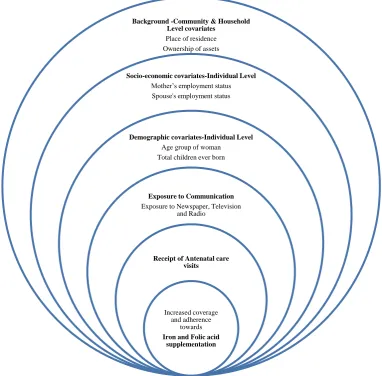
Conceptual framework
Based on an extensive literature review, the analysis of the surveys considered the following covariates:
Independent covariates
Background -community and household level covariates
Place of residence: urban / rural
Ownership of assets: wealth quintiles (poorest to richest)
Socio-economic covariates-individual level
Mother’s employment status: Working currently / not working currently
Spouse's employment status: Working currently / not working currently
Demographic covariates-individual level
Age group of woman: seven five year age groups from 15 to 49 years of age.
Total children ever born: Have 2 or more children/ have more than 2 children
Exposure to communication
Exposure to 1. Newspaper 2. Television 3. Radio
Receipt of antenatal care visits
Received less than three antenatal care visits/ received three or more antenatal care visits
Dependent variables
Receipt of any iron tablets/ syrup or iron and folic acid tablets/ syrup
Adherence to 90+ days of iron tablets/ syrup or iron and folic acid tablets/ syrup
This has been presented in a diagram below:
Figure 1: Conceptual framework. Background -Community & Household
Level covariates
Place of residence Ownership of assets
Socio-economic covariates-Individual Level
Mother’s employment status Spouse's employment status
Demographic covariates-Individual Level
Age group of woman Total children ever born
Exposure to Communication
Exposure to Newspaper, Television and Radio
Receipt of Antenatal care visits
Increased coverage and adherence
towards
RESULTS
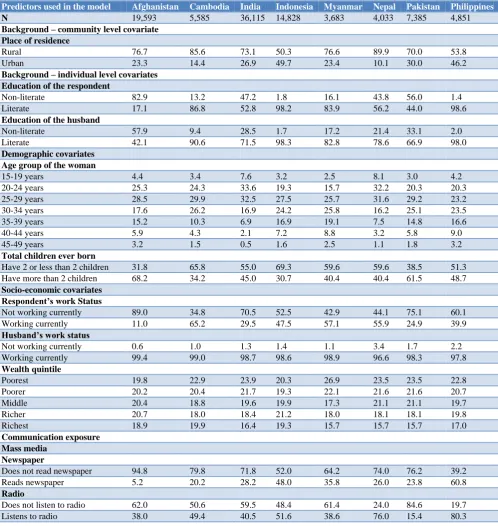
The cross-country analyses of the eight countries reveal that the women who took iron tablets/ syrup or iron with folic acid for 90 days or more varies from 6.8% in Afghanistan to 75.9% in Cambodia, while the anaemia prevalence varied from 30% in Indonesia to 51% in Cambodia. The socio-demographic-economic variables in these countries are being described as follows: With regards to the place of residence, per cent rural sample varies from 50.3% in Indonesia to 89.9% in Nepal. The
literacy of respondents varied from 17.1% in Afghanistan to 98.6% in Philippines. The literacy of the respondent’s husband varied from 42.1% in Afghanistan to 98.0% in Philippines and 98.3% in Indonesia. The percent of women who reported to have received or bought iron tablets or syrup varied from 45.2% in Pakistan to 97.7% in Myanmar. Exposure to mass media in terms of reading newspaper varied from 5.2% in Afghanistan to 60.8% in Philippines, while the proportion, who listened to radio varied from 15.4% in Pakistan to 80.3% in Philippines. Those who reported to watch television varied from 47.8% in Afghanistan to 95.7% in India.
Table 2: Socio-economic, demographic and health variables in selected eight countries in Asia, demographic and health surveys (DHS) (%).
Predictors used in the model Afghanistan Cambodia India Indonesia Myanmar Nepal Pakistan Philippines
N 19,593 5,585 36,115 14,828 3,683 4,033 7,385 4,851
Background – community level covariate Place of residence
Rural 76.7 85.6 73.1 50.3 76.6 89.9 70.0 53.8
Urban 23.3 14.4 26.9 49.7 23.4 10.1 30.0 46.2
Background – individual level covariates Education of the respondent
Non-literate 82.9 13.2 47.2 1.8 16.1 43.8 56.0 1.4
Literate 17.1 86.8 52.8 98.2 83.9 56.2 44.0 98.6
Education of the husband
Non-literate 57.9 9.4 28.5 1.7 17.2 21.4 33.1 2.0
Literate 42.1 90.6 71.5 98.3 82.8 78.6 66.9 98.0
Demographic covariates Age group of the woman
15-19 years 4.4 3.4 7.6 3.2 2.5 8.1 3.0 4.2
20-24 years 25.3 24.3 33.6 19.3 15.7 32.2 20.3 20.3
25-29 years 28.5 29.9 32.5 27.5 25.7 31.6 29.2 23.2
30-34 years 17.6 26.2 16.9 24.2 25.8 16.2 25.1 23.5
35-39 years 15.2 10.3 6.9 16.9 19.1 7.5 14.8 16.6
40-44 years 5.9 4.3 2.1 7.2 8.8 3.2 5.8 9.0
45-49 years 3.2 1.5 0.5 1.6 2.5 1.1 1.8 3.2
Total children ever born
Have 2 or less than 2 children 31.8 65.8 55.0 69.3 59.6 59.6 38.5 51.3 Have more than 2 children 68.2 34.2 45.0 30.7 40.4 40.4 61.5 48.7
Socio-economic covariates Respondent’s work Status
Not working currently 89.0 34.8 70.5 52.5 42.9 44.1 75.1 60.1
Working currently 11.0 65.2 29.5 47.5 57.1 55.9 24.9 39.9
Husband’s work status
Not working currently 0.6 1.0 1.3 1.4 1.1 3.4 1.7 2.2
Working currently 99.4 99.0 98.7 98.6 98.9 96.6 98.3 97.8
Wealth quintile
Poorest 19.8 22.9 23.9 20.3 26.9 23.5 23.5 22.8
Poorer 20.2 20.4 21.7 19.3 22.1 21.6 21.6 20.7
Middle 20.4 18.8 19.6 19.9 17.3 21.1 21.1 19.7
Richer 20.7 18.0 18.4 21.2 18.0 18.1 18.1 19.8
Richest 18.9 19.9 16.4 19.3 15.7 15.7 15.7 17.0
Communication exposure Mass media
Newspaper
Does not read newspaper 94.8 79.8 71.8 52.0 64.2 74.0 76.2 39.2
Reads newspaper 5.2 20.2 28.2 48.0 35.8 26.0 23.8 60.8
Radio
Does not listen to radio 62.0 50.6 59.5 48.4 61.4 24.0 84.6 19.7
Predictors used in the model Afghanistan Cambodia India Indonesia Myanmar Nepal Pakistan Philippines
Television
Does not watch Television 52.2 29.3 43.7 4.3 29.0 34.6 34.6 9.1
Watches Television 47.8 70.7 56.3 95.7 71.0 65.4 65.4 90.9
Receipt of at least 3 ANCs
Received less than 3 ANCs 67.9 11.5 47.3 6.6 22.0 33.5 50.9 8.8
Received 3+ ANCs 32.1 88.5 52.7 93.4 78.0 66.5 49.1 91.2
Iron receipt
Did not receive or bought any
iron supplements or syrup 55.3 4.3 34.4 23.1 12.3 20.4 54.8 7.9 Received or bought iron
supplements or syrup 44.7 95.7 65.6 76.9 97.7 79.6 45.2 92.1
Iron adherence (90+ days of iron tablets or syrup or iron and folic acid tablets)
Did not consume for 90 or more
days 93.2 24.1 76.8 67.1 40.2 44.1 78.5 53.1
Consumed for 90 or more days 6.8 75.9 23.2 32.9 59.8 55.9 21.5 46.9
A bivariate analysis was conducted for receipt of iron tablets/syrup as well as for consumption of iron tablets/ syrup for 90+ days. The variables considered for analysis were various background level and individual level socio-demographic and socio-economic covariates. Results indicate that a significantly higher proportion of women residing in urban areas received iron tablets or syrup as compared to rural areas across all countries similarly, adherence for 90+ days was also found to be higher among the women residing in urban areas in all the countries except Afghanistan and Cambodia.
On considering the individual level covariates like literacy status of the women, it is found that there was a significant difference between receipt and adherence (for 90+ days) of iron tablets/syrup in literate women as compared to illiterate ones across all the countries. Similarly a significant proportion of women having literate spouses consumed iron tablets/syrup for at least 90 days across all countries.
Working status of women was also found to play a significant role; as a significant proportion of working women received iron tablets/syrup as compared to non-working women except in Cambodia, Indonesia and Philippines. Consumption for at least 90+ days was also found to be significantly high among the working women in the countries except Cambodia.
On looking at the exposure to different mediums of communication, it has been found that a significant proportion of women who read newspaper and watch television received and adhered to IFA as compared to those women who do not read newspaper and does not watch television across all the countries. A significant proportion of women who received at least 3 ANCs received and adhered to iron for at least 90 days across all the countries.
Results of the multivariate binary logistic regression analyses
Predictors used in the model: Background level and individual level socio-demographic and socio-economic covariates, which are expected to influence the iron
tablets or syrup coverage and adherence behaviour have been described in Table 3. The predictors used in the model are the place of residence, age of the woman, children ever born, education of the respondent and her spouse (husband), current work status of the respondent and her husband, household assets used in the construction of wealth quintile and exposure to mass media and receipt of antenatal care.
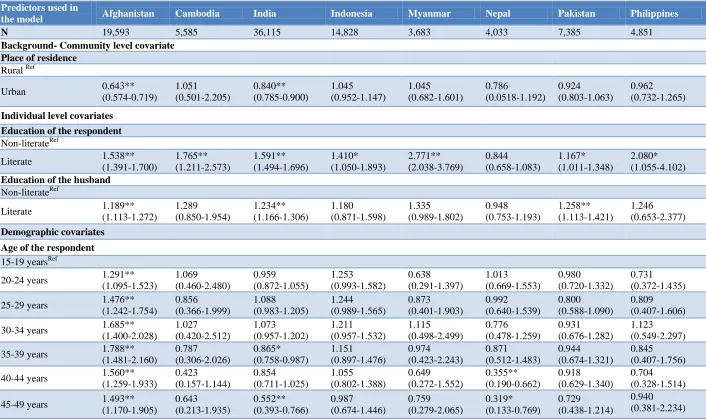
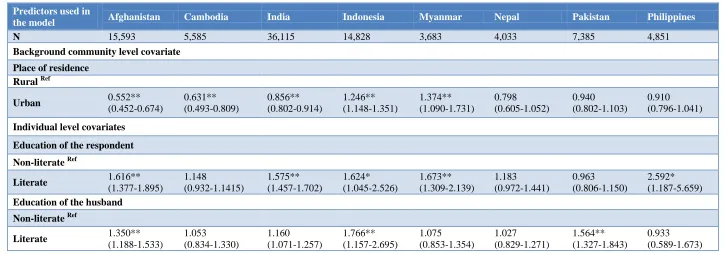
After adjusting for different variables, exposure to newspaper was found to be a predictor of adherence to iron tablets or syrup in all countries except Afghanistan, Cambodia and Myanmar. Exposure to television seemed to be a significant predictor of coverage and adherence to iron tablets or syrup except for countries of Cambodia, Nepal, Pakistan and Philippines. Access to antenatal care seems to the best predictor of adherence to iron tablets for at least 90 days. Those who had received at least three antenatal care visits, were 3.830 times in Afghanistan to 29.884 times in Indonesia, who were more likely to adhere to at least 90 days of iron tablets or syrup or iron and folic acid tablets supplementation.
Indonesia seems to be way ahead in the provisioning of antenatal care, as according to the Indonesia DHS, 2012, 87.8% of the women reported to have received 4+ antenatal care visits, with 73.5% receiving at least one visit in the first trimester, at least one in the second, and at least two in the third, which reflects clearly on early registration of pregnancy. Eight out of ten women had already received an ANC visit within the first four months of pregnancy during the DHS 2012, which has shown an increase from three fourths (75%) in Indonesia DHS 2007.
Table 3: Received/ bought iron by socio-economic and demographic variables in selected countries in Asia, demographic and health surveys (DHS) (%).
Afghanistan Cambodia India Indonesia Myanmar Nepal Pakistan Philippines
Predictors used in the model
Non-Iron users
Iron users
Non-Iron users
Iron users
Non-Iron & folic acid users
Iron & folic acid users
Non-Iron users
Iron users Non-Iron users
Iron users
Non-Iron users
Iron users
Non-Iron users
Iron users
Non-Iron users
Iron users
N 10,769 8,697 244 5,434 13,437 25,589 3,322 11,086 422 3,002 837 3,267 4,025 3,325 372 4,353
Background - community level covariate
Rural 57.4 42.6 4.7 95.3 38.4 61.6 26.9 73.1 14.5 85.5 21.4 78.6 60.3 39.7 9.2 90.8 Urban 48.5 51.5* 2.1* 97.9* 23.6 76.4* 19.1* 80.9* 5.2 94.8* 10.9 89.1* 41.9 58.1* 6.3 93.7*
Individual level covariates Education of the respondent
Non-Literate 58.9 41.1 12.0 88.0 50.4 49.6 54.1 45.9 36.5 63.5 31.1 68.9 65.9 34.1 42.6 57.4 Literate 38.2 61.8* 3.1 96.9* 20.1 79.9* 22.5 77.5* 7.7 92.3* 12.1 87.9* 40.6 59.4* 7.4 92.6*
Education of the husband
Non-Literate 60.6 39.4 10.8 89.2 50.8 49.2 46.7 53.3 29.4 70.6 34.3 65.7 67.5 32.5 26.9 73.1 Literate 48.1 51.9* 3.6 96.4* 27.9 72.1* 22.6 77.4* 8.7 91.3 16.6 83.4* 48.5 51.5* 7.5 92.5*
Demographic covariates age group of the woman
15-19 years 61.7 38.3 4.6 95.4 34.2 65.8 29.8 70.2 15.5 84.5 14.1 85.9 52.7 47.3 6.5 93.5 20-24 years 55.9 44.1 2.8 97.2 31.8 68.2 22.0 78.0 15.4 84.6 15.6 84.4 51.9 48.1 8.2 91.8 25-29 years 55.7 44.3 3.2 96.8 31.6 68.4 21.4 78.6 12.1 97.9 16.7 83.3 54.9 45.1 7.5 92.5 30-34 years 54.0 46.0 3.6 96.4 36.4 63.6 21.5 78.5 9.0 91.0 24.8 75.2 53.1 46.9 5.8 94.2 35-39 years 52.0 48.0 7.0 93.0 47.4 52.6 24.6 75.4 10.1 89.9 32.1 67.9 56.0 44.0 8.8 91.2 40-44 years 57.0 43.0 13.4 86.6 54.4 45.6 28.3 71.7 17.3 82.7 54.5 45.5 64.3 35.7 11.6 88.4 45-49 years 58.9 41.1 17.4 82.6 69.2 30.8 33.5 66.5 24.4 75.6 66.0 34.0 71.2 28.8 10.0 90.0
Total children ever born
Have 2 or less than 2
children 54.3 45.7 2.2 97.8 25.0 75.0 20.3 79.7 9.5 90.5 12.4 87.6 47.8 52.2 5.5 94.5 Have more than 2
children 55.8
44.2
n.s. 8.2 91.8* 46.0 54.0* 29.2 70.8* 16.5 83.5* 32.2 67.8* 59.1 40.9* 10.4 89.6*
Socio-economic covariates respondents work status
Not working
Afghanistan Cambodia India Indonesia Myanmar Nepal Pakistan Philippines
Non-Iron users
Iron users
Non-Iron users
Iron users
Non-Iron & folic acid users
Iron & folic acid users
Non-Iron users
Iron users Non-Iron users
Iron users
Non-Iron users
Iron users
Non-Iron users
Iron users
Non-Iron users
Iron users
Husband’s work status
Not working
currently 56.4 43.6 1.9 98.1 36.0 64.0 31.6 68.4 56.4 43.6 1.9 98.1 36.0 64.0 30.1 22.9 Working currently 55.3 44.7 4.3 95.7 34.4 65.6 12.1 87.9 55.3 44.7 4.3 95.7 34.4 65.6 22.9 77.16
Wealth quintile
Poorest 61.6 38.4 9.0 91.0 50.6 49.4 36.3 63.7 21.0 79.0 38.4 61.6 71.1 28.9 14.8 85.2 Poorer 61.1 38.9 4.6 95.4 42.7 57.3 24.0 76.0 15.2 84.8 22.0 78.0 64.8 35.2 6.8 93.2 Middle 57.2 42.8 3.7 96.3 32.7 67.3 21.1 78.9 9.8 90.2 17.6 82.4 56.8 43.2 6.0 94.0 Richer 52.7 47.3 1.6 98.4 24.4 75.6 19.9 80.1 4.9 95.1 11.5 88.5 42.8 57.2 4.1 95.9 Richest 43.3 56.7 1.7 98.3 13.3 86.7 13.6 86.4 4.7 95.3 5.3 94.7 32.0 68.0 4.1 95.9
Communication exposure Mass media
Newspaper
Does not read 56.5 43.5 4.9 95.1 42.1 57.9 27.6 72.4 15.8 84.2 24.9 75.1 60.8 39.2 11.3 88.7 Reads 33.4 66.6* 1.8 98.2* 14.9 85.1* 18.2 81.8* 6.1 93.9* 7.4 92.6* 35.4 64.6* 5.7 94.3*
Radio
Does not listen 55.2 44.8 4.7 95.3 38.9 61.1 25.6 74.4 15.3 84.7 27.0 23.0 56.4 43.6 13.6 86.4 Listens 55.6 44.4 3.9 96.1 27.9 72.1* 20.6 79.4* 7.5 92.5* 18.3 81.7* 45.8 54.2* 6.5 93.5*
Television
Does not watch 65.7 34.3 8.3 91.7 9.6 50.4 40.9 59.1 21.3 78.7 31.8 68.2 65.7 34.3 22.8 77.2 Watches 44.0 56.0* 2.6 97.4* 22.7 77.3* 22.3 77.7* 8.6 91.4* 14.3 85.7* 49.0 51.0* 6.4 93.6*
Receipt of at least 3 ANCs
Received less than 3
antenatal care visits 67.2 32.8 33.1 66.9 55.8 44.2 66.5 33.5 43.4 56.6 53.2 46.8 74.0 26.0 44.6 55.4 Received 3+
antenatal care visits 30.3 69.7* 0.6 99.4* 15.2 84.8* 20.0 80.0* 3.5 96.5* 3.9 96.1* 34.8 65.2* 4.3 95.7*
Table 4: Adherence to iron intake by socio-economic and demographic variables in selected countries in Asia, demographic and health surveys (%).
Afghanistan Cambodia India Indonesia Myanmar Nepal Pakistan Philippines
Predictors used in the model
Non-Iron users
Iron users
Non-Iron users
Iron users
Non-Iron & folic acid users
Iron & folic acid users
Non-Iron users
Iron users
Non-Iron users
Iron users
Non-Iron users
Iron users
Non-Iron users
Iron users
Non-Iron users
Iron users
N 18,147 1,320 1,369 4,308 29,989 9,037 9,664 4,744 1,378 2,046 1,811 2,293 5,766 1,584 2,509 2,216
Background- community level covariate
Rural 93.7 6.3 24.5 75.5 81.2 18.8 73.3 26.7 45.2 54.8 45.6 54.4 82.9 17.1 56.0 44.0 Urban 91.8 8.2 21.8 78.2 65.0 35.0 60.8 39.2* 24.2 75.8* 31.2 68.8* 68.1 31.9* 49.7 50.3*
Individual level covariates Education of the respondent
Non-Literate 94.5 5.5 35.4 64.6 89.9 10.1 90.3 9.7 67.3 32.7 60.3 39.7 86.2 13.8 87.0 13.0 Literate 87.1 12.9* 22.4 77.6* 65.2 34.8* 66.7 33.3* 35.1 64.9* 31.5 68.5* 68.6 31.4* 52.6 47.4*
Education of the husband
Non-Literate 95.1 4.9 33.7 66.3 89.2 10.8 88.5 11.5 59.9 40.1 63.9 36.1 88.5 11.5 69.9 30.1 Literate 90.6 9.4* 23.1 76.9* 71.9 28.1* 66.7 33.3* 36.2 63.8* 38.8 61.2* 73.5 26.5* 52.8 47.2*
Demographic covariates Age group of the woman
15-19 years 94.2 5.8 24.2 75.8 83.0 17.0 77.2 22.8 54.2 45.8 37.2 62.8 77.8 22.2 56.0 44.0 20-24 years 93.4 6.6 24.1 75.9 76.9 23.1 67.9 32.1 46.4 53.6 38.7 61.3 79.3 20.7 54.7 45.3 25-29 years 93.4 6.6 22.5 77.5 73.6 26.4 66. 34.0 39.3 60.7 41.6 58.4 77.8 22.2 50.9 49.1 30-34 years 93.3 6.7 21.9 78.1 76.1 23.9 64.7 35.3 35.8 64.2 48.1 51.9 76.8 23.2 50.9 49.1 35-39 years 91.2 8.8 28.1 71.9 82.4 17.6 67.6 32.4 36.6 63.4 56.5 43.5 78.2 21.8 54.3 45.7 40-44 years 93.8 6.2 31.7 68.3 88.9 11.1 69.8 30.2 43.9 56.1 78.2 21.8 84.9 15.1 54.7 45.3 45-49 years 95.8 4.2 45.3 54.7 91.5 8.5 73.3 26.7 58.1 41.9 85.1 14.9 86.4 13.6 60.3 39.7
Total children ever born
Have 2 or less than
2 children 92.6 7.4 20.7 79.3 69.5 30.5 63.9 36.1 33.9 66.1 33.7 66.3 73.6 26.4 47.4 52.6 Have more than 2
children 93.5 6.5* 30.8 69.2* 85.9 14.1* 74.2 25.8* 49.6 50.4* 59.6 40.4* 81.5 18.5* 59.1 40.9*
Socio-economic covariates Respondents work status
Not working
Afghanistan Cambodia India Indonesia Myanmar Nepal Pakistan Philippines
Predictors used in the model
Non-Iron users
Iron users
Non-Iron users
Iron users
Non-Iron & folic acid users
Iron & folic acid users
Non-Iron users
Iron users
Non-Iron users
Iron users
Non-Iron users
Iron users
Non-Iron users
Iron users
Non-Iron users
Iron users
Husband’s work status
Not working
currently 100 0.0 14.8 85.2 79.2 20.8 77.7 22.3 68.4 31.6 55.0 45.0 82.1 17.9 52.0 48.0 Working currently 93.2 6.8* 24.2 75.8 76.8 23.2 66.9 33.1 39.9 60.1 43.8 56.2 78.4 21.6 53.1 46.9
Wealth quintile
Poorest Ref 95.1 4.9* 35.0 65.0 90.1 9.9* 80.1 19.9* 54.7 45.3 62.6 37.4 88.5 11.5 63.8 36.2 Poorer 94.5 5.5 24.3 75.7 86.9 13.1 71.7 28.3 45.0 55.0 48.7 51.3 87.2 12.8 60.3 39.7 Middle 94.0 6.0 23.7 76.3 78.5 21.5 68.0 32.0 39.0 61.0 46.4 53.6 81.9 18.1 51.6 48.4 Richer 92.5 7.5 18.4 81.6 69.3 30.7 63.2 36.8 30.0 70.0 32.5 67.5 72.2 27.8 43.2 56.8 Richest 89.8 10.2 16.9 83.1* 50.7 49.3 52.2 47.8 21.8 78.2 20.5 79.5 57.7 42.3 37.3 62.7
Communication exposure- Mass Media Newspaper
Does not read
newspaper 93.7 6.3 25.3 74.7 84.6 15.4 72.5 27.5 46.4 53.6 51.3 48.7 83.2 16.8 72.5 27.5 Reads newspaper 84.7 15.3* 19.7 80.3* 57.2 42.8* 61.3 38.7* 29.2 70.8* 23.9 76.1* 63.1 36.9* 61.3 38.7*
Radio
Does not listen to
radio 93.6 6.4 26.5 73.5 79.8 20.2 71.2 28.8 43.0 57.0 52.8 47.2 79.4 20.6 61.2 38.8 Listens to radio 92.6 7.4* 21.7 78.3* 72.5 27.5* 63.2 36.8* 35.8 64.8* 41.4 58.6* 73.5 26.5* 51.1 48.9*
Television
Does not watch
Television 96.4 3.6 32.1 67.9 88.3 11.7 77.6 22.4 53.3 46.7 59.2 40.8 86.3 13.7 69.3 30.7 Watches Television 89.8 10.2* 20.8 79.2* 68.0 32.0* 66.6 33.4* 34.9 65.1* 36.2 63.8* 74.3 25.7* 51.5 48.5*
Receipt of at least 3 ANCs
Received less than 3
antenatal care visits 96.7 3.3 73.5 26.5 93.3 6.7 98.8 1.2 81.6 18.4 84.0 16.0 93.1 6.9 92.6 7.4 Received 3+
antenatal care visits 85.9 14.1* 17.7 82.3* 62.1 37.9* 64.8 35.2* 28.6 71.4* 24.1 75.9* 63.3 36.7* 49.3 50.7*
Table 5: Adjusted Odds Ratio (AOR) from the multivariate binary logistic regression of coverage of iron tablets or syrup or iron and folic acid or syrup in selected countries in Asia, Demographic & Health Surveys (DHS) ((95% CI) of receipt of iron supplementation or syrup) Dependent variables: Receipt of iron
supplementation or syrup.
Predictors used in
the model Afghanistan Cambodia India Indonesia Myanmar Nepal Pakistan Philippines N 19,593 5,585 36,115 14,828 3,683 4,033 7,385 4,851
Background- Community level covariate Place of residence
Rural Ref
Urban 0.643** (0.574-0.719) 1.051 (0.501-2.205) 0.840** (0.785-0.900) 1.045 (0.952-1.147) 1.045 (0.682-1.601) 0.786 (0.0518-1.192) 0.924 (0.803-1.063) 0.962 (0.732-1.265)
Individual level covariates Education of the respondent
Non-literateRef
Literate 1.538** (1.391-1.700) 1.765** (1.211-2.573) 1.591** (1.494-1.696) 1.410* (1.050-1.893) 2.771** (2.038-3.769) 0.844 (0.658-1.083) 1.167* (1.011-1.348) 2.080* (1.055-4.102)
Education of the husband
Non-literateRef
Literate 1.189** (1.113-1.272) 1.289 (0.850-1.954) 1.234** (1.166-1.306) 1.180 (0.871-1.598) 1.335 (0.989-1.802) 0.948 (0.753-1.193) 1.258** (1.113-1.421) 1.246 (0.653-2.377) Demographic covariates
Age of the respondent
15-19 yearsRef
20-24 years 1.291** (1.095-1.523) 1.069 (0.460-2.480) 0.959 (0.872-1.055) 1.253 (0.993-1.582) 0.638 (0.291-1.397) 1.013 (0.669-1.553) 0.980 (0.720-1.332) 0.731 (0.372-1.435) 25-29 years 1.476**
(1.242-1.754) 0.856 (0.366-1.999) 1.088 (0.983-1.205) 1.244 (0.989-1.565) 0.873 (0.401-1.903) 0.992 (0.640-1.539) 0.800 (0.588-1.090) 0.809 (0.407-1.606) 30-34 years 1.685**
(1.400-2.028) 1.027 (0.420-2.512) 1.073 (0.957-1.202) 1.211 (0.957-1.532) 1.115 (0.498-2.499) 0.776 (0.478-1.259) 0.931 (0.676-1.282) 1.123 (0.549-2.297) 35-39 years 1.788**
(1.481-2.160) 0.787 (0.306-2.026) 0.865* (0.758-0.987) 1.151 (0.897-1.476) 0.974 (0.423-2.243) 0.871 (0.512-1.483) 0.944 (0.674-1.321) 0.845 (0.407-1.756) 40-44 years 1.560**
(1.259-1.933) 0.423 (0.157-1.144) 0.854 (0.711-1.025) 1.055 (0.802-1.388) 0.649 (0.272-1.552) 0.355** (0.190-0.662) 0.918 (0.629-1.340) 0.704 (0.328-1.514)
Predictors used in
the model Afghanistan Cambodia India Indonesia Myanmar Nepal Pakistan Philippines Total children ever born
Have 2 or less than 2 childrenRef Have more than 2 children 0.930 (0.854-1.014) 0.622* (0.405-0.954) 0.737** (0.693-0.783) 0.801** (0.719-0.893 1.114 (0.810-1.533) 0.802 (0.621-1.036) 0.915 (0.805-1.041) 0.781 (0.573-1.066) Socio-economic covariates Respondent's current work status
Does not work currentlyRef
Works currently 1.017 (0.921-1.124) 0.755 (0.538-1.059) 1.337** (1.267-1.410) 1.090* (1.002-1.185) 0.895 (0.692-1.158) 0.703** (0.568-0.870) 0.932 (0.824-1.055) 0.906 (0.701-1.170)
Husband’s work status
Does not work currently Ref
Works currently 0.963 (0.643-1.443) 1.866 (0.198-17.603) 1.053 (0.856-1.294) 1.119 (0.804-1.558) 1.753 (0.686-4.476) 1.386 (0.826-2.326) 1.309 (0.871-1.967) 1.486 (0.690-3.202) Wealth quintile
Poorest Ref
Poorer 1.029 (0.933-1.135) 1.114 (0.736-1.686) 0.970 (0.907-1.037) 1.376** (1.213-1.561) 0.865 (0.631-1.186) 1.795** (1.388-2.322) 1.091 (0.925-1.285) 1.432* (1.014-2.023)
Middle 1.197** (1.086-1.320) 0.954 (0.589-1.547) 0.997 (0.925-1.075) 1.472** (1.290-1.681) 1.107 (0.753-1.628) 1.680** (1.266-2.229) 1.254* (1.050-1.499) 1.481* (1.010-2.170) Richer 1.121
(1.013-1.240) 1.080 (0.561-2.078) 0.965 (0.882-1.056) 1.442** (1.257-1.655) 1.670* (1.038-2.687) 1.769** (1.244-2.516) 1.651** (1.350-2.019) 1.695* (1.074-2.676) Richest 1.369**
(1.187-1.578) 0.739 (0.339-1.607) 1.203** (0.882-1.056) 2.172** (1.853-2.547) 0.993 (0.560-1.763) 2.223** (1.351-3.655) 1.839** (1.439-2.350) 1.450 (0.879-2.392)
Communication exposure- Mass media Newspaper
Does not read newspaper Ref
Reads newspaper 1.058 (0.897-1.249) 1.106 (0.634-1.928) 1.311** (1.213-1.418) 1.245** (1.135-1.365) 1.019 (0.735-1.413) 1.182 (0.842-1.659) 1.221 (1.053-1.415) 1.080 (0.824-1.417) Radio
Does not listen to radio Ref
Predictors used in
the model Afghanistan Cambodia India Indonesia Myanmar Nepal Pakistan Philippines Television
Does not watch Television Ref
Watches Television 1.802** (1.684-1.930)
1.297 (0.900-1.870)
1.470** (1.388-1.558)
1.012 (0.831-1.233)
1.291 (0.979-1.703)
1.013 (0.809-1.270)
0.887 (0.781-1.007)
1.460* (1.007-2.117)
Receipt of at least 3 ANCs
Received less than 3 antenatal cares visitsRef
Received 3+ antenatal cares visits
4.008** (3.745-4.290)
71.490** (46.146-110.752)
4.505** (4.270-4.753)
5.639** (4.855-6.549)
14.056** (10.619-18.607)
22.987** (18.039-29.293)
3.887** (3.471-4.353)
13.156** (10.140-17.069)
Note: 95% CI: Confidence Interval, *: p<0.05 : Statistically Significant at 5% level **: p<0.01 : Statistically Significant at 1% level, n.s.: Not significant. ref Refers to Reference Category. Adjusted for Woman’s age, place of residence and work status of woman and her spouse.
Table 6: Adjusted Odds Ratio (AOR) from the multivariate binary logistic regression of coverage and adherence of iron tablets or syrup or iron and folic acid tablets or syrup for at least 90 days in selected countries in Asia, demographic & health surveys (DHS) (95% CI) of adherence of iron supplementation or syrup for
at least 90 days) Dependent variable: adherence to iron supplementation or syrup for at least 90 days.
Predictors used in
the model Afghanistan Cambodia India Indonesia Myanmar Nepal Pakistan Philippines N 15,593 5,585 36,115 14,828 3,683 4,033 7,385 4,851
Background community level covariate
Place of residence Rural Ref
Urban 0.552**
(0.452-0.674)
0.631** (0.493-0.809)
0.856** (0.802-0.914)
1.246** (1.148-1.351)
1.374** (1.090-1.731)
0.798 (0.605-1.052)
0.940 (0.802-1.103)
0.910 (0.796-1.041)
Individual level covariates
Education of the respondent
Non-literate Ref
Literate 1.616**
(1.377-1.895)
1.148
(0.932-1.1415)
1.575** (1.457-1.702)
1.624* (1.045-2.526)
1.673** (1.309-2.139)
1.183 (0.972-1.441)
0.963 (0.806-1.150)
2.592* (1.187-5.659)
Education of the husband
Non-literate Ref
Literate 1.350**
(1.188-1.533)
1.053 (0.834-1.330)
1.160 (1.071-1.257)
1.766** (1.157-2.695)
1.075 (0.853-1.354)
1.027 (0.829-1.271)
1.564** (1.327-1.843)
Predictors used in
the model Afghanistan Cambodia India Indonesia Myanmar Nepal Pakistan Philippines Demographic covariates
Age of the respondent
15-19 years Ref
20-24 years 1.166 (0.843-1.612) 0.787 (0.528-1.173) 1.177** (1.051-1.318) 1.336* (1.051-1.697) 1.232 (0.731-2.077) 1.020 (0.757-1.374) 0.877 (0.565-1.182) 1.021 (0.740-1.409) 25-29 years 1.411*
(1.009-1.973) 0.869 (0.583-1.296) 1.477** (1.315-1.660) 1.386** (1.095-1.756) 1.812* (1.085-3.026) 0.953 (0.696-1.303) 0.848 (0.587-1.225) 1.235 (0.893-1.707) 30-34 years 1.625**
(1.134-2.327) 1.026 (0.677-1.554) 1.543** (1.355-1.757) 1.484** (1.166-1.887) 2.266** (1.344-3.822) 0.960 (0.670-1.375) 0.978 (0.669-1.429) 1.247 (0.895-1.738) 35-39 years 2.167**
(1.509-3.111) 0.949 (0.603-1.194) 1.445** (1.230-1.699) 1.549** (1.204-1.993) 2.333** (1.364-3.992) 1.107 (0.723-1.695) 1.036 (0.693-1.548) 1.235 (0.869-1.754) 40-44 years 1.695*
(1.114-2.579) 0.956 (0.572-1.598) 1.233 (0.944-1.611) 1.591** (1.205-2.100) 2.253** (1.26-4.014) 0.481 (0.269-0.860) 0.976 (0.610-1.560) 1.366 (0.932-2.002) 45-49 years 1.116
(0.659-1.889) 0.712 (0.370-1.370) 1.291 (0.740-2.252) 1.566* (1.055-2.324) 1.966 (0.959-4.029) 0.386 (0.144-1.033) 1.005 (0.522-1..936) 1.144 (0.711-1.838)
Total children ever born
Have 2 or less than 2 childrenRef Have more than 2
children 0.843* (0.719-0.989) 0.759** (0.635-0.908) 0.711** (0.665-0.760) 0.658** (0.595-.0728) 0.639** (0.524-0.779) 0.747** (0.611-0.913) 0.856* (0.737-0.993) 0.724** (0.623-0.842) Socio-economic covariates Respondent's current work status
Does not work currently Ref Works currently 1.009
(0.845-1.204) 0.982 (0.852-1.133) 1.143** (1.072-1.213) 1.109** (1.030-1.194) 0.882 (0.751-1.036) 0.892 (0.755-1.055) 1.012 (0.866-1.182) 1.025 (0.903-1.164)
Husband’s work status
Does not work currently Ref
Works currently 21.902
(0.616-779.203) 0.823 (0.383-1.771) 1.183** (0.931-1.502) 1.515* (1.073-2.140) 2.890** (1.313-6.361) 2.088** (1.395-3.125) 1.121 (0.672-1.868) 1.126 (0.746-1.699) Wealth quintile
Poorest Ref
Poorer 1.078* (0.877-1.325) 1.400** (1.144-1.714) 0.935 (0.846-1.034) 1.247** (1.095-1.420) 1.089 (0.872-1.359) 1.276* (1.012-1.609) 0.840 (0.665-1.061) 0.931 (0.772-1.122) Middle 1.101
(0.899-1.349) 1.237 (0.998-1.534) 1.116** (1.055-1.289) 1.325** (1.163-1.511) 1.074 (0.841-1.371) 1.012 (0.795-1.289) 0.988 (0.778-1.256) 1.286* (1.056-1.565) Richer 1.066
Predictors used in
the model Afghanistan Cambodia India Indonesia Myanmar Nepal Pakistan Philippines Communication exposure – Mass Media
Newspaper
Does not read newspaper Ref
Reads newspaper 1.037 (0.829-1.297)
0.933 (0.772-1.126)
1.368** (1.279-1.464)
0.165** (1.075-1.262)
1.184 (0.989-1.418)
1.278* (1.028-1.588)
1.316** (1.123-1.543)
1.247** (1.089-1.430)
Radio
Does not listen to radio Ref
Listens to radio 1.090 (0.966-1.229)
1.078 (0.934-1.244)
1.079** (1.021-1.140)
1.169** (1.081-1.263)
0.975 (0.826-1.150)
0.955 (0.787-1.158)
1.189* (1.012-1.397)
1.128 (0.957-1.330)
Television
Does not watch Television Ref
Watches Television 2.052** (1.786-2.358)
1.064 (0.900-1.259)
1.160** (1.081-1.245)
0.691** (0.556-0.859)
1.245* (1.035-1.498)
1.110 (0.917-1.342)
0.892 (0.755-1.053)
1.043 (0.810-1.343)
Receipt of at least 3 ANCs
Received less than 3 antenatal care visits
Ref
Received 3+ antenatal care visits
3.830** (3.382-4.338)
10.866** (1.418-2.496)
4.797** (4.472-5.146)
29.884** (16.593-53.822)
7.510** (6.061-9.306)
12.420** (10.358-14.893)
5.667** (4.846-6.651)
9.652** (6.643-14.025)
DISCUSSION
The cross-country analyses of the eight countries reveal that the women who took iron tablets/ syrup or iron with folic acid for 90 days or more varies from 6.8% in Afghanistan to 75.9% in Cambodia, while the anaemia prevalence varied from 30% in Indonesia to 51% in Cambodia. Similar to earlier studies, like the study on factors influencing consumption of iron and folic acid supplementations in high focus states of India, which revealed that factors including maternal age, education, wealth index, birth order, type of caste/tribe, husband present during ANC visit, mass media exposure and religion were significantly associated with IFA supplementation, it is also observed in this analysis that increasing the coverage of antenatal care and increased use of mass media channels of communication could be useful in improving the coverage and adherence to IFA.11
CONCLUSION
There is an urgent need to address the situation of anaemic in the Asia region and specifically in these low and middle income countries, where it is a moderate to severe public health problem. Antenatal care visits seem to be the key to increased adherence to iron and folic supplementation in all these countries, which could be one of the important strategies to combat iron deficiency anaemia in these countries. In monitoring data on anaemia prevalence at younger ages among younger mothers, who are at more risk due to teenage pregnancies, there is an urgent need to address data gaps during the 10 to 14 years age group. It could be advocated that in the Demographic and health surveys, we cover the 10 to 49 years age group for both genders or at least among women in place of 15 to 49 years age group being covered currently. This would be helpful in increasing program focussed on adolescent girls and increasing iron stores among them. Interpersonal communication and counselling questions could be included for messaging for different nutrition and health interventions. Interpersonal counselling helps in problem solving and it is based on instant feedback, even though it is more expensive. However, focusing attention to the design of messages through each channel would be critical. Mass media would need to be aimed at creating an appeal and recall among a diverse set of target audiences, whereas the interpersonal communication messages should be tailored to specific socio-cultural contexts, within the overarching key messages.
ACKNOWLEDGEMENTS
The authors acknowledge the use of the data published on the public domain by DHS program implemented by ICF International and partners Blue Raster, The Futures Institute, The Johns Hopkins Bloomberg School of Public Health Center for Communication Programs (JHUCCP), PATH, and Vysnova, and two new partner organizations in 2013—EnCompass and Kimetrica.
Funding: No funding sources Conflict of interest: None declared
Ethical approval: Procedures and questionnaires for standard DHS surveys have been reviewed and approved by ICF Institutional Review Board (IRB)
REFERENCES
1. WHO. The global prevalence of anaemia in 2011. World Health Organization. 2015. Available at: http://apps.who.int/iris/bitstream/10665/177094/1/97 89241564960_eng.pdf. Accessed on 10 October 2017.
2. Maina-Gathigi L, Omolo J, Wanzala P, Lindan C, Makokha A. Utilization of folic acid and iron supplementation services by pregnant women attending an antenatal clinic at a regional referral hospital in Kenya. Matern Child Health J. 2013;17(7):1236-42.
3. WHO. Guideline: Intermittent iron and folic acid supplementation in non-anaemic pregnant women. WHO (2012); Geneva.
4. United Nations, Department of Economic and Social Affairs, Population Division. World Population Prospects: The 2017 Revision, Key Findings and Advance Tables. (2017). Working Paper No. ESA/P/WP/248. Available at: https://esa.un.org/ unpd/wpp/publications/Files/WPP2017_KeyFindings .pdf. Accessed on 10 October 2017.
5. Stevens GA, Finucane MM, De-Regil LM, Paciorek CJ, Flaxman SR, Branca F, et al. Global, regional, and national trends in haemoglobin concentration and prevalence of total and severe anaemia in children and pregnant and non-pregnant women for 1995–2011: a systematic analysis of population-representative data. The Lancet Global Health. 2013;1(1):e16–e25.
6. WHO. Iron deficiency anaemia assessment, prevention, and control: a guide for programme managers. Geneva: WHO.2001, WHO/NHD/01.3. 7. Balarajan Y, Ramakrishnan U, Ozaltin E, Shankar
AH, Subramanian SV. Anaemia in low-income and middle-income countries. Lancet. 2011;378(9809):2123-35.
8. Tolentino K, Friedman JF. An update on anaemia in less developed countries. Am J Trop Med Hyg. 2007;77:44–51.
9. Imdad A, Bhutta ZA. Routine Iron/Folate Supplementation during Pregnancy, Paediatric Perinatal Epidemiol. 2012;26(1):168–77.
10. Arega Sadore A, Abebe Gebretsadik L, Aman Hussen M. Compliance with iron-folate supplement and associated factors among antenatal care attendant mothers in Misha District. South Ethiopia: community based cross-sectional study. J Environ Public Health. 2015;2015:781973.
12. United States Agency for International Development (USAID) and PATH. Community-Based Distribution of Iron-Folic Acid Supplementation: Evidence and Program Implications, Maternal and Child Survival Program, MCSP Nutrition Brief, 2017.
13. Imhoff-Kunsch B, Martorell R. Nutrition Education and Counselling Provided during Pregnancy: Effects on Maternal, Neonatal and Child Health Outcomes. Paediatric Perinatal Epidemiol. 2012;(Suppl 1):1–3. 14. Alam, Ashraful, Rasheed S, Khan NUZ, Sharmin T,
Huda TM, et al. How Can Formative Research Inform the Design of an Iron-Folic Acid Supplementation Intervention Starting in First Trimester of Pregnancy in Bangladesh? BMC Public Health. 2015;15(1):374.
15. Central Statistics Organization (CSO), Ministry of Public Health (MoPH), and ICF. Afghanistan Demographic and Health Survey 2015. Kabul, Afghanistan: Central Statistics Organization, 2017. 16. National Institute of Statistics, Directorate General
for Health, and ICF International. Cambodia Demographic and Health Survey 2014. Phnom Penh, Cambodia, and Rockville, Maryland, USA: National Institute of Statistics, Directorate General for Health, and ICF International, 2015.
17. International Institute for Population Sciences (IIPS) and Macro International. National Family Health Survey (NFHS-3), 2005–06: India: Volume I. Mumbai: IIPS, 2007.
18. Statistics Indonesia (Badan Pusat Statistik—BPS), National Population and Family Planning Board (BKKBN), and Kementerian Kesehatan
(Kemenkes—MOH), and ICF International. Indonesia Demographic and Health Survey 2012. Jakarta, Indonesia: BPS, BKKBN, Kemenkes, and ICF International, 2013.
19. Ministry of Health and Sports (MoHS) and ICF. Myanmar Demographic and Health Survey 2015-16. Nay Pyi Taw, Myanmar, and Rockville, Maryland USA: Ministry of Health and Sports and ICF, 2017. 20. Ministry of Health and Population (MOHP) [Nepal],
New ERA, and ICF International Inc. 2012. Nepal Demographic and Health Survey 2011. Kathmandu, Nepal: Ministry of Health and Population, New ERA, and ICF International, Calverton, Maryland, 2012.
21. National Institute of Population Studies (NIPS) [Pakistan] and ICF International. Pakistan Demographic and Health Survey 2012-13. Islamabad, Pakistan, and Calverton, Maryland, USA: NIPS and ICF International, 2013.
22. Philippine Statistics Authority (PSA) [Philippines], and ICF International. Philippines National Demographic and Health Survey 2013. Manila, Philippines, and Rockville, Maryland, USA: PSA and ICF International, 2014.