Original Research Article
Knowledge and awareness regarding eye donation among medical and
para medical students in a tertiary care hospital in Odisha:
a comparative study
Ankit Rattan
1, Antaryami Sahoo
2*, Z. U. Khan
1, Archana Patnaik
2,
Priyatama Singh
2, Mahesh Rath
2INTRODUCTION
One of the major causes of visual impairment and blindness in the developing world has been attributed to corneal diseases. According to the 2010 global blindness estimate, it accounts for around 4%of the total burden of burden of 50 million.1 From amongst the 50 million blind in the world, 1/4th are present in India. Approximately
18.7 million people are blind in India, and 1,90,000 are blind from bilateral corneal disease.2 Every year another 20000 join the list.3 As per the records of National Programme for Control of Blindness (NPCB), the annual procurement of donor eyes is 18000 which is quite dismal. The Govt of India under the 11th 5-year plan envisages to eliminate avoidable blindness completely by 2020.4,5 In the current scenario, India needs around
ABSTRACT
Background: India needs around 2,77,000 donations annually to perform 1,00,000 corneal transplants. To enhance the procurement of corneal donations further, raising the level of public education on eye donation was the most important first step. The Govt. of India under the 11th 5-year plan envisages eliminating avoidable blindness completely by 2020. The aim and objective of the study was to compare the awareness of eye donation and willingness to donate eyes among medical and paramedical students.
Methods: A cross sectional studywas carried out among 400 final year MBBS students and interns and also among the final year B.Sc. nursing students and at Hi-Tech Medical College and Hospital, Bhubaneswar from August 2018 to September 2018.
Results: The study participants were in the age group of 18-25 years. While 100% medical students had heard about organ donation, 85.5% of paramedical students heard about organ donation. Positive opinion regarding donation of eye post death was got from all the medical students as against 85% of paramedical students. More than 1/3rd of the study participants in both the groups were willing to donate eyes and know more regarding the sameand also had a fair idea regarding shortage of donors in India.
Conclusions: Awareness of eye donation is better in medical students compared to paramedical students, preferably due to the exposure and study curriculum. Most of the students in both groups were inclined to pledge for eye donation. Awareness regarding eye donation will form the prime base for the elimination of avoidable blindness in India.
Keywords: Eye donation, Medical student, Intern, Odisha
1
Department of Ophthalmology, 2Department of Community Medicine, Hitech Medical College and Hospital, Bhubaneswar, Odisha, India
Received: 14 January 2019
Revised: 30 January 2019
Accepted: 31 January 2019
*Correspondence:
Dr. Antaryami Sahoo,
E-mail: [email protected]
Copyright: © the author(s), publisher and licensee Medip Academy. This is an open-access article distributed under the terms of the Creative Commons Attribution Non-Commercial License, which permits unrestricted non-commercial use, distribution, and reproduction in any medium, provided the original work is properly cited.
2,77,000 donations annually to perform 1,00,000 corneal transplants.3 To enhance the procurement of corneal donations further, raising the level of public education on eye donation was the most important first step.6 Guidelines for mandatory consent as well as suggesting eye donation to relatives of gravely ill or injured patients in ICU, causality, and trauma centre by grief counselling after death should be devised.7-9 Electronic and print media are important sources of information on eye donation. Well informed medical and paramedical students could be expected to influence the eye donation rates.10 In a hospital setting, the medical and paramedical person are in a distinct advantageous position as most of the deaths are witnessed or attended by them. Hence if these persons are convinced about the cause of blindness it will be easier on their part to convince the relatives and create awareness regarding eye donation.
Aim and objective
To compare the awareness of eye donation and willingness to donate eyes among medical and paramedical students.
METHODS
A cross sectional study was carried out among all the final year MBBS students and interns and also among the final year B.Sc. nursing students and at Hi-Tech Medical College and Hospital, Bhubaneswar. The study subjects included all the final year students and interns in MBBS and B.Sc. nursing by which the final study sample came out to be 400 by universal sampling. They were asked to fill up a semi-structured questionnaire for collecting the necessary information after getting informed consent. The questionnaire was on demographic profile, their awareness on eye donation, sources of information and willingness to donate eyes (Annexure 1). The study was carried over a period of 1month from August 2018 to September 2018. These data were entered into IBM SPSS statistics 24.0 of SPSS South Asia Pvt Ltd and analysed. Ethical permission from the institutional ethics committee was taken regarding the same.
RESULTS
Four hundred medical and nursing students participated in the study.
Age distribution
The age distribution of medical students was 22 years (26.13%), 23 years (50.25%), 24 years (72.36%), 25 years (52.26%) whereas paramedical students 18 years (40.20%), 19 years (66.33%), 20 years (34.17%), 21 years (58.30%). There were 117 males (58.5%) and 83 females (41.5%) among medical students, 70 males (35%) and 130 (65%) among paramedical students (Figure 1). There was no significant difference in the
distribution of male and female students with regard to age.
Figure 1: Distribution of study participants according to sex.
Knowledge regarding eye donation
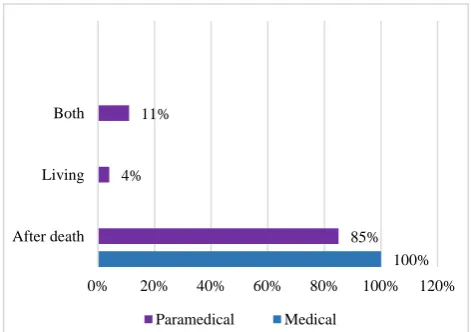
It was observed that 200 (100%) medical students had heard about organ donation but only 171 (85.5%) of paramedical students heard about organ donation. All the medical students had knowledge that eye can be donated after death but among the paramedical students 170 (85%)that eyes can be donated only after death while 4% thought that eye can be donated while alive, 11% had a mixed opinion of donation being possible both while living and being dead. Although all the medical students had knowledge regarding eye donation, regarding timing of eye harvesting, only 150 (75%) of medical students knew that ideal time duration to retrieve eyes is within 6 hours after death while 77 (38.5%) from among the paramedical students had idea of the same.
Figure 2: Distribution of study participants according to knowledge regarding eye donation.
While 120 (60%) medical students thought there was an age limit for donor, from amongst the paramedical students 180 (90%) had the same opinion. Regarding eye donation from a patient who had suffered from any
58.50% 41.50% 35% 65% 0.00% 10.00% 20.00% 30.00% 40.00% 50.00% 60.00% 70.00% Male Female Medical Paramedical 100% 85% 4% 11%
0% 20% 40% 60% 80% 100% 120%
After death Living Both
it was possible while 92 (46%) of paramedical students had a different opinion.
Willingness for eye donation
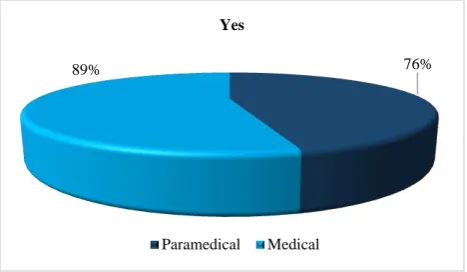
It was quite encouraging to know that more than 1/3rd (178 medical and 152 paramedical) of the study participants in both the groups were willing to donate eyes and know more regarding the same. Regarding shortage of eye donors in India, both the groups were consistent in their thoughts while 184 (92%)of medical students agreed regarding it, 174 (87%)paramedical also voiced the same opinion.
Figure 3: Distribution of study participants according to willingness for eye donation.
DISCUSSION
In the present study, it was very heart-warming to know that 100% of medical and 85.5% of paramedical were aware about organ donation. Regarding eye donation after death, while 85% of paramedical students replied in affirmation, all the medical students were of the equal opinion. In the study among South India population, 50.7% of the participants were aware of eye donation6. In study among hospital staff, 97% of them had good to excellent knowledge about transplantation of various human organs11. A large number of students, 150 (75%) of medical students knew that ideal time duration to retrieve eyes is within 6 hours after death while 77 (38.5%)from among the paramedical students had idea of the same. A study on medical and nonmedical students also observed that 79.6% of medical students knew that eyes can be donated after death and 63.3% knew that it should be done within six hours.10
Our study showed that more than 1/3rd (178medicaland 152 paramedical) of the study participants in both the groups were willing to donate eyes and know more regarding the same. Regarding shortage of eye donors in India, both the groups were consistent in their thoughts while 184 (92%)of medical students agreed regarding it, 174 (87%)paramedical also voiced the same opinion.
In the study among optometry students, 64.5% of the respondents were willing for eye donation.5 Another study in the urban population observed that 73.8% were aware of aye donations and only 44.9% were willing to pledge their eyes.12
Mandatory consent for donation expressed before the death of the donor should form the basis for eye donation ideally. However, in case of unavailability of such consent, consent from adult family members of the deceased donor should be obtained for eye donation. In a study done on the responses of relatives of post-mortem donors, only 44.3% of relatives of such cases gave consent for donation after intensive counselling.13 Mass media in the form of television, newspapers, magazines and posters were important sources of information on eye donation. Other studies also found publicity campaigns and media to be the major sources on this issue.12
The awareness of eye donation is better in medical students compared to paramedical students, but most of the students in both groups were inclined to pledge for eye donation. There is need to create awareness about eye donation in paramedical students. The medical and paramedical students could be actively involved as volunteers in eye donation campaigns, where in after proper training in counselling techniques, they can act as counsellors for eye donors.
CONCLUSION
In this study we found out that the awareness of eye donation is better in medical students compared to paramedical students, preferably due to the exposure and study curriculum. It was very heartening to know that most of the students in both groups were inclined to pledge for eye donation. However, we felt that there is need to create awareness about eye donation in paramedical students primarily to train them as counsellors. We feel that by proper training the medical and paramedical students could be actively involved as volunteers in eye donation campaigns as well as act as counsellors for eye donors also.
Funding: No funding sources Conflict of interest: None declared
Ethical approval: The study was approved by the Institutional Ethics Committee
REFERENCES
1. Krishnaiah S, Kovai V, Nutheti R, Shamanna BR, Thomas R, Rao GN, et al. Awareness of eye donation in rural population of India. Indian J Ophthal. 2004;52:73-8.
2. NPCB. Statistics of 2016-17 of eye donation. Available at: http://www.npcb.in.
3. Patil R, Gothankar J, Bhat P, Saluja J, Sane S. Eye donation: Awareness and willingness among
76% 89%
Yes
shopkeepers. Int J Community Med `Public Health. 2017;4:2056.
4. Vijayamahantesh M, Bijapur, Vallabha K.
Knowledge, attitude and practice pattern regarding eye donation, eye banking and corneal transplant in a tertiary care hospital. JKIMSU. 2015;4(4):94-103. 5. Dandona L, Dandona R, Naduvilath TJ, Mccarty C
A, Nanda A, Srinivas M. Is current eye care policy focus almost exclusively on cataract adequate to
deal with blindness in India. Lancet.
1998;351:1312-6.
6. Priyadarshin B, Srinivasan M, Padmavathi A, Selvam S, Saradha R, Nirmalan PK. Awareness of eye donation in an adult population of Southern India. A pilot study. Indian J Ophthalmol. 2003;51(1):101–4.
7. Uplap PA, Singh R. Exploring scope for
improvement in knowledge attitude and practices about organ donation and transplantation among post graduate medical students in mumbai, India. Int J Community Med Public Health. 2017;4(1):229-34. 8. Chakradhar K, Joshi D, Reddy BS. Knowledge, attitude and practice regarding organ donation among Indian dental students. Int J Organ Transplantation Med. 2016;7(1):28-35.
9. Vijayalakshmi P, Sunitha TS, Gandhi S, Thimmaiah R, Math SB. Knowledge, attitude and behaviour of the general population towards organ donation: an
Indian prospective. Natl Med J India.
2016;29(5):257-61.
10. Kannan KA. Eye donation movement in India. J Indian Med Assoc. 1999;97:318-9.
11. Golchet G, Carr J, Harris MG. Why don’t we have enough cornea donors? A literature review and survey. Optometry. 2000;71:318-28.
12. Tandon R, Verma K, Vanathi M, Pandey RM, Vajpayee RB. Factors affecting eye donation from post-mortem cases in a tertiary care hospital. Cornea. 2004;23:597-601.
13. Pradke KD, Anandh U. Ethics of paid organ donation. Pediatr Nephrol 2002;17:309-11.
Cite this article as: Rattan A, Sahoo A, Khan ZU, Patnaik A, Singh P, Rath M.Knowledge and
ANNEXURE 1
1. Name
2. Age
3. Sex
4. Education
5. Have you heard of organ transplant? [Y/N]
6. Do you know that eyes can be donated after death or living? 1. After death 2. Living 3. Both
7. Ideal time duration to retrieve eyes is within 6 hours after death. [Y/N]
8. Any age limit for donor? [Y/N]
9. Can a person with communicable disease donate eyes? [Y/N]
10. Are you willing to donate your eyes? [Y/N]