Original Research Article
Perceived level of return to functional abilities of mothers six weeks
after childbirth in the teaching hospital Enugu
Ada C. Nwaneri
1, Eunice O. Osuala
2*, Catherine C. Eze
1, Clementina O. Ezenwuba
3INTRODUCTION
Becoming a mother is a thing of joy though it has been reported as a time of great personal and family stress, which may likely make the woman who is preparing for motherhood to seek for information pertaining to her wellbeing and that of her baby. During pregnancy so many physiological changes occur, level of progesterone and estrogen rises continually, suppressing the hypothalamus axis and subsequently the menstrual cycle.1 These changes are expected to gradually return to normal after delivery and subsequently the return to pre-
pregnant functional activities/ status. According to Fawcet and Tulman, functional status is a multidimensional concept that is seen as the readiness of a woman to resume her desired level of infant care, self care activities, house hold activities, occupational, social and community activities.2 This functional status could be used interchangeable with functional abilities which when fully resumed, normal activities occur. This is important for the well being of the mother as well as the baby. Functional status contains five domains which are household function, infant function, personal, occupational and social and community function. These
ABSTRACT
Background: Functional status of mothers after delivery has implications for maternal and child health (MCH). The study is aimed at determining the perceived level of return to functional status of mothers attending post partum clinic, after six weeks of childbirth at the teaching hospitals in Enugu. Information gathered would help in designing programmes for improved MCH.
Methods: Descriptive survey design was adopted for the study. Data was collected using (IFSAC)-36 self rated items that was validated by experts in the field. Descriptive and inferential statistical analysis was done and findings presented in graphs and tables.
Results: Return of mothers to their functional abilities after six weeks of childbirth was good though in some aspects of functional ability it was low. 260 (73.9%) had a high level of return to infant care while 238 (67.68%), 218 (61.9%) and 159 (45.2%) had a low level of resumption to occupational, personal life, social and community activities respectively. There was a significant difference in the level of attainment of functional status of mothers attending past partum clinic with an F-value of 340.75<p value-0.05 There was no significant relationship observed between parity and return to functional status after 6 weeks of childbirth with 0.02 and 0.03 respectively (p>0.05).
Conclusions: Majority of mothers attending post partum clinic returned to functional status after six weeks of childbirth. Awareness on the importance of post partum clinic attendance need to be intensified for improved MCH as maternal and infant morbidity and mortality rate is high in Nigeria.
Keywords: Functional status, Mothers, Childbirth, Post-partum clinic
Department of Nursing Science, College of Medicine, 1University of Nigeria Nsukka Enugu State, 2Nnamdi Azikiwe University, Nnewi Campus Anambra State, 3Imo State University, Imo State, Nigeria
Received: 21 September 2018
Accepted: 29 October 2018
*Correspondence:
Dr. Eunice O. Osuala,
E-mail: [email protected]
Copyright: © the author(s), publisher and licensee Medip Academy. This is an open-access article distributed under the terms of the Creative Commons Attribution Non-Commercial License, which permits unrestricted non-commercial use, distribution, and reproduction in any medium, provided the original work is properly cited.
domains entail resumption to house chores, working, washing dishes, bathing and feeding of baby ability to resume sociality with friend and relation.
Barbara stated that infant care may likely take precedence over other aspect of functional status, thereby affecting the full performance of other domains of functional status of mothers.3
Maternal factors thought to affect the rate at which mothers will engage in and achieve full functional status after childbirth include maternal, age, parity and support from friends and family. Also exhaustion, fatigue and mild depression may also be a factor which may affect return to functional status. The mode of delivery, be it vaginal, caesarian section or instrumental delivery may also affect functional status, since those who delivered through caesarean section may require a longer period of recovery unlike mothers who had spontaneous vaginal delivery.
Women who experience caesarian birth have reported higher level of tiredness, breast feeding problems, constipation, depression, anemia, headache, difficulty in voiding, abnormal bleeding, urinary tract infection, abnormal pain and vaginal discharge than the counterpart who had spontaneous vaginal delivery.4 These are issues that may determine whether a woman return fully or not.
In Nigeria, traditionally family and social support are given to mothers after delivery in order to help them cope with their new status. Unfortunately in recent times this tradition has been eroded by the crave to make ends meet due to economic recession. Everybody is busy, even grandparents are retired but not tired as they embrace one job/ business or the other to survive, thereby making their support shorter or not being given at all, thereby loading the entire responsibility of house core and care of new born on the partum mothers.
The study setting, University of Nigeria Teaching Hospital (UNTH) –Ituku Ozalla was built by the colonial administrators and Enugu State teaching hospital Enugu State, (ESUTH) by the State, both in Enugu, Nigeria. The hospitals have a broad objective on services, teaching and research and consists of various clinics such as the postnatal clinic, where women after six weeks of childbirth are found. However few studies focus on the perceived level of return to functional abilities of mother after six weeks of child birth. This informed the researchers to investigate the perceived level of return to functional status of mothers attending post-partum clinic after6 weeks of childbirth in the teaching hospital Enugu.
METHODS
This descriptive survey was carried out in the University of Nigeria Teaching hospital Ituku-Ozalla, and Enugu State Teaching Hospital Enugu State, Nigeria. The total population of mothers attending postnatal clinic in the
teaching hospital in Enugu after six weeks of childbirth was 3,156 (records department UNTH and ESUTH, 2012- 2013) and this is made up of 896 mother in University of Nigeria Teaching hospital and 2260 mothers in Enugu State University teaching hospital.
Sample
The sample size of 355 mothers from UNTH and ESUTH attending postnatal clinic after 6 weeks of childbirth was used for the study. This was done using the Taro Yameni’s formular for sample size calculation.5
A stratified random sampling method was used in selecting mothers attending postnatal clinic in the teaching hospitals in Enugu six weeks after childbirth. In order to build a representative in the study based on the area of study, a proportionate sampling technique was carried out using the formula. Sample size of 101 was for the University of Nigeria teaching hospital and 254 for Enugu State University Teaching hospital.
Participants were chosen on the basis of willingness to participate in the study, emotionally stable, mothers who are attending postnatal clinic after six weeks of childbirth, those present at time of study and are within age range of 15-45 years, and mothers who speak English and pigeon English. The instrument for data collection was adapted by the researcher from the inventory of functional status after childbirth (IFSAC) a 36-items, self rated scale that measures physical infant care, house hold care, social activities and community activities.6
Validity
Face validity was carried out by giving the questionnaire to experts in this field from the University of Nigeria Nsukka, who made appropriate suggestion. Also a content validity was reported to be 84.4% from the standardized instrument.
Construct validity was also carried out to test the instrument which was done using ANOVA test analysis for both type of feeding and parity of the sampled group.
Reliability
A pilot study with 35 copies of questionnaire was administered at Bishop Shanahan Hospital, Nsukka which is different from the hospital under study. Same was analyzed using Cronbach’s alpha. An alpha of 0.81 and an inter-item (standardized) coefficient of 0.80 were obtained.
Ethical consideration
In order to obtain ethical permit a letter was written through the head of department, nursing science to the university of Nigeria teaching hospital and Enugu state teaching hospital research committees who gave ethical approval (UNTH/CSA/329/VOL.5).
The distribution of the questionnaire was done in the postnatal clinics of the teaching hospitals.
A research assistant was recruited and she was properly trained on how to collect data from client. Interview administered method was used as some participants do not have secondary education. Data collection was done during the clinic hours usually time 8:30 AM - 2:00 PM daily. This lasted for four weeks.
The scores obtained from the instrument were subjected to simple descriptive statistics ranging from frequencies, percentage and mean score to standard deviation. The result from analysis was presented in tables. Pearson product moment correlation and one way ANOVA (at 95% level of significant) were used in testing the set of hypothesis. This was done using SPSS version 17.0 software. The decision rule for data analysis of 38-75 indicates low level of return to functional status; 76-113 is moderate, while 114-152 indicate high level of return to functional status. For each domain, the following scores was used; for household activities domain:11-21 is termed low, 22-23 is moderate and 34-44 is high; for social and community domain, 5-9 is low, 11-15 is moderate and 16-20 is high. For infant care domain 9-17 is low, 18-27 is moderate and 28-36 is high, finally personal care domain: 8-15 is low, 16-24 is moderate and 25-32 is high.
RESULTS
Demographic data of respondents
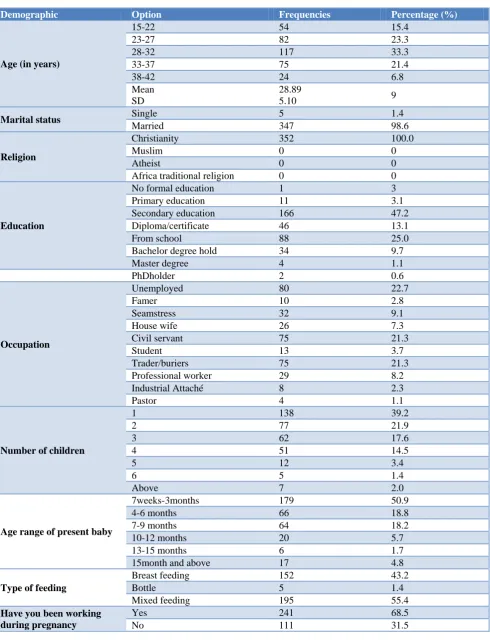
Characteristics of the overall data from 352 respondents that participate in the study, 54 (15.4%) respondents are aged 15-22 years, 82 (23.3%) respondents are 23-27 years, 117 (33.2%) respondents are aged28-32 years, 75 (21.4%) respondents are aged 33-37 years, 24 (6.8%) respondents are aged 38-42 years.
Single mothers were 5 (1.4%) while 347 (98.6%) respondents are married. All respondents had formal education, 11 (3.1%) respondents have primary education, 166 (47.2%) respondents have secondary education 46 (13.1%) respondents have Diploma / certificate from school, 88(25%) respondents have
bachelors degree 34 (9.7%) respondents have National diploma, 4 (1.1%) respondents have masters degree while 2 (0.6%) respondents have PhD. 80 (22.7%) respondents are unemployed, 10 (2.8%) respondents are farmer, 32 (9.1%) respondents are seamstress, 26 (7.3%) respondents are housewives, 75 (21.3%) respondents are civil servants, 13 (3.2%) respondents are student, 75 (21.3%) respondents are traders, 29 (8.2%) respondents are professional workers, 8 (2.3%) respondents are industrial attaches and 4 (1.1%) respondents are pastors.
138 (39.2%) respondents have 1 child, 77 (21.9%) respondents have 2 children, 62 (17.6%) respondents have 3 children, 51 (14.5%) respondents have 4 children, 12 (3.48) respondents have 5 children, 5 (1.4%) respondents have 6 children, and 7 (2%) respondents have more than six children. 179 (50.9%) respondents present baby age range is 7 weeks to 3 months, 66 (18.8%) respondents had their babies age as 4-6 months, 64 (18.2%) respondents had their babies age as 7-9 months, that of 20 (5.7%) respondents is 10-12 months, 6 (1.7%) respondents had theirs as 13-15months and 17 (4.8%) respondents had theirs as 15months and above. 152 (43.2%) respondents plan to breast feed their new born, 5 (1.4%) respondents plan to bottle feed their new born while 195 (55.46) plan to breast feed their newborn, 241 (68.5%) respondents have been working during their pregnancy while 11 (31.5%) respondents have not been working during pregnancy (Table 1).
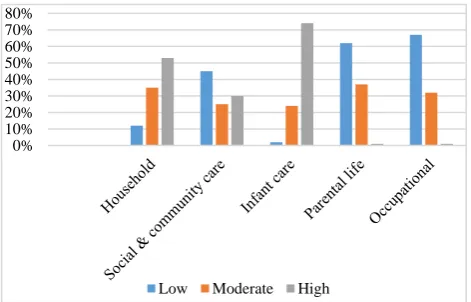
Figure 1: Level of attained functional status based on activities.
Household activities
Forty-three (12.2%) respondents attained low level of household activities, 122 (34.7%) moderate level of household activities and 187 (53.1%) attained high level of household activities
Social and community activities
One hundred and fifty-nine (45.2%) respondents attained low level of resumption to social and community activities, 87 (24.7%) moderate level of return to social and community activities and 106 (30.1%) high level of social/ community activities.
0% 10% 20% 30% 40% 50% 60% 70% 80%
Table 1: Demographic data of respondent.
Demographic Option Frequencies Percentage (%)
Age (in years)
15-22 54 15.4
23-27 82 23.3
28-32 117 33.3
33-37 75 21.4
38-42 24 6.8
Mean SD
28.89
5.10 9
Marital status Single 5 1.4
Married 347 98.6
Religion
Christianity 352 100.0
Muslim 0 0
Atheist 0 0
Africa traditional religion 0 0
Education
No formal education 1 3
Primary education 11 3.1
Secondary education 166 47.2
Diploma/certificate 46 13.1
From school 88 25.0
Bachelor degree hold 34 9.7
Master degree 4 1.1
PhDholder 2 0.6
Occupation
Unemployed 80 22.7
Famer 10 2.8
Seamstress 32 9.1
House wife 26 7.3
Civil servant 75 21.3
Student 13 3.7
Trader/buriers 75 21.3
Professional worker 29 8.2
Industrial Attaché 8 2.3
Pastor 4 1.1
Number of children
1 138 39.2
2 77 21.9
3 62 17.6
4 51 14.5
5 12 3.4
6 5 1.4
Above 7 2.0
Age range of present baby
7weeks-3months 179 50.9
4-6 months 66 18.8
7-9 months 64 18.2
10-12 months 20 5.7
13-15 months 6 1.7
15month and above 17 4.8
Type of feeding
Breast feeding 152 43.2
Bottle 5 1.4
Mixed feeding 195 55.4
Have you been working during pregnancy
Yes 241 68.5
Table 2: Descriptive statistics for various domains of.
N Mean Std.dev Std 95% confidence interval for mean Interval
Lower bound Upper bound Minimum Maximum
Household activities 352 2.41 0.07 0.04 2.34 2.48 100.0 3.0
Social and
community activities 352 1.85 0.86 0.04 1.76 1.94 100.0 3.0
Infant care 352 2.72 0.49 0.03 2.67 2.77 100.0 3.0
Parental care 352 1.39 0.51 0.03 1.34 1.44 3.0
Occupation 352 1.33 0.48 0.03 1.28 1.38 100.0 3.0
Total 1760 1.94 0.83 0.02 1.90 1.98 100.0 3.0
Table 3: Result for test of hypothesis 1.
Sum of square df Mean square F Sig
Between groups 531.78 4 132.94 34.75 0.000
Within groups 684.72 1755 0.39
1216.50 1759
Table 4: Correlation (symmetric measure) result for hypothesis 2.
Interval by interval Pearson’s R Value Symp.std. Error App Appro.sig
Ordinary by ordinary Spearman 0.07 0.05 1.33 0.19
Correlation 0.07 0.05 1.36 0.18
Number of valid Cases 352
Table 5: Correlation (symmetric measure) result for hypothesis 3.
Value Asympstd Error Appprox. App
Interval by interval Pearson R 0.02 0.06 .34 0.73
Ordinary by ordinary spearman correlation 0.03 0.05 .56 0.58
Number of valid cases 352
Infant care activities
Seven (20%) of the respondents attained low level of baby care, 85 (24.1) moderate level of baby care and 260 (73. 98) high level of baby care
Parental life activities
Two hundred and eighteen (61.9%) respondents have low level of personal life attainment, 131 (27.2%) moderate level of parental life attainment and 3 (0.9%) high level of parental life attainment
Occupational activities
Two hundred and thirty (67.6%) respondents have low level of work life attainment, 112 (31.8%) moderate level of work life attainment and 2 (0.6%) high level of work life attainment
Overall functional status
Overall functional status was 66% for low, 80% for moderate and 14% for high (Figure 2).
Figure 2: Overall functional status. Descriptive statistics for various domains
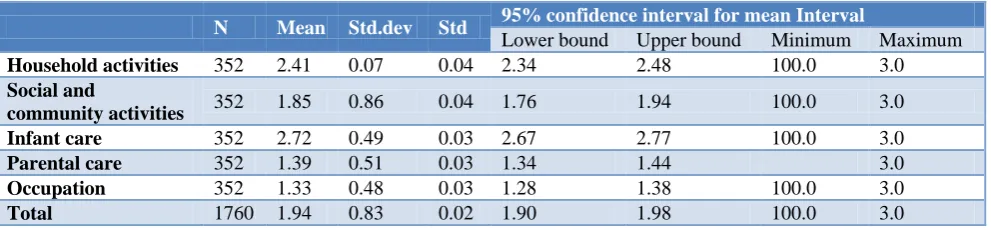
Descriptive statistics for various domains showed that respondents exhibited higher attainment of functional status in baby care (mean=2.41) followed by social and community activities (mean=1.85) personal care (mean=1.39) and finally work life (mean=1.33) (Table 2).
For the tested hypotheses, ANOVA (F-value) results is stated.
66%
80% 14%
For hypothesis 1, ANOVA result (F-value) is 340.75. This result is significant as p<0.05. This show that there is a significant difference in the level of attainment of functional status of mother attending post partum clinic, after 6 weeks of childbirth in the teaching hospital in Enugu across the various domain of functional status.
For hypothesis 2, the Pearson product- moment and Spearman rank correlation coefficient are 0.07 and 0.07 respectively with p>0.05.
This shows that there is no significant relationship between type of feeding and functional status of mothers attending postpartum clinic after 6 weeks of childbirth in the hospital Enugu.
For hypothesis 3, the Pearson product- moment correlation and spearman rank correlation coefficient are 0.02 and 0.03 respectively, the p>0.05. This shows that there is a significant relationship between parity and functional status of mothers attending postpartum clinic, after 6 week of childbirth in the teaching hospital Enugu.
Finally, the overall functional status of mother was characterized as, 21 (6%) respondents are low, the functional status of 28% (80.4%) respondents is moderate and the functional status of 48 (13.6%) respondents is high.
DISCUSSION
Findings of the study in general, revealed that majority of mothers attending post partum clinic returned moderately to their functional status after six weeks of childbirth. Specifically, mothers attending postpartum clinic attained high level of household activities and infant care, and low level of attainment in resumption to occupational activities, social and community activities. There is also no significant relationship between type of feeding and functional status as well as between parity and functional status of mother attending post partum clinic after six (6) weeks of childbirth. There is however a significant difference in various domain of functional status of mother attending postpartum clinic after 6 weeks of childbirth in the teaching hospitals in Enugu.
The major constraint of this study was dearth of literatures in this field. Due to this fact, comparism with works of other researchers was difficult.
In the level of attainment of household activities of mothers, it was said to be high. It was also seen that most of the mothers attending post partum clinic resumed fully to the care of family members, laundry work, cooking activities and shopping. This could be attributed to the fact that majority of respondents had only one child. A great number of mothers also practiced mixed feeding thereby reducing the attention which could have been given to infant feeding and then it is being utilized in other domains of functional status. Furthermore, in
Nigeria, where the sole duty of a wife is to care for her household, it becomes a very strong influencing factor.
For the social and community activities domain, a higher percentage of mothers reflected low resumption to social and community activities and also professional organization. This is similar to findings in the study done in Italy and France even though the environment is not same.7 This could explain the fact that since majority of mothers lacked social support, and there is increased (high) level of attainment of household chores, this could hinder mothers from participating in social/ community activities. Also, there is a general believe that when babies are tender they are exempted from social activities of which automatically their mothers are also exempted, this could be associated with the age range of most of the babies which is between seven weeks-three months.
The infant care level was also high, this is in line with work done by Barbara which states that infant care may likely take precedence over other aspect of functional status.3 This finding is contrary to work by Norhayati et al in which the most affected domain was infant care (p=0.002).8 This may be due to the morbid state of the mothers. Based on data obtained, it was seen that most mothers were never punctual to work, this could be attributed to the quality time been given to household chores and infant care.
Furthermore, level of attainment of personal care was low, this may be related to increase in household activities and infant care, thereby reducing the time for personal care. Also babies’ temperament as it is seen from data obtained that majority of the babies have high temperament, this could make babies demand high attention from mothers than usual.
Lack of social support could be related to decrease in personal care, because mothers are expected to meet up with other roles which are essential to their wellbeing. Mothers are faced with challenges of meeting up with the increased demand on them, with limited energy and time, which could be basis for affecting their personal care.
Also if working conditions are not favorable, there might be no source of motivation for the woman to work. Waters and Lee reported that maternal role acquisition could result in more sleep deprivation and fatigue than maternal role expansion which may likely affect resumption to occupational activities.9 In another study it was found out that employed mothers viewed returning to the workplace as having more challenges than the expected, because the experience was viewed as being mostly negative.10
Significant difference was seen between the various domains of functional status of mothers after six weeks of childbirth. This could be based on their level of knowledge of mothers since most of the respondents were secondary school leavers who may not have basic knowledge of how they ought to return to functional abilities. Also anxiety could be a major cause since this is usually seen at the initial state of adaptation. There is no significant relationship between the type of feeding and the functional status of mothers after six-weeks of childbirth; this implies that type of feeding does not improve the functional abilities. This could also be related to the fact that mothers lacked social support. This may be a factor to return to functional status than type of feeding. Therefore, irrespective of the form of feeding pattern once mothers lack social support, the feeding pattern will not determine the level of resumption to functional abilities.
Finally, there was no significant relationship between parity and the functional status of mothers. This shows that functional abilities of mothers could increase or decrease irrespective of the number of children.
CONCLUSION
The findings of the study showed that majority of mothers attending postpartum clinic returned to their functional status after childbirth. Awareness on the importance of post partum clinic attendance among women of child bearing age need to be intensified for improved MCH especially functional status of mothers after birth as maternal and infant morbidity and mortality rate is high in Nigeria. Health care providers (doctors, nurses, midwives and community health workers) should intensify health education and campaign on how to live optimally with child birth, encouraging activities which are not energy sapping. Strategies to increase return to occupational, personal care, social and community activities such as proper home visit and occupational therapy should be put in place. Clinical managers should help in provision of pre-counseling, post counseling and ongoing counseling for mothers in order to enhance personal functional level. Government should also increase maternity leave of mothers; this will also help their full resumption to functional status.
ACKNOWLEDGEMENTS
We wish to acknowledge the assistance of University Teaching Hospital Ituka Ozalla management that made access to the participants possible.
Funding: No funding sources Conflict of interest: None declared
Ethical approval: The study was approved by the Institutional Ethics Committee
REFERENCES
1. Barbara P. Functional status outcome in mothers with and without postpartum depression. Journal of midwifery women’s health 2008;53(4):310-8. 2. Fawcet J, Tulman L. Women’s health during and
after Pregnancy:a theory based study of adaptation to change. New York: Springer publishing company 2003.
3. Frasers DM, Cooper MA. Myles textbook for midwives. Churchill living stone: UK 2009.
4. Hannah M, Hanah W, Hodnett E, Chalmer B, Kung R, Willan A. Planned caesare vs. planned vaginal delivery for breech presentation at term:the international randomized term Breech trial. JAMA. 2000;287:1822-31.
5. Yamane T. Statistics and introductory analysis. New York: Harpers & Roy; 1973.
6. Fawette J, Tulman L, Myers ST. Development of the inventory of Functional status after Birth. J Nurse-Midwifery. 1998;33(6):252-60.
7. Saurel-Cubizolles MJ, Romito P, Lelong N, Ancel PY. Women’s Health after Child birth:a longitudinal study in France and Italy 2013. BJOG. 2000;107(10):1202-9.
8. Norhayati MN. Functional Status of Women with and without Severe Maternal Morbidity:A prospective Cohort Study. Women and Birth. 2016;29(5):443-9.
9. Water MA, Lee KA. Differences between primigravida and multigravida mother in sleep disturbance, fatigue, and functional status. J Nurse Midwife. 1996;41:364-7.
10. Nicholas MR, Roux GX. Maternal perspectives on postpartum return to workplace. J Obstet Gynaecol Neonatal Nurs. 2004;33:463-71.