Original Research Article
Re-emergence of diphtheria in Kerala: the need for change in
vaccination policy
Priya Chandran*, M. P. Lilabi, Thomas Bina, Jayakrishnan Thavody, Smiji George
INTRODUCTION
Diphtheria is an infectious disease of acute onset caused by the bacterium Corynebacterium diphtheria, which primarily infects the throat and upper airways. The exotoxin produced by the bacteria causes a membrane of dead tissue to build up over the throat and tonsils, making breathing and swallowing difficult.1 The toxin affects organs like the heart and nervous system causing myocarditis or peripheral neuropathy in severe cases. The disease is characterized by sore throat, low-grade fever
and cervical lymphadenopathy. Death can occur due to circulatory failure during the first 10 days of the illness.2 Introduction of diphtheria toxoid in vaccination programs has reduced the mortality and morbidity of diphtheria dramatically the world over. However, diphtheria is still a significant child health problem in countries with poor immunization coverage.1 In countries endemic for diphtheria, the disease occurs mostly as sporadic cases or as small outbreaks.1
ABSTRACT
Background Diphtheria cases continue to occur in India despite a national vaccination program targeting the disease. Outbreaks of diphtheria have been known to occur in areas of low immunization coverage. An age shift has been noted to older children and adults in recent outbreaks from the Indian states of Andhra Pradesh, Karnataka, Delhi and Assam. Kerala witnessed its largest outbreak of diphtheria in recent times from 2015 to 2017.
Methods: Surveillance data from the Regional PEID cell during the outbreak period was analysed and epidemiological data generated.
Results: A total of 734 cases of diphtheria were reported during this period with eight deaths (Case fatality rate=1.08%). The mean age of the cases was 17.4 years (±13.9). More than 72% of the cases occurred in children above 10 year of age and 68% of the cases were either unimmunized or partially immunized. 32% of the cases were immunized for age. Of these, immunized children, 88% were above 10 years of age, indicating waning immunity with age. The existence of a sizeable unimmunized cohort in the adolescent age group and waning immunity among immunized were two major factors contributing to the outbreak.
Conclusions: An age shift has been observed in the occurrence of diphtheria cases during the outbreak in Kerala. Booster doses with Td vaccine during adolescence in addition to maintaining a high immunization coverage in the routine immunization program, with special emphasis on pockets of low coverage is essential for preventing the reemergence of diphtheria.
Keywords: Age shift, Diphtheria outbreak, Td vaccine
Department of Community Medicine, Government Medical College Kozhikode, Kerala, India
Received: 10 December 2018
Accepted: 12 January 2019
*Correspondence:
Dr. Priya Chandran,
E-mail: [email protected]
Copyright: © the author(s), publisher and licensee Medip Academy. This is an open-access article distributed under the terms of the Creative Commons Attribution Non-Commercial License, which permits unrestricted non-commercial use, distribution, and reproduction in any medium, provided the original work is properly cited.
A major share of the diphtheria cases occurring in the world each year is from India. There has been a declining trend in new cases after the introduction of the Universal immunization Program (UIP) in India. Still, around 2000 to 4000 cases get reported annually in the country.3 In the last decade, there have been reports of re-emergence of diphtheria from several states: Andhra Pradesh, Delhi, Maharashtra,Assam, Karnataka, Chandigarh, Gujarat and many of them presenting as outbreaks.4-8 Most of the outbreaks were characterized by cases in low immunization pockets.
Kerala, the southernmost state of India has high immunization coverage of 82% and better health indices when compared to the rest of India. Despite these favourable factors, outbreaks of diphtheria were reported from Kerala during three consecutive years-2015, 2016 and 2017. The outbreak began in the district of Malappuram in 2015 and spread initially to the neighbouring district of Kozhikode and later to other districts. Apart from the fact that the outbreak began in an area of low immunization coverage, another feature of interest was the age shift that was noted. In this article, we share the epidemiological details of this outbreak that was generated through a routine surveillance system and recommends an urgent modification in the national vaccination policy.
METHODS
Our Institution is a tertiary care center which serves as a referral center for five districts in Northern Kerala. We analysed the surveillance data from the onset of the outbreak in September 2015 to December 2017. The data was obtained from our Regional Prevention of Epidemics and Infectious Diseases Cell (RPEID Cell) which is part of a network of surveillance units established in all government medical colleges in Kerala and managed by the departments of Community Medicine in each college.
Case surveillance
Daily line list of “Probable and confirmed diphtheria cases” were collected from the medicine, pediatrics, infectious diseases and Ear Nose Throat (ENT) wards and outpatient department as part of surveillance activity during this period.9
Immunisation history
Details of immunization was elicited from individual cases and crosschecked with the immunization cards for children (≤15 years). Verbal history of immunization was relied upon, for adults. Those who had not received even one dose of the primary immunization series of DPT/Pentavalent vaccine were categorized as „unimmunised‟. Those who had received at least one dose of diphtheria toxoid either as DPT/Pentavalent vaccine but not completed the WHO recommended schedule of 5 doses were categorized as „partially immunized‟ and
those who had taken all 5 doses of the diphtheria toxoid were categorized as „fully immunized‟. Those who could not recall their immunization status were also categorized as „unimmunized‟.
Laboratory testing
Throat swabs for culture of Corynebacteria were taken soon after admission by trained medical officers and tested at the Microbiology Department of our institution. The throat swabs were processed and the isolate was identified by culture using 5% sheep blood agar and serum Tellurite agar. C. diphtheriae colonies were confirmed with the cystinase test growing black colonies with a brown halo on Tinsdale agar. Antibiotic sensitivity testing was performed using Kirby Bauer disc diffusion method on Mueller–Hinton blood agar plates. All isolates were sent to State Public Health Lab, Thiruvananthapuram, for Elek gel diffusion test and Tox gene demonstration by polymerase chain reaction.
RESULTS
The epidemic of diphtheria in Kerala began in September 2015 and continued till 2017. A total of 734 cases reported to our institution during this period with 8 deaths yielding a case fatality rate of 1.08%.
The index case
The first case brought to the notice of the health system was a 12 year old boy from a hostel (orphanage cum residential school) in Malappuram district, admitted to the pediatric ward of our institution on 7th September 2015 with toxic features and a membrane over the throat. Corynebacterium was cultured from the throat swab of the case.
The second case
This was from the same hostel was admitted with similar symptoms on 8th September 2015, and confirmed as diphtheria by throat swab culture. Despite treatment with antibiotics and antitoxin, the second case died on 17th September 2015.
The primary case
Death of a 13 year old boy residing in the same hostel occurred on 4th September 2015. The cause of death was retrospectively diagnosed as “Probable diphtheria” as per the CDC case definition of diphtheria.9 The primary case shared the same seating arrangements at school with the index case and the second case.
Surveillance
confirmed and probable cases were done. Throat swabs were taken from 28 probable cases out of which six were laboratory confirmed as diphtheria positive. As all the inmates of the hostel were unimmunized, they were immunized with 3 doses of Td vaccine (at 0, 1 and 6 months). Following strict control measures, no more cases were reported in the year 2015.
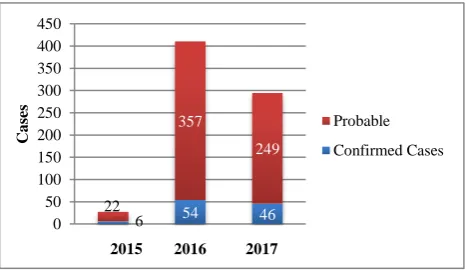
In the year 2016, cases of diphtheria started reporting in our institution from the month of May. As in the year 2015, the initial cases were from Malappuram district. Kozhikode district reported its first case in June 2016. Subsequently, more cases were reported from both Malappuram and Kozhikode districts and the outbreak continued with 411 and 295 cases reporting to our institution in 2016 and 2017 respectively (Table 2). Of the total 734 „probable diphtheria‟ cases, 14% (106) were confirmed by throat swab culture (Figure 1). All the isolates were sensitive to Penicillin and Erythromycin and positive for toxgene.
Table 1: Diphtheria-case definition.
Probable
In the absence of a more likely diagnosis, an upper respiratory tract illness with:
An adherent membrane of the nose, pharynx, tonsils, or larynx; and
Absence of laboratory confirmation; and
Lack of epidemiologic linkage to a laboratory-confirmed case of diphtheria
Confirmed
An upper respiratory tract illness with an adherent membrane of the nose,
pharynx, tonsils, or larynx; and any of the following:
Isolation of Corynebacterium diphtheriae from the nose or throat; or
Histopathologic diagnosis of diphtheria; or
Epidemiologic linkage to a laboratory-confirmed case of diphtheria.
Figure 1: Diphtheria cases during outbreak.* *Surveillance data from RPEID Cell Kozhikode
Control measures
Control measures were initiated immediately by the department of health services in the district of Malappuram and Kozhikode and other affected districts. Cases admitted in our institution were treated in a dedicated isolation ward with antitoxin, crystalline Penicillin and supportive care. Cases were kept in isolation for a minimum period of two weeks and discharged only after two consecutive throat swabs taken 24 hours apart were negative. Close contacts of the confirmed cases were immunized with diphtheria containing vaccine (Td or DPT) according to age and immunization status. Prophylaxis with Erythromycin was initiated for family contacts and close contacts of cases. Active measures to identify unimmunized/partially immunized children were initiated and school-based vaccination campaigns conducted to increase the immunization coverage in the age group 5 to 15 years.
Epidemiology
Cases were reported from 11 of the 14 districts in the state with maximum cases being reported from the districts of Kozhikode and Malappuram. Out of the total 734 cases, eight succumbed to the disease–case fatality rate 1.08%.
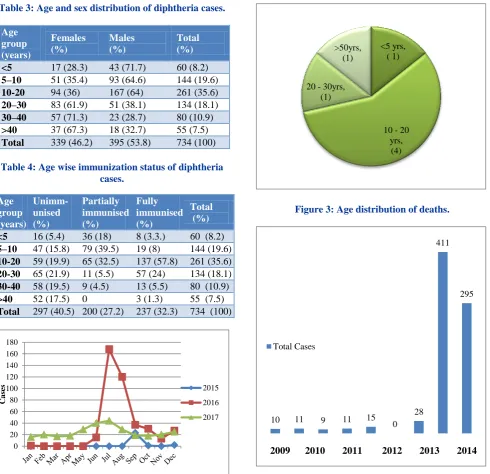
Seasonality of the outbreak was observed from the months of July to October with the maximum number of cases in the month of July (Figure 2).
Figure 1: Diphtheria cases during outbreak.* *Surveillance data from RPEID Cell Kozhikode
The mean age of the cases was 17.4 years (±13.9), median age was 16 years (Range-6 months to 65 years). Majority of cases (35.6%) were seen in the age group of 10-20 years. More than 72% of the cases occurred in those more than 10 years of age (Table 3).
The number of males was marginally more than females (395, 53.8%) (Table 3). Males were more affected among children and adolescents (<20 years), but female predisposition was observed among adults (>20 years).
6 54 46
22
357
249
0 50 100 150 200 250 300 350 400 450
C
a
ses
2015 2016 2017
Probable Confirmed Cases
6 54 46 22
357
249
0 50 100 150 200 250 300 350 400 450
C
a
ses
2015 2016 2017
The breakup of diphtheria cases based on religion shows that most of them (71.5%) were from the Muslim community. As per 2011 census the district of Malappuram has a higher proportion of Muslims (70%).
Kozhikode too has a high share (39%) of muslim population. Even when the high distribution of muslim population in the districts is considered, the cases among the Muslim community were high.
Table 2: District wise and year wise diphtheria cases in North Kerala*
District/
Year Kozhikode Malappuram Kannur Wayanad Palakkad Others Total Cases
2015 - 28 - - - - 28
2016 206 154 16 21 8 3 411
2017 132 98 22 40 3 295
Total 338 (46.1%) 280 (38.2%) 38 (5.2%) 61 (8.3%) 8 (1.1%) 6 (0.8%) 734 (100%)
*Surveillance data from regional PEID Cell Kozhikode
Table 3: Age and sex distribution of diphtheria cases.
Age group (years)
Females (%)
Males (%)
Total
(%)
<5 17 (28.3) 43 (71.7) 60 (8.2)
5–10 51 (35.4) 93 (64.6) 144 (19.6)
10-20 94 (36) 167 (64) 261 (35.6)
20–30 83 (61.9) 51 (38.1) 134 (18.1)
30–40 57 (71.3) 23 (28.7) 80 (10.9)
>40 37 (67.3) 18 (32.7) 55 (7.5)
Total 339 (46.2) 395 (53.8) 734 (100)
Table 4: Age wise immunization status of diphtheria cases.
Age group (years)
Unimm-unised (%)
Partially immunised (%)
Fully immunised (%)
Total (%)
<5 16 (5.4) 36 (18) 8 (3.3.) 60 (8.2)
5–10 47 (15.8) 79 (39.5) 19 (8) 144 (19.6)
10-20 59 (19.9) 65 (32.5) 137 (57.8) 261 (35.6)
20-30 65 (21.9) 11 (5.5) 57 (24) 134 (18.1)
30-40 58 (19.5) 9 (4.5) 13 (5.5) 80 (10.9)
>40 52 (17.5) 0 3 (1.3) 55 (7.5)
Total 297 (40.5) 200 (27.2) 237 (32.3) 734 (100)
Figure 2: Seasonality of diphtheria cases.
Figure 3: Age distribution of deaths.
Figure 4: Diphtheria cases in north Kerala 2009 to 2017.
0 20 40 60 80 100 120 140 160 180
C
a
ses 2015
2016 2017
<5 yrs, ( 1)
10 - 20 yrs,
(4) 20 - 30yrs,
(1) >50yrs,
(1)
10 11 9 11 15
0 28
411
295
Total Cases
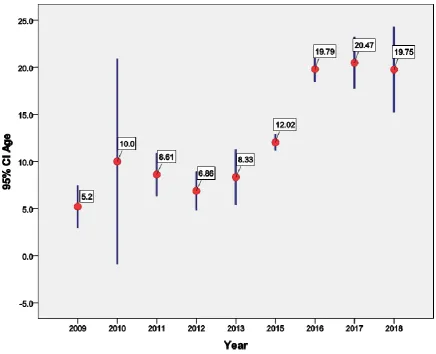
Figure 5: Mean age of diphtheria cases showing age shift.
More than 68% of the cases were either unimmunized or partially immunized (Table 4). Diphtheria was also seen in the fully immunized population. 32% of the cases were immunized for age but a majority of these (nearly 88%) were above 10 years of age, indicating waning immunity with age. Diphtheria was seen only among a small percentage of those immunized for age in the under-five age group (3.3%) and 5-10 year age group (8%) (Table 4).
Including the primary case, eight deaths occurred during the outbreak of which 7 were males. Most (4 deaths) were in the adolescent age (10-20 years) (Figure 3). All of them were unimmunized. The cause of death included myocarditis and septic shock.
DISCUSSION
The outbreak of diphtheria in Kerala which began in September 2015 and continued to 2017 was the largest outbreak in recent times in Kerala. As our institution is the tertiary care centre for Kozhikode and neighbouring districts and a dedicated diagnostic centre in North Kerala, more than 75% of the cases which occurred in the state were treated here. As seen from the surveillance data over the years the number of cases of Diphtheria
being reported annually has been low until 2015 when it re-emerged as a localised outbreak (Figure 4).
There has been a shift in the burden of disease to the adolescent age group in the outbreak as can be seen from the fact that more than 72% of the cases were above 10 years of age. Mean age of the reported cases in Kerala over the years has shown a gradual shift to the adolescent age from 5.2 years in the year 2009 to 20.5 years in 2017 (Figure 5). A shift in the age group has also been demonstrated internationally in outbreaks which have occurred in the Dominican Republic and Europe.14,15 Outbreaks in Andhra Pradesh reported age shift in cases where children above 10 years were increasingly affected.4,16 In an outbreak in Assam in 2009 only adults >20 years were affected.17 Reports from other states like Delhi, Haryana,West Bengal also indicate an age shift with cases increasingly being reported among the older children.5,18 Presence of an older unimmunized cohort and the waning of immunity to diphtheria during adolescence are factors responsible for the age shift of the disease to the adolescent age.
Majority of the cases in the current study were either unimmunized or partially immunized, which emphasizes the protection afforded by routine childhood immunization against diphtheria, especially among the very young. But the occurrence of diphtheria among immunized subjects in the older age group (>10 years) indicates waning of immunity with age. In addition, opportunities for boosting of antibody titre with subclinical infection were also low. This calls for additional booster doses of diphtheria toxoid during adolescence to maintain protective antibody titres against diphtheria. In India, diphtheria toxoid is given as 3 primary doses at 6, 10 and 14 weeks and boosters at 16-18 months and five to six years of age in the national immunization schedule. Replacement of Tetanus toxoid vaccine with tetanus and diphtheria toxoid (Td vaccine) at 10 years and 16 years will help in boosting the waning immunity.
Outbreaks of diphtheria are dependent on herd immunity of the population. Maintaining high routine immunization coverage in the Universal Immunisation Programme (UIP) and active measures to identify pockets of low immunization can ensure herd immunity is above the threshold level.
In the below 20yrs age group, males were mostly affected. But in the above 20 years age group, females were the ones more affected. Females above 20 years are caregivers for children and adolescents which places them at higher risk for contracting the disease, which might explain the high proportion of cases in this age group. Female preponderance in diphtheria has been reported from outbreaks in Andhra Pradesh whereas a study from Gujarat observed male preponderance among children.4,16,19
The cases fatality rate in the current outbreak was only 1.08% which is considerably lower than the overall case
fatality rate of 2.2% for diphtheria observed in India.20 Higher case fatality has been reported in Delhi (4.2%) and Assam (3.3%), Andhra Pradesh (3%).16,17,2. Prompt outbreak response by the health system and active surveillance ensured early diagnosis, isolation and treatment of cases and contacts which was the main reason for the low case fatality.
The main reason for this huge outbreak in Kerala was the presence of an unimmunized cohort of adolescent children which can be seen from the fact that it began in a closed community of a hostel where most of the children were unimmunized. Overcrowding and mixing of the population was another factor which could have resulted in the outbreak as the hostel also had inmates from other states. The persistence of diphtheria in the community in the form of subclinical infection and carriers resulted in the outbreak continuing in the subsequent years. A waning of immunity in the adolescent age among those already immunized further added to the outbreak. Currently (in 2018), diphtheria cases are still being reported in our institution, the number of cases have come down to 77 cases but surveillance is continuing and the epidemic may wane in the coming years.6
CONCLUSION
There has been a re-emergence of diphtheria in Kerala with an age shift to older children and adults. Cohorts of unimmunised, partially immunised and those with waning immunity are more at risk. The age shift observed in the current outbreak in Kerala and outbreaks in other states of India call for an urgent update in vaccination policy. In order to protect the adolescent population, the introduction of diphtheria toxoid during adolescence is essential to prevent re-emergence of diphtheria in future. Till then booster vaccination with Td at college entry may also be considered. Strategies to identify areas of low immunization coverage in addition to maintaining high routine immunization coverage is essential to maintain high herd immunity and prevention of outbreaks among children.
ACKNOWLEDGEMENTS
We acknowledge the help of the Department of Microbiology, GMC Kozhikode for laboratory support and the cooperation of Dr Sheela Mathew, Professor Infectious diseases and Dr Sindhu TG, Associate Professor in charge of Pediatric Infectious diseases Department, GMC Kozhikode for their valuable comments. We also are indebted to the Department of Health Services Malappuram and Kozhikode Districts for their support in surveillance activities.
Funding: No funding sources Conflict of interest: None declared
REFERENCES
1. WHO. Diphtheria: World Health Organisation. Available at http://www.who.int/immunization/ diseases/diphtheria/en/. Accessed 2 January 2017. 2. Government of India. Annual report 2012. India:
Ministry of Health; 2012.
3. WHO Vaccine preventable Diseases monitoring system 2009 Global summary. Available at www.who.int/vaccines-documents/. Accessed 12 October 2018.
4. Bitrangunta S, Muhrekar MV, Hutin YJ, Penumur PP, Gupta MD. Persistence of Diphtheria in Hyderabad, India: 2003-2006. Emerging Infectious Diseases. 2008;14:1144-6.
5. Sharma NC, Banavaliker JN, Ranjan R, Kumar R. Bacteriological and Epidmiological characteristics of Diphtheria cases in and around Delhi. A retrospective study. Indian J of Med Res. 2007;126:545-52.
6. Singhal T, Lodha R, Kpil A, Jain Y, Kabra SK. Diphtheria–Down but not out. Indian pediatr. 2000;37:728-38.
7. Khan N, Shastri J, Singal U, Doctor B. Resurgence of Diphtheria in vaccination Era. Indian J Med Microbiol. 2008; 26:434.
8. Dravid MN, Joshi SA. Resurgence of Diphtheria in Malegaon and Dhule regions of North Maharashtra. Indian J Med Res. 2008;127:616-7.
9. National Notifiable Disease surveillance system. Centre for Disease Control and prevention. Available at www.cdc.gov/nndss/conditions/ diphtheria/case-definition/2010/. Accessed on 14 September 2018.
10. National Family Heath Survey Report (NFHS-4)– Kerala, 2015-2016. Available at rchiips.org/ NFHS/NFHS-4.Reports/Kerala. Accessed on 14 September 2018.
11. National Family Heath Survey Report (NFHS-3) – Kerala, 2004–2005. Available at rchiips.org/ NFHS/NFHS-3. Reports/Kerala. Accessed on 14 September 2018.
12. Rajeev GR. The fallacies of the faithful. Available at http://www.thehindu.com/search/?q=14479789. Accessed on 22 September 2018.
13. Herriman R. India: Diphtheria takes the life of unvaccinated Kerala teen, 2016. Available at http://outbreaknewstoday.com/india
diphtheriatakesthe-life-of-unvaccinated-kerala-teen-59420/. Accessed on 22 September 2018.
14. Garib Z, Danovaro-Holliday M, Tavarez Y, Leal I, Pedreira C. Diphtheria in the Dominican Republic: reduction of cases following a large outbreak. Rev Panam Salud Pública. 2015;38 (4):292–9.
15. Wagner K, White J, Lucenko I, Mercer D, Crowcroft N, Neal S, et al. Diphtheria in the postepidemic period, Europe, 2000–2009. Emerg Infect Dis. (2012);18(12):217–25.
16. Meera M, Rajarao M. Diphtheria in Andhra Pradesh–a clinical-epidemiological study. Int J Infect Dis. 2014;74-78.
17. Saikia L, Nath R, Saikia NJ, Sarkar M. A diphtheria outbreak in Assam, India. Southeast Asian J Trop Med Public Health. 2010;41(3):647-52.
18. Ray SK, Gupta DS, Saha I. A report of diphtheria surveillance from a rural medical college hospital. Journal of Indian Med assoc. 1998;96:236-8. 19. Maheriya KM, Pathak GH, Chauhan AV, Mehariya
MK, Agrawal PC. Clinical and epidemiological profile of diphtheria in tertiary care hospital. Gujarat med j. 2014;69(2):105-8.
20. Central Bureau of Health Intelligence (CBHI), Govt of India. National Health Profile 2005 Onwards. Available at http://www.cbhidghs.nic.in/index1.asp? linkid=267. Accessed 1 December 2017.
21. Das PP, Patgiri SJ, Saikia L, PauL D. Recent outbreaks of diphtheria in Dibrugarh district, Assam, India. J Clin Diagn Res. 2016;10(7):DR01-3.