© 2016 IJSRSET | Volume 2 | Issue 1 | Print ISSN : 2395-1990 | Online ISSN : 2394-4099 Themed Section: Engineering and Technology
DFIG for Wind Energy Generation Using Stator Voltage
Orientation Control – A Review
Mariya Alvi*, Rakesh Sharma
Department of Electrical Engineering, BBDU, Lucknow, Uttar Pradesh, India
ABSTRACT
Now a days as one of the most important renewable source of energy is wind energy that is gaining interest due to its ecofriendly nature. This paper is about the study on control of wind driven doubly fed induction generator. A converter setup that is back to back PWM with stator voltage oriented vector control is used to control the DFIG. The back to back PWM converter set up consists of the Rotor Side Converter and the Grid Side Converter with intermediate DC link. Decoupled control of the DC link voltage and the grid reactive power is obtained through Voltage oriented control of GSC. Similarly independent control of power from wind and reactive power of DFIG is carried out by stator voltage oriented vector control of RSC. Coordinated control of the back to back converter setup in both sub synchronous and super synchronous mode is presented.
Keywords : DFIG, stator voltage orientation control scheme, rotor side converter, grid side converter, decoupled control.
I.
INTRODUCTION
Wind energy have been attracting great attention due to the cost increase, limited reserves, and adverse environmental impact of fuel such as coal, oil, or natural gas. In the meantime, technological advancements, cost reduction, and governmental motive have made some renewable energy sources more desiring in the market. Among them, wind energy is the fastest growing renewable energy sources. Over the past two decades a variety of wind power technologies have been developed, which have improve the conversion efficiency reduced the costs for wind energy production. A wind energy conversion system transforms wind kinetic energy to mechanical energy by using rotor blades; this energy is then transformed into electrical energy by generator.
The DFIG is essentially a wound rotor in induction generator in which the rotor circuit is controlled by external devices to achieve variable speed operation. In [1] thatsummaries the researches in the area of study of
transmission network for a disturbance which cause the stability of long term voltage. In the case first the voltage control of the terminal bus of the plant will be performed only through the rotor‐side converter, while in the case second the voltage control will also have the additional contribution of the reactive power delivered by the grid side converter.
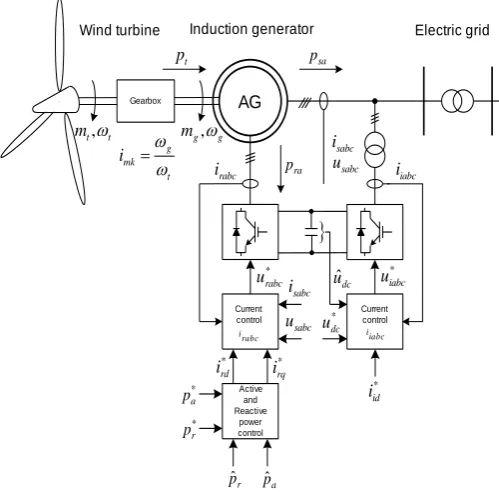
Electric grid Gearbox AG Induction generator iabc i Current control * iabc u * dc u
dc uˆ iabc i * id i Current control rabc i * rabc u rabc i * rd i r pˆ * r p * rq i a pˆ * ap Activeand Reactive power control sabc i sabc u sabc u sabc i t g mk i Wind turbine t t
m, mg,g
t
p psa
ra p
Figure 1 : Wind turbine control system with DFIG
Doubly Fed Induction Generator (DFIG) is basically a wound rotor induction generator, that is used to fed power from both stator and rotor circuit. Stator provides power directly to grid which is unidirectional. Rotor circuit is connected to a bidirectional ac/dc/ac converter that having a common dc link bus. In rotor side power flow is bidirectional that is depending on the mode of operation the power flow may be from rotor side to grid or it may be from grid side to rotor. The rotor side converter also fed reactive power to the generator so as it will be run at a near unity power factor. The function of the grid voltage converter is to maintain the DC link voltage constant that fed a constant amplitude ac voltage to rotor side for maintaining the flux constant.
II.
METHODS AND MATERIAL
A. Wind Turbine Components
Wind turbine components are turbine blade, gear box, pitch mechanism, rotor mechanical break, and generator, yaw drive, wind sensors etc.
In wind conversion squirrel cage induction generator, doubly fed induction generator, and synchronous generator (wound rotor and permanent magnet) have been used. The most popular is doubly fed induction generator (DFIG) in wind energy industry, the stator of the generator is connected with the grid directly, while the rotor is interfaced with the grid through a power converter system with reduced power capacity. It also enables the generator-side active power control and grid-side reactive power control.
Wind turbine can be classified into fixed-speed and variable-speed turbines. Fixed-speed wind turbines rotate at almost a constant speed, which is determined by the gear ratio and the grid frequency, and the number of poles of the generator. On the other hand, variable-speed wind turbines system can achieve maximum energy conversion efficiency over a wide range of speeds. The turbine is continuously adjusting its rotational speed according to the wind speed. The tip speed ratio should be kept at an optimal value to find the maximum power conversion efficiency at different speeds.
employed in wind turbines. Among induction generators, doubly fed induction generators (DFIG) offer variable speed, while keeping the size of the controllers small so as to reduce the costs. In this thesis, we will compare different DFIG models. When a wound rotor induction machine (WRIM) works as a generator and fed power from both stator and rotor side, it is termed as Doubly Fed Induction Generator (DFIG). DFIG scheme is used as a variable speed fixed frequency topology. In this scheme, stator is directly connected to the grid while the rotor circuit is connected to grid through an AC/DC/AC back to back frequency converter. The rating of this converter is typically 25-30% of the total power rating of the generator. This is the main advantage of DFIG over other variable speed topologies as it provides same features at lesser cost and provides good efficiency. DFIG is basically a wound rotor induction generator which has a stator and rotor circuit. Stator circuit of the DFIG consist of stator frame, laminated stator core having stator slots embedded in it and a balanced 3 phase windings placed 120 degree electrically apart from each other. The winding distributed in nature, are insulated and are housed in the stator slots. Stator windings may be connected in delta or star manner. Rotor circuit consist of rotor, rotor slots and a 3 phase insulated winding. These 3 phase winding is uniformly distributed .These windings are connected to one end to form star connection and on the other side connected to slip rings. The stator circuit is connected directly to grid (or sometimes through a soft stator to minimize the high inrush current). Rotor circuit is connected to grid through a bidirectional AC/DC/AC bidirectional converter.
B. Reference Frame Transformation
The reference frame theory is used to simplify the analysis of electric machines and also to facilitate the simulation and digital implementation of control schemes in wind energy conversion systems. A number of reference frames have been proposed:
Three phase stationary frame(also known as abc reference frame),
Two phase stationary frame(αβ frame) Synchronous frame(dq rotating frame)
abc/dq Reference Frame Transformation
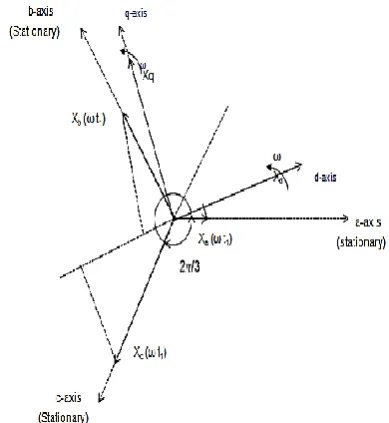
In order to derive a simpler model, it is convenient to switch to a more suitable reference frame. One such reference frame is the so-called dq-reference frame.
The dq-reference frame is a rotating reference frame, defined by its displacement related to the stationary stator reference frame. Let dq be the angular displacement between the d-axis and the rotor circuit.
Figure 2 : Space vector ⃗ and its three phase variables
and
Consider three phase axis that is electrical variables
, which can represent either current, voltage, or flux linkage.
There is the transformation of the abc variables to the dq frames referred to as abc/dq transformation and can be expressed in a matrix form:
* +
[ ] [ ]
In this case the rotating speed of the arbitrary reference frame is set to the synchronous speed of an induction generator given by
∫
Where, is initial angular position
B. Control Strategy for Grid Side Converter
Control of DFIG for proper and achieving maximum conversion of wind energy is necessary and unavoidable. It maintains magnitudes of the generator, such as torque, active and reactive power, and magnitudes that related to the grid side converter, such as the reactive power and the bus voltage close to their optimum values. A typical DFIG-based Wind Energy Conversion System that consist of the wind turbine including gearbox, doubly fed induction generator and back to back converters connected to the grid. The stator of the doubly fed induction generator is directly connected to the grid side. The rotor of the DFIG is connected to the grid through the back to back connection form of rotor side converter and grid side converter. A dc link capacitor is connected between the two converters. The block diagram of this system is shown in figure 1 clearly. The Grid Side Converter (GSC) employs Voltage oriented control (VOC) and the Rotor Side Converter (RSC) employs stator voltage oriented vector control.
Grid side converter control is used to regulate the voltage across the DC link and sometime also to compensate harmonics. This is a two stage controller scheme which is achieved by grid voltage oriented vector control scheme i.e. by aligning the dq- axis in the direction of grid voltage. Grid converter is typically a three phase, two level voltage source converter which uses IGBT as a switching device. As we have discussed
earlier, the main purpose of grid side converter control is done to regulate the DC link voltage. This is done by implementing grid voltage oriented control scheme.
Figure 4 : control scheme of grid side converter
The above figure shows the schematic of voltage oriented control. In the voltage orientation control, the grid voltage is measured the angle is detected from phase lock loop (PLL) for the voltage orientation. Assuming that the grid voltage , that are three phase balanced sinusoidal waveforms, and angle can be obtained by
Where , ( )
(√ √ )
√ (
)
For
To achieve the VOC control scheme, the d-axis of the synchronous frame is aligned with the grid voltage vector, therefore the d-axis grid voltage is equal to its magnitude ( ) and the resultant q-axis voltage
is then equal to zero, from which the active and reactive power of the system can be calculated by-
For ,
( )
The q-axis current reference can be obtained from
Where is the reference for the reactive power, which can be set to zero for unity power factor operation, a negative value shows the leading power factor operation, or a positive value shows the lagging power factor operation. The grid side converter performs two main function that is, it keeps the dc link voltage constant and provides the reactive power to the grid when required. The reactive power can be set to zero for unity power factor operation. It is seen that the DC-link voltage can be controlled via .The control scheme utilizes current control loops for the dq axis grid current with the d axis current demand being determines from the DC-link voltage error through a standard PI controller. The q axis current demand finds the displacement factor on the supply-side of the inductors. The main function of the grid side converter control is to control the DC link voltage and to control active and reactive power. If the dc link voltage is greater than its reference value , this means that more power must be flow from the DC link to electric utility via grid-side converter.
C. Control Strategy for Rotor Side Converter
The main purpose of controlling rotor side converter is to control stator side active and reactive power independently. In order to implement the decoupled control method of active and reactive power, stator flux oriented vector control scheme is adopted. To achieve this stator field oriented scheme, some assumption has to be made which are given as follows.
I. Stator voltage drop across resistance has been neglected as the stator resistance values are quite low in value.
II. The DFIG is connected to stiff grid i.e. the
frequency and amplitude of stator and grid voltage is assumed to be constant.
III. The q- axis is rotating 90o ahead of d-axis at
synchronous speed in the direction of rotation.
IV. The stator flux vector is aligned with the d-axis of
the stator.
The resultant d-axis and q-axis voltages are:
Where is the magnitude of ⃗⃗⃗⃗ also the peak value of the three phase stator voltage. The angle between the stator voltage vector and the rotor is the slip angle , is defined as:
Since the DFIG operates with the unity power factor, the stator current vector ⃗⃗⃗ is aligned with the ⃗⃗⃗⃗ but with the opposite direction, that is generating mode. The rotor voltage and current is controlled by the converters in the rotor circuit. The DFIG wind energy system can be controlled by the electromagnetic torque speed control or active power. In contrast to the other wind energy system, the electromagnetic torque of the generator, the active power and the reactive power of the stator are controlled by the rotor- side converter.
( )
Putting the value of current and flux linkages the torque equation is:
( )
The above torque equation shows that the is the function of rotor current and stator flux linkages. In this system the stator voltage is constant, since it is directly connected to the grid. To find the relationship between the torque, stator voltage and rotor current referred to the induction generator model. The stator voltage vector for the steady state operation of the generator is-
It has to represent in dq-axis is-
( ) ( ) ( )
Substituting the value of flux linkage into the electromagnetic torque equation, with , for the stator voltage orientated control, and ignoring stator resistance which is normally very low for large DFIG, the torque is simplified
Above equation shows that the torque is the function of d-axis rotor current and stator voltage.
The stator active power and reactive power is
( )
( )
Using stator voltage orientation control , the equation of power can be simplified to
Substituting the value of and and flux linkages in above equation and neglect the rotor resistance because it is very small , we have to find the rotor current equation that is
The above equations shows that the given stator voltage and stator active power and reactive power can be controlled by dq-axis rotor current.
Depending on the speed of the rotor, there are two modes of operation in the doubly fed induction generator wind energy conversion system, that is the Supersynchronous mode and subsynchronous mode. In the supersynchronous mode where the generator
operates above the synchronous speed and in subsynchronous mode where the generator operates below the synchronous speed.
In the supersynchronous operation mode, the mechanical power delivered from the shaft to the grid through both stator and rotor circuit. For subsynchronous operation, the rotor receives the power from the grid and both mechanical power and rotor power are delivered to the grid through the stator. The stator power is the sum of mechanical power and rotor power but it will not exceed its power rating since in subsynchronous mode the mechanical power from the generator shaft is lower than that in the supersynchronous mode.
III. CONCLUSION
This review paper is to analyze a DFIG based wind energy power system and control technique for maximum energy extraction and grid synchronization under stator voltage orientation reference frame and conditions. A rotor-side converter control design has been presented which is the „key‟ to work conducted in this paper. The performance assessment of the controller designed has been carried out by analyzing its real/reactive power control in stator-voltage oriented frame, and analyzing its effectiveness in speed control, and the ability of the controller in facilitating effective synchronization with the power grid.
IV. REFERENCES
[1] Ankit Gupta, S.N.Singh, Dheeraj K. Khatod,
“Modeling and Simulation of Doubly Fed Induction Generator Coupled with Wind Turbine – An Overview”, JEC&AS, Vol. 2, No.8, Aug. 2013.
[2] Nalini Telu, K. Veeresham, Rohini Telu “Design,
Simulation and Control of A Doubly Fed Induction Generator” International Journal of Engineering Research and Applications (IJERA) Vol. 2, Issue 3, May-Jun 2012.
[3] Bhim singh and N. K. Swami Naidu, ” Doubly Fed
Induction Generator for Wind Energy Conversion System with Integrated Active Filter capabilities“ IEEE Transactions On Automatic Control, Vol. 54, No. 7, July 2015.
[4] E. Toledo, L. Aromataris, G. Tarnowski, M.
Fed Induction Generators” Energy Study Center to Development (CEED), National University of Misiones (UNaM) Oberá, Misiones, Argentina.
[5] Resham R. Wandile1, Sandeep V.
Karemore2,Rakesh G. Shriwastawa “Direct active and reactive power control of DFIG for wind energy generation” International Journal Of Innovative Research In Electrical, Electronics, Instrumentation And Control Engineering Vol. 3, Issue 5, May 2015.
[6] Arifujjaman,Md., Iqbal,M.T., Quaicoe, J.E
,‟‟Vector control of a DFIG based wind turbine‟‟, Journal of Electrical And Electronics Engineering, Vol-9, Number-2, Year-2009.
[7] Muller, S., Deicke, M., Doncker, R.W.D., ” Doubly
fed induction generator system for wind turbines‟‟, IEEE Industry Application Magazine, May-June, 2002.
[8] Liyan Qu, Wei Qiao, ‟‟Constant Power Control of
DFIG Wind Turbines With Supercapacitor Energy Storage”, IEEE Transaction On Industrial.
[9] Shaheen, S.A, Hasanien, M., Badr, M.A., ”Study
On Doubly-Fed Induction Generator Control”, MPECON‟10,December 19-21,2010, ID 251
[10] Leban, K.,‟‟ Doubly fed induction generator fault
simulation‟‟, Institute of Energy Technology Aalborg 2009.
[11] Rakesh Sharma, Kuldeep Sahay, Sateyndra Singh,
“Effects of Varying Load on DC- Link Voltage in DFIG Based Wind Energy Conversion System,” International Journal of Advanced Research in
Electrical, Electronics and Instrumentation
Engineering, Vol. 3, Issue 5, May 2014.
[12] Ajay Kushwaha1, Inderpreet Singh, “Literature
review paper on doubly fed induction generator wind turbine technology” International Journal of Enhanced Research in Science Technology & Engineering, ISSN: 2319-7463, Vol. 2 Issue 9, September-2013.
[13] Andreas Petersson, “Analysis, Modeling and
Control of Doubly-Fed Induction Generators for Wind Turbines” Department of Electric Power Engineering Chalmers University Of Technology.
[14] A.A.Hassan1, A.M. El-Sawy1, O.M.Kamel “Direct
Torque Control of a Doubly fed Induction Generator Driven By a Variable Speed Wind Turbine” Journal of Engineering Sciences, Assiut University, Vol. 41 No1 pp.199-216 - January 2013.
[15] Xue Yingcheng,Tai Nengling “System frequency