RESEARCH ARTICLE
URBAN TRANSPORTATION PROBLEMS IN OWERRI, IMO STATE
Uzondu Chinebuli and Chris Ikeogu
Department of Transport Management Technology, Federal University of Technology, Owerri
Received 28th February, 2013; Received in Revised from; 14th March, 2013; Accepted 12th April, 2013; Published online 16th May, 2013
ABSTRACT
Owerri urban is one of the historical cities in Imo state and has seen a tremendous growth in the last few years. It has become the educational hub, and also the industrial and tourism developments during this period has increased. Due to a burst in population, the city is facing severe urban transport problem like traffic congestion, traffic fatalities, air pollution, poor traffic management etc. These traffic problems are mainly due to limited transport infrastructure, rapid development of suburban areas all around owerri, growing traffic volume in major road networks, rapid increase in motor vehicle ownership, poor public transport services etc. This paper analyzes the extent and cause of most severe urban transport problems faced by the city and recommends some ways for improvement that would help to mitigate the problems.
Key words: Public Transport, Traffic Management, Urban Transport.
INTRODUCTION
Owerri (Owèrrè) is an important regional centre and the capital of Imo State in Nigeria, set in the heart of the Igbo land. The city is located on coordinates 5.485°N, 7.035°E. Owerri consists of three Local Government Areas (LGAs) including Owerri Municipal (176,334), Owerri North (101,754) and Owerri West (125,337), it has a population of about 403,425 as of 2008 and is approximately 40 square miles (100 km2) in area. Owerri is bordered by the Otamiri River to the east and the Nworie River to the south. The city encompasses other smaller towns and villages like Orji, Nekede, Mbieri, Egbu, Amakohia, Akwakuma etc. The city’s history can be traced to its growth during the Nigerian civil war which made Owerri the capital of the Republic of Biafra in 1969. The capital of the secessionist state was continuously being moved as Nigerian troops captured the older capitals. Owerri has grown at an average rate being the major city in the state and its stake as the seat of government and higher education.
The major activity centres in the city are government public buildings like the state secretariat and medical health centres and centres of higher education like Imo State University (IMSU), Alvan Ikoku Federal College of Education (AIFCE), Federal University Of Technology (FUTO), Federal Polytechnic, Nekede (FEDNEK), School of Nursing and Midwifery, Imo State Polythecnic etc. For years now, Owerri metropolis as the capital of the state is usually locked up in traffic especially any time it rains heavily, as the traffic grinds to a complete halt with vehicles and passengers trapped for up to 4 hours in the unprecedented chaotic traffic jams. In such cases no vehicle can neither enter nor leave the city, the consequence being that workers, traders and others get to their
*Corresponding author:[email protected], [email protected]
homes as late as 11pm, although ordinarily they would have been home before 7pm. The growth rate of population in our urban areas and the influx of rural residents to the urban area(s) means that there is need to look into the urban transportation problems in Owerri and so improve movement of people and goods which will in future reduce pollution/noise, congestion and mostly parking problems which is common with the present transport system. It is on this background that this study is carried out to look into urban transportation problems in Owerri. The primary objective of this research is to study the problems encountered by commuters in Owerri, look into the growth rate of vehicles and to recommend strategies/measures that will meet the growing need of the people of Imo State in general. It is expected that this study will make a practical contribution to the study area and to Nigeria in general. The study is vital in creating awareness of the effect of indiscriminate parking, poor traffic management, congestion etc on the economy of the people of owerri. Not with standing, it is important for one to make trips for various reasons and on time too.
Urban Development
The total urban population of Owerri has been rising continuously over the last few years. Population of the city in the year 2006 was around 403,425 (NPC 2005).Over the years, there has been increasing ownership of vehicle/cars by individuals whereby one family has more than one car; the number of tricycles (Keke Napep) has also increased. There is inadequate transport infrastructure to serve the new suburban developments and residences and this has caused enormous pressure on public transport system. Most of the streets in Owerri are currently suffering from traffic congestion, various parking problems, poor public transport system etc. The operators and passengers have converted most of the road junctions to motor parks and bus stops and most of this road
ISSN: 0976-3376 Asian Journal of Science and Technology Vol. 4, Issue 05, pp.016-021, May, 2013
Available Online at http://www.journalajst.com
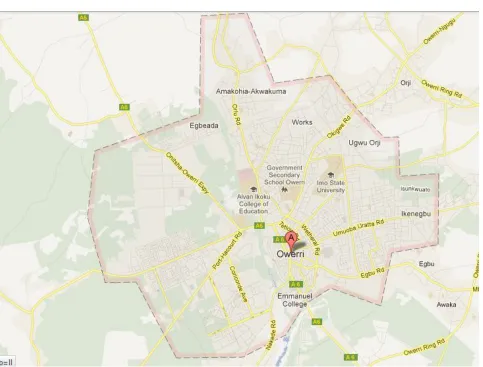
Source: Google maps.
Fig. 1.1 shows the satellite map of Owerri municipal
Table 1: Number of Vehicles Registered by Type and Year in Imo State(2000-2011)
Type of vehicle 2000 2001 2002 2003 2004 2005 2006 2007 2008 2009 2010 2011 total
Motor cycle 3,229 1,601 21,594 28,074 7,501 8,736 3,078 3,383 1,389 1,067 3,900 4,019 87,571
Cars 1,638 899 16,612 21,207 1,733 1,432 392 522 59 77 890 954 46,415
Buses 269 581 6,658 8,661 608 532 111 169 34 21 300 212 18,156
Pickup 15 272 884 166 47 50 24 18 3 1 25 11 1,516
Lorry/tipper 45 20 164 0 34 45 21 14 0 0 21 51 415
Jeep/land rover 0 43 463 346 13 18 2 5 4 1 25 31 951
Trucks/tractors 0 64 126 0 27 3 0 0 0 0 0 0 220
Keke 0 0 0 0 0 0 0 0 0 0 219 76 295
Source: Board of internal Revenue Owerri (2012)
Table 2. below previews the accident rate in Imo State 2000-2011
YEAR FATAL SERIOUS MINOR CASES TOTAL CASES KILLED INJURED TOTAL CASUALTY
2000 66 75 13 154 100 81 181
2001 73 92 7 172 103 104 207
2002 199 235 50 484 291 916 1207
2003 80 199 19 298 183 705 888
2004 74 138 30 242 87 437 524
2005 39 38 38 115 70 320 390
2006 78 122 25 225 187 364 551
2007 47 201 42 290 73 321 394
2008 29 122 47 198 129 662 791
2009 37 50 34 122 50 361 411
2010 38 42 33 113 54 325 379
2011 35 60 7 102 63 303 366
side motor parks like the Mbaise road, school road by Douglas park, wetheral by Douglas road park in front of Emmanuel College and Ama J.K have all given rise to traffic congestion. Many states of the federation introduced bus transit as a means of alleviating the transport needs of the public. The Table 1 shows the number of registered motor vehicles in Owerri urban. In the last few years, government invested a lot in public transpoprt, Buses and more recently the Tricycles (keke Napep) are the main contributors to the public transport system in Owerri. According to statistics of Owerri urban the number of registered private cars is far more than the public vehicles. The total number of private vehicles between 2000-2012 is quite more than the public vehicles. The growth rate of population in our urban areas and the influx of rural residents to urban areas means that there is need to provide for a better means of transport which will in future help reduce pollution, congestion and mostly parking problems which is mainly common with the present transport system in Owerri Imo state.
Urban Transport Problems
Most prevalent traffic problems faced by the city are highlighted below
Traffic Accidents and Injuries
In Nigeria today, the highway has become a very popular mode of transporting goods and people and also a mode for regional and inter-regional goods movement. the road mode also constitute a risk problem to all road users with its negative effects including noise, environmental pollution, delays congestion, accidents etc. Road accidents claim several thousands of precious human life annually. Unfortunately, road mishaps are majority of the people that die in such road mishap snare in their productive years (Ogunsanya, 2002) for those who survive, the do so with injuries and other accident related psychological disorders such as post-traumatic stress disorder (PTSD), acute stress disorder (ASD) and post-shock daze (Alvord 2000) there seem to be a direct relationship between increase in motor vehicles and road traffic accidents in the country. The economic cost of traffic accidents in Nigeria which is estimated by Arosanyin (2001) at N1.9 billion in 2001 is really enormous. The Federal Road Safety Commission and the Nigerian Police traffic department in Owerri compiles and analyzes the accidents taking place in Owerri. Most traffic accident occurs because of failure of commuters to obey traffic rules and regulations; other reasons for accidents in Owerri include:
Congestion
Inadequate road network.
Inadequate or non-existent traffic signals, signage.
Encroachments on the road by street vendors.
Broken down vehicles on the Road.
Overcrowding of buses, auto rickshaws and other
private vehicles.
On street parking at various locations on the city roads.
Traffic Congestion
Traffic Congestion can be said to be a queue of lines, jam, and hold up, go-slow etc. It is the slow movement of vehicles or an instant stoppage of the movement of vehicles as a result of physical obstacles created by material or artificial objects
thereby affecting the movement of vehicles. Traffic congestion is probably the most vital problem, which the city is facing today, it is the level at which a transportation system performance is no longer acceptable due to traffic (Ibe and Ejem 2009). The cause of the congestion can be categorised as
either incident or recurrent. (Schruck et al., 1993; Strickland
and Berman 1994). Recurrent congestion is the predictable delay caused by high volumes of vehicles using the road way during the same daily periods and at critical location such as intersections and interchanges. While incident congestion, on the other hand is unpredictable delay usually caused by spontaneous unplanned occurrences such as accidents, emergency maintenance etc. The main reason for congestion is the rapid increase in vehicular ownership in Owerri. The growth in population in Owerri Urban and without Adequate and effective urban transport system has resulted in traffic congestion in the city. It has become so common that some streets and roads look more like parking lots than roads during rush hours.
From Table 1, the people in Owerri use more of Private vehicles than buses and taxes. This problem is aggravated because of limited road network in the city. The population of the city keeps increasing over the years as well as the number of vehicles and ownership of both private and public. Apart from some very few roads in the city which are double lane, most of the roads are narrow with only one lane. Buses and Taxes usually cause obstruction on the roads; especially broken down buses. Majority of the roads do not have sidewalks or footpath for pedestrians thereby forcing them to walk on the roadway itself thereby causing congestion. Street vendors also cause congestion by selling to people in moving vehicles; these vehicles usually slow down thereby causing congestion. Illegal parking on the streets especially these one lane road increases traffic congestion. Use of multi-transport modes on the same road with slow non-motorised modes such as cycles, handpulled carts and trucks, buses etc. Also as noted by Ogunsanya (2002), in Britain, drivers lose about 1.5 billion man-hours a year to traffic congestion. According to Engwitch (1992), the forecast of global traffic volume is that it will double between 1990 and 2020 and again 2050.
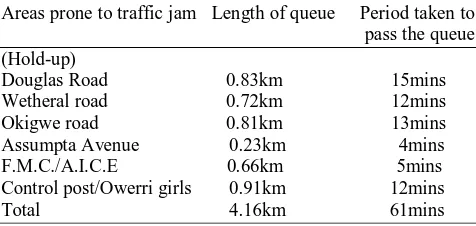
Traffic Congestion Areas in Owerri is shown in the Table 3
Table 3: Traffic Congestion Areas in Owerri
Areas prone to traffic jam Length of queue Period taken to pass the queue (Hold-up)
Douglas Road 0.83km 15mins Wetheral road 0.72km 12mins Okigwe road 0.81km 13mins Assumpta Avenue 0.23km 4mins F.M.C./A.I.C.E 0.66km 5mins Control post/Owerri girls 0.91km 12mins Total 4.16km 61mins
Source; Nigeria police traffic department (State C.I.D. Owerri) (2007)
Suggestions for Urban Transport Crisis
Some proposed solutions to these urban transport problem includes Road construction with improved right of way for pedestrians and non- motorized travellers, Even then the local and state governments have largely ignored the needs of
motorized travellers. Hence, wherever feasible, it is very much essential to design and construct roads for non-motorized vehicles like cycles and pedestrians. There should be enough paths for pedestrians and cyclists on the road. This will reduce traffic congestion as well as provide safety for non-motorized travellers. Improved Public Transport Services: Buses should be the major mode of public transport in Owerri. Thus, the main focus of public transport policy must be on improved bus transport. This can be easily done by replacing some old buses with new ones. Old buses are vulnerable for breakdowns causing inconvenience to passengers as well as lead to traffic congestion. If these buses are replaced, then such problem May not occur. The road public means of transport can carry a large number of passengers at a time based on the vehicle involved. Most buses are quite long and seats about 80-120 passengers including the standees. But in terms of train as a means of land public transport, it can carry about 500 (five hundred) passengers or more at ago
The bus-stops and bus depots are inadequate. Majority of the bus- stops are crowded, I ll-planned and wrongly located as a result of which buses are made to stop on the roads covering a majority of the width of the road. This causes inconvenience to the passengers waiting at the bus-stop and also affects the traffic moving on the road. To avoid these situation bus depots must be properly located at some important locations and these places made attractive to an extent. Such proposals can be implemented by private participation by leasing these places for adverts. Also at certain bus-stops stalls including bank ATMs may be installed there and commuters can make good use of the waiting time. At present majority of the bus-stops are surrounded by hawkers and people who are mentally unstable thereby blocking the easy movement of buses from bus depots, resulting in a very slow movement. Owerri city has keke Napep running between many of its routes and these bring a lot of passengers to places like Douglas road, Tetlow, Wetheral, Bank road etc.
These areas require Strong support of public transport services. Privatization of some bus services is an option that has helped to improve public transport services at less cost and its being used efficiently. Their destinations. Hence, near such areas strong support of public transport services is required. Privatization of bus services may be one more option to improve public transport services at less cost. All these vehicles both public and private cause pollution .The toxic gases emanating from these vehicles are harmful to the public. Urban travellers are only mindful of themselves at the cost of others’ convenience. Thus they cause trouble to the health of the inhabitants of the city. Such pollution can be controlled by reducing the use of private vehicles and increasing the use of public transport. This will reduce congestion on the roads and avoid pollution.
Parking: A park is a piece of land or terminal where public passenger vehicles or other vehicles may be parked. Faulks (1980) defines parking lot as outdoor lot for parking automobiles. But in the study area, parking is mostly along the roads or streets, of the study area. It has been observed that lack of proper parking facilities could lead to congestion; it is one of the many problems confronting a lot of people in the urban areas, as vehicle owners require space to park their vehicles but when this space is not available, they seem to park any how or anywhere. This causes obstruction and congestion which leads to delays in journey movement. People who go into shops or supermarkets are asked to park their vehicles on nearby lanes. Most office buildings or premises do not allow parking of vehicles in their buildings except one has an office there, all these result in on-street parking. Most times, drivers are asked to park on one side of the road, but the Table 5 shows location of public parks in Owerri
Table 5: Location of Public Parks in Owerri
Source: Field survey 2012
provision of parking space is still not enough considering the increase in private vehicles and the three wheelers (Keke
Napep). The parking problem in Owerri is because too many people (illegal bodies) enforce different rules and the inability of the civic body to enforce these basic parking areas for business purposes and force customers or visitors to park their vehicles on the roads. e.g Douglas road on-street parking reduces speed of traffic and also cause traffic flow congestion. To make the traffic flow smoother and faster, car parking at main roads like Tetlow road, Old Nekede road, Douglas road must be removed or owners of these cars must be charged heavily. The land owned by the public authorities like the municipalities, State government etc are owned by the public and is supposed to be used in the interest of the society at large. In this case, only few people are utilizing such lands which create inequitable use of public properties. Hence, such cars must be charged heavily for parking on such congested roads. The money realised from this should be used for creating more parking spaces or for improvement in public transport.
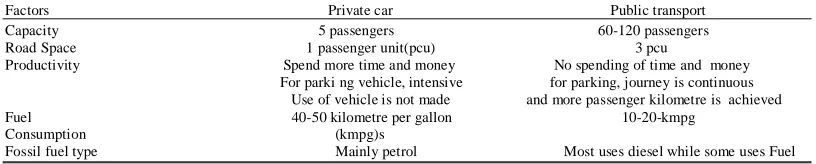
Table 4: Comparison of performance of buses and private Cars
Factors Private car Public transport
Capacity 5 passengers 60-120 passengers Road Space 1 passenger unit(pcu) 3 pcu
Productivity Spend more time and money No spending of time and money For parki ng vehicle, intensive for parking, journey is continuous Use of vehicle is not made and more passenger kilometre is achieved Fuel 40-50 kilometre per gallon 10-20-kmpg
Consumption (kmpg)s
Fossil fuel type Mainly petrol Most uses diesel while some uses Fuel
Redesigning the Route Structure: Buses and the three wheelers (Keke Napep) contribute more to the public transport in Owerri. At present many of the bus routes are selected in such a way that they pass through congested parts of the city and this is usually places with heavy traffic like Douglas road, Royce road, Mbaise road etc. All these routes definitely serve the commuters, but as they have to pass through congested areas, they require more time to complete one trip. This also reduces their frequency and number of trips per day. In the present situation, if somebody wants to travel from Orji to Douglas, which is approximately 5 km, it takes almost 30-45 mins in the peak time. To avoid this route, restructuring must be done. For example, constructing the road which is expected to link Owerri recreational club with Orji will reduce traffic along Okigwe road. Some people are of the opinion that construction of a road from Agbala to wetheral road with a bridge across the Otamiri River would help decongest Owerri-Aba road. Also rehabilitation of road by pass from MCC Uratta to Egbu to ease traffic flow on the Umuahia/Mbaise road, while it is suggested that the situation along Orlu/Amakohia road would improve once the ongoing work on shoe industry at Ihitte Mberi Ubomiri road is completed. By doing this traffic along Wetheral, Assumpta Avenue, etc will be greatly decongested. Obviously buses travelling on congested routes usually travel at a slow speed; in order to reduce congestion in such areas, very nominal fare is charged. Also we can ban entry of private vehicles in such areas at peak hours. To test the efficiency of such a system, this route structure must be operated on a trial for one week to judge the reactions of the commuters.
Better Traffic Management: Traffic management involves the professional techniques administered in a systematic manner in order to solve problems generated by the interaction of land uses and transportation in urban cities. These problems include poor road network, inadequate traffic signal/signs at intersections, neglect of pedestrian walk-way, park noise and air pollution accidents and congestions. Every trip has origin and destination, origin generate the traffic while the destination attracts it. It is this process of generation and attraction of traffic that produces traffic problems (Ibe and Ejem (2009)).Traffic management has the essence of ensuring its general tasks in making sure that all facilities are used to the best advantage and should involve the following:
Enact laws and regulation
Keep highways clean and in good conditions
Organise adequate bodies of traffic officers who are
equipped with modern tools and devices
Above all encourage mass transit buses.
Traffic management in Owerri can be increased by using advanced technologies of signalling and enforcing stricter traffic regulations. There is an urgent need to install intelligent traffic management system in Owerri. Traffic signs, signals and road markings must be improved. Installation of electronic surveillance and synchronized traffic signals will go a long way in helping to improve traffic situation in Owerri. With this system, police and traffic authorities will be able to monitor the movement of traffic at various locations on TV screens. Also videos can be stored for a very long time. Main junctions and locations of Owerri city can be covered by this system. On the other hand, there is insufficient number of
trained traffic personnel and there is an inadequate mass transit bus. It is poor traffic management and traffic education that is responsible for greater traffic congestion in Owerri.
Broken down vehicles: All vehicles broken down or involved in accidents are a major cause of traffic congestion. These vehicles that often spoil on the road block the roads thereby causing delays that disrupt traffic. Motorists in the city are helpless in dealing with the phenomenon of broken down vehicles on the major highways in the city (metropolis). Drivers and passengers commuting the major roads have had contend with heavy vehicular traffic as a result of persistent break down of vehicles. The maximum five to ten minutes journey now take over an hour to drive through and the condition usually worsen during Monday rush hour when vehicular movement increases. A road hazard is also created as other articulated trucks attempt to manoeuvre through any available route. Measures should be taken to address the challenge of removing broken down vehicles, which account for about 20percent of most cases of accidents in the country.
Traffic discipline: One of the major reasons for urban traffic problem in Owerri is that commuters do not have better traffic discipline. Self-dicipline have regarding traffic rules is very much required .it comes only by enforcing traffic rules. Though there are strict traffic rules in existence, they are rarely enforced by police due to corruption. After violating the traffic rules, commuters normally pay the money to police and get away .In such situations, instead of asking people to pay in terms of money, traffic violators should be asked to manage traffic at major chowks for one hour or a day. Money collected from such enforcements can be utilized for further improvement in traffic management system. Self discipline in traffic rules can be developed in commuters by talking to them and taking active participation in managing traffic related issues. This can be effectively done by forming a group of people of different categories. The group can meet periodically and discuss traffic problems and can come out with solutions that help the police and traffic authorities .Such proposals can be implemented effectively, without any trouble as they come from the grass roots level.
Conclusion
Owerri’s vehicular traffic growth is multifold due to increased importance of the city in the area of education, industry and commercial activities. This over-burst of vehicle population in the city leads to urban transport problems. Some more measures are required to be implemented in the coming years. The recommendations suggested above are feasible to implement in Owerri. If these recommendations are implemented, air pollution and traffic congestion on major roads will be reduced. Hence, travel will be much safer and faster. In Owerri, these urban crises can also be partly resolved by providing better traffic infrastructure. Role of the private sector in the construction of better traffic infrastructure will be a good alternative for all new road and bridge constructions, rail services, bus services etc., in the
interest of the society as a whole
REFERENCES
Alvord, K. (2000): Divorce your car-Ending the love affair with your automobile. New Society publishers, Canada.
Arosanyin, G.T. (2001): Economic impact assessment of Road Traffic Accident Casualties in Nigeria (1980-1995) PhD Theses O.A.U., Ile-Ife.
Berman (1994)
Engwitch, D. (1992): Towards an Eco-city: calming the traffic (Enviro book).
Ibe, C.C. and Ejem, A.E. (2009): Empirical Analysis of Private Car Preference to Public Transport Modes in Owerri, Imo State, Nigeria. Port Harcourt journal of Social Science. Vol.1 Number 1.
National Population Commission (2005)
Nigeria Police Traffic Department (state CID Owerri 2007),Federal Road Safety Commission 2012
Ogunsanya A.A. (2002): Maker and Breaker of Cities, An Inaugural Lecture presented to the University of Illorin, June 27.
Rew. W.F. (1980): Principles of transport (Fourth Edition). McGraw-Hill Book Company.
Schruck (1993)