ISSN: 2395-3519
www.ijatca.com 31
International Journal of Advanced Trends in
Computer Applications
www.ijatca.com
Improved algorithm for number Automatic number plate
segmentation using 2D-wavelet and morphological
operators
1
Komal Jaswal, 2Vijay Kumar Singh, 3Sanjay
1
SIEET Naulakha, Sunder Nagar, Mandi (HPTU) 2
Assistant Professor 3
Assistant Professor 1
[email protected], [email protected], [email protected]
Abstract:
In India, the quantity of vehicles has growing in agreement with the innovation. The need to perceive the vehicles has expanded in parallel to the quantity of the vehicles. Need of vehicle acknowledgment was risen for the instances of security, programmed exchanging frameworks, roadway speed location, light infringement. Tag acknowledgment framework comprises of three principle subjects: finding plate area from advanced pictures, character division from the plate pictures and character acknowledgment from sectioned characters. In this Thesis, a study is led on character segmentation from plate picture and character acknowledgment from segmented area. For the completion of above task we have used wavelet based denoising first, and subsequently the morphological operator which produces binariesed image which is further compare the template which is being already saved in the database, in our proposed scheme we have achieved 99.7% accuracy which is the higher accuracy ever mentioned in the literature. As well as the time and space complexity of our algorithm is the lowest. So we can say that proposed algorithm is best algorithm present in the literature.I. INTRODUCTION
In the present era, the clogging emergence of vehicular traffic has become a major source of concern among the people residing in the capitals, metropolitans and the big cities, which in turn is accompanied by regular peril road accidents thereby causing loss of lives of many. Not only the lack of rules of traffic safety but also the emerging increases in the number of high speed road vehicles are causing hazardous increase in the number of road accidents, which obviously poses a severe threat to the environment. The other penalties one has to bear or pay because of these are environmental pollution, energy waste and energy loss.
The count of motor vehicles in the developing countries has increased at an enormous rate in the last few decades in accordance with that of technical expertise. This builds up a desire to identify the vehicle in correspondence to the number of the vehicles. The main motive behind the recognition of vehicle was to sort out the prime issues that include safety, security, speed detection, violation of the traffic rules, etc [1]. The over emergence in the number of vehicles in the metropolitan cities requires a serious initiative, i.e. to launch an effective automatic system for the efficient arrangement and management of the traffic. Hence, VLPR Systems, abbreviated as Vehicle License Plate Recognition
System can be taken into account, which primarily works by capturing the vehicular images and thus, interprets the licence plate’s registration number automatically [2].The prime owner of the vehicles providing facilities to the passengers by means of taxi services need to register their vehicles annually either by the Department of the Motor Vehicles or by the State Bureau. This agenda has been initiated and implemented by the law agencies and orders the owners to affix a License Plate on the Vehicles that are visible both to the public as well as to the legal governing bodies and staff [3]. New York is considered as the first state to ratify, pass and endorse the Vehicle Registration Legislation on 25th April, 1901, later California followed the footsteps in 1902.Automatic Licence Plate Recognition (ALPR) Technology. The Automated license plate recognition (ALPR) technology was first invented in the year 1976, by the Police Scientific Development Branch (PSDB), Home Office, United Kingdom [4]. An AVLPR System can be defined as a kind of mass surveillance technique which keeps a track of the Licence Plate images by employing OCR (Optical Character Recognition) scheme.
ISSN: 2395-3519
www.ijatca.com 32
a series of both alphabets and numeric characters that provides the reference to the Vehicle Identification Number (VIN),
the manufacturing year,
the model number
Vehicle registration number
The information about the owner or the proprietor of the vehicle.
Other Names Given to AVLPR System:
AVLPR (Automatic Vehicle License Plate Recognition) System is known with different other names, which include:
ALPR-Automatic License Plate Recognition
LPR- License Plate Recognition
AVI- Automatic Vehicle Identification
CPR- Car Plate Recognition
AN PR- Automatic Number Plate Recognition
CPR- Car Plate Reader
OCR- Optical Character Recognition (for Cars).
Modules of the AVLPR (Automatic Vehicle License Plate Recognition) System:
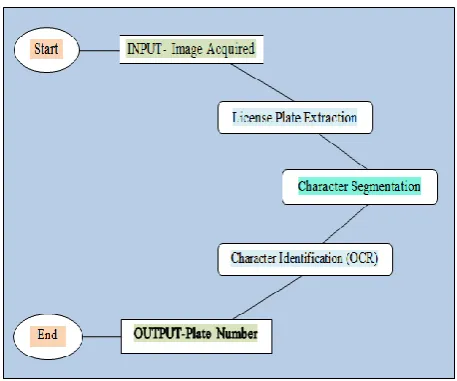
The three main subjects mainly considered in the Automatic Vehicle License Plate Recognition (AVLPR) System include [5]:
To detect the location of the Licence Plate via vehicular digital images
Character Segmentation from the localised Licence Plate images
Optical Character Recognition (OCR) from the characters extracted by the above process.
Figure 1.1: Flowchart representing an AVLPR System
The localization task of the license plate in the vehicular digital images basically involves the implementation through the solutions of edge extraction, the morphological and the Sobel operators. The edge extraction scheme is considered to a simpler and a fast
one whereas the Sobel Operator provides an optimistic impact on the generated images. The localization work of the license plates through the consideration of morphological based scheme is not liable and prone to noise but provides an extreme closeness during the process of execution.
After the completion of the License Plate localization, the process which is taken into consideration is the character segmentation process. Basically, this process implies heavily on the histogram computation and thresholding but recent advanced protocol involves the implementation of the artificial neural networks [7]. The final task in the AVLPR (Artificial Vehicle Licence Plate Recognition) System is the completion of the process of the character recognition. In order to deal with the variations faced among the characters in the different license plates, the segmented characters are required to go through some stages of pre-processing that includes normalization and the skew correction. These pre-processing steps prove to be of great help in reducing the analytical and the computational duration [8].
II. Literature Review
ISSN: 2395-3519
www.ijatca.com 33 accurate and the efficient nature of the proposed
protocol in comparison to the classical proposed schemes.
S. Kranthi et al. [19] proposed the algorithm for the recognition of character in the Vehicle License Plates. This system of recognition is provided the name ANPR, which stands for Automatic Number Plate Recognition. Automatic Number Plate Recognition (ANPR) is a mass monitoring system that works by capturing the vehicular images and thereby, recognizing the license number. The proposed proves beneficial in solving out the cases of stolen vehicles, hence reducing crime and helps in the efficient law enforcement. The current scheme proposes a recognition technique through the implementation of which the image of the vehicular license plate is captured (with the help of digital cameras) and later the image acquired is processed in order to fetch out the license plate information. The image of the vehicle acquired here is a rear one and various protocols and algorithmic schemes are employed in order to carry out the task of image processing efficiently. In the proposed work, a unique “feature-based license plate localization” method has been taken into consideration which primarily targets on two prompt techniques, that includes the Edge Finding technological method and the Window Filtering method in order to develop the vehicle number or license plate recognition system in a better manner.
BolotovaYu.A. et al [20] proposed a hierarchical temporal memory model in order to bring about the recognition of vehicle license or the number plate in an efficient manner. In the present scenario, one of the challenging chores is to develop a high-quality and an accurate character recognition system for the vehicle number plates. The recognition procedure of the vehicle number plates involves various steps, i.e. localization of the license plate, character segmentation and recognition. The proposed scheme includes the procedures associated with the allowance of the number plate, the character segmentation and its recognition. The main problems encountered during the development of these algorithms include the obscuring onto the license plate and the angular inclination. The paper primarily focuses on developing a novel method for the number plate recognition system through preliminary image filtering, character segmentation by connected component process and character recognition by means of hierarchical temporal memory model. The prefiltering of the acquired images helped in improving the effectiveness of successive binarization procedure. Character segmentation in the license plates is generally demonstrated through the histogram technique, by means of various inclination angles of the number plate. Hence, the rotation of the number plates leads to a decrease in the quality of the image. However, the
consideration of the connected component technique completely boycotts the rotation procedure and therefore, causes no loss in the quality of the image. The identification process can be made complicated by assigning different codes and symbols to the images under a small angle after the completion of the character segmentation process. The proposed hierarchical temporal memory model for the recognition of characters in the license plates, earlier practiced for the inclined images, generates favourable outcomes and witnesses higher accuracy, and can therefore, be practiced for distorted script segmentation and recognition processes.
ISSN: 2395-3519
www.ijatca.com 34 AmrBadr et al [22] proposed and introduced an ANPR
(Automatic Number Plate Recognition) System for localization and character segmentation in the license plates. This is brought about through the implementation of morphological techniques, the histogram manipulation and the edge detection method. However, for the character differentiation and recognition process artificial neural networks are taken into consideration. In the present scenario, the boundless increase in the count of vehicles makes it impossible to manage the transportation system efficiently. Hence, this all accounts for a need of the recognition of the number plate of the vehicles in order to sort out the emerging issues and complexities encountered in the daily life and to deal effectively with the traffic management, car parking, vehicle toll collection system, violation of traffic rules, border checkpoints, controlling the criminal activities, like thefts, vehicle stealing, etc. Inspite of all this, accomplishing the above system is a challenging task since the image acquired for the localization faces a differentiation in the format of the license plates, i.e., difference in the scripts, angular inclination and irregular lighting conditions, etc. the proposed system has been experienced on the stagnant and the stationery images of the vehicles, which further have been alienated into various sets on the basis of complexities. It was observed that the blurred and skewed images group generated poor recognition rate as compared to those images that were taken clearly. The main focus of the proposed analytical work was not to generate fully accurate recognition snapshot sets but to examine the invariance of the protocol on random images that are differenced methodically into the sets on the basis of their properties.
III. Proposed algorithm
Algorithm 1:
A1 = center pixel value of character A2= average of the 3*3 neighborhood An= average of the n*n neighborhood
If (( A2> A2 + α1 ) and ( A2 > A1 + α2 ))... ( An-1 > An + αn )) OR (( A1< A2 + α1 )
and ( A1 < A2 + α2 ))... ( An-1 < An + αn ) Then Character
Else
Not character
Where n= size of mask and α1, α2,… αn >= 0
Algorithm 2:
r= Function 'controlling' outputs the array of indices of boxes required for extraction of characters.
noPlate=Initializing the variable of number plate string. for v=1:length(r)
N= Extracting the binary image corresponding to the indices in 'r'.
letter=readLetter;
while letter=='O' || letter=='0' if v<=4 letter='O'; else
letter='0'; end
break; end
while letter=='B' || letter=='8' if v<=4
letter='B'; else
letter='8'; end
break; end
while letter=='B' || letter=='4' if v<=4 letter='B'; else
letter='4'; end
break; end
while letter=='Z' || letter=='2' if v<=4 letter='Z'; else
letter='2'; end
break; end
while letter=='I' || letter=='1' if v<=4 letter='I'; else
letter='1'; end
break; end
while letter=='A' || letter=='1' if v>=4
letter='1'; else
letter='A'; end
break; end
ISSN: 2395-3519
www.ijatca.com 35
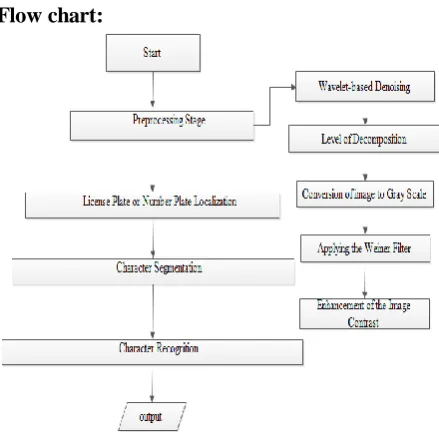
Flow chart:
Figure 4.1: Overview of Proposed Methodology
The proposed scheme has been tested on a desktop computer and laptop with the configurations, respectively Gigabyte Processor, 8.00 GB RAM, i5 2.66 GHz, 4.00 GB RAM. 80 plate’s images are used to test the software application and MATLAB version 2014A simulator is used Over 100 images. The results simulated demonstrate the level of accuracy to 99.6%. As we have evaluated that the accuracy of our algorithm is almost 100% for the detection of no plates, the further analysis of demonstrated output is summarized below with the comparison of exiting algorithm present in literature, given the table below shows the comparison of the proposed scheme,
Table 5.1 Comparisons of the algorithm
Authors Accuracy
W. Faqheri et. al 94.87%
S. Saha et. al 96.39%
S. al-Shami et. al 98.37%
Proposed 99.7%
From the above table it is quite clear that our proposed scheme having much more accuracy than the existing one. So, we can easily implement the proposed algorithm in real time system as there is very less no of application available in India for no plate recognition system. Proposed algorithm is not only good enough accurate but also it is quite simple having very less
complexity and as far as execution time is concern all the operation is being done in a very short time.
Conclusion
ALPR scheme proves to be an effective tool undertaken by the legislative and consumer safety forums. It helps to mechanize the hectic, tedious and the physical procedure of the officers which they encounter and deal with in their regular day life, and serves to provide efficacy and efficiency in the identification of the vehicles from hundreds and thousands of vehicles observed in the regular patrolling task. Apart from this, it functions to provide affluent and stable records of the vehicle location, in correspondence to time, date, etc. This data significantly improves the undercover competency of the law enforcement agencies and hence, proves beneficial in the intelligence and the analytical functioning. In the current approach, two diverse characteristics of the vehicles are combined in order to generate a system for the successful recognition of the license plate and the results computed demonstrate more robustness to the deception of the vehicles.
From the above results, we draw the following conclusions:
In order to carry the localization process of the number plate efficiently, the prime requirement is the presence of the proper edge between the vehicle license plate boundary and the background. This provides assistance to the Weiner filter in detecting the edge.
The camera must be located at a specific distance from the number plate, in order to provide a suitable range to the count of the pixels within the license plate region and to make them constant in nature.
The major drawback encountered in the character segmentation process is the presence of fancy scripts and formats which results in the creation of obstruction during the procedure.
References
[1] Kayhan Bora, work on “Car Plate Recognition”, A Master’s Thesis in Computer Engineering, 2009. [2] Tran DucDuan et al., “Building an Automatic Vehicle
License-Plate Recognition System”, presented at International Conference in Computer Science, RIVF’05 on February 21-24, 2005, Can Tho, Vietnam. [3] David J. Roberts and Meghann Casanova, “Automated
License Plate Recognition Systems: Policy and Operational Guidance for Law Enforcement”, a research report submitted to the US Department of Justice, in September 2012.
ISSN: 2395-3519
www.ijatca.com 36 License Plate Recognition System”, VI International
Journal of Advanced Engineering Sciences and Technologies, 10-14, 2011.
[5] LihongZheng, Xiangjian He; Qiang Wu, WenjingJia; Samali, B., Palaniswami, M., “A Hierarchically Combined Classifier for License Plate Recognition”, Computer and Information Technology, 2008. CIT 2008, 8th IEEE International Conference on 8-11 July 2008 Page(s):372-377 Digital Object Identifier 10.1109/CIT.2008.4594704.
[6] SaeedRastegar, Reza Ghaderi,
GholamrezaArdeshipr&NimaAsadi, “An intelligent control system using an efficient License Plate Location and Recognition Approach”, International Journal of Image Processing (IJIP) Volume(3), Issue(5) 252, 2009. [7] H.; Gecim, H. S., Alkar, A. Z., “Efficient Embedded Neural-Network-Based License Plate Recognition System Caner”, Vehicular Technology, IEEE Transactions on Volume 57, Issue 5, Sept. 2008, Page(s): 2675–2683 Digital Object Identifier 10.1109/TVT.2008. 915524.
[8] SaeedRastegar, Reza Ghaderi, GholamrezaArdeshipr &NimaAsadi, “An intelligent control system using an efficient License Plate Location and Recognition Approach”, International Journal of Image Processing (IJIP) Volume(3), Issue(5) 252, 2009.
[9] Dai Yan; Ma Hongqing, Liu Jilin, Li Langang, “A high performance license plate recognition system based on the web technique” Intelligent Transportation Systems, 2001. Proceedings 2001 IEEE 25-29 Aug’2001, Page(s):325-329, Digital Object Identifier 10.1109/ITSC.2001.948677.
[10]A. S. HadiSharifiKolour, “An evaluation of license plate recognition algorithms”, International Journal of Digital Information and Wireless Communications (IJDIWC), pages 281–287, 2011.
[11]Tran DucDuan, Tran Le Hong Du, Tran VinhPhuoc, Nguyen Viet Hoang “Building an Automatic Vehicle License-Plate Recognition System”, February 2005 [12]Fukunaga K., “Introduction to Statistical Pattern
Recognition”, Academic Press, San Diego, USA, 1990. [13]Plate Geometry and Basic Syntax
(http://www.platerecognition.info/1102.htm).
[14]Applications of AVLPR System,
(http://www.anpr.net/anpr_09/anpr_applicationareas.ht ml)
[15]SatadalSaha, SubhadipBasu, MitaNasipuri, and Dipak Kumar Basu “An Offline Technique for Localization of License Plates for Indian Commercial Vehicles”. [16]CristianMolder, powerpoint presentation on the topic,
“An Automatic License Plate Recognition Plate Recognition (ALPR) System”.
[17]Drawbacks faced in License Plate Recognition (https://en.wikipedia.org/wiki/Automatic_
number_plate_recognition).
[18]Salah Al-Shami, Ali El-Zaart, RachedZantout, Ahmed Zekri and KhaledAlmustafa, “A New Feature Extraction Method for License Plate Recognition”, IEEE, 2015.
[19]S.Kranthi, K.Pranathi, A.Srisaila, “Automatic Number Plate Recognition”, International Journal of Advancements in Technology, ISSN 0976-4860.
[20]BolotovaYu.A., Druki A.A. and Spitsyn V.G., “License Plate Recognition with Hierarchical Temporal Memory Model”, The 9th International Forum on Strategic Technology (IFOST), October 21-23, 2014, Cox’s Bazar, Bangladesh.
[21]Shih-Jui Yang, Chian C. Ho,Jian-Yuan Chen and Chuan-Yu Chang, “Practical Homography-Based Perspective Correction Method for License plate Recognition”, IEEE, 2012.
[22]AmrBadr, Mohamed M. Abdelwahab, Ahmed M. Thabet, and Ahmed M. Abdelsadek, “Automatic Number Plate Recognition System”, Annals of the University of Craiova, Mathematics and Computer Science Series Volume 38(1), 2011, Pages 62–71, ISSN: 1223-6934.