Original Research Article
Impact of pedestrian crossing behavior at intersections on road traffic
accidents in Shivamogga, Karnataka: an observational study
Praveen Kumar N., Nandini C.*, R. Saranya, Sridevi N. H.
INTRODUCTION
Every year about 1.25 million people die as a result of road traffic injuries and they are the leading cause of death among people aged 15-29 years. Half of those dying on the world‟s roads are “vulnerable road users” like pedestrians, cyclists and motorcyclists. Without action, road traffic crashes are predicted to rise to become the 7th leading cause of death by 2030.1
Each year, more than 2,70,000 pedestrians lose their lives on the world‟s roads. Globally, pedestrians constitute 22% of all road deaths.2
Millions of people are injured in traffic-related crashes while walking, some of whom become permanently disabled, incidents cause suffering and grief as well as economic hardship for families.2
The risks to pedestrians include issues related to multiple factors like driver behavior, particularly in relation to
ABSTRACT
Background: Every year about 1.25 million people die as a result of road traffic injuries and half of those dying on the world‟s roads are “vulnerable road users” like pedestrians, cyclists and motorcyclists. The objectives of the study were to assess the demographic characteristics of pedestrians and its effects on their crossing behavior and to identify the impact of technological and social distractions among pedestrians on road traffic accidents.
Methods: A community based, observational study was conducted for the duration of 2 weeks from 15-Aug-2017 to 30-Aug-2017, all major Pedestrian traffic generating intersections of Shivamogga city were identified; among them three intersections were selected by simple random sampling. Data was collected for 5 days at each intersection for all the three intersections. Convenient sampling was used for sample size. Data on demographic and behavioral information for each pedestrian were recorded. Data was analyzed using SPSS 21 software.
Results: Crossing behaviors of 468 pedestrians at Intersections were recorded. The majority (46.6%) of pedestrians were in the 25–44 year age category, more than half of the pedestrians observed were males (60.9%). Approximately 22.6% of pedestrians observed performed a distracting activity while crossing. Most of the pedestrians crossed the road by hesitating (32.1%) and by running (28.2%). Pedestrians with technological and social distractions were more prone for road traffic injuries (χ2=31.59, df=4, p=0.001).
Conclusions: There is a need to implement pedestrian safety rules and to provide facilities for pedestrians in the infrastructure of roads in India and effective interventions to protect pedestrians.
Keywords: Pedestrian, Distraction, Road traffic injuries, Crossing behavior, Intersections
Department ofCommunity Medicine, Shimoga Institute of Medical Sciences, Shimoga, Karnataka, India
Received: 17 March 2018
Revised: 25 April 2018
Accepted: 27 April 2018
*Correspondence:
Dr. Nandini C.,
E-mail: [email protected]
Copyright: © the author(s), publisher and licensee Medip Academy. This is an open-access article distributed under the terms of the Creative Commons Attribution Non-Commercial License, which permits unrestricted non-commercial use, distribution, and reproduction in any medium, provided the original work is properly cited.
speeding as well as drinking and driving, pedestrian road crossing behavior, infrastructure in terms of a lack of dedicated facilities for pedestrians such as sidewalks, and vehicle design and poor trauma care services.2
In India the total number of road accidents increased by 2.5 per cent from 4,89,400 in 2014 to 5,01,423 in 2015.The analysis of road data 2015 reveals that about 1,374 accidents and 400 deaths take place every day and 57 accidents and loss of 17 lives on an average every hour on Indian roads.3
Karnataka stands in 4th position among Indian states with respect to road traffic accidents (8.8%, 44,011). Persons killed in road accidents in terms ofpedestrians in India is 9.5% and Karnataka is 8.6%.3
Pedestrian collisions should not be accepted as inevitable because they are, in fact, both predictable and preventable.4
In India road traffic injuries have been increasing over the past twenty years, may be partly due to the increase in number of vehicles on the road but mainly due to the absence of coordinated evidence based policy to control the problem.5
There is a need to implement pedestrian safety rules and to provide facilities for pedestrians in the infrastructure of roads in India. Successful interventions to protect pedestrians and promote safe walking require an understanding of the nature of risk factors for pedestrian crashes. Not many studies are done to know the pedestrian risks and their crossing behaviors in our country. Hence an attempt is made to study in this regard, which helps policy makers to make decisions on pedestrian safety.
Objectives of the study
To assess the demographic characteristics of pedestrians and its effects on their crossing behavior. To identify the impact of technological and social
distractions among pedestrians on road traffic accidents.
METHODS
A community based, observational study was conducted for the duration of 2 weeks from 15 August 2017 to 30 August 2017, all major pedestrian traffic-generating intersections of Shivamogga city were identified; among them three intersections were selected by simple random sampling. Data was collected for 5 days at each intersection for all the three intersections. Convenient sampling was used for sample size estimation.
After identifying the pedestrian traffic-generating intersection; to maximize the flow of pedestrians and observe a variety of pedestrians, four observation time periods were selected: 8:00–9:00 am, 12.00- 13:00 pm,
16:00–17:00 pm and 19:00-20:00 pm. Data collection sheets were created for each intersection.
To avoid possible selection bias, timer was carried, that vibrated once per minute. The data was recorded for the first person who reached the curb after the timer vibrates. In cases where two individuals arrived completely simultaneously at the curb following the timer, the first person to step off the curb was selected as the „index pedestrian‟.
Data on demographic and behavioral information for each pedestrian were recorded. The demographic information recorded included the gender and estimated age of the pedestrian. Then data regarding, pedestrian characteristics (whether the pedestrian was alone or in a group). Individuals were counted as being in a group if they appeared to be in a social interaction with another individual while crossing, like for example, holding hands.
Pedestrian technological distractions like whether the pedestrian was using a mobile phone (phone to ear or earpiece), music player (earphones), or texting (manual use of mobile device) while crossing and social distraction like talking in group were observed. If an individual was talking to another person while crossing the road, they were counted as group talking.
For assessing pedestrian crossing behaviors, the observer recorded the direction the pedestrian walked, whether the pedestrian looked left and right before crossing, crossed by running, hesitation, whether hears to the vehicle horn and so on.
All data were entered into an Excel spreadsheet and SPSS 21 was used for data analysis using proportions and associations were examined by Pearson chi square test..
RESULTS
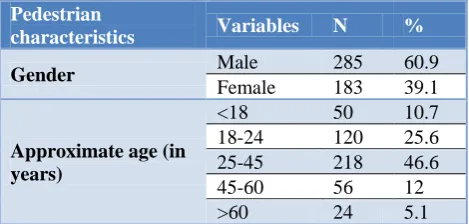
Crossing behaviors of 468 pedestrians at Intersections were recorded. The majority (46.6%, N=218) of pedestrians were in the 25–44 year age category followed by 18-24 years (25.6%, N=120), more than half of the pedestrians observed were males (60.9%, N=285) while females were about 39.1% (N=183) (Table 1).
Table 1: Age and gender wise distribution of study participants.
Pedestrian
characteristics Variables N %
Gender Male 285 60.9
Female 183 39.1
Approximate age (in years)
Pedestrian distractions
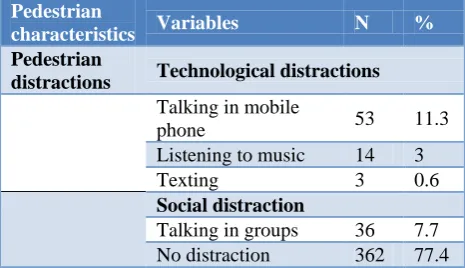
Approximately 22.6% of pedestrians observed performed a distracting activity while crossing. Distractions while in the roadway included using mobile phone for talking (11.3%, N=53), listening to music (N=14, 3%), texting (N=3, 0.6%) and social distraction like talking in groups (N=36, 7.7%) were observed (Table 2).
Table 2: Technological and social distractions of pedestrian crossing the road at intersection.
Pedestrian
characteristics Variables N %
Pedestrian
distractions Technological distractions
Talking in mobile
phone 53 11.3
Listening to music 14 3
Texting 3 0.6
Social distraction
Talking in groups 36 7.7 No distraction 362 77.4 Talking on phone and listening to music were more among pedestrian aged 25-44 years (N=18, 8.3%), (N=11, 5%) respectively, while talking in groups among 18-24 years (N=12, 10%). Distractions were more observed among males (N=66, 23.2%) except texting which was more among females (N=2, 1.1%).
Gender was not significantly associated with pedestrian distractions while crossing road (χ2
=1.285, df=4, p=0.864), but age was strongly associated (χ2
=27.12, df=16, p=0.040) with pedestrian distractions.
Pedestrian crossing behavior
Most of the pedestrians crossed the road by hesitating (N=150, 32.1%) and by running (N=132, 28.2%) (Table 3). Both male and female pedestrians had almost similar crossing behavior while crossing road (χ2
=1.471, df=4, p=0.832), age has no effect on the pedestrian crossing behavior across roads (χ2
=15.36, df=16, p=0.498).
Table 3: Pedestrian crossing behavior on roads at intersection.
Pedestrian
characteristics Variables N %
Pedestrian crossing behavior
Cross with caution like watch for turning vehicles
101 21.6
By running 132 28.2 Hesitating 109 32.1 Cross when vehicles
are at safe distance
45 9.6 Alert on vehicle horn 40 8.5
Nearly 60.3% of the pedestrians were observed walking in groups and 39.7 % (N=186) were found crossing alone.
A significant association between age and gender with pedestrian characteristics like walking alone and walking in groups (χ2=21, df=4, p=0.001), (χ2
=0.047, df=1, p=0.047) respectively was observed.
Road traffic accidents
Road traffic accidents were observed in 4 pedestrians while crossing the road (0.9%). (Table 4) Road traffic accidents were strongly influenced by the gender of pedestrian (χ2
=6.283,df=1, p=0.012) but not with age ( χ2
=4.515, df=4, p=0.341). Females were more prone for road traffic accidents (N=4, 2.2%) compared to males.
Table 4: Road traffic accidents among pedestrians crossing the road at intersection.
Pedestrian characteristics Variables N %
Road traffic accidents Yes 4 0.9
No 464 99.1 Pedestrians with technological and social distractions were more prone for road traffic injuries (χ2
=31.59, df=4, p=0.001) almost 100% among those who use mobile phones for talking while crossing roads. Pedestrians crossing in groups were safe from accident (χ2
=6.12, df=1, p=0.013) than crossing alone.
DISCUSSION
In our study, majority (46.6%) of pedestrians were in the 25–44 year age category followed by 18-24 years (25.6%), more than half of the pedestrians observed were males (60.9%) while females were about 39.1%, a study conducted by Mariswamynathan found that the proportion of male pedestrians is higher than female pedestrians during peak hours and proportion of adult pedestrians is the largest comparing old people, similar to our study findings. 6
Many studies revealed that age and gender significantly affect the pedestrian distraction contrast to our study in which gender was not significantly affected but age was associated significantly and found that males have a tendency to show more hazardous road crossing behavior than females similar to our study findings.11-13
Various walking safety rules and tips have been given after a comprehensive review of literature of organizations, such as not wearing headphones or talking on a cell phone while crossing a street, keeping the volume down, hanging up the phone while walking, being aware of traffic and avoiding distractions like walking with texting.14
In one of the study at unsignalized locations found that the changes in pedestrian behavior like running or hesitating, correlated with changes in the likelihood of motorists‟ stopping and running was observed to be the predominant abnormal pedestrian behavior similar to our study finding.15
In our study, most of the pedestrians crossed the road by hesitating (32.1%) and by running (28.2%). Similar to study in China,when pedestrians were interacting with vehicles during crossing, 31.9% of them ran and 11.4% stepped backwards (hesitate) and running pedestrians usually began running at the borderline rather than within the lanes, they crossed second half of the road with significantly higher speed.16
Females were more prone for road traffic accidents in our study might be due to lack of awareness of road safety rules and also confusion and hesitation nature; which strongly depicts the need of educating people.
Limitations of the study
The presence of an observer may alert a pedestrian, who may have potentially altered his or her crossing behavior. If so, it is likely that the true prevalence of distraction may be higher than reported.
The study was conducted in Shivamogga city and results may not be representative of other locales. Observation time windows may have favored
working-age individuals.
We saw evidence of highly risky pedestrian behavior, such as crossing by running and hesitating between moving vehicles and conducted all observations during daylight hours.
CONCLUSION
There is a need to implement pedestrian safety rules and to provide facilities for pedestrians in the infrastructure of roads in India and effective interventions to protect pedestrians. A comprehensive approach that focuses on a combination of engineering, enforcement and education
should be considered. All actions will eventually contribute to a culture of safety, to make walking safe and save pedestrian lives.
Recommendations
Based upon the results in our study,
There is a demand for more innovations and advancements in understanding how to deal with distracted walking.
There is a need for more quantifiable data that can show how much of a problem distracted walking has become in our society.
Finding more efficient efforts to alert the public about the dangers of distracted walking.
The effectiveness of current legislations must be measured in terms of efficiency.
Funding: No funding sources Conflict of interest: None declared
Ethical approval: The study was approved by the Institutional Ethics Committee
REFERENCES
1. Road traffic injuries. World Health Organization. 2015. Available at: http://www.who.int/ mediacentre/factsheets/fs358/en/. Accessed on 30 September 2017.
2. WHO. Pedestrian safety: a road safety manual for decision-makers and practitioners. Who.int. 2016. Available at: http://www.who.int/roadsafety/ projects/manuals/pedestrian/en/. Accessed on 30 September 2017.
3. Road Accidents in India - 2015. Pibphoto.nic.in. 2015. Available at: http://pibphoto.nic.in/ documents/rlink/2016/jun/p20166905. Accessed on 30 September 2017.
4. Peden M, Scurfield R, Sleet D, Mohan D, Hyder AA, Jarawan E, et al, eds. World report on road traffic injury prevention. Geneva, World Health Organization, 2004.
5. Road Safety in India Status Report. 2015 - Transportation Research. tripp.iitd.ernet.in. 2015. Available at: http://tripp.iitd.ernet.in/road_safety _in_India_status_report. Accessed on 30 September 2017.
6. Marisamynathan, Perumal V. Study on pedestrian crossing behavior at signalized intersections. Journal of Traffic and Transportation Engineering (English Edition). 2014;1(2):103-10.
7. Bungum TJ, Day C, Henry LJ. The association of distraction and caution displayed by pedestrians at a lighted crosswalk. J Community Health 2005;30:269–79.
crash in young drivers. Pediatric Academic Societies Meeting; 2012.
9. Schwebel D, Stavrinos D, Byington K, Davis T, O‟Neal E, de Jong D. Distraction and pedestrian safety: How talking on the phone, texting, and listening to music impact crossing the street. Accident Analysis Prevent. 2012;45:266-71. 10. Thompson L, Rivara F, Ayyagari R, Ebel B. Impact
of social and technological distraction on pedestrian crossing behaviour: an observational study. Injury Prevention. 2012;19(4):232-7.
11. Khan FM, Jawaid M, Chotani H, Luby S. Pedestrian environment and behaviour in Karachi, Pakistan. Accid Anal Prev. 1999;31(4):335–9.
12. Shahin MM. Pedestrian behavior with mixed traffic in developing countries. Traffic Eng Control. 2006;47(8):303–9.
13. Das S, Mansk CF, Manuszak MD. Walk or wait? An empirical analysis of street crossing decisions. J Appl Econom. 2005;20(4):529–48.
14. Mwakalonge J, Siuhi S, White J. Distracted walking: Examining the extent to pedestrian safety problems. J Traffic Transportation Engineering (English Edition). 2015;2(5):327-37.
15. Huang H, Zegeer C, Nassi R. Effects of Innovative Pedestrian Signs at Unsignalized Locations: Three Treatments. J Transportation Res Board. 2000;1705:43-52.
16. Zhuang X, Wu C. Pedestrians‟ crossing behaviors and safety at unmarked roadway in China. Accident Analysis Prevention. 2011;43(6):1927-36.