Gurleen Kaur, International Journal of Advanced Trends in Computer Applications (IJATCA) Volume 2, Number 6, November - 2015, pp. 37-44 ISSN: 2395-3519
International Journal of Advanced Trends in
Computer Applications
www.ijatca.com
DOCUMENT IMAGE BINARIZATION TECHNIQUE
FOR DEGRADED DOCUMENT IMAGES BY USING
MORPHOLOGICAL OPERATORS
1
Rupinder Kaur, 2Mr. Naveen Goyal
1
M.TECH (ECE) BGIET, SangrurBGIET, Sangrur
2
Assistant Professor BGIET, SangrurBGIET, Sangrur 1
[email protected], 2[email protected]
Abstract:
Segmentation of badly degraded document images is done for discriminating a text from background images but it is a very challenging task. So, to make a robust document images, till now many binarizationtechniques are used. But in existing binarization techniques thresholding and filtering is an unsolved problem. In the existing method, edge based segmentation can be done and Canny edge detector used. In our proposed technique, Image Binarzation for degraded document images has being use Region based segmentation. Firstly, an RGB image covert into gray image then image filtering can be done on the basis of Wiener Filtering and Gaussian filter. Secondly, morphological operators use to discriminate foreground from background. Then Otsu and Sauvola’sthresholding did for better results. Finally, proposed method results compare with the method used in DIBCO 2011 dataset. The evaluation based on few parameters like F-measure,PSNR, DRD and MPM.Keywords:
Filtering, Morphological operators, and thresholding.I.
INTRODUCTION
Document Image Binarization is the first process that occurs in document analysis and it is used for discriminating foreground text from document background.[1] Binarization is used as pre-processor before Optical Character Recognition. This technique converts the gray scale document image into binary document image. Image Binarization is classified in two main classes:(i) global and (ii) local.[2] Image
binarization technique must be fast and an accurate for better document image processing tasks.Document Image Binarization techniques have been used from many years ago, but problem of thresholding exists till now because of high variation between text stroke and the document background. Therefore for an input image, some pre-processing stages should be used before text extraction. Out of which one stage is binarization technique.[3]
Gurleen Kaur, International Journal of Advanced Trends in Computer Applications (IJATCA) Volume 2, Number 6, November - 2015, pp. 37-44 ISSN: 2395-3519
In the Fig1(a) describes general approach of the binarization processing flow.[2]A Binary image processed better than a gray scale image. As shown in Fig1(b) Processing of documents that are of very low quality like historical documents because of leaking ink from opposite side of the page or general degradation of the paper and ink, background noise and variation in contrast and illumination are also found.
Figure1(b) Figure 1(c)
In Fig1(c) the variation present in handwritten text causes degradation due to stroke width, stroke brilliance, stroke connectivity and document background.[4] Due to all these reasons or say degradations tends to induce thresholding errors. In this paper our proposed document binarization technique extends our existing adaptive contrast mapping method and techniques used in latest DIBCO2011. The proposed method is more reliable,
simple and efficient. It can be able to control complex documents that contain many degradations but with minimum parameter tuning. It makes use of morphological operators instead of canny edge detector because region based segmentation is capable to segment both inner and outer edges to preserve pixel strokes.
The rest of this paper is explained as follows. In Section II overview of the current state of binarization techniques. In Section III our proposed method is explained. Then in Section IV shows experimental results. Then Section V describes conclusions.
II.
RELATED WORK
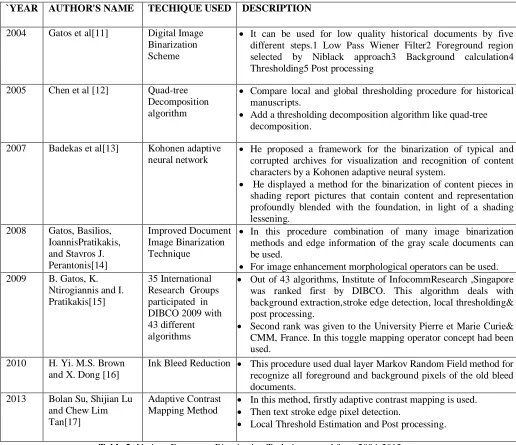
There are so many techniques that are introduced for document image binarization. As we know, in binarization we convert gray scale image into binary one. For this purpose image segmentation is required. Thresholding is best, accurate and high processing speed segmentation approach to monochrome image. Till now various binarization method exits and explained below in tables:
YEAR AUTHOR'S NAME
TECHIQUE USED DESCRIPTION
1979 Otsu[5] Automatic
OptimalThresholding Selection
Optimal Threshold is naturally selected based on global property but not on local property.
It can be used for picture segmentation so that maximum separation can be done between resultant classes of gray levels.
1985/1986 Kapur&Niblack[6] Maximum Entropy Algorithm
By using this algorithm there are two possibilities to separate the histogram of the image.
Out of which one can define object and another define background.
1999 Solihin,Y. and C.H. Leedham[7]
Histogram Based Global Thresholding
This procedure is also called Integral Ratio.
It is based on two levelthresholding approach in which each pixel of handwritten image can be divided into three parts: foreground, background and fuzzy area between them. We can decide whether a pixel lies in foreground or
background on the basis of Native IR and Quadratic IR. 2000 Yang and Yan[8] Logical Adaptive
Thresholding
It use Logical thresholding method for binarization of seriously degraded complex background gray scale images. It cannot affect useful information.
2000 Sauvola's[2] Adaptive Document Image Binarization
The evaluation of local threshold is based on estimation of local mean and local standard deviation.
2001 Randolph[9] Binary Domain Approach
It can be used for enhancement in Fax documents.
Gurleen Kaur, International Journal of Advanced Trends in Computer Applications (IJATCA) Volume 2, Number 6, November - 2015, pp. 37-44 ISSN: 2395-3519 2003 Wu et al[10] Multi-stage Global
Thresholding
In first stage global thresholding technique used.
In second stage refinement of threshold value can be done. It is used for both simple and complex images that have
different shading like postal envelopes.
Table 1: Various Document Binarization Techniques used upto 2003 year
`YEAR AUTHOR'S NAME TECHIQUE USED DESCRIPTION
2004 Gatos et al[11] Digital Image Binarization Scheme
It can be used for low quality historical documents by five different steps.1 Low Pass Wiener Filter2 Foreground region selected by Niblack approach3 Background calculation4 Thresholding5 Post processing
2005 Chen et al [12] Quad-tree Decomposition algorithm
Compare local and global thresholding procedure for historical manuscripts.
Add a thresholding decomposition algorithm like quad-tree decomposition.
2007 Badekas et al[13] Kohonen adaptive neural network
He proposed a framework for the binarization of typical and corrupted archives for visualization and recognition of content characters by a Kohonen adaptive neural system.
He displayed a method for the binarization of content pieces in shading report pictures that contain content and representation profoundly blended with the foundation, in light of a shading lessening.
2008 Gatos, Basilios, IoannisPratikakis, and Stavros J. Perantonis[14]
Improved Document Image Binarization Technique
In this procedure combination of many image binarization methods and edge information of the gray scale documents can be used.
For image enhancement morphological operators can be used. 2009 B. Gatos, K.
Ntirogiannis and I. Pratikakis[15]
35 International Research Groups participated in DIBCO 2009 with 43 different algorithms
Out of 43 algorithms, Institute of InfocommResearch ,Singapore was ranked first by DIBCO. This algorithm deals with background extraction,stroke edge detection, local thresholding& post processing.
Second rank was given to the University Pierre et Marie Curie& CMM, France. In this toggle mapping operator concept had been used.
2010 H. Yi. M.S. Brown and X. Dong [16]
Ink Bleed Reduction This procedure used dual layer Markov Random Field method for recognize all foreground and background pixels of the old bleed documents.
2013 Bolan Su, Shijian Lu and Chew Lim Tan[17]
Adaptive Contrast Mapping Method
In this method, firstly adaptive contrast mapping is used. Then text stroke edge pixel detection.
Local Threshold Estimation and Post processing.
Table 2: Various Document Binarization Techniques used from 2004-2013 year
III.
PROPOSED METHOD
In this part we can describe our proposed procedure. In our proposed scheme we take the RGB degraded image document as an input image. Firstly, convert RGB image to gray scale image document and binarized that image and get binary one. Then, image enhancement can be done by using filtering technique. After that morphological operators can be implemented for region
based segmentation. To achieve more accurate and better performance Otsu threshold is applied to the output of morphological operators. To maintain the quality of
image binarization technique further
Sauvola'sthresholding is used.
Gurleen Kaur, International Journal of Advanced Trends in Computer Applications (IJATCA) Volume 2, Number 6, November - 2015, pp. 37-44 ISSN: 2395-3519
B. RGB To Gray image Conversion
RGB is a device-dependent color model. The fundamental reason for the RGB shading model is for the sensing, representation and presentation of pictures in electronic systems. To form a color with RGB, three light beams (one red, one green, and one blue) must be superimposed. Each of the three beams is known as a component of that color.[18]
C. Image Filtering
Image processing is a vast field that contains so many tasks like compression, filtering, feature detection, enhancement and classification. [19] We need to enhance the visibility of the document image. The enhancement process does not increase the information content. Image enhancement contains grey level, contrast manipulation, removal of noise, edge sharpening, and pseudocoloring and so on. Denoising is one of the method used for the removal of noise. A document to be examined can itself be debased with noise .Sometimes, scanning itself presents some noise. Noise may be because of dust, spot, degeneration, maturing and so on .For noise reduction we can utilize smoothing operations as a part of document picture. [20] Denoisingare filtering system that reduce the noise, improve the nature of content characters and make the background composition uniform.[21] Denoising methods are isolated in filtering in spatial and frequency domain. In our work we executed one filter in spatial
area (Wiener filter) with different windows sizes and one filter infrequency area (Gaussian filter).
a. Wiener Filter
Wiener filter, known as “minimum mean square error filter” or "least square error filter".[22]We can say that it is anversatile linear filter which is connected to image locally, by considering the neighborhood picture fluctuation. At the point when the difference in a image is huge the Wiener filter brings about light neighborhood smoothing, while when the fluctuation is little, it gives an enhanced nearby smoothing. The product of complex quantity with its conjugate is equal to magnitude of complex quantity squared. This result can be described as Wiener Filter. [23]
𝑊𝑖𝑒𝑛𝑒𝑟 𝐹𝑖𝑙𝑡𝑒𝑟 = 𝐺∗ 𝑥, 𝑦 𝐺 𝑥, 𝑦 2+𝑆𝛼 𝑥,𝑦
𝑆𝛽 𝑥,𝑦
… … … . . (1)
Where G*(x, y) denotes complex conjugate of degraded function G(x, y);
𝐺 𝑥, 𝑦 2= 𝐺∗ 𝑥, 𝑦 𝐻(𝑥, 𝑦)
𝑆𝛼 𝑥, 𝑦 = 𝑁 𝑥, 𝑦 2=Power spectrum of noise
𝑆𝛽 𝑥, 𝑦 = 𝐹 𝑥, 𝑦 2=Power spectrum of un-degraded
image.
b. Gaussian Filter
It is frequency domain based filter that remove the noise but blurred the image.[24] In two dimension Gaussian filter mathematically defined as follows:
𝐻 𝑥, 𝑦 = 𝑒−𝐷 𝑥,𝑦 2𝜎 2 ……….(2)
where D(x, y) denotes the distance from the origin of the Fourier transform.
Gaussian filter is a low pass filter which perform Fourier Transform. It is also known as smoothing frequency filter because they can be used to smooth edges.
D. Morphological Operators
The meaning of morphology is to describe the properties of the structure and shape of any objects. Morphological operations operate on Sets. In mathematically morphology, sets represent objects in the image. Morphological operations can be used both in preprocessing and final stages for image processing.
Gurleen Kaur, International Journal of Advanced Trends in Computer Applications (IJATCA) Volume 2, Number 6, November - 2015, pp. 37-44 ISSN: 2395-3519
image as output by using threshold function. Basic Operation used in morphology are Dilation, Erosion, Opening and Closing etc.Dilation and Erosion are two fundamental operations. Dilation enlarges foreground, shrinks background. Erosion shrinks foreground, enlarges background.[25]
Figure2(b): Erosion process
Figure2(c): Dilation process
Opening and Closing derived from basic Dilation and Erosion operations. Opening is the dual of shutting(closing) i.e. opening the foreground pixels with a specific structuring element is equivalent to closing the background pixels with the same element. In our existing method, Canny edge detector has been used after contrast mapping but drawback is that it can be based on edge segmentation which is not capable for outer edges segmentation.
E. Thresholding
Digital image is composed of finite no of elements; each has distinct location and value. [27] These elements are called pixels. Binary image is that digital image in which only two colors can be possible, one is white and other is black. Binary images are also called as bi-level, two-level, and monochrome.To convert and get binary images from gray images thresholding has been done. [28]Thresholding is the first preprocessing scheme that can be used before document analysis. [29]
a. Otsu Thresholding
Otsu Thresholding is most successful global thresholding technique. The simplest way for implementation of thresholding is to select an intensity value as threshold level. [30] The value which is below the threshold level is treated as 0(black) and which is above the threshold level that select as 1(white). If we assume that Z is the global threshold of an given image
f(x, y) and then g(x, y) is the threshold image that can be given by as follows:
𝑔 𝑥, 𝑦 = 1 𝑤𝑒𝑛 𝑓 𝑥, 𝑦 ≥ 𝑍, 0 𝑜𝑡𝑒𝑟𝑤𝑖𝑠𝑒...(5)
The strategy proposed by Otsu explained a clustering analysis built technique based with respect to picture variation. It automatically performs histogram shape-based picture thresholding for the decrease of a grey level picture to a binary picture. The calculation expect that the image for thresholding contains two classes of pixels (e.g., foreground area and background) and then calculates the optimum threshold differentiating those two classes so that their combined spread is minimal.Itexhaustively scans for the limit that minimizes the intra-class fluctuation, characterized as the weighted sum of variations of the two classes.
𝜎 2 𝑡 = 𝛽1 𝑡 𝜎2 𝑡 + 𝛽2 𝑡 𝜎2 𝑡 … … … (6)
The Otsu method gives better performance when the numbers of pixels in each class are close to each other.The expansion of the first technique to multi-level thresholding is referred to as the Multi Otsu method.[31]
b. Sauvola'sThresholding
The strategy proposed by Sauvola's et al. is local-variance based method. It is a change on the system proposed by Niblack, particularly when the background contains light composition, enormous variations, re-colored and badly degraded documents. It adapts the contribution of the local mean and standard deviation. When document is dirty or re-colored paper then threshold value is lowered. The threshold is calculated as follows:
𝑇 𝑥, 𝑦 = 𝑚 𝑥, 𝑦 ∗ 1 + 𝑘 𝜎 𝑥, 𝑦
𝑅 − 1 … … . . (7)
Where value of m(x, y) and σ(x,y) same as in Niblack system.Here, m and σ denotes the mean and standard deviation of the entire window. Sauvola's estimate value of k=0.5 and R=128 and k is a fixed value. It was conclude that the suggestion of R has a little impact on the quality while the estimations of k and window size influence it fundamentally. The smaller the estimation of k, the thicker is the binarized stroke, and the more cover exists between characters. [32]A smaller window size will create thinner strokes. An ideal blend of k and the sliding window will deliver a good binary image.
IV.
EXPERIMENTS AND
DISCUSSION
Gurleen Kaur, International Journal of Advanced Trends in Computer Applications (IJATCA) Volume 2, Number 6, November - 2015, pp. 37-44 ISSN: 2395-3519
another method that can be used in DIBCO dataset 2011.
Parameter used:
For evaluation there are few parameters that can be use to check the Binarization performance like F-Measure, Peak Signal to Noise Ratio(PSNR), Distance Reciprocal Distortion (DRD) and Misclassification Penalty Metric (MPM).
F-Measure:
It is a measure of a test's accuracy. It assumes both the precision p and the recall r of the test to compute the score.
𝐹𝑀𝑒𝑎𝑠𝑢𝑟𝑒 = 2. 𝑝𝑟𝑒𝑐𝑖𝑠𝑖𝑜𝑛. 𝑟𝑒𝑐𝑎𝑙𝑙 𝑝𝑟𝑒𝑐𝑖𝑠𝑖𝑜𝑛 + 𝑟𝑒𝑐𝑎𝑙𝑙. . (8)
p is the number of correct results divided by the number of all returned results and r is the number of correct results divided by the number of correct results that should have been returned. F measure achieves its best value at 1 and worst score at 0.
Peak signal-to-noise ratio (PSNR):
PSNR is a term for the ratio between the maximum possible power of asignaland the power of corruptingnoise that affects the fidelity of its representation. Because numerous signals have a very wide dynamic range, PSNR is usually expressed in terms of the logarithmic decibel scale. PSNR is most
effectively characterized through the mean squared error (MSE).
To compute the PSNR, the block first calculates the mean-squared error using the following equation:
MSE = [I1 m, n − I2(m, n)]2
M ∗ N
MN
… . . . . (9)
In the previous equation, M and N are the number of rows and columns in the input images, separately. Then the block computes the PSNR using the following
equation: PSNR = 10 log10 R 2
MSE … . (10)
Where R denotes the maximum fluctuation in the input image data type.
Misclassification penalty metric (MPM)
The Misclassification penalty metric MPM evaluates the prediction against the Ground Truth (GT) on an object-by object basis. Misclassification pixels are punished object-by their distance from the ground truth object’s border.
𝑀𝑃𝑀 =𝑀𝑃𝐹𝑁+𝑀𝑃𝐹𝑃
2 … … (11)
Where𝑀𝑃𝐹𝑁 = 𝑑𝐹𝑁
𝑖 𝑁 𝐹𝑁 𝑖=1
𝐷 , 𝑀𝑃𝐹𝑃 =
𝑑𝐹𝑃𝑗 𝑁 𝐹𝑃 𝑗 =1 𝐷
diFNandd j
FPdenote the distance of the ith false negative
and the jth falsepositive pixel from the contour of the text in the GT image. The normalization factor D is the sum over all the pixel-to contour distances of the GT object. A low MPM score denotes that the algorithm is good at identifying an object’s boundary.
A. Testing on Competition Dataset
In this part, we can compare our proposed method result with another techniques result that used in DIBCO 2011 dataset. This method includes Otsu’s method, Sauvola method, Niblack method, Brensen’s method, Gatos et al.’s method, LMM, BE, LELO, SNUS, HOWE methods and also Bolan Su Adaptive Contrast Mapping method. The DIBCO 2011 dataset includes eight degraded handwritten documents and eight degraded printed documents. Therefore, total 16 document images. Table I shows the evaluation results as follows:
Methods F-Measure
(%)
PSNR DRD MPM
OTSU 82.22 15.77 8.72 15.64
SAUV 82.54 15.78 8.09 9.20
NIBL 68.52 12.76 28.31 26.38 BERN 47.28 7.92 82.28 136.54
GATO 82.11 16.04 5.42 7.13
LMM 85.56 16.75 6.02 6.42
BE 81.67 15.59 11.24 11.40
LELO 80.86 16.13 104.48 64.43
SNUS 85.2 17.16 15.66 9.07
HOWE 88.74 17.84 5.37 8.64
BOLAN 87.8 17.56 4.84 5.17
Proposed 91.5 20.89 3.37 1.31
Table I: Evaluation Results Of The Dataset Of DIBCO 2011
As shown in Table I our proposed method results can be best in terms of all above parameters. That means our proposed method maintains best visibility and provides good text stroke contours. Figure 3(a), (b) and (c) shows three document images (HW-08, PR 08and PR-06) from DIBCO 2011 dataset.
(a) (b)
Gurleen Kaur, International Journal of Advanced Trends in Computer Applications (IJATCA) Volume 2, Number 6, November - 2015, pp. 37-44 ISSN: 2395-3519
(a) (b)
Figure3(b)Binarization results of the sample document image (PR 08) (a) Input Image (b) Proposed Method Image
(a) (b) (c)
(d) (e) (f)
(g) (h) (i)
(j) (k) (l)
(m)
Figure3 (c)Binarization results of the sample document image (PR 06) in DIBCO 2011 dataset produced by different
methods. (a) Input Image. (b) OTSU (c) SAUV(d) NIBL (e) BERN (f) GATO (g) LMM (h) BE (i) LELO (j) SNUS (k)
HOWE (l) Bolan Su. (m) Proposed
In this figure3(c) all parameters like F-measure gives 91.5value, PSNR 20.87, DRD 3.37 and MPM 1.31value.
B.
DISCUSSION
There are so many parameters are used in our proposed method to check the ability to remove the different kinds of degradation in an input document images. Firstly, our proposed technique makes the document images stable and noise free. Secondly,region based segmentation gives better performance instead of edge based segmentation. Third, our proposed techniques extract foreground from background by using morphological operators.
V.
CONCLUSION
This paper presents an image Binarization technique for degraded images by using morphological operators. The proposed method is easy, more reliable and an efficient way. The proposed method makes use of morphological operators then Otsu and Sauvola’sthresholding. The output can compare with DIBCO 2011 dataset on the basis of PSNR, F-measure, DRD and MPM.
REFERENCES
[1] George Nagy, "Twenty years of document image analysis in PAMI," IEEE Transactions on Pattern Analysis and Machine Intelligence22.1, pp. 38-62, 2000.
[2] Jaakko, and Matti Pietikäinen Sauvola, "Adaptive Document Image Binarization," Pattern Recognition 33.2, pp. 225-236, 2000.
[3] Keechul, Kwang In Kim, and Anil K. Jain Jung, "Text information extraction in images and video: a survey,"
Pattern recognition 37.5, pp. 977-997, 2004.
[4] Yefeng Zheng, "Handwriting identification, matching, and indexing in noisy document images," 2005.
[5] N. Otsu, "A threshold selection method from gray-level histograms," IEEE Trans. Systems, Man, and Cybernetics, vol. 9, pp. 62-66, 1979.
[6] J., P.K. Sahoo, and A.K.C. Wong Kapur, "A new method for gray-level picture. Thresholding using the Entropy of the Histogram," Computer Vision Graphics and Image Processing, vol. 29, pp. 273-285, 1985.
Gurleen Kaur, International Journal of Advanced Trends in Computer Applications (IJATCA) Volume 2, Number 6, November - 2015, pp. 37-44 ISSN: 2395-3519 761-768, 1999.
[8] Yibing Yang and Hong Yan, "An adaptive logical method for binarization of degraded document images Pattern Recognition," Pattern Recognition Society, Elsevier Science , vol. 33, no. 5, pp. 787-807, 2000. [9] T. Smith, M Randolph, "Enhancement of fax documents
using a binary angular representation," in Proceedings of, Int Symp on Intelligent Multimedia, Video and Speech Processing, , Hong Kong, China, 2001.
[10] Adnan Amin, Wu Sue, "Automatic Thresholding of Gray-level Using Multi-stage Approach," in Proceedings of the 7th International Conference on Document Analysis and Recognition (ICDAR 2003),IEEE, 2003. [11] I. Pratikakis, S. Perantonis Gatos B, "An Adaptive
Binarization Technique for Low Quality Historical Documents," Document Analysis Systems VI , vol. 3163, 2004.
[12] Chen Y. and G. Leedham, "Decompose algorithm for thresholding degraded historical document images,"
IEEE Proc.-Vis. Image Signal Process., vol. 152, December 2005.
[13] Chen Y. and G. Leedham, "Document binarization using Kohonen," IET Image Process., pp. 67-85, 2007.
[14] Basilios, Ioannis Pratikakis, and Stavros J. Perantonis. Gatos, "Improved document image binarization by using a combination of multiple binarization techniques and adapted edge information," Pattern Recognition, vol. ICPR 2008. 19th International Conference on. IEEE, 2008., 2008.
[15] Basilios, Konstantinos Ntirogiannis, and Ioannis Pratikakis Gatos, "ICDAR 2009 Document Image Binarization Contest (DIBCO 2009)," ICDAR, vol. 9, 2009.
[16] Yi, Michael S. Brown, and Dong Xu. Huang, "User-assisted ink-bleed reduction," Image Processing, IEEE Transactions , pp. 2646-2658, Oct. (2010).
[17] Bolan, Shijian Lu, and Chew Lim Tan Su, "Robust document image binarization technique for degraded document images.," Image Processing, IEEE Transactions on 22.4 , pp. 1408-1417, 2013.
[18] Cindy M., et al. Goral, "Modeling the interaction of light between diffuse surfaces," ACM SIGGRAPH Computer Graphics, vol. 18, 1984.
[19] Michael, Dick de Ridder, and Heinz Handels Egmont-Petersen, "Image processing with neural networks—a review," Pattern recognition 35.10, pp. 2279-2301, 2002. [20] David, and Michael Howard LeBlanc, Writing secure
code.: Pearson Education, 2002. [21] Saeed V. Vaseghi,., 2008.
[22] Li, and Rendong Zhang Ke, "Multiscale wiener filtering method for low-dose CT images," Biomedical Engineering and Informatics (BMEI), 2010 3rd International Conference , vol. 1, no. IEEE.
[23] Emmett N., and Juris Upatnieks Leith, "Reconstructed wavefronts and communication theory.," in JOSA 52.10 , 1962, pp. 1123-1128.
[24] Yansun, et al. Xu, "Wavelet transform domain filters: a spatially selective noise filtration technique," in Image Processing, IEEE Transactions on 3.6 , 1994, pp. 747-758.
[25] S.,and F. Ahmed Farid, "Applications on Niblack's method on images," in Emerging Technologies, 2009. ICET 2009. International Conference on IEEE (2009). [26] Srinivas C., et al. Turaga, "Convolutional networks can
learn to generate affinity graphs for image segmentation,"
Neural Computation 22.2 , pp. 511-538, 2010.
[27] Rafael C., Richard Eugene Woods, and Steven L. Eddins Gonzalez, Digital image processing using MATLAB.. India: Pearson Education , 2004.
[28] Christopher M., and Kevin J. Parker Miceli, "Inverse halftoning," Journal of Electronic Imaging 1.2 , pp. 143-151, 1992.
[29] Xiaoyi, and Daniel Mojon Jiang, "Adaptive local thresholding by verification-based multithreshold probing with application to vessel detection in retinal images.,"
Pattern Analysis and Machine Intelligence, IEEE Transactions on 25.1 , pp. 131-137, 2003.
[30] J. R. Parker, "Gray level thresholding in badly illuminated images.," IEEE Transactions on Pattern Analysis and Machine Intelligence 13.8 , pp. 813-819, 1991.
[31] Vandana, and Shailja Shukla Roy, "Automatic Removal of Artifacts from EEG Signal based on Spatially Constrained ICA using Daubechies Wavelet,"
International Journal of Modern Education and Computer Science (IJMECS) 6.7 , 2014.