http://www.ijcmph.com pISSN 2394-6032 | eISSN 2394-6040
Original Research Article
Prevalence of rifampicin resistant mycobacterium tuberculosis and
associated factors among presumptive tuberculosis patients in eastern
Uttar Pradesh: a cross sectional study
Praveen B. Gautam
1*, Ashwini Mishra
1, Santosh Kumar
2INTRODUCTION
Tuberculosis is a major public health problem. India accounts for one fourth of the global TB burden. In 2015, an estimated 28 lakh cases occurred and 4.8 lakh people died due to TB. India has highest burden of TB and MDR TB based on estimated report 2016, an estimated 1.3 lakh incident multi-drug tuberculosis patients emerge annually
in India which includes 7900 MDR TB patients estimated among notified pulmonary cases.1
Drug resistance tuberculosis is a major public health problem that threatens progress made in TB cases and control worldwide. According to global tuberculosis report 2015, globally 3.3% of new and 20% of previously treated tuberculosis cases was multi-drug resistant (MDR-TB) in 2014.2
ABSTRACT
Background: Drug resistant tuberculosis threatens global TB control and is a major public health problem in several countries and India has the highest tuberculosis in the world. The rifampicin resistance is a good predictor of multidrug resistant tuberculosis. The aim of this study was to determine the prevalence of rifampicin resistance M. tuberculosis and associated factor among presumptive tuberculosis patients in eastern Uttar Pradesh.
Methods: A cross-sectional study was conducted from October 2016 to September 2017. Detection of M. tuberculosis and resistance to rifampicin was performed using Gene Xpert MTB/RIF assay. Data was collected using pre-structured questionnaire by face to face interview. The chi-square test was used to assess the statistical significance of each ratio, p<0.05 was considered significant.
Results: Out of 510 patients, Mycobacterium tuberculosis was detected in 168 (32.9%). Out of these 168 patients, the prevalence of rifampicin resistance tuberculosis was 44 (26.1%). It was higher among male 38 (30.6%) than female 6 (13.6%). Regarding age distribution, maximum numbers of rifampicin resistance patients were in the age group of 20-40 years 36.7%. The prevalence of rifampicin resistance was 36 (27.6%) and 8 (21.0%) in pulmonary and extra-pulmonary respectively. Out of 44 rifampicin resistant cases, 39 (37.8%) were previously treated and 5 (7.6%) cases were treatment naïve patients. In this study, among presumptive DRTB cases, new 2 (11.7%), relapse 13 (39.3%), failure 23 (46.0%), loss to follow-up 1 (10.0%) and MDR contact 1 (20.0%) respectively were rifampicin resistant and one HIV seropositive patient was found to be rifampicin resistant.
Conclusions: Previously treated cases were significantly associated with rifampicin resistance tuberculosis. The Gene Xpert is a good equipment for rapid detection and management of drug resistant tuberculosis for both pulmonary as well as extra-pulmonary tuberculosis.
Keywords: MDR-TB, Gene Xpert MTB/RIF, Rifampicin resistance
Department of TB and Chest, 1BRD Medical College, Gorakhpur, 2SN Medical College, Agra, Uttar Pradesh, India
Received: 10 April 2018
Accepted: 05 May 2018
*Correspondence:
Dr. Praveen B. Gautam,
E-mail: [email protected]
Copyright: © the author(s), publisher and licensee Medip Academy. This is an open-access article distributed under the terms of the Creative Commons Attribution Non-Commercial License, which permits unrestricted non-commercial use, distribution, and reproduction in any medium, provided the original work is properly cited.
Drug resistant tuberculosis is caused by genetic mutation of bacilli, an inadequate or poorly administered treatment regimen and weak services programme that lead to delay detection and effective treatment of drug resistance and are unequipped to support patients to keep adherence to treatment.3
Multidrug resistance tuberculosis (MDR-TB) is defined as disease caused by mycobacterium tuberculosis which is resistant to at least isoniazid and rifampicin with or without other first line anti-tubercular drugs.4 The rapid detection of mycobacterium tuberculosis is essential for early diagnosis and disease management because the high risk of transmission from person to person and emergence of MDR-TB and XDR-TB (extensively drug resistant tuberculosis). Culture is the “gold standard” for final determination but it is time consuming and may take up to 2-8 weeks. In 2011, WHO introduced the wide use of Xpert MTB/Rif assay, it is fully automated diagnostic molecular test using real-time polymerase chain reaction (PCR) technology to simultaneously detected M. tuberculosis and rifampicin resistance mutation in the rpo B gene.5 The Xpert assay is highly rapid, sensitive and specific in diagnosis of both pulmonary and extra-pulmonary tuberculosis.6-8
The aim of this study was to determine the prevalence and associated factors of rifampicin resistant M. tuberculosis among patients presumptive for either TB or drug resistant tuberculosis in B.R.D. Medical College Gorakhpur.
METHODS
A cross sectional study was conducted from October 2016 to September 2017 at tertiary health care TB & Chest Department B.R.D. Medical College Gorakhpur. A total of 510 presumptive TB cases of pulmonary as well as extra-pulmonary who were potential MDR suspect were included and study was ethically approved by the institutional ethical committee.
Inclusion criteria
Patients presumptive for pulmonary or extra-pulmonary tuberculosis attending in the Department of TB & Chest and volunteered to participate in the study were included.
Exclusion criteria
Presumptive patients of pulmonary or extra-pulmonary tuberculosis who provided inadequate sample for the laboratory analysis were excluded from the study.
Definition of presumptive tuberculosis:9
Presumptive pulmonary TB refer to a patients with any of the symptoms and signs suggestive of TB including cough >2week, fever >2week, significant
weight loss, haemoptysis, any abnormality chest radiograph.
Presumptive extra-pulmonary TB refer to the
presence of organ specific symptoms and signs like lymph node, pain and swelling in joints, neck stiffness, disorientation etc. and or constitutional symptoms like significant weight loss, fever for >2 weeks, night sweats.
Presumptive DR TB refer to –
New treatment failure.
TB patients who are found positive on any
follow-up sputum smear examination in
retreatment cases.
Previously treated TB cases.
TB patients who are contacts of DR-TB cases.
TB patients with HIV co-infection.
Laboratory procedures
Each eligible patient who signed written consent and provided clinical specimens were included in the study. From each presumptive TB patient, 2-4 ml of sputum was collected. In case of presumptive extra-pulmonary TB, 2-4 ml of either pus, lymph node aspirates, CSF, pleural or peritoneal fluid samples were collected. Samples were immediately processed for gene Xpert MTB/Rif assay. The sample was inspected for quality and appropriate sample regent was added to the sample in ratio of 2:1 and lid was closed. Sample was then shaken for 10-20 min. and incubated for approximately 10 min. Sample was shaken again and incubated for a further 5 min. The liquefied sample was then transferred in to the Gene Xpert Cartridge in the Gene Xpert MYB/Rif assay system. The computerized system was then operated according to the standard operating procedures to carry out the analysis. Results were automatically generated after 2 hour, indicating if MTB was detected or not detected, where MTB was detected, the Gene Xpert automatically generated result indicating if the MTB was rifampicin resistant or not resistant.
Statistical analysis
All variables were described by proportion and difference between independent groups was compared using the chi-square test. P<0.05 was considered as statistically significant.
RESULTS
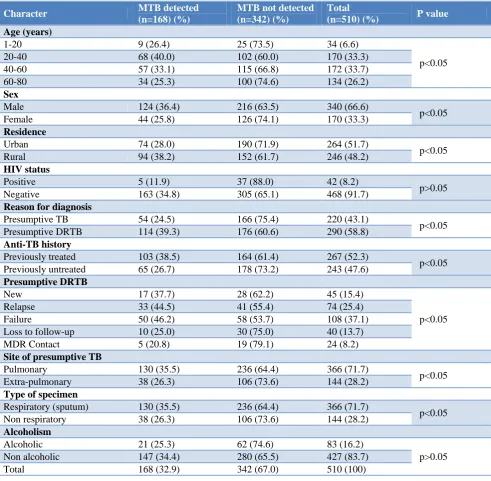
A total 510 presumptive TB or presumptive DRTB patients were analysed in the study.
Prevalence of mycobacterium tuberculosis
and 130 (35.5%) were pulmonary whereas 38 (26.3%)
were extra-pulmonary tuberculosis cases. Five
presumptive DRTB categories were involved in this
study, 17 (37.7%) new, 33 (44.5%) relapse, 50 (46.2%) failure, 10 25.0%) loss to follow up and 5 (20.8%) MDR contact. 5 (11.9%) patients were HIV positive (Table 1).
Table 1: Prevalence of M. tuberculosis among presumptive TB using Gene Xpert MTB/RIF assay.
Character MTB detected
(n=168) (%)
MTB not detected (n=342) (%)
Total
(n=510) (%) P value
Age (years)
1-20 9 (26.4) 25 (73.5) 34 (6.6)
p<0.05
20-40 68 (40.0) 102 (60.0) 170 (33.3)
40-60 57 (33.1) 115 (66.8) 172 (33.7)
60-80 34 (25.3) 100 (74.6) 134 (26.2)
Sex
Male 124 (36.4) 216 (63.5) 340 (66.6)
p<0.05
Female 44 (25.8) 126 (74.1) 170 (33.3)
Residence
Urban 74 (28.0) 190 (71.9) 264 (51.7)
p<0.05
Rural 94 (38.2) 152 (61.7) 246 (48.2)
HIV status
Positive 5 (11.9) 37 (88.0) 42 (8.2)
p>0.05
Negative 163 (34.8) 305 (65.1) 468 (91.7)
Reason for diagnosis
Presumptive TB 54 (24.5) 166 (75.4) 220 (43.1)
p<0.05
Presumptive DRTB 114 (39.3) 176 (60.6) 290 (58.8)
Anti-TB history
Previously treated 103 (38.5) 164 (61.4) 267 (52.3)
p<0.05
Previously untreated 65 (26.7) 178 (73.2) 243 (47.6)
Presumptive DRTB
New 17 (37.7) 28 (62.2) 45 (15.4)
p<0.05
Relapse 33 (44.5) 41 (55.4) 74 (25.4)
Failure 50 (46.2) 58 (53.7) 108 (37.1)
Loss to follow-up 10 (25.0) 30 (75.0) 40 (13.7)
MDR Contact 5 (20.8) 19 (79.1) 24 (8.2)
Site of presumptive TB
Pulmonary 130 (35.5) 236 (64.4) 366 (71.7)
p<0.05
Extra-pulmonary 38 (26.3) 106 (73.6) 144 (28.2)
Type of specimen
Respiratory (sputum) 130 (35.5) 236 (64.4) 366 (71.7)
p<0.05
Non respiratory 38 (26.3) 106 (73.6) 144 (28.2)
Alcoholism
Alcoholic 21 (25.3) 62 (74.6) 83 (16.2)
p>0.05
Non alcoholic 147 (34.4) 280 (65.5) 427 (83.7)
Total 168 (32.9) 342 (67.0) 510 (100)
Rifampicin resistance mycobacterium tuberculosis
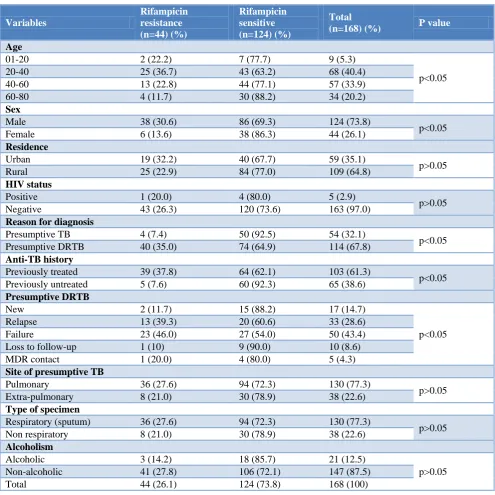
Of the 168 cases, 44 (26.1%) were resistant to rifampicin. Out of 44 rifampicin resistance TB patients 38 (30.6%) were male while 6 (13.6%) were female and most of them were in the age group of 20-40 years (36.7%). 36 (27.6%) patients were pulmonary whereas 8 (21.0%) were extra-pulmonary drug resistance tuberculosis.
39 (37.8%) rifampicin resistance TB patients were in previously treated TB cases and 5 (7.6%) were previously untreated TB cases.
Table 2: Prevalence of rifampicin resistant M. tuberculosis in each variable among the total M. tuberculosis cases using Gene Xpert MTB/RIF assay.
Variables
Rifampicin resistance (n=44) (%)
Rifampicin sensitive (n=124) (%)
Total
(n=168) (%) P value
Age
01-20 2 (22.2) 7 (77.7) 9 (5.3)
p<0.05
20-40 25 (36.7) 43 (63.2) 68 (40.4)
40-60 13 (22.8) 44 (77.1) 57 (33.9)
60-80 4 (11.7) 30 (88.2) 34 (20.2)
Sex
Male 38 (30.6) 86 (69.3) 124 (73.8)
p<0.05
Female 6 (13.6) 38 (86.3) 44 (26.1)
Residence
Urban 19 (32.2) 40 (67.7) 59 (35.1)
p>0.05
Rural 25 (22.9) 84 (77.0) 109 (64.8)
HIV status
Positive 1 (20.0) 4 (80.0) 5 (2.9)
p>0.05
Negative 43 (26.3) 120 (73.6) 163 (97.0)
Reason for diagnosis
Presumptive TB 4 (7.4) 50 (92.5) 54 (32.1)
p<0.05
Presumptive DRTB 40 (35.0) 74 (64.9) 114 (67.8)
Anti-TB history
Previously treated 39 (37.8) 64 (62.1) 103 (61.3)
p<0.05
Previously untreated 5 (7.6) 60 (92.3) 65 (38.6)
Presumptive DRTB
New 2 (11.7) 15 (88.2) 17 (14.7)
p<0.05
Relapse 13 (39.3) 20 (60.6) 33 (28.6)
Failure 23 (46.0) 27 (54.0) 50 (43.4)
Loss to follow-up 1 (10) 9 (90.0) 10 (8.6)
MDR contact 1 (20.0) 4 (80.0) 5 (4.3)
Site of presumptive TB
Pulmonary 36 (27.6) 94 (72.3) 130 (77.3)
p>0.05
Extra-pulmonary 8 (21.0) 30 (78.9) 38 (22.6)
Type of specimen
Respiratory (sputum) 36 (27.6) 94 (72.3) 130 (77.3)
p>0.05
Non respiratory 8 (21.0) 30 (78.9) 38 (22.6)
Alcoholism
Alcoholic 3 (14.2) 18 (85.7) 21 (12.5)
p>0.05
Non-alcoholic 41 (27.8) 106 (72.1) 147 (87.5)
Total 44 (26.1) 124 (73.8) 168 (100)
DISCUSSION
In the present study, the prevalence Mycobacterium tuberculosis infection was 32.9% which is similar to Alvarez-uria et al (27.6%) and Dinic et al 31.4%.10,11
In India, prevalence of MDR tuberculosis is about 1-3% in new cases and around 12-17% in previously treated cases.12 In the present study, prevalence of rifampicin resistant M. tuberculosis was found to be 26.1% which is similar to the report from Jaipur 28.2% by Malhotra et al and New Delhi 33.7% by Jain et al though Bombay
reports a very high incidence of rifampicin resistance of 66.8% (Chowgule et al).13-15
might to be due to social and health seeking behaviour difference and higher exposure of male to outer environment, smoking and alcoholism.
Among the proportion of rifampicin resistant MTB,
presumptive DRTB patients 40 (35.0%) were
significantly higher as compared to presumptive TB patients 4 (7.4%) (p<0.05). This might be due to treatment failure, non-adherence to anti-tuberculosis treatment and contact with drug resistant TB patients. Out of 40 DRTB patients, two (11.7%) cases of new treatment failure (cat I failure) cases were found to be rifampicin resistant. A study from south India found 17.0% MDR-TB among category I failure patients.19 Another study by Singla et al found that 14% of category I failure developed drug resistant.20 Among category II patients, the proportion of rifampicin resistant M. tuberculosis was significantly higher in failure cases 23 (46.0%) as compared to relapse cases 13 (39.3%) (p<0.05). This was comparable to the study done by Gupta et al who found that 34% of cat II failure were drug resistant and Ganguly et al who found 41.8% among cat II failure cases were rifampicin resistant.21,22
In the current study, out of 5 MDR contact one (20%) was found to be rifampicin resistant. This is consistent with the study done by Ganguly et al who found only one resistant case with history of contact with MDR-TB.22
In the present study only one patient of MDR-TB was found to be HIV seropositive. This is in accordance to the study done by Gaude et al who found only 2 out of 36 patients tested positive for HIV.23
In the present study, the proportion of rifampicin resistance TB was higher in pulmonary 27.6% as compared to extra-pulmonary tuberculosis cases 21.0%. A study done by Chakraborty et alfound 13.7% from pulmonary and 8.6% from extra-pulmonary cases were rifampicin resistant.24
CONCLUSION
Emergence of MDR-TB has the potential to be serious public health problem in India. Rapid diagnosis of drug resistance using molecular methods such as Gene Xpert is crucial to the early treatment of drug resistant tuberculosis and prevention of its transmission. Previously treated cases are significantly associated with rifampicin resistance. So adequate treatment periods and observation of TB cases with strict implementation of direct observed treatment should be considered and duration of treatment need to be documented.
ACKNOWLEDGEMENTS
We are thankful to entire staff of RNTCP for providing data and their valuable co-operation.
Funding: No funding sources Conflict of interest: None declared
Ethical approval: The study was approved by the Institutional Ethics Committeeof BRD Medical College, Gorakhpur
REFERENCES
1. Central TB Division, Directorate General of Health Services, Ministry of health and family welfare nirman bhawan, New Delhi. Available at: http://www.tbcindia.gov.in. Revised National TB Control Programme, annual status report 2017.
2. Tuberculosis WHO Global Tuberculosis Report
2015. Available at: http/www.whoint/tb/
publication/factsheet_globalpdf. Accessed on 3 February 2018.
3. Guidelines on programmatic management of drug resistant tuberculosis in India, RNTCP 2017. 4. Ormerod LP. Multi-drug resistant tuberculosis
(MDR-TB) epidemiology, prevention and treatment. British Medical Bulletin 2005;73and74:17-24. 5. Chang K, Lu W, Wang J. Rapid and effective
diagnosis of tuberculosis and rifampicin resistance with Xpert MTB/RIF assay: a meta analysis. J Infect. 2012;64(6):580-8.
6. Tessema B, Beer J, Emmrich F, Sack U, Rodloff AC. First- and second-line anti-tuberculosis drug resistance in Northwest Ethiopia. Int J Tuberc Lung Dis. 2012;16(6):805–11.
7. Getahun M, Ameni G, Kebede A, Yaregal Z, Hailu
E, Medihn G, et al. Molecular typing and drug sensitivity testing of Mycobacterium tuberculosis isolated by a community-based survey in Ethiopia. BMC Public Health. 2015;15:751.
8. Story BE, Helb D. Evaluation of the analytical performance of the Xpert MTB/RIF assay. J Clin Microbiol. 2010;48(7):2495–501.
9. Technical and operational guidelines for
tuberculosis control in India, RNTCP 2016.
10. Alvarez-Uria G, Azcona JM, Midde M, Naik PK, Reddy S, Reddy R. Rapid diagnosis of pulmonary and extra-pulmonary tuberculosis in HIV-infected
patients. Comparison of LED Fluorescent
Microscopy and the GeneXpert MTB/RIF assay in a district hospital in India. Tuberc Res Trea. 2012;2012:1–4.
11. Dinic L, Akande P, Idigbe EO, Ani A, Onwujekwe
D, Agbaji O, Akanbi M, Nwosu R. Genetic determinants of drug-resistant tuberculosis among HIV infected patients in Nigeria. J Clin Microbiol. 2012;50(9):2905–9.
12. Paramasivan CN, Venkataraman P, Chandrasekaran
V, Bhat S, Narayanan PR. Surveillance of drug resistance intuberculosis in two districts of South India. Int J Tuberc Lung Dis. 2002;6(6):479-84. 13. Malhotra B, Pathak S, Vyas L, Katoch VM,
14. Jain NK, Chopra KK, Prasad G. Initial and acquired INH and rifampicin resistant to Mycobacterium tuberculosis and its implication for treatment. Indian J Tuberc. 1992;39:180-6.
15. Chowgule RV, Deodhar L. Pattern of secondary acquired drug reistance to antituberculosis drug in Mumbai, India -1991-1995. Indian J Chest Dis Allied Sci. 1998;40:23-31.
16. Faustini A, Hall AJ, Perucci CA. Risk factors for multidrug resistant tuberculosis in Europe: a systematic review Thorax. 2006;61:158–63.
17. Rasaki SO, Ajibola A, Musa SA, Moradeyo AK, Odeigah LO, Abdullateef SG, et al. Rifampicin Resistant Tuberculosis in a Secondary Health Institution in Nigeria, West Africa. J Infect Dis Ther. 2014;2(3):1000139.
18. Sharma SK, Kumar S, Saha PK, George N, Arora SK, Gupta D, et al. Prevalence of multidrug-resistant tuberculosis among Category II pulmonary
tuberculosis patients. Indian J Med Res.
2011;133:312-5.
19. Santha T, Gopi PG, Rajeswari R, Selvakumar N, Subramani R, Chandrasekaran V, et al. Is it worth treating Category I failure patients with Category II regimen? Indian J Tuberc. 2005;52:203–6.
20. Singla R, Srinath D, Gupta S. Risk factors for new pulmonary tuberculosis patients failing treatment
under the Revised National Tuberculosis Control Program, India. Int J Tuberc Lung Dis. 13(4):521–6. 21. Gupta Anil M, Nilesh D, Patel N. Prevalence of Multi Drug Resistance-TB in Category-2 failure. Gujarat Med J. 2014;69:44-7.
22. Joydeep G, Souvik R, Suman N. A study to evaluate pattern of rifampicin resistance in case of sputum positive pulmonary tuberculosis. J Evol Med Dental Sci. 2015;28(6):4762-8.
23. Gaude GS, Kumar P, Hattiholli J. Drug resistance patterns among pulmonary tuberculosis patients in tertiary care hospital in northern Karnataka. J Med Trop. 2015;17:81-6.
24. Chakraborty S, Chakraborty A, Talukder T,
Mukherjee M, Chatterjee T. Prevalence of Mycobacterium tuberculosis Strains Isolated from Both Pulmonary and Extra Pulmonary Samples and Their Resistance to Rifampicin: A Study from Kolkata and Surrounding Suburbs. J Tuberculosis Res. 2016;4:61-71.