Original Research Article
Knowledge of obstetric danger signs among pregnant women attending
antenatal clinic at rural health training centre
of a medical college in Hyderabad
Manoj Aravind Bhumi, Sunil Pal Singh Chajhlana*
INTRODUCTION
A pregnant women is a dyad– A unit of two individuals consisting of mother and the foetus-, which starts after conception continues through all the phases of pregnancy and post pregnancy.1
The birth of a baby is a major reason for celebration around the world. Societies expect women to bear children and honor women for their role as mothers. Yet in most of the world, pregnancy and childbirth is a perilous journey.2 The major cause for the death of women is due maternal mortality. Around 529,000 women die annually from maternal causes (World Health
ABSTRACT
Background: One of the major causes for the death of women is due to maternal mortality. Around 529,000 women
die annually from maternal causes (World Health Organization (WHO) estimate) Majority of these deaths occur in the less developed countries. An Indian woman dies from complication related to pregnancy and child birth for every 7 minutes. For every woman who dies =30 more women suffer injuries, infection and disability. In Sub-Saharan Africa, where one of every 16 women dies of pregnancy related causes during her lifetime, compared with only 1 in 2,800 women in developed regions. Raising awareness of women about obstetric danger signs would improve early detection of problems and helps in seeking timely obstetric care.
Methods: A cross sectional study was conducted among pregnant women who attended antenatal clinics between
May 2014–August 2014 at field practice areas of RHTC, KAMSRC. A total 274 pregnant women had given consent and participated in the study. Data was collected by interview in local language and a predesigned and pretested questionnaire was used which include socio demographic profile, parity, ANC visits, gravid, knowledge regarding danger signs during pregnancy, post-partum period. Socio-economic status was assessed according to Modified Kuppuswamy’s classification (as per June 2015 CPI).
Results: About 35.7%, pregnant women have good awareness 21.2%, average and 43% have poor knowledge about
danger signs of pregnancy. Pregnant women in the age group of >30 years, educational status and occupational status of pregnant women and their husbands and pregnant mothers who had regular antenatal check-ups had significant associations with the awareness of obstetric danger.
Conclusions: Our study concludes that there is need of creating awareness and increasing the knowledge of women
about obstetric danger signs.
Keywords: Obstetric danger signs, Labour, Antenatal and post natal period
Department of Community Medicine, Kamineni Academy of Medical Sciences and research centre, Hyderabad, Telangana, India
Received: 22 March 2018
Revised: 03 May 2018
Accepted: 05 May 2018
*Correspondence:
Dr. Sunil Pal Singh Chajhlana, E-mail: [email protected]
Copyright: © the author(s), publisher and licensee Medip Academy. This is an open-access article distributed under
the terms of the Creative Commons Attribution Non-Commercial License, which permits unrestricted non-commercial use, distribution, and reproduction in any medium, provided the original work is properly cited.
Organization (WHO) estimate).Majority of these deaths occur in the less developed countries. An Indian woman dies from complication related to pregnancy and child birth every 7 minutes. For every woman who dies =30 more women suffer injuries, infection and disability.2,3 The situation is most dire for women in Sub-Saharan Africa, where one of every 16 women dies of pregnancy related causes during her lifetime, compared with only 1 in 2,800 women in developed regions.4 Most maternal deaths are in resource poor countries. “Delay to make a decision to seek care, delay to reach place of care and delay in receiving appropriate and adequate care” are the main attributed to the three delays.5 Women should be made aware of danger signs of obstetric complications during pregnancy, delivery and the postpartum.6There is unavailability of facilities with skilled attendants and functional emergency obstetric care services in most of the rural areas. Ultimately, improving the knowledge will empower them and their families to make prompt decisions. In order to achieve millennium development goal-5, several interventions were undertaken under National Rural Health Mission to ensure access to skilled care at birth, emergency obstetric care for complications, financial assistance for availing antenatal and intranatal care including referral transport.7 Most importantly, the demand by women and the community for utilization of resources is equally important. For the enhancing the utilization of skilled care during low-risk births and emergency obstetric care in complicated cases in low income countries, knowledge of obstetric danger signs and birth preparedness are the major strategies.8,9 Maternal deaths due to obstetric complications can be reduced with the presence of skilled attendants at births and availability of emergency obstetric care.10-12 and this depends on a functional referral system from rural communities to health facilities.13 There is a risk of sudden, unpredictable complications that could end in death of pregnant woman or injury to herself or to her infant. Pregnancy related complications cannot be reliably predicted.14
Danger signs of obstetric are the symptoms which can be easily identified even by non-clinical personnel.
Raising awareness of women about obstetric danger signs would improve early detection of problems and helps in seeking timely obstetric care.15
Aim of the study
To assess the knowledge of obstetric danger signs among pregnant women in rural areas.
METHODS
Study design
A cross sectional study was conducted among pregnant women who attended antenatal clinics between May 2014–August 2014 in the field practice areas of rural
health training center, KAMSRC. A total 274 pregnant women who had given consent for the study have been included in the study. Data was collected by interview in local language and a predesigned and pretested questionnaire was used which included socio demographic profile, parity, ANC visits, gravid, knowledge regarding danger signs during pregnancy, labour and postpartum period.
Socio-economic status was assessed according to Modified Kuppuswamy’s classification (as per June 2015 CPI).
Inclusion criteria: Antenatal mothers who are attending ANC OPD and are who have given consent for the study.
Exclusion criteria: Non Pregnant women attending OPD and who have not given consent for the study.
Knowledge assessment of pregnant mother’s was done and categorized as:16
Good awareness: could mention >75% of obstetric danger signs
Fair awareness: could mention 50% - 75% of obstetric danger signs
Poor awareness: could mention <50% of obstetric danger signs.
Study area: Field practice area of RHTC, KAMSRC.
Study population: Pregnant women attending ANC clinic.
Ethical clearance: Taken from the institutional ethical committee.
Consent
Study subjects have been explained about the purpose of the study in local language and oral consent have been taken.
RESULTS
Table 1: Factors associated with knowledge of obstetric danger signs among the study population.
Variable Knowledge
Good (98) (%) Fair (58) (%) Poor (118) (%) Total (%) P value
Age (in years)
<20 37 (49.3) 13 (17.3) 252 25 (33.3) 75 (100)
<0.05
21-30 18 (20.9) 23 (26.7) 45 (52.3) 86 (100)
>30 43 (38.1) 22 (19.5) 48 (42.5) 113 (100)
Educational status of pregnant women
Illiterate 1 (5.3) 3 (15.8) 15 (78.9) 19 (100)
<0.05
Primary schooling 7 (11.3) 6 (9.7) 49 (79) 62 (100)
Middle schooling 44 (59.5) 14 (18.9) 16 (21.6) 74 (100)
Intermediate 46 (38.7) 35 (29.4) 38 (31.9) 119 (100)
Educational status of the husband
Illiterate 8 (17.8) 11 (24.4) 26 (57.8) 45 (100)
<0.05 Primary schooling 20 (22) 25 (27.5) 46 (50.5) 91 (100)
Middle schooling 49 (50.5) 15 (15.5) 33 (34) 97 (100)
Intermediate 21 (51.2) 7 (17.1) 13 (31.7) 41 (100)
Occupation of the pregnant women
Housewife 18 (21.7) 18 (21.7) 47 (56.6) 83 (100)
<0.05
Unskilled 39 (54.2) 10 (13.9) 23 (31.9) 72 (100)
Semiskilled 41 (34.5) 30 (25.2) 48 (40.3) 119 (100)
Occupation of the husband
Unskilled 14 (26.4) 9 (17) 30 (56.6) 53 (100)
<0.05
Semiskilled 29 (30.2) 24 (25) 43 (44.8) 96 (100)
Skilled 55 (44) 25 (20) 45 (36) 125 (100)
Antenatal check visits to health care facility
Regular 62 (30.8) 43 (21.4) 96 (47.8) 201 (100)
<0.05
Irregular 36 (49.3) 15 (20.5) 22 (30.2) 73 (100)
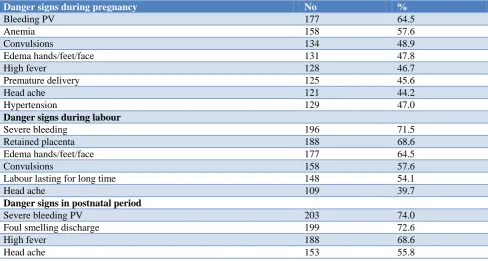
Table 2: Knowledge about obstetric danger sign among pregnant women (n=274).
Danger signs during pregnancy No %
Bleeding PV 177 64.5
Anemia 158 57.6
Convulsions 134 48.9
Edema hands/feet/face 131 47.8
High fever 128 46.7
Premature delivery 125 45.6
Head ache 121 44.2
Hypertension 129 47.0
Danger signs during labour
Severe bleeding 196 71.5
Retained placenta 188 68.6
Edema hands/feet/face 177 64.5
Convulsions 158 57.6
Labour lasting for long time 148 54.1
Head ache 109 39.7
Danger signs in postnatal period
Severe bleeding PV 203 74.0
Foul smelling discharge 199 72.6
High fever 188 68.6
Head ache 153 55.8
36.5% of study population belongs to lower socioeconomic class followed by 25.5% upper lower
About 35.7%, pregnant women have good awareness 21.2%, average and 43% have poor knowledge about danger signs of pregnancy. Pregnant women in the age group of >30 years, educational status and occupational status of pregnant women and their husbands and pregnant mothers who had regular antenatal checkups had significant associations with the awareness of obstetric danger signs of pregnancy, during labour and post natal period (p<0.0005).
Type of family, socioeconomic status and religion doesn’t have association with obstetric danger sign in the present study.
Danger signs during pregnancy: In the present study, 64.6% of the study population is aware about bleeding PV during pregnancy, followed by anemia (57.6%), convulsions (48.9%). Edema hands/feet/face (47.8%) and danger signs during labour: severe bleeding (71.5%), retained placenta (68.6%), edema hands/feet/face (64.5%) and convulsions (57.6%) labour lasting for more time (54.2%).
Danger signs in postnatal period: severe bleeding per vagina (74.0%), foul smelling discharge per vaginum (72.6%), and high fever (68.6%) (Table 2).
In the present study the major source of health information was by medical officer followed by ANM and anganwadi workers.
DISCUSSION
A total of 274 pregnant women have participated in the present study. Majority of them were in the age group of 30 years and above of age group (41.2). Majority of pregnant women (43.4) completed up to intermediate and their husbands (35.4) have completed middle school level. Majority of the study population (43.4%) is working as unskilled workers, 30% housewives, 26% were unskilled workers, and their husband are skilled workers (45.6%), semiskilled (34%) and unskilled (19.3%) (Table 1).
A study conducted by Vijay et al found that the 47% of the study subjects were aged group 0f 20- <25 years, 39% are aged 25-<30 years, 11% were aged 30-<35 years and only 3% were aged >35 years.16 Educational status of study subjects in the study, 12% completed primary education, 64% of subjects completed secondary education. Majority of subjects were housewives (82%).
In the present study about (98) 35.7%, pregnant women have good awareness (58) 21.2%, average and (118) 43% have poor knowledge about danger signs of pregnancy. A study shows that 20% of the subjects have fair knowledge, 73% has poor knowledge about danger signs.16 Similar study conducted by Krishna et al found that the respondent’s knowledge of danger signs was quite low and this is indeed worrisome.17
In the present study, pregnant women in the age group of >30 years, educational status and occupational status of pregnant women and their husbands and pregnant mothers who had regular antenatal checkups had significant associations with the awareness of obstetric danger signs of pregnancy, during labour and post natal period (p<0.0005).
In a study showed that women ≥31 years had better knowledge when compared to the women of the other two categories.17 The socio-demographic, individual, and health service-related factors did not have any significant association with participants’ knowledge on all key danger signs, but have significant association with knowledge of at least one key danger sign.
Vijay et al found in their study that educational status had significant association with level of knowledge on danger signs during pregnancy.16 Similarly study shows that there is a significant association between knowledge scores about danger signs with mother age, education and it was found that religion has no significant association.18 In the present study, 64.5% of the study population is aware about bleeding per vaginum during pregnancy, following anemia (57.6%), convulsions (48.9%), edema of hands/feet/face (47.8%).
In a study among the 200 antenatal women, 39% were aware of vaginal bleeding and convulsions, 33.5% reported fever.17 28%, 27.5% were aware of severe head ache and leg swellings respectively, whereas only 20% and 18% of the women could tell about reduced fetal movements and water leak without pain respectively. In our study danger signs during labour severe bleeding (71.5%), retained placenta (68.6%), edema hands/feet/face (64.5%) and convulsions (57.6%).
Similar results were also found in the study conducted by Vijay et al.16 A study conducted by Acharya et al also found that only 27.8% women knew any one danger sign during pregnancy.19 Mukhopadhya et al study also observed that proportion of women knowing at least one danger sign ranged from 12.1% to 37.2%.20
Severe abdominal pain (n=232; 60.7%) was the most common danger signal of pregnancy followed by heavy bleeding (n=216; 56.5%) were the findings in the study conducted byNithya et al.21
In our study, findings for the danger signs in postnatal period were severe bleeding per vagina (74.0%), foul smelling discharge (72.6%), and high fever (68.6%).
CONCLUSION
In the present study less than 50% pregnant women have good awareness 21.2%, average and 43% have poor knowledge about danger signs of pregnancy. Hence there is an urgent need for creating awareness and increasing the knowledge of women about obstetric danger signs among the population.
Funding: No funding sources Conflict of interest: None declared
Ethical approval: The study was approved by the Institutional Ethics Committee
REFERENCES
1. Dhaar GM. Foundations of community medicine 2nd edition; 2008:303.
2. Ransom EI, Yinger NV. Making motherhood safer, overcoming obstacles on the pathway to care. Population reference Bureau, February 2002. Available at: http://www.prb.org/pdf/Mak Motherhd Safer_Eng.pdf. Accessed on 3 January 2018. 3. Bhalwar R. Text book of Public health and
Community medicine, in collaboration with WHO, India office, Dept of Community medicine, AFMC, Pune.
4. World Health Organization (WHO), United Nations Children’s Fund (UNICEF), and United Nations Population Fund (UNFPA). Maternal mortality in 2000: estimates developed by WHO, UNICEF and UNFPA. WHO, Geneva; 2004.
5. Thaddeus S, Maine D. Too far to walk: maternal mortality in context. Soc Sci Med. 1994;38(8):1091-110.
6. World Health Organization: Mother-Baby Package: Implementing safe motherhood in countries. Practical guide WHO/FHE/MSM/94.11. Geneva. 7. World Health Organization: Mother-Baby Package:
Implementing safe motherhood in countries. Practical guide WHO/FHE/MSM/94.11. Geneva. 8. JHPIEGO. Monitoring birth preparedness and
complication readiness: tools and Indicators for maternal and newborn health. Baltimore: 2004. 9. Starrs AM. Safe motherhood initiative: 20 years and
counting. Lancet. 2006;368(9542):1130-2.
10. Koblinsky MA, Campbell O, Heichelheim J. Organizing delivery care: what works for safe motherhood? Bull World Health Organ. 1999;77(5):399-406.
11. Bell J, Hussein J, Jentsch B, Scotland G, Bullough C, Graham W. Improving skilled attendance at
delivery: a preliminary report of the SAFE strategy development tool. Birth. 2003;30(4):227-34. 12. Paxton A, Maine D, Freedman L, Fry D, Lobis S.
The evidence for emergency obstetric care. Int J Gynaecol Obstet. 2005;88(2):181-93.
13. Graham W, Themmen E, Bassane B, Meda N, De Brouwere V. Evaluating skilled care at delivery in Burkina Faso: principles and practice. Trop Med Int Health. 2008;13(1):6-1.
14. JHIPEGO. Maternal and neonatal health (MNH) program. Birth preparedness and complication readiness: A Matrix of shared responsibilities. MNH; 2001.
15. UNICEF. Saving the lives of the world’s women, new borns and children, 2010. Available at: http://www.childinfo.org/files/CountdownReport_2 000-2010.pdf. Accessed on 3 January 2018.
16. Vijay NR, Kumare B, Yerlekar DS. Awareness of obstetric danger sign among pregnant women In tertiary care teaching hospital. J south Asian Feder obst Gynae. 2015;7(3):171-5.
17. Krishna SJ, Venkat CG. Awareness of danger signs during pregnancy, labour, child birth and during the first seven days of life attending antenatal care at KAMSRC. Int J Reprod Contracept Obstet Gynecol. 2017;6:4106-10.
18. Gupta N. Maternal Mortality: Magnitude, causes and concerns. J Obstet Gynecol Today. 2004:9:555-8.
19. Acharya AS, Kaur R, Prasuna JG, Rasheed N. Making Pregnancy Safer-Birth Preparedness and Complication Readiness Study Among Antenatal Women Attendees of A Primary Health Center, Delhi. Indian J Community Med. 2015;40:127-34. 20. Mukhopadhyay DK, Mukhopadhyay S,
Bhattacharjee S, Nayak S, Biswas AK, Biswas AB. Status of birth preparedness and complication readiness in Uttar Dinajpur District, West Bengal. Indian J Public Health. 2013;57:147-54.
21. Nithya R, Dorairajan G, Chinnakali P. Do pregnant women know about danger signs of pregnancy and childbirth? – A study of the level of knowledge and its associated factors from a tertiary care hospital in Southern India. Int J Adv Med Health Res. 2017;4:11-7.
Cite this article as: Bhumi MA, Chajhlana SPS.