Original Research Article
Geriatric health related problems in an urban
area of southern Rajasthan
Nitesh Mangal
1, Dilip Kumar L.
1*, K. A. Varghese
1, Meet Chauhan
2, Matariswa Samanta
3INTRODUCTION
There are five distinctive stages in human life including infancy, childhood, adolescence, adulthood and old age and every stage has its significance and challenges. Old age is unavoidable and perhaps is the problem ridden phase of life. These problems relate to all domains of health. Old age is a period of physical deterioration, social alienation and it has become a universal phenomenon.1 The Universal Health Coverage under
sustainable development goals encompasses good health for all which obviously includes the elderly people also.2 There is a paradigm shift in the social values towards the elderly people due to urbanization coupled with higher education linked migration and collapse of joint family system. Consequently, problems like loneliness, lack of emotional support, economic insecurities are faced by the elderly population.3
ABSTRACT
Background: There is a paradigm shift in the social values towards the elderly people due to urbanization and higher educational linked migration. Consequently, problems like loneliness, lack of emotional support, economic insecurities are faced by the elderly population. The objectives of the study were to assess the socio-economic dimensions and to examine the morbidity and mortality patterns of elderly persons in the study area.
Methods: A cross- sectional study was conducted among 536 elderly persons from May to August 2019 in an urban area of Udaipur. A pre-structured and pre-tested questionnaire was used to collect information on socio-demographic details, morbidity profile and socio-economic problems of elderly persons. The data was analyzed using class frequencies, ‘t’ test for equality of gender difference in mortality ages and Chi-square test for association of age class with morbidity.
Results: A majority of study subjects were females (52.05%). There was significant difference in proportions of elderly male and female persons across their educational levels. The chi-square test for association of age classes with number of health problems revealed significant association. About 56.34% of 536 elderly people were leading an unsatisfactory life.
Conclusions: The major morbidities included arthritis, hypertension, diabetes, cataract, dental problems, cardiovascular problems etc. Financial problems were more severe among elderly. The availability of trained paramedical professionals for home care and day care units and legal bindings on family members for safety and security of elderly person can be effective measures to overcome the problems being faced by them.
Keywords: Elderly person, Morbidity, Mortality, Trained paramedical
1Department ofCommunity Medicine, Pacific Institute of Medical Sciences, Udaipur, Rajasthan, India
2Department ofCommunity Medicine, Shantabaa Medical College and General Hospital, Amreli, Gujarat, India 3Department of Pathology, Pacific Institute of Medical Sciences, Udaipur, Rajasthan, India
Received: 22 August 2019
Accepted: 19 September 2019
*Correspondence:
Dr. Dilip Kumar L.,
E-mail: [email protected]
Copyright: © the author(s), publisher and licensee Medip Academy. This is an open-access article distributed under the terms of the Creative Commons Attribution Non-Commercial License, which permits unrestricted non-commercial use, distribution, and reproduction in any medium, provided the original work is properly cited.
The average life expectancy at birth in India has increased from 49.7 years in 1970-1975 to 68.3 years in 2011-2015.4 India has thus acquired the label of an “Ageing Nation”.5 The social challenges of elderly
include lack of infrastructure, change in family structure, lack of social support, social inequalities, non-utilization of health care and economic dependency.6 The life security of old people is yet another challenge as brutal killings of old for robbery and other intentions by anti-social elements in urban, semi-urban and even in rural areas are not uncommon during these days. Every person of the society at every phase of life has a right to live and lead a decent and dignified life. Research reports that life satisfaction is strongly related to socio-demographic and psycho-social variables.7
The decadal growth rate of the elderly population in India has always been greater than the decadal growth rate of total population. The ever increasing share of elderly population to total population since 1951 may be due to enhanced access to health amenities, better preventive interventions and relative improved quality of life, the combined effect of which might have led to increased life expectancy of our people.8 Nearly half of older Indians have at least one chronic disease such as asthma, angina, arthritis, depression, hypertension or diabetes.9 The multiple health problems, the physical slow down, physiological problems, mental disorders, psychotic depression as well as emotional and social problems of old age people throw light on the need to create specific medical care for geriatric classes of people.10
The sex ratio of female elderly population (aged 60+) across states in India in 2011 varied from 813 in Sikkim to 1226 in Kerala. This is due to interstate disparity in the share of female elderly population which is attributable to variation in medical infrastructure and other socio-economic factors across states.11 Out of 8.6 percent of total population above 60 years in 2011, 6.4 percent are between 60 to 74 years of age.12 The geriatric population was 77 million in India in 2001 which is expected to rise to 150 million by 2025.13
During the elderly phase of life a person is physically weak on one side and he or she largely feels neglected on the other side. In some cases the self-mobility of such people also is constrained. The old people in our country face problems like economic insecurity, isolation, neglect, abuse, fear, idleness, lowered self-esteem along with falling health. With the kind of ageing scenario, there is pressure on various aspects like finance, health, mobility, security, and so on. Hence it is natural for them to feel marginalized, neglected, isolated and unsecured.14 Lack of preparedness is a common problem in India as large number of people enters into old age with little or no preparedness for it. Old age is irreversible but one can minimize the problems with preparedness by self and with reasonable support by near and dear ones. The
nature and extent of geriatric problems may be different in rural and urban areas. The objectives of the study held in a specific urban area include to assess the socio-economic dimensions of elderly persons in the urban area and to examine the morbidity and mortality pattern of elderly persons in the study area.
METHODS
The present cross-sectional study was carried out in urban field practice area of Pacific Institute of Medical Sciences, Udaipur from May to August 2019. A door to door survey was carried out in the major residential areas around UHTC to prepare a list of households having at least one elderly person who is above 60 years old. In all 3856 houses were covered out of which 3006 had at least one elderly person. For the purpose of this study 10 percent sample households out of 3006 identified households were randomly selected using simple random
sample technique giving each household equal
probability of being included in the sample. Thus a sample of 300 households was selected. There were 536 elderly persons in these households.
A pre-structured and pre-tested questionnaire was prepared based on quality of life and modified as per experts observation.15 The questionnaire included the socio-demographic details, morbidity profile and other problems of the elderly people. Wherever possible the information was collected from the concerned elderly person. In such cases either the elderly person was absent or not able to give information, it was collected from the earning member or any other knowledgeable family member. The inclusion criteria include the households having at least one elderly person more than 60 years of age and willing to participate. The household not having elderly person or those not willing to participate were excluded from the study. The study was approved by the Institutional Ethics Committee.
The quantitative techniques used in this study included assessment of class frequencies, relative frequencies, ‘t‘ test for equality of elderly male and female mortality ages and Chi-square test for association of age class with morbidity.
RESULTS
Table 1: Gender wise distribution of households.
Households (HHs) type No. of HHs No. of elderly persons
Total Male Female
HHs with 4 elderly persons 4 16 8 8
HHs with 3 elderly persons 8 24 10 14
HHs with 2 elderly persons 208 416 208 208
HHs with 1 elderly person 80 80 31 49
Total 300 536 257 279
Table 2: General profile of selected elderly persons (n=536).
Particulars
Elderly persons
P value
Total persons (%) (n=536)
Male (%) (n=257)
Female (%) (n=279) 1. Age wise groups
Young-old (60-75 yrs) 305 (56.90) 150 (58.37) 155 (55.55) 0.496
Old-old (75-85 yrs) 182 (33.96) 86 (33.46) 96 (34.41) 0.825
Very-old (>85 yrs) 49 (9.10) 21 (8.17) 28 (10.04) 0.471
2. Level of education
Illiterate 95 (17.72) 32 (12.45) 63 (22.58) 0.002
Primary and middle 124 (23.13) 42 (16.34) 82 (29.39) 0.0003
Secondary and higher sec. 176 (32.84) 98 (38.13) 78 (27.96) 0.012
Graduates and above 141 (26.31) 85 (33.07) 56 (20.07) 0.0006
3. Financial Security
Pensioner 63 (11.76) 44 (17.12) 19 (6.81) 0.0002
Self Independent 212 (39.55) 167 (64.98) 45 (16.13) <0.00001
Dependent 261 (48.69) 46 (17.90) 215 (77.06) <0.00001
4. Social/family life activeness
Active 371 (69.22) 190 (73.93) 181 (64.88) 0.023
Inactive 165 (30.78) 67 (26.07) 98 (35.12) 0.023
5. Participation in physical/economic activities
Service 28 (5.22) 21 (8.17) 7 (2.51) 0.0031
Business 53 (9.89) 49 (19.07) 4 (1.43) <0.00001
Normal family life 253 (47.20) 73 (28.40) 180 (64.52) <0.00001
Walking or yoga 68 (12.69) 47 (18.29) 21 (7.53) 0.0002
Personal work or activities (only) 52 (9.70) 27 (10.51) 25 (8.96) 0.528
Dependent or bed ridden 82 (15.30) 40 (15.56) 42 (15.05) 0.872
6. Dietary pattern
Vegetarian 371 (69.22) 161 (62.65) 21 (75.27) 0.0014
Non-vegetarian 165 (30.78) 96 (37.35) 69 (24.73) 0.0014
7. Mobility status
Self-movable 454 (84.70) 217 (84.44) 237 (84.95) 0.872
Movable with support 64 (11.94) 29 (11.28) 35 (12.54) 0.667
Bed ridden 18 (3.36) 11 (4.28) 7 (2.51) 0.250
It was seen that out of 536 elderly persons, 305 (56.90%) were young-old (60-75 years), 182 (33.96%) were old-old and 49 (9.10%) were very-old-old. There was no significant difference in the relative shares of male and female elderly persons across age classes as evidenced by non-significant p values. While only 12.45% elderly males were illiterate, the extent of illiteracy in elderly females were 22.50%. There was significant difference in proportions of elderly male and female persons across
in one or the other physical or economic activities like service, business, walking, yoga, etc. About 52 out of 536 elderly persons were doing their personal work/activities only, 82 such persons were either dependent or bed ridden for their personal work and there was no significant gender bias in the same. The dietary pattern revealed that 69.22% of the elderly persons were vegetarians and 30.78% were non-vegetarians. The dietary pattern revealed significant gender difference (Table 2).
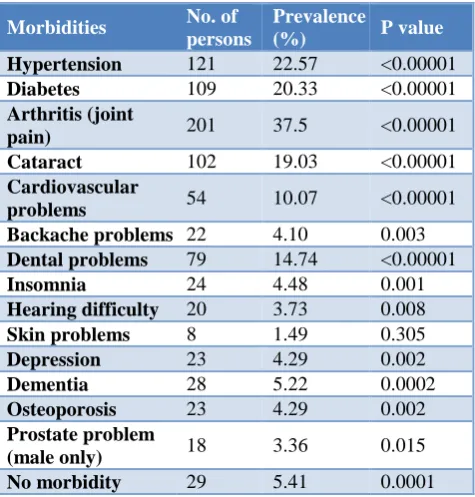
Table 3: Major chronic diseases/morbidities in elderly persons.
Morbidities No. of
persons
Prevalence
(%) P value
Hypertension 121 22.57 <0.00001
Diabetes 109 20.33 <0.00001
Arthritis (joint
pain) 201 37.5 <0.00001 Cataract 102 19.03 <0.00001
Cardiovascular
problems 54 10.07 <0.00001 Backache problems 22 4.10 0.003
Dental problems 79 14.74 <0.00001
Insomnia 24 4.48 0.001
Hearing difficulty 20 3.73 0.008
Skin problems 8 1.49 0.305
Depression 23 4.29 0.002
Dementia 28 5.22 0.0002
Osteoporosis 23 4.29 0.002
Prostate problem
(male only) 18 3.36 0.015 No morbidity 29 5.41 0.0001
It was observed that arthritis 201 (37.50%), hypertension 121 (22.57%), diabetes 109 (20.33%), cataract 102
(19.03%), dental problems 79 (14.78%) and
cardiovascular problems 54 (10.07%) were the major health problems of elderly persons in the study area. There were people suffering from other health related issues like backache problems, insomnia, hearing difficulty, skin problems, depression, dementia, osteoporosis, prostate problems, etc. Only 29 (5.41%) persons were free from any major health problems. Except skin problem the prevalence rate of all other diseases were statistically significant (Table 3).
The large number of elderly persons was having multiple health problems. While 236 (44.03%) persons out of 536 person had only one major health problem as many as 162 (30.22%) had any two major problems and another 65 (12.12%) persons had any three major health problems and the remaining 44 (8.21%) persons had four or more health problems. Only 29 (5.4%) persons of selected elderly persons were free from any chronic diseases (Figure 1).
Figure 1: Multiple health problems in selected elderly persons (n=536).
The chi-square test for association of age classes with number of health problems revealed significant association between age and number of health problems at p value <0.0001. (Calculated chi-square value= 85.74) (Table 4).
Table 4: Number of elderly persons according to age and health problems (n=536).
Age class Number of health problems Chi
square P value
Nil 1 2 3 >4 Total
60-75 17 148 106 31 3 305
85.74 <0.0001*
75-85 7 81 47 19 28 182
>85 5 7 9 15 13 49
*: Significant (p<0.05).
Table 5: Socio-economic problems expressed by selected persons.
Socio-economic problems Number of persons %
Feeling of loneliness 61 11.38
Feeling of un-safety 84 15.67
Feeling of neglect by family members 154 28.73
Ill treatment by family members 83 15.48
Financial constraints 203 37.87
Overall un-satisfaction 302 56.34
29 (5.40%)
236 (44.03%) 162
(30.22%) 65 (12.12%) 44 (8.21%)
Healthy
One Problem
Two Problems
Three Problems
Loneliness was felt by 61 (11.38%) persons, un-safety was felt by 84 (15.67%) persons, neglect by family members was felt by 154 (28.73%) persons and 83 (15.48%) persons expressed ill treatment by family members. In all 203 (37.87%) persons expressed financial constraints. Leaving the home was the last choice expressed by them. It was observed that as many as 302 (56.34%) of 536 elderly people were leading an unsatisfactory life (Table 5).
The better option expressed by these persons included to have a paramedical persons at home for their look after or to have a common place in the vicinity were old people can spend their time.
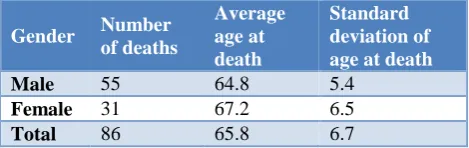
There were 86 elderly persons who lost their life partners and leading lonely life with other family members. The average age of 55 male members who expired was found to be 64.8 years and those of 31 female members was 67.2 years. The ‘t’ test for difference in average age of expiry of male and female members revealed statistical significance in life span of male and female members at p=0.01 (Table 6).
Table 6: Average age at mortality of life partners (n=86).
Gender Number
of deaths
Average age at death
Standard deviation of age at death
Male 55 64.8 5.4
Female 31 67.2 6.5
Total 86 65.8 6.7
DISCUSSION
The geriatric health is going to be a great challenge for fast developing countries like India. On one side the size of geriatric population is on a steady increase and on the other side the preparedness to meet the wellness of this group of people is quite inadequate in our country. The focus of all social security programmes are family based and the family system has radically changed from joint family to nuclear families. It has increased the gravity of problems faced by elderly persons.3
The selected 300 households with the condition of having at least one elderly person were having 536 elderly persons. It implies that those households having at least one elderly person has on an average 1.78 elderly persons per household. The selected area for the study mostly includes new settlement areas of households shifted or migrated from other places for service and business during the last 40 to 50 years. Hence majority of the households were having two elderly persons who were in the young-old (60-75 years) category. The presence of households with 3 or 4 elderly persons in the sample revealed the fact that there is concerned for elderly person
in Rajasthan by their children even when they themselves fall in elderly category.
Remarkably, there was no significant difference in the proportion of male and female elderly persons across age group classes as young-old, old-old and very-old categories. However the total number of female (52.02%) exceeded that of male (47.95%) in the present study. Similar findings were reported by Shah et al study.16 The economic dependency of elderly in the present study was to the extent of 48.7%. Shah et al study reported a much higher rate of dependency (83.2%) of the elderly people.16 The extent of male illiteracy was only 12.45% and that of female was 22.58%. Shah et al study reported a much higher illiteracy (52.4%) and Sharma et al also reported the extent of illiteracy as (49.8%).16,17 The higher literacy in the present study is attributable to the fact that the study was conducted in a newly settled urban area either for job or for business. The number of female elderly persons exceeded number of male persons up to middle class level of education and beyond that level, the number of male exceeded that of female implying that the female were deprived of higher education compared to male in the past. The increased number of female for financial or economic dependence is attributable to their low level of education. The higher proportion of male old persons leading active social life is also attributable to
their involvement in economic activities. The
involvement of elderly female was much more than the male in normal family life.
The prevalence rates of all major diseases of elderly persons were statistically significant except for skin diseases. The major diseases or health problems included joint pain (37.5%), hypertension (22.5%), diabetes (20.3%), cataract (19.03%), dental problems (14.7%), cardiovascular problems (10.1%) etc. Similar observation was reported by Shah et al as well as Sharma et al in their studies.16,17 The elderly persons with multiple health problems exceeded than persons having any morbidity or persons free from any morbidity. There were only 29 (5.40%) persons found free from any morbidity out of 536 persons. Fauci et al as well as Kowal et al study also reported high extent of multiple problems in elderly people.18,19 The age classes and number of health problems are found to be highly associated implying that as the age goes up number of health problems also increases.
that 63.4% were financially independent and 36.6% were financially dependent.21 Seth et al study reported feeling for emptiness in life by 51.8% and un-safety feeling by 35.3% of the elderly people.22 There should be adequate and ensured financial support from government side so as to overcome the financial crises felt by them. There is need to have legal bindings on family members to safeguard the interest of elderly people.
Limitation of the study
As the study was confined to newly settle urban area, the results cannot be generalized for all urban areas.
CONCLUSION
The mobility status of elderly persons did not show any significant gender effect. The prevalence rates of all major diseases of elderly persons were statically significant except for skin diseases. The major diseases or health problems included joint pain, hypertension, diabetes, cataract, dental problems, cardiovascular problems etc. The elderly persons with multiple health problems exceeded that of persons free from either one or no morbidity. The age classes and number of health problems are found to be highly significant. Financial related problems are more severe among elderly people. The other problems faced by them included neglect by family members, unsafely feeling, ill treatment by family members and feeling of loneliness.
Recommendations
The availability of trained paramedical professionals for home care, establishment of day care units for elderly persons and strict legal bindings on family members to ensure safety and security of elderly persons can prove to be effective measures to overcome the problems being faced by elderly people.
Funding: No funding sources Conflict of interest: None declared
Ethical approval: The study was approved by the Institutional Ethics Committee
REFERENCES
1. Kumar V. Ageing in India- an overview. Indian J Med Res. 1997;106:257‑64.
2. Goman M, Zaidi A. Global Age Watch Index 2015:
Insight report. London: Help Age International.
Available at: https://fiapam.org/wp-content/
uploads/2015/09/helpage-indice-global-envejec imiento-2015.pdf. Accessed on 10 June 2019. 3. Pandey MK. On ageing, health and poverty in rural
India. Munich Personal RePEc Arch. 2009: 1-27. 4. National Health Profile Central Bureau of Health
Intelligence Directorate General of Health Services Ministry of Health & Family Welfare, Government of India 2018. Available at http://www.indiaenviron
mentportal.org.in/files/file/NHP%202018.pdf. Accessed on 9 August 2019.
5. Ingle GK, Nath A. Geriatric health in India: Concerns and Solutions. Indian J Community Med. 2008;33(4):214-8.
6. Mane AB. Ageing in India: Some Social Challenges
to Elderly Care. J Gerontol Geriatr Res. 2016;5(2):1-2.
7. Iyer V. Old age protection in urban agglomeration of a developing economy:An integration analysis. Aging Hum Develop. 2003;1(3):241-2 50.
8. Jairaj S, Palabindela R, Sridhar D. A community based cross sectional study on morbidities and social problems among geriatric population. Int J Community Med Public Health. 2019;6 (8):3554-8. 9. Chatterji S. The health of aging populations in
China and India. Health Aff (Millwood).
2008;27(4):1052-63.
10. Sirohi A, Kaur R, Goswami AK, Mani K,
Nongkynrih B, Gupta SK. A study of falls among elderly persons in a rural area of Haryana. Indian J Public Health. 2017;61 (2):99-104.
11. Women and Men in India 2017. Social Statistics Division Central Statistics Office Ministry of
Statistics and Programme Implementation
Government of India. Available at: http://www. mospi.gov.in/sites/default/files/publication_reports/
Women%20and%20men%20in%20india-2017%20Mail.pdf. Accessed on 17 July 2019. 12. Elderly in India-profile and programmes.Central
Statistics Office Ministry of Statistics and Programme Implementation Government of India 2016. Available at: http://mospi.nic.in/sites/ default/files/publication_reports/ElderlyinIndia_201 6.pdf. Accessed on 8 August 2019.
13. Dawale AK, Mudey A, Lanjewar A, Wagh VV.
Study of morbidity pattern in inmates of old age homes in urban area of central India. J Indian Acad Geriatr. 2010;6(1):23-7.
14. Ananda A. Old age homes for rural senior citizens:a proposal. Int J Multidisciplinary Educ Res. 2017;7(11):28-39.
15. Kumar GS, Majumdar A, Pavithra G. Quality of Life (QOL) and its associated factors using
WHOQOL-BREF among elderly in urban
Puducherry, India. J Clin Diagnostic Res.
2014;8(1):54-57.
16. Shah VR, Christian DS, Prajapati AC, Patel MM, Sonaliya KN.Quality of life among elderly population residing in urban field practice area of a tertiary care institute of Ahmedabad city, Gujarat. J Family Med Prim Care. 2017;6(1):101-5.
17. Sharma D, Parashar A, Mazta SR. Functional status and its predictor among elderly population in a hilly state of North India. Int J Health Allied Sci. 2014;3(3):159-63.
19. Kowal P. Ageing and adult health status in eight lower income countries: The in depth WHO-Sage collaboration. Global Health Action. 2010;2:11-22. 20. Adhikari P. Geriatric Health Care in India - Unmet
Needs and the Way Forward. Arch Med Health Sci. 2017;(5)1:112-4.
21. Amonkar P, Mankar MJ, Thatkar P, Sawardekar P, Goel R, Anjenaya S. A comparative study of health status and quality of life of elderly people living in old age homes and within family setup in Raigad District, Maharashtra. Indian J Community Med 2018;43(1):10-3.
22. Seth RK. Morbidity pattern and psychosocial problems of elderly in a rural population of Uttar Pradesh, India: a cross-sectional study. Int J Res Med Sci. 2017;5(1):162-5.