Original Research Article
Breast cancer screening: knowledge and practices among women
employees of a tertiary care hospital
Padmavathi V. Dyavarishetty*, Megha S. Mistry
INTRODUCTION
It is estimated that the prevalence of breast cancer in India is 92.6/lakh population with a mortality rate of 12.7/lakh population.1 Though both men and women can develop breast cancer, women are more at risk of breast cancer.2 Age increases the risk of breast cancer. Most breast cancers develop after the age of 50 years.2 However in Indian women, the age at which women get breast cancer is much lower than in developed countries, almost a decade earlier.3-5 Early onset of menarche, first live birth at the age of 30 years and above, never giving
birth to a child, starting menopause after the age of 55 years, being physical inactive, being obese, having dense breasts, prolonged use of combined oral contraceptive pills, personal history of breast cancer/non-cancerous breast disease, previous radiotherapy treatment, and history of breast cancer in the first degree relatives increases the risk of breast cancer.2
There is no country wide programme that offers awareness and screening services.6 The facilities for mammogram are available in some private hospitals but cost is an hindering factor. In addition the awareness
ABSTRACT
Background: Women employees, despite working in hospital do not undergo regular breast cancer screening due to poor awareness about the disease and the importance of undergoing regular breast cancer screening. The objectives of the study were to assess knowledge related to breast cancer disease, proportion of women ever screened for breast cancer and proportion of women with one or more risk factors for breast cancer.
Methods: Observational descriptive cross-sectional study design was adopted to interview 88 women employees of a tertiary health care institute in Mumbai. A list of women employees other than a nurse or doctor, aged 30 years and above, working in the hospital or medical college was prepared. Women were sequentially approached and interviewed after obtaining an informed consent using a pre-tested, structured interview tool, till the sample size of 88 was reached. Data is presented using descriptive statistics like percentages, mean, standard deviation and standard error of mean.
Results: Knowledge score of women was low with regard to symptoms and risk factors of breast cancer but high with regard to modalities of breast cancer screening. Overall proportion of women undergoing regular breast cancer screening by any of the methods (mammography, clinical breast examination or self-breast examination) is very poor. Knowledge levels greatly influenced the practice of breast cancer screening.
Conclusions: Creating awareness about the disease and the need to undergo regular screening for breast cancer is required even for hospital employees.
Keywords: Breast cancer, Knowledge, Practices, India
Department of Community Medicine, K. J. Somaiya Medical College and Research Centre, Mumbai, Maharashtra, India
Received: 11 September 2019
Accepted: 15 October 2019
*Correspondence:
Dr. Padmavathi V. Dyavarishetty, E-mail: [email protected]
Copyright: © the author(s), publisher and licensee Medip Academy. This is an open-access article distributed under the terms of the Creative Commons Attribution Non-Commercial License, which permits unrestricted non-commercial use, distribution, and reproduction in any medium, provided the original work is properly cited.
about the risk factors for breast cancer and the need to undergo breast cancer screening is poor.7
There are several tertiary care hospitals in India with hundreds of women employees working in the hospital. Despite working in a hospital, the awareness level is expected to be poor and not much different from the general population. The aim of the present study is to assess knowledge, attitude and practices pertaining to breast cancer in women employees of a tertiary care hospital. The objectives of the study were to assess knowledge related to breast cancer disease; proportion ever screened for breast cancer; and proportion of woman with one or more risk factors.
METHODS
The study was an observational descriptive cross-sectional study carried out in a teaching hospital located in Mumbai. Women employees of the institute who are not directly involved in care giving, but working as support staff were chosen as study sample. Nursing staff and doctors were not included in the study, as it was presumed that they are more likely to be aware of breast cancer and practicing regular screening. A list of women employees aged 30 years and above; working as support staff (laboratory technician, medical social workers, outreach workers, peon, sweeper, clerical staff etc.) was obtained from the administrative officer.
Assuming that only 50% of the women have some knowledge about breast cancer, and a non-response rate of 10%, the sample size was calculated to be 88 at 95% confidence interval using the sample size calculator from the free open source software for epidemiological statistics.8
The data was collected over a period of three months in 2018 after obtaining Institutional Ethics Committee approval. A pre-tested, structured questionnaire prepared in English and local language was orally administered. The women were consecutively approached as per the order of the list, and interview conducted after obtaining informed consent at the respondent’s place of work.
The demographic variables like age, education, nature of work, years in employment, religion, family size and monthly family income was collected. The tools included questions to ascertain source of information; knowledge levels pertaining to symptoms of breast cancer, risk factors and measures for protecting oneself from breast cancer; and practice of self-breast examination (SBE), clinical breast examination (CBE) and mammography. Data is presented using descriptive statistics. A knowledge score on symptoms was computed by scoring three closed ended questions in the form of true and false statements and an open-ended question (atleast four symptoms to be enumerated). Knowledge on risk factors was scored by clubbing open ended question (atleast six risk factors to be cited) and four closed ended questions. Knowledge about the kind of checkup a women needs to undergo was assessed through an open ended question. Individuals were also categorized as having poor, average and good level of knowledge. Age is tabulated using a ten year age interval. Marital status has been classified into ever married or never married. Ever married means a woman who was married and currently may or may not be living with spouse. The nature of work is classified into those coming in contact with patient (laboratory technician, medical social workers, outreach workers, pharmacist, ward helper etc.) and those not coming in contact with patient (peon, sweeper, clerk, librarian, artist etc). Socioeconomic class was calculated using Modified BG Prasad classification 2019.9 The present article is written referring to the Strobe checklist for cross-sectional study.10
RESULTS
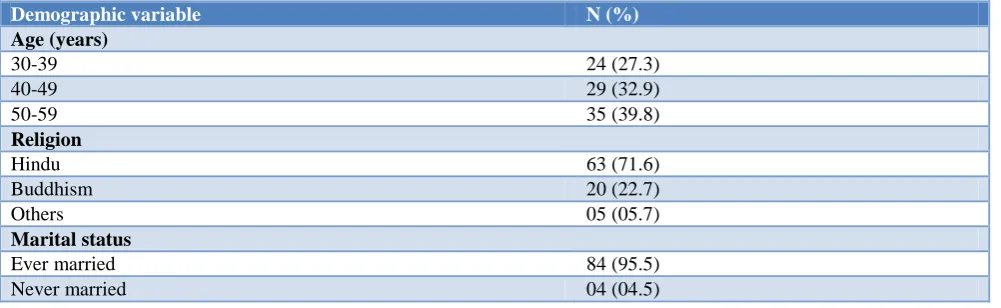
A total of 88 women were approached and interviewed. None of the women approached refused to participate. However a convenient time had to be mutually decided for the interview. Age of respondents ranged between 30 to 59 years with mean age of 45.3 years and a standard deviation of 8.25. Amongst the 84 ever-married women, 76.2%, were currently living with spouse. Religion, educational status, nature of work, duration of employment in institute and socio-economic class of the women is mentioned in Table 1.
Table 1: Demographic profile of the women (n=88).
Demographic variable N (%)
Age (years)
30-39 24 (27.3)
40-49 29 (32.9)
50-59 35 (39.8)
Religion
Hindu 63 (71.6)
Buddhism 20 (22.7)
Others 05 (05.7)
Marital status
Ever married 84 (95.5)
Never married 04 (04.5)
Demographic variable N (%)
Educational status
Illiterate 04 (4.5)
Studied between 1st to 4th standard 05 (5.7) Studied between 5th to 7th standard 18 (20.5) Studied between 8th to 10th standard 15 (17) Studied between 11th to 12th standard 07 (8) Studied between 13th to 15th standard 10 (11.4)
Master’s degree 16 (18.2)
Professional course 13 (14.8)
Nature of work
Comes in contact with patient 50 (56.8)
No contact with patient 38 (43.2)
Duration of employment (years)
<1 05 (5.7)
1-2 08 (9.1)
3-5 08 (9.1)
> 5 67 (76.1)
Socio-economic status (Modified B.G. Prasad classification, 2019)
Social class I 48 (54.5)
Social class II 0
Social class III 15 (17.1)
Social class IV 25 (28.4)
Social class V 0
Table 2: Knowledge amongst women about breast cancer disease- symptoms, risk factors and screening methods.
Minimum Score
Maximum score
Mean
Score SD SEM
Mean confidence intervals
Knowledge about symptoms 0 7 2.557 1.173 0.125 2.311–2.802
Knowledge about risk factors 0 10 3.431 1.388 0.148 3.141–3.721
Knowledge about methods for breast
cancer checkup 0 3 1.386 0.615 0.065 1.257–1.514
Overall score 0 20 7.375 2.446 0.261 6.864–7.886
SD:standard deviation; SEM: standard error of mean.
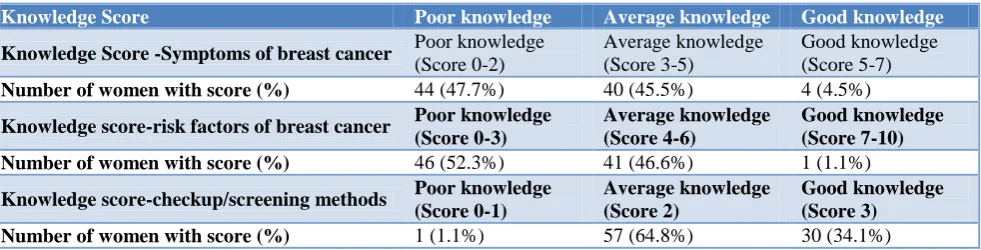
Table 3: Knowledge of women regarding symptoms and risk factor of breast cancer and methods of health checkup for breast cancer.
Knowledge Score Poor knowledge Average knowledge Good knowledge
Knowledge Score -Symptoms of breast cancer Poor knowledge
(Score 0-2)
Average knowledge (Score 3-5)
Good knowledge (Score 5-7)
Number of women with score (%) 44 (47.7%) 40 (45.5%) 4 (4.5%)
Knowledge score-risk factors of breast cancer Poor knowledge (Score 0-3)
Average knowledge (Score 4-6)
Good knowledge (Score 7-10)
Number of women with score (%) 46 (52.3%) 41 (46.6%) 1 (1.1%)
Knowledge score-checkup/screening methods Poor knowledge (Score 0-1)
Average knowledge (Score 2)
Good knowledge (Score 3)
Number of women with score (%) 1 (1.1%) 57 (64.8%) 30 (34.1%)
Knowledge of breast cancer was assessed on three domains; awareness about symptoms; awareness about the risk factors; and awareness about methods for screening of breast cancer. Three-fourth women (75%) had heard about breast cancer. Most of them obtained the information from doctors (36.4%), family and friends (19.3%), television (17.1%). Thirty seven (42%) women
had said they had not heard about breast cancer also when asked about symptoms cited lump in breast as a symptom. Risk factors of breast cancer cited by women included not breast-feeding (31.8%); addictions (13.6%); age above
30-35 years (11.4%); family history of breast cancer (8%). Wearing an ill fitted bra or padded bra (4.5%) was also thought to be one of the reasons for breast cancer. However 43.8% women said that they do not know the risk factors.
Table 4: Breast cancer screening practices–clinical breast examination and mammography in women above 40 years of age (n=64).
Clinical breast examination Mammography
N (%) N (%)
Doing examination 18 (28.1) 06 (9.4)
Doing examination as per recommendation (clinical breast
examination–annually; mammography–biennial) 07 (10.9) 01 (1.6)
Women who have ever undergone screening in the past five
years 17 (26.6) 06 (9.4)
Women who have ever undergone screening in the past five
years atleast once 11 (17.2) 05 (7.8)
Women who have ever undergone screening in the past five
years atleast twice 05 (7.8) 0 (0)
Women who have ever undergone screening in the past five
years atleast thrice 01 (1.6) 01 (1.6)
Table 5: Practice of breast cancer screening and knowledge score
Breast cancer screening method No. of women with knowledge score on symptoms of breast cancer
Poor knowledge (n=44) Average knowledge (n=40) Good knowledge (n=4)
No. doing mammography (%) 2 (4.5) 3 (7.5) 1 (25)
No. doing CBE (%) 6 (13.6) 14 (35) 2 (50)
No. doing SBE (%) 16 (36.4) 30 (75) 1(25)
Breast cancer screening method No. of women with knowledge score on risk factors of breast cancer
Poor knowledge (n=46) Average knowledge (n=41) Good knowledge (n=1)
No. doing mammography (%) 3 (6.5) 3 (7.3) 0
No. doing CBE (%) 9 (19.6) 13 (31.7) 0
No. doing SBE (%) 23 (50) 25 (60.9) 1 (100)
Breast cancer screening method No. of women with knowledge score on breast cancer screening methods Poor knowledge (n=58) Average knowledge (n=25) Good knowledge (n=5)
No. doing mammography (%) 3 (5.2) 1 (4) 2 (40)
No. doing CBE (%) 11 (20.7) 6 (24) 4 (80)
No. doing SBE (%) 28 (48.3) 16 (66.7) 5 (100)
Women who responded affirmatively to question on measures for self-protection, said, women could undergo health checkup by doctor (59.1%), do regular SBE (19.3%); breast feed their children (11.4%); and not have any addictions (8%). Breast cancer was thought to be curable by 59.1% women. However 17% said that they had no idea about the measures to be taken for protecting themselves against breast cancer.
97.7% women felt that it was important for women to undergo regular checkup for breast cancer, while only 76.1% felt that they themselves should undergo a checkup. Fifteen women who did not want to undergo checkup stated that they did not have any problem and therefore it was not necessary to undergo checkup.
Women cited that health checkup by physician (81.8%), self-breast examination (38.6%), and Mammography (21.6%) are the modalities for checkup. The age for checkup according to the women is 18-30 years (45.5%), 31-39 years (17.1%), and 40-49 years (32.9%). A woman should undergo checkup monthly (10.2%), quarterly (11.4%), six monthly (37.5%), yearly (26%) as opined by the women.
Twenty-two (25%) women had ever undergone CBE. Of the 22 women, who had done CBE, four women were below 40 years of age. Seventeen women did CBE in the past five years. Seven women aged 40 years and above have undergone CBE in the past one year (Table 4). Regular annual clinical breast examinations were not practiced by any of the women. Twenty-seven women reported to have heard of Mammography. Only six women have undergone mammography, of whom only one appears to be practicing biennial screening. All of them reported to have mammography done in the past five years. Table 4 shows breast cancer screening practices (clinical breast examination and mammography) among women aged 40 years and above. SBE was reported to being practiced by 49 (55.7%) women, but only five (5.6%) of them were doing it monthly. The remaining 44 (89.8%) women did SBE, as and when they remembered. Table 5 shows the breast cancer screening
practices among women with varying levels of knowledge. Eight women were detected with a problem, when they underwent clinical breast examination or mammogram, of whom only one did not take treatment. Four women had lump; two women said they had a lump during breastfeeding; one had fibrosis and one had a boil/abscess. All of them reported that their health problem had resolved and currently none of them had any problem.
It was observed that the following risk factors were not found in the study group: history of breast cancer in the past, not breastfeeding the child, alcohol addiction. Though all women with a child have breastfed their children, the proportion breastfeeding for less than 2 years was 61%. Table 5 shows the number of women with risk factors and the health care practices.
Table 6: Practice of breast cancer screening and presence of risk factors.
Risk factors No. of women who underwent
Mammography Clinical breast examination Self-breast examination
N (%) N (%) N (%)
Unmarried (n=4) - 1 (25) -
Age of marriage >30 years (n=5) - 1 (20) -
Nulliparity (n=7) 1 (14.3) 1 (14.3) -
Age at first pregnancy >30 years
(n=12) 3 (25) 2 (16.7)
Duration of breast feeding <2 years
(n=47) 1 (2.1) 8 (17) 2 (4.3)
Use of oral contraceptive pills for
more than 5 years (n=1) - - -
Age at menarche <12 years (n=4) - - 1 (25)
No physical activity or less that 150
minutes per week (n=76) 1 (1.3) 7 (9.2) 1 (1.3)
Family history of breast cancer (n=4) 1 (25) 1 (25) -
DISCUSSION
In the present study 75% had heard about breast cancer which was higher than that reported by Shreshta (30%) and Tripathi et al (34.88%).11,12 The higher awareness levels could be because the women were working in health care institutes and are likely to have heard it from the doctors and other health care providers in the institute. In another study conducted in hospital setting amongst patients attending surgery outpatient department, 95% had heard about breast cancer.13
Though the proportion of women who heard about breast cancer was high in our present study, only 45.5% had average knowledge and 4.5% had good knowledge. In a community based study, 8.1% were reported to have good knowledge; and 45.3% average knowledge.14 In a study conducted in teachers in Delhi, 92.7% were aware of atleast one sign and symptom.15 In present study 66.1% reported breast lump as a sign of breast cancer, which was much higher than that reported by 33.45% rural women.12 Awareness levels in teachers seems to be higher that
general population as seen in the studies where 90.2% and 83.3% teachers reported lump in breast as a sign of cancer.15,16 The study in a surgery outpatient department in Mumbai reported the patients could enumerate atleast one symptom of breast cancer and 40% of the patient knew atleast five symptoms of breast cancer.13 Studies have found that knowledge levels were associated with age, marital status, education and social class/income.12,14 This probably explains why in the present study the knowledge levels are higher than general population but less than the teachers.
The present study findings showed doctors as major source of information, followed by friends as compared to the study in hospital patients where friends were a major source of information.13 The difference observed could be due to the fact that women were all employees of a tertiary care hospital and interact with doctors much more than other groups of population.
the finding of Tripathi et al.12 Other studies have reported much higher figures as observed in the study on patients in Mumbai hospital (42.5%), and teachers (58-65.3%).12,13,15,16 Not breastfeeding as a risk factor for breast cancer was reported by 7.69% of college teachers, 12.81% of rural women, and 88.8% patients, in contrast to 31.8% women in the present study.12,13,16 Awareness about the other risk factors, was low or absent in the present study as against the finding in other studies which have cited increasing age, obesity, use of oral contraceptive pills, and nulliparity.13,16,17
Awareness about self-breast examination (38.6%) was similar to the findings of the studies conducted in Delhi, Varanasi and Mumbai.15,17,18 The proportion of women stating clinical breast examination (81.8%) as a modality for checkup was similar to the study conducted in teachers.15 Knowledge about mammography was better in the present study than the community women in urban (16.6% -19.1%)and rural areas (1.78%) but poorer than the study in working population in Delhi(99%).12,14,17,19 Correct age and frequency of doing mammography was known to 11.8% and 21.6% of women respectively in a study by Khokhar.19
Regular SBE was being practiced only by 5.6% in the present study as compared to other studies, which reported 11-19%.13,16,17,20 Proportion of women reported as undergoing CBE varied from as low as zero percent by teachers in Delhi,and 1.42% by rural women in sharp contrast to 35% reported in the present study.12,15 However proportion of women doing regular CBE even in the present study was poor. Mammography was done by 6.8% women in the present study similar to the findings of Tripathi et al.12 However the results of the present study are much lower as compared to the study in Delhi in working women (16.5%).5 The difference could be due to the knowledge levels, accessibility and cost of mammography. The present study reveals that breast cancer screening practices increases with knowledge levels.
CONCLUSION
Three fourths of the women had heard about breast cancer, but knowledge about symptoms was in general poor. Lump in breast was the most commonly cited symptom. Awareness about risk factors was poor. However women were comparatively better aware about measures to protect themselves from breast cancer but only three fourth said that they needed to undergo checkup. Overall proportion of women undergoing regular mammography/ clinical breast examination and self-breast examination was poor. However the proportion undergoing regular breast cancer screening practices was higher in those with average and good knowledge. Creating awareness amongst hospital employees will increase the utilization of breast cancer screening services by the employees.
Funding: No funding sources Conflict of interest: None declared
Ethical approval: The study was approved by the Institutional Ethics Committee
REFERENCES
1. GLOBOCAN 2012: Estimated Incidence, Mortality and Prevalence Worldwide in 2012. Available from http://gco.iarc.fr/today/fact-sheets-populations. Accessed on 2nd June 2019.
2. Centers for Disease Control and Prevention. What are the risk factors for breast cancer. Available at https://www.cdc.gov/cancer/breast/basic_info/risk_f actors.htm. Accessed on 2nd June 2019.
3. Kakarala M, Rozek L, Cote M, Liyanage S, Brenner D. Breast cancer histology and receptor status characterization in Asian Indian and Pakistani women in the U.S. - a SEER analysis. BMC Cancer. 2010;10:191.
4. Sandhu DS, Sandhu S, Karwasra RK, Marwah S. Profile of breast cancer patients at a tertiary care hospital in north India. Indian J Cancer. 2010;47:16-22.
5. Chopra B, Kaur V, Singh K, Verma M, Singh S, Singh A. Age shift: Breast cancer is occurring younger age groups – Is it true? Clin Cancer Investig J. 2014;3:526-9.
6. Gupta S. Breast cancer: Indian experience, data, and evidence. South Asian J Cancer. 2016;5(3):85-6. 7. Singh S, Shrivastava JP, Dwivedi A. Breast cancer
screening existence in India: A non-exisitng reality. Indian J Med Paediatr Onco. 2015;36(4):207-9. 8. Dean AG, Sullivan KM, Soe MM. OpenEpi: Open
Source Epidemiologic Statistics for Public Health, Version. Available at www.OpenEpi.com. Accessed on 2nd June 2019.
9. Pandey VK, Aggarwal P, Kakkar R. Modified BG Prasad Socio-economic Classification, Update – 2019. Indian J Comm Health. 2019;31(1):123-5. 10. Strobe Statement — Checklist of items that should
be included in reports of cross-sectional studies. Available at http://www.equator-network.org/wp-content/uploads/2015/10/STROBE_checklist_v4_cr oss-sectional.pdf. Accessed on 2nd June 2019. 11. Shrestha K. Breast cancer knowledge and screening
practice among women visited to KIST medical college. Nepal Med Coll J. 2012;14(4):308-11. 12. Tripathi N, Kadam YR, Dhobale RV, Gore AD.
Barriers for early detection of cancer amongst Indian rural women. South Asian J Cancer. 2014;3(2):122-7.
13. Ahuja S, Chakrabarti N. To Determine The Level Of Knowledge Regarding Breast Cancer And To Increase Awareness About Breast Cancer Screening Practices Among A Group Of Women In A Tertiary Care Hospital In Mumbai, India. Internet J Public Health. 2009;1(1).
utilization of mammogram among women in selected villages of Udupi district, Karnataka. NUJHS. 2014;4(4):ISSN 2249-7110.
15. Khokhar A. Level of Awareness Regarding Breast Cancer and its Screening amongst Indian Teachers. Asian Pac J Cancer Prev. 2009;10(2):247-50. 16. Shankar A, Rath GK, Roy S, Malika A, Bhandari R,
Kishor K, et al. Level of Awareness of Cervical and Breast Cancer Risk Factors and Safe Practices among College Teachers of different states in India: Do awareness Programmes have an Impact on Adoption of Safe Practices? Asian Pac J Cancer Prev. 2015;16(3):927-32.
17. Paul S, Solanki PP, Shahi UP, Srikrishna S. Epidemiological Study on Breast Cancer Associated Risk Factors and Screening Practices among Women in the Holy City of Varanasi, Uttar Pradesh, India. Asian Pac J Cancer Prev. 2015;16(18):8163-71.
18. Shinde SD, Kadam SB. Breast cancer awareness among women in Vikhroli: a suburban area of Mumbai, Maharashtra, India. Int J Community Med Public Health. 2016;3(8):2281-6.
19. Khokhar A. Study on knowledge, experiences and barriers to mammography among working women from Delhi. Indian J Cancer. 2015;52(4):531-5. 20. Parsa P, Kandiah M, Parsa N. Factors associated
with breast self-examination among Malaysian women teachers. East Mediterr Health J. 2011;17:509-16.