http://www.ijcmph.com pISSN 2394-6032 | eISSN 2394-6040
Original Research Article
Factors affecting breastfeeding techniques among postnatal mothers:
an experience in a tertiary care centre
Shubhra Agarwal Gupta
1, Mini Sharma
1*, Abha Ekka
2, Nirmal Verma
1INTRODUCTION
Mothers milk provides complete nutrition to infants up to six month of life and after 6 months with complementary foods up to 2 years of age.1 Mothers milk improves child survival by reducing the mortality and improved growth and development and also protecting the child from insulin dependent diabetes mellitus, inflammatory bowel disease, coeliac disease and lymphoma.2,3
Effective breast feeding depends on correct positioning and attachment which in turn result in effective suckling via increasing the more milk production and release.4 In other words, Improper positioning of mother, incorrect attachment of baby to the breast may result in ineffective suckling and overall responsible for lactation failure and breastfeeding problems. Although breastfeeding is a
natural phenomenon, effective breastfeeding can be a complex task for the mother-infant units. Several factors can be used to measure breastfeeding effectiveness, inspite of mother's correct positioning and attachment of neonates to the mothers breast, some maternal and neonatal factors associated with breastfeeding techniques include age of babies, race, parity, gestation, birth weight of babies, younger mothers (<20 years old), having more children, cesarean section delivery, preterm infants and low birth weight.5Many different studies have found that early postnatal lactation support on correct breastfeeding technique results in effective suckling, longer duration of breastfeeding with reduction of breastfeeding problems.
5-14
However, little literature is available on Chhattisgarh related to factors associated with breast feeding technique. Hence, in the present study an effort was done to know the association of the maternal and infant
ABSTRACT
Background: Large number of factors related to mother and neonates can affects breastfeeding technique. Therefore, the main objective of this study was to know the association of maternal and neonatal characteristics that can affect correct breastfeeding techniques after intervention among post natal mothers admitted in a tertiary care centre.
Methods: An institutional-based pre and post interventional study design was used. 414 lactating mothers were contacted during study period.
Results: It was found that parity, time of delivery, mode of delivery, birth weight were statistically significantly associated with correct breast feeding technique.
Conclusions: This study highlights that correct breastfeeding technique depends on various factors related to mother and neonate.
Keywords: Breast feeding technique, Postnatal mothers, Tertiary care center
Department of Community Medicine, 1Pt. Jawahar Lal Nehru Memorial Medical College, Raipur, 2Government Medical college, Ambikapur, Chhattishgarh, India
Received: 14 April 2019
Accepted: 03 June 2019
*Correspondence:
Dr. Mini Sharma,
E-mail: [email protected]
Copyright: © the author(s), publisher and licensee Medip Academy. This is an open-access article distributed under the terms of the Creative Commons Attribution Non-Commercial License, which permits unrestricted non-commercial use, distribution, and reproduction in any medium, provided the original work is properly cited.
characteristics with breastfeeding techniques after intervention.
METHODS
A pre and post interventional study was carried out in post natal ward of obstetrics and gynaecology department of Dr. BRAM hospital, Raipur, Chhattisgarh, India from August to September 2014. This study comprised of 414 babies both preterm and term who were born during the study period (immediate postnatal period) at Dr. BRAM hospital, Raipur with their mothers as mother –neonate units, not having any congenital problems or medical problems as well. Mother was informed about the purpose of study. prior to data collection informed verbal consent was taken from every post natal mothers. For assessment of breastfeeding positioning and attachment pre and post intervention (education and support) was done among study subjects. Institutional ethic committee approval was taken before stating the data collection.The concerned authorities were explained about the nature of study and permission was taken.
The information on the maternal and neonatal characteristics like age, education, economic status, parity, birth weight of their babies, breast problem, preterm/full term etc. was obtained by using pre-designed, pre-tested semi structured questionnaire.
For assessment of breastfeeding positioning and attachment
Observation was doneby trained and qualified persons in IMNCI guidelines while mother feeding their baby on first day for 4 minutes and then they recorded the babies positioning and attachment to the breast according to IMNCI guidelines, later, irrespective of the correct or incorrect positioning or attachment of breast feeding technique, demonstration and education (intervention) of correct technique among all the mothers were done and on next day second assessment of correct positioning and attachment of breastfeeding was done. Positioning at the breast has been defined as the relationship between the baby’s body and the mother’s, whereas attachment is the relationship between the baby’s mouth and the mother’s breast.15
The following criteria of positioning (mother and neonates), attachment and during breastfeeding based on IMNCI criteria was adopted.
Correct body positioning criteria
I)Baby neck and body straight, II) baby close to mother, III) baby turn toward mother, IV) baby whole body supported by mother.
Correct baby’s attachment criteria
I) Chin touching breast, II) mouth wide and open, III) lower lip turned out, IV) upper areola more visible.
Statistical analysis
The data were analyzed by using the Microsoft excel. To test the association between maternal and neonatal characteristics with breastfeeding technique chi-square test was applied. A result with a p value of less than 0.05 was considered as statistically significant.
Table 1: Socio-demographic characteristics of study subjects (n=414).
Characteristics N (%)
Mothers age (in years)
<23 232 (56) >23 182 (44)
Education Primary school 178 (43) >Primary school 236 (57)
Working status Housewife 385 (93.1)
Working 29 (6.9)
Religion Hindu 398 (96.2) Muslim 16 (3.8)
Residence Urban 295 (71.3)
Rural 119 (28.8)
Types of family Nuclear 142 (34.3)
Joint 272 (65.7)
Parity Primigravida 228 (55.1)
Multigravida 186 (44.9)
Time of delivery Term 381 (92)
Preterm 33 (8)
Mode of delivery
Normal/assisted
vaginal delivery 266 (64.3) Caesarean section 148 (35.7)
Sex of baby Male 193 (46.6) Female 221 (53.4)
Birth weight Low birth weight 97 (23.4) Normal weight 317 (76.6)
Birth order 1 228 (55.1) >2 147 (35.5)
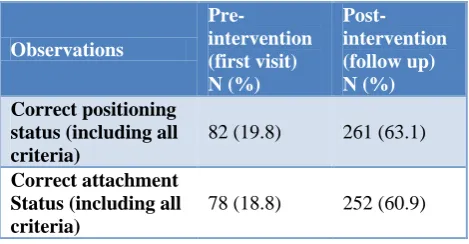
Table 2: Assessment of breast positioning and attachment before and after intervention by observing
study subjects (n=414).
Observations
Pre-intervention (first visit) N (%)
Post-intervention (follow up) N (%)
Correct positioning status (including all criteria)
82 (19.8) 261 (63.1)
Correct attachment Status (including all criteria)
78 (18.8) 252 (60.9)
RESULTS
Only 57% mothers were educated beyond the primary school. 93.1% mothers were housewife. 55.1% mothers were primigravida and 44.9% were multigravida mothers, only 3.2% neonates were preterm. 76.6% neonates had normal birth weight (more than 2.5 kg) and 23.4% had low birth weight (more than 2.5 kg). Normal/assisted vaginal delivery (64.3%) and caesarean section (35.7%). 85.3% babies had not taken prelacteal fed and colostrums were fed to 83.6% of the babies. 23.4% neonates were
low birth weight (Table 1). It was noted that correct body positioning status was found only in 19.8% mothers during pre-intervention, after post intervention 63.1% mother were practising the correct body position. Similarly correct attachment status was found only in 18.8% mothers during pre-intervention, after post intervention 60.9% mother were practising the correct body position (Table 2).
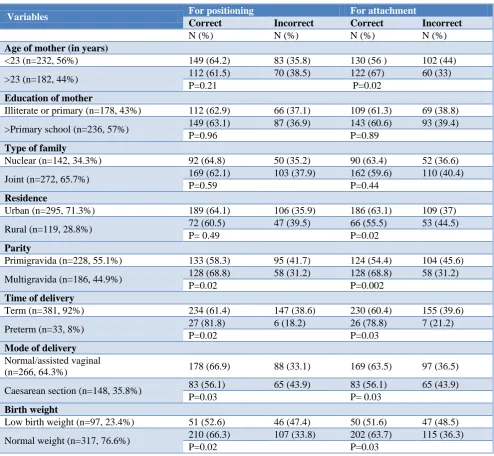
Table 3: Associations of maternal and infant characteristics with post interventional breastfeeding technique (n=414).
Variables For positioning For attachment
Correct Incorrect Correct Incorrect
N (%) N (%) N (%) N (%)
Age of mother (in years)
<23 (n=232, 56%) 149 (64.2) 83 (35.8) 130 (56 ) 102 (44) >23 (n=182, 44%) 112 (61.5) 70 (38.5) 122 (67) 60 (33)
P=0.21 P=0.02
Education of mother
Illiterate or primary (n=178, 43%) 112 (62.9) 66 (37.1) 109 (61.3) 69 (38.8) >Primary school (n=236, 57%) 149 (63.1) 87 (36.9) 143 (60.6) 93 (39.4)
P=0.96 P=0.89
Type of family
Nuclear (n=142, 34.3%) 92 (64.8) 50 (35.2) 90 (63.4) 52 (36.6) Joint (n=272, 65.7%) 169 (62.1) 103 (37.9) 162 (59.6) 110 (40.4)
P=0.59 P=0.44
Residence
Urban (n=295, 71.3%) 189 (64.1) 106 (35.9) 186 (63.1) 109 (37) Rural (n=119, 28.8%) 72 (60.5) 47 (39.5) 66 (55.5) 53 (44.5)
P= 0.49 P=0.02
Parity
Primigravida (n=228, 55.1%) 133 (58.3) 95 (41.7) 124 (54.4) 104 (45.6) Multigravida (n=186, 44.9%) 128 (68.8) 58 (31.2) 128 (68.8) 58 (31.2)
P=0.02 P=0.002
Time of delivery
Term (n=381, 92%) 234 (61.4) 147 (38.6) 230 (60.4) 155 (39.6) Preterm (n=33, 8%) 27 (81.8) 6 (18.2) 26 (78.8) 7 (21.2)
P=0.02 P=0.03
Mode of delivery
Normal/assisted vaginal
(n=266, 64.3%) 178 (66.9) 88 (33.1) 169 (63.5) 97 (36.5) Caesarean section (n=148, 35.8%) 83 (56.1) 65 (43.9) 83 (56.1) 65 (43.9)
P=0.03 P= 0.03
Birth weight
Low birth weight (n=97, 23.4%) 51 (52.6) 46 (47.4) 50 (51.6) 47 (48.5) Normal weight (n=317, 76.6%) 210 (66.3) 107 (33.8) 202 (63.7) 115 (36.3)
P=0.02 P=0.03
Parity,time of delivery, mode of delivery, birth weight were found to be significantly associated with correct positioning and attachment. Similarly, age of mother and residence had statistically significant association with correct attachment. Significantly more number of correct positioning and attachment were found to be seen with multigravida mothers’, with preterm babies, with normal
DISCUSSION
The study was undertaken to know the association of maternal and neonatal characteristics with breastfeeding technique in a tertiary care. In the current study, after intervention, statistically significant (P=0.02) correct attachment were reported in younger mothers (>23 years of age). However, correct body positioning is reported more in older mothers (>23 years of age). Although, study done by Goyal et al found that younger mothers (<20 years) had shown insignificant association between the mother’s age and correct positioning and attachment.4
However, contrast result is reported in a study done by Arpit et al in which poorer attachment was observed in younger mothers (<25 years of age).16
After intervention, correct body positioning were reported among study subjects who studied more than primary school. However, correct attachment were reported in study subjects who were studies up to primary school or illiterate and the education status had insignificant association with both body positioning and attachment. In a study done by Tiruye et al in Eastern Ethiopia showed in their study that effective breastfeeding technique is more in mothers who were educated secondary school education and above.17 This was in accordance with a study done in Indian East Delhi.18
In our study, more than two third (68.8%) multigravida mother had shown statistically significant association between correct poisoning and attachment as compared to primigravida. This result is consistent with the results done by Arpit et al, Rahim et al and Goyal et al in which poor positioning and attachment were found among primipara.4,16,19 However, contrast result was found in a study done by Gupta et al from North India.20
We found that, preterm babies had shown statistically significant correct positioning and attachment after intervention. Arpit et al and Rahim et al reported that preterm babies had poor positioning, attachment and suckling compared to full term babies.16,19 However Goyalet al did not find any association between poor positioning and preterm babies however had shown significant association between poor attachment and preterm babies.4
In our study, low birth weight babies were significantly associated with incorrect positioning and incorrect attachment after intervention. Goyal et al also narrates the similar results had shown significant association between poor attachment and Low birth weight babies in their study.4 Similar result is found in a study done in Gujrat.16 In the present study, correct body positioning and attachment were found more with normal or assisted delivery as compared to caesarean delivery and the association was statistically significant (P=0.03), but study done by Nagendra et al showed no association of
mode of delivery with breast feeding technique.21 The reason could be fatigue and maternal pain after delivery.
CONCLUSION
To conclude, that inspite of giving health education related to correct breastfeeding technique several other factors must be considered which were directly or indirectly related to breastfeeding technique.
Funding: No funding sources Conflict of interest: None declared
Ethical approval: The study was approved by the Institutional Ethics Committee
REFERENCES
1. Elyas L, Mekasha A, Admasie A, Assefa E. Exclusive Breastfeeding Practice and Associated Factors among Mothers Attending Private Pediatric and Child Clinics, Addis Ababa, Ethiopia: A Cross-Sectional Study. Int J Pediatr. 2017;2017.
2. UNICEF. Division of Communication. Tracking progress on child and maternal nutrition: a survival and development priority. UNICEF; 2009.
3. Booth I. Does the duration of breast feeding matter? Maybe—but not enough to counter current support for breast feeding. BMJ. 2001;322(7287):625–6. 4. Ingle GK, Malhotra C. Integrated management of
neonatal and childhood illness: an overview. Indian J Community Med. 2007;32(2):108.
5. Lau Y, Htun TP, Im Lim P, Ho-Lim S, Klainin-Yobas P. Maternal, infant characteristics, breastfeeding techniques, and initiation: structural equation modeling approaches. PloS one. 2015;10(11):e0142861.
6. Ingram J, Johnson D, Greenwood R. Breastfeeding in Bristol: teaching good positioning, and support from fathers and families. Midwifery. 2002;18(2):87-101.
7. Duffy EP, Percival P, Kershaw E. Positive effects of an antenatal group teaching session on postnatal nipple pain, nipple trauma and breast feeding rates. Midwifery. 1997;13(4):189-96.
8. Su LL, Chong YS, Chan YH, Chan YS, Fok D, Tun KT, et al. Antenatal education and postnatal support strategies for improving rates of exclusive breast feeding: randomised controlled trial. BMJ. 2007;335(7620):596.
9. Henderson A, Stamp G, Pincombe J. Postpartum positioning and attachment education for increasing breastfeeding: a randomized trial. Birth. 2001;28(4):236-42.
10. Righard L. Are breastfeeding problems related to incorrect breastfeeding technique and the use of pacifiers and bottles? Birth. 1998;25(1):40-4. 11. Coca KP, Gamba MA, Sousa e Silva RD, Abrão
12. Dongre AR, Deshmukh PR, Rawool AP, Garg BS. Where and how breastfeeding promotion initiatives should focus its attention? A study from rural Wardha. Indian J Community Med. 2010;35(2):226. 13. Carvalhaes MA, Corrêa CR. Identification of difficulties at the beginning of breastfeeding by means of protocol application. Jornal de pediatria. 2003;79(1):13-20.
14. Shimoda GT, Silva IA, Santos JL. Characteristics, frequency and factors present in the occurrence of nipple lesion in nursing mothers. Rev Bras Enferm. 2005;58(5):529-34.
15. Inch S. Letters. Br J Midwifery. 2003;11(3):148. 16. Prajapati AC, Chandwani H, Rana B, Sonaliya KN.
A community based assessment study of positioning, attachment and suckling during breastfeeding among 0-6 months aged infants in rural area of Gandhinagar district, Gujarat, India. Int J Community Med Pub Health. 2016;3(7):1921-6. 17. Tiruye G, Mesfin F, Geda B, Shiferaw K.
Breastfeeding technique and associated factors among breastfeeding mothers in Harar city, Eastern Ethiopia. Int Breastfeeding J. 2018;13(1):5.
18. Parashar M, Singh S, Kishore J, Patavegar BN. Breastfeeding Attachment and Positioning
Technique, Practices, and Knowledge of Related Issues Among Mothers in a Resettlement Colony of Delhi. ICAN. 2015;7(6):317-22.
19. Kronborg H, Væth M. How are effective breastfeeding technique and pacifier use related to breastfeeding problems and breastfeeding duration? Birth. 2009;36(1):34-42.
20. Gupta M, Aggarwal AK. Feasibility study of IMNCI guidelines on effective breastfeeding in a rural area of North India. Indian Assoc Prev Soc Med. 2008;33(3):201.
21. Nagendra K, Shetty P, Rudrappa S, Jaganath S, Nair R. Evaluation of breast feeding techniques among postnatal mothers and effectiveness of intervention: Experience in a tertiary care centre. Sri Lanka J Child Health. 2017;46(1):39-43.