Original Research Article
Study of diarrheal disease among under five children in a rural
community: telephone based follow up study
Vishesh R. Lohakpure, Vinod L. Vedpathak*
INTRODUCTION
Diarrhoea is a major cause of mortality among the under-five children in India and is considered an important public health problem.1 Diarrhoeal diseases are a group of diseases in which the predominant symptom is diarrhoea. Acute diarrhoeal diseases are one of the leading causes of morbidity and mortality in the developing countries and a major contribution of malnutrition especially among infants and children under 5 years of age, particularly those between 6 months and 2 years. Acute diarrhoea is rivaled in importance only by respiratory infection as a cause of morbidity on a worldwide scale.2
All children in the world suffer from diarrhoeal disease at some time. For a majority there will be one or a few acute attacks of watery diarrhoea followed by spontaneous and complete recovery. Unfortunately for many children there may be repeated attacks, some of which are serious and result in death.3
Approximately two-thirds of the world population live in the developing countries characterized by a lack of potable drinking water, improper means of disposal of human faecal waste, intense crowding in houses and often primitive standards of personal hygiene. Under such conditions of poverty, under development and lack of
ABSTRACT
Background: Acute diarrhoeal diseases are one of the leading causes of morbidity and mortality in the developing
countries and a major contribution of malnutrition especially among infants and children under 5 years of age. Approximately two-thirds of the world population live in the developing countries characterized by a lack of potable drinking water, improper means of disposal of human faecal waste, intense crowding in houses and often primitive standards of personal hygiene. In India, diarrhoeal diseases are a major public health problem among children under 5 years. The objective of the study was to estimate number of episodes of diarrhoea in children under five years in a rural area.
Methods: Community based longitudinal study conducted among 622 children.
Results: The overall incidence of diarrhoeal disease was found to be 2.11 episode/child/year. It was observed that the
diarrhoeal disease morbidity decreased with the increasing age of the child. Diarrhoeal disease morbidity increased in children from lower socioeconomic status 2.32 episodes/child/year.
Conclusions: The lower incidence rate has been found in those children who were better nourished, had received immunization and had been breast fed. Hence there is a need to make efforts to still further improve and sustain immunization coverage, give importance to the nutrition of the children, encourage the mothers to breast feed their children for at least 2 years.
Keywords: Diarrhoeal diseases, Under five children, Telephone, Follow up
Department ofCommunity Medicine, SRTR GMC Ambajogai, Maharashtra, India
Received: 19 March 2019
Revised: 06 May 2019
Accepted: 08 May 2019
*Correspondence: Dr. Vinod L. Vedpathak, E-mail: [email protected]
Copyright: © the author(s), publisher and licensee Medip Academy. This is an open-access article distributed under
the terms of the Creative Commons Attribution Non-Commercial License, which permits unrestricted non-commercial use, distribution, and reproduction in any medium, provided the original work is properly cited.
education, the various pathogens that cause diarrhoeal disease are readily transmitted to young children, resulting in an enormous burden of enteric disease. In India, diarrhoeal diseases are a major public health problem among children under 5 years. In health institutions nearly one third of total pediatric admissions are due to diarrhoeal diseases and one fifth of all deaths in indoor pediatric patients are diarrhoea related.4
With these considerations in mind, the present study was undertaken.
Aim and objectives
To estimate number of episodes of diarrhoea in children under five years in a rural area.
To study the risk factors associated with diarrhoea among children under five years.
METHODS
Type of study: Community based longitudinal study.
Study area
The study was conducted in the field practice area of Urban Health Training Centre comes under Dept. of Community Medicine, SRTR GMC Ambajogai, Beed Maharashtra. (March 2017-March 2018).
Study population
All under five children at the time of selection of study subject from house to house survey.
Sample size
To determine the sample size required for the study, the following formula was used:
N=Z2PQ/L2, N=sample size, Z=normal variate (1.96
≅2), P=Prevalence of disease Q=100-P, L=required precision (20% of P).
A pilot study was conducted in a rural study area, among 100 under 5 children to obtain 2 week prevalence of diarrhoeal disease morbidity in the last two weeks, which was found to be 15%. Using the formula calculated sample size 566. By considering 10% sample loss during the study period, 622 children were included in the study. After necessary approval was obtained from the institutional ethical committee sample was taken from the field practice area. All the under five children listed from Anganwadi record and by simple random sampling 622 under five children selected from list and confirmed by house to house visit and data collected and record of follow up kept.
In the study baseline information was obtained within period of one month regarding general particulars of the parents and children and also on birth, immunization history (cross checked from records), breast feeding history and environmental history was taken. Socio-economic status of the family was determined by modified B.G. Prasad’s scale, according All India Consumer’s price index (AICPI). Anthropometric measurement of the child along with general and systemic examination of the each child was carried out. The information was collected from mother/father/ guardian. During these period parent were told about the sign and symptoms of diarrhoeal disease so that they can deliver proper history. Any of the children having acute diarrhoea at the time of visit or had acute diarrhoea in preceding 2 week was taken as case of acute diarrhoea for this study. Contact number of family (any personal mobile no. from any of the family member/landline fixed No.) noted for further follow up on call. If in case of lack of mobile/landline in family then contact number of neighbor sorted out and family were follow up and enquired for any episode of diarrhoea in under five children from neighbor contact no. We contacted family on provided contact number 2 times in a month (in an interval of 15 days) to enquire about diarrhoeal disease so as to count any episode of diarrhoea in last 2 week. Subsequent three follow up home visit were carried out at interval of every 4 months i.e. in month of August, December and April. So total 25 follow up visit including 21 visit on call and 4 home visit (including first baseline data collection) taken to avoid recall bias. At the same time Parents/Guardian of child were also free to contact on mobile number provided in case of child get attack of diarrhoea, in case of due to technical error (mobile signal coverage)/economical reason (unable to recharge) cannot call then in that case they can contacted nearby health care centre to provide information so, all the precaution taken to count each and every episode of diarrhoea. Separate records of each of 622 children were maintained throughout the study.
Meanwhile during these home visit ORS packet distributed to all these houses free of cost (as an incentive) and family were counsel about general sanitary measure and health practices. After the last visit health education on preventive measures of diarrhoeal diseases and hygiene was imparted to all the parents.
Operational definitions
Diarrhoea: Any of the selected children having acute diarrhea at the time of interview or have had acute diarrhea in the preceding 2 weeks was taken as a case of acute diarrhea for this study.
Fully immunized: A child who had received all the vaccines according to national immunization schedule as per his/her age at the time of baseline interview.
Not immunized: A child who had not received any vaccines according to national immunization schedule as per his/her age at the time of baseline interview.
Exclusive breastfeeding: Infant receives only breast milk (including breast milk that has been expressed) and nothing else, except for ORS, medicines and vitamins and minerals.
Nutrition status: The nutritional status was assessed and the grade of malnutrition was calculated on the basis of expected weight for age by plotting in the growth chart as classified by the Indian Academy of Pediatrics
Sanitation: Environmental factors such as methods of sewage and waste disposal, water source and fly nuisance were observed and sanitary condition was classified as Present and Absent as per the guidelines.
Statistical analysis
The collected data were entered into MS-Excel spreadsheets for analysis. Percentages were used in this study to analyze epidemiological variables.
RESULTS
In the present study, 622 under five children were taken up, in which there were 317 (50.96%) boys and 305 (49.04%) girls. 137 (22.03%) were in the age group of 0-6 months while 227 (30-6.5%) in the age group of 37-0-60 months. It was observed that 50.80% children were staying in the families with family size of 6-8. 27.82% and 21.38% children were staying in the families with family size of ≤5 and ≥9 respectively.
In current study maximum number of children belonged to Socio economic status Class III (35.53%). Out of total 50.32% children received exclusive breast feeding. Present study show that 4.34% of children not received immunization while 68.65% & 27.01% of children were fully and partial immunized. Maximum Children were staying in semi pucca houses (49.68%). In the present study, 76.53% of the children were staying in the houses with the facility of sanitation available. Based on IAP classification (weight for age) 46.14% of children were undernourished.
Diarrhoeal disease morbidity decreased with the increasing age of the child. The overall incidence of diarrhoeal disease was found to be 2.11 episodes/child/year. 66.72% of the children had less than three episodes of diarrhoea in the year while 6.59% of the children had five or more than five episodes of diarrhoea in the year. It was observed that 81.15% of all episodes of diarrhoea lasted for ≤3 days while 6.09% of all episodes of diarrhoea lasted for ≥6 days. The average duration per episode of diarrhoea was 2.56 days.
Table 1A: Distribution of diarrhoeal morbidity with sociodemographic characteristic among under five
children.
Variables
No of children (n=622)
No of episode of diarrhoea (n=1315)
Episode/ child/ year
Age wise (in months)
0-6 137 (22.03) 245 (18.63) 1.78 7-11 126 (20.26) 660 (50.19) 5.23 12-36 132 (21.22) 213 (16.2) 1.61 37-60 227 (36.49) 197 (14.98) 0.86 Gender
Boys 317 (50.96) 698 (53.08) 2.2 Girls 305 (49.04) 617 (46.92) 2.02 Family size
≤ 5 173 (27.82) 341 (25.93) 1.97 6–8 316 (50.80) 662 (50.34) 2.09 ≥ 9 133 (21.38) 312 (23.73) 2.34 Socio economic status
Upper (I & II) 205 (32.96) 397 (30.19) 1.93 Middle (III) 221 (35.53) 462 (35.13) 2.09 Lower
( IV & V) 196 (31.51) 456 (34.68) 2.32 Birth weight
Normal 175 (28.14) 328 (24.94) 1.87 Low birth
weight 447 (71.86) 987 (75.06) 2.2 Breast feeding upto 6 months
Yes 313 (50.32) 321 (24.41) 1.53 No 309 (49.68) 994 (75.65) 3.18
Table 1B: Distribution of diarrhoeal morbidity with sociodemographic characteristic among under five
children.
Variables
No of children (n=622)
No of Episode of Diarrhoea (1315)
Episode/ child/ year
Immunization
Fully immunized 427(68.65) 438(33.30) 1.02 Partial immunized 168(27.01) 390(29.66) 2.32 Not immunized 27(4.34) 487(37.04) 18.03 Type of house
Pucca 209(33.6) 411(31.25) 1.97 Semi pucca 309(49.68) 658(50.04) 2.13 Kuchcha 104(16.72) 246(18.71) 2.36 Sanitation
Present 476(76.53) 515(39.16) 1.08 Absent 146(23.47) 800(60.84) 5.48 Nutritional status
Table 2: Seasonal distribution of diarrhoeal episode among under five children.
Season Winter Summer Rainy No. of episode
of diarrhea (%) 442 (33.61)
480 (36.5)
393 (29.89)
No. of children 208 200 180
Episode/
child/year 2.13 2.4 2.18
The highest incidence of diarrhoea was in the summer season (2.40 episodes/child/year) followed by rainy (2.18 episodes/child/year) and winter (2.13 episodes/child/year) season (Table 2).
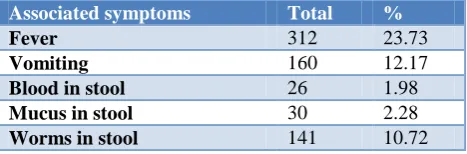
Table 3: Associated symptomps with diarrhoea.
Associated symptoms Total %
Fever 312 23.73
Vomiting 160 12.17
Blood in stool 26 1.98
Mucus in stool 30 2.28
Worms in stool 141 10.72
Table 3 showed that the most common symptom associated with diarrhoea was fever which was present in 23.73% of all episodes of diarrhoea. Blood and mucus in stool was respectively present in 1.98% and 2.28% of the episodes of diarrhoea. 12.17% and 10.72% of the episodes were associated with vomiting and passage of worms in the stool respectively.
DISCUSSION
Overall incidence rate of diarrhoea among under five children was 2.11 episodes/child/year compared to incidence was observed in study conducted by Gupta S et al11 at Jammu was 1.38 episodes/child/year and In a study carried out by WHO & MOHFW New Delhi (1994) in rural and urban areas in 11 states of India, the median diarrhoea incidence adjusted for seasonality varied from 1.5 and 4.7 episodes/child/year in urban and rural areas respectively.4
Diarrhoeal disease morbidity decreased with the increasing age of the child. The incidence of diarrhoea was found to be very high in the first one years of life. In current study incidence among 7-11 months children was 5.23 episodes/child/year similar high incidence was noted by Gupta et al.6 Avachat et al, in their study on recurrent diarrhoea among under five of rural area of Western Maharashtra showed that diarrhoea was more common in the age group of 13-24 months (29.6%) and 25-36 months (23.4%).5 This may be because at this age, weaning foods are introduced and the child is also exposed more to the environmental condition as it starts crawling and walking.
In the present study, the incidence of diarrhoea in both the boys and the girls was found to be 2.2 episodes/child/year and 2.02 episodes/child/year respectively similar finding was noted by Gupta et al at Jammu whereas, Avachat et al and Ghai et al observed in their study, a higher prevalence of diarrhoea among the boys when compared to the girls.5,7,11
Diarrhoeal disease morbidity was higher in children from large families than children from smaller sized families. Overcrowding in the households increases the risk for diarrhoea. Similar finding was noted by Rajesh at Davangere, Karnataka.8
Diarrhoeal disease morbidity increased in children from lower socioeconomic status 2.32 episodes/child/year. These findings are in accordance with finding of Avachat et al.5
It was observed that the diarrhoeal disease morbidity high among low birth weight children i.e. 2.2 episode/child/years compared to normal birth weight children similar finding noted by Stanly et al.9 Infants who were exclusive breast fed (1.53 episodes/child/year) had a lower incidence of diarrhoea than those who were not (3.18 episodes/child/year). Highest morbidity of diarrhoeal disease observed among children who not received immunization (18.03 episode/child/year) compared to partially immunized (2.32 episode/child/ year) and fully immunized children (1.02 episode/child/year).
In the present study, it was observed that diarrhoeal disease morbidity was higher in children living in kachcha houses (2.36 episode/child/year) than children living in semi pucca (2.13 episode/child/year) and pucca houses (1.97 episode/child/year).
No difference in diarrhoeal disease morbidity was observed in the children from households with presence of sanitation (2.24 episode/child/year) and those without it (2.23 episode/child/year). However Avachat et al, find that recurrent diarrhoea were more common in children residing in houses having poor sanitary conditions.5 The normally nourished children had a morbidity of 1.85 episode/child/year compared to malnourished children 2.26 episode /child/year. This enforces the finding of Ghai et al.10 in their study on relationship of under nutrition to diarrhoea in infants and children observed that diarrhoea was twice more frequent in undernourished as compared to normal.
CONCLUSION
efforts to still further improve and sustain immunization coverage, give importance to the nutrition of the children, encourage the mothers to breast feed their children for at least 2 years.
Bringing down the childhood morbidity goes a long way in the development of a nation, hence all efforts in these regards are worth taking.
Recommendation
Education on exclusive breast feeding and weaning should be imparted as soon as the pregnancy gets confirmed. Education should be given to the mother and other members of the family on improvement of domestic and peridomestic sanitation along with proper hand washing practices. Intensifying awareness can be done through mass education programs and the use of the mass media to inform the public. In rural areas, it can also be done through the use of public health officials on a door-to door basis.
Limitation of study
There may be a lack of recall by the mother. Not all factors associated with diarrhoeal disease morbidity could be studied. As the mothers were not very sure of the cause of death, mortality pattern could not be studied.
ACKNOWLEDGEMENTS
I am thankful to my mother for her encouragement and unlimited help during the course of study.
Funding: No funding sources Conflict of interest: None declared
Ethical approval: The study was approved by the Institutional Ethics Committee
REFERENCES
1. Banerjee B, Hazra S, Bandyopadhyay D. Diarrhea management among under fives. Indian Pediatr. 2004;41(3):255–60.
2. Park K. Chapter 5 II.Intestinal Infections. Park’s Textbook of Preventive and Social Medicine. 22nd
ed. Jabalpur: M/s Banarsidas Bhanot; 2013: 200– 207.
3. Cutting Wiliam AM. Diarrhoeal diseases. Diseases of Children in the Subtropics and Tropics. 4th edition. ELBS; 1991: 455–495.
4. Govt.of India. National Child Survival and Safe Motherhood Programme. MCH Division, Department of Family Welfare, Ministry of Health and Family Welfare, New Delhi. 1994.
5. Avachat SS, Phalke VD, Phalke DB, Aarif SMM, Kalakoti P. A crosssectional study of socio- demographic determinants of recurrent diarrhoea among children under five of rural area of Western Maharashtra. Australas Med J. 2011;4(2):72–5. 6. Gupta A, Sarker G, Rout AJ, Mondal T, Pal R. Risk
correlates of diarrhea in children under 5 years of age in slums of bankura, west bengal. J Glob Infect Dis. 2015;7(1):23-9.
7. Ghai OP, Kalra SL, Jaiswal VN. Epidemiology of diarrhea in infants and preschool children in a rural community near Delhi. Indian Pediatr. 1969;6(5):263–71.
8. Subramaniam R. Epidemiology and Incidence of Diarrhea in Children Living in Urban Slums. Dissertation submitted to Kuvempu University.; 1994.
9. Stanly AM, Sathiyasekaran BWC, Palani G. A population based study of acute diarrhoea among children under 5 years in a rural community in south India. 2009;1(1):1–7.
10. Ghai OP, Jaiswal VN. Relationship of undernutrition to diarrhea in infants and children. Indian J Med Res. 1970;58:789–95.
11. Gupta S, Gupta SK, Jamwal DS, Kumar D. Incidence of diarrhea among under-five children in a rural area of Jammu– A longitudinal study. Indian J Matern Child Health. 2011;13(2):1–6.
Cite this article as: Lohakpure VR, Vedpathak VL.