Physically Active Math and
Language Lessons Improve
Academic Achievement: A Cluster
Randomized Controlled Trial
Marijke J. Mullender-Wijnsma, MS,a Esther Hartman, PhD,a Johannes W. de Greeff, MS,a Simone Doolaard, PhD,b,c Roel J. Bosker, PhD,b,c Chris Visscher, PhDa
abstract
OBJECTIVES: Using physical activity in the teaching of academic lessons is a new way oflearning. The aim of this study was to investigate the effects of an innovative physically active academic intervention (“Fit & Vaardig op School” [F&V]) on academic achievement of children.
METHODS: Using physical activity to teach math and spelling lessons was studied in a cluster-randomized controlled trial. Participants were 499 children (mean age 8.1 years) from second- and third-grade classes of 12 elementary schools. At each school, a second- and third-grade class were randomly assigned to the intervention or control group. The intervention group participated in F&V lessons for 2 years, 22 weeks per year, 3 times a week. The control group participated in regular classroom lessons. Children’s academic achievement was measured before the intervention started and after the first and second intervention years. Academic achievement was measured by 2 mathematics tests (speed and general math skills) and 2 language tests (reading and spelling).
RESULTS: After 2 years, multilevel analysis showed that children in the intervention group had significantly greater gains in mathematics speed test (P < .001; effect size [ES] 0.51), general mathematics (P < .001; ES 0.42), and spelling (P < .001; ES 0.45) scores. This equates to 4 months more learning gains in comparison with the control group. No differences were found on the reading test.
CONCLUSIONS: Physically active academic lessons significantly improved mathematics and spelling performance of elementary school children and are therefore a promising new way of teaching.
aCenter for Human Movement Sciences, University Medical Center Groningen, bGroningen Institute for
Educational Research, and cDepartment of Educational Sciences, Faculty of Behavioral and Social Sciences,
University of Groningen, Groningen, Netherlands
Ms Mullender-Wijnsma contributed to the design of study and drafted the initial manuscript; Ms Mullender-Wijnsma and Mr de Greeff acquired the data; Drs Hartman, Doolaard, Bosker, and Visscher and Mr de Greeff participated in the design and critically reviewed the manuscript; and all authors analyzed the data and approved the manuscript as submitted.
This trial has been registered at http:// www. isrctn. com (ISRCTN17021806).
DOI: 10.1542/peds.2015-2743 Accepted for publication Dec 21, 2015
To cite: Mullender-Wijnsma MJ, Hartman E, de Greeff JW, et al. Physically Active Math and Language Lessons Improve Academic Achievement: A Cluster Randomized Controlled Trial. Pediatrics. 2016;137(3):e20152743
WHAT’S KNOWN ON THIS SUBJECT: Physically active academic interventions have been shown to positively affect children’s academic engagement in the short term, but few studies have assessed the effects of prolonged physically active academic interventions on academic achievement.
The development of new ways of teaching and learning to foster children’s academic achievement is an important issue in educational sciences. Recently, programs have been developed that incorporate physical activity into the teaching of academic lesson content.1–7 The
majority of the studies focused on short-term, immediate effects and showed that children’s
academic engagement,1,4,5 academic
motivation,6 and executive
functioning7 were enhanced shortly
after physically active academic lessons. Effects of prolonged intervention periods are largely unknown. A 4-month intervention that integrated physical activity into academic lessons positively influenced the fluid intelligence of children, but no effects were found on language arts, math, and science.8
In another study, positive effects of the 3-year Physical Activity Across the Curriculum project (PAAC) were found on academic achievement: math, reading, and spelling scores improved.2,3 Although it was an
elegant study, the aim of PAAC was not to improve academic
achievement, but to promote physical activity and reduce obesity rates. PAAC coupled academic areas including math, history, geography, language, science, and health with moderate to vigorous physical activity for 90 min per week. Because math and language skills play a key role in children’s educational career and are of great importance for their social and occupational functioning in daily life,9 physical activity should
specifically be incorporated when teaching math and language to optimally improve those skills. We recently developed “Fit & Vaardig op School” (Fit and Academically Proficient at School [F&V]), a new series of lessons in which physical exercise is specifically used when teaching math and language in Dutch elementary schools. An initial 1-year pilot study to improve the program supported the feasibility of the
intervention and indicated that F&V lessons may positively affect reading and math outcomes.10
The F&V intervention is designed to increase academic achievement. During F&V lessons and traditional classroom lessons, similar academic goals are pursued. The difference is that the goals are achieved by different ways of teaching and learning.10 Integrating physical
exercise into visual and auditory academic lesson content may have several benefits. First, sensorimotor information obtained by the body (for example, through physical activity) appears to be an effective aid to learning during childhood.11
Second, it has been found that moderate to vigorous physical activity that immediately increases activity in the brain may enhance attention,12,13 and this might cause
enhanced academic engagement after physically active academic lessons.4,5,14 Because academic
engagement is a key predictor of academic achievement,15 it seems
likely that more time on task during regular lessons (after a physically active academic lesson) might improve academic achievement in the long term. Furthermore, a longer period of regular moderate to vigorous physical activity might cause the brain to change morphologically (develop new cells and blood vessels) and functionally (affect brain cognitive performance).12,16 A study with
7- to 9-year-old children found that functional changes to the brain occurred in children who participated in a 9-month afterschool physical activity program: the children showed improved brain indices of executive control.17
Building on the results of the initial 1-year F&V pilot study,10
we designed a 2-year
cluster-randomized controlled trial to further investigate the effects of the F&V program on the reading, spelling, and math performance of children.
We expected that the intervention would improve children’s academic achievement. Because the main focus of the F&V lessons was on math and language, we specifically expected math and language skills to be improved by the intervention.
METHODS
Participants
The study was conducted within 5 elementary school boards in the northern Netherlands (46 schools). To be included, schools were required to be mainstream schools, and only second- and third-grade classes were eligible to participate. Twelve of the 46 schools agreed to participate. At each school, a second- and third-grade class were randomly assigned to the intervention (n = 249) or the control group (n = 250). Randomization was performed by the Netherlands Central Plan Bureau for Economic Policy. School principals, teachers, parents, children, and researchers were unaware of upcoming assignments. At schools where the second-grade class had been assigned to the intervention, the third-grade class served as control, and vice versa. Written informed consent was obtained from the school principals of the participating schools. The parents/legal guardians were informed before the start of the intervention and were given the option to withdraw their permission for their child to participate at any time. All procedures were approved by the ethics committee of the Center for Human Movement Sciences of the University Medical Center Groningen/University of Groningen.
Sample Size Determination
Based on findings from the PAAC study,2,3 an effect size of 0.44 was
25 children per class (power 0.8, 1-tailed, α = 0.05).18
Intervention
We developed a manual of physically active math and language lessons (F&V lessons). The difficulty of the teaching material was based on the math and language curriculum of second- and third-grade classes in the Netherlands. The lessons were aimed at young schoolchildren because these children were found to be more affected by classroom-based physical activity interventions than older children.19 The intervention
lessons were taught in the classroom during 2 school years, 22 weeks per year, 3 times a week for 20 to 30 min. In each lesson, 10 to 15 min were spent on math activities and 10 to 15 min on language activities. The main focus was on constant practice and repetition. For example, the children jumped on the spot 8 times to solve the multiplication sum “2 × 4.” Each lesson was supported by a presentation on the interactive whiteboard. The physical exercises were aimed at moderate to vigorous intensity.10
Measures
Academic achievement was measured by 2 language tests (reading and spelling) and 2 math tests (speed and general math skills). Children’s (technical) reading ability was determined using the One-Minute Test, which entails the children reading aloud as many words as possible within a minute; this is then repeated with a different set of words. The total number of words read correctly determines the score (from 0 to 232). Test-retest reliability (r = 0.89 to 0.92) and construct validity (r = 0.78 to 0.86) of the One-Minute Test for reading are good.20
The Speed Test–Arithmetic assesses math speed performance. The children have to solve problems as quickly as possible. The test
contains 5 rows of arithmetic sums. The children compute as many sums as possible per row within 1 min. The score is calculated as the total number of tasks solved; the maximum score is 200. Standardization was done on a sample of 4804 elementary schoolchildren from 54 schools in the Netherlands.21
In addition, ability scores on spelling and math were retrieved from a child academic monitoring system (CAMS). This standardized and norm-referenced test battery is administered twice a year by the majority of the elementary schools in the Netherlands. The spelling test has 2 parts. During the first part, the teacher reads out a sentence and repeats a certain word from it; the children then have to write that word correctly. The second part consists of individually identifying misspelled words. The reliability (r = 0.90 to 0.93), construct, and content validity of the spelling test were good.22 The
math test is an individual task that involves number sense, arithmetic, algebra, geometry, time and money, and knowledge of ratios and
fractions. In second and third grades, the test sets great store on solving arithmetic problems; from fourth grade onward, the attention shifts to algebra and knowledge of ratios and fractions.23 The reliability (r = 0.93 to
0.96), construct, and content validity of the math test were good.24
Procedure
Children’s academic achievement was measured before the start of the intervention (T0) at the end of the previous school year (CAMS) and at the beginning of the new school year (One-Minute Test and Speed Test–Arithmetic), after the first intervention year (8 months to 1 year after T0 [T1]), and after the second intervention year (1 year after T1 [T2]). Test administrators were trained to familiarize them with the One-Minute Test and the Speed
Test–Arithmetic. These pretests were individually administered at the schools within 3 weeks. The test administration in the intervention and control groups was done under the same conditions. After the first and second intervention year, the children were posttested in a similar way as the pretesting.
In both intervention years, the intervention group participated in the F&V lessons for 22 weeks, whereas the control group received regular sedentary classroom lessons. The total instruction time was the same in the intervention and control groups. Six qualified elementary school teachers were hired to teach the F&V lessons in the first year. A 1-day training program was provided before the start of the intervention. The teachers learned to work with the lesson material and gave a trial lesson on a school that was not participating in the study. In the second year, the lessons were taught by the regular classroom teachers; all teachers had undergone 1 day of training beforehand. At the start, halfway through, and at the end of the intervention they received coaching in the classroom. Blinding of children and teachers to group assignment was not possible, as the intervention included physically active academic lessons.
Statistical Analyses
The descriptive statistics were calculated using the Statistical Package for the Social Sciences (version 22.0), with significance level set at 0.05. Baseline differences between intervention and control group were examined by using independent t test or χ2 test.
(T0, T1, T2) as level 1 U, children as level 2 U, and schools as level 3 U. Explanatory variables for the score on each academic achievement test included grade, gender, and
time (model 1). To assess the effect of the intervention on academic achievement, we used condition (intervention or control) and the interaction between condition
and time as predictors (model 2). To account for multiple testing, we used a Bonferroni correction, resulting in a significance level of 0.0063. Effect sizes (ESs) were calculated as (estimated intervention effect)/√(variance at student level).25 Interpretation of ES was
done to determine the learning gains of the intervention group compared with the control group. First, to determine the academic progress that the children would normally make in a school year (12 months, during which children attend school for about 10 months), the academic progress of the children in the control group in the second intervention year (from T1 to T2) was calculated as (estimated score T2
− estimated score T1)/√(variance at student level). Second, by dividing ES by (academic progress of the control group) and multiplying this by 10 (months of education per year), the
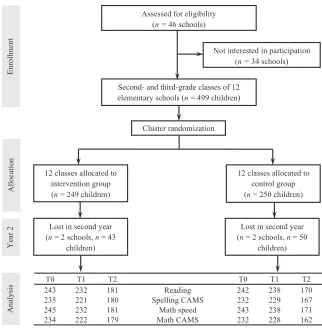
FIGURE 1
Flow of schools and students from enrollment, allocation, and analysis.
TABLE 1 Pretest Characteristics, by Condition Characteristic Control F&V P
n 250 249
Age, y 8.2 (0.74) 8.0 (0.72) .026a Male gender 110 (22) 116 (23) .562b Second grade 116 (23) 141 (28) .022b
Values are expressed as mean (SD) or n (%).
a Independent t test. bχ2 test.
TABLE 2 Scores on Academic Achievement Tests
Group T0 T1a T2b
Mean (SD) n Mean (SD) n Mean (SD) n
Reading
Intervention 80.73 (29.95) 243 102.62 (28.89) 232 125.34 (26.01) 181
Control 80.81 (31.29) 242 103.45 (29.05) 238 124.82 (30.93) 170
Spelling CAMS
Intervention 117.85 (7.40) 235 126.86 (7.90) 221 135.12 (8.72) 180
Control 118.84 (7.98) 232 127.16 (9.09) 229 133.49 (9.07) 167
Math speed
Intervention 38.82 (17.49) 245 60.44 (22.51) 232 83.81 (28.16) 181
Control 42.05 (18.70) 243 61.01 (23.53) 238 78.35 (26.59) 171
Math CAMS
Intervention 48.03 (19.16) 234 69.58 (16.78) 222 82.36 (15.85) 179
Control 53.94 (18.14) 232 68.65 (17.63) 228 82.83 (16.68) 162
a The children in the intervention group who were not retained in the study did not differ from the children in the control group who were not retained in the study (age, grade, gender,
condition, and pretest scores).
b Of the children who were not retained in the study at the math CAMS test, there were signifi cantly fewer third-grade children in the intervention group than the control group (χ2 = 5.31,
number of months learning gains of the intervention group after 2 intervention years was obtained.
RESULTS
Figure 1 shows that of the initial 499 children (mean age 8.1 ± 0.7 years) of 12 elementary schools, 249 children were assigned to the intervention and 250 children to the control group. Two schools dropped out in the second intervention year: 1 because of long-term absence of the teacher and the other because it was closed down. At T0, 466 to 488 children were measured, at T1, 453 to 475 children, and at T2, 341 to 352 children. Common reasons for not completing the tests were absence from school or leaving to attend another school.
The number of boys was similar in the control and intervention groups. However, the children in the control group were significantly older than the children in the intervention group (t = −2.2, P = .03), as significantly more children in the control group were in third grade (χ2 = 5.2, P =
.02) (Table 1). Table 2 presents the mean scores of children who took the academic achievement tests per measurement moment.
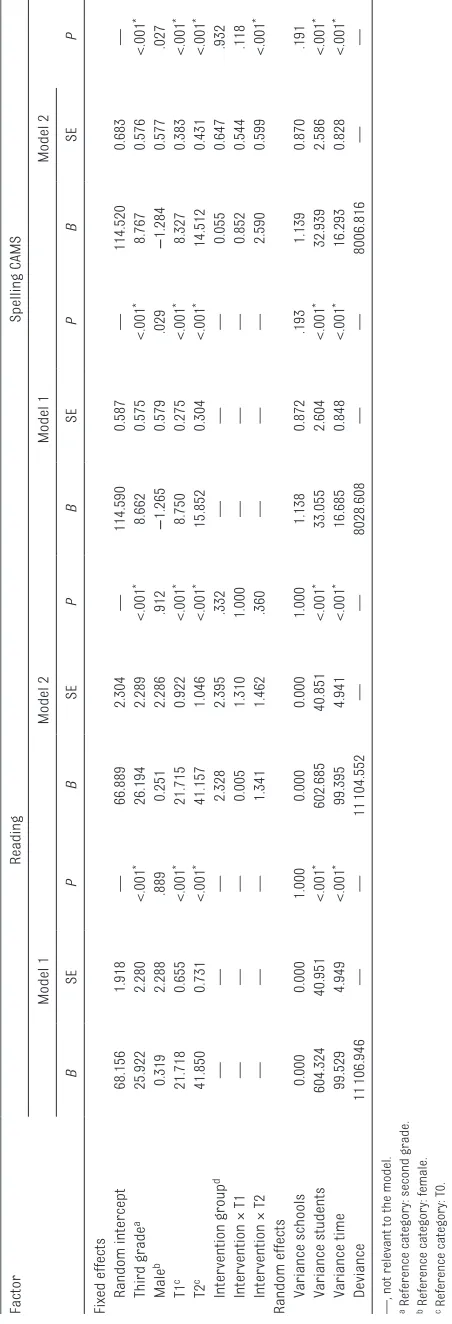
The results of the multilevel analysis can be found in Tables 3 and 4. At T0, only the math CAMS score of the intervention group was significantly lower than that of the control group (t = -2.77; P = .005) (model 2). The results further revealed no significant effect of the intervention on reading scores after 1 year (t = 0.00; P = 1.00; ES = 0.00, 95% confidence interval (CI) −0.10 to 0.10) or after 2 years (t = 0.76; P = .45; ES = 0.05, 95% CI
−0.06 to 0.17) (Fig 2A). The results of the spelling test revealed no significant effect after 1 intervention year (t = 1.57; P = .12; ES = 0.15, 95% CI −0.04 to 0.33). However, after the second year, there was a significant effect of the intervention
TABLE 3
Multilevel Regression Coeffi
cient (
B
) for Each Factor Predicting the Domains of Academic Achievement in Reading and Spelling CAMS
Factor Reading Spelling CAMS Model 1 Model 2 Model 1 Model 2 B SE PB SE PB SE PB SE P
Fixed effects Random
intercept 68.156 1.918 — 66.889 2.304 — 114.590 0.587 — 114.520 0.683 — Third grade a 25.922 2.280 <.001 * 26.194 2.289 <.001 * 8.662 0.575 <.001 * 8.767 0.576 <.001 * Male b 0.319 2.288 .889 0.251 2.286 .912 − 1.265 0.579 .029 − 1.284 0.577 .027 T1 c 21.718 0.655 <.001 * 21.715 0.922 <.001 * 8.750 0.275 <.001 * 8.327 0.383 <.001 * T2 c 41.850 0.731 <.001 * 41.157 1.046 <.001 * 15.852 0.304 <.001 * 14.512 0.431 <.001 * Inter vention group d — — — 2.328 2.395 .332 — — — 0.055 0.647 .932 Inter
vention × T1
— — — 0.005 1.310 1.000 — — — 0.852 0.544 .118 Inter
vention × T2
— — — 1.341 1.462 .360 — — — 2.590 0.599 <.001 *
Random effects Variance
schools 0.000 0.000 1.000 0.000 0.000 1.000 1.138 0.872 .193 1.139 0.870 .191 Variance students 604.324 40.951 <.001 * 602.685 40.851 <.001 * 33.055 2.604 <.001 * 32.939 2.586 <.001 * Variance time 99.529 4.949 <.001 * 99.395 4.941 <.001 * 16.685 0.848 <.001 * 16.293 0.828 <.001 * Deviance 11 106.946 — — 11 104.552 — — 8028.608 — — 8006.816 — —
—, not relevant to the model. a Reference category: second grade. b Reference category: female. c Reference category: T0. d Reference category: control group. * Signifi
cant (
P
< .00625) regression coeffi
on the spelling scores (t = 4.32; P < .001; ES = 0.45, 95% CI 0.25 to 0.66) (Fig 2B). This equates to 4 months (0.45/1.08 × 10 = 4.17) more learning gains after 2 intervention years in comparison with the control group. In the math speed test, the children in the intervention group showed no significant improvement after 1 intervention year (t = 2.44;
P = .02; ES = 0.20, 95% CI 0.04 to 0.37), but after the second year they showed significantly greater improvement in comparison with the control group (t = 5.44; P < .001; ES = 0.51, 95% CI 0.32 to 0.69) (Fig 2C). This equates to >4 months (0.51/1.12 × 10 = 4.55) more learning gains after 2 intervention years in comparison with the control group. Last, the results of the math CAMS test revealed that the scores of the children in the intervention group had improved significantly more than those of the control group after 1 year (t = 6.27; P < .001; ES = 0.53, 95% CI 0.36 to 0.69) and also after 2 years (t = 4.49; P < .001; ES = 0.42, 95% CI 0.23 to 0.60). The greatest improvement was after 1 year, and there was a retention of this effect after 2 years (Fig 2D). After 2 intervention years, 4 months (0.42/1.03 × 10 = 4.08) more learning gains were made by the intervention group compared with the control group.
DISCUSSION
The results add to those from the PAAC study, in which various existing academic lessons were coupled with physical activity to promote physical activity: that study showed that physically active academic lessons improved children’s academic achievement.2,3
Our study goes beyond this finding by demonstrating that a new physically active series of lessons specifically aimed at improving
TABLE 4
Multilevel Regression Coeffi
cient (
B
) for Each Factor Predicting the Domains of Academic Achievement in Math Speed and Math CAMS
Math Speed Math CAMS Model 1 Model 2 Model 1 Model 2 B SE PB SE PB SE PB SE P
Fixed effects Random
intercept 27.565 1.681 — 28.194 1.899 — 40.589 1.382 — 42.514 1.562 — Third grade a 24.209 1.531 <.001 * 24.425 1.533 <.001 * 16.586 1.242 <.001 * 16.615 1.247 <.001 * Male b 3.379 1.544 .029 3.332 1.538 .031 5.251 1.251 <.001 * 5.201 1.248 <.001 * T1 c 20.054 0.665 <.001 * 18.455 0.921 <.001 * 18.034 0.542 <.001 * 14.740 0.745 <.001 * T2 c 39.924 0.741 <.001 * 35.876 1.041 <.001 * 30.391 0.601 <.001 * 27.712 0.846 <.001 * Inter vention group d —— — − 1.445 1.688 .392 — — — − 3.801 1.372 .005 * Inter
vention × T1
— — — 3.196 1.308 .015 — — — 6.622 1.056 <.001 * Inter
vention × T2
— — — 7.912 1.454 <.001 * — — — 5.252 1.171 <.001 *
Random effects Variance
schools 13.083 8.246 .113 12.739 8.082 .116 9.174 5.657 .106 8.919 5.545 .109 Variance students 245.041 18.503 <.001 * 244.099 18.353 <.001 * 158.390 12.062 <.001 * 159.079 12.014 <.001 * Variance time 103.236 5.117 <.001 * 99.959 4.954 <.001 * 64.414 3.286 <.001 * 61.177 3.121 <.001 * Deviance 10 778.213 — — 10 747.902 — — 9776.413 — — 9734.880 — —
—, not relevant to the model. a Reference category: second grade. b Reference category: female. c Reference category: T0. d Reference category: control group. * Signifi
cant (
P
< .00625) regression coeffi
math and language improves the math and language achievement of elementary schoolchildren. Because the school curriculum is comparable on most Dutch elementary schools, the findings of our study can be generalized to other Dutch elementary schools. Generalizing results to other economically developed countries seems
warranted, as similar findings were obtained in the PAAC study. The F&V intervention improved performance on math and spelling but not on reading. This discrepancy might be caused by the content of the intervention program and the academic tests. The F&V program mainly focused on repetition of concepts that children had learned in earlier classes and memorization of
these concepts. More concretely, the main focus was on solving arithmetic problems and the spelling of words and less on reading speed.10 The
focus of the math speed test lies on solving arithmetic problems. In second and third grades, the math CAMS test also focuses on solving arithmetic.23 The spelling CAMS
measures children’s spelling level, and the reading test is about reading as many words as possible within a minute. This could mean that the intervention was particularly effective for improving the academic skills practiced during F&V lessons.
The effects of the intervention on academic achievement might be the result of a combination of mechanisms. One might be the effect
of moderate to vigorous physical activity on the brain12,13,16,17 and
on academic engagement.4,5,14 It is
also possible that the innovative teaching method may be effective because brain and body work in conjunction and because our cognitive knowledge is rooted in bodily awareness.11,26 This would
apply to children in particular, because all knowledge initially stems from sensory stimulation and motor processes.27 Further research with
more than one intervention group and a control group is needed to find out why using physical exercise in teaching academic content is effective in improving children’s academic achievement.
In previous research, it has been shown that children exercised at
FIGURE 2
moderate to vigorous intensity for 64% of the duration of the F&V lessons.10 Extra physical activity
during academic lessons may contribute positively to children’s overall health, prevent children from being overweight, and help in reaching the recommended 60 minutes of daily moderate to vigorous physical activity.2,28,29
Future research is needed to further investigate whether the lessons contribute to children’s health. Some limitations to the findings should also be noted. First, enhanced academic performance after the first intervention year might be possible due to the presence of specially trained intervention teachers. This was obviated by training regular classroom teachers to teach the F&V lessons in the second year. Second, the CAMS was administered by the schools itself. Although this test administration is practice as usual, this could have influenced
the results. Strengths of this study were the design (cluster-randomized controlled trial) and the large sample size. Furthermore, the novel contribution of this study is showing that specifically integrating physical activity into math and language lessons is sufficient to improve important academic skills.
CONCLUSIONS
Participation in the F&V physically active math and language
intervention positively contributed to math and spelling performance of elementary school children. After 2 intervention years, they gained 4 more months in spelling and math achievement compared with control children. The findings suggest that physically active academic lessons should be part of the school curriculum because it is an innovative and effective way for teachers to improve children’s
academic achievement. Physical activity should specifically be integrated into math and language lessons to optimally improve those important skills.
ACKNOWLEDGMENTS
The authors thank the intervention teachers and the participating schools for their cooperation in this study. The language editor of a near-final draft of this paper was J. Burrough.
REFERENCES
1. Bartholomew JB, Jowers EM. Physically active academic lessons in elementary children. Prev Med. 2011;52(1 Suppl 1): S51–S54
2. Donnelly JE, Greene JL, Gibson CA, et al. Physical Activity Across the Curriculum (PAAC): a randomized controlled trial to promote physical activity and diminish overweight and obesity in elementary school children. Prev Med. 2009;49(4):336–341
3. Donnelly JE, Lambourne K. Classroom-based physical activity, cognition, and academic achievement. Prev Med. 2011;52(1 Suppl 1):S36–S42
4. Grieco LA, Jowers EM, Bartholomew JB. Physically active academic lessons and time on task: the moderating effect of body mass index. Med Sci Sports Exerc. 2009;41(10):1921–1926
5. Mahar MT, Murphy SK, Rowe DA, Golden J, Shields AT, Raedeke TD. Effects of a classroom-based program on physical activity and on-task behavior. Med Sci Sports Exerc. 2006;38(12):2086–2094
6. Vazou S, Gavrilou T, Mamalaki E, Papanastasiou A, Sioumala N. Does integrating physical activity in the elementary school classroom infl uence
academic motivation? Int J Sport Exerc Psychol. 2012;10(4):251–263
7. Vazou S, Smiley-Oyen A. Moving and academic learning are not antagonists: acute effects on executive function and enjoyment. J Sport Exerc Psychol. 2014;36(5):474–485
8. Reed JA, Einstein G, Hahn E, Hooker SP, Gross VP, Kravitz J. Examining the impact of integrating physical activity on fluid intelligence and academic performance in an elementary school setting: a preliminary investigation. J Phys Act Health. 2010;7(3):343–351
ABBREVIATIONS
CAMS: child academic monitoring system
CI: confidence interval ES: effect size
F&V: Fit and Academically Proficient at School PAAC: Physical Activity Across
the Curriculum
Address correspondence to Marijke J. Mullender-Wijnsma, University of Groningen, University Medical Center Groningen, Center for Human Movement Sciences, Antonius Deusinglaan 1, 9713 AV Groningen, Netherlands. E-mail: [email protected]
PEDIATRICS (ISSN Numbers: Print, 0031-4005; Online, 1098-4275). Copyright © 2016 by the American Academy of Pediatrics
FINANCIAL DISCLOSURE: The authors have indicated they have no fi nancial relationships relevant to this article to disclose.
FUNDING: This work was supported by the Ministry of Education, Culture and Science (ODB10015).
POTENTIAL CONFLICT OF INTEREST: The authors have indicated they have no potential confl icts of interest to disclose.
9. Heckman JJ, Masterov DV. The productivity argument for investing in young children. Rev Agr Econ.
2007;29(3):446–493
10. Mullender-Wijnsma MJ, Hartman E, de Greeff JW, Bosker RJ, Doolaard S, Visscher C. Improving academic performance of school-age children by physical activity in the classroom: 1-year program evaluation. J Sch Health. 2015;85(6):365–371
11. Kontra C, Goldin-Meadow S, Beilock SL. Embodied learning across the life span. Top Cogn Sci. 2012;4(4):731–739
12. Best JR. Effects of physical activity on children’s executive function: Contributions of experimental research on aerobic exercise. Dev Rev. 2010;30(4):331–551
13. Hillman CH, Pontifex MB, Raine LB, Castelli DM, Hall EE, Kramer AF. The effect of acute treadmill walking on cognitive control and academic achievement in preadolescent children.
Neuroscience. 2009;159(3):1044–1054
14. Mullender-Wijnsma MJ, Hartman E, de Greeff JW, Bosker RJ, Doolaard S, Visscher C. Moderate-to-vigorous physically active academic lessons and academic engagement in children with and without a social disadvantage: a
within subject experimental design.
BMC Public Health. 2015;15(1):404
15. Greenwood CR, Horton BT, Utley CA. Academic engagement: current perspectives in research and practice.
School Psych Rev. 2002;31(3):328–349
16. Hillman CH, Erickson KI, Kramer AF. Be smart, exercise your heart: exercise effects on brain and cognition. Nat Rev Neurosci. 2008;9(1):58–65
17. Hillman CH, Pontifex MB, Castelli DM, et al. Effects of the FITKids randomized controlled trial on executive control and brain function. Pediatrics. 2014;134(4). Available at: www. pediatrics. org/ cgi/ content/ full/ 134/ 4/ e1063
18. Spybrook J, Raudenbush SW. Optimal Design Software. Ann Arbor, MI: University of Michigan; 2008
19. Erwin H, Fedewa A, Beighle A, Ahn S. A quantitative review of physical activity, health, and learning outcomes associated with classroom-based physical activity interventions. J Appl Sch Psychol. 2012;28(1):14–26
20. Brus BT, Voeten M. One minute test: Justifi cation and Manual. Nijmegen: Berkhout; 1973
21. de Vos T. Speed test arithmetic: Manual. Nijmegen: Berkhout; 1992
22. de Wijs A, Kamphuis F, Kleintjes F, Tomesen M. Spelling for grade 1 to 4: scientifi c justifi cation. Arnhem: Cito; 2010
23. Janssen J, Hickendorff M. Categories analysis for the mathematics CAMS test. Arnhem: Cito; 2008
24. Janssen J, Verhelst N, Engelen R, Scheltens F. Mathematics for grade 1 to 6: scientifi c justifi cation. Arnhem: Cito; 2010
25. Hedges LV. Effect sizes in cluster-randomized designs. J Educ Behav Stat. 2007;32(4):341–370
26. Niedenthal PM. Embodying emotion.
Science. 2007;316(5827):1002–1005
27. Koziol LF, Lutz JT. From movement to thought: the development of executive function. Appl Neuropsychol Child. 2013;2(2):104–115
28. Strong WB, Malina RM, Blimkie CJ, et al. Evidence based physical activity for school-age youth. J Pediatr. 2005;146(6):732–737
DOI: 10.1542/peds.2015-2743 originally published online February 24, 2016;
2016;137;
Pediatrics
Doolaard, Roel J. Bosker and Chris Visscher
Marijke J. Mullender-Wijnsma, Esther Hartman, Johannes W. de Greeff, Simone
A Cluster Randomized Controlled Trial
Physically Active Math and Language Lessons Improve Academic Achievement:
Services
Updated Information &
http://pediatrics.aappublications.org/content/137/3/e20152743
including high resolution figures, can be found at:
References
http://pediatrics.aappublications.org/content/137/3/e20152743#BIBL
This article cites 22 articles, 2 of which you can access for free at:
Subspecialty Collections
http://www.aappublications.org/cgi/collection/school_health_sub
School Health
_sub
http://www.aappublications.org/cgi/collection/community_pediatrics
Community Pediatrics
following collection(s):
This article, along with others on similar topics, appears in the
Permissions & Licensing
http://www.aappublications.org/site/misc/Permissions.xhtml
in its entirety can be found online at:
Information about reproducing this article in parts (figures, tables) or
Reprints
http://www.aappublications.org/site/misc/reprints.xhtml
DOI: 10.1542/peds.2015-2743 originally published online February 24, 2016;
2016;137;
Pediatrics
Doolaard, Roel J. Bosker and Chris Visscher
Marijke J. Mullender-Wijnsma, Esther Hartman, Johannes W. de Greeff, Simone
A Cluster Randomized Controlled Trial
Physically Active Math and Language Lessons Improve Academic Achievement:
http://pediatrics.aappublications.org/content/137/3/e20152743
located on the World Wide Web at:
The online version of this article, along with updated information and services, is
by the American Academy of Pediatrics. All rights reserved. Print ISSN: 1073-0397.