University of Pennsylvania
ScholarlyCommons
Publicly Accessible Penn Dissertations
1-1-2013
Multigranularity Representations for Human
Inter-Actions: Pose, Motion and Intention
Aikaterini Fragkiadaki
University of Pennsylvania, [email protected]
Follow this and additional works at:http://repository.upenn.edu/edissertations Part of theComputer Sciences Commons, and theRobotics Commons
This paper is posted at ScholarlyCommons.http://repository.upenn.edu/edissertations/859
For more information, please [email protected]. Recommended Citation
Fragkiadaki, Aikaterini, "Multigranularity Representations for Human Inter-Actions: Pose, Motion and Intention" (2013).Publicly Accessible Penn Dissertations. 859.
Multigranularity Representations for Human Inter-Actions: Pose, Motion
and Intention
Abstract
Tracking people and their body pose in videos is a central problem in computer vision. Standard tracking representations reason about temporal coherence of detected people and body parts. They have difficulty tracking targets under partial occlusions or rare body poses, where detectors often fail, since the number of training examples is often too small to deal with the exponential variability of such configurations.
We propose tracking representations that track and segment people and their body pose in videos by
exploiting information at multiple detection and segmentation granularities when available, whole body, parts or point trajectories.
Detections and motion estimates provide contradictory information in case of false alarm detections or leaking motion affinities. We consolidate contradictory information via graph steering, an algorithm for simultaneous detection and co-clustering in a two-granularity graph of motion trajectories and detections, that corrects motion leakage between correctly detected objects, while being robust to false alarms or spatially inaccurate detections.
We first present a motion segmentation framework that exploits long range motion of point trajectories and large spatial support of image regions.
We show resulting video segments adapt to targets under partial occlusions and deformations.
Second, we augment motion-based representations with object detection for dealing with motion leakage. We demonstrate how to combine dense optical flow trajectory affinities with repulsions from confident detections to reach a global consensus of detection and tracking in crowded scenes.
Third, we study human motion and pose estimation.
We segment hard to detect, fast moving body limbs from their surrounding clutter and match them against pose exemplars to detect body pose under fast motion. We employ on-the-fly human body kinematics to improve tracking of body joints under wide deformations.
We use motion segmentability of body parts for re-ranking a set of body joint candidate trajectories and jointly infer multi-frame body pose and video segmentation.
We show empirically that such multi-granularity tracking representation is worthwhile, obtaining significantly more accurate multi-object tracking and detailed body pose estimation in popular datasets.
Degree Type Dissertation
Degree Name
Graduate Group
Computer and Information Science
First Advisor Jianbo Shi
Keywords
perceptual organization, pose estimation, tracking, video segmentation
Subject Categories
MULTI-GRANULARITY REPRESENTATIONS FOR
HUMAN INTER-ACTIONS: POSE, MOTION AND
INTENTION
Aikaterini Ioannou Fragkiadaki
A DISSERTATION
in
Computer and Information Science
Presented to the Faculties of the University of Pennsylvania
in
Partial Fulfillment of the Requirements for the Degree of Doctor of Philosophy
2013
Jianbo Shi, Associate Professor Computer and Information Science
Supervisor of Dissertation
Val Tannen, Professor Computer and Information Science
Graduate Group Chairperson
Dissertation Committee
Kostas Daniilidis, Professor, Computer and Information Science
Camillo J. Taylor, Professor, Computer and Information Science
Ben Taskar, Boeing Associate Professor, Computer Science and Engineering
University of Washington
Martial Hebert, Professor, School of Computer Science
MULTI-GRANULARITY REPRESENTATIONS FOR HUMAN
INTER-ACTIONS: POSE, MOTION AND INTENTION
c
2013
To my family:
Mom and Dad, for giving me a lifelong place to call home;
Acknowledgements
I would like to thank my advisor Jianbo Shi whose excitement and devotion to Computer
Vision has been more inspiring than anything else. His advising has shaped my research
skills equally well as my character towards discipline, patience, persistency, humbleness.
The education he has given me will always be part of my research work.
I would like to thank George Pappas for accepting my application at Penn and for
allowing me to change topics according to my interests. I would like to thank Kostas
Daniilidis for his support and encouragement, throughout my Ph.D. and as chair of my
committee. I would like to thank the rest of my committee members, CJ Taylor for his
thorough comments and positive energy and Martial Hebert for his directions towards
wide and detailed experimentation. I especially thank Ben Taskar for making the FLIC
dataset available to me before its public release and wish him a happy and most successful
career in UoW.
I would like to thank my co-authors Geng Zhang, Weiyu Zhang, Elena Bernardis, Han
Hu for good and fruitful collaboration. We have spent many agonizing and celebrating
moments together which I shall never forget, especially the agonizing ones. I would like
to thank Ben Sapp for the great discussions we had inside and outside the lab, his great
examples on MATLAB hacking and the mutual support during deadlines. I would like
to thank Kosta Derpanis for proofreading our papers and providing great suggestions for
improvements. I would like to thank Mike Felker for his great secretarial work, taking
care of all of us throughout our Ph.Ds.
you for your effort on maintaining our laptops and server, that ensured I could work with
comfort from any place outside the lab, our home in Philly or D.C., Cretan seaside and
ABSTRACT
MULTI-GRANULARITY REPRESENTATIONS FOR HUMAN INTER-ACTIONS:
POSE, MOTION AND INTENTION
Aikaterini Ioannou Fragkiadaki
Jianbo Shi
Tracking people and their body pose in videos is a central problem in computer vision.
Standard tracking representations reason about temporal coherence of detected people and
body parts. They have difficulty tracking targets under partial occlusions or rare body
poses, where detectors often fail, since the number of training examples is often too small
to deal with the exponential variability of such configurations.
We propose tracking representations that track and segment people and their body
pose in videos by exploiting information at multiple detection and segmentation
granu-larities when available, whole body, parts or point trajectories. Detections and motion
estimates provide contradictory information in case of false alarm detections or leaking
motion affinities. We consolidate contradictory information via graph steering, an
algo-rithm for simultaneous detection and co-clustering in a two-granularity graph of motion
trajectories and detections, that corrects motion leakage between correctly detected
ob-jects, while being robust to false alarms or spatially inaccurate detections.
We first present a motion segmentation framework that exploits long range motion of
point trajectories and large spatial support of image regions. We show resulting video
segments adapt to targets under partial occlusions and deformations. Second, we augment
motion-based representations with object detection for dealing with motion leakage. We
demonstrate how to combine dense optical flow trajectory affinities with repulsions from
confident detections to reach a global consensus of detection and tracking in crowded
scenes. Third, we study human motion and pose estimation. We segment hard to detect,
fast moving body limbs from their surrounding clutter and match them against pose
to improve tracking of body joints under wide deformations. We use motion
segmentabil-ity of body parts for re-ranking a set of body joint candidate trajectories and jointly infer
multi-frame body pose and video segmentation.
We show empirically that such multi-granularity tracking representation is worthwhile,
obtaining significantly more accurate multi-object tracking and detailed body pose
Contents
Acknowledgements vi
1 Introduction 1
1.1 Previous literature . . . 3
1.2 Remaining challenges . . . 5
1.3 Contributions of this thesis . . . 7
1.3.1 Models for spatio-temporal perceptual organization (Chapter 3) . 9
1.3.2 Two-granularity tracking for concurrent multi-object tracking and
segmentation (Chapter 4) . . . 9
1.3.3 Graph steering for inferring classification-clustering in two -
gran-ularity graphs (Section 4.4). . . 10
1.3.4 Motion for body pose detection (Chapters 5,6) . . . 10
1.4 Published work supporting this thesis . . . 11
2 Preliminaries 12
2.1 Spectral Partitioning . . . 13
2.2 Clustering with Bias . . . 16
3 Spatio-temporal Perceptual Organization 19
3.1 Introduction . . . 20
3.2 Related work . . . 25
3.3.1 Trajectory spectral discontinuities . . . 28
3.3.2 Trajectory to pixel partitioning via random walkers . . . 35
3.3.3 Experiments . . . 38
3.4 Topological Tracking . . . 46
3.4.1 Experiments . . . 50
3.4.2 Discussion . . . 52
4 Two-Granularity Tracking 53 4.1 Introduction . . . 54
4.2 Related work . . . 58
4.3 Tracking units . . . 60
4.3.1 Fine-grained point trajectories . . . 61
4.3.2 Coarse-grained detectlets . . . 62
4.3.3 Trajectory to detectlet associations . . . 64
4.4 Two-view steering cut . . . 65
4.4.1 Graph steering . . . 65
4.4.2 Steering cuts . . . 68
4.4.3 Graph steerability. . . 73
4.5 Experiments . . . 77
4.6 Discussion. . . 90
5 Two-Granularity Body Pose Tracking 91 5.1 Introduction . . . 91
5.2 Related work . . . 93
5.3 Pose and segmentation model . . . 96
5.3.1 Space-time body pose graph . . . 96
5.3.2 Detection-by-tracking: State binding for space-time pose estimation 98 5.3.3 Trajectory motion graph . . . 101
5.3.5 Joint pose and motion figure-ground segmentation . . . 103
5.3.6 Body pose estimation under interactions . . . 105
5.4 Experiments . . . 106
5.5 Discussion. . . 112
6 Articulated Optical Flow 113 6.1 Introduction . . . 114
6.2 Related work . . . 116
6.3 From flow to pose . . . 117
6.3.1 Region motion affinities . . . 118
6.3.2 Region detection-driven repulsions. . . 119
6.3.3 Steering cut . . . 120
6.3.4 Matching pose segmentations to exemplars . . . 122
6.4 From pose to flow . . . 123
6.4.1 Articulated optical flow. . . 123
6.5 Experiments . . . 127
6.6 Discussion. . . 129
List of Tables
3.1 Quantitative segmentation results in the Berkeley motion segmentation
benchmark. . . 40
3.2 Quantitative segmentation results of topological tracking in Berkeley
mo-tion segmentamo-tion dataset . . . 50
3.3 Quantitative segmentation results of topological tracking in Figment . . . 51
List of Figures
1.1 Multi-granularity representations for person and body pose tracking. . . . 3
1.2 Previous tracking literature. . . 4
1.3 Human body pose manifold. . . 6
3.1 Gains and ambiguities in motion estimation. . . 23
3.2 Trajectory spectral discontinuities . . . 30
3.3 Multiscale trajectory partitioning . . . 33
3.4 Robustness of discontinuities to the number of eigenvectors . . . 34
3.5 Random walkers on spatio-temporal region graphs . . . 37
3.6 Qualitative segmentation results in the Berkeley motion segmentation bench-mark. . . 39
3.7 Video segmentation results in the dataset ofChen and Corso(2010) . . . 42
3.8 Results in the CMU boundary detection benchmark . . . 43
3.9 Pixel probability of occlusion boundary map. . . 44
3.10 Precision-recall curve in the CMU occlusion boundary benchmark . . . . 44
3.11 Comparison of spectral embedding discretizations. . . 46
3.12 Motion versus topology . . . 47
3.13 Trajectory motion saliency . . . 49
3.14 Topology-driven trajectory repulsions . . . 49
3.15 Qualitative segmentation results in Figment . . . 51
4.1 Two-granularity trackers . . . 55
4.3 Complementarity of motion segmentation and detection. . . 60
4.4 Detection linking into detectlets . . . 63
4.5 Trajectory to detectlet cross-associations . . . 64
4.6 Graph steering. . . 66
4.7 Steering and graph connectivity . . . 67
4.8 Comparison of motion, disparity and detection driven trajectory affinities 70 4.9 Graph steering versus co-clustering. . . 72
4.10 Feasibility analysis of steering cut . . . 74
4.11 Two-granularity tracking results in UrbanStreet . . . 78
4.12 Two-granularity tracking versus standard tracking-by-detection . . . 79
4.13 Groundtruth segmentations in UrbanStreet . . . 80
4.14 Drifting in two-granularity tracking . . . 81
4.15 Comparison of 2D and 3D two-granularity tracking in UrbanStreet . . . . 82
4.16 Tracklet fragmentations . . . 83
4.17 Two-granularity baseline systems. . . 84
4.18 Two-granularity tracking results in PETS S2.L1 . . . 85
4.19 Two-granularity tracking results in TUD crossing . . . 86
4.20 Two-granularity tracking results in ETH sunny day . . . 87
4.21 Two-granularity tracking results in iLids Hard dataset . . . 88
4.22 Two-granularity tracking for multi-class object tracking in crowded scenes 89 5.1 Body pose estimation under occlusions. . . 94
5.2 Markov Random Field for space-time human body pose. . . 97
5.3 Body joint state binding. . . 99
5.4 Tree decomposition.. . . 101
5.5 Trajectory motion graph. . . 102
5.6 Body part segmentability. . . 104
5.7 Pose detection under occlusions . . . 105
5.9 Quantitative pose estimation results in FLIC dataset. . . 108
5.10 Qualitative pose estimation results in FLIC dataset. . . 110
5.11 Trajectory motion graph. . . 111
6.1 Long trails of human body pose distribution. . . 115
6.2 Pose from flow. . . 117
6.3 Articulated optical flow . . . 124
6.4 Comparison of articulated flow and standard optical flow. . . 125
6.5 Qualitative pose detection results in the Friends dataset . . . 127
Chapter 1
Introduction
The only thing worse than being blind is having sight but no vision.
— Hellen Keller
Visual sensors on cellphones, tablets, glasses, clothes, computers, produce large amounts
of video footage daily. Progress on robotic automation and human-computer interaction
depends on how well we can understand and predict the visual world captured from these
sensors. Understanding what the people are doing, how they interact with their
environ-ment, and what they want to do next in the video footage is important for applications in
entertainment, safety, health care, education. This thesis is about estimating people’s body
motion in unconstrained videos from various sensors, as a step towards understanding their
activities.
The fact that human body motion aids recognition of human activity dates back to the
experiments ofJohansson(1973): Johansson showed that image sequences of point-lights
attached to the limbs of a moving actor could be identified as depicting actions, although
they did not define a form when stationary. In other words, a set of point light trajectories
Obtaining automatically long temporal correspondences of moving body joints,
simi-lar to those perceived by the human subjects in Johansson’s experiments, is challenging.
Body motion estimation is a difficult problem on its own and has received a lot of
atten-tion in Computer Vision community. In fact, estimating pixel moatten-tion is often ambiguous
without appropriate object specific or object independent, smoothness driven, priors. We
will explore representations that combine imperfect motion estimates with detectors for
segmenting and tracking people and their body pose in videos.
We propose multi-granularity representations for detection, segmentation and
tempo-ral association in videos.
• Detectors reliably recognize image parts well captured in their training sets. Usually such image parts come at a coarse granularity since too small templates are
ambigu-ous to recognize. This is the case also for part based representations, where a set
of parts are scored together to disambiguate the small image support of each one of
them.
• Video segmentors partition fine-grain entities such as pixels or point trajectories into a potentially exponential number of groups, guided by object independent grouping
principles, such as motion coherence. These groups may correspond to very small
or very large image parts, that can or cannot be reliably recognized by detectors.
• Trackers associate image parts from one frame to another, by learning a model for
the image part against its surroundings, or by exploiting smoothness of
correspon-dence and global optimization, or both. They may incorporate object specific
kine-matic constraints.
Our goal is to obtain detections at any granularity needed in the video (e.g., body
parts of a half occluded person) and segmentation at the right semantic granularity (e.g.,
segments do not fragment torso from legs or leak across similarly moving people). We
will show that jointly reasoning over segmentation and detection in videos can achieve this
Figure 1.1: Multi-granularity representations for people and body pose tracking. 1st Row:
Detection responses ofBourdev et al.(2010) (left) and body pose estimates ofYang and
Ramanan(2011), retrained on pedestrian poses ofAndriluka et al.(2008) (right).
Detec-tors reliably recognize configurations captured in their training sets, such as the distinctive
wide leg walking pose. They often fail at partial occlusions where detection responses
span across closeby people. 2nd Row: Our proposed two-granularity tracking for whole
object (left) and detailed body pose tracking (right). We track heavily occluded people
and recognize partially visible body poses by combining detections with spatio-temporal
grouping of trajectories.
object independent, motion based grouping relationships and object specific, detection
based repulsive ones. We will use the term “tracking” to refer to parsing of people and/or
their body pose in videos, although the term may be overloaded.
1.1
Previous literature
There is a tremendous previous Computer Vision literature on tracking people and their
body pose in monocular or multi-view videos. To understand the connections between
Figure 1.2: We explore
the interplay between
asso-ciation, motion segmentation
and detection for tracking
under partial occlusions and
body deformations, where
standard detectors and data
association often fail.
Tracking‐by‐detecWon (Huang et al. 2008, Brendel et al. 2011, Park and Ramanan 2011…) AssociaWon Model update trackers (Grabner et al. 2008, Ramanan et al. 2008, Okuma et al. 2004, Breitenstein et al. 2011, …) OpWcal flow (Lucas and Kanade 1981, Horn and Schunk 1981, Black and Anandan 1996, Brox et al. 2004…) KinemaWc tracking (Regh and Kanade 1995, Bregler and Malik 1998, Oikonomidis et al. 2012…) D e te cW o n
tasks: detection and association. Determining the state of a target at a given frame can be
done both by corresponding to a training exemplar (detection) or by corresponding to the
target state in the previous (or next) frames (association). Detection is by definition object
specific. Association can be object specific using object tailored kinematic constraints,
or object independent, using general smoothness driven assumptions in matching pixel
appearance from frame to frame.
We place previous works in a 2D diagram that has detection and association as its
main axes, shown in Figure 1.2. In the bottom right part of the diagram we have optical
flow methods that estimate pixel motion in an object independent way, without using any
information about the content of the video scene. Kinematic tracking methods track an
initialized template in time using object specific kinematic constraints. Recent progress of
object detectors has shifted attention towards tracking-by-detection approaches that track
by linking detections across consecutive frames, such as works of Brendel et al.(2011);
Huang et al. (2008b); Park and Ramanan (2011). Tracking works of Breitenstein et al.
(2009); Grabner et al.(2008); Okuma et al.(2004); Yang and Nevatia (2012) use along
1.2
Remaining challenges
Partial occlusions, unusual object configurations and fast body motion are the three
chal-lenges we identify, still hard to deal with state-of-the-art tracking methods.
Partial occlusions People interactions result in partial occlusions, a challenge for both
detection and data association:
1. Detectors often fail under partial occlusions. Object like features are erroneously
aggregated from both the occluder and the occludee, resulting in either a spatially
inaccurate detection, spanning across the two closeby objects, or a miss detection
due to mismatched or missing template information, as depicted in Figure1.1. In
essence, partial occlusions ask for a large number of different detection models to
be checked against the visual input for matching, each one representing a different
occlusion scenario. Learning and calibrating different occlusion models is not easy
from current size of training sets.
2. Tracking objects under partial occlusions is difficult due to the continuous change
of object visibility masks. Committing to a fixed bounding box shaped object state
often misses objects under occlusions and cannot keep good track of target’s
visi-bility.
Unusual object configurations Unusual object configurations are captured by few
train-ing examples and are hard to detect reliably with current detectors. The distribution of
visual data is often characterized by few, frequently re-occurring templates and a large
collection of rare ones, forming the long tails of the distribution. This is particularly the
case for the human body. People take a wide range of body poses, with few re-occurring
ones, depicted at the upper right part of Figure 1.3, and lots of rare ones, depicted at the
lower left. While each one of them is rare, collectively they comprise a big chunk of
the body pose distribution. This fact is not a result of dataset bias but rather reflects the
Unusual object configurations are hard to harvest training exemplars for. One solution
is to use graphics simulations and rendering techniques to collect training exemplars for
the desired rare configurations, as proposed inShotton et al.(2013). Though this may be
a promising direction, we expect the realism of such exemplars to be low for simulating
human motion.
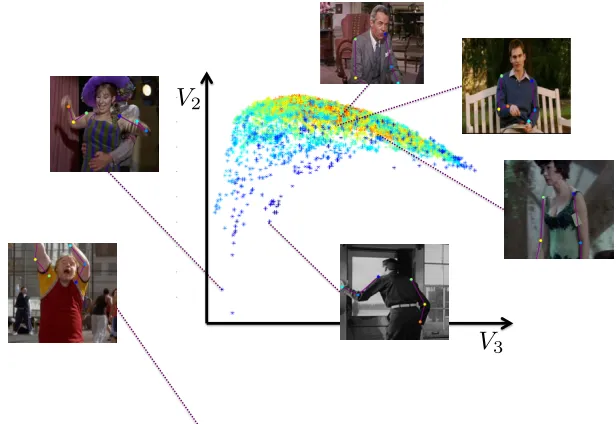
Figure 1.3: Human body pose manifold computed from the pose training exemplars of
Sapp and Taskar (2013). We visualize body pose training exemplars using the top two
spectral eigenvectors of their affinities, that depend on body pose similarity. Point color
in-dicates number of close neighbors, red corresponds to large number of neighbors. Widely
deformed poses are outliers in the dataset. Notice the large number of dark blue points.
They correspond to rare body poses. Each one of them is rare but collectively they
com-prise a large chunk of the body pose distribution.
Fast body motion Fast body motion is hard to track with state-of-the-art coarse-to-fine
gradient-based motion estimation schemes such asBrox et al.(2004);Lucas and Kanade
(1981): body parts are small and thus are often lost in the coarse levels of the image
pyra-mid. Their large displacements are hard to recover from the finer pyramid levels. On the
As a result, descriptor augmented optical flow methods, such asBrox and Malik(2010a),
often fail to track fast body motion. Kinematically constrained tracking introduced in
Bre-gler and Malik(1998) exploits human body connectivity along articulated chains, and may
outperform bottom-up motion estimation methods, such as optical flow or point tracking,
when the human skeleton is initialized. However, it still fails under frequent self
occlu-sions from large body deformations, as noted inDatta et al.(2008).
1.3
Contributions of this thesis
This thesis contributes to the tracking literature with representations and inference
frame-works that employ multi-granularity detection and association for tracking people and
their body pose under partial occlusions and unusual pose configurations.
We start by presenting a spatio-temporal perceptual organization method in Chapter3
that segments a video using long range motion of trajectories and large spatial support of
image regions. Pixel trajectories are computedbottom-up, independent to the video
con-tent. They encode strong grouping relationships in their long range motion (and disparity
in case of multi-view video) based similarities.
The success of the video segmentation framework in tracking entangled objects in
monocular videos shows there is rich information in the video signal and its motion even
without any model matching. Resulting segments accurately capture partially occluded
objects and objects under unusual configuration, which are challenges for object
detec-tors. However, we identify two problems with our video segmentation method, which
characterize any object independent motion segmentation method in general:
1. Model selection. For general non-rigid object motion, grouping cost functions have
multiple optima corresponding to coarser of finer partitioning of the objects and
the scene. Since in general object motion is not uniform, such partitionings may
posed problem in that sense since all partitionings are equally good. The one
corre-sponding to the desired semantic segmentation is not easy to pick without additional
information.
2. Leakage under lack of distinct motion across objects. In case of no motion or
ac-cidental long range motion similarity across objects, motion affinities and resulting
clusters leak across objects.
To recover from those problems, in Chapters4and5we combine video segmentation with
detector responses. We ask for alignment between segments and detections, which selects
the right segmentation granularity and addresses the model selection problem. Further, we
introduce graph steering where motion affinities are changed (steered) from repulsions
in-duced between trajectories associated with incompatible detections. We show robustness
of our framework against spatially inaccurate or false alarm detections and their wrongly
induced repulsions. Graph steering addresses the problem of motion leakage in case of
accidental motion similarity across objects. Trajectories propagate detections across
miss-detection gaps, where miss-detections are whole objects in Chapter4and body joints in Chapter
5.
Object independent point trajectories though have limitations: they fail to track fast
body motion. Their frequent fragmentations under body self occlusions and deformations,
limit their usefulness. In Chapter6we explore ways of using on-the-fly body pose
detec-tion to inject kinematic constraints in computing modetec-tion trajectories. Such constraints
help deal with the untexturedness and aperture problems of human body limbs and their
fast motion.
1.3.1
Models for spatio-temporal perceptual organization (Chapter
3)
We cast video segmentation as partitioning of point trajectories and image regions. We
have the following contributions:
• Multiscale trajectory partitioningfor video segmentation. We introduce a discon-tinuity detector that estimates a probability of boundary between spatially adjacent
trajectories. It detects sudden drops or peaks of spectral embedding affinities
be-tween neighboring trajectories. Thresholding such probability of boundary in
var-ious cutoff values provides trajectory partitions in different levels of granularity.
Each trajectory cluster corresponds to an object hypothesis in space and time.
• Random walkers on multiscale region graphsfor mapping point trajectory
clus-ters to image regions. Regions that overlap well with trajectory clusclus-ters are the
designated seeds. Seed labels are propagated efficiently to regions that fall on
tra-jectory gaps using multiscale appearance based region affinities.
• Object connectedness constraints from foreground topologyas repulsive weights
between point trajectories. Motion is insufficient for segmenting articulated bodies:
articulated parts move distinctly while distinct objects may move similarly. We
show object connectedness constraints can help video segmentation under motion
ambiguities.
1.3.2
Two-granularity tracking for concurrent multi-object tracking
and segmentation (Chapter
4)
Tracking objects in crowds is a joint detection and segmentation problem, due to the
con-tinuously changing spatial support of the objects, while interacting with each other.
Mo-tivated by this observation, we propose two-granularity tracking, a graph theoretic
tracklets are comprised of detection responses, under good object visibility, and
trajec-tory clusters, under object partial occlusions or deformations. Miss-detection gaps are
“bridged” by trajectory clusters instead of utilizing motion smoothness assumptions or
lowering the detection confidence threshold. Our goal is to improve tracking
robust-ness, diminishing drifts caused by interpolation across miss detection gaps, rather than
the segmentation itself. Point trajectories are independent of object categories. Thus,
two-granularity tracking can easily be used for tracking any object category with the
ap-propriate replacement of the object detector.
1.3.3
Graph steering for inferring classificationclustering in two
-granularity graphs (Section
4.4)
Graph steering is our tool for inference in two-granularity representations. It is a
cluster-ing with bias algorithm that computes spectral clustercluster-ing in a graph of motion/appearance
based node affinities and detection-driven repulsions. The detection input may contain
false alarms. Clustering in the steered graph is robust to wrong (false alarm) or spatially
inaccurate detections, as analyzed in Section 4.4.3. Previous clustering with bias
algo-rithms such as random walkers ofGrady(2006) or pixel labeling works of Boykov et al.
(2001);Komodakis et al. (2011) assume a label set known. Graph steering does not
as-sume a known label set, but rather uses soft not-group constraints from pairs of detections,
for discovering the grouping of graph nodes into objects. Graph nodes may be trajectories
or image regions.
1.3.4
Motion for body pose detection (Chapters
5,6)
Motion is a strong cue for body pose detection. We have the following contributions:
• Body joint temporal bindingfor body pose inference under temporal
correspon-dences. (Section 5.3.2). We bind body joint candidates on multiframe
loopy space-time Markov Random Fields (MRFs) for human body pose often omits
temporal edges for efficiency of inference in a simplified tree structured graph.
In-ference under temporal binding of the state candidates is less vulnerable to such
MRF graph decompositions.
• Pose specific motion segmentabilityclassifiers for re-ranking body joint candidate
based on the agreement with the underlying video segmentation (Section5.3.5).
Pre-vious approaches use optical flow boundaries as a feature for body part detection.
They suffer from contradictions between poses under large or no motion, where
flow boundaries are strong or nonexistent respectively. Pose specific motion
seg-mentability can recover from such contradictions.
• Articulated optical flow for tracking fast body part motion(Section6.4) We use
detected articulated joints to impose kinematic constraints in optical flow
estima-tion, for tracking arm kinematic chains through deformations. Standard optical flow
estimates without kinematic constraints frequently drift to surroundings under fast
body part motion.
1.4
Published work supporting this thesis
Part of our video segmentation work in Chapter 3 first appeared inFragkiadaki and Shi
(2011);Fragkiadaki et al.(2012a). The two-granularity tracking framework discussed in
Chapter 4 was introduced inFragkiadaki et al. (2012c). The articulated flow work and
pose segmentation in Chapter 6 appears in Fragkiadaki et al. (2013). Work of Chapter
5is under review. While not discussed in this thesis, the video segmentation framework
of Chapter 3 found application in 3D cell segmentation presented in Fragkiadaki et al.
Chapter 2
Preliminaries
Graph partitioning algorithms can be categorized according to their apriori information on
the number and properties of a label set for the graph nodes. Apriori label information
often allows to establish per node label probabilities, independent of inter-node
relation-ships. In cases a label set is given apriori, graph partitioning is often referred to as node
labeling. We call this a ”closed world“ partitioning framework.
In this chapter we review “open” and “closed” world graph partitioning or graph
la-beling formulations. We will use the term open world to refer to graph partitioning
frame-works that do not assume apriori information on the number or properties of node labels,
e.g. bottom-up segmentation methods of Cheng(1995); Shi and Malik(2000). We will
use the term closed world to refer to graph partitioning frameworks that assume apriori
information on the number and properties of different labels (or classes), e.g. in the form
of seed nodes or training exemplars. Notably, such apriori information often allows to
establish per node label probabilities, independent of inter-node relationships (unary label
scores). The more closed the assumption about the world, the more emphasis the
algo-rithms put on per node label probabilities as opposed to node cross-associations.
Section 2.1 reviews spectral clustering, a popular open world clustering framework
with many variants in image and video segmentation. Section2.2 reviews some closed
et al.(2001) and random walkers ofGrady(2006).
2.1
Spectral Partitioning
Let G(V,W) be a weighted graph over a node set V. Let n denote the cardinality of
V. Matrix W is assumed symmetric and non-negative. Partitioning the node set V in
K clusters is finding disjoint sets V1· · ·VK so that ∪iK=1Vk = V. Let ΓKV F denote the
partitioning.
Normalized Cut Partitioning Criterion Given node setsA, B, we definelinks(A,B)
to be the total weighted connections fromAto setB:
links(A,B) = X
i∈A,j∈B
W(i, j). (2.1)
The degree of a set is defined as the total links of its nodes to all the nodes inV:
degree(A) = links(A,V). (2.2)
The cut of a node setAis defined as the total links fromAto its complement:
cut(A) = links(A,V/A). (2.3)
Thenormalized cutof a node setAis defined as the fraction of its cut and its degree:
ncut(A) = cut(A)
degree(A). (2.4)
The criterion forK-way graph partitioning proposed inShi and Malik(2000);Yu and
Shi(2003) minimizes the normalized cuts of the clusters in the partitioningΓK V:
kncuts(ΓKV) =
K X
k=1
cut(Vk)
degree(Vk)
. (2.5)
Since
minimizing ncuts is equivalent to maximizing intra-cluster normalized associations:
knassoc(ΓKV) =
K X
k=1
links(Vk,Vk)
degree(Vk)
. (2.7)
We consider the partition matrix X = [X1· · ·XK] ∈ {0,1}n×K. Let DW ∈ Rn×n
denote the diagonal degree matrix of the affinity matrixW:
DW = Diag(W1n). (2.8)
Then theK-way normalized association criterion can be re-written as:
knassoc(X) =
K X
k=1
XT
kWXk
XT
kDWXk
(2.9)
and results in the following maximization problem:
max.
X (X) =
PK k=1
XkTWXk
XT kDWXk
subject to X ∈ {0,1}n×K, PK
k=1XK =1n.
(2.10)
The problem above has been shown inShi and Malik(2000) to be NP-complete even for
K = 2. Below we will show the spectral relaxation that is typically used to obtain a near
global optimum.
Spectral relaxation We relax the problem in Eq. 2.10 by ignoring its constraints. We
do the following change of variables: we divide each indicator vectorXkwith the square
root of the degree(XKTDWXk)of the corresponding cluster:
Zk =Xk(XkTDWXk)−
1
2, Z =X(XTDWX)− 1
2. (2.11)
Then, it is easy to see that
ZTDWZ = (XTDWX)−
1 2XTD
WX(XTDWX)−
1 2 =I
K, (2.12)
and we obtain the following maximization problem:
max.
Z (Z) = tr(Z
TWZ)
subject to ZTD
WZ =IK.
If we do a last change of variables:
Y =D
1 2
WZ, Z =D −1
2
WY (2.14)
we obtain:
max.
Y (Y) = tr(Y TD−12
WWD
−1 2
WY)
subject to YTY =I
K.
(2.15)
Above we recognize a Rayleigh quotient optimization problem. We consider the
La-grangian relaxation:
tr(YTD−
1 2
WWD
−1 2
WY)−λ(Y TY
−IK). (2.16)
We differentiate with respect toY and obtain:
D− 1 2 WWD −1 2
WY + (D −1 2 WWD −1 2 W) TX
−2λY = 0⇔D−
1 2
WWD
−1 2
WY =λY, (2.17)
which shows that columns of Y are eigenvectors of the symmetric normalized affinity
matrixWnsym = D −1
2
WWD
−1 2
W. We obtain theY that maximizestr(YTWnsymY)by the
topK eigenvectorsV¯ ofWnsym. We convert back toZ using Eq. 2.14 and obtainV =
D−
1 2
WV¯. Given that each node has a positive degree and matrixDW is invertible,(x, λ)is
an eigenvector, eigenvalue pair ofWnsymif and only if (D −1
2
Wx, λ)is an eigenvector and
eigenvalue pair of the random walk matrix D−W1W. Thus, we can obtain Z directly by
computing the rankK eigen decomposition ofD−W1W, as noted inMeila and Shi(2001).
Discretizing the spectral embedding We obtain the node partitioning by discretizing
the solution of the spectral relaxation. There are two popular ways of discretizing the
continuous eigenvectorsV:
1. K-means on the node embedding coordinates, proposed inNg et al.(2001).
2. eigenvector rotation, proposed inYu and Shi (2003). The authors exploit the fact
that the maximizer of Eq. 2.13 is not unique, but rather is arbitrary up to an
discrete solution by assigning each node to the cluster is has the largest value in the
corresponding row of the continuous matrixV, and finding a rotation matrixRthat
brings closerV to the discretized solution.
Both discretization algorithms often break coherent regions. Regularizations are needed
to find a stable discrete partitioning. In Section3.3.1we present our discretization
algo-rithm where discontinuities of embedding affinities are used to detect and fix artificial
fragmentations.
2.2
Clustering with Bias
Many works have addressed clustering with some type ofbias, in the form of seed nodes in
Duchenne et al.(2008);Grady(2006);Joachims(2003), multi-node relationships inMaire
et al. (2011); Yu et al. (2002), not-group (repulsion) constraints in Yu and Shi (2001),
training exemplars for different labels inMunoz et al.(2010) or any general per node label
bias in Boykov et al. (2001) and general Markov Random Fields. The stronger the per
node label bias (or label potentials) the less critical are the cross-node associations.
We are going to take a closer look into random walkers of Grady (2006) as a
rep-resentative of seeded graph partitioning methods. Furthermore, we will use the random
walker framework for mapping trajectory clusters to image regions for video segmentation
in Section3.3.2.
Seeded segmentation with random walkers LetG(V,W)be a weighted graph over a
node setVof cardinalityn, same as in the previous section. LetL = {1· · ·K}denote a
label set. Let the label be known in a set of nodesVM (marked orseeds). We want to find
the node labels inVU = V/VM. For now we will assume K = 2. For ease of notation
letVF, VB denote the corresponding two seed node sets (F, B stand for foreground and
It has been established inKakutani(1945) that the probability a random walker
initial-ized at a graph node first reaches a seed node exactly equals the solution to the Dirichlet
problem with boundary conditions at the location of the seed nodes and the seed node in
question fixed to unity while the others set to 0. Random walkers introduced in Grady
(2006) consider the combinatorial Dirichlet problem on an arbitrary graph and compute
analytically the probabilityxk
athat a random walker starting at nodevafirst reaches a seed
node with labelk.
Letx∈Rn×1denote node potentials in our graphG. Then a combinatorial formulation
of the Dirichlet integral, using the discrete Laplace operator, is:
D(x) = 1
2 X
i,j
Wij(xi−xj)2. (2.18)
Observe thatD(x) = 12xTLx, whereL =DW−Wis the unnormalized Laplacian ofW.
We have the following optimization problem:
min.
x D(x) =
1 2x
TLx
subject to xB = 0, xF = 1.
(2.19)
Assuming without loss of generality that nodes are ordered into marked (seeds) and
un-marked (non seeds), the previous equation can be decomposed as:
D(xU) =
1 2 h
xT
M xTU i
LM LM U
LT
M U LU xM xU = 1 2 x T
MLMxM + 2xTUL T
M UxM +xTULUxU
,
(2.20)
wherexM =
xF
xB
, xU correspond to potentials of marked and unmarked nodes
respec-tively. SinceL is positive semi-definite, critical points of Eq. 2.20 will be minima.
Dif-ferentiatingD(xU)with respect toxU yields:
LUxU =−LTM UxM. (2.21)
Solving the system of linear equations results in potentials for each unlabeled node. We
solve Eq.2.21for each labell ∈ Land assign each unmarked node to the label for which
Note that random walkers use the unnormalized graph LaplacianLwhile spectral
clus-tering uses the spectrum of the normalized LaplacianLnsym = D −1
2
WLD
−1 2
W (it is easy to
show that the topKeigenvectors of the symmetric normalized affinity matrixWnsym
cor-respond to the bottom K eigenvectors of Lnsym). Under seed guidance, normalization
with respect to cluster size is not needed.
Min-cuts Another popular graph partitioning with bias criteria is min-cut. Under the
same graph setup, min-cut minimizes the following objective:
min.
x
1 2
P
i,jWij|xi−xj|
subject to xB = 0, xF = 1.
(2.22)
It can be shown that the dual of the problem in Eq. 2.22 is a max-flow problem (
Klein-berg and Tardos(2005)). As such, min-cut can be computed efficiently and has found wide
applicability in any image or video labeling problem in which reliable per node class
prob-abilities can be obtained, e.g., inBoykov and Funka-Lea(2006);Xiao and Shah (2005).
Note that such per node probabilities (unary label scores) can be incorporated in Eq. 2.22
by adding edges from each node to phantom foreground or background nodes. Work of
Chapter 3
Spatio-temporal Perceptual
Organization
We see in order to move, we move in order to see.
— William Gibson The Perception of the Visual World
Perceptual organization is the process of structuring visual information intocoherent
units. Coherence may be measured in terms of uniformity in color, texture, motion, or
contour curvature continuity. Gestalts philosophy advocates a set of principles underlying
perceptual organization in animals’ visual perception, such as the principle of proximity,
similarity, closure, good continuation, figure-ground, as described inWertheimer(1938).
Gestaltic principles have inspired numerous computer vision algorithms that aim at
seg-menting images and videos into coherent groups and delineating their boundaries, without
the use of any model matching.
In the era of model-driven image parsing, the question is what perceptual organization
has to offer to visual recognition. In contrast to model-driven approaches, perceptual
visual distribution is known to have few re-occurring configurations (frequent objects
un-der canonical pose or viewpoint) and many rare ones, it has long tails as noted inHoiem
et al.(2012). Thus, there will always be cases where model-driven visual parsing is
unre-liable.
Spatio-temporal percepts (segments) are useful for visual recognition because they
al-low opportunistic parsing in time. Thanks to their temporal extent, matching them against
object models can be done sparsely rather than densely in time, in the frames when the
object pose or viewpoint is easy to recognize. This parsing then propagates along the
tem-poral dimension of the percepts. Opportunistic parsing in time is a big advantage we see
in spatio-temporal perceptual organization over static image segmentation.
In this chapter, we present a spatio-temporal organization framework that partitions a
video sequence into moving objects and the world scene, exploiting long range motion
and appearance coherence. In the following chapters, we will combine the video
repre-sentation developed here with information from object detectors, in order to track objects
and their pose through occlusions and wide deformations.
3.1
Introduction
Motion as a grouping cue for perceptual organization has long occupied scientists and
philosophers of animal vision and perception. “We see in order to move, we move in
order to see”, writes Gibson in his work on motion perceptionGibson(1951). Grouping
by motion similarity is expressed in the Gestaltic principle of “common fate” inJohansson
(1973). Motion segregation as a perceptual cue, aside of motion similarity, is explored in
the psychophysics experiments ofNothdurft(1992): bar-link visual concepts are perceived
as a group, when viewed in background of similar concepts that dier from them in motion
or orientation, despite their low intra-coherence.
Numerous computer vision algorithms have been proposed that exploit motion
without matching to object models. Most of them critically depend on the accuracy of
pixels’ apparent 2D displacements from frame to frame. Dense pixel displacement fields
are referred as optical flow in the computer vision literature, a term borrowed from
Gib-son (1951). In fact, progress in optical flow estimation may have been the most critical
determinant behind high accuracy video segmentation and occlusion boundary detection,
as reported inGarg et al.(2013);Sundberg et al.(2011).
Optical flow estimation has a large impact in all aspects of video analysis and has
al-ways been an active area of Computer Vision research. Most motion estimation works
assume constancy of some pixels’ properties under motion, such as image brightness in
Lucas and Kanade(1981), image gradient in Brox et al. (2004), and, more recently,
ag-gregated gradient histograms (HOG descriptors) in Brox and Malik (2010a); Xu et al.
(2012b). The seminal work ofLucas and Kanade(1981) assumes that pixel motion
repre-sented by a translation or affine transformation is constant within a small image window.
Their method expresses the brightness of the displaced patch as a function of the pixel
displacement using first order Taylor expansion, under small displacement assumptions.
Window-based motion estimation methods are referred to as ’local’ because they do not
couple motion estimates across different image windows. The seminal work of Horn and
Schunck Horn and Schunck(1981) introduced a variational model for optical flow
esti-mation which minimizes pixel brightness differences (linearized with respect to the pixel
displacement as in Lucas and Kanade(1981)) and a quadratic penalizer of displacement
gradient magnitude, enforcing smoothness of the estimated motion field. The original
Horn and Schunck model has been modified and extended in two main directions: 1)
Tackling motion discontinuities and occlusions by employing non-quadratic penalizers
in the smoothness and data terms Black and Anandan (1996);Memin and Perez (1998).
2) Relaxing small displacement assumptions by employing either coarse-to-fine warping
schemes as in Brox et al. (2004) (similar to those used in Lucas and Kanade (1981)),
or discrete-continuous optimization as in the works of Lempitsky et al.(2008);Xu et al.
Many video segmentation approaches in order to take advantage of longer time
hori-zon use point trajectories instead of per frame flow fields. Given a video sequence, point
trajectories are computed on pixels with reliable frame-to-frame correspondence. Early
work ofShi and Tomasi(1994) computes trajectories on corner-like features and employs
long range affine matching to determine drift and trajectory termination. Recent work
ofSundaram et al.(2010) computes trajectories on a dense pixel grid and employs a per
frame forward-backward consistency check of optical flow estimates to determine
trajec-tory termination. Such check fails under occlusion or dis-occlusion of pixels as well as at
very low textured image regions, where correspondence is ambiguous, as shown in Figure
3.7. Experiments ofSundaram et al.(2010) quantify that trajectories computed from
link-ing state-of-the-art optical flow fields ofBrox and Malik(2010a) are more accurate than
the long standing KLT trajectories ofLucas and Kanade(1981);Shi and Tomasi(1994),
while being denser.
Multi-body factorization methods cluster trajectories by reasoning about relationships
between the corresponding motion subspaces Costeira and Kanade (1995); Rao et al.
(2008);Yan and Pollefeys(2006). Each trajectory cluster ideally corresponds to an object
hypothesis in space and time. These works extend the factorization framework
intro-duced inTomasi and Kanade(1991), under low rank assumptions on per frame 3D shape
deformations in Costeira and Kanade (1995); Yan and Pollefeys (2006) or multi-frame
trajectory motion inAkhter et al.(2011). Most factorization methods require trajectories
to have the same (large enough) length. This is often an infeasible requirement under
articulated motion where frequent self occlusions and deformations of the objects cause
frequent trajectory terminations. Works of Brostow and Cipolla (2006); Brox and
Ma-lik(2010b);Fradet et al.(2009) and ours Fragkiadaki and Shi(2011) cluster trajectories
directly from similarities of their 2D motion profiles, without modeling the camera
pro-jection process or attempt 3D reconstruction. These works do not require trajectories to
have the same length. In fact, trajectory spectral clustering computed from 2D motion
Figure 3.1: Gains and ambiguities in motion estimation. Column 1: Trajectory sparsity
in untextured regions due to unreliable frame to frame correspondence. Column 2 : Flow
estimates do not drift under accidental appearance similarity across objects. The
result-ing trajectory partitionresult-ing digs out the faint boundaries boundary between the two men
wearing the same black suit and bridges fake shirt-suit contour. Column 3: Optical flow
estimates bleed to the untextured background between the legs of the actor. Out of plane
rotations of limbs cause trajectories to terminate suddenly. Column 4: Trajectory sparsity
in one dimensional limbs due to aperture problems.
The clustering is obtained by discretizing the top eigenvectors of a normalized trajectory
affinity matrix; affinities reflect motion similarity between the corresponding point
trajec-tories. In essence, trajectory spectral partitioning extends the per frame motion profile
partitioning work of Shi and Malik(1998) to large temporal horizon, crucial for dealing
with per frame motion ambiguities.
Despite the progress in optical flow and trajectory computation, there remain intrinsic
ambiguities in motion estimation of low textured image regions and articulated structures.
Untextured backgrounds cause optical flow of the foreground region to “bleed” across, as
shown in Figure3.1 and described inThompson(1998). Wide deformations, self
occlu-sions, out-of-plane rotations of human body limbs are hard to track with bottom-up motion
estimation methods, due to aperture problems.
both motion and appearance coherence for spatio-temporal grouping. Works of
Fragki-adaki et al.(2012a);Lezama et al.(2011);Ochs and Brox(2011) combine point
trajecto-ries with image regions to produce a pixel-wise video segmentation from sparse trajectory
clusters. Work of Xu et al. (2012a) computes a hierarchical voxel segmentation based
on pixel proximity and color similarity, bypassing optical flow computation. While fast,
it fails under color similarity across different objects. This is precisely the strength of
motion based frameworks: they can separate objects with similar appearance and distinct
motion, digging out faint contours while bridging fake, interior ones, e.g., due to colorful
clothing. This is depicted in Figure3.1column 2.
Given a video sequence that contains object or camera motion, we want to compute
a hierarchical segmentation of the objects and the background. We exploit information
in dense point trajectories (of large temporal and small spatial support) and static image
regions (of large spatial and small temporal support) in textured and untextured areas of
the video selectively. We establish a point trajectory adjacency graph whose edge weights
convey boundary probability, the probability of two adjacent trajectories belonging to
dif-ferent objects. We compute link boundary probabilities using the spectral embedding of
trajectory motion affinities. Thresholding link boundary probabilities at different cutoff
values provides trajectory clusterings of different granularities. Given a trajectory
clus-tering, we map trajectory clusters to image regions using random walkers on a multiscale
space-time region graph. Such mapping effectively recovers from optical flow bleeding
effects and trajectory sparsity under low image texturedness.
We present quantitative and qualitative results of our method that outperform previous
approaches on established segmentation as well as motion boundary detection datasets.
Our code is available at www.seas.upenn.edu/∼katef/videoseg.html. We
explore generality and limitations of our approach with varying spatial resolution, object
3.2
Related work
Numerous works have addressed simultaneous segmentation and motion estimation in
layer video representations. Works of Ayer and Sawhney (1995); Jepson et al. (2002);
Pawan Kumar et al. (2008); Soatto (2005); Wang and Adelson (1994); Xiao and Shah
(2005) consider affine layer motion models, which assume that image layers are
projec-tions of planar 3D patches. Parametric models have been shown to be too restrictive to
capture the often diverse layer motion, as discussed inSun et al. (2010). Work of Weiss
(1997) imposes a smoothness constraint on non parametric layer motion fields and work
of Sun et al. (2010) assumes affine layer motions with a robust penaliser of deviations
from it. Inferred segmentation boundaries on motion discontinuities block diffusion of the
smoothness motion coupling inXiao et al. (2006). While earlier works mostly consider
pair of frames, works ofSun et al.(2012);Xiao and Shah(2005) infer motion and
segmen-tation across multiple frames simultaneously, exploiting structure consistency over time to
disambiguate layer depth ordering.
Numerous works have attempted to extend the notion of segments or superpixels from
the static image domain to videos. Approaches that rely on pixel appearance similarity for
spatio-temporal grouping, such as Brendel and Todorovic (2009); Vazquez-Reina et al.
(2010);Wang et al. (2011);Xu et al.(2012a), aim at temporal consistency of superpixel
labels, whether they capture moving or stationary objects. Approaches that rely on
mo-tion similarity, such asShi and Malik(1998), aim at segmenting moving objects from the
static world scene, and neglect groups of non distinct apparent motion. Approaches of
Gao et al.(2008);Mahadevan and Vasconcelos(2010);Rahtu et al.(2010a) compute
mo-tion saliency via a center-surround momo-tion dissimilarity computamo-tion in a sliding window
fashion across multiple scales. They focus on fast segmentation of the moving
ensem-ble from the background, without trying to dis-entangle adjacent moving objects. Early
work of Shi and Malik (1998) segments a video frame into moving objects by spectral
clustering of pixel motion profiles, i.e., probability distributions over possible pixel
between the objects. Work of Grundmann et al.(2010) builds a hierarchical super-voxel
graph, using dense optical flow and color similarity for establishing super-voxel affinities.
Work ofXu et al. (2012a) bypasses optical flow computation, to produce a streaming
hi-erarchical video segmentation by reasoning about pixel intra-frame and cross-frame color
similarities. While fast, it fails under accidental color similarity across different objects.
Segmentation ambiguities from cross-object appearance similarities can be resolved with
long range trajectory motion, as shown in Figure3.1.
In order to take advantage of longer time horizon many approaches use point
trajec-tories. Multi-body factorization methods of Costeira and Kanade (1995);Elhamifar and
Vidal (2009); Rao et al. (2008); Yan and Pollefeys (2006) segment rigid object motion
relying on properties of an affine camera model. These works extend the low rank
con-straint on a trajectory matrix proposed inTomasi and Kanade(1991), under assumptions
about 3D object deformation and camera projection. Recent work ofAkhter et al.(2011)
uses trajectory rather than shape decomposition of the 2D trajectory matrix and can
re-construct point trajectories without the need to pre-infer their segmentation. It is the first
work to reconstruct ensemble of articulated objects. Reconstruction allows segmentation
to take place in the estimated 3D point cloud rather than in 2D trajectories. Factorization
methods thought generally require all trajectories to have the same length, and quality of
reconstruction depends on long trajectories that track the object across rotations.
How-ever, tracking is a hard problem on its own and factorization methods often assume the
trajectory input to be given, which makes them impractical. Works ofElhamifar and Vidal
(2009);Rao et al. (2008) have tried to recover from the requirement of trajectory length
equality to a certain extent. However, deformable or articulated motion still poses
chal-lenges to the factorization literature. Authors ofYaser Sheikh and Kanade(2009) obtain a
figure ground classification of trajectories under a projective camera model by estimating
the basis for trajectories of the static rigid world scene using RANSAC.
Works of Brostow and Cipolla(2006);Brox and Malik(2010b);Fradet et al.(2009);
from similarities of their 2D motion profiles, without modeling the camera projection
process. While most approaches employ pairwise trajectory similarities, work ofP.Ochs
and T.Brox(2012) considers trajectory hyper-graphs with affinities on trajectory triplets
using in plane rotation models. The authors back-project to pairwise trajectory affinities
for spectral clustering.
Numerous works have addressed occlusion boundary detection, manifested as motion
boundaries under object motion or camera motion, due to parallax. Works ofAyvaci and
Soatto(2012);Ravichandran et al.(2012) use motion discontinuities and pixel occlusions,
output of the occlusion-aware optical flow ofAyvaci et al.(2012) for video segmentation.
Work ofDerpanis and Wildes(2010) uses spatio-temporal filter responses for texture and
structure boundary detection. Work ofHe and Yuille(2010) assumes a rigid video scene
and scaled-orthographic projection, and estimates camera projection matrices and pixel
pseudo-depths, so that the difference of their camera projections in consecutive frames
matches the optical flow estimates. The estimated pseudo-depths and appearance cues
are used to classify superpixel boundaries as occlusion or not. The motion boundary
detector of Stein et al.(2007) estimates translational motion for pair of regions adjacent
to a superpixel boundary, down-weighting the contribution of pixels close to the boundary
to avoid contamination of the estimated motion models. The local boundary strength
measurements from motion disagreements are incorporated into an MRF for inferring
globally consistency boundaries, which are further used for object segmentation inStein
et al..
Recently, work ofSundberg et al.(2011) showed that aggregating state-of-the-art
op-tical flow estimates ofBrox et al.(2004) in image regions and comparing the fitted affine
estimates along the shared region boundary works better than estimating flow and regions
together: information from the shared region contour is too important to be neglected in
the motion estimation process, despite lack of information regarding local segmentation
and possibility of bleeding. Interestingly, increasing spatial resolution alleviates from
their bleeding effects. However, when the regions are too small for the computed cues to
be reliable, spurious boundaries are detected. Also, body deformations may give rise to
many interior boundaries, not corresponding to objects.
3.3
Motion segmentation from trajectories and regions
Point trajectories We define a point trajectorytri to be a sequence of video pixels that
correspond to 2D projections of the same 3D physical point in time:
tri ={(xti, yit), t∈Ti}, (3.1)
whereTiis the frame span oftri.
We compute point trajectories by linking optical flow fields, as proposed inSundaram
et al. (2010): a trajectory is produced by following the optical flow vectors. A trajectory
terminates at the frame when forward-backward flow consistency check fails, indicating
ambiguity in correspondence. This is usually the case under occlusion or dis-occlusions
of the reference pixel, as well as under low image texturedness. Given a video sequence
I, we consider the trajectory set T = {tri, i = 1· · ·nT}, where nT is the number of
trajectories.
3.3.1
Trajectory spectral discontinuities
We seek a motion discontinuity measure that given a pair of spatially neighboring
tra-jectories reflects the probability they belong to different objects. We measure trajectory
spatial neighborness using Delaunay triangulations on trajectory points of each frame, as
shown in Figure3.2. By definition of the Delaunay triangulation, three trajectory points
are connected if no other point is contained in the circumcircle of their triangle. Each
tri-angulation is a planar graph on trajectory points, with Delaunay edges incident to spatially
neighboring trajectory points (we denote spatial neighborness with symbol∼). We
time, from trajectory points to trajectories:
(i, j)∈ED iff ∃t s. t. (xti, yti)∼(xtj, yjt), i, j = 1· · ·nT (3.2)
Two trajectories are adjacent in G if they are adjacent in any frame during their time
overlap.
We seek a discontinuity measure d that reflects the probability that two trajectories
adjacent to an edge inGbelong to different objects:
Trajectory Spectral Discontinuities d:ED →[0,1]. (3.3)
Discontinuities depend on trajectory motion (dis)similarities, which we describe right
be-low.
Trajectory motion affinities We compute trajectory motion affinitiesAT ∈[0,1]nT×nT,
whereAT(i, j) measures motion similarity between trajectoriestri andtrj. Our motion
affinities are a function of the maximum velocity difference between the corresponding
trajectories, as proposed inBrox and Malik(2010b):
AT(i, j) = exp (−
dij∆uij
σ )·δ(Ti∩Tj 6=∅), (3.4)
whereδis the Dirac function being one if its argument is true and 0otherwise,dij is the
maximum Euclidean distance betweentri andtrj. ∆uij is the largest velocity difference
betweentriandtrj during their time overlap:
∆uij = max t∈Ti∩Tj
|~ui t−~u
j t|22
tf
, (3.5)
where~ui
t = (xit+tf −x
i
t, yti+tf −y
i
t) is the velocity oftri at time t. The largest velocity
difference ∆u between two trajectories in Eq. 3.4 is the most informative measurement
regarding their association. It avoids periods of accidental motion similarity between
ob-jects, e.g., when objects are stationary with respect to each other. We use σ = 100and
TexPoint fonts used in EMF.
Read the TexPoint manual before you delete this box.: AAAA
Embedding affini=es
Embedding affini=es Mo=on affini=es
Ni
Nj
Normalizing w.r.t neighborhood density ⇢
AT
ˆ
W=V⇤VT ⇤ = Diag( )
Embedding affini=es
Normalized embedding affini=es Wˆ ij
max(⇢i, ⇢j)
⇢i= max
j2Ni ˆ
Wij
Boundary link probabili=es d(eij) = (1
ˆ
Wij max(⇢i, ⇢j)
) diag(V VT)6=1nT
Spectral Embedding:
Rank approxima=on of DA1TAT
V 2Rntr⇥K, 2[0,1]K⇥1
V 2RnT⇥K
2
R
K⇥1diag(V VT) =1nT
K
Figure 3.2: Trajectory spectral discontinuities. We show trajectory motion affinities AT,
embedding affinities Wˆ and discontinuities d on per frame Delaunay edges.
Disconti-nuities lies in[0,1]and are calibrated against scales and kinematic nature of the various
objects in the scene. We have links with large discontinuities between trajectories