Oxygen Saturation Targets in Preterm
Infants and Outcomes at 18–24
Months: A Systematic Review
Veena Manja, MD, MS, a, b Ola D. Saugstad, MD, PhD, c Satyan Lakshminrusimha, MD, FAAPdabstract
CONTEXT: The optimal oxygen saturation target for extremely preterm infants remains unclear.OBJECTIVE: To systematically review evidence evaluating the effect of lower (85%–89%) versus higher (91%–95%) pulse oxygen saturation (SpO2) target on mortality and neurodevelopmental impairment (NDI) at 18 to 24 months.
DATA SOURCES: Electronic databases and all published randomized trials evaluating lower versus higher SpO2 target in preterm infants.
STUDY SELECTION: A total of 2896 relevant citations were identified; 5 trials were included in the final analysis.
DATA EXTRACTION: Data from 5 trials were analyzed for quality of evidence and risk of bias.
LIMITATIONS: Limitations include heterogeneity in age at enrollment and comorbidities between trials and change in oximeter algorithm midway through 3 trials.
RESULTS: There was no difference in the incidence of primary outcome (death/NDI at 18–24 months) in the 2 groups; risk ratio, 1.05, 95% confidence interval 0.98–1.12, P = .18. Mortality before 18 to 24 months was higher in the lower-target group (risk ratio, 1.16, 95% confidence interval 1.03–1.31, P = .02). Rates of NDI and severe visual loss did not differ between the 2 groups. Proportion of time infants spent outside the target range while on supplemental oxygen ranged from 8.2% to 27.4% <85% and 8.1% to 22.4% >95% with significant overlap between the 2 groups.
CONCLUSIONS: There was no difference in primary outcome between the 2 SpO2 target groups. The collective data suggest that risks associated with restricting the upper SpO2 target limit to 89% outweigh the benefits. The quality of evidence was moderate. We speculate that a wider target range (lower alarm limit, 89% and upper, 96%) may increase time spent within range, but the safety profile of this approach remains to be determined.
aDivision of Cardiology, Department of Internal Medicine, Veterans Affairs Medical Center, Buffalo, New York; bDepartment of Clinical Epidemiology and Biostatistics, McMaster’s University, Hamilton, Ontario, Canada; cDepartment of Pediatric Research, Oslo University Hospital, University of Oslo, Oslo, Norway; and dDivision of Neonatal-Perinatal Medicine, Department of Pediatrics, Woman and Children's Hospital of Buffalo, University at Buffalo, Buffalo, New York
Dr Manja conceptualized and designed the study, reviewed the literature, carried out the initial analyses, and reviewed and revised the manuscript; Dr Saugstad critically reviewed and extensively revised the manuscript; Dr Lakshminrusimha was the second reviewer of the literature and drafted the initial manuscript; and all authors approved the fi nal manuscript as submitted and agree to be accountable for all aspects of work.
DOI: 10.1542/peds.2016-1609 Accepted for publication Oct 10, 2016
To cite: Manja V, Saugstad OD, Lakshminrusimha S. Oxygen Saturation Targets in Preterm Infants and Outcomes at 18–24 Months: A Systematic Review. Pediatrics.
2017;139(1):e20161609
Oxygen therapy for preterm infants was introduced in the 1940s and is the most commonly used “drug” in neonatal intensive care. 1 Liberal use
of oxygen in the 1940s and 1950s resulted in an increase in retinopathy of prematurity (ROP), a well-known complication of extreme prematurity. 2, 3
Restriction of oxygen use in the 1960s and clinical tolerance of hypoxia in premature infants resulted in increased mortality. 4 More recently,
improvements in technology have allowed precise measurement of pulse oxygen saturation (SpO2), enabling titration of oxygen delivery. In 2007, the American Academy of Pediatrics (AAP) stated that SpO2 between 85% and 95% and partial pressure of oxygen, arterial (PaO2) between 50 and 80 mm Hg are examples of ranges pragmatically determined by some clinicians to guide oxygen therapy in preterm infants.5 However,
the optimal SpO2 target in extremely premature infants has been debated for many years with varying results in previous randomized and observational studies leading to significant uncertainty. 6, 7
Between 2005 and 2007, 5 randomized controlled trials (RCTs) were initiated to resolve the uncertainty of target SpO2 range in extremely preterm infants (<28 weeks’ postmenstrual age [PMA] at birth). 8 These studies are part of the
Neonatal Oxygenation Prospective Meta-analyses (NeOProM), a collaborative effort 8 examining the
effect of lower-target (85% to 89%) and higher-target (91% to 95%) SpO2 levels. The trials have recruited 4911 extremely preterm newborns and include SUPPORT (Surfactant, Positive Pressure and Pulse Oximetry Randomized Trial), 9 the 3 BOOST-II
(Benefits of Oxygen Saturation Targeting-II) studies, 10 and the COT
(Canadian Oxygen Trial).11
An audit of the pulse oximeter used in these trials revealed an artifact in the algorithm causing an artificial elevation of SpO2 that was maximal
at a displayed value of 90%, leading to less frequent readings of 87% to 90%. 12 A new revised software
algorithm was installed midway through 3 trials (BOOST-II UK, BOOST-II Australia, and COT). This artifact may affect the results and will be explored in a subgroup analysis.
A meta-analysis of these studies showed an increased risk ratio (RR) for mortality and necrotizing enterocolitis (NEC), while RR for severe ROP was decreased, in lower compared with higher SpO2 target. 13 There was no
difference in the combined outcome of death and neurodevelopmental impairment (NDI) at 18 to 24 months, bronchopulmonary dysplasia (BPD), ROP, NDI, or hearing loss at 18 to 24 months. Based on the Grades of Recommendation, Assessment, Development, and Evaluation criteria, the quality of evidence for the outcomes in this analysis was moderate to low. 14 These
meta-analyses were conducted before the publication of 2-year outcomes from the BOOST-II Australia/UK trials. 15
With this publication, 18–24 month outcomes are available for all the studies conducted by the NeOProM collaboration.
The objectives of this systematic review were to assess whether targeting a lower SpO2 range (85%– 89%) has an effect on mortality and NDI compared with a higher SpO2 range (91%–95%) after accounting for the risk of bias of each included study as well as the quality of evidence for each outcome.
METHODS
The written protocol for this meta-analysis was reviewed by 2 authors (VM and SL) but was not registered online.
Criteria for Selecting Studies
All published RCTs with sufficient information were eligible for inclusion in our review. Preterm
infants <28 weeks’ PMA at birth receiving supplemental oxygen for any duration at any time before hospital discharge were included. The intervention of lower (85%– 89%) SpO2 target was compared with higher (91%–95%) target. The outcome measures included any of the following at 18 to 24 months: death or severe NDI, death, NDI, or visual or hearing loss. We have previously reported a meta-analysis of short-term outcomes, such as BPD, NEC, and severe ROP. 13, 14 Studies
other than RCTs, studies including infants ≥28 weeks’ PMA at birth, and SpO2-target range other than 85% to 89% for the lower-target and 91% to 95% for the higher-target were excluded.
Data Collection and Analysis
Study Selection
The titles and abstracts retrieved by the search were reviewed independently by the authors. Any discordance was identified; disagreement was resolved by discussion. A κ≥ 0.65 was chosen a priori to indicate adequate agreement among reviewers.
Software and Summary of Findings
All meta-analyses were carried out by using Review Manager 5.3 (RevMan; The Nordic Cochrane Center, Cochrane Collaboration, Copenhagen, Denmark, 2014). The level of confidence in the estimate of effect was assessed by using GRADEpro (Evidence Prime, Inc, Ontario, Canada). The Cochrane risk-of-bias tool was used to assess study quality.
Impact of “Tails”
Assessment of Quality of Evidence and Confi dence in Estimates of Effect for Each Outcome
We assessed the quality of the evidence to support the estimate of effect for each outcome by using GRADEpro. By using this method, the level of evidence is assessed for the following domains: risk of bias, 16
inconsistency, 17 indirectness, 18
imprecision, 19 and publication bias.20
Measure of Treatment Effect
Dichotomous data are expressed as RRs with 95% confidence intervals. A random-effects model was used and a 2-tailed P < .05 was considered statistically significant. A fixed-effect model assumes that the true effect size is the same in all studies and the summary effect is an estimate of this effect size and assigns weight based on the size of the study and largely ignores information in smaller studies. 21 A random-effects model
assigns a disproportionately smaller weight to larger studies. Our goal was to estimate the mean effect of all 5 studies and not let the overall estimate be overly influenced by 1 study. Although these 5 trials were performed by researchers using similar outlines, the investigators operated independently, and the patients and protocols differed in ways that may have affected the results. Therefore, we did not assume a common effect size and preferred the random-effects model.
Sensitivity Analysis
Results using the fixed-effects model were explored in a sensitivity analysis.
Dealing With Missing Data
The SUPPORT reported disability as Bayley Scale of Infant Development III (BSID-III) with a cutoff cognitive composite score <70. The other trials used a BSID-III composite language/ cognitive cutoff score <85. Data on proportion of time spent <85% and >95% (“tails”) were available for COT
and BOOST-II but not for SUPPORT. The steering committee of the Neonatal Research Network provided the data from SUPPORT for disability by using a cutoff score of <85 and proportion of time spent <85% and >95%.
Assessment of Heterogeneity
Statistical heterogeneity was evaluated both by visual inspection of the Forest plot and by using a standard χ2 test. Heterogeneity also
was assessed by using the I2 statistic
for each outcome. An I2 estimate
≥50% with a P < .10 for χ2 was
interpreted as substantial.
Planned Subgroup Analysis
The effect of the SpO2 target may vary depending on oximeter algorithm; to elucidate these differences, subgroup analysis based on oximetry calibration algorithm were planned for the outcome of death and death/NDI by 18 to 24 months of age. Analyses for visual/hearing impairment were performed by using pooled data because of small numbers.
RESULTS Search Strategy
The results of the search are summarized in the Preferred Reporting Items for Systematic Reviews and Meta-Analyses flow diagram ( Fig 1). The weighted κ for overall agreement between reviewers for the title/abstract screening was 0.88. There was no disagreement in the selection of the final articles for the systematic review.
Included Studies
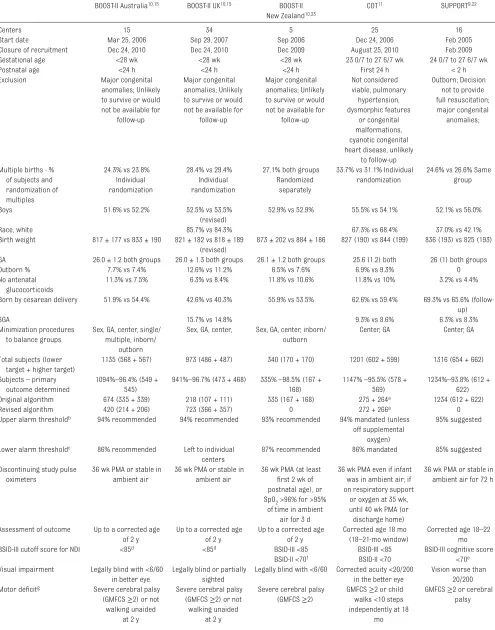
Five trials were included in this review. Table 1 provides a brief description of the trials and differences that might have influenced outcomes. The SUPPORT was conducted in the United States, and published in 2010 9; the COT
was a multinational trial published in 2013 11; and the BOOST-II
included 3 trials conducted in the
United Kingdom, Australia, and New Zealand, and was published in 2013. 10 The 18- to 24-month
results for the outcome of death/ NDI in SUPPORT were published in 2012.22 The 2-year outcome for
the composite of death/disability was published for BOOST-II New Zealand in 2014 23 and for the United
Kingdom/Australia in 2016. 15
Patient Characteristics
All 5 trials enrolled extremely premature infants <28 weeks’ PMA at birth. The exact postnatal age at inclusion and the lower limit of gestation differed slightly ( Table 1). The percentage of outborn infants differed between the studies; the SUPPORT trial included only inborn infants. There was a higher percentage of white infants enrolled in the BOOST-II (UK) compared with SUPPORT.
Primary Outcome
The primary outcome of the follow-up component of these 5 trials was death or NDI at 18 to 24 months’ corrected age. There was no difference between lower-target and higher-target groups (46.5% and 44.4%, respectively, P = .18, Fig 2A).
Outcomes by Subgroup: Pulse Oximeter Algorithm Assignment
impairment did not differ between the 2 groups (Figs 4 and 5).
Risk of Bias
By using the Cochrane risk-of-bias assessment, these studies were all at low risk of bias for sequence generation, concealment of allocation, blinding of participants and personnel, blinding of outcome assessment, incomplete outcome data, and selective outcome reporting. In the domain of other sources of bias, assessment of adequacy of achieved SpO2 in the 2 groups was a prespecified criterion in our protocol. Although a distinct, maximal 6% separation of SpO2 was planned in the study protocols, there was significant overlap in the SpO2 values achieved in the intervention and comparator groups.
Quality of Pooled Data for Each Outcome
The quality of pooled data for each outcome was high in the domains of inconsistency, 17 indirectness, 18
imprecision, 19 or publication bias. 20
The quality of evidence across all outcomes was assigned as moderate because of the overlap between the intervention and control groups.
Tails and Revision of Algorithm
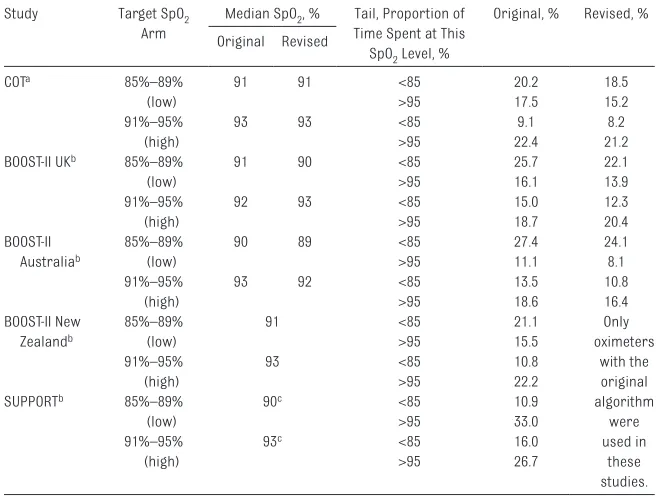
It has been suggested that proportion of time spent <85% (lower tail) may be associated with adverse outcomes such as mortality. The proportion of time spent <85% and >95% with original and revised pulse oximeter algorithms from SUPPORT, COT, and BOOST-II trials while infants were on supplemental oxygen is shown in Table
2. In the COT, after the first 3 days, data from infants who received >12 hours of supplemental oxygen only were included. The proportion of time spent <85% was significantly higher in the lower-target group compared with the higher-target group. Revision of the algorithm modestly reduced the proportion of time spent <85% and increased the proportion of time spent within the target 85% to 89% range in the lower-target group but this increase did not reach statistical significance ( Fig 6). We did not generate similar graphs for NEC and ROP because of the subtle differences in definitions in various trials and the impact of mortality on these outcomes.
Sensitivity Analysis
There was no difference in outcomes between random-effects and fixed-effects analysis.
Heterogeneity
Clinical and statistical heterogeneity was low for all outcomes.
Limitations
Subtle differences in inclusion criteria were observed ( Table 1): no outborn infants in the SUPPORT trial; time of randomization was short in SUPPORT compared with other trials. These differences could have contributed to the heterogeneity of patients. Errors in the pulse oximeter algorithm led to revision of the algorithm midway through 3 trials and could have contributed to heterogeneous results.
DISCUSSION
The 5 trials included in this systematic review were carefully planned in a collaborative manner to answer the following question: “Is the incidence of death and/or NDI different with a target SpO2 of 85% to 89% vs 91% to 95% in extremely premature infants?” With primary combined outcome data available in FIGURE 1
TABLE 1 Characteristics of the 5 Trials Addressing Optimal Oxygen Saturation Targets in Extremely Preterm Infants (Percentages Shown as Lower-Target Versus Higher-Target Groups)
BOOST-II Australia 10, 15 BOOST-II UK 10, 15 BOOST-II
New Zealand 10, 23
COT 11 SUPPORT 9, 22
Centers 15 34 5 25 16
Start date Mar 25, 2006 Sep 29, 2007 Sep 2006 Dec 24, 2006 Feb 2005
Closure of recruitment Dec 24, 2010 Dec 24, 2010 Dec 2009 August 25, 2010 Feb 2009
Gestational age <28 wk <28 wk <28 wk 23 0/7 to 27 6/7 wk 24 0/7 to 27 6/7 wk
Postnatal age <24 h <24 h <24 h First 24 h < 2 h
Exclusion Major congenital
anomalies; Unlikely to survive or would not be available for
follow-up
Major congenital anomalies; Unlikely to survive or would not be available for
follow-up
Major congenital anomalies; Unlikely to survive or would not be available for
follow-up Not considered viable, pulmonary hypertension, dysmorphic features or congenital malformations, cyanotic congenital heart disease, unlikely
to follow-up
Outborn; Decision not to provide full resuscitation; major congenital
anomalies;
Multiple births - % of subjects and randomization of multiples
24.3% vs 23.8% Individual randomization
28.4% vs 29.4% Individual randomization
27.1% both groups Randomized
separately
33.7% vs 31.1% Individual randomization
24.6% vs 26.6% Same group
Boys 51.6% vs 52.2% 52.5% vs 53.5%
(revised)
52.9% vs 52.9% 55.5% vs 54.1% 52.1% vs 56.0%
Race, white 85.7% vs 84.3% 67.3% vs 68.4% 37.0% vs 42.1%
Birth weight 817 ± 177 vs 833 ± 190 821 ± 182 vs 818 ± 189 (revised)
873 ± 202 vs 884 ± 186 827 (190) vs 844 (199) 836 (193) vs 825 (193) GA 26.0 ± 1.2 both groups 26.0 ± 1.3 both groups 26.1 ± 1.2 both groups 25.6 (1.2) both 26 (1) both groups
Outborn % 7.7% vs 7.4% 12.6% vs 11.2% 6.5% vs 7.6% 6.9% vs 9.3% 0
No antenatal glucocorticoids
11.3% vs 7.5% 6.3% vs 8.4% 11.8% vs 10.6% 11.8% vs 10% 3.2% vs 4.4%
Born by cesarean delivery 51.9% vs 54.4% 42.6% vs 40.3% 55.9% vs 53.5% 62.6% vs 59.4% 69.3% vs 65.6% (follow-up)
SGA 15.7% vs 14.8% 9.3% vs 8.6% 6.3% vs 8.3%
Minimization procedures to balance groups
Sex, GA, center, single/ multiple, inborn/
outborn
Sex, GA, center, Sex, GA, center, inborn/ outborn
Center, GA Center, GA
Total subjects (lower target + higher target)
1135 (568 + 567) 973 (486 + 487) 340 (170 + 170) 1201 (602 + 599) 1316 (654 + 662) Subjects – primary
outcome determined
1094%–96.4% (549 + 545)
941%–96.7% (473 + 468) 335% –98.5% (167 + 168)
1147% –95.5% (578 + 569)
1234%–93.8% (612 + 622)
Original algorithm 674 (335 + 339) 218 (107 + 111) 335 (167 + 168) 275 + 264a 1234 (612 + 622)
Revised algorithm 420 (214 + 206) 723 (366 + 357) 0 272 + 266a 0
Upper alarm thresholdb 94% recommended 94% recommended 93% recommended 94% mandated (unless
off supplemental oxygen)
95% suggested
Lower alarm thresholdc 86% recommended Left to individual
centers
87% recommended 86% mandated 85% suggested
Discontinuing study pulse oximeters
36 wk PMA or stable in ambient air
36 wk PMA or stable in ambient air
36 wk PMA (at least fi rst 2 wk of postnatal age), or SpO2 >96% for >95%
of time in ambient air for 3 d
36 wk PMA even if infant was in ambient air; if on respiratory support
or oxygen at 35 wk, until 40 wk PMA (or discharge home)
36 wk PMA or stable in ambient air for 72 h
Assessment of outcome Up to a corrected age of 2 y
Up to a corrected age of 2 y
Up to a corrected age of 2 y
Corrected age 18 mo (18–21-mo window)
Corrected age 18–22 mo BSID-III cutoff score for NDI <85d <85d BSID-III <85 BSID-III <85 BSID-III cognitive score
<70e
BSID-II <70f BSID-II <70
Visual impairment Legally blind with <6/60 in better eye
Legally blind or partially sighted
Legally blind with <6/60 Corrected acuity <20/200 in the better eye
Vision worse than 20/200 Motor defi citg Severe cerebral palsy
(GMFCS ≥2) or not walking unaided
at 2 y
Severe cerebral palsy (GMFCS ≥2) or not walking unaided
at 2 y
Severe cerebral palsy (GMFCS ≥2)
GMFCS ≥2 or child walks <10 steps independently at 18
mo
4751 infants, there is no difference between these 2 SpO2 target groups.
These trials used the composite outcome of mortality and NDI. The rationale for using the composite outcome in these trials was to account for death as a competing outcome and not because a difference in mortality was expected a priori. 24 Composite
outcomes, in which multiple end points are combined (with one of the end points being mortality), are frequently used as primary outcome measures in neonatal RCTs. In a review of major trials with composite outcomes, only 4% of the trials were significant for mortality but not for the primary composite outcome. 25 The
results of the current meta-analysis show higher mortality with lower target compared with higher target without any difference in composite primary outcome. This has led to considerable controversy regarding recommendations, with the revised European guidelines recommending a higher-target range (90%–94%) with Grades of Recommendation, Assessment, Development, and Evaluation level of evidence “B.” 26
However, adaptation of higher target has been linked to increased ROP 27
and the impact of these guidelines on mortality and long-term visual impairment and NDI needs to be closely observed.
Although a pooled analysis of the 3 BOOST-II trials did not show a
difference in primary outcome, 28 2
recent meta-analyses of all 5 studies 29, 30
reported an increased death/NDI with the lower target (RR 1.07 with 95% confidence interval 1.00–1.14, P = .04). However, these analyses included NDI as reported by individual study investigators with a BSID-III cognitive cutoff score of <70 for the SUPPORT and <85 for other trials. We have used uniform criteria for BSID-III cutoff scores for NDI (<85% for all studies) and demonstrated no significant difference for this primary outcome ( Fig 2A).
The quality of evidence was rated as high in the following domains: consistency, directness, precision, and lack of publication bias. The heterogeneity was low for all outcomes. The risk-of-bias category was graded as moderate due to a lack of separation in the target saturations. 31 A maximal separation of
6% was intended by using a masking algorithm that allowed gradual reduction to no separation outside of the target SpO2 range. 31–33 We
acknowledge that quality of evidence is subjective and should not be penalized, if maintaining SpO2 within a target range is exclusively due to clinical and practical factors. However, as pointed out by the COT investigators, 33 the
masking algorithm may have played a role in reducing the separation between the 2 groups. In the lower-target group, the displayed SpO2 decreased from 88% to 84% when
the true SpO2 changed from 85% to 84%, creating a zone of instability and tendency for the bedside provider to increase fraction of inspired oxygen (FIO2). This partly explains high median SpO2 (89%–91%) in the lower-target arms of the various trials ( Table 2). Similarly, in the higher-oxygen target group, the displayed SpO2 increased from 92% to 96% when the true saturation changed from 95% to 96%, creating a zone of instability and a tendency for the provider to decrease FIO2. However, the masking algorithm did not significantly affect the higher-target group (median SpO2 92%–93%, Table 2). The net effect was reduced separation between the 2 groups possibly as a consequence of the masking algorithm.
In the previously published BOOST-I trial comparing 2 SpO2 targets (91%– 94% and 95%–98%), the masking algorithm was simple with display SpO2 ± 2% throughout without an area of “correction” or instability. 7
The BOOST-I investigators achieved the intended 4% separation between the groups with this simple algorithm (a median of 93% in the “standard” saturation group with desired target SpO2 range 91%–94% and a median of 97% in the high SpO2 group with a desired target SpO2 range 95%– 98%). In contrast, most trials in the NeOProM collaboration achieved a median SpO2 of 90% to 91% in the lower-target group (outside the intended target 85%–89%). The
BOOST-II Australia 10, 15 BOOST-II UK 10, 15 BOOST-II
New Zealand 10, 23
COT 11 SUPPORT 9, 22
Hearing impairment Hearing loss requiring or too severe to benefi t from aiding or a cochlear implant
Hearing loss requiring or too severe to benefi t from aiding or a cochlear implant
Deafness requiring hearing aids
Prescription of hearing aids or cochlear
implants
Inability to understand the oral directions of the examiner and to communicate with or without hearing
amplifi cation GA, gestational age.
a In the COT trial, 70 infants were exposed to both algorithms. b Upper alarm limit refers to the displayed SpO
2 value (95% displayed SpO2 value corresponds to 92% in the lower-target group and 95%–96% in the higher-target group). c Lower alarm limit refers to the displayed SpO
2 value (86% displayed SpO2 value corresponds to 84%–85% in the lower-target group and 89% in the higher-target group). d Alternative measures of cognition and language if BSID-III not arranged in BOOST-II UK and Australia trials.
e Data for BSID-III cognitive score <85 included in this analysis.
f BSID-II <70 (assessed in 25 infants) and BSID-III <85 (assessed in 238/289 infants) or <10-word vocabulary at 2 years (assessed in 3/33 infants). g GMFCS: gross motor function classifi cation system scores range from 0 (normal) to 5 (most impaired).
NeOProM trials did achieve a median SpO2 of 92% to 93% in the high-target group (within the intended target range 91%–95%). Inability to achieve target SpO2 within the target range
appears to predominantly involve the lower-target range.
It is also possible that it is difficult to maintain SpO2 in the lower-target range
of 85% to 89% due to the inherent nature of the oxygen-hemoglobin dissociation curve 15 and not exclusively
due to the masking algorithm. The higher range includes the plateau of FIGURE 2
the oxygen-hemoglobin dissociation curve, in which SpO2 fluctuates less with changing PaO2. In contrast, the slope of the oxygen-hemoglobin dissociation curve is steep in the 85% to 89% range,
resulting in higher fluctuation in SpO2 with small changes in PaO2.
Finally, studies evaluating manual versus automated (closed-loop) FIO2
control provide data on difficulties in limiting SpO2 within a target range. Recent closed-loop FIO2 control studies 34, 35 suggest that the
proportion of time spent within FIGURE 3
range to be considerably higher with automated control (62% during automated and 57% with manual with target SpO2 of 91%–95% and 72.8% during automated and 59.6% with manual with target SpO2 of 90%–95%). However, the proportion of time spent within range with manual adjustment in these studies
is higher than that reported within the 91% to 95% target arm in the BOOST-II UK and Australia trial (43.4% and 48.7%, respectively). This further suggests that the masking algorithm may have played a role in reducing the amount of time spent within the target range.
The lower-target groups had higher SpO2 than intended and yet had significantly increased mortality compared with the higher-target group without significant heterogeneity for this outcome. Would the composite primary outcome or its components differ if the NeOProM studies had achieved the intended FIGURE 4
separation and the lower-target group had median SpO2 of ∼87%? One can speculate that the effect size of mortality and/or the combined outcome of mortality/NDI may be higher in the lower-target group if this group had spent more time in the 85% to 89% range (as intended). However, a subgroup analysis of the COT trial showed that centers with more separation observed lower rates of death/NDI in the 85% to 89% than the 91% to 95% target range. 36 Such post hoc analysis should
be interpreted with caution and the planned individual patient data meta-analysis might clarify the impact of separation on mortality.
From a physiologic perspective, revision of the algorithm had only
a minor impact on SpO2 and led to slightly better separation of the low- and high-target groups in the BOOST-II UK trial 15 (median SpO
2
in Table 2). The influence of this revision on outcome, especially mortality, varied between trials. In the SUPPORT trial, mortality at discharge was higher in the lower-target group with the original algorithm. In the BOOST-II UK trial, mortality trended lower in the lower-target group with the original algorithm and shifted to a significantly higher mortality after algorithm revision. In the BOOST-II Australia and COT trials, revision of the algorithm did not significantly change outcome. These differences in outcomes with algorithm revision are difficult to explain and we based the remainder of the discussion on
pooled analysis (original + revised algorithms). We hope that the planned individual patient data meta-analysis of the NeOProM studies will enhance our understanding of the impact of revision of algorithm on outcomes.
Although the studies were planned to be identical with similar patient population and SpO2 targets, many geographic and methodological differences may have contributed to differences in outcome ( Table 1). The early time of enrollment and randomization in the SUPPORT trial potentially led to inclusion of many sicker infants. It was recently reported that the increased mortality in the lower-target arm of the SUPPORT trial was predominantly seen in infants small for gestational FIGURE 5
age (SGA). 37 Respiratory diagnoses
(respiratory distress syndrome, BPD, and pulmonary hypoplasia) accounted for 48.6% of mortality among SGA infants in the SUPPORT. The incidence of SGA infants was similar in both arms of the study in all the trials but their percentage was higher in BOOST-II UK compared with COT and SUPPORT and could have contributed to higher mortality/morbidity in that trial. Exclusion of infants with pulmonary hypertension from the COT trial may potentially have contributed to lack of difference in mortality, as low SpO2 target may exacerbate pulmonary hypertension. 38 Outborn
infants, at risk for higher mortality and morbidity, were excluded from SUPPORT. Finally, oximeter alarm settings and implementation differed between the studies ( Table 1) and could have influenced outcomes.
If the median saturations were not well separated, what other factors could have influenced mortality in the lower-target group? The proportion of time spent <85% and >95% significantly differed between the lower-target and higher-target groups (as expected). Revision of the algorithm decreased the lower tail ( Table 2 and Fig 6). Although profound hypoxemia is associated with adverse outcome, we could not demonstrate an association between time spent <85% SpO2 at a study level and mortality. However, no conclusions can be derived from this observation without performing individual patient data analysis. It is possible that intermittent, profound desaturations and SpO2 range that an individual patient spends irrespective of whether on supplemental oxygen or not may influence outcome.
Major neonatal morbidities, including ROP, have a strong genetic component. 39, 40 Variations
in genetic factors 41 may play a role
in differences in mortality, NDI, and visual/hearing impairment
observed between BOOST-II UK compared with other studies. The percentage of white infants was higher in BOOST-II UK compared
with COT and SUPPORT ( Table 1) and might have played a role in increasing morbidity and mortality.42
TABLE 2 Median Saturations and Proportion of Time Spent <85% (Lower Tail) and >95% (Higher Tail) Based on Pulse Oximeter Algorithm (Original or Revised) While on Supplemental Oxygen
Study Target SpO2
Arm
Median SpO2, % Tail, Proportion of
Time Spent at This SpO2 Level, %
Original, % Revised, % Original Revised
COTa 85%–89%
(low)
91 91 <85 20.2 18.5
>95 17.5 15.2
91%–95% (high)
93 93 <85 9.1 8.2
>95 22.4 21.2
BOOST-II UKb 85%–89%
(low)
91 90 <85 25.7 22.1
>95 16.1 13.9
91%–95% (high)
92 93 <85 15.0 12.3
>95 18.7 20.4
BOOST-II Australiab
85%–89% (low)
90 89 <85 27.4 24.1
>95 11.1 8.1
91%–95% (high)
93 92 <85 13.5 10.8
>95 18.6 16.4
BOOST-II New Zealandb
85%–89% (low)
91 <85 21.1 Only
oximeters with the original algorithm
were used in
these studies.
>95 15.5
91%–95% (high)
93 <85 10.8
>95 22.2
SUPPORTb 85%–89%
(low)
90c <85 10.9
>95 33.0
91%–95% (high)
93c <85 16.0
>95 26.7
a All study days with >12 hours of supplemental O 2. b Time when the infant was receiving oxygen. c Estimate based on visual inspection of the graphs.
FIGURE 6
ABBREVIATIONS
AAP: American Academy of Pediatrics
BOOST-II: Benefits of Oxygen Saturation Targeting-II BPD: bronchopulmonary
dysplasia
BSID: Bayley Scale of Infant Development
COT: Canadian Oxygen Trial FIO2: fraction of inspired oxygen NDI: neurodevelopmental
impairment
NEC: necrotizing enterocolitis NeOProM: Neonatal Oxygenation
Prospective Meta-analyses
PaO2: partial pressure of oxygen, arterial
PMA: postmenstrual age
RCT: randomized controlled trial ROP: retinopathy of prematurity RR: risk ratio
SGA: small for gestational age SpO2: pulse oxygen saturation SUPPORT: Surfactant, Positive Pressure and Pulse Oximetry Randomized Trial
Primary Outcome
Based on this systematic review, a moderate level of evidence exists that suggests no significant difference in the primary outcome of death/NDI between SpO2 targets of 85% to 89% and 91% to 95% by using pooled data. We have previously reported that the incidence of NEC is more common in the target group. The lower-target group has a tendency toward reduced severe ROP. 13 Interestingly,
the higher incidence of ROP did not translate to increased severe visual impairment (defined as bilateral legal blindness, Table 1) at 18 to 24 months in the higher-target group. However, severe ROP and intervention for severe ROP result in other forms of visual impairment (eg, unilateral blindness) and nonvisual morbidity, 28
affecting quality-of-life outcomes for extremely preterm infants and must be taken into account while creating practical guidelines.
Conclusions and Practical Recommendations
The SUPPORT, BOOST-II, and COT are well-conducted trials addressing a very important question in neonatology. The study oximeters (errors in the original algorithm and the effect of masking algorithm on maintaining target range) may have at least partly influenced the results, casting doubt on the validity of these findings. The higher mortality (19.9% vs 17.1%) and reduced severe ROP in the lower-target group was not accompanied by a significant change in severe visual impairment (1.3% vs 1.2%). Although the primary outcome was similar between the 2 groups, these data do not support restricting the upper limit of SpO2 target range to 89% in preterm infants. Oxygen saturation targets between 91% and 95% appear safer, but are associated with increased incidence of ROP. 27 Practical
considerations, such as difficulty in maintaining SpO2 in a narrow 5% range, have resulted in subjects randomized to 91% to 95% spending
13.9% to 22.4% of the time with SpO2 >95% and subjects randomized to 85% to 89% spending 20.2% to 27.4% of the time <85% while on supplemental oxygen. Although the safer range appears to be 91% to 95%, avoidance of hyperoxia is warranted through education, innovation, and identification of alternate methods of monitoring (such as transcutaneous PO2) 43 and automated, closed-loop
adjustment of FIO2. 35, 36
Some experts have suggested reducing the lower limit of SpO2 alarm to the high 80s. 32 Target
ranges should not be equated to alarm settings. Alarm limits (lower limit of 89% and upper limit of 96%) have not been rigorously studied, but may offer a practical solution. Such settings can potentially limit the amount of time an extremely preterm infant spends in extreme hypoxemia (<85%) and hyperoxemia (>95%) but need further investigation.
The recently published AAP Clinical Report states that the ideal physiologic target range is a compromise among negative outcomes associated with either hyperoxemia or hypoxemia. 44 This
report mentions that recent RCTs suggest that targeted SpO2 range of 90% to 95% may be safer than 85% to 89% at least for some infants. The AAP report concludes that the ideal SpO2 range for extremely low birth weight infants remains unknown. 44
The revised 2016 European guidelines recommend SpO2 target between 90% to 94% (quality of evidence: moderate; strength of recommendation: weak) and alarm limits at 89% and 95% (quality of evidence: very low; strength of recommendation: weak) for preterm infants receiving oxygen. 26
Individual preterm infants have different mechanisms of susceptibility to injury and resilience to hypoxia and hyperoxia. 45 Factors such as corrected
gestational age, 46 growth status, 37
pulmonary hypertension, 38 and ROP47
influence the risk of hyperoxia and hypoxia. Results from the planned meta-analysis of individual patient data may clarify optimal targets for individual patients based on clinical characteristics and comorbidities and lead to an era of “precision-medicine” in neonatology. 43
In the meantime, we can state with moderate confidence that a lower alarm limit of 89% and an upper alarm limit of 96% offer a practical solution pending further studies and analyses.
ACKNOWLEDGMENTS
REFERENCES
1. Vento M, Saugstad OD. Oxygen as a therapeutic agent in neonatology: a comprehensive approach. Semin Fetal Neonatal Med. 2010;15(4):
185–189
2. Silverman WA. Oxygen therapy and retrolental fi broplasia. Am J Public Health Nations Health. 1968;58(11):2009–2011
3. Robertson AF. Refl ections on errors in neonatology: I. The “Hands-Off” years, 1920 to 1950. J Perinatol. 2003;23(1):48–55
4. Bolton DP, Cross KW. Further observations on cost of preventing retrolental fi broplasia. Lancet. 1974;1(7855):445–448
5. American Academy of Pediatrics, American College of Obstetricians and Gynecologists, March of Dimes Birth Research Foundation. Guidelines for Perinatal Care. Elk Grove Village, IL: American Academy of Pediatrics; 2007
6. Greenspan JS, Goldsmith JP. Oxygen therapy in preterm infants: hitting the target. Pediatrics. 2006;118(4):1740–1741
7. Askie LM, Henderson-Smart DJ, Irwig L, Simpson JM. Oxygen-saturation targets and outcomes in extremely preterm infants. N Engl J Med. 2003;349(10):959–967
8. Askie LM, Brocklehurst P, Darlow BA, Finer N, Schmidt B, Tarnow-Mordi W; NeOProM Collaborative Group. NeOProM: Neonatal Oxygenation Prospective Meta-analysis Collaboration study protocol. BMC Pediatr. 2011;11(1):6
9. Carlo WA, Finer NN, Walsh MC, et al; SUPPORT Study Group of the Eunice Kennedy Shriver NICHD Neonatal Research Network. Target ranges of oxygen saturation in extremely
preterm infants. N Engl J Med. 2010;362(21):1959–1969
10. Stenson BJ, Tarnow-Mordi WO, Darlow BA, et al; BOOST II United Kingdom Collaborative Group; BOOST II Australia Collaborative Group; BOOST II New Zealand Collaborative Group. Oxygen saturation and outcomes in preterm infants. N Engl J Med. 2013;368(22):2094–2104
11. Schmidt B, Whyte RK, Asztalos EV, et al; Canadian Oxygen Trial (COT) Group. Effects of targeting higher vs lower arterial oxygen saturations on death or disability in extremely preterm infants: a randomized clinical trial. JAMA. 2013;309(20):
2111–2120
12. Johnston ED, Boyle B, Juszczak E, King A, Brocklehurst P, Stenson BJ. Oxygen targeting in preterm infants using the Masimo SET Radical pulse oximeter.
Arch Dis Child Fetal Neonatal Ed. 2011;96(6):F429–F433
13. Saugstad OD, Aune D. Optimal oxygenation of extremely low birth weight infants: a meta-analysis and systematic review of the oxygen saturation target studies. Neonatology. 2014;105(1):55–63
14. Manja V, Lakshminrusimha S, Cook DJ. Oxygen saturation target range for extremely preterm infants: a systematic review and meta-analysis.
JAMA Pediatr. 2015;169(4):332–340 15. Tarnow-Mordi W, Stenson B, Kirby A,
et al; BOOST-II Australia and United Kingdom Collaborative Groups. Outcomes of two trials of oxygen-saturation targets in preterm infants.
N Engl J Med. 2016;374(8):749–760 16. Guyatt GH, Oxman AD, Vist G, et al.
GRADE guidelines: 4. Rating the quality of evidence—study limitations
(risk of bias). J Clin Epidemiol. 2011;64(4):407–415
17. Guyatt GH, Oxman AD, Kunz R, et al; GRADE Working Group. GRADE guidelines: 7. Rating the quality of evidence—inconsistency. J Clin Epidemiol. 2011;64(12):1294–1302 18. Guyatt GH, Oxman AD, Kunz R, et
al; GRADE Working Group. GRADE guidelines: 8. Rating the quality of evidence—indirectness. J Clin Epidemiol. 2011;64(12):1303–1310 19. Guyatt GH, Oxman AD, Kunz R, et al.
GRADE guidelines 6. Rating the quality of evidence—imprecision. J Clin Epidemiol. 2011;64(12):1283–1293 20. Guyatt GH, Oxman AD, Montori V, et al.
GRADE guidelines: 5. Rating the quality of evidence—publication bias. J Clin Epidemiol. 2011;64(12):1277–1282 21. Borenstein M, Hedges LV, Higgins JPT,
et al. Introduction to Meta-Analysis. Hoboken, NJ: Wiley; 2011
22. Vaucher YE, Peralta-Carcelen M, Finer NN, et al; SUPPORT Study Group of the Eunice Kennedy Shriver NICHD Neonatal Research Network. Neurodevelopmental outcomes in the early CPAP and pulse oximetry trial. N Engl J Med. 2012;367(26):2495–2504 23. Darlow BA, Marschner SL, Donoghoe
M, et al. Randomized controlled trial of oxygen saturation targets in very preterm infants: two year outcomes. J Pediatr. 2014;165(1):30–35.e2
24. Polin RA, Bateman D. Oxygen-saturation targets in preterm infants. N Engl J Med. 2013;368(22):2141–2142 25. Freemantle N, Calvert M, Wood J,
Eastaugh J, Griffi n C. Composite outcomes in randomized trials: greater precision but with greater uncertainty?
JAMA. 2003;289(19):2554–2559 Address correspondence to Satyan Lakshminrusimha, MD, Division of Neonatal-Perinatal Medicine, Women and Children’s Hospital of Buffalo, Buffalo, NY 14222. E-mail: [email protected]
PEDIATRICS (ISSN Numbers: Print, 0031-4005; Online, 1098-4275). Copyright © 2017 by the American Academy of Pediatrics
FINANCIAL DISCLOSURE: The authors have indicated they have no fi nancial relationships relevant to this article to disclose.
FUNDING: Funded by 5 R01 HD072929 – Optimal oxygenation in neonatal lung injury (Dr Lakshminrusimha). Funded by the National Institutes of Health (NIH).
26. Sweet DG, Carnielli V, Greisen G, et al. European consensus guidelines on the management of respiratory distress syndrome – 2016 update. Neonatology. 2016;111(2):107–125
27. Manley BJ, Kuschel CA, Elder JE, Doyle LW, Davis PG. Higher rates of retinopathy of prematurity after increasing oxygen saturation targets for very preterm infants: experience in a single center. J Pediatr. 2016;168:242–244
28. Cummings JJ, Lakshminrusimha S, Polin RA. Oxygen-saturation targets in preterm infants. N Engl J Med. 2016;375(2):186–187
29. Stenson BJ. Oxygen saturation targets for extremely preterm infants after the NeOProM Trials. Neonatology. 2016;109(4):352–358
30. Tarnow-Mordi W, Stenson B, Kirby A. Oxygen-saturation targets in preterm infants. N Engl J Med. 2016;375(2):187–188
31. Lakshminrusimha S, Manja V, Mathew B, Suresh GK. Oxygen targeting in preterm infants: a physiological interpretation. J Perinatol. 2015;35(1):8–15
32. Sola A, Golombek SG, Montes Bueno MT, et al. Safe oxygen saturation targeting and monitoring in preterm infants: can we avoid hypoxia and hyperoxia? Acta Paediatr. 2014;103(10):1009–1018 33. Schmidt B, Roberts RS, Whyte RK,
et al. Impact of study oximeter masking algorithm on titration of oxygen therapy in the Canadian oxygen trial.
J Pediatr. 2014;165(4):666–671.e2
34. Lal M, Tin W, Sinha S. Automated control of inspired oxygen in ventilated preterm infants: crossover physiological study. Acta Paediatr. 2015;104(11):1084–1089
35. van Kaam AH, Hummler HD, Wilinska M, et al. Automated versus manual oxygen control with different saturation targets and modes of respiratory support in preterm infants. J Pediatr. 2015;167(3):545–50.e1–2
36. Schmidt B, Whyte RK, Shah PS, et al; Canadian Oxygen Trial (COT) Group. Effects of targeting higher or lower oxygen saturations in centers with more versus less seperation between median saturations. J Pediatr. 2016;178:288–291.e2
37. Walsh MC, Di Fiore JM, Martin RJ, Gantz M, Carlo WA, Finer N. Association of oxygen target and growth status with increased mortality in small for gestational age infants: further analysis of the Surfactant, Positive Pressure and Pulse Oximetry Randomized Trial. JAMA Pediatr. 2016;170(3):292–294
38. Lakshminrusimha S, Manja V, Steinhorn RH. Interaction of target oxygen saturation, bronchopulmonary dysplasia, and pulmonary
hypertension in small for gestational age preterm neonates. JAMA Pediatr. 2016;170(8):807–808
39. Bhandari V, Gruen JR. What is the basis for a genetic approach in neonatal disorders? Semin Perinatol. 2015;39(8):568–573
40. Bizzarro MJ, Hussain N, Jonsson B, et al. Genetic susceptibility to
retinopathy of prematurity. Pediatrics. 2006;118(5):1858–1863
41. Bhandari V, Bizzarro MJ, Shetty A, et al; Neonatal Genetics Study Group. Familial and genetic susceptibility to major neonatal morbidities in preterm twins. Pediatrics. 2006;117(6):1901–1906
42. Ravelli AC, Schaaf JM, Mol BW, et al. Antenatal prediction of neonatal mortality in very premature infants.
Eur J Obstet Gynecol Reprod Biol. 2014;176:126–131
43. Quine D, Stenson BJ. Does the monitoring method infl uence stability of oxygenation in preterm infants? A randomised crossover study of saturation versus transcutaneous monitoring. Arch Dis Child Fetal Neonatal Ed. 2008;93(5):F347–F350 44. Cummings JJ, Polin RA; Committee
on Fetus and Newborn. Oxygen targeting in extremely low birth weight infants. Pediatrics. 2016;138(2):e20161576
45. Synnes A, Miller SP. Oxygen therapy for preterm neonates: the elusive optimal target. JAMA Pediatr. 2015;169(4):311–313
46. Hergenhan A, Steurer M, Berger TM. Gestational age-adapted oxygen saturation targeting and outcome of extremely low gestational age neonates (ELGANs). Swiss Med Wkly. 2015;145:w14197
47. Supplemental Therapeutic Oxygen for Prethreshold Retinopathy Of Prematurity (STOP-ROP), a randomized, controlled trial. I: primary outcomes.
DOI: 10.1542/peds.2016-1609 originally published online December 5, 2016;
2017;139;
Pediatrics
Veena Manja, Ola D. Saugstad and Satyan Lakshminrusimha
A Systematic Review
24 Months:
−
Oxygen Saturation Targets in Preterm Infants and Outcomes at 18
Services
Updated Information &
http://pediatrics.aappublications.org/content/139/1/e20161609
including high resolution figures, can be found at:
References
http://pediatrics.aappublications.org/content/139/1/e20161609#BIBL
This article cites 45 articles, 7 of which you can access for free at:
Subspecialty Collections
http://www.aappublications.org/cgi/collection/respiratory_tract_sub
Respiratory Tract
http://www.aappublications.org/cgi/collection/pulmonology_sub
Pulmonology
http://www.aappublications.org/cgi/collection/neonatology_sub
Neonatology
sub
http://www.aappublications.org/cgi/collection/fetus:newborn_infant_
Fetus/Newborn Infant
following collection(s):
This article, along with others on similar topics, appears in the
Permissions & Licensing
http://www.aappublications.org/site/misc/Permissions.xhtml
in its entirety can be found online at:
Information about reproducing this article in parts (figures, tables) or
Reprints
http://www.aappublications.org/site/misc/reprints.xhtml
DOI: 10.1542/peds.2016-1609 originally published online December 5, 2016;
2017;139;
Pediatrics
Veena Manja, Ola D. Saugstad and Satyan Lakshminrusimha
A Systematic Review
24 Months:
−
Oxygen Saturation Targets in Preterm Infants and Outcomes at 18
http://pediatrics.aappublications.org/content/139/1/e20161609
located on the World Wide Web at:
The online version of this article, along with updated information and services, is
by the American Academy of Pediatrics. All rights reserved. Print ISSN: 1073-0397.