GSJ: Volume 7, Issue 4
,
April
2019, Online: ISSN 2320-9186
www.globalscientificjournal.com
N
ATURAL
R
ESOURCES FROM
C
URSE TO A
B
LESSING
:
C
ONJURING THE
C
URSE
Dr. Saloua-Nassima Chaouche* [email protected]
Ecole Supérieure de Statistique et Economie Appliquée (Algiers)
Imen Benameur**
Ecole Supérieure de Statistique et Economie Appliquée (Algiers)
Professor Rachid Toumache*** [email protected]
Ecole Supérieure de Statistique et Economie Appliquée (Algiers)
Many countries are blessed with natural resources which in a perfect world means that they have the power to transform their economies, so that the abundance of the natural resource could produce wealth for the nation, but actually it leads to become overly dependent on one resource to the detriment of the rest of the economy. The volatile resource prices have especially negative impacts on weak-state economies and cause growth to be unstable, they actually become poorer. Given this very sad picture, one can ask if the curse of natural resources is a fatality, can anything be done? The main point for our purpose is to explore if the improvement of the governance, education sector , and high institutional quality with more transparency can be the antidotes and will help to conjure the spell and turn to "resource blessing". We estimated a regression variable for the period from 1986 to 2017, which is a function of a vector of explanatory variables, including the variable that measures the abundance of natural resources, those measuring institutional quality, as well as other control variables.
INTRODUCTION
Since the dawn of time people have moved to abundant natural resources land where natural resource endowments have helped many countries to grow and prosper; and since then natural resources remains a central axis of the debate about their impact on development. Indeed one of the core issues of development theory is the role of natural resources in the promotion of economic growth.
near-consensus has formed supporting the existence of a “resource curse” and the conventional wisdom postulates that natural resources are a curse for development occurred, contradicting the natural view that natural riches are riches. Using a simple cross-sectional design, Sachs and Warner find that countries with a higher ratio of commodity exports to GDP in 1970 had slower average growth over the next 20 years ,the literature on natural resources and growth has taken this result as a given.
However since the 1960s, a robust statistical evidence based on empirical growth studies taken into account all the possible influences and interactions has showed that natural resources are less often a blessing than a curse, countries rich in natural resources grow more slowly. This surprising feature of resource-rich economies is often argued that natural-resource production obstacle development by creating institutional failures. These economic explanations do not answer questions about the differences in performance across resource-rich countries, such as why diamonds have been a curse for Sierra Leone but a blessing for Botswana, or why oil has been a blessing for Indonesia. Neither can they explain why point source natural resources affect growth differently from natural resources with more diffuse rents.
Furthermore, in another important body of literature (Gelb 1988) and (Oss 1999) suggests that natural riches produce institutional where due to the abundance of natural resources various social groups attempt to capture the economic rents derived from the exploitation of natural resources. Since the 1990s, institutional economics has been the focus of debate following a series of studies. It has been demonstrated that the availability and productivity of resources used in productive processes are influenced by political decisions and by the institutional environment in general. Explore the link between natural resources and quality of institutions. One form of the institutions-driven resource curse is that resource discovery subsequently weakens institutions and thus growth1 . Another form treats institutions as exogenous to resource wealth, and the interaction between resources and institutions explains the divergent outcomes of resource rich countries2. More than that not only economic growth is affected negatively , indeed countries that are rich in natural resources have more unequal income distribution and a larger share of their population in poverty; they exhibit greater corruption, have more authoritarian regimes, spend more on the military, and face a higher probability of an armed conflict.
The structure of recent models of the relationship between natural resource abundance and economic growth is nearly always the same. An abundance of natural resources and heavy dependence on natural resources is taken to influence some variable that impedes growth, and the aim of the work is to identify these intermediate variables and their mechanisms. Two kinds of explanation have emerged to explain the “natural resource curse” The first focuses on how natural resources affect the economy, and the second on how they affect institutions3. The idea in this paper is an attempt to pinpoint the mechanisms through which natural resources harm growth, and to find which factors cause a resource curse or blessing to
1
See Ross 2001, Leite & Weidmann 2002, Sarr et al 2011
materialize, trying by to answer the following question what are the mechanisms behind the negative effect of natural resources.
EXISTING EXPLANATIONS FOR THE NATURAL RESOURCES CURSE
A large literature exists in the existing theoretical explanations of a resource curse, in other words the mechanism by which natural-resource production actively impedes the development process in non-resource industries. To provide explanations for the curse one needs to ask the right questions: Why do resource-rich economies grow slowly? Are natural resources a curse, are they destiny? When you start a research on natural resources curse you will probably be oriented to the so-called Dutch Disease phenomenon, named after the decline in the tradable sector that have been caused by the discovery of natural gas in the Netherlands4, basically the economy suffers from a Dutch Disease when natural-resource industries off crowd out off other growth promoting industries such as manufacturing5. The natural resource curse mechanisms Initial research, most notably Sachs and Warner (1995, 1999, 2001) pointed the macroeconomic transmission mechanisms, more specifically the Dutch Disease, as the main mechanism behind the negative effects of resource abundance on growth (Stevens and Dietsche 2008). Later studies, Robinson, Torvik and Verdier (2006), Mehlum, Moene and Torvik (2006), Stevens and Dietsche (2008) and Kolstad and Wiig (2009), have focused more on the political economy models. Kolstad and Wiig presented a new view criticizing the work of Sachs and Warner for putting later empirical studies “on the wrong track”, they argued that the resource curse is not necessarily about resource abundance, but the economic rents created by exploitation of natural resources. A natural resource discovery decreases the level of technology in the non-resource industry and decreases total economic growth, the equilibrium becomes inefficient because the positive externality associated with working in the non-resource industry is not internalized by labor.
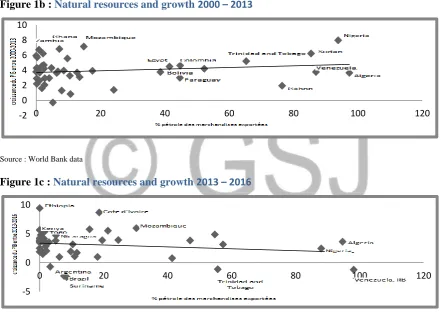
This first part of the paper judiciously examines the relationship between growth and resource dependence for a variety of growth periods using a range of linear regression specifications. Figure 1a, 1b and 1c show a scatter plot of natural resource abundance and economic growth around the world. The figures cover 48 countries for three periods the first period goes from 1990 to 1999, the second period from 2000 to 2013 and the last period goes from 2013 to 2016. Natural resource abundance, which is represented along the horizontal axis, is measured by the share oil export (% of exported goods), and economic growth per capita from 1990 to 1999– (see World Bank, 1999 for the data ). This measure of natural resources abundance comes closer to a direct measurement of the abundance of natural resources across countries than the various proxies that have been presented in the literature.
4 See Stijns, 2005 5
Figure 1a : Natural ressources and growth 1990 – 1999
Source : World bank data
Figure 1b : Natural resources and growth 2000 – 2013
Source : World Bank data
Figure 1c : Natural resources and growth 2013 – 2016
Source : World Bank data
Figures 1a and 1c show a negative trend of the regression line which prove a negative relationship between the abundance on natural resources and the economic growth.
The regression line through the scatter plot in Figure 1a suggests that an increase of 1 % points in the share oil export (% of exported goods) is associated with a decrease about an average of 5% of economic growth from 1990 to 1999. The regression line through the scatter plot in Figure 1c suggests that an increase of 1 % points in the share oil export (% of exported goods) is associated with a decrease about an average of 15% of economic growth for the third period 2013-2016. The figure 1a and 1c suggest that natural resource intensity may hurt the economic growth, this relationship is economically as well as statistically significant which coincide with the theory of natural resources.
0 5 10 15
0 20 40 60 80 100 120
-2 0 2 4 6 8 10
0 20 40 60 80 100 120
-5 0 5 10
The figure 1b covers the same 48 countries as in figure 1a and 1c, in opposite to the figure 1a the figure 1b shows a positive trend of the regression line which prove a positive relationship between the abundance on natural resources and economic growth. The slope of the regression line through the scatter plot of figure 1b suggests that an increase of 1 % points in the share oil export (% of exported goods) goes along with an increase about an average of 10% of economic growth for the second period 2000-2013.
The positive trend of the regression line which proves the existence of a positive relationship between the abundance on natural resources and economic growth.
The difference in trend proves that the study of bi-variate cross-sectional relationships has many shortcomings, it comes from the fact that these kind of analysis don’t account nor for the diversity of individual country experiences, neither for economic developments over time. In fact no conclusions could be drawn from the precedent regressions as a cause and effect.
However , one of the interpretation that we defend is that the curse of natural resources is not anymore seen as an "eternal fatality" , this difference of trends can give us little hope; natural resource rents can strengthen institutions and thereby contribute to economic development.
Indeed as the curse was strongly observed only during the period of post-independence of certain natural ressources rich contries , during which the powerful states of World have supported autocratic predatory regimes in order to expand their ideological positioning and to support the reproduction of their extractive colonizing powers, this context made the expropriation of annuities easier for the certain elite.
It is true that the discovery and exploitation of oil in Cameroon coincided with a economic decline and a deterioration of development, but it coincided with successful economic and human development in Botswana , Australia, Chile, Norway and the United States . This prove the wealth of resources could be blessing and contribute to economic development. The majority of empirical tests for the resource curse focus on the relationship between growth and resource dependence across countries, but there are reasons to believe that the resource curse is more prominent among countries. For example, institutional quality and human capital vary across countries, and such factors play crucial roles in some explanations of the resource curse.
ARE NATURAL RESOURCES A CURSE? ECONOMETRIC EVIDENCE
Empirical design
The average effect of resource outcomes is estimated with the following equation:
with
To address this problem, we apply three types of category variables suggested in the literature. Natural resources variables : Two measures of natural resources abundance are used to ensure unbiased results. The first measure is the share of oil, gas and ores rent from GDP, the second measure is the logarithm of one plus the value of per capita oil production6. Institutions quality variables : The variables used to measure institutional quality7 are ranked between -2.5 (weak institution) and 2.5 (strong institution) such that the institutional quality increases with the value of the indicator. Rule of law that represents the credibility rate of the population in state institutions, Regulatory quality reflects the ability of the public authorities to put in place sound policies and regulations that allow the development of the private sector, Government Effectiveness which reflects the perception of public services’ quality , as well as its degree of independence from political pressures, the quality of policy formulation and implementation, and credibility of the government's commitment to these policies. Control variables: Doppelhofer and Miller (2003)8 identified among 70 variables that could affect the economic growth, 17 variables are statistically robust, we selected9 the following variables: degree of openness10 , gross fixed capital formation, price index ,trade exchange term . We added two other variables representing capital human which are life expectancy at birth and average number of years of schooling at the age of 1511. All variables used in the different specifications of the model are stationary variables , we used for these purpose the Ducky fuller test (See table 2 appendix ). Data
6
See Alexeev and Conrad (2008) and (2009)
7
See Kaufmann, Kraay, and Zoido-Lobaton (2017)
8 See determinants of long-term growth: a bayesian averaging of classical estimates (bace) approach Xavier Sala-i-Martin, Gernot
Doppelhofer and Ronald I. Miller* February 15, 2003
9 The choice of these variables was made according to the availability of data
10 Calculated from data provided by the World Bank [instead of the number of years the country is open (SW Openess)], 11
EMPIRICAL RESULTS
Table 1: Estimation of the model with the first natural resources measure
Basic model
Model with institutions quality measures Model with capital human measure
Rule of law(1)
Government effectiveness(2)
Regulatory quality(3)
Rule of law(4) Government effectiveness(5)
Regulatory quality(6)
Control variables
Price index -0,33 -0,041 -0,023 -0,33 -0,024 -0,017 -0,008 (-1,76**) (-2,25**) (-1,29) (-1,88) (-1,17) (-0,87) (-0,48)
Degree of
Openness index -0,039 0144 0,308 0,271 0,356 0,265 -0,366 (-0,08) (0,30) (1,68) (0,49) (-0,75) (-0,57) (-0,968**)
Gross fixed
capital formation index 0,308 0,306 0,331 0,316 0,315 0,329 0,3721 (12,76***) (13,047**) (14,26**) (23,88***) (13,33***) (12,53***) (11,745***)
Exchange term
index 0,0007 0,0007 0,0007 0,0006 0,0008 0,0008 0,0009 (3,18**) (3,49**) (3,65***) (2,65***) (3,74***) (3,74***) (7,47***)
Oil-gaz-mineral
rente index 0,049 0,047 0,028 0,041 0,039 0,031 0,005 (2,47**) (2,5***) (1,45) (2,49**) (2,10**) (1,54) (0,24)
Institutions quality
Rule of law index -0,39 -0,028 (-1,95*) (-1,334)
Government
Effectiveness index -0,05 0,032 (-2,109**) (-1,542*)
Regulatory quality index 0.069 0,08 (2,034**) (1,95**)
Capital human
Life expectancy index 0,084 0.041 0.043 ( 0.906) (0.350) (0.447)
Average Nbre of years of schooling
At the age of 15 index -0,198 -0,188 -0,263 (-0.954) (-0.866) (-1.732)
Constant 0,0004 0,0008 -0,032 0.010 0.001 -0.0208 0.0106 (0.134) (0,314) (-1,99)* , (1,434)* (1,434)* (0,882) (1.953)**
Trend -0.0007
(-1.631)**
Nombre d’observations 32 32 32 32 32 32 32 R² 0.76 0.77 0.70 0.73 0.60 0.72 0.80
F-Stat 12.12 12.5 12.21 12.6 12.01 13.01 12.50
Note: Dependent variable log GDP , the estimation period is 1986-2017, the data are yearly data ,
t-statistics shown in parentheses. * significant at 10 percent, ** significant at 5 percent, *** significant at 1 percent.
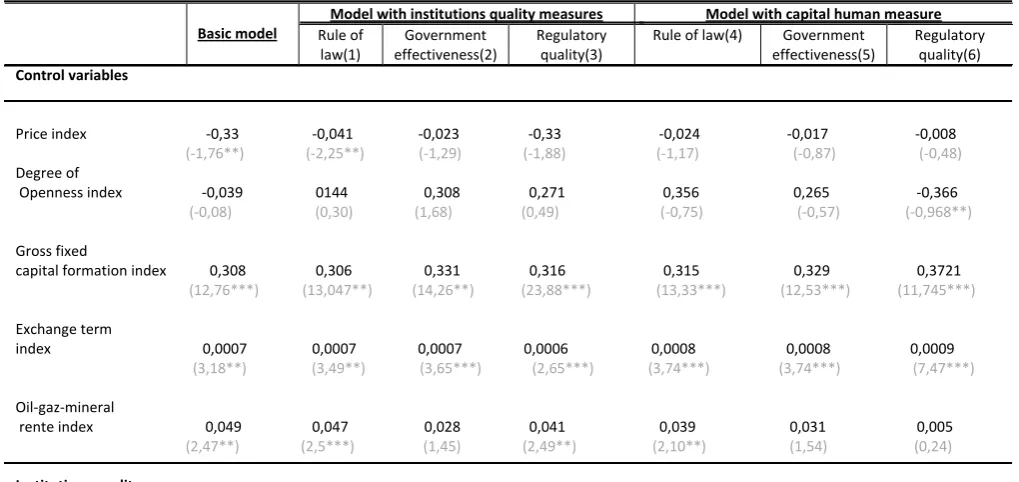
results in a variation of 0.048% of GDP. The impact of this variable does not change after the introduction of the institutional quality variables, this is seen in the regression (2), (3) and (4) a variation of 1% of this variable leads to a variation estimated at 0.047% of GDP with the "rule of law" variable as a measure of institutional quality, 0.069% with " Regulatory quality ", and 0.028% by introducing "government efficiency" as a measure of institutional quality. On the other hand, the institutional quality variable for the two measures "rule of law" and "government efficiency" has a negative effect on GDP, the level of significance of these variables is 10% in the two regressions (2) and (3), and is significant at 5% in the fourth, where a 1% increase in government efficiency would result in an estimated 5% decline in GDP. A 1% change in the "rule of law" variable would result in an estimated GDP decrease of 3.9%, while a 1% change in " Regulatory quality" is estimated to result in a 6% increase in GDP.
By introducing the measures of human capital the measure of the abundance of natural resources remains positive and significant except when we introduce " Regulatory quality" where it is not, thus a variation of 1% of the oil rent gas and minerals would result in an estimated variation of 0.039% of GDP. We take this as further evidence that the dangerous mix of weak institutions and resource abundance causes the resource curse.
The effect of the variable that measures the average number of schooling at the age of 15 is significant at 5% only in equation (6), where a 1% change would lead to an estimated decrease of 26% of GDP. In all regressions in the first table, the gross fixed capital formation variable is significant at 1%, and a variation of 1% would result in an estimated variation of 0.3% of GDP. In the same way a 1% change in the term of the exchange will result in an estimated variation of 0.07% of GDP with a level of significance of 1%.
With respect to the regressions in Table1, the only significant variables are the variable that measures the effect of natural resources and gross fixed capital formation, both of which have a positive effect on economic growth with a level of significance of 1%, so a 1% change in gross fixed capital formation would result in a 0.23% increase in economic growth, and a 1% increase in oil growth would lead to an estimated 0.27% increase in GDP. The equations (2), (3) and (4) in the table 1 show that the effect of the variables that measure the institutional quality is negative on the GDP. Variables that measure human capital are also negative in all regressions but their effect is not significant in all equations .
In Table 4 (See appendix ) we used mineral abundance as measure of natural resources – the share of mineral production in GDP12 – the regressions shows that the direct negative effect of natural resources becomes stronger, and the interaction effect increases substantially. Given that easily recoverable resources appear to be particularly detrimental to growth in countries with weak institutions13.
However , our worry is that our estimates may be biased by leaving out important explanatory variables. In regression 3 in Table 2 we investigate whether our results survive when we control for the level of education by introducing the average level of schooling at the age of 15 called the school enrolment rate14 . Compared to the estimates in regressions (6) and (5) in Table 1, the coefficients on resource abundance decrease marginally. This indicates that the growth disruptive effects that we identify are due to resources and institutions. In regression (6) we include all three variables above. As seen, our estimated coefficients are quite stable and remain significant.
INSTITUTION AND INSTITUTIONAL QUALITY
The natural resources curse theory was unable to explain the differences in performance across resource-rich countries, and unable to answer the very simple question : why natural resources have been a curse for a country and a blessing for another one? We assume that the right problematic is to understand why natural resources have affected economic growth differently. We want to investigate the association of the weakness of institutions governance and the waste on an enormous scale of natural resources through corrupted institutions. This paper is built on the intuition that institutional development is the best indicator for structural development and long term welfare creation for a nation. We don’t negate the fact the economic growth through the GDP growth is key for determining the short term trajectory of a nation regardless of its origin, but institutional quality determines whether short term gains are sustainable over the longer term. Actually a good quality of institutions cannot avoid all the economic crisis times of a nations neither prevent them , but institutions and long term economic progress are intimately linked . A good quality of institutions can helps the nation to recover from each crisis and regain some balance by returning to the path of growth and development .
The idea that the economic impact of natural resources is conditional on the quality of institutions15consists with the fact that there is a negative correlation between resource abundance (as measured by the ratio of exports of primary products relative to GDP and economic growth in countries where the quality of institutions is bad. But the same correlation is positive for countries, like Norway, which have stronger institutions.
Actually the literature is not clear on the way in which institutional quality influences growth, but it seems that institutions are weaker in resource-rich countries because it is easy for elites to capture or take large sums of cash, the theory suggests that large single source of revenue can be
12
See Sachs and Warner (1995)
13
A more detailed exploration of how different types of resources, in combination with institutions, affect economic growth has been done by Boschini et al. (2004). They use four different measures of resource abundance and show that institutions are more decisive the more appropriable the natural resources.
14
Sachs and Warner (1995).
15
managed outside the normal budget process and are relatively easily captured by powerful elites. elites in natural resource-rich countries are less likely to invest in productive enterprises, such as job-creating manufacturing industries, and instead pursue seeking, seeking and rent-seizing promotes corruption and is damaging to institutional development
Such differences in performance have given rise to a large literature offering political and institutional explanations of the resource curse.
Based on this view, we were attracted by the idea that the institutional quality can play a major role affecting the ability of countries to avoid the resource curse by creating a enabling environment conducive to economic growth. Economic growth is often seen at the success of economic policies pursued by the leadership of a country, this feeds through into the remaining discussion about what should be the first concern of the natural resources rich economies ; the institutional quality and development , or the economic growth , even more the independence of the economy from the natural resources rent . If institutional quality has a significant impact on the economic developments of resource-rich countries, the improvement of the quality of those is certainly the way to conjure the curse. In the econometric language we are trying to establish a relation between the institution quality natural resources curse, considering institution as the only channel through which resources influence the economy .
We need to distinguish between the concept of institutions and economic policies that directly address the issues related to the resource curse. We can see institutions as presented by Douglass C. North16 , he described the institutions as both formal and informal rules of behavior, as well as ways and means of enforcing these rules. It can be seen as the equilibrium outcome which arises through repeated interactions between agents. Examples of measures of institutional quality are many; the rule of law, transparency and accountability, trust and economic policies as it was defined by Masahiko Aoki17
One of important concept related to Institutions is the institutions quality and their effect on the GDP , and it was proved in many papers studying this relationship that countries with bad institutions performed worse and the most resource dependent countries in this group showed particularly low growth rates18 . Weak institutions are attractive to unproductive influence activities, the so-called rent-seeking institutions focus their activities to exploit natural resources and don’t involve in productive activities which establish a negative relation of correlation between the rent seeking purpose and production . Creating a kind of a competitive relation beneficing the elite in purpose which affect considerably the economic activity good health . The problem of institutional change is that those who benefit from the partially enhancing institution often are in a position to resist to the change. Government officials in countries with weak institutions will for instance be unwilling to reduce their opportunities to secure wealth and powerful positions through patronage and corruption. Minor institutional reforms will not be sustainable because elites have incentives to reverse the changes.
The assumption that are dressed here is that the institutions should be viewed as a basic requirement for economic development and long term growth, this implies that institutional quality should be constructed as a variable that is independent from economic growth and
16 Institutions, Institutional Change and Economic Performance, Cambridge: Cambridge University Press 1990 17 Endogenizing institutions and institutional changes 2007
18
changed in a way that aligns the interest of the government with the population, and that gives entrepreneurs incentives to behave socially optimal.
Of course there are many ways to measure the quality of institutions, and many of these measures are correlated. The three Norwegians created an institutional quality index based on the unweighted average of five indexes based on data from the Political Risk Services: a rule of law index, a quality index of the administration, a corruption index of government, an expropriation risk index, and a contract repudiation index by the government. Since many of the institutional measures used in this literature are the result of political processes, they are also closely linked to political factors.
Thus, this curse depends on a large number of factors that condition the impact of resources and affect the fundamental aspects of a country's political institutions (such as the nature of the Constitution), the basic economic institutions (the security of property rights), the nature of the state (quality of bureaucracy) and government policy (repudiation of contracts). In the end, their work reports a very important result: Cameroon experienced a resource curse after 1977 because some key aspects of its institutions were initially poor.
INSTITUTIONAL EFFECTS : ECONOMETRIC EVIDENCE
Regression Specification
One of the assumptions of the curse of natural resources is that it causes the growth of rent-seeking corruption and low government efficiency. Institutions are endogenous and can be affected by natural resources, to do this we will test if an intensity of natural resources act on through the
institutional variables to reduce growth 19
(1)
(2)
With
We want to measure the effect of natural resources measures on the institution quality using a time series linear regression presented in equation 1. Where λt is an institutional measure at time t , NRt is
the variable which represents natural resources, with a lag 1. It could either be the percentage of national income from primary commodity exports, the percentage of total exports from primary commodity exports, or the natural resources rents as in (M;Couttenier 2010) .
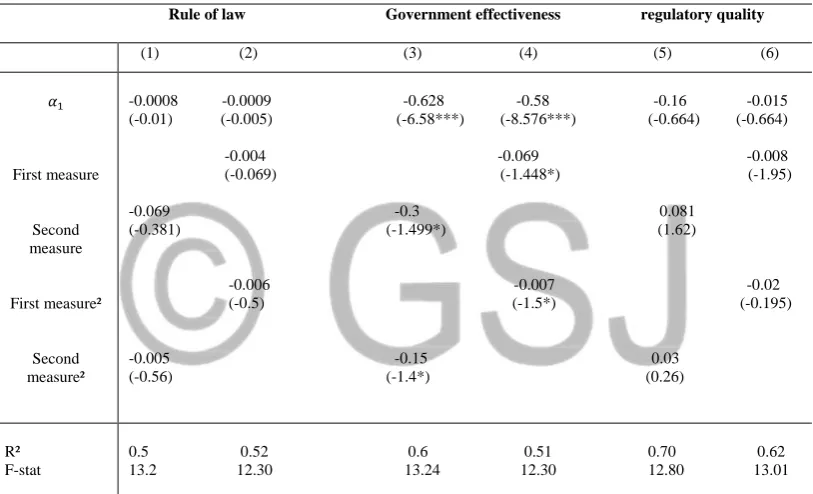
Equation 1 captures the natural resources linear effect on Institutional quality and the estimation results are presented in Table3, Equation 2 captures the natural resources no linear effect on Institutional quality and the estimation results are presented in (Appendix Table 5).
Table 3 and 5 summarizes all the results for the first six specifications using 3 different institutional measures which are endogenously determined by natural resources rents.
19
Table 3: The linear effect of natural resources on institution
Rule of law Government effectiveness regulatory quality
(1) (2) (3) (4) (5) (6)
First measure Second measure
-0.00002 -0.00009 -0.628 -0.62 -0.015 -0.015 (-0.001) (-0.005) (-8.642***) (-8.576***) (-0.664) (-0.664)
-0.004 -0.069 -0.014 (-0.069) (-1.448*) (-0.196) -0.069 -0.277 0.041
(-0.381) (-1.499*) (0.206) R²
F-stat
0.69 0.65 0.802 0.7 0.70 0.50 13.25 13.24 12,50 13.05 12.58 11.25
Note: Dependent variable is institutions quality measures (Rule of law , Government effectiveness , regulatory quality), t-statistics shown in parentheses. * significant at 10 %, ** significant at 5 %, *** significant at 1 %.
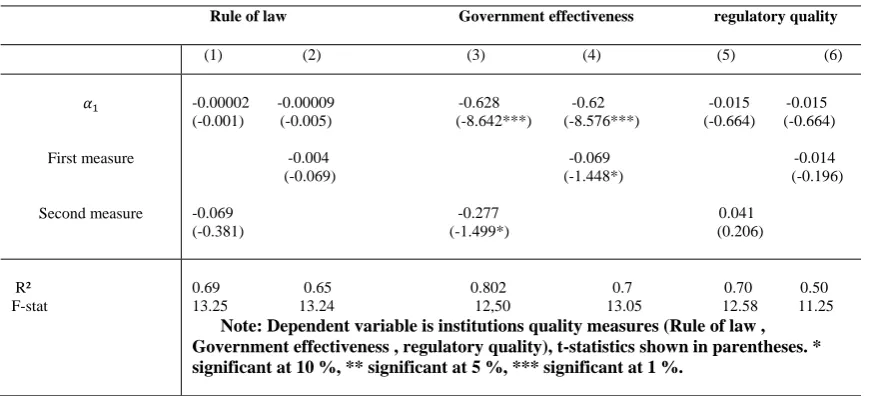
Results for specifications (1), (2), (5) and (6) suggest some different interpretations. The results in the previous table show that natural resources have a negative effect on institutional quality, even though they are not significant in all regressions.
The two variables that measure natural resources are significant in the only regressions (3) and (4) thus an increase in the oil revenue from gas and minerals would lead to a decrease of 0.069% in the efficiency of the government, and a decrease of of 0.277% using the value of oil as a measure of natural resources. These results support the hypothesis that natural resources affect economic growth through institutional quality.
The idea that we want to develop in this paper is that a good institutional quality can help reduce the curse or may even turn it into a blessing, but it is not obvious which type of institutional qualities is most beneficial in reaping the benefits of natural resources. This has important policy implications for government who tend to invest in improvements of the institutions in resource-rich countries to avoid the curse.
CONCLUDING REMARKS
The review of the relevant literature suggests that institutional quality drives economic progress predominantly by generating an environment conducive to technological change and adoption of innovations and new ways of organizing economic production, institutions determine how conducive the environment is for individuals to drive change. Indeed it determines the incentives people have to invest in physical and human capital to carve out their own economic success and drive macroeconomic growth in the process.
While our analysis so far is rough, leaving open many issues that warrant further analysis, we present clear preliminary results that suggest that institutional quality matters for natural resources countries to conjure the curse and achieve long term economic growth, and reap the benefits of their nature gift.
Countries rich in natural resources constitute both growth losers and growth winners, the hypothesis of the work claims that the main reason for these diverging experiences is differences in the quality of institutions and they are decisive for the resource curse.
We tried to show that the quality of institutions determines whether countries avoid the resource curse or not. The combination of good institutions and resource abundance leads to low growth. Institutions help countries to take full advantage of their natural resources. These results contrast the claims of Sachs and Warner that institutions are not decisive for the resource curse.
APPENDIX
Table 2 : Stationnarity test results
ADF(level) Critical value ADF(1 st differentiation)
Critical value ADF (2nd differentiation )
Critical value LGDP 1.19 -1.95 -4.64 -1.95
Price index 1.54 -1.95 -0.93 -1.95 -5.83 -1.95 Degree of
openness
-0.78 -1.95 -7.37 -1.95 L fixed capital
formation
-2.62 -3.6 -3.6 -1.95 Exchange term -0.52 -1.95 -7.1 -1.95 Oil rent 0.44 -1.95 -4.2 -1.95 Oil gaz miniral
rent
-0.31 -1.95 -3.12 -1.95 Rule of law -2.08 -3 -11.19 -1.95 Government
effectiveness
-4.7 -3.6 Regulatory
quality
0.32 -1.95 -6.13 -1.95
Life expectancy -0.14 -1.95 -1.09 -1.95 -5.52 -1.95 Nbre of years of
schooling
1.52 -1.95 -0.61 -1.95 -5.07 -3.6 Note : The ADF test decision rule : if Calculated value < critical value we reject H0 : there is no unit root
(the data are stationary ), and we accept H1: there a unite root (the data are not stationary )
Table 3: Statistical validation tests the linear effect of natural resources on institution
Normality test Autocorrelation test Durbin-Watson
Heteroskedasticity test
Specification stat p-value stat p-value stat p-value (1) 0.959 0.311 1.55 0.108 2.86 0.72
(2) 0.966 0.461 1.503 0.103 2.813 0.831
(3) 0.965 0.451 1.531 0.085 3.059 0.801
(4) 0.955 0.259 1.619 0.157 5.822 0.443
(5) 0.977 0.078 1.53 0.078 5.952 0.652
(6) 0.969 0.545 1.559 0.069 6.366 0.606
(7) 0.968 0.516 1.618 0.111 8.254 0.409
Table 4: Estimation of the model with the second natural resources measure Dependant
variable GDP growth
Basic model
Model with institutions quality measures Model with capital human measure
Rule of law Government effectiveness Regulatory quality
Rule of law Government effectiveness
Regulatory quality
Control variables (1) (2) (3) (4) (5) (6) (7)
Price index 0,006 -0,01 -0,006 -0,006 -0,012 -0,009 -0,008 (-0.306**) (-0.493**) (-0.332) (-0.289) (-0.594) (-0,459) (-0.398)
Degree
Openness index -0,209 -0127 -0,222 -0,193 -0,250 -0,034 -0,323 (-0,432) (-0,257) (-0.44) (-0.383) (-0,49) (-0.684) (-0,624)
Gross fixed
capital formation index 0,238 0,239 0,243 0,236 0,241 0,246 0,239 (6.68) (6.84) (6.43) (6.21) (6.82) (6.43) (6.23)
Exchange term
index 0,0001 0,0001 0,0001 0,00001 0,00001 0,0006 0,00001 (0.515) (0.487) (0.486) (0.447) (0.037) (-0.006) (0.045)
Oil-gaz-mineral
rente index 0,276 0,272 0.272 0,279 0,302 0,302 0,307 (4.80) (4.69) (4.54) (4.61) (4.77) (4.68) (0.96)
Institutions quality
Rule of law index -0,22 -0,022 (-0.86) (-0.842)
Government
Effectiveness index -0,012 -0,0.17 (-0.335) (-0.245)
Regulatory quality index -0,008 -0,003 (-0.19) (-0.09)
Capital human
Life expectancy index -1.466 -0.16 -0.144 (-1.16) (-1.210) (-1.109)
Average Nbre of years of schooling
At the age of 15 index -0,192 -0,166 -0,199 (-0.852) (-0.689) (-0.86)
Constant 0.002 0.002 -0.005 0.002 -0.001 0.01 0 0.008
R² 0.56 0.57 0.60 0.54 0.36 0.59 0.36
F-Stat 13.00 12.01 11.58 12.69 12.58 13.25 12.50
Note: Dependent variable log GDP , the estimation period is 1986-2017, the data are yearly data
t-statistics shown in parentheses. * significant at 10 percent, ** significant at 5 percent, *** significant at 1 percent.
Table 5 : The non linear effect of natural resources on institution
Rule of law Government effectiveness regulatory quality (1) (2) (3) (4) (5) (6)
First measure Second measure First measure²
Second measure²
-0.0008 -0.0009 -0.628 -0.58 -0.16 -0.015 (-0.01) (-0.005) (-6.58***) (-8.576***) (-0.664) (-0.664)
-0.004 -0.069 -0.008 (-0.069) (-1.448*) (-1.95) -0.069 -0.3 0.081
(-0.381) (-1.499*) (1.62)
-0.006 -0.007 -0.02 (-0.5) (-1.5*) (-0.195) -0.005 -0.15 0.03
(-0.56) (-1.4*) (0.26)
R² F-stat
0.5 0.52 0.6 0.51 0.70 0.62 13.2 12.30 13.24 12.30 12.80 13.01
REFERENCES
Abbas Amini(2018), « Studing the Effect of Abundance of Natural Ressources on Economic
Growth », European Journal of Development, N°1, Vol. 7, P. 201-208.
Althammer et Schneider(2013), « Does Oil and Gaz Wealth Eat uptotal Wealth : Analyzing
the ressource curse with measures of sustainable wealth », papers.ssrn.com.
Alexeev M. et Conrad R. (2009), « The Elusive Curse Of OIL », N° :91, The Review of
Economics and Statistics, N°. 3, Vol.91, 586-598.
Alexeev et Robert (2011), « The Natural Resource Curse and Economic Transition »,
Economic Systems, N°4, Volume 35, P. 445-461.
Bimal Chandra Roy, Satyaki Sarkar, Nikhil Ranjan Mandal (2013), « Naturla Resource
Abundance and Economic Performance- A Literature Review », Scientific Research
Publishing, N°4, Vol.1, 148-155.
Brunnschweiler C. N. (2008), « Cursing the Blessings ? Natural ressource abundance,
Institutions, and Economic Growth » World Developement, N°3, Vol. 36.
Doppelhofer et al. (2004), « Determinants of Long-Term Growth : A Bayesian Averaging of
Classical Estimates (BACE) Approach », American Economic Association,Vol. 94, N°4, 813-
835.
Frankel J., « The Natural Resource Curse : A Survey » (2010), Faculty Research Working
Paper Series
Gylfason,T. (2001), « Natural Ressources, education, and economic developement »,
european Economic Review, N°45, 847-859.
Mehlum et al. (2006), « Institutions and the Ressource Curse », The Economic
Journal,N°.508,Vol.116, 1-20.
Ramez A. Badeeb et Hooi Hooi Lean (2017), « The Evolution of the Natural Ressource Curse
Thesis : A Critical Literature Survey »,Resources Policy, Vol. 51,123-134.
Sachs J.D. et Warner A.M., (1995), « Natural Resource Abundance and Economic Growth».
Sachs J.D. et Warner A.M., (1997), « Natural resource abundanceand econmic growth »,
Center for International Development and Harvard Institute for International Development.
Sachs J.D. et Warner A.M. (2001), « Natural Ressources and Economic Development, The
curse of natural ressources », N° 45, European Economic Review, 827-838
Sala-i-Martin X., et Arvind Subramanian (2003), « Addressing the Natural Resource Curse :
An illustration from Nigeria », Economic Policy Options for a Prosperous Nigeria, P61-92.
Sala-i-Martin X., (1997), « I Just Ran two Million Regressions », American Economic