Indoor Positioning using cellular network and relay node
for wearables
Sreelakshmi Gollapudi
1,*, Lalit Kumar Pathak
1, Tushar Vrind
1, Diwakar Sharma
1and Samir Kumar
Mishra
11 Samsung Semiconductors India R&D Centre, Samsung Electronics, Bangalore, India
Abstract
Keywords: 3GPP, Narrow Band IoT, Device to Device Communication.
Received on 25 October 2018, accepted on 10 November 2018, published on 07 December 2018
Copyright © 2019 Sreelakshmi Gollapudi et al., licensed to EAI. This is an open access article distributed under the terms of the Creative Commons Attribution licence (http://creativecommons.org/licenses/by/3.0/), which permits unlimited use, distribution and reproduction in any medium so long as the original work is properly cited.
doi: 10.4108/eai.16-5-2018.156533
*
Corresponding author. Email:[email protected]
1. Introduction
As Per United States (US) Federal Communications Commission (FCC) the majority of wireless calls are now made indoors; and the majority of calls to 911 are from wireless phones. Traditional location accuracy technologies such as Global navigation satellite systems (GNSS) or Global Positioning System (GPS) are generally not suitable to establish indoor locations due to challenges of microwaves attenuation and scattering by roofs, walls and other objects. According to [1], FCC adopted an order on January 29th, 2015 in which, all carrier providers must provide location coordinates (x/y) within 50 meters, for the 40% of wireless 911 calls within 2 years and for 80% of wireless 911 calls within 6 years. Indoor position accuracy is very critical in public/children/women safety and emergency services.
An indoor positioning system (IPS) which locates people or objects inside building using radio waves, magnetic fields, acoustic signals or other sensory information collected by mobile devices should meet this new FCC requirement. This new requirement of the US FCC Enhanced 911 capability triggered 3GPP Release-13 study Item [2] for evaluating the performance of existing positioning methods and comparing with propo sed enhancements for indoor positioning with in E-UTRA and UTRA.
Observed Time Difference of Arrival (OTDOA) and Enhanced Cell ID (E-CID) mechanisms are the Pre Release-13 positioning methods. Observed Time Difference of Arrival (OTDOA) is a Location bas ed service, in which User Equipment (UE) measures the observed time difference of arrival from neighbouring base stations to serving base station, which is used by network (NW) entity to calculate the position of UE. In LTE Positioning Reference Signal (PRS) is specifically introduced for this purpose. The measured time difference
on Cloud Systems
Research Article
of arrival from serving to neighbouring base stations is called Reference Signal Time Difference (RSTD) is reported to NW. NW based on the positions of base stations and received RSTD calculates the position of UE. Reference [3] provides details of OTDOA in LTE.
Enhance Cell Id (E-CID) is a feature introduced in 3GPP Rel-9[4], in which Reference Signal Received Power (RSRP), Timing Advance, Round Trip Time (RTT) and Angle of Arrival from serving and neighbour cells are used to calculate the position of UE.
As part of 3GPP study Item [2] for 3GPP Release-13, Device to Device (D2D) aided positioning mechanism is considered for evaluation purpose. D2D is a mechanism in which direct communication between mobiles is enabled without going through base station or core network. First, it has been introduced in 3GPP, Rel-12[5] for public safety purposes in out of service areas during disasters like earthquake etc. Now it is being enhanced for positioning purposes.
RAT independent positioning methods such as Terrestrial Beacon System (TBS), Wi-Fi/BT and Barometer sensing are considered in study Item [2] for working along with 3GPP positioning methods to improve the indoor location accuracy.
TBS consists of a network of ground-based transmitters, broadcasting signals only for positioning purposes. The measured strength of broadcasting signals values are used for locating the device coordinates. In Wi-Fi based solution the User Equipment (UE), measured values such as RSSI of Wi-Fi will be used for positioning purposes.
In Blue tooth solution (BT), Blue tooth Low energy (BT-LE) beacons will be broadcasting signals with low power, and the target device that is in proximity can get the beacon ID and using the data base query, location of the device can be determined.
Barometers are good at detecting the altitude; with barometer sensing method vertical positioning accuracy will be improved.
3GPP Release-13 study Item [2] proposed enhancements are tabulated in the Table 1.
Based on the literature survey, we can say that the current state of art suffer the accuracy in the positioning, when object is in deep coverage area even with all these proposed enhancements. The 3GPP technology, Narrow Band Internet of Things (NB-IoT) introduced as part of [6], might be useful in addressing the deep coverage area problem. NB-IoT is a narrow band system that has been introduced to provide low-cost, low power, wide-area cellular connectivity for the Internet of Things. NB-IoT is based on Long Term Evolution (LTE) technology, supports most LTE functionalities though with essential simplifications to reduce device complexity. Further optimizations to increase coverage, reduce overhead and reduce power consumption while increasing capacity have been introduced as well. The design objectives of NB-IoT include low-complexity devices, high coverage (20dB), long device battery life, and massive capacity.
Table 1: Proposed Enhancements for Positioning
In [7] performance of various IPS methods are evaluated and as per which, the particle filter is the best optimal method and Kalman filter is the second best method for positioning. Kalman filter is best suited for linear Gaussian environment. The study in [8] presents a deeper study of unscented Kalman filter and particle filter. The study in [9] presents a detailed system modelling for positioning, tracking, and navigation.
In this research work, to best of our knowledge, first time attempt is made to improve the accuracy of indoor Existing Proposed Enhancements or New proposals OTDOA More dense PRS in time domain
PRS transmission enhancements for the same Physical Cell Identity (PCI) case
PRS or PRS-like transmission in un-license band
Cell Specific Reference Signal (CRS) together with PRS for RSTD measurement
Elevation Beamforming/Full Dimension MIMO based positioning enhancement
Enhanced RSTD measurements Reduce RSTD quantization error
Measurement performance
enhancements under Wide-band PRS etc
E-CID Network solution based on the UL component
Using Cell Specific Reference Signal (CRS) muting to differentiate among Transmission Point (TP)s
Using Channel State Information (CSI)-Reference Signal Received Power (RSRP ) measurements to determine the TP transmitting CRS used for the UE Rx-Tx
Using CSI-RS for UE Rx-Tx etc.
UE Rx-TX measuremen t with one serving cell
Enhancement of UE Rx-TX
measurement over multiple cells. Example, in the case of Dual connectivity Rx-TX measurement is done for both serving cells.
RAT Independent positioning
Interworking RAT Independent Positioning mechanisms along with 3GPP was proposed.
position by applying the existing algorithms of IPS (particle filter) with add-on framework of NB-IoT (by utilizing the high coverage aspect of NB-IoT ) and employing the relay based mechanism (LTE D2D) to get coarse and fine level proximity. D2D relay mechanism helps in the identifying the target device where target device is not in the coverage of NB-IoT or Macro cell. In the scenario, where NB-IoT coverage is available, D2D relay mechanism improves the accuracy of position coordinates.
Rest of the paper is organized in below format. Section 2 talks proposed model, section 3 talks about proposed schemes, section 4 talks about simulation results and section 5 about Conclusion and Future work. References are provided at the end.
2. SYSTEM MODEL
Our study addresses the problem related to the position of Indoor device “target node” which is NB-IoT and D2D capable. Three scenarios 1a), 1b) and 1c) are considered
1a) Target device has a weak connection with NB-IoT cell and no connection with LTE macro cell as shown in Figure 1.
1b) Target device has no connection with NB-IoT and LTE macro cell as shown in Figure 2.
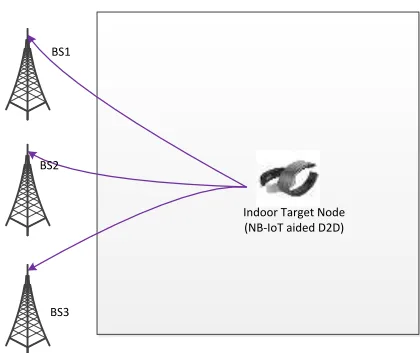
1c) Target device has direct connection with LTE Macro cells as shown in Figure 3.
NB-IoT is a promising technology for indoor positioning with 20dB coverage extension, but due to a large cell radius; it leaves scope for inaccuracies in positioning at least with Time of Arrival (TOA), OTDOA, and Angle of Arrival (AOA) based method where actual propagation of reference signal is higher than the line of sight (LOS) path.
In this mechanism target device has LTE D2D nodes around it to enable relay positioning and coarse position calculation from NB-IoT cells. In figure 1, OTDOA based method is considered to measure the position of relay nodes (using LTE macro and small cells) [2] and hierarchically use it to measure the position of target node using these relay nodes and NB-IoT cell.
In scenario 1a, OTDOA measurement based scheme, the hyperbolic equation has been set up and solved using joint least-square-based iterative method and Taylor series expansion for each relay node. Taylor series expansion method is an iterative method that starts with an initial guess of the condition that is close to the true solution to avoid local minima and subsequently improves the estimate at each step by determining the local linear least squares. Convergence of steepest descent method is fast when the initial guess is far from the true solution and Taylor expansion performs well when we are close to true solution [10]. This scheme used both Taylor expansion and steepest decent method to leverage the benefits of both methods.
In scenario 1b, also, the above-mentioned scheme is used to find the positioning of target node, however, in
this proposal, NB-IoT target node is not under cell coverage and completely depends upon the positioning reference point as relay node.
RE3:LTE D2D Relay RE1:LTE D2D Relay
RE2:LTE D2D Relay
Indoor Target Node (NB-IoT aided D2D) BS1
BS2
BS3
NB1
NB2
NB3
Figure.1 In the coverage area of NB-IoT and D2D relays
RE3:LTE D2D Relay RE1:LTE D2D Relay
RE2:LTE D2D Relay
Indoor Target Node (NB-IoT aided D2D) BS1
BS2
BS3
NB1
NB2
NB3
Figure.2 In the coverage area of only D2D relays
Indoor Target Node (NB-IoT aided D2D) BS1
BS2
BS3
3. PROPOSED SCHEMES
Consider deployment as shown in Fig. 1, 2, or 3, where set of NB-IoT cells, Nb = {NB1… … NBi} , set of 3GPP LTE macro or small cells Bs = {BS1… … BS𝑗} and set of relay nodes Re ={𝑅𝑒1… … Re𝑘} are considered to calculate location of the target node.
For 3GPP LTE small or macro cells Positioning Reference Signal (PRS) is used to get the relay node positions by applying OTDOA algorithm [1]. As there is no PRS available for IoT and LTE D2D system, NB-IoT reference signal and D2D discovery signals are considered to calculate Reference Signal Time Difference (RSTD) measurements for OTDOA.
The below pseudo code briefly describes the proposed algorithm, which is elaborated as well in following text.
Algorithm 1: Indoor Positioning Algorithm Step 1
Input: 𝑽 = 𝑩𝒔, positions of elements of 𝑽, N = |V| Output: Location of relay node
MET HOD For each Relay Node
1. Compute delay from each element of 𝑽 to relay node
2. Correlate the received reference signal from each element of 𝑽 with locally generate reference signal.
3. Estimate arrival time of signal from each element of 𝑽 at the relay node as position of the correlation peak.
4. Estimate time difference of arrival at relay node for each pair of elements of 𝑽 as the intersection of circles generated with the elements in the pair as centre.
(Radius of circle = speed of light * time difference of arrival) 5. Generate hyperbolas of constant delay difference using various
possible radii which intersects at the relay node location 6. Find the intersection point of hyperbolas using steepest descent. 7. After each measurement, update the intersection point using
Taylor series expansion. END
Step 2
Input: 𝑽 = 𝑹𝒆 ∪ 𝑵𝒃 (for scenario 1a) or 𝑽 = 𝑹𝒆 (for scenario 1b), N = |V| Output: Location of the indoor target node
MET HOD
Run Step 1 with updated input set 𝑽and get indoor target node location. END
Let’s assume 𝑋𝑖, 𝑌𝑖 are coordinate of 𝑉𝑖 node, 𝑅𝑖 is the distance between 𝑉𝑖 and target node and (x,y) are the coordinates of target node. 𝑅𝑖,1 is the value of range difference between node 𝑉𝑖 and node 𝑉1 (first reference node), which should be a constant on hyperbolic curve. 𝑅𝑖,1 = 𝑐 (𝑡
𝑖− 𝑡1)= c∆𝜏𝑖 = 𝑅𝑖 -𝑅1 (1)
To find the solution we need to start with an initial guess of target location (𝑥0,𝑦0) and declining 𝜃(𝑥, 𝑦) in the direction of steepest descent until we reach minima of 𝜃(𝑥, 𝑦) to get the solution [5].
𝜃(𝑥, 𝑦) = ∑ [∅
𝑁 𝑖(𝑥, 𝑦)
𝑖=1
]
2 (2)Here,
∅
𝑖(𝑥, 𝑦) = 𝑓
𝑖(𝑥, 𝑦) − 𝑑̂
𝑖+1,1 + 𝜀𝑖+1,1 (3) Where,𝑓𝑖(𝑥, 𝑦)=
√(𝑋𝑖+1− 𝑥)2+ (𝑌
𝑖+1− 𝑦)2 -√(𝑋1 − 𝑥)2+ (𝑌1− 𝑦)2
(4)
Let 𝑡̂𝑖 be the corresponding time of arrival at 𝑉𝑖
𝑓
𝑖(𝑥, 𝑦)
=
𝑑̂
𝑖+1,1+
𝜀
𝑖+1,1(5)
Where d̂i+1,1 = c( t̂i+1− t̂1) andεi+1,1 is the range differences estimation error with covariance 𝑹.
Now, new (𝑥1,𝑦1)(based on steepest descent) can be updated using Taylor series expansion to improve the accuracy of target node [5].
𝑓𝑖(x1, y1) + 𝑎𝑖,1𝛿𝑥 + 𝑎𝑖,2𝛿𝑦 = 𝑑̂𝑖+1,1
+
𝜀
𝑖+1,1(6)
Here,𝛿 is weighted least square [5] as mentioned below
𝛿
= [𝐴𝑇 𝑹−1 𝐴]−1𝐴𝑇𝑹−1𝐷(7)
𝛿=
[δ
x,δ
y],
A=
[
𝑎
1,1𝑎
1,2𝑎
𝑁−1,1𝑎
𝑁−1,2],
D=
[
𝑑̂
2,1− 𝑓
1,0𝑑̂
𝑁,1− 𝑓
𝑁−1,0]
𝐑is the covariance matrix of the estimated observed time difference of arrival.
4. SIMULATION AND RESULTS
In our simulation environment, since there is no PRS available for NB-IoT and LTE D2D system, we have considered NB-IoT reference signal and D2D discovery signals to calculate RSTD measurements for OTDOA. The simulation environment is captured in Table 2, where in assumption is made that all the relay nodes are also static in position. LTE base station and NB-IoT base stations are already of static in nature.
Table 2: S imulation environment No of LT E base station - Bs 3 No of NB-IoT base station -Nb 3 Relay Node (LT E D2D device) -
Re 3
Target Node -T n 1
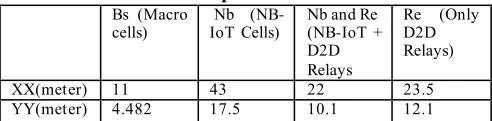
The simulation result is captured to identify the error in detection in the location of target Node Tn from the actual position in case of GPS coordinates are not available. Results are captured for multiple scenarios as mentioned in the Table 3.
Table 3: Result-error in position coordinates detection Bs (Macro
cells) Nb (NB-IoT Cells) Nb and Re (NB-IoT + D2D Relays
Re (Only D2D Relays)
XX(meter) 11 43 22 23.5
YY(meter) 4.482 17.5 10.1 12.1
only NB-IoT cells (reference signals no PRS) due to large cells site.
Using the proposed algorithm, the error in detection the Tn location reduced to (22, 10.1) from (43, 17.5) in scenario 1a, once the LTE D2D relay nodes are introduced. Here initial guess of the Tn location is taken as the one detected using NB-IoT nodes.
We have applied the proposed algorithm and captured the results with scenario 1b under which only LTE relay nodes are used and NB-IoT coverage is not available.
In scenario 1b, simulation results show more inaccuracies as compare to 1a (from (22, 10.1) to (23.5, 12.1)), due to the absence of NB-IoT nodes and inaccuracy at LTE-D2D location propagated while calculating the position at target node.
5. CONCLUSION AND FUTURE WORK
In this paper, the indoor positioning of the target node (NB-IoT and D2D capable) using NB-IoT and LTE-D2D relay nodes is proposed and studied. While proposed method (Taylor expansion and steepest descent method: forced non-linearization) enables indoor positioning for the weak or isolated node, at the same time, relay node positioning inaccuracies have been propagated to target node resulting errors in the position coordinates of the target node. This inaccuracy can be addressed by choosing best LTE-D2D relay nodes while calculating positioning for the target node. Our future work involves usage of unscented particle filters to mitigate the inaccuracy caused due to the LTE D2D relay mechanism and mobility aspects.
References
[1] https://docs.fcc.gov/public/attachments/FCC-15-9A1.pdf [2] 3GPP, TR 37.857- Study on indoor positioning
enhancements for UTRA and LTE Release 13
[3] http://www.rfwireless-world.com/Terminology/OTDOA-basics-and-OTDOA-working-in-LTE.html
[4]
http://www.rohde-schwarz-wireless.com/documents/LTELBSWhitePaper_RohdeSch warz.pdf
[5] http://d2d45g.gforge.inria.fr/Workshop -June2016/slides/Overview_LTE_D2D.pdf
[6] RP-151621, NB-IOT, QualComm, 3GPP TSG RAN M eeting #69, Phoenix, USA, Sep. 14 - 16, 2015
[7] Lepaski, Novel M ethods for Personal Indoor Positioning. ISBN (electronic: 978-952-15-3612-0) Tampere university [8] Eric wan, “The unscented kalman filter”
https://www.seas.harvard.edu/courses/cs281/papers/unscen ted.pdf
[9] Gustafsson Particle Filters for Positioning, Navigation and Tracking. IEEE Transactions on Signal Processing, Feb 2002