Joint optimization for broadcast service rendering and
call connectivity for dual stack mobile devices
Krishna Daamini E*, Rohan Raj
, Vinay Kumar Shrivastava
and Lalit Pathak
Samsung Semiconductor India R&D Center
Samsung Electronics
Bangalore, India
Abstract
INTRODUCTION: Multimedia Broadcast Multicast Service (MBMS) primarily targets broadcasting mobile television contents and video streaming services. Consumers worldwide are rapidly using Dual SIM Dual Standby (DSDS) device that utilizes a single common Radio Frequency Integrated Circuit (RFIC) for supporting more than one Subscriber Identity Module (SIM) cards. These two popular feature requirements are quite contrasting and pose a significant challenge to the design and implementation of User Equipment (UE) to achieve lossless MBMS video performance and Call connectivity Key Performance Indexes (KPIs).
OBJECTIVE: This paper targets a cross-layer optimization merging the application-domain quality metrics to the modem level realization of the DSDS scheduler algorithm and enhances the performance.
METHOD: The knowledge about the video quality metrics is used to design inputs to the modem scheduler and derive the packet loss thresholds that would be bearable to sustain the desired video quality.
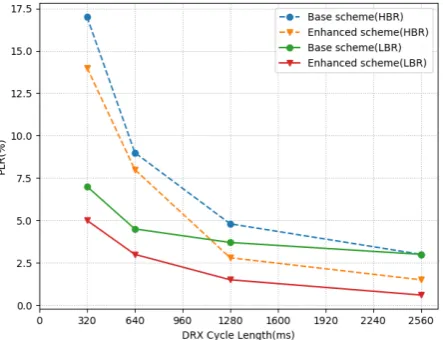
RESULTS: Simulation model is prepared based on configurations which are taken from real field values used in commercial network operations. Different configurations of the jitter buffer sizes are defined along with watermarks level to determine the buffer status and corresponding set of actions in terms of DSDS scheduler operation adaptation as a feedback. Based on experimentation, with buffer window of 50ms and 10 % FEC redundancy configuration, optimum performance is determined when RFIC throttling with 25% RFIC rejection for paging occasions is applied. No adverse impact is seen on paging while packet loss performance is optimized.
CONCLUSION: Performance of MBMS operation on DSDS device is considered in this paper. Proposed algorithm provides the guidelines for designing the RFIC scheduler for DSDS operation to achieve robust and enhanced MBMS video performance along with maintaining call connectivity KPIs.
Keywords: MBMS, DSDS, QoS, RFIC, SIM, PLR, LTE, Video.
Received on 20 August 2019, accepted on 14 October 2019, published on 05 November 2019
Copyright © 2019 Krishna Daamini E et al., licensed to EAI. This is an open access article distributed under the terms of the Creative Commons Attribution licence (http://creativecommons.org/licenses/by/3.0/), which permits unlimited use, distribution and reproduction in any medium so long as the original work is properly cited.
doi: 10.4108/eai.5-11-2019.162594
*Corresponding author. Email:[email protected]
1. Introduction
MBMS primarily targets distributing mobile television contents and video streaming services over wider coverage
regions in a spectrally efficient manner using LTE broadcast communication. Recently MBMS is becoming increasingly popular with more than 20 leading operators worldwide in the process of trialling/ commercializing the service [1]. At the same time, DSDS UEs that utilize a
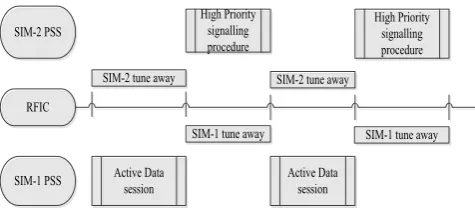
cards are getting RFIC SIM-1 PSS SIM-2 PSS Active Data session High Priority signalling procedure Active Data session High Priority signalling procedure SIM-2 tune away
SIM-1 tune away
SIM-2 tune away
SIM-1 tune away
Figure 1. DSDS Operation in SIM-1 and SIM-2
rapidly used by consumers leveraging the benefit of multiple Networks/ Radio Access Techniques/ Mobile numbers /Data Tariff plans with the same UE (currently DSDS UEs occupy 74% market share in China and India). However, these two popular feature requirements are quite contradictory and pose a significant challenge to the design and implementation of UEs in achieving lossless MBMS video performance while maintaining the KPIs of call connectivity in DSDS device.
In the next two subsections, a brief overview about DSDS and MBMS operation is discussed which will help in establishing the problem more clearly.
1.1. DSDS Operation
In a DSDS UE, SIM-1 and SIM-2 are associated with respective operators and to save cost, RFIC is shared by the respective Protocol Software Stacks (PSS) catering to each SIM. Capability of DSDS UEs to connect with two operators through a single RF to avail the benefits offered by both operators makes DSDS an attractive solution. DSDS RFIC tune away operation in UE, while SIM-1 is on an active data session with Operator-1 and SIM-2 is scheduled to attend higher priority time critical operations (e.g. paging, signaling, system information read, measurements, broadcast info reception etc.) with Operator-2, will eventually tune away RFIC from SIM-1 PSS, thus moving SIM-1 PSS to a standby state. 3rd Generation Partnership Project (3GPP) Long Term Evolution (LTE) specification is now considering dual SIM (MultiSim) functionality as a feature for DSDS operation [8]. The RFIC tune-away events are handled with the efficient design in the UE with the specific module named as DSDS scheduler to have fair scheduling of the RFIC across the SIMs so that for both SIMs various KPIs are maintained at satisfactory level.
1.2. MBMS Operation
With the ease of mobile internet access, multimedia applications have increased tremendously. Most of the multi-media content is common to all the users. Instead of transmitting the same data on multiple resources, it is
the users trying to access the content. For this purpose, 3GPP has introduced MBMS feature in the release 9 of LTE standard, sometimes also termed as LTE Broadcast. In a standard unicast transmission, the data reaches many users but only the single targeted user decodes it. The other users simply ignore it. MBMS feature makes use of this inherent broadcast quality of the wireless network such that any user who wants to receive the data can decode it. In this way, the resources used by broadcast transmission are significantly reduced than unicast transmission. One way to realize this is the use of Single Frequency across all the cells broadcasting a set of multimedia services (Multimedia Broadcast Single Frequency Network). All these cells use the same frequency resources and transmit the same content in a time-synchronized manner. Multi-cell transmission with time synchronization also facilitates over the air combining of the signal and enhances the reliability and coverage of the MBMS services. MBMS terms referred in this paper are explained below.
• MBSFN Area: It consists of a group of cells,
which transmit the same MBMS data in a time-synchronized manner.
• MCCH Modification Period: The EUTRAN
modifies the MBMS configuration sent on MCCH (MBMS Control Channel) at the start of MCCH modification period.
• MCCH Repetition Period: The same MCCH
repeats with Repetition Period within a Modification Period so that UE trying to receive MBMS service in the middle of modification period can get the configuration.
• MSP: Indicates MBMS Scheduling Period which
is the periodicity used for providing MCH scheduling information at lower layers (MAC) applicable for an MCH [7].
1.3. Video Quality Evaluation (VQA)
Satisfactory user experience with enhanced Quality of Experience (QoE) and Quality of Service (QoS) for the video applications while ensuring efficient call connectivity KPIs is of paramount importance. Previous works have mainly concentrated on video application enhancements targeting subjective/objective QoE [2] [3].
As explained earlier, MBMS scheduling is independent of UE request or channel condition or UE type (single SIM or DSDS). This becomes a problem when the UE supports DSDS. If SIM-1 PSS is receiving MBMS data and SIM-2 PSS is set for other high priority time critical operations, MBMS packets will be lost while the RFIC is scheduled for those time critical operations in SIM-2 PSS. This loss of packets will trigger the poor quality of video reception as a result hampering the user experience. Typically, user experience is degraded with video freeze or stalling problems (when sufficient video packets are not available in the jitter buffer to play out smooth video) and video glitches problems (when there are losses of video packets in the received stream).
Literature has not captured this problem where MBMS operation is considered on DSDS device. To the best of our knowledge, first time this paper targets a cross-layer optimization merging the application-domain quality metrics to the modem level realization of the DSDS scheduler algorithm and meeting both the requirements. The rest of the paper organized as below. Section II captures system model and proposed solution, Section III talks about the simulation and results and section IV summarize the current research work along with the future scope
2. System Model and Approach
Subjective video quality as perceived by users is expressed using MOS (Mean Opinion Score) ranging 1 to 5, whereas objective Video Quality Assessment (VQA) algorithms with respect to original reference video stream evaluate in terms of PSNR (Peak Signal to Noise Ratio) ranging over a scale of 1 to 100 in the order of higher quality.
In our proposed solution, we translate the knowledge about the video quality metrics to design inputs to the modem scheduler and derive the packet loss thresholds that would be bearable to sustain the desired video quality. We further adapt the RFIC scheduling operation for DSDS UEs to meet the twin challenge of maintaining video quality and retain the KPI of call connectivity at the same time. Moreover, it is attempted to transform the bulk and continuous packet losses into random losses with efficient RFIC scheduling operation that, in turn, facilitates the FEC (Forward Error Correction) codes e.g. Raptor codes or file repair operation to rectify and recover the losses more efficiently. It also enables better operation from the jitter buffer with lesser buffering requirements.
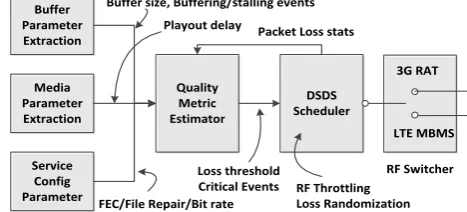
Fig. 2 shows the overall structure of proposed system wherein the cross layer operation is realized by utilizing extracted QoE metrics to derive inputs to the DSDS scheduler. As depicted, three different sets of static and
dynamic QoE parameters are extracted pertaining to buffer, media and configuration blocks for the MBMS video service. These inputs along with critical events like buffering/stalling etc. are fed to Quality Metric Estimator block. It also receives video packet loss statistics as
Buffer Parameter Extraction Media Parameter Extraction Service Config Parameter Quality Metric Estimator DSDS Scheduler 3G RAT LTE MBMS RF Switcher Packet Loss stats
RF Throttling Loss Randomization Loss threshold
Critical Events FEC/File Repair/Bit rate
Buffer size, Buffering/stalling events Playout delay
Figure 2. Structure for Optimized MBMS-DSDS capable UE
feedback from DSDS scheduling operation. Based on these inputs, loss threshold for the given video service is determined and is given to DSDS scheduler that appropriately switches RFIC scheduling between non-MBMS and non-MBMS PSS. It utilizes two approaches in order to meet loss threshold viz. RFIC throttling that implies a ratio of RFIC rejection to the total RFIC requests made from the non-MBMS stack and loss randomization wherein to avoid larger RFIC black-outs, rather multiple smaller RFIC allocations are provided to non-MBMS stack in response to RFIC requests.
In our algorithm following different QoE based design parameters are considered:
• FEC: The application level Forward Error
Correction (FEC) scheme addresses the issue of packet loss by use of redundant data. It adds error-correcting information to the original data, which can be used to maintain video quality even when packets are lost
• Jitter Buffer size: The UE maintains a jitter buffer
for the received packets for playing out contents. Therefore, if there is a delay in reception of packets or bearable packet loss, the buffer packets can be played without degrading the video quality.
• Play out delay: The packets will be received with
slight delay after the transmission based on network. To overcome these delays the receiver waits for certain number of packets before playout. This gap between the transmission of packets and actual playout at the receiver is called playout delay.
Loss threshold is determined on the basis of static attributes like FEC and file repair capability, bit rate,
service delay constraints (design parameter, Wstatic).
Wcrit). This determination is to be updated at each scheduling occasion and is to be fed to DSDS scheduler block. We formulate this with assigning different weightage to involved design parameters and evaluate
overall weight factor W to compute and scale
instantaneous loss threshold as
W = µWstatic - βWdyna - γWcrit - δWstat (1)
Where μ, β, γ, and δ are linear factors that represent
relative significance of the design parameters, Wstatic, Wdyna,
Wcrit and Wstat respectively.
Further, to facilitate loss randomization and RFIC throttling approaches, MBMS control and scheduling information, which are configured by network signaling for longer periods such as, determined by MBMS scheduling Period (MSP), MCCH Modification Period (MP) and Repetition Period (RP) are also provided to DSDS scheduler at beginning of these periods.
3. Simulation Results
Simulation model is prepared based on the mathematical model presented in section II and performance of suggested approach is evaluated using the data from real test beds and commercial devices. It is assumed that SIM-1 PSS has access to LTE for MBMS video service and SIM-2 PSS with other time critical operations like paging.
Table 1. Simulation Parameters [4]
Information Type Distribution Parameters
Inter-arrival time
(successive frames) Deterministic (20 fps ) 50 ms # Packets in a frame Deterministic 8 Packet size Truncated Pareto (Mean
= 400 bytes , Max= 1000 bytes)
K = 160 bytes
α = 1.2
Inter-arrival time
(packets in a frame) Truncated Pareto (Mean = 6 ms , Max= 12.5 ms) K = 2.5 ms α = 1.2
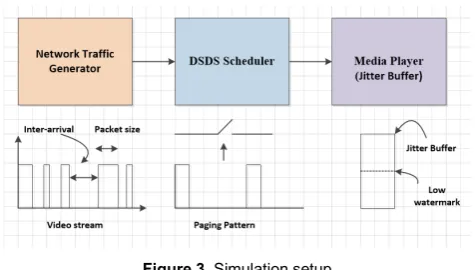
MBMS video streaming traffic is modeled with parameters as listed in Table 1. As shown in Fig 3, packet size is distributed as a truncated Pareto, while the inter-arrival of the video stream packets is modeled as truncated Pareto distributed due to encoding delays. The generated traffic from video source applications, which typically reside on server, is routed to the MBMS core/RAN network consisting of Broadcast Multicast Switching Center (BMSC), MBMS Coordination Entity (MCE) and Enhanced Node B (eNB). Transmission of MBMS contents over MBSFN is done in burst mode utilizing the full radio access network bandwidth (we considered 20 MHz) and in specified MBSFN sub-frames which are typically interleaved with sub-frames carrying unicast traffic. This is to resemble to the real network and scheduling behavior as much as possible. In general, MBMS traffic is consisting of multiple services out of
video stream service. These services are statistically multiplexed in the MSP period in time domain. The occupied time duration of the specific service in the MSP period is taken as randomly distributed so as it can occur in any order of services in the MSP.
UE decodes the specific video stream service with the aid of MCH Scheduling Information (MSI) information
Figure 3. Simulation setup
available and further subject to the DSDS scheduling operation across MBMS and non-MBMS protocol stacks. The DSDS scheduler is shown as an ON/OFF switch, which is a function of the paging pattern and other time critical operations for the other stack. For the ease of simulation the other time critical operation on SIM-2 PSS like signaling, measurement, which will also affect the DSDS scheduler operation, are simulated with a random distribution in the current evaluation and are considered to influence in conjunction of the periodic activity of paging reception.
We defined different configurations of the jitter buffer sizes to evaluate the performance along with watermarks level to determine the buffer status and corresponding set of action s in terms of DSDS scheduler operation adaptation as a feedback. MBMS control channel and scheduling parameters are configured which are taken from real field values used in commercial network operations (Modification Period (MP): 5120 ms, Repetition Period (RP): 320 ms, MCH Scheduling Period (MSP): 320 ms). Generated packets at network are therefore fitted to the MBMS scheduling pattern. Two different services with data rates 500 kbps (LBR) and 1 mbps (HBR) are taken. Paging cycle for the non-MBMS stack is altered between different values to see the relative
impact. Weight factors are set as μ=0.1, γ=0.05 and β and
δ are dynamically derived from buffer size and deviation
of previous scheduling.
for paging occasions is applied. No adverse impact is seen on paging while packet loss performance is optimized.
Fig. 5 shows the results for the allowable RFIC rejection (y-axis) for the DSDS scheduler operation with video stream FEC redundancy of 10% and 30% are applied so that PLR up to 10% and 30% are bearable for video playout as function of buffer threshold (x-axis). In order to maintain higher level of watermarks, RFIC rejection for paging stack applied is more. Further, as noticed with higher DRX cycle lengths like 640 ms, RFIC rejection can be further reduced. Notably, lesser RFIC rejections facilitate better KPIs for
Figure 4. Simulation Results for Base and Enhanced scheme
Figure 5. Simulation Results for allowable RFIC rejection as a function of Jitter Buffer thresholds
Figure 6. Simulation Results for allowable RFIC rejection as a function of FEC redundancy for MBMS video stream
call connectivity performance for the other stack. Therefore, this is important inference to derive the allowable RFIC rejection for the DSDS scheduler along with maintaining quality MBMS video performance.
Fig. 6 presents the allowable RFIC rejection (y-axis) for the DSDS scheduler operation as function of FEC redundancy (x-axis) for MBMS video stream. Buffer threshold is fixed at 10% and 50% of the Jitter Buffer and different paging cycle lengths are considered. As evident, with increased FEC redundancy, more PLR can be borne by MBMS stack and RFIC rejection for the paging stack can be reduced with effective enhancement of call connectivity KPIs. In our scheme, this is achieved with the feedback parameter generated as function of the packet loss rate and is applied to DSDS scheduler to control the RFIC rejection
4. Conclusion and Future Work
Paper presents a cross-layer optimized approach to enhance MBMS video performance for a DSDS UE. Simulation results provided exemplify the potential gains achievable. Proposed algorithm provides the guidelines for designing the RFIC scheduler for DSDS operation to achieve robust and enhanced MBMS video performance along with maintaining call connectivity KPIs. In our future work, we will evaluate MBMS video performance with DSDS in mobility scenarios.
References
[1] GSMA, Network2020 the 4G broadcasting opportunity www.gsma.com/network2020 (2017).
[2] International Conference on Intelligent Information Hiding and Multimedia Signal Processing: Yongjin Cho et al, (2006) “Video streaming over 3G networks with GOP-based priority scheduling”.
2009)
[5] Globecom: Georgios Baltoglou, (2012) “IPTV QoS and QoE Measurements in Wired and Wireless networks”. [6] IEEE International Conference on Dependable, Autonomic
and Secure Computing: Xingang Liu, (2009) “Efficient Video Qaulity Assessment for Broadcasting Multimedia Signal”.
[7] 3GPP TS 36.331; TSGRAN; EUTRAN; RRC protocol specification.