Node Credit Based Efficient Flooding (NCBEF)
Method for Mobile Ad-hoc Networks
Hemant Kumar Gianey
1, Tanupriya Choudh
u
ry
2, Ahmed A. Elngar
3,*1Department of Computer Science & Engineering, Thapar Institute of Engineering & Technology, Patiala, Punjab,
India, [email protected]
2Department of Computer Science, University of Petroleum and Energy Studies, Dehradun, India.
3Faculty of Computers & Artificial Intelligence, Beni-Suef University, Beni-Suef City, Salah Salem Str., 62511,
Egypt, [email protected]
Abstract
Effective routing is one important research issue for mobile ad-hoc network where gadgets have confined resources. Due to non-foreseeing network topology, frequent link failure occurred that drives route break, partitions and high routing overhead issue. These issues result superfluous resource wastage and diminish network life. Existing reactive routing algorithm helps nodes to discover route via broadcast of route request to all these reachable nodes. Receiving node of route request further forward to all its neighbours’ nodes that lead flooding. Here broadcasting of route request results several issues such as wastage of resources, congestions, redundancy of route request and broadcast storm problem. Though to maximize resource utilization and minimize broadcast storm problem, efficient broadcast method in routing algorithm is required. Numerous contributions have done towards efficient broadcasting which concentrate different aspects. In this paper, NCBEF method is presented that motive was to do efficient flooding. NCBEF method enables node to broadcast route request to some neighbours instead of all. To do this, NCBEF method, determine high creditable neighbours during hello signal transmission. Few hypotheses were formulated to evaluate and test NCBEF method. Hypotheses were evaluated by simulation of NCBEF method in network simulator software on the basis of certain criteria.
Keywords: Wireless Networks, Mobile Ad-hoc Networks, Routing, Broadcasting, Flooding, Broadcast Storm Problem, NCBEF.
Received on 15 June 2019, accepted on 29 August 2019, published on 30 August 2019
Copyright © 2019 Hemant Kumar Gianey et al., licensed to EAI. This is an open access article distributed under the terms of the Creative Commons Attribution licence (http://creativecommons.org/licenses/by/3.0/), which permits unlimited use, distribution and reproduction in any medium so long as the original work is properly cited.
doi: 10.4108/eai.13-7-2018.159944
1. Introduction
As correspondence bearer point of view, network
classifies in wired and wireless form. Further wireless network likewise had some expertise in ∗
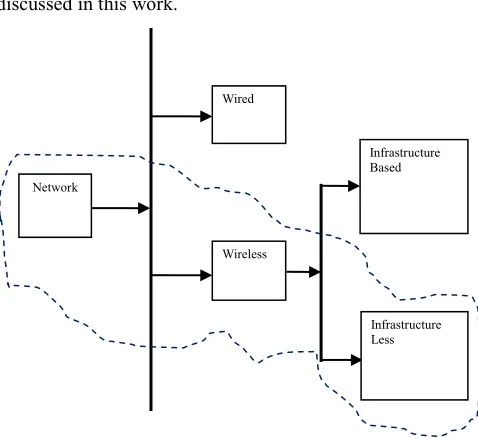
foundation less on the interest of uses and conditions. Figure 1 presents classification of network in in setting of correspondence bearer. In the figure coloured arc highlight the concern which will be discussed in this work.
Figure 1.
Category of networks
Mobile Ad-hoc Network (MANET) is an example infrastructure less classification where every gadget or node achieves its correspondence paying little respect to pre-set up arrangement. Figure 2 indicates scenario of mobile ad-hoc network that contains four nodes numbered 1 to 4. Here node 1 can convey to node 2 or 3 or 4 and the other way around in light of the fact that they have a place inclusion territory of node1.
Figure 2.
MANET Scenario
In MANET, every node is fit to process routing, route maintenance and re-configuration. Contrarily every node has constrained assets like inclusion territory, battery reinforcement and transmission capacity. Restricted asset limitations property may lead system segments; effective routing and life channel of node also network issues. Customary routing algorithms utilize in assortment of routing conventions which concentrates calculation overhead, accuracy and proficiency. Reactive routing protocol is one of routing protocol types. It works request based methods on the off chance that a node needs send data to other then first it updates routing information through topology change observation and after that discover route. Reactive protocol results less overhead however drives blockage, repetition of routing packets and pointless utilization of assets issues. The reason of issues come about by reactive routing protocols is flooding activity that utilize in route discovery and maintenance. In any case, effective routing is focal central issue of network in nearness of various limitations. The goal of the research is to address effects of flooding activities of reactive routing protocols and attempts to make efficient flooding methods. Further sections present major of flooding, broadcasting, effects of flooding, sorts of flooding methods and recent contributions.
Background
As discussion happened in previous section, flooding method play vital role in route discovery phase of reactive routing protocols. Flooding deals with routing packets to assists routing protocol for route findings. The working of flooding, flooding impacts and types have presented here.
1
2
3
4 Network
Wired
Wireless
Infrastructure Based
1.1 Flooding
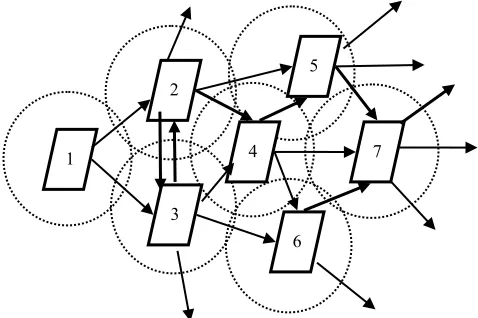
Flooding initiated via broadcasting of routing packets by a node that require route for communication. At this moment receiving node rebroadcast received packets to its covering nodes. Further broadcasting of routing packets spreads throughout the network that results flooding. This method enables routing protocols to tell a node for receiving routing packets and rebroadcast further [1]. Simple scenario of flooding presents in figure 3.
Figure 3.
Network Scenarios for Flooding
In above figure, network with seven devices is illustrate where each device labelled with unique number like device 1, 2, 3, 4 etc. Here device begin forwarding of routing messages to its neighbours 2 and 3. Each neighbour receives messages and further forwards to its successor. When device receive same message from all neighbours then process first one and discard others. For example, device 1 receive message from device 1 and 3 then it processes message of device 1 instead of device 3. Likewise, same phenomena follow by all the devices which results flooding.
1.2 Impacts
With the presence of finite resource constraints of devices, ad-hoc network becomes more concentrating field of study and research. Flooding resulted replications of the same packets where each device receives multiple copies of packets which lead numerous problems such as wastage of resource, congestion and many more.
In case of large network, flooding results unnecessary transmission of same routing messages which leads wastage of bandwidth and power, congestions and collisions. Replications of message occurred bandwidth choke and congestion issues. Below figure illustrates discussed issue.
At another site, each device receives messages from those preceding devices and further forwards to those successor devices which are reachable. If network is large then this procedure results storm of messages named broadcast storm problem which impact network functioning or denying services. Figure 4 shows the scenario of storm problem where each device forward to all its successor devices.
Figure 4.
Broadcast Storm Problem
1.3 Flooding Classification
For the reactive routing procedure, flooding is pulse which deal with route discovery in ad-hoc networks. Numerous routing protocols employs flooding like
1
2
3
4 5
6
7 1
2
3 4
5
DSR [2], AODV [3], LAR [4], ZRP [5] etc. Every routing protocol is responsible for route discovery, repair and topology update. Thus, appropriate
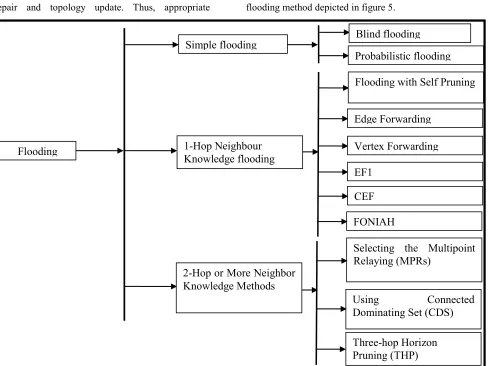
flooding methods are required to accomplish routing with less overhead [6, 7]. Various category of flooding method depicted in figure 5.
Figure 5.
Various category of Flooding
Simple Flooding
This method defines common properties between all the devices of the network where each one forward routing messages without knowing of neighbours. Following sub-category comes in this.
Blind flooding - Blind flooding method alternatively known as pure flooding where every device forwards broadcasting message during route discovery phase [8] [9]. In this, when a device receive forwarding message then it is require to forward further.
Probabilistic flooding - Earlier method resulted
broadcast storm problem which leads wastage of network resources. To sort out this problem, a method suggested that referred as probabilistic [9]. This was employed concept of probabilistic rebroadcast. Therefore, it categorized in counter based, distance based [9], location based [10] and cluster based [11]. This scheme advantages control of redundant transmission of packets over blind method [12].
Hop Neighbor Knowledge Methods
Flooding
Blind flooding
Probabilistic flooding
Simple flooding
1-Hop Neighbour
Knowledge flooding
Flooding with Self Pruning
Edge Forwarding
Vertex Forwarding
EF1
CEF
FONIAH
2-Hop or More Neighbor
Knowledge Methods
Selecting the Multipoint
Relaying (MPRs)
Using
Connected
Dominating Set (CDS)
This category method offers knowledge of neighbor’s information for every device of the network. Every device gathers and shares its 1-hop neighbor knowledge via exchanging of HELLO message [13]. To choose forwarding nodes, two alternatives are possible. First is, sender node deciding neighbors list for the further forwarding which named sender based. Another one is receiving node decides list of neighbors for further broadcasting which named as receiver based. The schemes expressed in [14] [15] [16] are sender-based, while the schemes proposed in [17] [18] [19] [20] [21] [22] [23] are receiver-based. Various flooding approach [24] [25] [26] falls in 1-hop neighbor knowledge method that ensure about entire message delivery.
2-Hop or More Neighbor Knowledge Methods
In this method, it has assumed that every device contains the record of two-hop neighbors. The one-hop neighbor knowledge gathers by the use of HELLO message in MAC sub-layer of DLL layer. To keep up-to date information about topology, HELLO messages periodically exchanged between devices.
Relevant Work
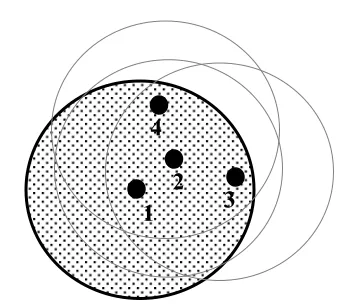
In preceding section, basic flooding operation and its traditional methods have presented. In few decades, more efforts have putted to contribute resourceful flooding. Here, individual were focused on different parameters and aspects like 0-hop, 1-hop and k-hop neighbour knowledge information. Following section highlight few contributions for the fruitful flooding. Authors in [24] expressed that a one-hop flooding approach accomplishes complete when each device like 1 the neighbor’s scope of 1 can be come to by F (1), where F(1) is characterized as a subset of 1’s neighbors that are chosen to forward the flooding message (F(1) incorporates 1 itself).The neighbor’s
region of a node 1 is the entire shadow zone appeared in Figure 6, where 2, 3, 4 is the entire neighbors of 1’s. Figure 6 shows Neighbor’s area of node 1.
Figure 6.
Neighbour’s area of node
Another method was advised named as Flooding with Self-pruning [27] in which 1-hop neighbour information used. Accordingly, to this method, device forward message by enclosing complete list of 1-hop neighbours. At the receiving site, each node who receive flooding message compare its neighbours with list enclosed in message. Ultimately device either discard forwarding message when it’s all 1-hop neighbours is available in the list, or forwards the message further.
Self pruning leads redundant transmission to exchange neighborhood information. To control this, every node maintains received adjacent neighbor records in memory [28].
Further, to offer more efficient flooding an Edge Forwarding [29] method was suggested that uses knowledge of 1-hop neighbor. This method effort to control flooding traffic through geographical knowledge results limited broadcasting within range of each device.
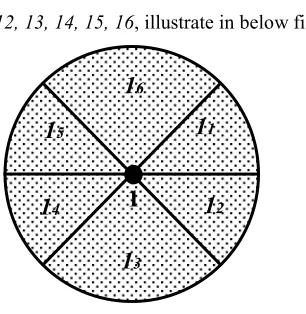
In this method, communication area of node is divided into six uniform subareas. Suppose node 1
communication range is divided in six subareas as 11, 12, 13, 14, 15, 16, illustrate in below figure.
Figure 7.
Transmission range of node 1
Authors [19] suggested another scheme named vertex forwarding advantaged to routing protocols by reducing traffic with the help neighbor information. Decision made on forwarding node set by the transmission range splitting as the Edge Forwarding [30].
Accordingly, EF1 [25], authors represented network in the form of graph where node was defined vertex that indicated by unique number i. e. v and communication coverage of node was defined as edge that indicated by e.
Therefore, Xian long Jiao et al in [31] advised CEF method to optimize performance of routing protocols use of directional antenna. Initially authors expected every node offered inclusive a single-beam directional antenna in EFDA [32], and afterward proposed CEF which is a calculation enhanced EFDA.
Authors [32] stated that for the ad-hoc networks directional antenna was benefited to optimize the performance.
A hybrid flooding strategy was additionally proposed which consolidates "Neighbor learning based flooding and Area-based flooding called
FONIAH (Flooding in light of One-bounce Neighbor Information and Adaptive Holding)" [33].
Further-more an approach advised in which every device aware about the network topography of 2-hop radius. Inappropriately, finding minimum set of devices was NP-hard. Therefore, Amir Qayyum et al. [34] suggested a heuristic method to determine the solution named Multipoint Relays (MPR).
Therefore, three-hop horizon pruning (THP) algorithm was the first heuristic to take into account 3-hop information in the selection of relay nodes for broadcast packets [35].
To achieve efficiency, selective rebroadcasting approach is further extended in another one referred as MISTRAL [36]. This resulted compensation between overhead and end delivery of messages. Forward error correction technique was adapted to accomplish compensation.
Moreover, another method was designed that known as ASTRAL [37]. A forward and backward packet recovery method was used here. Many norms presented regarding of network topography, coverage of nodes, mobility and MAC protocols.
Further, “An Efficient Reliable one-hop broadcasting (EROB)” [38] came in picture which ensures about delivery of message to nodes in the coverage of source node. It leads local one hop broadcasting. It was deal with both data as well as control packets. Data was transmitted via encapsulating in data packets and efficiency enhanced with the help of control packets.
For offering decision capability to nodes for rebroadcasting or discarding receiving packets, a method [39] was advised. In these nodes made
1
1
11
21
31
41
5decision on the basis of amount and timestamps of packets.
Global Queue Pruning [40] method was presented that restricts the overhead of the transmission and to enable delivery of packets to each node. It considered virtual topology where few nodes work as forwarders.
At the last but not least, Selective Epidemic Broadcast Algorithm [41] method devised to control storm problem of flooding. It was also enhanced rate of data spreading via a new BSSA based on Selective Epidemic Broadcast Algorithm (SEB). The selection of nodes to broadcast packets depends on passive acknowledgement from the neighbours.
2. Proposed Methodology
Apart from discussed all flooding methods, to enable efficient flooding for routing protocols by concentrating limited resource constraints a method is proposed. Proposed method known as Node Credit Based Efficient Flooding (NCBEF). NCBEF method uses one hop neighbour information concept to broadcast routing packets for route discovery. NCBEF assists sender or any other node to select some appropriate neighbours instead of all for further broadcasting. According to NCBEF, sender or any node select high creditable neighbours to broadcast routing packets during routing. The creditability of node is defined by credit (C) which is determined by weight calculation. Therefore, to determine a credit coverage area, stay time and power backup of node have considered. However, Credit (C) is factorized in c1, c2 and c3 with the respect of coverage area, stay time, power backup. The value of c1, c2 and c3 is constant and the sum of all is should be 1. A formula to calculate credit (C) of node defines in below equation.
PB
c
ST
c
CA
c
C
=
1
*
+
2
*
+
3
*
Where:
CA- CA is coverage area of node ST- ST is stay time of node at any place PB- PB is power backup of node c1, c2 and c3 are credit factors
NCBEF functions in in two steps. First, each node of network determines its credit via calculating weight. Then nodes exchange their credit value with the neighbours to maintain record. Nodes credit exchange achieve through periodic exchange of modified hello signal. In general hello signal leads neighbour discovery in wireless communication. Hello signal is broadcasted in form of message that has number of fields. General format of hello message defined below.
For the NCBEF method, hello message modified by defining new field i.e. C_Val in existing format. The modified hello message shows below.
Src . N ID H el lo_I nt Re f_ In t V LT Se q N o N ei
ghbor ID C_Va
l
. .
O
pt
ions
In second step, neighbour table is constructed and updated at each node with the help of modified hello signal. Constructed table keep records of every reachable node and its credit value. Though sender or any broadcasting node use neighbour table to selects higher creditneighbour for further broadcasting.
The whole process of NCBEF method is designed in
Src . N ID H el lo_I nt Re f_ In t V LT Se q N o N ei
ghbor ID . . .
O
pt
algorithm that represents in pseudo code form.
2.1 Algorithm
NCBEF method achieves its goal via taking input, processing and resulting output. Thus, node coverage area, stay time and power backup takes as input. Credit calculation defined as process and higher credit value neighbors list as output. The complete process illustrates in below pseudo code.
Algorithm: NCBEF algorithm to select appropriate neighbors for broadcasting
1. Function NCBEF (Node [], N); Input: CA, ST, PB, i, C_Val, NB Output: Appropriate neighbors list Neighb[ ] 2. for i=1 to N do
3. C_Vali=c1*CAi+c2* STi+c3* PBi;
4. end for
5. for j=1 to NB do
6. Node[j+1] =Node[j]->Send(hello,Cj);
7. Node[j+1]->update(Node[j], Cj);
8. end for
9. for i=1 to NB-1 do 10. for j=1 to NB do
10. if (C_Vali>C_Valj+1) then
11. Neighb[i]=i; 12. end for 13. end for 14. for i=1 to N do 15 return Neighb[i]; 16. end for
Designed algorithm of proposed method takes N number of nodes in Node [ ], coverage area CA, stay time ST and power backup PB as input. Additionally, to assign credit value of node takes C_Val, NB numbers of neighbors are also takes. It results
appropriate number of neighbors of each node with high credits which listed in Neighb[ ].
Moreover, to evaluate and test NCBEF method few hypotheses have formulated which may be accepts or rejects. Subsequent subsection represents formulated hypotheses.
2.2 Hypothesis Formulation
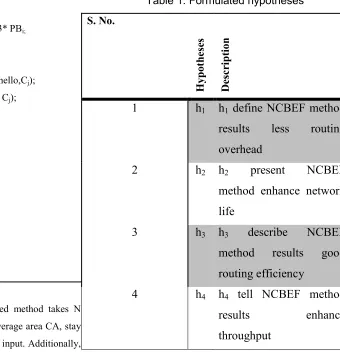
NCBEF method has proposed to control packet redundancies, collisions rate and enhance network life by efficient utilization of resource. Thus to evaluate the method some hypotheses formulated which are presents in table 1.
Table 1. Formulated hypotheses
S. No.
H
ypo
the
se
s
D
escr
ip
tio
n
1
h
1h
1define NCBEF method
results less routing
overhead
2
h
2h
2present NCBEF
method enhance network
life
3
h
3h
3describe NCBEF
method results good
routing efficiency
4
h
4h
4tell NCBEF method
results enhance
throughput
evaluate and analyze with the existing blind flooding method. Though, experiment will perform with the help of simulation software or tools. Next section defines the whole thing about experiment of proposed method.
3. Experiment of NCBEF Method
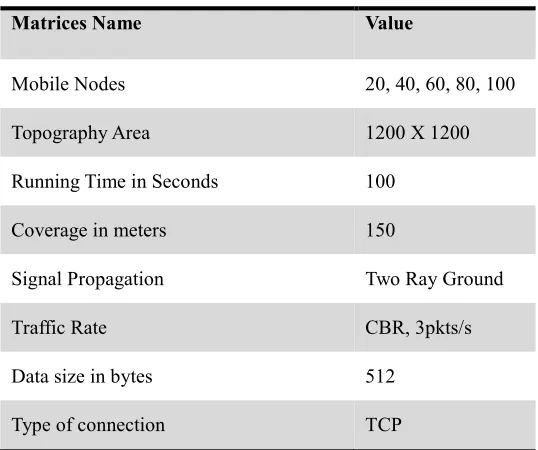
In previous section, NCBEF method described hypothetically. Here experimental setup and simulation of proposed method presented. NCBEF method is practically simulated in network simulator software i.e. NS-2. To simulate NCBEF method, various network matrices like packet size, traffic type, number of devices etc. are considers. Table 2 presents network characteristics in form of matrices.
Table 2. Simulation matrices
3.1 Simulation Tool (Network
Simulator2)
Network Simulator-2 (NS-2) is function evaluation software for the network which is free available and open source. It is event based that designed and
developed for the communication and network relevant research. NS-2 facilitated numerous types and layer functions of the network.
Network Scenario
To simulate NCBEF method, mobile ad-hoc network scenario is assumes which is comprises of several set of mobile nodes such as 20, 40, 60, 100. Every node is mobile in nature and may act as sender, receiver or forwarder during the transmission. Figure 8 show a network scenario of 100 mobile nodes.
Figure 8.
A mobile ad-hoc networks
scenario
4. Evaluation of NCBEF Method
NCBEF method is evaluated through test of hypotheses which have been formulated in proposed methodology section. Formulated hypotheses tested on the basis of routing efficiency, routing overhead, throughput and network life. Moreover, NCBEF method is evaluated with comparisons of blind flooding method.
Routing Overhead - Number of routing request employs to route findings and repairs are called routing overhead. The unit is used to measure routing overhead is total number of routing request used in
Matrices Name Value
Mobile Nodes 20, 40, 60, 80, 100
Topography Area 1200 X 1200
Running Time in Seconds 100
Coverage in meters 150
Signal Propagation Two Ray Ground
Traffic Rate CBR, 3pkts/s
Data size in bytes 512
whole transmission. Figure 9 shows comparative routing overhead of both methods.
Figure 9.
Comparative routing overhead
Network Life - NCBEF method results more network life in time period unit’s comparatively blind method. Figure 10 shownetwork life comparison of
both methods.
Figure 10.
Comparative network life
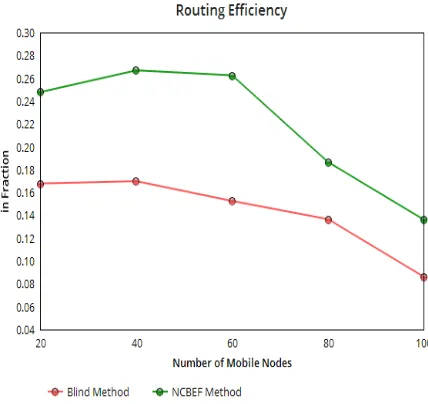
Routing Efficiency - Routing Efficiency is characterized as proportion of information transmitted to the aggregate routing requests and information packets. Comparative routing efficiency
of both methods presents in figure 11.
Figure 11.
Comparative routing efficiency
Throughput - NCBEF method results more throughput comparatively blind method. Throughput is data units received successfully per unit time at the receiver. Figure 12 show routing efficiency comparison of both methods.
Figure 12.
Comparative throughput
4.1 Result Discussions
efficicency, network life and less overhead obserevd. Means, forumlated hypotheses are accepted as per reults. May be some hypotheses rejects for the same.
5. Conclusion
Due to non-anticipating network topology, frequent link failure occurred that leads route break, partitions and high routing overhead issue. These issues results unnecessary assets wastage and diminish network life. Existing reactive routing algorithm encourages nodes to discover route through communicate of course solicitation to all these reachable nodes. Receiving node of route request further forward to all its neighbours’ nodes that lead flooding. Here communicating of course solicitation results a few issues, for example, wastage of assets, blockages, excess of course solicitation and communicate storm issue. However, NCBEF technique empowers hub to communicate course solicitation to certain neighbors rather than all. To do this, NCBEF strategy, decide high respectable neighbors during hello signal transmission. Few hypotheses were formulated to evaluate and test NCBEF method which was accepted.
References
[1] Hui Zeng, Minming Li, Hai Liu, Xiaohua Jia, 2013, “Efficient Flooding in Mobile Ad Hoc Networks”, School of Computer Science, Wuhan University, IJCSMC, Vol. 2, Issue. 12, pg.332 – 337 [2] D. Johnson and D. A. Maltz, 1996 ,“Dynamic Source Routing in Ad Hoc Wireless Networks,” in Mobile Computing, T. Imielinski and H. F. Korth, Eds., Kluwer Academic Publishers, Dordrecht, The Netherlands, pp. 153-181.
[3] C. E. Perkins, 1997, “Ad Hoc On-Demand Distance Vector (AODV) Routing,” INTERNET
DRAFT - Mobile Ad hoc Networking (MONET) Working group of the Internet Engineering Task Force (IETF).
[4] Y. Ko and N. Yaidya, 1998, “Location-Aided Routing (LAR) in Mobile Ad Hoc Networks,” in Proc. of MOBICOM’98, pp. 66-75.
[5] Z. J. Haas and M. R. Pearlman, 1997, “The Zone Routing Protocol (ZRP) for Ad Hoc Networks,” INTERNET DRAFT - Mobile Ad hoc NETworking (MONET) Working group of the Internet Engineering Task Force (IETF).
[6] Deying Li, Xioahua Jia and Hai Liu, 2004, “Energy efficient broadcast routing in ad-hoc wireless networks”, IEEE Trans on Mobile Computing, Vol. 3, No. 2, pp.144-151.
[7] J.E. Wieselthier, G. D. Nguyen, and A. Ephremides, 2000, “On the Construction of Energy-Efficient Broadcast and Multicast Trees in Wireless Networks”, IEEE Infocom’.
[8] C. Ho, K. Obraczka, G. Tsudik, and K. Viswanath, 1999, “Flooding for Reliable Multicast in Multi-hop Ad Hoc Networks,” in Proc. of the Int’l Workshop on Discrete Algorithms and Methods for Mobile Computing and Communication, pp. 64-71. [9] J. Jetcheva, Y. Hu, D. Maltz, and D. Johnson, 2001, “A Simple Protocol for Multicast and Broadcast in Mobile Ad Hoc Networks,” Internet Draft: draft-ietf-manet-simple-mbcast-01.txt.
[10] S. Ni, Y. Tseng, Y. Chen, and J. Sheu, 1999, “The broadcast storm problem in a mobile ad hoc network,” Proc. of ACM/IEEE MOBICOM’99, pp. 151-162.
[11] A. S. Tanenbaum, Computer Networks: Third edition (Prentice Halt, 1996, pp351-352.
of Technology, Technical Report IC/2002/54. [13] M. T. Sun, W. C. Feng, and T. H. Lai, 2001, “Location Aided broadcast in wireless ad hoc networks,” in Proc. of GLOBECOM’01.
[14] I.S. Committee Wireless LAN medium access control (MAC) and physical (PHY) specifications,1997, in IEEE 802.11 Standard. IEEE, New York, ISB 1-55937-935-9.
[15] A. Qayyum, L. Viennot, and A. Laouiti, 2002, “Multipoint Relaying for Flooding Broadcast Messages in Mobile Wireless Networks,” In Proceeding of the 35th Hawaii International Conference on System Sciences.
[16] Wei Lou and Jie Wu, 2004, “Double-Covered Broadcast (DCB): A Simple Reliable Broadcast Algorithm in MANETs,” in Proc. of INFOCOM 2004.
[17] Xinxin Liu, Xiaohua Jia, Hai Liu, and Li Feng, 2007, “A Location Aided Flooding Protocol for Wireless Ad Hoc Networks”, MSN 2007, LNCS 4864, pp.302-313.
[18] B. Chen, K. Jamieson, H. Balakrishnan, and R. Morris, 2001, “SPAN: An Energy-Efficient Coordination Algorithm for Topology Maintenance in Ad Hoc Wireless Networks,” in Proceedings of MOBICOM, pp. 85-96.
[19] I. Stojmenovic, M. Seddigh, and J. Zunic, 2002, “Dominating Sets and Neighbor Elimination Based Broadcasting Algorithms in Wireless Networks,” IEEE Transactions on Parallel and Distributed Systems, vol. 13, no. 1, pp. 14-25.
[20] J. Sucec and I. Marsic, 2000, “An Efficient Distributed Network-Wide Broadcast Algorithm for Mobile Ad Hoc Networks,” in Rutgers University, CAIP Technical Report 248.
[21] J. Wu and F. Dai, 2003, “Broadcasting in Ad Hoc Networks Based on Self Pruning,” in Proc. of
INFOCOM’03.
[22] J. Wu and H. Li, 1999, “On Calculating Connected Dominating Set for Efficient Routing in Ad Hoc Wireless Networks,” in Proc. of the 3rd Int’l Workshop on Discrete Algorithms and Methods for Mobile Computing and Communications (DiaLM), pp. 7-14.
[23] Sung-Hee Lee and Young-Bae Ko, 2006, “An Efficient Neighbor Knowledge Based Broadcasting for Mobile Ad Hoc Networks”, ICCS 2006, Part II. LNCS 3992, pp.1097-1100.
[24] W. Peng and X. Lu, 2000, “On the Reduction of Broadcast Redundancy in Mobile Ad Hoc Networks,” in Proc. of MOBIHOC’2000.
[25] H. Lim and C. Kim, 2000, “Multicast Tree Construction and Flooding in Wireless Ad Hoc Networks,” In Proc. of the ACM Int’l Workshop on Modeling, Analysis and Simulation of Wireless and Mobile System (MSWIM), pp 61-68.
[26] Hai Liu, Pengjun Wan, Xiaohua Jia, Xinxin Liu and Frances Yao, 2006, “Efficient Flooding Scheme Based on 1-hop Information in Ad Hoc Networks”, in proceedings IEEE infocom, Communications Society subject.
[27] Chun-Chuan Yang and Chao-Yu Chen, 2002, “A Reachability-Guarantee Approach for
Reducing the Broadcast Storms in MANETs,” Proceedings of IEEE Semiannual Vehicular Technology Conference (VTC-2002 Fall).
[30] Ying Cai, Kien A. Hua, and Aaron Phillips, 2005, “Leveraging 1-hop Neighborhood Knowledge for Efficient Flooding in Wireless Ad Hoc Networks”, 24th IEEE International Performance Computing and Communications Conference(IPCCC), Phoenix, Arizona.
[31] Xianlong Jiao, Xiaodong Wang, and Xingming Zhou, 2007, “A comprehensive Efficient Flooding Algorithm Using Directional Antennas for Mobile Ad Hoc Networks”, LNCS 4847, pp.525-534, 2007. [32] X. Jiao, X. Wang, X. Zhou, 2007, “Efficient Flooding for Wireless Ad Hoc Networks with Directional Antennas” In: Proceedings of ISCIT. [33] A. Spyropoulos, C.S. Raghavendra, 2002, “Energy Efficient Communications in Ad Hoc Networks Using Directional Antennas”, Proceedings of IEEE INFOCOM, IEEE Computer Society Press, Los Alamitos.
[34] A. Qayyum, L. Viennot, and A. Laouiti, 2002, “Multipoint Relaying for Flooding Broadcast Messages in Mobile Wireless Networks,” In Proceeding of the 35th Hawaii International Conference on System Sciences.
[35] M. A. Spohn, J.J. Garcia-Luna-Aceves, 2004, “Improving Broadcast Operations in Ad Hoc Networks Using Two-Hop Connected Dominating Sets,” In Proceedings of IEEE Global Telecommunications Conference Workshops. [36] Stefan Pleisch, Mahesh Balakrishnan, Ken Birman, Robbert van Renesse, 2006, “MISTRAL: Efficient Flooding in Mobile Ad-hoc Networks”, MobiHoc’06, Florence, Italy.
[37] Jinman Jung, Yookun Cho, Yeongkwun Kim, Injoo Kim, 2010, “ ASTRAL: An Adaptive, Efficient, and Reliable Flooding Mechanism for MANET”, SAC’10, Sierre, Switzerland.
[38] Seungjin Park, Seong-Moo Yoo, 2013, “An efficient reliable one-hop broadcast in mobile ad hoc networks”, Ad Hoc Networks 11 ,19–28 Elsevier. [39] M. Chekhara, K. Zine-Dine, M. Bakhouya, A. Aaroud, D. El Ouadghiri, 2016, “An Efficient Broadcasting Scheme in Mobile Ad-Hoc Networks”, The 7th International Conference on Emerging Ubiquitous Systems and Pervasive Networks (EUSPN 2016), Published by Elsevier B.V.
[40] Slawomir Nowak, Mateusz Nowak, Krzysztof Grochla and Piotr Pecka, 2016, “Global Queue Pruning Method for Efficient Broadcast in Multihop Wireless Networks”, ISCIS 2016, CCIS 659, pp. 214–224