Trond Solhaug is professor at the Norwegian University of Science and Technology (NTNU), Jonsvannsvg. 82, 7491 Trondheim, Norway Email: [email protected]
2
Trond Solhaug
Democratic Schools – Analytical Perspectives
Keywords
Democracy, participation, knowledge, democratic values, institutions, citizenship
1 Democratic schools
In this introduction democratic schools means schools which are run according to democratic principles and values.
Why publish a special issue on democratic schools? First, from an educational perspective, schools are the most important public institution for citizen’s qualifyca-tion and socializaqualifyca-tion in life. While most students qualify for further studies or work, they experience schools very differently, and a large minority drop out before gradu-ating. It is important to research how schools support all students and qualify them for later studies in life. Second, democracies are struggling to provide work and welfare for many citizens, and these democratic failures often lead to declining political trust. Democratic schools are often associated with preparing students for active citizenship where the idea is that student participation in democratic schools may promote students’ inclination to participate in civic activities after leaving school (Biesta, 2011). This way, schools are to some extent seen as a solution to the political challenges in democracies. In this introduction to a special issue on democratic schools, I elaborate theoretically on what we should mean and how we should analyse schools as more or less democratic schools?
I argue that to really analyse how democratic the schools are, one must consider several aspects of their legal framework as well as their guiding norms and practices. This implies taking a holistic view of school based on democratic and educational theories and ana-lysing several factors: participation, school as an insti-tution, teaching styles, values, virtues, and above all, inclusion in school. A citizenship perspective is used to focus on the relationship between students, parents, and school leadership and related governing bodies, muni-cipalities, and the state. Such a perspective clarifies that students at any level in school have rights and duties and should be treated as citizens. This perspective contrasts the view often held in schools that students are only citizens ‘in the making’. Such a perspective tends to ignore that children are legal entities with extensive rights in society and framed by the UN’s Convention on the Rights of the Child (UN. 1989). It is argued that a citizenship perspective is a fruitful guiding principle for teacher practices to sufficiently cover important demo-cratic aspects of schooling. The outline of the intro-duction is as follows. The main body is the theoretical
framework of schools, followed by a presentation of the research contributions in this special issue. Finally, I offer some research samples and suggestions for further reading.
2 Conceptual clarification and legal framework
Carl Cohen defines democracy as, “that system of community government in which, by and large, the mem-bers of a community participate, directly or indirectly, in the making of decisions which affect them all” (Cohen, 1971, 7). While Cohen had governing bodies of states in mind, the ‘system of community government’ might also work for the governing structures of schools and their body of decisions. Schools are usually regulated by law, and using Norway as an example, the law on education specifies the rights and duties of students and parents. Also, different governing bodies such as counties and municipalities have freedom and responsibilities in governing schools (Opplæringslova, 1998). Since stu-dents’ (and their parents’) life in school is regulated by legal frameworks we may speak of a ‘school citizenship’. Isin og Nyers defines citizenship as …“an institution’ mediating rights (and duties – author comment) between the subjects of politics and the polity of which these subjects belong” (Isin & Nyers, 2014, p. 1). Using this definition, we may speak of students and parents in schools as political subjects in a single school which is included in local governmental bodies or schools in the state as levels of government and their accompanying polities. School citizenship might be defined as follows; school is an ‘institution’ mediating rights and duties concerning schooling between students and their parents and the levels of school government of which these students and parents belong. What states might have in common, with some variation, is schools as qualifying and socializing institutions with accompanying rights and duties of students and their parents (i.e. school citizen-ship). What might be more variable is the local autonomy of schools and local school government. While the Scandinavian countries have a somewhat centralized system of national curricula, the US and Germany offer considerably more local autonomy to states and Länder. The legal framework of schools might be subject to various democratic influences such as media, political debates, and elections in a large society.
2.1 A democratic tension
3
well as ensures continuity in complex societies. In any country, there is a body of governing educational struc-tures, usually with a cabinet ministry providing all their administrative support and a county or municipality level of school government, or both. Although there are de-mocratic processes through elections and hearings on educational policies, it is beyond doubt that these governing bodies are there to implement educational policies and exercise supervision and control of schools. These governing systems might function differently across countries, but their task is to promote the con-tinuation and development of societies in a relatively top down system. When there are tensions between the political state’s interest and the interests of various groups (e.g., what subjects to teach and what knowledge to learn), the government certainly has the power to limit the influence on school outcomes from non-state actors. Actually, most schooling is decided upon by the state, and its interest is in the continuation and development of societies (Apple, 1995, 2004). In sum, schools are fundamental to societies, and many aspects of schools are not subject to democratic influence. This fact and the tensions between groups’ and states’ in-terests in schooling need to be considered when re-searching topics related to democratic schools. This tension might particularly affect the range of criticality related to what knowledge to teach and the political education in schools.
3 Democratic schools – analytical perspectives
In the following paragraphs, I will focus on the individual school as a relatively democratic unit, and I will only touch upon theoretical aspects of democratic schools, including how schools are perceived as relatively demo-cratic. Within an individual school, governmental legal frameworks regulate the school’s citizenship, and only school and classroom rules may be subject to influence, which limits the ‘range’ of school democracy (Cohen, 1970). With a focus on participation in decisions as the key aspect of democracy, I continue to apply Carl Cohen’s democratic theory outlining three analytical dimensions of democracy, applied to individual schools in this case. First, Cohen speaks of ‘democratic breath’ which is a quantitative aspect of the share of participants actively involved in decision-making. As the share of participation increases, the school becomes more demo-cratic. Second, he speaks of the depth of democracy, which is a qualitative matter. Central to decision-making is how well issues at stake are enlightened and argued for in a public debate. Many democratic theorists have pointed out the importance of public debates for a democracy (Barber, 1984; Cohen, 1971; Dahl, 1998; Diamond & Morlino, 2005; Habermas, 1995). Such participation might be regulated in laws or rules, which is the case in Norway (Opplæringslova, 1998). In practice, schools constantly have debates, particularly at the classroom level, but also at the school level on matters of importance. The procedures of democracy and the quali-ty of the debate’s content is of course vital for decision-making (Dahl, 1979), and schools and classrooms are
suitable arenas for ‘public’ debate. The third aspect in Cohens analytical theory is ‘democratic range’ (Cohen, 1971). This concept is related to the substance of demo-cracy or what sort of issues are subject to democratic decision-making processes in both the legal framework and school practice. Cohen continues by dividing the range into a sovereign and an effective range; the sovereign range includes all possible issues for demo-cratic involvement, and effective issues are those re-flected in decision-making practices. Hence, as both sovereign and effective ranges broaden, a school be-comes more democratic because all those affected by the decisions will have a say in matters of importance to them. Issues like teaching, assessment, homework, and learning procedures are all very important to all groups in schools, but most importantly, ‘knowledge and qualification’ is at the heart of the matter for students, teachers, and society at large. Consequently, democratic involvement in matters of importance to students’ school experience such as knowledge, its content, and ways of learning characterize democratic schools, while limited involvement in issues less important to students characterizes less democratic schools (Solhaug, 2003).
3.1 Knowledge and teaching
4
democratized in the sense that students make choices of which path to follow, what to focus on, and what to explore with support from their teachers. Furthermore, Dewey acknowledged the need for a democratic govern-ment, but he was primarily preoccupied with the public (i.e. the citizens) and social life, which he saw as a precondition for democracy. He emphasised that citizens are all bound together (i.e. interdependent) in a ‘joint living experience’. For Dewey, education is also in-herently social and nourished by communicative ex-periences (Dewey, 2000). It may be argued that Dewey’s approach to teaching and learning in school leads to much more student, or democratic, influence on the development of knowledge. His emphasis on social learning and interdependence also supports social awareness and students’ sense of responsibility for each other, which may be considered democratic. Dewey’s perspective on teaching and learning influenced later educationalists, particularly when discussing what types of knowledge to focus on and how they are taught in school (Freire, 1993). A recent frequently-debated issue is the diversification of classrooms and the challenges in teaching, learning, and knowledge development accom-panying these processes. Following Dewey, Cherry A. Mc Gee Banks and James Banks (1995) argue that diverse learners have diverse life experiences which are often not present in schools. Their view is that in teaching- and learning-processes the school should try to connect the knowledge to the learners’ diverse background and life experiences. By connecting knowledge to learner’s experiences, students’ learning processes may be faci-litated, equalized, and democratised despite the differ-rences (James A. Banks, 2009; Banks et al., 2004). Mc Gee Banks and Banks overall educational point may be fruitfully elaborated on by using Bourdieu’s concept of habitus. According to Bourdieu (1990), habitus is closely linked to an individual’s objective position in the social space, as it is formed by the opportunities and constraints that this position reveals. Habitus therefore designates an acquired disposition and can be described as follows. “Systems of durable, transposable dispo-sitions, structured structures predisposed to function as structuring structures that can be objectively adapted to their outcomes without presupposing a conscious aiming at ends or an express mastery of the operations necessary in order to attain them” (Bordieu, 1990). Bourdieu’s overall point is that all socialization works as an embodiment of social structures, which the individual carries around, and educators need to connect to these embodied structures to provide equal opportunities for a diverse student body; see discussion of equality and democracy below. Furthermore, Bourdieu also provided concepts of economic, social, and cultural capital that have contributed to tools for analysing educational differences (Bourdieu, 1986). Using the concept of ‘taste’, he provides a ground-breaking sociological under-standing of how ‘taste’ classifies social groups, and how it classifies the classifier (Bordieu, 1995). Bourdieu’s ideas offer concepts and analytical approaches to differences and inequality in education as well as
inequality in society at large, which may only be men-tioned here. Below, I will elaborate on the question of equality and democracy but will make a summary of this brief sketch of knowledge and democratic schools.
Knowledge is about understanding the world, premises for action, and the basis for qualifications in a student’s future professional life. Student involvement and par-ticipation in knowledge development may be considered as learning to take charge and develop self-consciousness and self-interest in their future pro-fessional life. The raison d’aitre of participation in this perspective is therefore more than the prospects of future voting and political protest. Participation in school may be regarded as learning options for the many aspects of a citizen’s life, self-determination, and social and political involvement. Schools may therefore be compared to the extent they take a citizenship pers-pective and involve students in teaching and all aspects of knowledge learning.
3.2 School as a democratic institution
5
variety of practices often prevents schools from being effective arenas for learning citizenship and of being truly democratic. For a school to be effective in its democratic practices, there should be a perceived substantial con-sistency between the levels’ rules, norms, and practices. In a citizenship perspective, participation in institutions is to regard schools as arenas for the many aspects of citizenship practice and learning. For a more detailed elaboration of the analytical framework of institutions, see (Scott, 2001).
3.3 Student council
The most prominent example of institutionalised school democracy and practice of ‘political citizenship’ is the student councils which exist in many countries, especially countries which have adopted the UN’s Convention on the Rights of the Child, as they have a responsibility to create structures for student participation and influence (UN, 1989). In Norway, concepts of student councils date back to the 1840s (Hareide, 1972), and they were formalized by 1964 in upper secondary schools and later in lower secondary and primary schools. School councils in Norway are also interconnected through student unions. The student council is usually a representative system of students from all classes in schools and has some rights and responsibilities. The aim of student councils in Norway is, according to Opplæringslova §11-2 and §11-6 (Law on Education), “to promote the common interest of students in school, to contribute to a favourable learning and school climate for all students”. The councils have a say on school climate issues in primary schools and contribute to the learning environment, working conditions, and student-welfare interests. Applying Cohen’s democratic criteria to the student council framework, for example, the democratic range does not involve teaching and learning, or much of the classroom practice, and seem to be excluded from the council’s issues, which severely limit their democratic range (Børhaug, 2008). Student councils are certainly important to democracy in schools because they are a formal option for election procedures in schools, formal representation, and a voice for students and their involvement in decision-making. As such, it is an example of students’ political school citizenship. However, in practice, student councils vary greatly in their effective-ness in democratic processes, in the number of partici-pants involved, and how deep the democratic processes are in schools. They may also vary greatly regarding issues they can discuss and influence on behalf of students in the school (Lindholm & Arensmeier, 2017; Michelsen, 2006). In short, democratic schools certainly need to have student councils as a formal option for influence, but I believe schools vary greatly according to how effective and democratic these councils are, particularly according to the issues in which student councils may get involved. Effective student councils involve most students in a school in matters of importance related to their knowledge and life develop-ment.
3.4 Democratic values and virtues
Values and virtues often underpin certain regulations, norms, cultural aspects, and behaviours and are certainly important to the democratic practice of school citizen-ship in a formal setting or in school life and classes. Values can be characterized as general standards in judgement and behaviour which are preferred by an individual (Rokeach, 1973). Virtues reflect values and express preferred behaviour. Particularly relevant and interesting to an analytical framework of democratic schools are civic virtues and democratic values. Virtues may be participation and critical reflections, as well as citizens obeying the law and having social and political trust in school and political institutions. Democratic values include among others, freedom, equality, tole-rance, and solidarity (Thommassen, 2008). While rules and norms are important guidelines for behaviour, most teachers, students, parents, and researchers are focused on the classroom and what takes place during lessons. I will elaborate on these core values and their relationship to democracy and democratic practices in society in general and schools in particular. The French revolution provided us with the terms liberté (freedom), egalité (equality), and fraternité (solidarity). I see these and other values as guiding principles for democratic citizen-ship practices in school.
3.4.1 Freedom
Democracies and democratic institutions are charac-terized by freedom of participation and involvement. However, some value freedom as an option for partici-pation (e.g., republicans), while others (e.g., liberals) view freedom as most important to individual choices. Empirically, freedom seems to be the most important value documented in the World Value Survey (Thommassen, 2008). In Norway, students enjoy legal participation rights, which are also regulated in the UN’s Convention on the Rights of the Child (UN, 1989) and official laws related to education (Opplæringslova 1998). However, classroom participation practices vary consi-derably both in frequency and content. While student participation is often viewed as a normative positive practice and an inherent quality of democracy (Diamond & Morlino, 2005), we must acknowledge that there is an ideological/political tension between liberals and repu-blicans on the question of participation (Dagger, 2002; Schuck, 2002). Having said this, I emphasize the over-whelming democratic theory, which expresses that de-mocracy in any unit, state, organization, and in this case, schools, is strengthened by citizens’ or members’ active participation. Consequently, I argue that as students and parents enjoy more freedom and engage in opportunities to participate, schools become more democratic.
3.4.2 Equality
6
the value of equality to schools is more complex. School has the role of qualifying citizens for economic, social, and professional self-determination. This implies that students should initially learn the same and later learn quite different professional topics. Coleman also com-plicates matters further by identifying three different approaches to equality in schooling (Coleman, 1968). First, equality in schooling means that students should have equal access. This implies that all children have a right to schooling, but this approach ignores what happens in school. Second, equality might imply that educational resources, usually teachers’ time, should be distributed equally among students during their time in school. The consequence of this understanding is that a variety of students get the same support. Third, equality may also be understood as equal outcomes for all students. This third understanding of equality acknow-ledges that students are different, which usually implies a redistribution of educational resources. Coleman’s three approaches to equality in education is analytically valuable but assumes that students are all going to learn essentially the same knowledge. Such an approach is relevant in most cases, but only relevant for a variety of groups in the upper classes of schooling when students specialize. I therefore turn to the concept of ‘equity’ in schooling. Banks and Banks (1995) understand ‘equity’ in school “… as teaching strategies and classroom environments that help students from diverse racial, ethnic, and cultural groups attain the knowledge, skills, and attitudes needed to function effectively within, and help create and perpetuate, a just, humane, and democratic society” (McGee, Banks & Banks, 1995,152). By using the concept of equity, it is acknowledged that students are all different with a variety of goals and interests, but they all use schooling as the basis for later qualifications in life. In this perspective, ‘equity’ under-stood as ‘equal opportunity’ is a concept which acknow-ledges students’ diversity and focuses on their rights to qualify and make individual professional choices. The aspect of equality built into these concepts are very complex to judge. In Norway, students have rights to schooling and teaching that are adapted to their special needs (Opplæringslova, 1998). However, the effective-ness of these rights in teaching and learning vary considerably, and consequently, the outcome of school-ing also varies for most students. A special case is the challenge of preventing school drop outs, and leaving school prematurely which is also an international challenge (Rumberger, 2011). In Norway, up to 30% of students do not complete upper secondary school after five years (3 years are required) (Lødding, 2009). School drop outs is therefore a significant challenge to demo-cratic schools because schools fail to qualify a substantial percentage of students for their professional life.
This discussion of equality and education is by no means exhausting, and judging equality or equity in education is very complex. Still, I argue that, at the theoretical level, schools which practice their teaching and learning process in accordance with equity principles will be more democratic. Also, schools which have a low
dropout rate and thereby manage to qualify most of their students are more democratic.
As previously noted, there might be tension between liberty and equality. The tension is most obvious in liberals’ and republicans’ views of participation; liberals view responsibilities as restrictions of freedom but repu-blicans view participation as options (Dagger, 2002; Habermas, 1995; Schuck, 2002). Additionally, unrestrict-ed liberty will lead to inequality of conditions which may not be acceptable to the citizens (Thomassen 2008). These values underpin norms in a democracy, and the dilemmas of unrestricted freedom versus market inter-vention and redistribution of values are closely related to perceptions of justice and fairness and are very common in both school and society at large. Their link to justice tends to engage students and makes dilemmas of free-dom and equality potential learning options for political citizenship. However, the controversies over freedom and participation makes it difficult to judge which school may be characterized as being more democratic.
3.4.3 Tolerance and intolerance
7
3.4.4 SolidaritySolidarity is defined as, “a feeling of unity between people who have the same interests or goals” (Merriam-Webster 2017). The extent of solidary is contested in several ways but above all between liberals and repu-blicans in their view of civic responsibilities. Repurepu-blicans and some social-liberals (i.e. pluralists) emphasize citizens’ responsibilities for other fellow citizens and society at large, while ultra-liberals consider these duties as limitations to their individual freedom (Roche, 2002; Schuck, 2002). Still, solidarity is emphasized in consi-derations of what defines a ‘good citizen’ (Van Deth, 2008). I acknowledge that there are controversies regarding this value which, in the Van Deth’ language, is considered as a norm of citizenship and practice. There also seems to be strong empirical support for solidarity as a basic civic virtue (Van Deth, 2008). Based on these premises, I consider schools where teachers and students practice acts of solidarity as important for the feeling of inclusion and empower students’ abilities. Such an empowering school climate supports students’ efforts and equity in the outcome of their schooling. Based on the above reasoning, schools characterized by the practice of citizenship as solidarity among students and teachers support equal opportunity and equity among students and will be more democratic.
3.4.5 Protection
Rights detailed in the UN’s Convention on the Rights of the Child (UN, 1989) are legally binding in all states which have ratified it, and this convention contains quite a few articles which are relevant to democratic schools. I would like to point out two of them: Article 12 concerns the rights to have a say (i.e. participation), and is already included in this introduction to democratic schools, and Article 19 requires that children are protected from any violation of interest and mental or physical abuse in school. The protective rights are very important because many children are subject to various forms of sup-pression during their time in school. Such negative experiences may have serious consequences for the outcome of their schooling and often have lifelong nega-tive implications. Schools’ failure to provide protection may limit students’ participation, and schooling in general and may deprive them of many options in life. Consequently, a democratic school provides effective protection for its students during their schooling.
3.4.6 Inclusiveness in schools
In response to what has previously been said about dropouts in schools and its potential consequences, I would like to draw attention to an analytical framework for inclusive citizenship developed by Neila Kabeer, Ruth Lister, and Nancy Fazer (Fraser & Honneth, 2003; Kabeer, 2005; Lister, 2008). This framework may be adjusted to most relevant units; there are six important points, and some have been touched upon already.
The first is about justice in school, understood as the question which asks, when is it fair to treat people equally and when is it fair to treat students differently?
This criterion acknowledges that we are all different and sometimes deserve to be treated differently as we are to fulfil our goals in life. This understanding of justice is a precondition for equity in schooling. Following this first criterion, a second criterion of inclusiveness is the recog-nition of equal worth regardless of differences. The third criterion is self-determination, understood as people’s ability to exercise some control over their own lives. Usually, self-determination is related to work and subsis-tence, where school, as pointed out earlier, has a key qualifying role. Particularly, the challenges caused by dropping out of school and lacking basic qualifications for academic studies and/or work places a burden of responsibility on students who drop out. The fourth criterion, solidarity, can be seen both as a societal goal and as especially important in education. The feeling of support from one’s environment is vital to social life. Linking the four aspects, Lister writes of “the capacity to identity with others and to act in unity with them in making claims”, “participatory parity”, or the ability of members in society to interact with one another as peers (Lister, 2008, pp. 49-50). Finally, Lister emphasises the “ethos of pluralization”; to avoid an exclusive identity and politics, one must recognize the right to be different and promote reflective solidarity as the “universalism of difference”(Lister, 2008, p. 50).
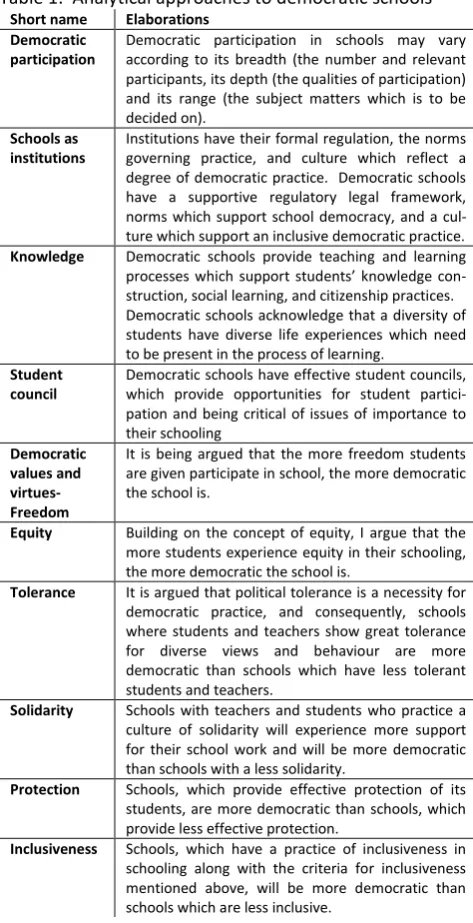
To really practice inclusiveness in schools is a very complex matter, but there should be no doubt that schools capable of practicing inclusiveness among their diverse students are more democratic than the schools which struggle in such practices. Below is a table which summarizes theoretical analytical aspects of a demo-cratic school. The introduction continuous by introducing the contributions in this special issue.
4 A summary of analytical approaches
8
Table 1: Analytical approaches to democratic schools
Short name Elaborations
Democratic participation
Democratic participation in schools may vary according to its breadth (the number and relevant participants, its depth (the qualities of participation) and its range (the subject matters which is to be decided on).
Schools as institutions
Institutions have their formal regulation, the norms governing practice, and culture which reflect a degree of democratic practice. Democratic schools have a supportive regulatory legal framework, norms which support school democracy, and a cul-ture which support an inclusive democratic practice.
Knowledge Democratic schools provide teaching and learning
processes which support students’ knowledge con-struction, social learning, and citizenship practices. Democratic schools acknowledge that a diversity of students have diverse life experiences which need to be present in the process of learning.
Student council
Democratic schools have effective student councils, which provide opportunities for student partici-pation and being critical of issues of importance to their schooling
Democratic values and virtues-Freedom
It is being argued that the more freedom students are given participate in school, the more democratic the school is.
Equity Building on the concept of equity, I argue that the
more students experience equity in their schooling, the more democratic the school is.
Tolerance It is argued that political tolerance is a necessity for
democratic practice, and consequently, schools where students and teachers show great tolerance for diverse views and behaviour are more democratic than schools which have less tolerant students and teachers.
Solidarity Schools with teachers and students who practice a
culture of solidarity will experience more support for their school work and will be more democratic than schools with a less solidarity.
Protection Schools, which provide effective protection of its
students, are more democratic than schools, which provide less effective protection.
Inclusiveness Schools, which have a practice of inclusiveness in
schooling along with the criteria for inclusiveness mentioned above, will be more democratic than schools which are less inclusive.
5 The special issue on democratic schools
This special issue addresses democratic topics of school- and classroom-climate, sexual diversity and its accep-tance in school, the role of criticality in citizenship, and human rights education, and finally, a paper on the role of emotions.
The first article is titled “Can schools engage students? Multiple perspectives, multidimensional school climate research in England and Ireland” and was written by Dorien Sampermans, Maria Magdalena Isaac, and Ellen Claes. Building on the previously-described analytical framework, this article contributes to the literature on schools as institutions by focusing on school climate, which is often associated with school culture. Three aspects of school climate are included: school order, interpersonal relations, and student-teacher relations. The study elaborates on how a general school climate along with control variables are associated with future electoral participation in an IEA ICCS 2009 sample from England and Ireland (IEA, see: www.iea.nl, ICCS,
International Civic and Citizenship Education study). Although knowledge, as expected, has the strongest association with future electoral participation, aspects of school climate also contribute. It is recommended that more attention be paid to overall school culture in political socialization.
The second article is titled “Creating Democratic Class Rooms in Asian Contexts: The Influences of Individual and School Level Factors on Open Classroom Climate” and was written by Xiaoxue Kuang, Kerry John Kennedy, Magdalena Mo Ching Mok. Many studies using data from international surveys like the CIVIC education study and the current ICCS study conducted by the IEA have explored the associations between an open classroom climate and various civic virtues. What often motivates these studies, as noted in the literature reviews in the article, is to explore how participation in classroom discussion in school may contribute to future democratic participation or other civic virtues. In the current study, which uses ICCS 2009 data from Chinese Taipei, Hong Kong, Indonesia, South Korea and Thailand, open classroom climate (OCC) is a dependent variable. The study acknowledge that OCC might be an important asset to schools, but the classroom climate might be perceived differently by students, and it is important to explore how schools may contribute to the classroom climate in these Asian societies. Using a multilevel analysis, both individual variables and school contextual variables are included. Such studies are rare in this region, and they revealed interesting findings on regional differences and possible local influences. The study adds to the literature on classroom climate, particularly because of its regional focus.
The third article is titled “Youth political engagement and communities of practice” and was written by Gary Homana. Data from the IEA Civic Education Study 2000 is analysed to investigate research questions on the association between participation in two civic commu-nities of practice, including a student council and volun-teer organizations, and two types of expected adult political participation as well as trust in political insti-tutions in Australia and the United States. The study takes an important theoretical perspective when using the term ‘communities of practice’ in the analysis of how such practices may be associated with civic engagement. Findings were that in both countries, participation in the two civic communities of practice was associated with higher levels of trust in political institutions and greater expectations to become an informed voter and an active citizen.
9
democratic schools and the field of protection (see above) for diverse students. The study builds on a large sample of student interviews (332) in Portuguese schools. A discourse analysis is applied which reveals findings of support, tolerance, and hostility towards sexual minorities. Particularly, the hostility is of course challenging to the school environment in general and to the students in question in particular.
The fifth article is titled “Leyla and Mahmood – Emotions in Social Science Education” and was written by Katarina Blennow. This study focuses on the role of emo-tions related to two cases, Leyla and Mohammed. Emotions are always important but rarely focused on in social science writings. Emotions in the current con-tribution are related to the two individual cases, Leyla and Mahmood, as refugees and at the same time subject to the teaching of subjects related to their destiny as refugees. Experiences with students’ reactions to contro-versial utterances about terrorism is discussed. The article opens up a field in social science teaching and learning which is rarely touched upon. Few writers en-gage with this difficult topic; one of them is Jon Elster, who discuss what emotions are and the role in regulating behavior (Elster, 1999, 2007).
Finally, Isabella Schild and Judith Breitfuss contribute to this special issue on ‘democratic schools’ with a report which discusses an interrupted school lecture in Austria. The report is titled, ‘Civic Education under Pressure? A Case Study from an Austrian School’. The case is about a representative from the Green party who was invited to lecture on political extremism in school, but a student and his influential father from a right wing party in Austria interrupted the discussion. The interruption and limiting of the expressions and the following debates are most interesting as such actions deal with the presence of politicians in school, their freedom of political expression, and the limits of controversy in civic education. Such debates are also at the heart of the matter for democratic schools and their framing of civic education. With reference to the German ‘Beutelsbach Consensus’ on controversies in civic education the authors do take a stand in favour of political expressions in school, but I recommend the audience to engage with this Austrian case also.
6 Samples of resent research on democratic schools In the following, I provide some samples of further reading and research.
6.1 On democratic schools
The first topic to be reviewed here are alternative approaches to research on school democracy. One recent contribution is by Feu, Serra, Canimas, Làzaro, & Simó-Gil, (2017). They list four dimensions to be discussed. The first is governance, or a body of struc-tures, and the accompanying possibility to participate and influence decisions in school. The second dimension is inhabitancy, which is about having basic, material, and health conditions and these qualities of life are pre-conditions for democratic involvement. Sen also
laun-ches the capability approach to human rights. People must have capabilities to convert their rights into action (Sen, 1999/2009). In school, inhabitancy is about well-being and every student’s feeling of support and general ability to do his or her best. Also, the diversity of indi-viduals should be recognized. The third approach in their analytic framework is ‘democracy as otherness’, or the recognition of difference between groups. Otherness refers to the recognition of the otherness of groups, which in schools may mean to avoid hegemony and dominance, to include, and positively assess the other. The fourth analytical approach concerns the virtues and values of a culture in schools. These virtues should support student’s capabilities in classrooms.
A second study is Turkish and builds on the Delphi technique which involves a group of 22 experts from nine countries responding to the importance of a number of criteria for democratic schools (Korkmaz & Erden, 2014). The Delphi technique is a procedure based on anonymity and consensus over survey-items. There were two rounds of analysis of a very comprehensive material starting with more than 800 items in the first round and dropping to 339 in the second round (Korkmaz & Erden, 2014). The outcome of the analysis ten main categories: 1) school funding process, 2) decision-making model, 3) school policy forming, 4) curriculums, 5) learners, 6) teaching staff, 7) nonteaching staff, 8) internal and ex-ternal relations, 9) physical properties, and 10) Financial resources. All these have subcategories.
6.2 On classroom practice
Not surprisingly, classroom practice is covered exten-sively. This is partly because the IEA CIVIC and ICCS studies have provided available data. There is an over-view of the IEA related research in: Knowles & Di Stefano, (2015). Although these data are valid and com-parable both longitudinally and cross sectionally (Country), a limited number of items was used which li-mits the survey outcome. My suggestion for future re-search is to use some of the available scales and add other scales which are theoretically founded and elabo-rate on important aspects which are not covered by these studies.
Important qualitative studies of classroom dialogue and discussion is Ljunggren and Øst, (2010) a study of Swedish teachers handling of controversies in class-rooms; see also Hess, (2009). Samuelsson has developed an inter-esting typology of classroom discussions (Samuelsson, 2016). A variety of factors of importance to the class-room discussions are elaborated on by Claes, Maurissen and Havermans, (2017); see also Carole Hahn’s overview (Hahn, 2010).
6.3 Diversity
10
discussions are related to the demographic composition of classes and the outcome of schooling or well-being of students in Davis, (2004) and Jacobsen, Frankenberg and Lenhoff (2012).
6.4 Values
School effectiveness research has been preoccupied with the concept of equity; see Mortimore, Field, & Pont, (2004). There are many approaches to research on equity which has created an enormous body of literature which encompass integration and segregation of schooling; recent contributions are Frankenberg, Frankenberg, Garces and Hopkins, (2016), Jefferson, (2015), Gregory and Fergus, (2017), while Kugelmass’s contribution is a bit older (Kugelmass, 2004). Important insights in equity pedagogy is delivered by McGee Banks and Banks (1995). Paul Vogt wrote an important book on tolerance and learning in education (Vogt, 1997). A much-tested hypothesis is the contact hypothesis where intergroup contact is assumed to have a positive effect on tolerance (Frølund Thomsen, 2012). Laura Lundy (2017) specifies important contact premises for the development of tolerance in education; see also Pettigrew (1998). A recent and perhaps controversial contribution is by van Waarden (2016).
A remarkable finding by Torbjörnson and Molin re-vealed that their students were not acquainted with solidarity as a concept. In cases where solidarity was mentioned at all in class, the students primarily contem-plated it in a historical context (Torbjörnsson & Molin, 2015). In a framework for inclusive citizenship, solidarity is emphasized by Kabeer (2005) and Lister (2008). Research on inclusiveness in education covers large fields of special needs education, diversity, and education. A handbook in the field is, Puri, Puri and Abraham, (2004). In citizenship education, Arthur & Cremin, (2012) write about citizenship debates. A relatively recent handbook in the field is, Arthur, Davis and Hahn, (2008), and there are other important contributions related to citizenship and education in Haste (2010), Lister (2009), Lister (2009), Osler (2012a) and Osler (2012b). The most recent handbook is the Palgrave International Handbook of Education for Citizenship and Social Justice (Peterson, 2016).
References
Apple, M. W. (1990). Ideology and Curriculum. London: Routledge.
Apple, M. W. (1995). The Politics of Official Knowledge: Does a National Curriculum Make Sense? Teachers College Record, 95(2), 222-241.
Apple, M. W. (2000a). Can Critical Pedagogy Interrupt Rightist Policies. Educational Theory, 50(2), 229-254.
Apple, M. W. (2000b). Official Knowledge. New York: Routledge.
Apple, M. W. (Ed.) (2004). The State and the Politics of Knowledge. London: Routledge Falmer.
Arthur, J., & Cremin, H. (Eds.). (2012). Debates in Citizenship Education. London: Routledge.
Arthur, J., Davis, I., & Hahn, C. (Eds.). (2008). The Sage Handbook of Education for Citizenship and Democracy. London: Sage.
Banks, J. A. (2004). Multicultural Education, Historical Development, Dimentions, and PracticeIn J. A. Banks & C. A. M. Banks (Eds.), Handbook of Research on
Multicultural Education. San-Fransisco: Jossey-Bass. Banks, J. A. (2009). Diversity, group identity and citizenship education in a global age. In J. A. Banks (Ed.), The Routledge International Companion to Multicultural Education (pp. 303-323). London Routledge.
Banks, J. A. (2009). The Routledge international companion to multicultural education. New York: Routledge.
Banks, J. A., Banks, C. A. M., Cortés, C. E., Hahn, C., Merryfield, M. M., Murphy-Shigematsu, S., . . . Parker, W. C. (2004). Democracy and Diversity. Principles and Concepts for Education Sitizens in a Global Age. Retrieved from Seattle W A: :
Barber, B. (1984). Strong Democracy. Berkeley: University of California Press.
Biesta, G. J. J. (2011). Learning Democracy in School and Society. Rotherdam Sense Publishers.
Bordieu, P. (1990). The Logic of Practice. Cambridge: Polity Press.
Bordieu, P. (1995). Distinksjonen, En sosiologisk kritikk av dømmekraften. Oslo: Pax forlag.
Bourdieu, P. (1986). The Forms of Capital. In A. H. Halsey, H. Lauder, P. Brown, & A. S. Wells (Eds.), Education Culture Economy Society (pp. 241-258). London: Oxford University Press.
Børhaug, K. (2008). Elevrådet som politisk opplæring. [Student council as political education] FOU i Praksis, 2(2).
Claes, E., Maurissen, L., & Havermans, N. (2017). Let's Talk Politics: Which Individual and Classroom
Compositional Characteristics Matter in Classroom Discussion? Young, 25(45), 18-35.
Cohen, C. (1971). Democracy: University of Georgia Press Athens.
Coleman, J. (1968). The Concept of Equality and Educational Opportunity. Harvard Educational Review, 38(1), 7-22.
Dagger, R. (2002). Republican Citizenship. In E. F. Isin & B. S. Turner (Eds.), Hanbook of Citizenship Studies (pp. 145-158). London: Sage.
11
Dahl, R. A. (1998). On Democracy. New Haven London: Yale University Press.
Davis, D. M. (2004). Merry-Go-Round: A Return to Segregation and the Implications for Creating Democratic Schools. Urban Education, 39(4), 394-407.
doi:10.1177/0042085904265104
Dewey, J. (1916/1968). Democracy and Education. Toronto/Ontario: The McMillan Company.
Dewey, J. (1938). Democracy and Education. An Introduction to the Philosophy of Education. New York: The Macmillan Company.
Dewey, J. (2000). Demokrati i utdanning. In S. Vaage (Ed.), Utdanning til demokrati Barnet, skolen og den nye pedagogikk John Dewey i utvalg (pp. 177). Oslo: Abstrakt forlag.
Diamond, L., & Morlino, L. (Eds.). (2005). Assessing the Quality of Democracy. New York Journal of Democracy Book.
Elster, J. (1999). Strong Feelings, Emotions, Addiction and Human Behavior. Cambridge, Massachusetts: The MIT Press.
Elster, J. (2007). Explaining Social Behavior. More Nuts and Bolts for the Social Sciences. Cambridge: Cambridge University Press.
Feu, J., Serra, C., Canimas, J., Làzaro, L., & Simó-Gil, N. (2017). Democracy and Education: A Theoretical Proposal for the Analysis of Democratic Practices in Schools. Studies in Philosophy and Education, 36(6), 647-661. doi:10.1007/s11217-017-9570-7
Frankenberg, E., Frankenberg, E., Garces, L. M., & Hopkins, M. (2016). School integration matters : research-based strategies to advance equity. In. Fraser, N., & Honneth, A. (2003). Redistribution or recognition? : a political-philosophical exchange. London: Verso.
Freire, P. (1993). Pedagogy of the Oppressed. New York: Continuum.
Frølund Thomsen, J. P. (2012). How does Intergroup Contact Generate Ethnic Tolerance? The Contact Hypothesis in a Scandinavian Context. Scandinavian Political Studies, 35(2), 159-178. doi:10.1111/j.1467-9477.2011.00282.x
Giroux, H. A. (1998). Education in Unsettling Times. In D. A. Carlson, Michael W. (Ed.), Power Knowledge and Pedagogy. Oxford: Wesview Press.
Gregory, A., & Fergus, E. (2017). Social and Emotional Learning and Equity in School Discipline. Future of Children, 27(1), 117-136.
Habermas, J. (1995). Three Normative Models of Democracy. Constellation, 1(1), 1-10.
Hahn, C. L. (2010). Comparative Civic Education Research: What we Know and What We Need to Know. Citizenship Teaching And Learning, 6(1), 5-23.
Hareide, B. (1972). De først elevrådene i Norge. [The first student councils in Norway] Oslo: Aschehoug.
Haste, H. (2010). Citizenship Education: A Critical Look at a Contested Field. In L. R. Sherrod, J. Torney-Purta, & C. Flanagan (Eds.), Handbook of Research on Civic
Engagment in Youth. New Jersey: John Wiley & sons. Hess, D. E. (2009). Controversy in Classroom. The Democratic Power of Discussion. London: Routledge. Isin, E. F., & Nyers, P. (2014). Introduction. Globalizing Citizenship Studies. In F. I. Engin & P. Nyers (Eds.), Routledge Handbook of Global SCitizenship Studies (pp. 1-11). London New York: Routledge.
Jacobsen, R., Frankenberg, E., & Lenhoff, S. W. (2012). Diverse Schools in a Democratic Society: New Ways of Understanding How School Demographics Affect Civic and Political Learning. American Educational Research Journal, 49(5), 812-843.
Jefferson, A. (2015). Examining Barriers to Equity: School Policies and Practices Prohibiting Interaction of Families and Schools. Issues and Ideas in Public Education, 47(1), 67-83. doi:10.1007/s11256-014-0284-7
Kabeer, N. (2005). Inclusive citizenship : meanings and expressions (Vol. vol. 1). London: Zed Books.
Kincheloe, J. L. (2001). Getting Beynond the Facts. Teaching Social Studies/Social Sciences in the Twenty-first Century. New York: Peter Lang.
Knowles, R. T., & Di Stefano, M. (2015). International Citizenship Education Research: An Annotated Bibliography of Research Using the IEA ICCS and IEA CIVED Datasets. . Journal of International Social Studies, 5(2), 86-118.
Korkmaz, H. E., & Erden, M. (2014). A Delphi Study: The Characteristics of Democratic Schools. The Journal of Educational Research, 107(5), 365-373.
doi:10.1080/00220671.2013.823365
Kugelmass, J. W. (2004). The inclusive school : sustaining equity and standards. New York: Teachers College Press. Lindholm, O., & Arensmeier, C. (2017). Elevdemokratins utformning och utmaningar: Villkorligt elevinflytande och elevråd som en möjlig demokratisk process. [Students democracy, its design and challenges] Ørebro University.
Lister, R. (2008). Inclusive citizenship. In E. F. Isin, P. Nyers, & B. S. Turner (Eds.), Citizenship between Past and Future (pp. 48-60). London: Routledge.
12
Ljunggren, C., & Øst, I. U. (2010). Skolors och lærerares kontrovershandtering. [How schools handle
controversies] In Skolverket (Ed.), Skolor som Politiske Arenor Medborgerkompetens och kontrovershandtering Analysrapport TILL 345. Stockholm
Lødding, B. (2009). Sluttere, slitere og sertifiserte : bortvalg, gjennomføring og kompetanseoppnåelse blant minoritetsspråklige ungdommer i videregående
opplæring. In Rapport (NIFU STEP : online), Vol. 13/2009. McGee Banks, C. A., & Banks, J. A. (1995). Equity
Pedagogy: An Essential Component of Multicultural Education. Theory Into Practice, 34(3), 152-158.
Meshulam, A. (2015). The "Two Way Street" of Having an Impact: A Democratic School's Attempt to Build a Broad Counterhegmonic alternative. Teachers. College. Record., 117, 44.
Michelsen, T. (2006). Elevråd og demokratisk praksis : kan elevråd i ungdomsskolen karakteriseres som et demokratisk organ med reell elevmedvirkning? [Student council and democratic practice] Master thesis. Oslo.
Merriam-Webster (2017) The Learners Dictionary www.learnersdictionary.com/definition/solidarity
Mortimore, P., Field, S., & Pont, B. (2004). Equity in Education Thematic Review. Norway Country Note. Retrieved from
Opplæringslova. (1998). Lov om grunnskolen og den vidaregåande opplæringa (opplæringslova). [Law on Education]: Kunnskapsdepartementet
Osler, A. (2012a). Citizenship Education in Europe. In J. A. Banks (Ed.), Encyclopedia of Diversity in Education (Vol. 1, pp. 375-378). London and Los Angeles.
Osler, A. (2012b). Education for Citizenship and Diversity. In J. A. Banks (Ed.), Encyclopedia of Diversity in Education (Vol. 1, pp. 353-361). London and Los Angeles CA: Sage.
Peterson, A. (2016). The Palgrave international handbook of education for citizenship and social justice. In Palgrave Handbooks.
Puri, M., Puri, M., & Abraham, G. (2004). Handbook of inclusive education for educators, administrators, and planners : within walls, without boundaries. In. Roche, M. (2002). Social Citizenship. Grounds of Social Change. In E. F. Isin & B. S. Turner (Eds.), Handbook of Citizenship Studies (pp. 69-86). London: Sage.
Rokeach, M. (1973). The Nature of Human Values. New York: The Free Press.
Rumberger, R. W. (2011). Dropping out: why students drop out of high school and what can be done about it. . Cambrige, Massachusets: Harward University Press.
Samuelsson, M. (2016). Education for Deliberative Democracy: A Typology of Classroom Discussions. Democracy and Education, 24(1), 1-9.
Schuck, P. H. (2002). Liberal citizenship. In E. F. Isin & B. S. Turner (Eds.), Handbook of Citizenship Studies (pp. 131-145). London: Sage.
Scott, R. W. (2001). Institutions and Organizations. London: Sage Publications.
Sen, A.K. (1999). Development as freedom. Oxford: Oxford University Press.
Sen, A.K. (2009). The idea of justice. Cambridge: The Belknap Press of Harvard University Press.
Solhaug, T. (2003). Utdanning til demokratisk
medborgerskap. (Disertation), [Education for democratic citizenship] Unipub
Thommassen, J. (2008). Democraic Values. In R. Dalton & H.-D. Klingemann (Eds.), The Oxford Handbook of Political Behavior (pp. 418-437). Oxford: Oxford University Press. Torbjörnsson, T., & Molin, L. (2015). In School We Have Not Time for the Future: Voices of Swedish Upper Secondary School Students about Solidarity and the Future. International Research in Geographical and Environmental Education, 24(4), 338-354.
doi:10.1080/10382046.2015.1086105
UN. (1989). United Nations Convention on the Rights of the Child. Adopted and opened for signature, ratification and accession by General Assembly resolution 44/25 of 20 November New York Retrieved from //www.ohchr.org /en/professionalinterest/pages/crc.aspx.