R E S E A R C H
Open Access
A general framework for shiftable
position-based dual-image reversible data hiding
Heng Yao
1,2, Chuan Qin
1, Zhenjun Tang
2*and Xinpeng Zhang
3Abstract
This paper proposes an improved method for shiftable position-based dual-image reversible data hiding. During the procedure of embedding data, the total number of shiftable coordinates is set as the parameter to make a trade-off between distortion and embedding rate. First, the optimal parameter is sought and the one-to-one code table is generated according to the expected embedding rate. Then, the message data is embedded into the cover image through a simple and effective code table lookup scheme to generate two visually similar stego images. During the procedure of data extraction, the message can be extracted in a reverse manner. The experimental results demonstrate that the proposed method has higher PSNR (peak signal-to-noise ratio) values than our previous work in the case of high embedding rates.
Keywords:Reversible data hiding, Dual images, Shiftable positions
1 Introduction
Reversible data hiding (RDH) is a technique to embed message bits into a cover image in a reversible manner. During the phase of extracting the hidden data, all pixels of the original cover image can be recovered without any distortion, which is very important for military and medical applications. In the past two decades, RDH has received much attention and there are many work pre-sented to promote the development of this research.
The first and most significant research direction is the RDH in uncompressed cover image. The cover image considered in this direction is uncompressed grayscale image in bitmap format. The mainstream of the current methods to hide data into an uncompressed image in a reversible manner can be roughly grouped into three as-pects: difference expansion (DE) methods, histogram shift (HS) methods, and prediction-error expansion (PEE) methods. The first DE method was proposed by Tian [1], where integer wavelet transform was first con-ducted on the cover image to generate difference values, and then, the difference values were expanded to create the space for embedding the secret data. Weng et al. [2] improved the DE method by using the invariability of
the sum of pixel pairs and pairwise difference adjust-ment (PDA) technique. The local-prediction-based DE method was proposed by Dragoi and Coltuc [3], where a predictor of least square was computed on a sub-block that centered on the pixel and the corresponding predic-tion error is expanded based on the framework of DE. The first HS method was proposed by Ni et al. [4], where the bins less than a given integer are shifted to-ward the left by one to create a vacant bin for data em-bedding before the message bits were subtracted from the values at the bin of the given integer. Luo et al. [5] improved the HS method by utilizing the difference be-tween interpolation value and corresponding pixel value, i.e., interpolation error, as the predictor to generate a sharp prediction-error histogram (PEH). By using the partial differential equations, Qin et al. [6] proposed an inpainting-assisted predictor to generate a prediction image that has similar structural and geometric informa-tion as the cover image. To better exploit the spatial re-dundancy in natural images, amounts of PEE methods [7–11] were presented to improve the embedding effi-ciency. These PEE methods can be deemed as an inte-gration of DE and HS methods. Sachnev et al. [7] used a rhombus predictor to estimate the center pixel before generating a PEH. Then, the bins in the center of the PEH were expanded to embed message bits, and the bi-lateral bins were shifted outwards to create the enough * Correspondence:[email protected]
2Guangxi Key Lab of Multi-source Information Mining and Security, Guangxi
Normal University, Guilin 541004, China
Full list of author information is available at the end of the article
vacancies. Through considering the correlations among prediction errors, Ou et al. [8] proposed a pairwise PEE method by jointing every two adjacent prediction errors and expanding the 2D PEH. Li et al. [9] proposed a multiple-histogram-based PEE method to further decrease the embedding distortion during the PEH ex-pansion phase, where the multiple histograms were gen-erated according to a local complexity measurement. Li et al. [10] proposed a pixel value ordering (PVO)-based PEE method, where all the pixel values in each sub-block were sorted and the pixel with the largest (or smallest) value was predicted by the second largest (or smallest) value. Weng et al. [11] improved PVO method through embedding data adaptively into each block ac-cording to a local complexity analysis. Apart from the above methods, there are some other research directions of RDH, such as RDH in encrypted domain [12–14], RDH for JPEG images [15, 16], RDH for RGB color im-ages [17, 18], RDH with the capability of image integrity authentication [19, 20], RDH with image enhancement [21,22], and RDH with dual-image mechanism [23–32].
As a branch of RDH research, dual-image RDH schemes have been well developed in recent years. Dif-ferent from the single-image RDH technique, a pair of stego images is generated simultaneously in the proced-ure of data embedding for dual-image RDH, and in the delivery process, users cannot extract the message and restore the cover image unless they possess both stego images. In addition, due to the extremely high similarity between the two stego images, the embedding capacity is obviously higher than single-image RDH methods with the same distortion. Therefore, dual-image RDH is now attracting much more attention since it can provide the benefits of good security and high embedding capacity.
Several attempts to develop effective dual-image RDH have been made. The first dual-image RDH method was proposed in [23]. In this method, a 256 × 256 modulus matrix was first generated, and then, a set of 2-bit mes-sages was converted into quinary symbols before com-bining a pair of quinary symbols as an indicator to modify the cover pixel. Finally, the values corresponding to the left and right diagonals in the matrix were sought according to the symbol set, and the values were deter-mined as the final stego pixel pair. In [24], the embed-ding capacity was improved by transferring the binary message into decimal symbols and seeking the stego values along the right diagonal of the corresponding sub-blocks in the modulus matrix, so that the stego value for selection was expanded from 5 to 9. In [25], an asymmetric method was proposed to generate the first stego image through a classical modification direction method [26] and to generate the second stego image by conducting an analysis of the first stego image. In [27], two tentative stego images were generated through a
least significant bit (LSB) matching method, and all pixels were classified into either reversible pixels or irre-versible pixels with the former remaining unchanged and the latter being updated via a rule table. In another work [28], the dual image was first embedded by one bit simultaneously without using complex rules, and then, one image was treated as the prediction of the other image. The capacity was further improved by using the concept of prediction for embedding the secret bits. In [29], each pair of cover pixels was treated as the center point in the cross pattern, and then, the bits of the se-cret message were embedded by using a four-direction modification. To avoid irreversibility, a location-based identification was conducted to determine whether the present modification should be kept or whether its ori-ginal value should be restored. In [30], the message bits were converted into quinary-based symbols without any under-utilization, and the symbols were embedded by controlling the relative positions of each pair of stego pixels. In [31], the center-folding strategy was used to re-duce the value of the secret symbol, and the rere-duced symbols were embedded in dual stego images through a simple, but effective, averaging operation. Recently, in our previous work [32], the data to be hidden was em-bedded based on a strategy for selecting the coordinates of shiftable pixels with minimum distortion.
In this paper, we propose a novel code-mapping-based dual-image RDH method by using the maximum allow-able position number as the parameter to make a trade-off between capacity and distortion, and we further integrate a general framework to select the optimal par-ameter adaptively. The rest of this paper is organized as follows. Section 2 and Section 3 introduce the motiv-ation and concrete steps of the proposed method, re-spectively. Section 4 presents the experimental results, and Section5concludes the paper.
2 Motivation of the proposed method
In this section, the related work of dual-image RDH with center-folding strategy [31] and our previous work [32] are briefly introduced, and meanwhile, its potential im-provement, i.e., the motivation of the proposed method, is also presented.
which was within the range of [−2l−1, 2l−1−1] by the center-folding strategy as
d0¼d−2l−1: ð1Þ
Then, d′was embedded into x to generate a pair of stego pixels, i.e., x1 and x2, by the following averaging operation:
x1¼xþfloorðd0=2Þ
x2¼x−ceilðd0=2Þ
ð2Þ
where functions floor and ceil indicate the rounding op-eration toward the directions of negative infinity and positive infinity, respectively. In the phase of message extraction and cover image recovery, xandd can be re-stored as
x¼ceil x1þx2 2
d¼d0þ2l−1¼ðx1−x2Þ þ2l−1 (
ð3Þ
Finally, original message bits {m1, …, mk} can be re-stored through a decimal-to-binary conversion ofd.
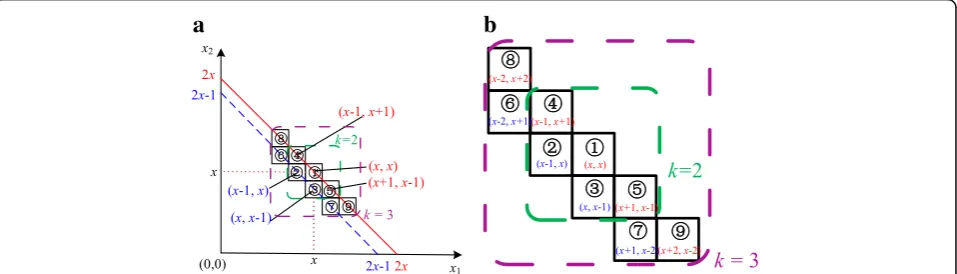
Recently, an improved work of [31] was proposed by us in [32]. Let us revisit the problem of restoringxfrom x1and x2as referred to (3). First, a coordinate system of x2with respect to x1was set up. In this way, for a desig-nated cover pixel x, the shiftable coordinate for (x1, x2) can be derived as being located at the pair straight line ofx2=−x1+ 2xand x2=−x1+ 2x−1. Figure1a shows a diagram of a coordinate system and the shiftable coordi-nates, and an enlarged view of its central region is also shown in Fig. 1b. It can be seen that the shiftable coordinates for embedding, in the case of k= 3, are (x, x), (x−1,x), (x,x−1), (x−1,x+ 1), (x+ 1,x−1), (x−2,x+ 1), (x+ 1, x−2), (x−2,x+ 2), and (x +2,x−2). To clarify the description, we allocated the position number, start-ing at 1 and increasstart-ing by increments of 1 to represent the shiftable coordinates. Note that, as the position number increases, the distortion of each pixel also
increases. Due to the aim for all the RDH methods that generate less distortion with a fixed embedding rate, we set a parameter k in our previous work, which was an integer equal to or greater than 1 to make a trade-off between distortion and embedding rate. Following [31], the k-length message bits, {m1, m2,…, mk}, were con-verted into decimal numberd, and different from [31], if dwas equal to 2k−1, an extra bit, mk + 1, was added to improve the capacity;dwas updated asd=d+mk +1 and then embedded intoxthrough:
x1¼xþfloorðd=4Þ;x2¼x1−ðd=2Þ;ifdis an even number
x1¼x−ceilðd=4Þ;x2¼x1þceilðd=2Þ;otherwise
ð4Þ
Eventually, the decimal numberdcan be restored in a reverse manner in the data extraction procedure.
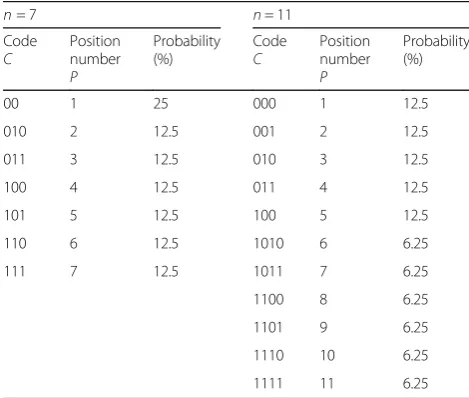
Now, we analyze the embedding strategy of our previ-ous work from a different perspective. Actually, for each embedding with parameter k, we generated a one-to-one code table to map the specific combination of k-length or (k+ 1)-length message bits, which is de-noted by C, to its corresponding shiftable position number P. Note that the maximum position number for each kwas 2k+ 1. For the ease of intuitive compre-hension, Table 1 lists the corresponding code table for k= 2 andk= 3. As seen in Table 1, the maximum pos-ition numbers for k= 2 and k= 3 are 5 and 9, respect-ively, and their average embedding bit lengths are 2.125 and 3.0625 bits, respectively. Indeed, according to our observations, the total number of allowable shift posi-tions, denoted by n, is more significant and elaborate than parameter k in the practical embedding perform-ance. Note that value of n can be set as any arbitrary odd number greater equal to or greater than 3, and when the values ofkare low enough, such ask= 1 or 2, their corresponding n values are 3 or 5, respectively, and there is no gap between them. However, as the
b
a
values ofkincrease, such ask= 3, 4, and 5, their corre-sponding nvalues are 9, 17, and 33. There are obvious gaps between 5 and 9, 9 and 17, and 17 and 33. For example, for k= 2 and 3, there is an optional setting of n= 7 between them, and similarly, fork= 3 and 4, there are triple optional settings ofn= 11, 13, and 15 between them. Therefore, to improve the embedding efficiency, the code length parameterkis no longer of use in this paper; we now use the maximum position parameter n. The code table with respect ton can be generated in a similar manner as Table 1. Table 2 lists two examples, i.e., for n= 7 and 11. To better explain the key idea of the proposed method, an example of how to embed the message bits is shown in Fig. 2, where message bits {00}2and {101}2are embedded into the cover pixels 45 and 90, respectively. A more general framework is dem-onstrated in Section3.
3 Proposed method
Based on the observation that the maximum allowable position number n is more significant than code length parameter k used in [32], in this paper, we propose a novel code-mapping method to improve the embedding efficiency, especially when there is a requirement for a higher embedding rate. In addition, different from the previous methods [31, 32] that the parameters were se-lected manually, the optimal parameter n* for a fixed embedding rate can be selected automatically before data hiding andn* can be identified correctly in advance before data extraction. The proposed method consists of two procedures, i.e., embedding data and extracting data/image recovery. In addition, the issue of underflow/ overflow also is addressed in this section. The detailed procedures are as follows.
3.1 Data embedding
For data embedding, the steps are as follows: Step 1: Seek the optimal parametern*
In almost all dual-image reversible data hiding methods, the research objective is to obtain lower distortion with a fixed embedding rateαor embedding capacityβ. The rela-tionship betweenαandβcan be derived by
α¼ β
MN2 ð5Þ
whereMandNare the row and column numbers of the cover image, respectively. According to (5), the optimization of embedding efficiency for a given β can be easily transferred to the optimization of that for a given α. Thus, in the remainder of this paper, we take the fixed embedding rate of α as an example. First, ig-nore the issue of underflow/overflow and set up the can-didate parameter setn= 3, 5, 7, 9,…, i.e.,ncan be set as an arbitrary odd integer greater than 1. As observed from Tables 1 and 2, the shortest code length, t, in the code table for each candidatencan be determined by Table 1One-to-one mapping code table for parameterk
k= 2 k= 3
Code
C
Position number
P
Probability (%)
Code
C
Position number
P
Probability (%)
00 1 25 000 1 12.5
01 2 25 001 2 12.5
10 3 25 010 3 12.5
110 4 12.5 011 4 12.5
111 5 12.5 100 5 12.5
101 6 12.5
110 7 12.5
1110 8 6.25
1111 9 6.25
Table 2One-to-one mapping code table for parametern
n= 7 n= 11
Code
C
Position number
P
Probability (%)
Code
C
Position number
P
Probability (%)
00 1 25 000 1 12.5
010 2 12.5 001 2 12.5
011 3 12.5 010 3 12.5
100 4 12.5 011 4 12.5
101 5 12.5 100 5 12.5
110 6 12.5 1010 6 6.25
111 7 12.5 1011 7 6.25
1100 8 6.25
1101 9 6.25
1110 10 6.25
1111 11 6.25
t¼floor logð 2ð Þn Þ ð6Þ
For instance, for n= 7, the shortest code is {00}2with the length of 2, and while for n= 11, the shortest codes are {000}2, {001}2, {010}2, {011}2, and {100}2 with the length of 3. If t is given, the value of n belongs to the interval of (2t, 2t+ 1). In other words, once the value of n is fixed, for each embedding on each pixel, we can embedttot+ 1 binary bits. It can also be observed from Tables1and 2, assuming the message bits are randomly permutated and the numbers of 0 and 1 are approxi-mately equal. Thus, the probability of eacht-length code is (2t+ 1−n)/2t, and the probability of each (t+ 1)-length code is (n−2t)/2t. Also, take n= 7 and n= 11 for example; for n= 7, the probabilities of occurrence of {00}2 and {010}2 are 25 and 12.5%, respectively, and for n= 11, the probabilities of occurrence of {000}2 and {1010}2 are 12.5 and 6.25%, respectively. Based on the above observations, the ideal embedding rateαn for any candidatencan be determined as
αn¼ t2
tþ1−n
2t þðtþ1Þ
n−2t 2t
1
2 ð7Þ
Note that the reason for appearance of 1/2 in (7) is due to that the embedding rate is calculated according to the dual images rather than a single image.
Next, if we consider the problem of underflow/over-flow, the number of pixels that cannot be modified should be identified. Here, we denote this number asKn and we discuss how to determine Kn in Section 3.3. After determining Kn, the amendatory embedding rate for a fixedncan be updated as:
~
αn¼ðMN−KnÞ αn
MN ð8Þ
For any candidaten, we calculate its limit-embedding rate ~
αn, and the optimal parametern*can be determined by
n ¼ minð Þn ∀~αn>α; n¼3;5;7;9;… ð9Þ
where min is the function to seek the minimum value.
Step 2: Generate the code table
The shiftable position numberPis allocated from 1 to n*, and the one-to-one mapping relationship between P and the binary code for embedding, i.e., C, should be established by the predefined regulations as described in Section2. For mapping from codeCto position number P, the first t* bits are converted to decimal number d, where t* is the shortest code length with respect to n* and determined from (5). As can be observed from Tables1and 2, the number of codes isn*, including the t*-length codes and the (t* + 1)-length codes with the numbers of 2t* + 1 − n* and 2n* −2t* + 1, respectively. Then, the mapping relationship can be interpreted as:
P¼dþ1; ifd≤2tþ1−n−1
P¼2tþ1−nþ2d−2tþ1þnþmþ1;otherwise
ð10Þ
wheremis the (t*+ 1)thbit of the message for embedding. For example, in the case ofn* = 11 andC= {001}2, it can be
easily calculated that d= 1, t* = 3, and d≤(2t*+ 1−n*−1); therefore, Pcan be directly determined byP=d+ 1 = 2. If
n* = 11 and C= {1011}2, in this case, d = 5, t* = 3, and d> (2t*+ 1−n*−1); therefore P can be determined by
P= (2t∗+ 1−n∗) + 2 × (d−2t∗+ 1+n∗) +m+ 1= 7.
Step 3: Modify the cover pixel pair
Each original cover pixel, x, is modified to its corre-sponding marked stego pixel pair, x1 and x2, according to the parity ofPas
x1¼xþfloor
P−1 4
;x2¼x−ceil P−1
4
;ifPis an odd number
x1¼x−ceil P 4
;x2¼xþfloor P
4
; otherwise
8 > > < > > :
ð11Þ
For example, as can be verified in Fig. 1, forP = 2, its corresponding modification equations are x1 = x −1, x2 = x, and for P = 7, its corresponding modification equations arex1=x+ 1,x2=x−2.
To this point, the message bits have been embedded into cover image with a dual-image mechanism.
3.2 Extraction of data and restoration of the cover image
To extract the message and restore the cover image, the steps are listed as follows:
Step 1: Restore the cover image and identifyn* For each pixel, the cover image can be restored through (3). Based on all groups of {x,x1andx2},n* can be identified as
n¼ maxðjx1−xj þjx2−xjÞ 2þ1;∀fx;x1;x2g
ð12Þ
where max is the function to seek the maximum value.
Step 2: Regenerate the code table
In the extraction procedure, the code table is estab-lished with the inverse order relative to the embedding procedure. First, after recognizing the unmodified pixels with the consideration of underflow/overflow, the pos-ition numberPP for the remaining pixels can be identi-fied as
P¼ ðjðx1−xjx1−xj þj þjx2−xjx2−xjÞ jÞ 22þ;otherwise1;ifx2≤x1
ð13Þ
where, {∙}2|t* is the conversion from decimal number to
t*-length binary digits, and |⋅| is a cascading operation onto two binary sequences.
Step 3: Extract the message bits
For each pixel without any underflow/overflow protec-tion, after identifying its position number Pand its cor-responding codeC, the message bits from each pixel can be extracted separately according to the code table as re-generated in Step 2. Finally, concatenate all messages into the entire message.
3.3 Underflow/overflow issue in the proposed method
For all RDH methods, the issue of underflow/overflow is inevitable. To avoid already modified pixels out of the bound of image representation, some original pixels are protected without any modification in the embedding process. The protection scope is
underflow:x−ceilððn−1Þ=4Þ<0 overflow:xþfloorððn−1Þ=4Þ>255
ð15Þ
Thus, pixels that belong to the intervals of [0, ceil((n−1)/ 4)⌈(n−1)/4⌉) and (255 − floor((n − 1)/4)⌈(n−1)/ 4⌉)⌊(n−1)/4⌋, 255] are not embedded in any message; instead, all remaining pixels are modified following the procedures described in Section 3.1. Note that the total number of pixels that belong to the underflow/overflow protection ranges is counted and denoted byKn.
4 Results and discussion
To demonstrate the efficacy of the proposed method, we compared our method with some state-of-the-art dual-image RDH methods [28,31,32]. First, four stand-ard test images, i.e., Lena, Baboon, Barbara, and Goldhill, were used in our evaluation as shown in Fig.3.
Figure 4 shows the comparative results of the average peak signal-to-noise ratio (PSNR) with respect to the embedding rate between our previous work [32], Lu et al.’s method [31], and the proposed method. Note that owing to being very close to the corresponding PSNR performances of [32] in the cases of k ≥4, for ease of comparison, the performance curves of [31] in the cases of l ≥4 are omitted in Fig. 4. Note that, for shiftable position-based, dual-image RDH methods, their corre-sponding embedding performances were essentially un-affected by the content of the cover image itself, except for small differences in underflow/overflow. Therefore, as shown in Fig. 4, there is no significant difference be-tween each image by using a specified method, whether it is [32] or the proposed method. It also should be pointed out that the parameters kand l in [31, 32], re-spectively, were not selected automatically; thus, there are multiple curves in each performance diagram based on the different settings of k and l. For the proposed method, the optimal parameter n* can be sought adap-tively, so the performance curve for the proposed method is integrated into a single curve. Due to the use of new parameter n*, the performance of our method provided an obvious improvement, especially for the higher embedding rates.
To further demonstrate the superiority for the require-ment of higher embedding rates, Table3lists the average PSNRs of the proposed method and some state-of-the-art methods, such as [28,31,32], with some fixed embedding rates. Due to the limited capacity for [28], we use“n/a”to stand for the occasion that is unavailable to fulfill the re-quired capacity. Note that for [31,32], based on the given embedding rates, we select the optimal parameter manually. It can be seen that all average PSNRs by the proposed method are higher than our previous work of
C¼
P−1
f g2jt; ifP≤2t
þ1−n
ceil P− 2 tþ1−n
ð Þ
2
þ2tþ1−n−1
2jt
modðP;2Þ
f g2j1;otherwise
8
> < >
: ð14Þ
[32] and Lu et al.’s method [31], and in the case ofα= 1.2, average PSNRs in [28] is slightly higher than the proposed method. However, with the increase ofα, the embedding rate is out of the maximum sustainable rate; in other words, the proposed method has more flexible capacity than [28].
Next, to demonstrate the universality of the proposed method, i.e., our method was not only effective on some specific standard test images but also arbitrary selected
images, 300 images were randomly selected from UCID dataset to involve into the test after a conversion from RGB color channels to gray images. Figure 5 shows the average PSNRs of each dual image pair with two fixed em-bedding rates of 1.2 bpp (bits per pixel) and 1.6 bpp, re-spectively. To present the superiority of the proposed method, the corresponding average PSNRs of [32] with the same embedding rates are also shown in Fig.5. It can be seen that the average PSNRs of the proposed method for the embedding rates of 1.2 bpp and 1.6 bpp were 48.71 and 45.07 dB, respectively, with the average gains of 1.19 and 3.38 dB, respectively, over our previous method [32]. Fig. 4Comparison of embedding rate and average PSNR between our previous method [32], Lu et al.’s method [31], and the proposed method
Table 3Comparison of the proposed method with other methods in terms of average PSNRs (dB) with fixed embedding rates (bpp). The best result for each image is presented in italics
Image Embedding rateα
Lu et al. [31]
Yao et al. [32]
Jafar et al. [28]
Proposed
Lena 1.20 47.33 47.51 48.75 48.71
1.60 41.70 41.75 n/a 45.34
2.20 35.35 35.40 n/a 38.86
Baboon 1.20 47.33 47.52 48.74 48.72
1.60 41.70 41.75 n/a 45.34
2.20 35.36 35.39 n/a 38.85
Barbara 1.20 47.34 47.52 48.74 48.72
1.60 41.70 41.78 n/a 45.33
2.20 35.36 35.40 n/a 38.86
Goldhill 1.20 47.33 47.51 48.74 48.71
1.60 41.70 41.75 n/a 45.34
2.20 35.34 35.38 n/a 38.87
Standard image Lena is adopted to demonstrate the imperceptibility of the proposed method. Figure6shows the comparison between the original cover image and the marked stego images, where the column (a) is the cover image and the zoom-in view of its red square re-gion, the columns (b) and (c) are the marked dual images with the embedding rate of 1.2 bpp and their corresponding zoom-in versions, the columns (e) and (f ) are the marked dual images with the embedding rate of 1.6 bpp and their corresponding zoom-in versions. As seen in Fig. 6, the marked dual images still exhibit ac-ceptable visual quality even with a relative higher em-bedding rate.
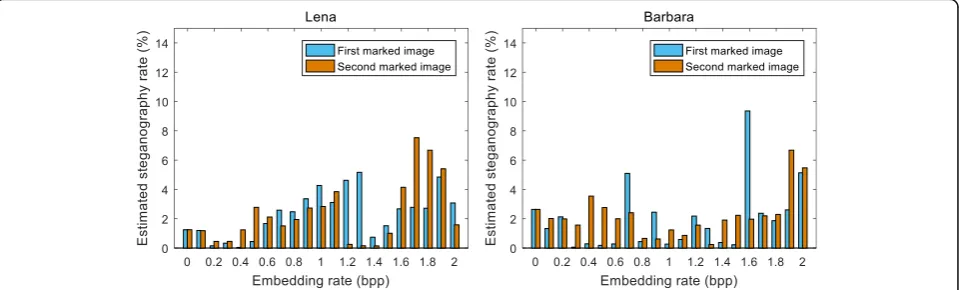
To verify the security of the proposed algorithm, the attacks of RS steganalysis [33] is conducted on the pro-posed method. The RS steganalysis was designed to de-tect the trace of LSB steganography and estimate the embedding rate of hidden message. In our experiments,
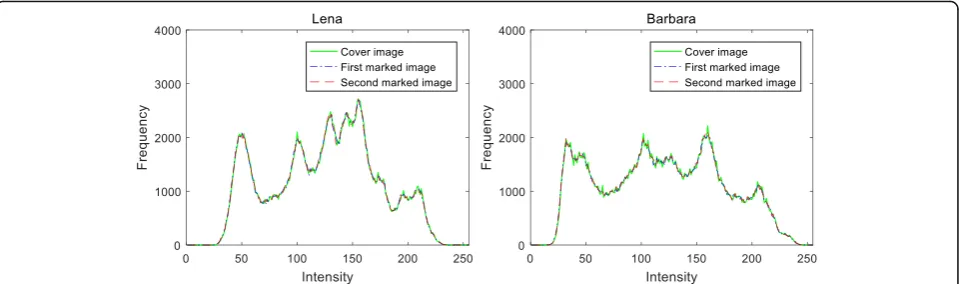
the RS test was conducted on the two test images, i.e., Lena and Barbara, respectively, with the different em-bedding rates. Figure 7shows the estimated steganogra-phy rate with respect to the actual embedding rates varying from 0 to 2.0 with the incremental step of 0.1. Note that embedding rate = 0 means the original cover image without any distortion. As can be seen in Fig. 7, all estimated steganography rates of the marked images are below 10%, which is a relative safe threshold to avoid causing the alert by the attackers. Furthermore, the histogram analysis is also applied on the marked dual images. Figure8shows the histogram comparison of the cover images, Lena and Barbara, and their correspond-ing marked stego dual images with the embeddcorrespond-ing rate of 1.2. It can be seen in Fig. 8 that there is no obvious differences between the cover images and the marked images; in other words, the proposed method is with high security to resist the histogram analysis attack.
a
b
c
d
e
Fig. 6Visual comparison of the cover image and the marked stego dual images.aCover image.b,cMarked stego dual images with the embedding rate of 1.2.e,fMarked stego dual images with the embedding rate of 1.6. All bottom images are the partial enlarged view of the red square regions from their corresponding top images
5 Conclusions
In this paper, we have proposed a general work for our previously proposed shiftable position-based, dual-image RDH method. Compared with the previous method, the proposed method used the total number of shiftable positions, rather than the code length, as the embedding parameter. The proposed method provides two main improvements, i.e., (1) the optimal parameter can be sought automatically with a designated embedding rate and (2) the efficiency in the case of high embedding rates outperforms our previous work. The experimental results have demonstrated the improvements provided by the proposed method.
Abbreviations
bpp:Bits per pixel; DE: Difference expansion; HS: Histogram shift; LSB: Least significant bit; PDA: Pairwise difference adjustment; PEE: Prediction-error expansion; PEH: Prediction-error histogram; PSNR: Peak signal-to-noise ratio; PVO: Pixel value ordering; RDH: Reversible data hiding
Acknowledgements
The authors would like to thank the anonymous reviewers for their helpful comments.
Funding
This work was supported in part by the National Natural Science Foundation of China (61702332, 61672354, 61562007, U1636206, 61525203, and 61472235), Research Fund of Guangxi Key Lab of Multi-source Information Mining & Security (MIMS16-03), the Guangxi Natural Science Foundation (2017GXNSFAA198222), the Guangxi Collaborative Innovation Center of Multi-source Information Integration and Intelligent Processing, the Shanghai Dawn Scholar Plan (14SG36), and the Shanghai Excellent Academic Leader Plan (16XD1401200).
Authors’contributions
HY did the main work. CQ and ZT did the experiments. XZ offered the suggestion. All authors read and approved the final manuscript.
Authors’information
Heng Yao received the B.S. degree from Hefei University of Technology, China, in 2004; the M.S. degree from Shanghai Normal University, China, in 2008; and the Ph.D. degree from Shanghai University, China, in 2012. Currently, he is with School of Optical-Electrical and Computer Engineering, University of Shanghai for Science and Technology, China. His research interests include digital forensics, data hiding, image processing, and pattern recognition. Chuan Qin received the B.S. degree in electronic engineering and the M.S. degree in signal and information processing from Hefei University of Technology, Anhui, China, in 2002 and 2005, respectively, and the Ph.D. degree in signal and
information processing from Shanghai University, Shanghai, China, in 2008. Since 2008, he has been with the faculty of the School of Optical-Electrical and Computer Engineering, University of Shanghai for Science and Technology, where he is currently an Associate Professor. He was with Feng Chia University at Taiwan as a Postdoctoral Researcher and Adjunct Assistant Professor from July 2010 to July 2012. His research interests include image processing and multimedia security. He has published more than 90 papers in these research areas.
Zhenjun Tang received the B. S. and M. Eng. degrees from Guangxi Normal University, Guilin, P.R. China, in 2003 and 2006, respectively, and the Ph.D. degree from Shanghai University, Shanghai, P.R. China, in 2010. He is now a Professor with the Department of Computer Science, Guangxi Normal University. His research interests include image processing and multimedia security. He has contributed more than 50 international journal papers. He holds six China patents. He is a senior member of China Computer Federation (CCF) and also a reviewer of more than 20 SCI journals, such as IEEE journals, IET journals, Elsevier journals, Springer journals, and Taylor & Francis journals. Xinpeng Zhang received the B.S. degree in computational mathematics from Jilin University, China, in 1995 and the M.E. and Ph.D. degrees in
communication and information system from Shanghai University, China, in 2001 and 2004, respectively. Since 2004, he has been with the faculty of the School of Communication and Information Engineering, Shanghai University, where he is currently a Professor. He was with the State University of New York at Binghamton as a visiting scholar from January 2010 to January 2011 and with University of Konstanz as an experienced researcher sponsored by the Alexander von Humboldt Foundation from May 2011 to August 2012. His research interests include multimedia security, image processing, and digital forensics.
Ethics approval and consent to participate Not applicable.
Consent for publication Not applicable.
Competing interests
The authors declare that they have no competing interests.
Publisher’s Note
Springer Nature remains neutral with regard to jurisdictional claims in published maps and institutional affiliations.
Author details
1Shanghai Key Lab of Modern Optical System, and Engineering Research
Center of Optical Instrument and System, Ministry of Education, University of Shanghai for Science and Technology, Shanghai 200093, China.2Guangxi Key Lab of Multi-source Information Mining and Security, Guangxi Normal University, Guilin 541004, China.3School of Communication and Information
Received: 22 August 2017 Accepted: 22 May 2018
References
1. J Tian, Reversible data embedding using a difference expansion. IEEE Trans. Circuits Syst. Video Technol.13(8), 890–896 (2003)
2. S Weng, Y Zhao, JS Pan, R Ni, Reversible watermarking based on invariability and adjustment on pixel pairs. IEEE Signal Process Lett.15, 721–724 (2008) 3. I Dragoi, D Coltuc, Local-prediction-based difference expansion reversible
watermarking. IEEE Trans. Image Process.23(4), 1779–1790 (2014) 4. Z Ni, Y Shi, N Ansari, W Su, Reversible data hiding. IEEE Trans. Circuits Syst.
Video Technol.16(3), 354–362 (2006)
5. L Luo, Z Chen, M Chen, X Zeng, Z Xiong, Reversible image watermarking using interpolation technique. IEEE Trans. Inf. Forensics Secur.5(1), 187–193 (2010) 6. C Qin, CC Chang, YH Huang, LT Liao, An inpainting-assisted reversible
steganographic scheme using a histogram shifting mechanism. IEEE Trans. Circuits Syst. Video Technol.23(7), 1109–1118 (2013)
7. V Sachnev, HJ Kim, J Nam, S Suresh, Y Shi, Reversible watermarking algorithm using sorting and prediction. IEEE Trans. Circuits Syst. Video Technol.19(7), 989–999 (2009)
8. B Ou, X Li, Y Zhao, R Ni, Y Shi, Pairwise prediction-error expansion for efficient reversible data hiding. IEEE Trans. Image Process.22(12), 5010–5021 (2013) 9. X Li, W Zhang, X Gui, B Yang, Efficient reversible data hiding based on
multiple histograms modification. IEEE Trans. Inf. Forensics Secur.10(9), 2016–2027 (2015)
10. X Li, J Li, B Li, B Yang, High-fidelity reversible data hiding scheme based on pixel-value-ordering and prediction-error expansion. Signal Process.93, 198– 205 (2013)
11. S Weng, J Pan, L Li, Reversible data hiding based on an adaptive pixel-embedding strategy and two-layer pixel-embedding. Inf. Sci.369, 144–159 (2016) 12. X Zhang, Reversible data hiding in encrypted image. IEEE Signal Processing
Lett18(4), 255–258 (2011)
13. K Ma, W Zhang, X Zhao, N Yu, F Li, Reversible data hiding in encrypted images by reserving room before encryption. IEEE Trans. Inf. Forensics Secur.
8(3), 553–562 (2013)
14. X Cao, L Du, X Wei, D Meng, X Guo, High capacity reversible data hiding in encrypted images by patch-level sparse representation. IEEE Trans Cybern
46(5), 1132–1143 (2016)
15. A Nikolaidis, Reversible data hiding in JPEG images utilising zero quantised coefficients. IET Image Process.9(7), 560–568 (2015)
16. F Huang, X Qu, HJ Kim, J Huang, Reversible data hiding in JPEG images. IEEE Trans. Circuits Syst. Video Technol.26(9), 1610–1621 (2016) 17. B Ou, X Li, Y Zhao, R Ni, Efficient color image reversible data hiding based
on channel-dependent payload partition and adaptive embedding. Signal Process.108, 642–657 (2015)
18. H Yao, C Qin, Z Tang, Y Tian, Guided filtering based color image reversible data hiding. J. Vis. Commun. Image Represent.43, 152–163 (2017) 19. C.C. Lo, .YC. Hu, A novel reversible image authentication scheme for digital
images. Signal Process. 98, 174–185 (2014)
20. W Hong, M Chen, TS Chen, An efficient reversible image authentication method using improved PVO and LSB substitution techniques. Signal Process. Image Commun.58, 111–122 (2017)
21. H Wu, J Dugelay, Y Shi, Reversible image data hiding with contrast enhancement. IEEE Signal Processing Lett22(1), 81–85 (2015) 22. H Chen, J Ni, W Hong, T Chen, Reversible data hiding with contrast
enhancement using adaptive histogram shifting and pixel value ordering. Signal Process. Image Commun.46, 1–16 (2016)
23. CC Chang, TD Kieu, YC Chou, inTENCON 2007—2007 IEEE Region 10 Conference. Reversible data hiding scheme using two steganographic images (IEEE, 2007), pp. 1–4
24. CC Chang, TC Lu, G Horng, YH Huang, YM Hsu, in9th International Conference on Information, Communications and Signal Processing (ICICS 2013). A high payload data embedding scheme using dual stego-images with reversibility (IEEE, 2013), pp. 1–5
25. C Qin, CC Chang, TJ Hsu, Reversible data hiding scheme based on exploiting modification direction with two steganographic images. Multimed Tools Appl74(15), 5861–5872 (2015)
26. X Zhang, S Wang, Efficient steganographic embedding by exploiting modification direction. IEEE Commun. Lett.10(11), 781–783 (2006) 27. TC Lu, CY Tseng, JH Wu, Dual imaging-based reversible hiding technique
using LSB matching. Signal Process.108, 77–89 (2015)
28. IF Jafar, KA Darabkh, RT Al-Zubi, RR Saifan, An efficient reversible data hiding algorithm using two steganographic images. Signal Process.128, 98–109 (2016) 29. CF Lee, KH Wang, CC Chang, YL Huang, inProceedings of the 3rd
International Conference on Ubiquitous Information Management and Communication. A reversible data hiding scheme based on dual steganographic images (IEEE, 2009), pp. 228–237
30. CF Lee, YL Huang, Reversible data hiding scheme based on dual stegano-images using orientation combinations. Telecommun. Syst.
52(4), 2237–2247 (2013)
31. TC Lu, JH Wu, CC Huang, Dual-image-based reversible data hiding method using center folding strategy. Signal Process.115, 195–213 (2015) 32. H Yao, C Qin, Z Tang, Y Tian, Improved dual-image reversible data hiding
method using the selection strategy of shiftable pixels’coordinates with minimum distortion. Signal Process.135, 26–35 (2017)
![Figure 4 shows the comparative results of the averagepeak signal-to-noise ratio (PSNR) with respect to theembedding rate between our previous work [32], Lu etal.’s method [31], and the proposed method](https://thumb-us.123doks.com/thumbv2/123dok_us/885640.1585988/6.595.61.539.616.716/figure-comparative-results-averagepeak-respect-theembedding-previous-proposed.webp)
![Fig. 5 Comparison of average PSNR for the specified embeddingrates of 1.2 bpp and 1.6 bpp between the proposed method andprevious method [32] using randomly selected 300 UCID images](https://thumb-us.123doks.com/thumbv2/123dok_us/885640.1585988/7.595.62.540.89.353/comparison-average-specified-embeddingrates-proposed-andprevious-randomly-selected.webp)