Volume 2007, Article ID 41516,12pages doi:10.1155/2007/41516
Research Article
Image Resolution Enhancement via Data-Driven Parametric
Models in the Wavelet Space
Xin Li
Lane Department of Computer Science and Electrical Engineering, West Virginia University, Morgantown, WV 26506-6109, USA
Received 11 August 2006; Revised 29 December 2006; Accepted 9 January 2007
Recommended by James E. Fowler
We present a data-driven, project-based algorithm which enhances image resolution by extrapolating high-band wavelet coeffi-cients. High-resolution images are reconstructed by alternating the projections onto two constraint sets: theobservationconstraint defined by the given low-resolution image and thepriorconstraint derived from the training data at the high resolution (HR). Two types of prior constraints are considered: spatially homogeneous constraint suitable for texture images and patch-based inhomogeneous one for generic images. A probabilistic fusion strategy is developed for combining reconstructed HR patches when overlapping (redundancy) is present. It is argued that objective fidelity measure is important to evaluate the performance of resolution enhancement techniques and the role of antialiasing filter should be properly addressed. Experimental results are reported to show that our projection-based approach can achieve both good subjective and objective performance especially for the class of texture images.
Copyright © 2007 Xin Li. This is an open access article distributed under the Creative Commons Attribution License, which permits unrestricted use, distribution, and reproduction in any medium, provided the original work is properly cited.
1. INTRODUCTION
Depending on the presence of antialiasing filer, there are two ways of formulating the resolution enhancement problem for still images—that is, how to obtain a high-resolution (HR) image from its low-resolution (LR) version? When no an-tialiasing filter is used (seeFigure 1(a)), we might use clas-sical linear interpolation [1], edge-sensitive filter [2], direc-tional interpolation [3], POCS-based interpolation [4], or edge-directed interpolation schemes [5,6]. When antialias-ing filter is involved (seeFigure 1(b)), resolution enhance-ment is twisted with contrast enhanceenhance-ment by deblurring which is an ill-posed problem itself [7].
When antialiasing filter takes the form of lowpass filter in wavelet transforms (WT) [8], there are a flurry of works [9–17] which transform the problem of resolution enhance-ment in the spatial domain to the problem of high-band ex-trapolation in the wavelet space. The apparent advantages of wavelet-based approaches include numerical stability and potential leverage into image coding applications (e.g., [18]). However, one tricky issue lies in the performance evaluation of resolution enhancement techniques—should we use sub-jective quality of high-resolution (HR) images or obsub-jective fidelity such as mean-square errors (MSE)?
The difficulty with the subjective option lies in that it opens the door to allow various contrast enhancement tech-niques as a postprocessing step after resolution enhance-ment. Both linear (e.g., [19]) and nonlinear (e.g., [20]) tech-niques have been proposed in the literature for sharpening reconstructed HR images. We note thatcontrastand resolu-tionare two separate issues related to visual quality of still images. Tangling them together will only make the prob-lem formulation less clean because it makes a fair compar-ison more difficult—that is, whether quality improvement comes from resolution enhancement or contrast enhance-ment? Therefore, we argue that subjective quality should not be used alone in the assessment of resolution enhancement schemes. Moreover, objective fidelity such as MSE can mea-sure the closeness of computational approaches to the more cost-demanding optics-based solutions, which is supplemen-tary to subjective quality indexes.
x(n) 2 s(n) (a)
x(n) H0(z) 2 s(n) (b)
Figure1: Two ways of formulating the resolution enhancement problem in 1D (2D generalization is straightforward): (a) without antialias-ing filter; (b) with antialiasantialias-ing filterH0(lowpass filter in wavelet transforms).
G0
G1
2
2
x(n) s(n)
0, 0,. . ., 0
(a)
Carey et al.’s scheme PSNR
Lazy scheme PSNR
Lena 4.2 4.9
Mandrill 0.2 1.3
Peppers 2.7 4.3
(b)
Figure2: (a) Diagram of lazy scheme (padding zeros to high band); (b) comparison of PSNR gains (dB) over bicubic between [10] and lazy scheme for three USC test images. Note that zero-padding-based lazy scheme achieves even higher PSNR values than more sophisticated scheme [10].
zeros into the three high bands before doing inverse WT (re-fer toFigure 2(a)).Figure 2(b)shows the PSNR gain of lazy scheme over bicubic interpolation—note that the impressive gain is not due to the ingeniousness of the lazy scheme itself but an unfair comparison because bicubic interpolation does not make use of the antialiasing filter at all. Unfortunately, such subtle difference caused by antialiasing filter appears to be largely ignored in the literature [10–15] which use bilin-ear/bicubic interpolation as the benchmark.
In this paper, we propose a data-driven, projection-based approach toward resolution enhancement by extrapolating high-band wavelet coefficients. Our work is built upon para-metric wavelet-based texture synthesis [21] and nonpara-metric example-based superresolution (SR) [22]. Similar to [22], we also assume the availability of some HR images as the training data; however, our extrapolation method is based on the parametric model proposed in [21]. Since para-metric texture models [21] cannot be directly used for res-olution enhancement of generic images due to their inho-mogeneity, we propose to use [22] as a preprocessing step of preparing HR training patches to drive parametric mod-els. Moreover, to reduce the artifacts introduced by patch-based representations, we propose a strategy of probabilis-tically fusing the overlapped patches synthesized at the HR, which can be viewed as the extension of averaging strategy adopted by [22].
The rest of the paper is structured as follows. InSection 2, we briefly cover the background and motivation behind our approach. InSection 3, we present a basic extension of syn-thesis technique [21] for resolution enhancement of spa-tially homogeneous textures. InSection 4, we generalize our new resolution enhancement into the spatially inhomoge-neous case by introducing patch-based representation and weighted linear fusion. Experimental results are reported in Section 5 to demonstrate the performance of our schemes and we make final concluding remarks inSection 6.
2. PROBLEM FORMULATION AND MOTIVATION
In wavelet-space extrapolation, the objective is to obtain an estimation of high-band coefficientsd(n) froms(n) (re-fer to Figure 3). Due to aliasing introduced by the down-sampling operator, such inter-band prediction (note its dif-ference from interscale prediction in wavelet-based image coding [18]) is not expected to work unless we impose some constraints on the original HR signalx(n). For example, it is well known that in 1D scenario, the way that extrema points of isolated singularities propagate across the scales can be characterized by local Lipschitz regularity [23]. Many pre-vious wavelet-based interpolation schemes (e.g., [9,10]) are based on such observation.
However, there are caveats with the above observation. First, aliasing introduced by the down-sampling operator adds phase ambiguity to the extrapolation problem. That is, the extrema points across the scales cannot be exactly located due to the phase uncertainty. Additional constraints are re-quired to help partially resolve such ambiguity. Such issue was insightfully pointed out by the authors of [9,16], but the success has been limited to subjective quality improve-ment so far. In fact, if such ambiguity is not properly re-solved, the predicted high-frequency band is often no better than zero-padding in the lazy scheme (i.e., lower MSE can-not be achieved). Second and more importantly, the problem of inter-band prediction becomes dramatically more difficult in 2D scenario due to the increased complexity of model-ing image signals in the wavelet space. The diversity of image structures in generic images (e.g., edges, textures, etc.) dra-matically increases the difficulty of the extrapolation task.
The motivation behind our attack is largely based on the existing parametric models [21] for texture synthesis in the wavelet space. However, we face two obstacles while apply-ing parametric models into resolution enhancement:aliasing
x(n) H0 H1 2 2 Analysis
s(n) P
d(n) 2 2
G0
G1
x(n)
Synthesis
Figure3: Problem formulation in 1D scenario: in wavelet-based interpolation, interscale prediction is designed to predict high-band coef-ficients from the low-band ones at the same scale.
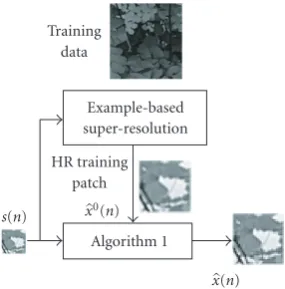
nontrivial (essentially a missing data problem) and inho-mogeneity calls for spatially varying (or localized) models. To overcome those difficulties, we borrow ideas from data-driven or example-based superresolution (SR) [22] to make the problem tractable. Assuming the availability of some cor-related HR images as training data, we propose to use non-parametric sampling [22] to first generate initial HR patches, then use them to drive the parametric model to synthesize in-termediate HR patches and lastly obtain the final HR patches via probabilistic fusion.
3. RESOLUTION ENHANCEMENT OF TEXTURE IMAGES
In this work, we have adopted a definition of textures in the narrow sense—that is, textures are modeled by a homo-geneous (stationary) random field. Homogeneity refers to that the probability distribution function (pdf) is indepen-dent of the spatial position. Statistical modeling of textures has been extensively studied in the literature (see [24–26]). In recent years, multiscale approaches toward texture anal-ysis and synthesis have also received more and more atten-tion (e.g., [21,27–29]). Both parametric and nonparametric models have been developed and demonstrated visually ap-pealing synthesis results. Among them, parametric models in the wavelet space [21] are adopted as the foundation for this work.
Resolution enhancement, unlike synthesis, addresses a new dimension of challenge due to aliasing introduced by the down-sampling operation. Depending on the choice of antialiasing filter and the spectral distribution of texture im-ages, we might observe significant visual difference between LR and HR pairs due to spatial aliasing. Even when aliasing does not dramatically change the visual appearance, HR im-age reconstructed by the lazy scheme often appears blurred due to the knock down of high-frequency coefficients. In pre-vious works on wavelet-based interpolation such as [30], no experimental results are reported for texture images. Accord-ing to [10], the PSNR gain of wavelet-based interpolation over bilinear/bicubic is almost unnoticeable formandrill im-age which contains abundant texture regions.
In view of the difficulty with finding a universal prior constraint for textures, we propose to make additional as-sumption that some HR training patches are available (re-fer toFigure 5(a)). It is believed that such training data are necessary for resolution enhancement of textures because the problem is ill-posed (i.e., two HR images corresponding to the same LR data can be visually different). However, the size
s(n) Observationconstraint at LR Model-based constraint at HR θ
xk(n)
Analysis HR training
patch
Figure 4: Resolution enhancement of textures: HR image is ob-tained by alternating the projection onto two constraint sets.
of training patch could be small since its role is to resolve the ambiguity among multiple solutions caused by aliasing. Specifically, we propose to combine patch-based prior con-straint with observation data concon-straint (i.e., the low-low band in the wavelet space is specified by the given LR image) and reconstruct HR images by alternating projections (refer toFigure 4).
Various statistical models developed for texture synthe-sis (e.g., [21,27,28]) can be used to derive the prior con-straint sets. Since the parametric model developed in [21] is projection-based and computationally efficient, we can easily build our resolution enhancement algorithm upon it. In [21], four types of statistical constraints (SC), namely, marginal statistics, raw coefficient correlation, coefficient magnitude statistics, and cross-scale phase statistics, are se-quentially enforced to iteratively adjust complex high-band coefficients (we denote it by projection operator Psc[x]).
Mathematical details on adjustment of constraints can be found in the appendix of [21]. The implementation of pro-jection onto observation constraint (Pobs[x]) is trivial—we
simply replace the low-low band ofx in the wavelet space by the given LR image (the MSE of low-low band is denoted by MSELL). By alternatively applying model-based prior
con-straint and data-driven observation concon-straint to high-band and low-band coefficients, we have the following algorithm.
Like any iterative schemes, starting point and stopping criterion are important to the performance ofAlgorithm 1. We have found thatAlgorithm 1is reasonably robust to the starting point (x0) (one example can be found inFigure 10).
We also note that unlike existing projection onto convex set (POCS) based algorithms [31], convergence is not a neces-sary condition even though we have found that MSELLoften
(i) Initialization: extract the parameter setΘfrom the train-ing patch and obtain HR imagex0 by lazy scheme or
example-based SR [22].
(ii) Iterations: alternate the following two projections.
(1) Projection onto prior constraint set: sequentially run the projection onto four statistical constraint sets to modify the HR image
xn+1=P
sc
xn|Θ. (1)
(2) Projection onto observation constraint set:
xn+2=P
obs
xn+1. (2)
(iii) Termination: if MSELLkeeps decreasing, continue the
it-eration; otherwise stop.
Algorithm1: Project-based resolution enhancement for textures.
model is often unknown. However, in the application of reso-lution enhancement, our projection-based algorithm can be stopped by checking MSELLbecause it is correlated with the
MSE of reconstructed HR image as shown inFigure 6. De-spite the lack of theoretical justification, such empirical stop-ping criterion works fairly well in practice.
4. RESOLUTION ENHANCEMENT OF GENERIC IMAGES
Generic photographic images contain a variety of singular-ities including edges, textures, and so on. The diversity of singularities suggests that image source cannot be modeled by a globally stationary (homogeneous) process. A natu-ral strategy of handling nonstationary process is via spatial localization—that is, to view an image as the composition of overlapping patches [22] (refer toFigure 5(b)). Such patch-based representation has led to many state-of-the-art image processing algorithms in both spatial and wavelet domains. Using patch-based representation, we decompose resolution enhancement of generic images into two subproblems: (1) how to enhance the resolution of a single patch? (2) How to combine the enhancement results obtained for overlapped patches? The first can be solved byAlgorithm 1except the generation of HR training patch; the second is related to the issue of global consistency due to the locality assumption of patches. We will study these two problems, respectively, next.
4.1. Single-patch resolution enhancement
Since generic images do not satisfy the assumption of global homogeneity, HR training patches have to be made spatially adaptive. Unlike texture images, how to generate an appro-priate HR training patch is nontrivial due to thelocation un-certainty. In texture images, an HR patch of any location is arguably useable because of the homogeneity constraint (we will illustrate this inFigure 10). However, such flexibility
Testing patch Training patch
(a)
A
B
A: Overlapping patches B: Nonoverlapping patches
(b)
Figure5: (a) Training patch and test patch in texture images; (b) overlapping and nonoverlapping patches in generic images.
does not hold for generic images any more—since the con-ditional probability distribution becomes a function of loca-tion, additional uncertainty needs to be resolved in the gen-eration of HR training patches.
One solution to resolve such location uncertainty is through nonparametric sampling [22,32]. In nonparametric sampling, patches with similar photometric patterns are clus-tered and new patch can be synthesized by sampling the em-pirical distribution. Such strategy cannot be directly applied here because the target to approximate is an LR patch and the population to draw from is the collection of HR patches. However, we can modify the distance metric in nonparamet-ric sampling to accommodate such resolution discrepancy, that is,
dxl,yh
=xl−DH
yhL2, (3)
180 200 220 240 260 280 300 320 340 360
MSE
1 2 3 4 5 6 7 8 9 10
Iteration number (a)
160 180 200 220 240 260 280
MSE
LL
1 2 3 4 5 6 7 8 9 10
Iteration number (b)
Figure6: The behavior of iterativeAlgorithm 1: (a) MSE of reconstructed HR image; (b) MSE of low-low band MSELL. Note that they are
highly correlated which empirically justifies the stopping criterion based on MSELL.
example-based superresolution [22] offers a convenient im-plementation of generating HR training patch.
Unlike [22], nonparametric sampling is used here to gen-erate the initial rather than the final result. This is because although nonparametric sampling often produces perceptu-ally appealing results, they do not necessarily have smallL2
distance to the ground truth. Therefore, we propose to use the outcome of nonparametric sampling as the training HR patch to drive the parametric texture model, as shown in Figure 7. Meantime, due to the descriptive nature of para-metric texture models, synthesized images might have sim-ilar statistical properties such as marginal or joint pdf but largeL2 distance to the original. Such weakness with
para-metric models can be alleviated by defining a new prior con-straint projection operatorPsc
xk+1=P sc
xk=Psc
xk+x0
2 . (4)
Such modification can be viewed as adding a bounded vari-ation constraint enforcing the initial conditionx0.
Such combination of nonparametric and parametric sampling is important to achieve good performance in terms of both subjective quality and objective fidelity. On one hand, it extends the parametric texture model [21] by introduc-ing nonparametric samplintroduc-ing to generate trainintroduc-ing patches re-quired at the HR. Despite being conceptually simple, such extension effectively overcomes the difficulty of resolution discrepancy and handles inhomogeneity in generic images. On the other hand, our combined scheme is more robust to training data than example-based SR [22]. This is because parametric texture model can tolerate some errors in the ini-tial estimate as long as they do not significantly change the four types of statistical constraints.
Training data
Example-based super-resolution HR training
patch
Algorithm 1 s(n)
x(n)
x0(n)
Figure7:Algorithm 2for resolution enhancement of a single patch (example-based SR provides an initial result to drive the parametric texture model).
4.2. Bayesian fusion of overlapped HR patches
patch-based fusion problem under a Bayesian framework and derive a closed-form solution as follows.
Using patch-based representation, we adopt the follow-ing probability model for each pixel:
p(x)=
p(x,z)dz=
p(x|z)p(z)dz, (5)
where the new random variablezdenotes thelocationof pixel xin the patch. Given a set of HR reconstruction resultsy =
[y1,. . .,yk,. . .,yN] (k is the discretized version of location
variablez,N is the total number of patches containingx), the Bayesian least-square estimator is
E[x|y]=
xp(x|y)dx
=
xp(x,z|y)dx dz
=
xp(x|z,y)p(z|y)dx dz
=
p(z|y)E[x|z,y]dz.
(6)
Note that whenzis given (i.e., the indexingkof HR patch yk), we haveE[x|k,y]=ykand (6) boils down to
x=E[x|y]=
N
k=1
wkyk, (7)
wherewk=p(k|yk) is the weighting coefficient for thekth
patch. To determinewk, we use Bayesian rule
pk|yk
= p
yk|k
p(k)
kp
yk|k
p(k), (8)
where likelihood functionp(yk|k) (the likelihood of pixelx
belonging to thekth patch) can be approximated by a Gaus-sian distribution of exp(−e2/K) where e = d[x
l,yh] as
de-fined in (3) indicates how well the observation constraint is satisfied andKis a normalizing constant as used in bilateral filter [33]. Currently, we adopt a uniform prior p(k)=1/N for the simplicity but more sophisticated form such as Gaus-sian can also be used.
Combining single-patch resolution enhancement and Bayesian fusion, we obtain the following algorithm of res-olution enhancement for generic images.
We note that the above Bayesian fusion degenerates into simple averaging across overlapping patches [22] when the likelihood function is approximately independent of loca-tions (i.e., all coefficients in (7) have the same weights). The characteristics of likelihood function depend on the size of patches as well as their overlapping ratio. As we will see from the experimental results next, even simple averaging can sig-nificantly improve the objective performance due to the ex-ploitation of the diversity provided by overlapping patches. The only penalty is the increased computational complex-ity which is approximately proportional to the redundancy ratio.
(i) Initialization: obtain HR training imagex0by
example-based SR [22].
(ii) Iteration: for every patch xl in the LR image, use the corresponding patch inx0as the training patch and call
Algorithm 1to reconstruct the HR patchyhand record the residued[xl,yh].
(iii) Fusion: calculate the final HR image by (7) and (8).
Algorithm2: Patch-based resolution enhancement for generic im-ages.
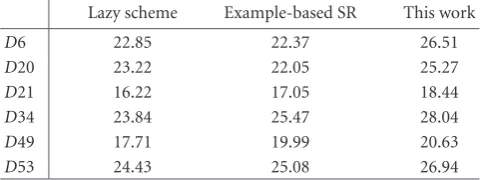
Table 1: Comparison of PSNR(dB) performance among lazy scheme, example-based SR, andAlgorithm 1for six texture images.
Lazy scheme Example-based SR This work
D6 22.85 22.37 26.51
D20 23.22 22.05 25.27
D21 16.22 17.05 18.44
D34 23.84 25.47 28.04
D49 17.71 19.99 20.63
D53 24.43 25.08 26.94
5. EXPERIMENTAL RESULTS
In this section, we use experimental results to show that (1) for texture images, Algorithm 1 significantly outper-forms lazy scheme and example-based SR [22] on both subjective and objective qualities; (2) for generic images, Algorithm 2achieves arguably better subjective performance than lazy scheme and better objective performance than example-based SR [22]. The wavelet filter used in this work is Daubechies’ 9-7 filter and resolution enhancement ratio is fixed to be two (i.e., one-level WT). Our implementation is based on several well-known toolboxes including WaveLab 8.5 for wavelet transforms, OpenTSTool for example-based SR [34], and MATLAB package for texture analysis/synthesis [21]. Test images and research codes accompanying this work will be made available at http://www.csee.wvu.edu/∼xinl/ demo/wt-interp.html.
5.1. Resolution enhancement of texture images
We have chosen six Brodatz texture images which approx-imately satisfy the homogeneity condition (seeFigure 8) to test the performance ofAlgorithm 1. The training patch and testing patch are sized 128×128 and 64×64, respectively. The training patch driving the parametric texture model does not overlap with the testing patch for the reason of fairness (re-fer toFigure 5(a)). The benchmark includes lazy scheme and example-based SR [22] and MSE is calculated for nonborder pixels only (to eliminate potential bias introduced by varying boundary handling strategies in different schemes).
(a) (b) (c)
(d) (e) (f)
Figure8: The collection of Brodatz texture images used in our experiments (left to right and top to bottom:D6,D20,D21,D34,D49, and D53).
(a) (b) (c) (d)
(a) (b) (c) (d)
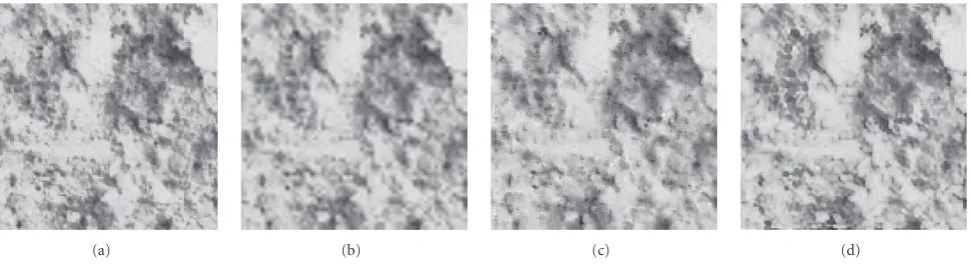
Figure10: Impact of training patch on the performance ofAlgorithm 1: (a) originalD20 image; (b) reconstructed image byAlgorithm 1
(PSNR=25.27 dB); (b) reconstructed image byAlgorithm 1with a different starting point (PSNR=25.32 dB); (d) reconstructed image by
Algorithm 1with a different training patch (PSNR=23.79 dB).
(a) (b) (c) (d)
Figure11: Performance comparison forD2. From left to right: original HR image, reconstructed images by lazy scheme (PSNR=25.00 dB), example-based SR (PSNR=22.12 dB), andAlgorithm 1(PSNR=23.06 dB).
can be observed that Algorithm 1 uniformly outperforms lazy scheme and example-based SR by a large margin (0.7– 4.1 dB) for the six test images. The most significant SNR improvement is observed for D6 and D34 which contain sharp contrast and highly regular texture patterns.Figure 9 compares the original HR image with the reconstructed HR images by three different schemes. It can be observed that Algorithm 1driven by parametric texture model achieves the best visual quality among the three, lazy scheme suffers from blurred edges, and example-based SR introduces noticeable artifacts.
To illustrate the impact of starting point (x0) on
recon-structed HR image, we test Algorithm 1 with two differ-ent initial settings: lazy scheme versus example-based SR. Figure 10 includes the comparison between reconstructed HR images by these two different starting points. It can be observed that the PSNR gap is negligible (0.05 dB), which suggests the insensitivity of Algorithm 1 to x0. To show
how the choice of training patch affects the performance of Algorithm 1, we run it with two different training patches on D20. It can be seen fromFigure 10that although two train-ing patches produce visually similar results, the gap on PSNR values of reconstructed HR images could be as large as 1.4 dB. Such finding is not surprising because it is widely known that
MSE does not well correlate with the subjective quality of an image.
The discrepancy between subjective quality and objec-tive fidelity becomes even more severe as texture patterns become more irregular (i.e., spatial homogeneity condi-tion is less valid). To see this, we report the experimental results of Algorithm 1 for two other Brodatz texture im-ages (D2 and D4) containing less periodic patterns (refer to Figures 11 and12). Due to more complex texture pat-terns involved, we observe that the PSNR performance of Algorithm 1 falls behind lazy scheme (though still outper-forms example-based SR). However, the subjective quality of HR images reconstructed byAlgorithm 1is convincingly better than that by lazy scheme especially in view of the im-provements on edge sharpness. Therefore, we conclude that ourAlgorithm 1achieves a better balance between subjective quality and objective fidelity than lazy scheme or example-based SR.
5.2. Resolution enhancement of generic images
(a) (b) (c) (d)
Figure12: Performance comparison forD4. From left to right: original HR image, reconstructed images by lazy scheme (PSNR=22.23 dB), example-based SR (PSNR=19.16 dB), andAlgorithm 1(PSNR=21.39 dB).
(a) (b) (c) (d)
Figure13: 128×128 portiones cropped out from thebikeimage. (a), (c) test data; (b), (d) training data.
(a) (b) (c) (d)
Figure14: (a) Originalwheelimage; (b) reconstructed HR image by lazy scheme (PSNR = 21.86 dB); (c) reconstructed HR image by example-based SR (PSNR=26.91 dB); (d) reconstructed HR image byAlgorithm 1(PSNR=26.88 dB). Note that lazy scheme suffers from severe ringing artifacts around sharp edges.
crop out two 128×128 portions (calledwheel andleaves) as the ground-truth HR images and their adjacent portions as the training data (refer toFigure 13). Figures14and15 include the comparison between reconstructed HR images by lazy scheme, example-based SR, and our Algorithm 1 which can be viewed as a special case ofAlgorithm 2with patch size being the same as the image size. It can be
(a) (b) (c) (d)
Figure15: (a) Originalleavesimage; (b) reconstructed HR image by lazy scheme (PSNR = 27.08 dB); (c) reconstructed HR image by example-based SR (PSNR= 24.31 dB); (d) reconstructed HR image byAlgorithm 1(PSNR =25.13 dB). Note that despite lower PSNR value, our HR image appears sharper than the one by lazy scheme.
(a) (b) (c) (d)
Figure16: Comparison of reconstructedwheelimages: (a)Algorithm 2with redundancy ratio of 1 (PSNR=27.06 dB); (b)Algorithm 2
with redundancy ratio of 4 (PSNR=27.55 dB); (c)Algorithm 2with redundancy ratio of 16 (PSNR=27.60 dB); (d) example-based SR [22] (PSNR=27.23 dB).
(a) (b) (c) (d)
Figure17: Comparison of reconstructedleavesimages: (a)Algorithm 2with redundancy ratio of 1 (PSNR=25.73 dB); (b)Algorithm 2
with redundancy ratio of 4 (PSNR=26.05 dB); (c)Algorithm 2with redundancy ratio of 16 (PSNR=26.09 dB); (d) example-based SR [22] (PSNR=24.31 dB).
To testAlgorithm 2, we have chosen a fixed patch size of 32×32 but different redundancy ratios. By increasing the overlapping ratio of adjacent patches from 0 to 1/2 and then 3/4, we observe that the redundancy ratio goes from 1 (nonoverlapping) to 4 and then 16. In our current imple-mentation, we have adopted the averaging strategy in [22] in-stead of the Bayesian fusion formula inSection 4(therefore,
outperforms example-based SR [22] on PSNR performance due to the enforcement of observation and priori constraints by alternating projections.
Finally, we want to report the experimental results on computational complexity. In our current nonoptimized MATLAB implementation, the running time ofAlgorithm 1 with 10 iterations is typically 30 seconds for reconstruct-ing an HR image sized 128×128 on a Pentium-IV lap-top (2.4 GHz and 512 M memory). The running time of Algorithm 2depends on the redundancy ratio of patch-based representation (i.e., how much overlap is allowed from one patch to the next) as well as patch size. For 128×128 im-ages, it takes around 2 minutes to run ourAlgorithm 2with redundancy ratio of one and patch size of 32×32 (iteration number is 5). When the redundancy ratio is increased to 4 and 16, the running time becomes 4 minutes and 20 min-utes, respectively. In view of PSNR results in Figures16-17, we conclude that a modest redundancy ratio of 4 is preferred to achieve a good balance between the performance and the computational cost.
6. CONCLUDING REMARKS
In this paper, we present a data-driven, projection-based resolution enhancement scheme which extends the previ-ous work of parametric texture models in the wavelet space. When both target HR data and training data are character-ized by homogeneous textures, parametric models are used to define prior constraint and we show how the paramet-ric texture model can be used as prior constraint along with observation constraint to derive an alternating projection-based HR image reconstruction algorithm. When both target HR data and training data are generic images, we propose to borrow the idea of nonparametric sampling and synthesize new training data to drive the parametric texture models. Using patch-based representation, we show how to proba-bilistically fuse the reconstruction results at HR. Experimen-tal results have shown that our new schemes achieve a good balance between subjective quality and objective fidelity. The importance of using both subjective quality and objective fi-delity in evaluating the performance of resolution enhance-ment is argued, which is expected to clarify some misunder-standings about wavelet-based approaches toward resolution enhancement in the literature.
ACKNOWLEDGMENT
The author wants to thank Dr. T. Q. Pham at Delft University of Technology for sharing his implementation of example-based SR [22].
REFERENCES
[1] H. C. Andrews and C. L. Patterson III, “Digital interpolation of discrete images,”IEEE Transactions on Computers, vol. 25, no. 2, pp. 196–202, 1976.
[2] S. Carrato, G. Ramponi, and S. Marsi, “A simple edge-sensitive image interpolation filter,” inProceedings of IEEE International Conference on Image Processing (ICIP ’96), vol. 3, pp. 711–714, Lausanne, Switzerland, September 1996.
[3] K. Jensen and D. Anastassiou, “Subpixel edge localization and the interpolation of still images,”IEEE Transactions on Image Processing, vol. 4, no. 3, pp. 285–295, 1995.
[4] K. Ratakonda and N. Ahuja, “POCS based adaptive image magnification,” inProceedings of IEEE International Conference on Image Processing (ICIP ’98), vol. 3, pp. 203–207, Chicago, Ill, USA, October 1998.
[5] J. Allebach and P. W. Wong, “Edge-directed interpolation,” inProceedings of IEEE International Conference on Image Pro-cessing (ICIP ’96), vol. 3, pp. 707–710, Lausanne, Switzerland, September 1996.
[6] X. Li and M. T. Orchard, “New edge-directed interpolation,” IEEE Transactions on Image Processing, vol. 10, no. 10, pp. 1521–1527, 2001.
[7] J. Biemond, R. L. Lagendijk, and R. M. Mersereau, “Itera-tive methods for image deblurring,”Proceedings of the IEEE, vol. 78, no. 5, pp. 856–883, 1990.
[8] G. Strang and T. Q. Nguyen, Wavelets and Filterbanks, Wellesley-Cambridge, Wellesley, Mass, USA, 1997.
[9] S. G. Chang, Z. Cvetkovic, and M. Vetterli, “Resolution en-hancement of images using wavelet transform extrema extrap-olation,” in Proceedings of IEEE International Conference on Acoustics, Speech and Signal Processing (ICASSP ’95), vol. 4, pp. 2379–2382, Detroit, Mich, USA, May 1995.
[10] W. K. Carey, D. B. Chuang, and S. S. Hemami, “Regularity-preserving image interpolation,”IEEE Transactions on Image Processing, vol. 8, no. 9, pp. 1293–1297, 1999.
[11] D. D. Muresan and T. W. Parks, “Prediction of image detail,” inProceedings of IEEE International Conference on Image Pro-cessing (ICIP ’00), vol. 2, pp. 323–326, Vancouver, BC, Canada, September 2000.
[12] Y. Zhu, S. C. Schwartz, and M. T. Orchard, “Wavelet do-main image interpolation via statistical estimation,” in Pro-ceedings of IEEE International Conference on Image Processing (ICIP ’01), vol. 3, pp. 840–843, Thessaloniki, Greece, October 2001.
[13] K. Kinebuchi, D. D. Muresan, and T. W. Parks, “Image inter-polation using wavelet-based hidden Markov trees,” in Pro-ceedings of IEEE International Conference on Acoustics, Speech and Signal Processing (ICASSP ’01), vol. 3, pp. 1957–1960, Salt Lake, Utah, USA, May 2001.
[14] D. H. Woo, I. K. Eom, and Y. S. Kim, “Image interpola-tion based on inter-scale dependency in wavelet domain,” in Proceedings of International Conference on Image Processing (ICIP ’04), vol. 3, pp. 1687–1690, Singapore, October 2004. [15] Y.-L. Huang, “Wavelet-based image interpolation using
mul-tilayer perceptrons,” Neural Computing and Applications, vol. 14, no. 1, pp. 1–10, 2005.
[16] C.-L. Chang, X. Zhu, P. Ramanathan, and B. Girod, “Light field compression using disparity-compensated lifting and shape adaptation,” IEEE Transactions on Image Processing, vol. 15, no. 4, pp. 793–806, 2006.
[17] Y. Itoh, Y. Izumi, and Y. Tanaka, “Image enhancement based on estimation of high resolution component using wavelet transform,” inProceedings of IEEE International Conference on Image Processing (ICIP ’99), vol. 3, pp. 489–493, Kobe, Japan, October 1999.
[18] J. Liu and P. Moulin, “Information-theoretic analysis of inter-scale and intrainter-scale dependencies between image wavelet coef-ficients,”IEEE Transactions on Image Processing, vol. 10, no. 11, pp. 1647–1658, 2001.
[20] V. Caselles, J.-M. Morel, and C. Sbert, “An axiomatic approach to image interpolation,”IEEE Transactions on Image Processing, vol. 7, no. 3, pp. 376–386, 1998.
[21] J. Portilla and E. P. Simoncelli, “Parametric texture model based on joint statistics of complex wavelet coefficients,” Inter-national Journal of Computer Vision, vol. 40, no. 1, pp. 49–71, 2000.
[22] W. T. Freeman, T. R. Jones, and E. C. Pasztor, “Example-based super-resolution,”IEEE Computer Graphics and Applications, vol. 22, no. 2, pp. 56–65, 2002.
[23] S. Mallat,A Wavelet Tour of Signal Processing, Academic Press, San Diego, Calif, USA, 2nd edition, 1999.
[24] B. Julesz, “Visual pattern discrimination,”IEEE Transactions on Information Theory, vol. 8, no. 2, pp. 84–92, 1962. [25] H. Wechsler, “Texture analysis—a survey,”Signal Processing,
vol. 2, no. 3, pp. 271–282, 1980.
[26] S. Geman and D. Geman, “Stochastic relaxation, gibbs distri-butions, and the Bayesian restoration of images,”IEEE Trans-actions on Pattern Analysis and Machine Intelligence, vol. 6, no. 6, pp. 721–741, 1984.
[27] D. J. Heeger and J. R. Bergen, “Pyramid-based texture anal-ysis/synthesis,” inProceedings of the 22nd Annual ACM Con-ference on Computer Graphics and Interactive Techniques (SIG-GRAPH ’95), pp. 229–238, Los Angeles, Calif, USA, August 1995.
[28] S. C. Zhu, Y. Wu, and D. Mumford, “Filters, random fields and maximum entropy (frame): towards a unified theory for texture modeling,”International Journal of Computer Vision, vol. 27, no. 2, pp. 107–126, 1998.
[29] J. S. de Bonet, “Multiresolution sampling procedure for anal-ysis and synthesis of texture images,” inProceedings of the 24th Annual Conference on Computer Graphics and Interactive Tech-niques (SIGGRAPH ’97), pp. 361–368, Los Angeles, Calif, USA, August 1997.
[30] S. Chang, “Image interpolation using wavelet-based edge en-hancement and texture analysis,” M.Sc. thesis, University of California, Berkeley, Calif, USA, 1995.
[31] P. L. Combettes, “The foundations of set theoretic estimation,” Proceedings of the IEEE, vol. 81, no. 2, pp. 182–208, 1993. [32] A. A. Efros and T. K. Leung, “Texture synthesis by
non-parametric sampling,” inProceedings of the 7th IEEE Interna-tional Conference on Computer Vision (ICCV ’99), vol. 2, pp. 1033–1038, Kerkyra, Greece, September 1999.
[33] C. Tomasi and R. Manduchi, “Bilateral filtering for gray and color images,” inProceedings of the 6th IEEE International Con-ference on Computer Vision (ICCV ’98), pp. 839–846, Bombay, India, January 1998.