Michail Exarchos (a.k.a. Stereo Mike)
London College of Music, University of Westminster, St Mary's Rd, London W5 5RF
Sample Magic:
(Conjuring) phonographic ghosts
and meta-illusions in contemporary
hip-hop production
Abstract
Sampling has been criticised as “a mixture of time-travel and seance”, “the
musical art of ghost co-ordination and ghost arrangement”, and a process that
“doubles (recording’s) inherent supernaturalism” (Reynolds 2012, pp. 313-314). Yet
out of all the sample-based music forms, hip-hop receives the lion’s share of
attention in popular music literature; critics are puzzled by its appeal, scholars
identify a plethora of problems in its function, and practitioners and audiences alike
are mesmerised by its effect. Rap producers attribute an inherent ‘magic’ to working
with past phonographic samples and fans appear spellbound by the resulting
‘supernatural’ collage. The author examines the music’s unique recipe of
phonographic juxtaposition, exploring the conditions of this ascribed ‘magic’,
investigating gaps in perception (Lehrer 2009) between emotional and intellectual
effect, and deciphering parallels in the practice and vocabulary mobilised against a
range of genres in performance magic.
Introduction
From ‘(al)chemists’ and ‘wizards’ of the beat to the ‘magic’ of phonographic
sampling in hip-hop music, the practice and literature surrounding sample-based
music production are inundated with supernatural references. But sample-based
music creation has also been criticised as ‘a mixture of time-travel and seance’
by contemporary music-makers. Whether ‘magical’ vocabulary is mobilised in these
contexts in a complimentary or critical sense, it is important to question why it is
used to describe musical phenomena and, specifically for the focus of this article,
how it applies to sample-based music creation.
At first glance, it is easy to see how the amazement resulting from musical
feats or pleasing aesthetic results (in any art form) can lead to exclamations of awe
and an elevation of the artist’s skill to supernatural dimensions. It is important,
however, to investigate more explicitly the conditions under which a musician—and
for the purposes of this article, a beat-maker1—becomes a magician in the eyes (ears) of their audience, as well as the implications of this transformation on both
artistic effect and the audience experience. Furthermore, it will be useful to explore
whether the frequent use of magical or supernatural characterisations simply
substitutes complimentary (or critical) language directed at artists, or whether there
is something more profound about their unanimous and universal usage. This will
also provide the opportunity to explore whether such terms have become pivot
mechanisms in popular music parlance diverting attention away from the serious
study of artistic phenomena, when there are unexplained aesthetic effects taking
place that warrant more careful examination.
Conditions and parallels
A logical position for the investigation to start from is the pursuit of the
conditions necessary for magic in a sample-based musical context to occur. But first
‘magic’ itself requires a definition relevant to an artistic context. The focus of this
article will remain on one understanding of magic as ‘stage’ or ‘performance’ magic,
examining the conditions necessary for performancemagic to occur, before drawing
any parallels to sample-based music creation. In doing so, it will demonstrate that
compared to magic, but also because stage magicians consistently use time-based,
musical metaphors when explaining their practice. Furthermore, the obstacle of
comparing a predominantly performable art form (stage magic) with a mediated one
(sample-based music production) will be dealt with, at large, through a discussion of
performable utterances that can be identified on the latter as an expression of
traditional turntable practices2.
Starting from a more generic notion of magic, Oxford Dictionaries (2018)
define it as ‘(t)he power of apparently influencing events by using mysterious or
supernatural forces’. Yet, from Houdini to Penn and Teller, performance magicians
have dedicated much of their lives’ efforts to exposing fraudulent claims towards the
supernatural, and educating their audiences about the skill and effort required in
delivering effective performance magic. Lamont and Wiseman (1999, p. xvi) claim
that ‘magic, properly performed, is a complex and skillful art’, while Vance (1985,
cited in Wilcock 2015, p. 40) describes magic as ‘a practical science, or more
properly, a craft’. Penn and Teller (cited in Miller and Zompetti 2015, p. 11) go as far
as to expose their methods on television because, according to them, ‘illusions are
just illusions’; and Fitzkee (1945/2009, cited in Miller and Zompetti 2015, p. 8)
agrees that ‘what makes a magic trick great ... is performance’. Claims such as
these are echoed throughout the world of performance magic, demonstrating that a
reading of terms and ideas referring to magic through the lens of craftsmanship,
mastery and skill (rather than an acceptance of the supernatural) may render
parallels that are more useful for the study of what is referred to as ‘magical’ in
other performing arts.
Teller (cited in Leddington 2016, p. 256) describes magic as ‘a very, very odd
[art]form’ and Leddington (2016, p. 254) agrees that ‘magic does not fit neatly into
our usual aesthetic categories’. This could also be said about the aesthetics of both
specifically, since the latter is borne out of the layering, manipulation and
juxtaposition of previously made phonographic constructs. In relation to hip-hop
music, Schloss (2014, p. 72) explains that ‘the idea of sampling as an aesthetic ideal
may appear jarring to individuals trained in other musical traditions, but it absolutely
exemplifies the approach of most hip-hop producers’, adding that ‘this preference is
not for the act of sampling, but for the sound of sampling: It is a matter of
aesthetics’ (idid., p. 78).
In his critique of sample-based music—which he entitles ‘seance fiction’—
critic Simon Reynolds (2012, p. 312) describes the aesthetic conundrum quite
acutely:
Recording is pretty freaky, then, if you think about it. But sampling doubles its inherent supernaturalism. Woven out of looped moments that are like portals to far-flung times and places, the sample collage creates a musical event that never happened... Sampling involves using recordings to make new
recordings; it’s the musical art of ghost co-ordination and ghost arrangement. (ibid., pp. 313-14)
Reynolds’ critical stance towards sample-based music allows him a distanced
analysis of the aesthetic phenomena on hand and, although rap practitioners may
not share his disdain, he does, however, offer some helpful analogies between the
two art forms: specifically, the manipulation of others’ energies, the condition of
distance, and the effect of unwillingness (on the side of subjects or audiences).
Lamont and Wiseman (1999)—assuming both practitioner and scholarly roles
—provide a systematic account of the conditions necessary for effective
performance magic, allowing us to draw more insightful parallels between the
mechanics of the two art forms. Their findings appear surprisingly apt at describing
the mechanics of music (both its performance and creation), especially if read with a
focus on the interdependence between a performer’s method and its effect on an
the performance of magic) requires that the spectator experience [sic] the effect
while being unaware of the method’ (ibid., p. 29), a dynamic that Miller and
Zompetti (2015, p. 8) echo as the precedence of ‘the wonder of the occurrence’ over
the ‘mechanics of a trick’. Indeed, Leddington (2016, p. 258) attests that ‘the
magician has to ... “cancel” all the methods that might reasonably occur to you’ and
Hay (1972, p. 2, cited in Miller and Zompetti 2015, p. 12) sums up that the ‘secret of
conjuring is a manipulation of interest’. What’s noteworthy in Magic in Theory,
however, is Lamont and Wiseman’s frequent discussion of rhythm and timing as
crucial devices in interest manipulation, which resonates sympathetically with
sample-based hip-hop’s preoccupation with rhythm and groove3. The authors
describe novelty, ‘sudden sound(s)’, ‘change of pace’, (relative) movement, contrast
(Lamont and Wiseman 1999, pp. 40-41), as well as highlighting the ‘moment of
effect’ over ‘the moment of method’, and using rhythm, punctuation and (on-)beat
and ‘off-beat’ moments as essential tools in physical misdirection and time-based
attention control (ibid., pp. 46-53).
The cyclic structure of sample-based hip-hop similarly depends on interest
manipulation through rhythmic and textural dynamics: cuts4 and stops of the beat, dynamic manipulation of found samples, use of sound effects and spatial effect
processing. If we take Gang Starr’s ‘Code of the Streets’ (1994) as a classic
example, producer DJ Premier juxtaposes the exposed—and slightly sped up—
introductory drum beat from ‘Synthetic Substitution’ (1973) by Melvin Bliss over the
pitch-shifted instrumental introduction from ‘Little Green Apples’ (1968) by Monk
Higgins. He then deploys Beside’s ‘Change the Beat’ (1982) as a source for his
turntable scratching and manipulation that constitutes the track’s chorus.
Throughout the track, Premier cuts the instrumental sample in time with the beat at
key moments to create dynamic interest (e.g. at 0’18” before rapper Guru starts his
using a delay effect, their repeats fading out into subsequent verses. The track also
features extraneous amounts of vinyl noise (underlining the connection to
turntablism already evident in the scratching), while the ‘Synthetic Substitution’
beat sounds reinforced through the use of equalisation, potentially additional drum
layers and a prominent level placement in the mix. Premier’s production here
illustrates how the organisation and manipulation of full phonographic layers—rather
than individual instrumental elements—results in striking dynamic, textural and
rhythmic effects, which he also deploys to provide the contextual materials behind
Guru taking centre stage in the verses. On a later production, such as ‘Deadly
Habitz’ (2003), his manipulation of Steve Gray’s ‘Beverly Hills’ (1979) demonstrates
how a beat-maker can create re-imagined phrases out of found phonographic
segments (typically, through percussive triggering of the samples on the drum pads
of physical or virtual sampling drum machines), creating rhythmical interactions
between the (recorded) gestures and those included in the sampled content5. As
such, motion is perceptible on multiple levels while various layers can be brought to
the listeners’ attention though relative level balancing (mixing), timbral and spatial
enhancements (equalisation, use of delay and reverb effects), or the performative
manifestations of the producer’s actions. As Schloss explains:
A hip-hop beat consists of a number of real-time collective performances (original recordings), which are digitally sampled and arranged into a cyclic structure (the beat) by a single author (the producer). In order to appreciate the music, a listener must hear both the original interactions and how they have been organised into new relationships with each other. (Schloss 2014, p. 159)
The cyclical nature of sample-based hip-hop follows Afrological priorities (Lewis
2017), which Tricia Rose (1994, p. 83) acknowledges as a characteristic of ‘black
cultural traditions and practices’ expressed in manifestations of ‘openness, ruptures,
rhythmic and lyrical invention expressed over a familiar loop, which is no different to
the phenomenon of diverting spectators’ foci to effect in performance magic, using
the mechanisms of ‘naturalness’, ‘consistency’, ‘familiarisation’, reinforcement,
continuity and subtlety—conditions Lamont and Wiseman (1999, pp. 60-74) identify
as essential for psychological (mis)direction.
Structure, control and subgenre
A further parallel that can be drawn between performance magic and
sample-based record production relates to the structure of the artistic exposition and the
use of ‘raw materials’ to construct it. Reinhart (2015, p. 26) cites the opening
sequence of mystery thriller ‘The Prestige’ to describe the typical ‘praxis of the
commercial magical show’:
Every great magic trick consists of three parts or acts. The first part is called “The Pledge” in which the magician shows you something ordinary... The second act is called “The Turn”. The magician takes the ordinary something and makes it do something extraordinary. Now you’re looking for the secret... That’s why every magic trick has a third act, the hardest part, art [sic] the part we call “The Prestige”. (from the opening sequence of ‘The Prestige’, cited in Reinhart 2015, p. 25)
Reinhart (2015, p. 26) explains that ‘in a great magic performance there are always
two gaps - one between the “Ordinary Something” and the “Unexpected” and the
second one between the “Unknown” and a magically restored order’. If we listen to
a number of sample-based hip-hop tracks, such as ‘Lightworks’ by J Dilla or ‘Filthy
(Untouched)’ by Madlib (under his The Beat Konductah alias), we can identify a very
similar structural idea. The producers initially expose relatively unprocessed (albeit
pitch-shifted and somewhat equalised) phonographic samples— segments from
Raymond Scott’s ‘Lightworks’ (2000) amongst others, and Vivien Goldman’s
‘perform’ so to speak, in order to then mesmerise us with their abilities to
manipulate, truncate, loop and re- order (‘chop’) their phonographic source. This is a
process collectively known as ‘flipping’ in hip-hop practice. Skilful rap producers
such as J Dilla and Madlib are capable of presenting re-imagined sequences and
sonic constructs substantially altered from their phonographic origins, therefore the
introductory ‘pledge’ plays in their favour, demonstrating a notable ‘gap’ or ‘turn’
into the ‘unexpected’. Note that the titles the producers choose for their resulting
sample-based creations are consistent with their process—J Dilla keeps the name
‘ordinary’ (the same), while Madlib hints at the ‘flipping’ strategy by naming his
track ‘Filthy (Untouched)’, rather than ‘Launderette’. It could be argued that the
‘restored’ order comes in the form of establishing a new cyclic structure held
together by the timbral and rhythmic coherency of the new main ‘hook’ (loop) that
drives the rest of the production. The limitation of having to work with a small
number of sampled phonographic instances (rather than unlimited
instrumentation6), necessitates the construction of narrative and the retention of interest predominantly through the manipulation of an ‘ordinary something’—a raw
sonic source in the context of a sample-based hip-hop structure. Although this
process becomes mediated on record, it owes much to the aural tradition of
turntablism, being communicated to listeners via this developmental exposition of
raw materials and subsequent sonic constructs. The parallel exposes a fundamental
structural insight in the art of ‘flipping’ samples in hip-hop, highlighting not only a
surface characteristic, but identifying instead an essential mechanism in engaging
and retaining listener interest, whilst authenticating the producer as ‘performer’ in
control.
Demonstrating control, furthermore, appears as another fundamental
condition before a performer can acquire ‘magical’ status within performance magic
control, and control of the situation can allow the magician to set the conditions’—an
axiom that also applies to beat-makers and their demonstration of ‘chopmanship’ or
‘wizzardy’ over phonographic samples. Loshin (2007, quoted in Miller and Zompetti
2015, p. 10) confirms that ‘(t)he metanarrative of magic is tied up with the notion of
control ... control of the natural world’. The notion can be expanded to include
scientists, as they can also discover, apply and display methods of control over
various forms of physical energy. For 18th century physics professor and stage
magician Étienne-Gaspard Robert ‘the magical show was simply a lesson in applied
physics, performed to amaze and educate his audience’ (Reinhart 2015, p. 32). In
the case of Thomas Alva Edison, his ‘power’ over acoustic energy channeled via the
invention of the phonograph earned him the nickname of the ‘Wizard of Menlo Park’:
through it he was capable of ‘transforming life into abstract signals and playing
them back ... (allowing) us to hear voices from people absent or long gone’ (ibid., p.
27). In the case of beat-makers, too, the control over sonic materials, demonstrated
through the art of flipping samples, is a form of control over musical (rhythmical,
textural, motivic) relationships, but also stylistic invariables. This is exemplified by
beat-makers’, DJs’ and mashup remixers’ aliases and characterisations, such as ‘The
Alchemist’, DJ Cut Chemist of Jurassic 5, and Amerigo Gazaway, described in the
press as a ‘chemist’ of the mashup (Caldwell 2015). In a more general sense,
Kugelberg (2007, p. 31) sees all of hip-hop music-making as an art form comparable
to alchemy or magic: ‘With hip hop, born in the Bronx, these guys created
something out of nothing. That's amazing. That's alchemy. That's magic’. For
Reinhart (2015, p.31), the ability to create ‘something out of nothing’ also
characterises scientists, inventors and magicians. This is because they are
‘exponents of the same mind set (as they) have learned to deal with the
phantasmatic space of the unknown in a creative way’ (ibid.). A quality that perhaps
sample-based producers due to the materiality (rather than abstraction) inherent in the
nature of control manifested over their sonic objects. Vanesa Chang explains:
The successful pursuit of new samples has, as its limit, the producer’s capacity to hear musical possibility in a song, to listen for connections that may not currently exist in the song, to perceive aural spaces where they might not be obvious. This requires conceiving of sound as plastic material, and not as a finished product. (Chang 2009, p. 147)
Control in this sense is defined as an intrinsic condition of both performance
magic and sample-based music production describing the actions the performer
exercises over the materials or objects deployed. The implication is that the
audience (or listeners) are entertained by observing (or listening to)—and
sometimes interacting with—the manifestations of control (effect), as exercised by
the performers (method). Robert-Houdin (1906, quoted in Reinhart 2015, p. 31)
categorises Modern Magic into classes according to such intrinsic characteristics (i.e.
what subjects are used and what actions are performed). For example, one of the
classes he identifies, ‘Experiments in Natural Magic’, is described as ‘(e)xpedients
derived from the sciences and which are worked in combination with feats of
dexterity, the combined result constituting conjuring tricks’ (ibid., p. 31). The
definition sounds analogous to how sample-based re- cord production could be
described as a (sub)genre: exponential phonographic illusions derived from sonic
phenomena (psychoacoustics) and the manifestation of producer (originally
turntablist) dexterity over phonographic sound objects—the combined result
constituting ‘supernatural sonic collages’.
As much as it is useful to classify art forms through the lens of practice and
the materials used (i.e. intrinsically), the resulting effect(s) (appreciation,
entertainment) cannot be fully comprehended without considering audience
perception and the context surrounding recipients (culture and mediation). Landman
performance ‘on a different contract between the performer and the audience, the
discourse used during performance and the effect on the audience both in terms of
its perception of what has transpired and the personal meaning attached to the
effect’. He expands with a fitting analogy:
Like the different strands in other performing arts (music, drama, comedy), these genres have distinctive communities and sub-cultures, as practitioners try to establish hegemony of one form of performance magic over others, or seek to construct separate identities around their stage persona and
approaches to performance magic. (ibid., p. 48)
Similarly, the work of sample-based beat-makers, through its historical association
to turntablism, is rooted in approaches to music production congruent with an
evolving stylistic contract between producers and fans, requiring methods of control
from the side of the makers, in order to create coherent sonic experiences for the
recipients. As with any evolving stylistic contract, the successful producers manage
to challenge recipient interest by balancing adherence to aesthetic criteria (genre
rules), whilst innovating; but the parallel force in action is the evolution of audience
perception itself. As Cohen (1994, cited in Miller and Zompetti 2015, p. 12) reports
on Penn and Teller, they are performers ‘willing to acknowledge...that the culture is
savvy to magic’; just as musical/hip-hop culture is savvy to sample-based utterances
and sampling technology. Williams (2014, p. 193) confirms: ‘hip-hop as a genre
presupposes an un-concealed intertextuality which is part and parcel of its
aesthetics. Much of this has to do with hip-hop communities’ expectations (its
‘generic contract’)...’
However, the adoption of developing mediation technologies into any
performing art adds another important factor that negotiates how the art form is
framed. The following section will widen the focus of the discussion to the totality of
record production, in order to explore parallels between mediation effects upon
contextualised as a subgenre defined specifically by sampling technology
affordances. The discussion hypothesises that if the art of record production evolved
from documentarian capture (as real) to the construction of sonic illusions
(hyper-real), then sample-based hip-hop introduces the notion of an exponential
juxtaposition of multiple illusions (meta-real). The phenomenon mirrors the evolution
of audience perception in performance magic from ‘seeing is believing’ (magic as
the occult), to illusionism (suspended disbelief), to TV illusionism (challenging the
interaction between performance and production). The interaction of technology
with both art forms has implications for their ‘frame’ in relation to liveness,
authenticity and defining aesthetic criteria, necessitating also a theorising of the
‘meta-effect’ that is possible through mediation. A schematic representation of the
parallel streams of evolution for both art forms and the respective audience
perception can be seen in Figure 1 below, including associated technological
Figure 1. A schematic representation of the parallel evolutionary streams for record
Technology, mediation and the alchemy of beat-making
Landman (2013, p. 52) proposes a convincing categorisation of genres and
subgenres in performance magic according to the methods (materials), effects and
frame adopted, but also the contract, engagement and discourse that can be
observed between performer(s) and the audience. In the case of the overarching
categories of ‘magic’, ‘mentalism’ and ‘mystery entertainment’, he finds that the
former two share a—contemporary—frame relating to the production of inexplicable
effects based on unknown methods, while in the latter there is an implicit claim
towards the supernatural (ibid., p. 56). As we have seen above, however, the
delineation away from supernatural claims characterises most modern magic,
mirroring the growing ‘savviness’ of a contemporary audience. The evolved
perception identifiable in audience culture is understandably the result of multiple
forces (it would be hard to imagine how, for example, the renaissance, a shift
towards scientific thinking, technological awareness and secularism in the West
would not have affected audience trends in their engagement with magic), but it is
also the result of conditioning borne out of the ongoing discourse between
performers and audiences. As Leddington (2017, p. 34) notes: ‘(t)hat the sign reads
“Magic Show” allows us to feel a measure of safety and control in the face of what
might otherwise be a frightening experience: encountering an apparent violation of
natural law’; and he maps audience reaction to a behavioural mechanism he
describes as an ‘activation of the “magic” genre script’ (ibid.)—something Landman
(2013) sees as the unspoken contract framed between performer and participants.
The obvious parallel with record production is a similar ‘savviness’ amongst
listeners about recording technologies, creative possibilities and resulting effects,
which create a range of artistic expectations throughout the history of the art form
and across different subgenres. Much has been written about the advent of
manipulation of separate layers of instrumentation in post-production (see, for
example, Jarrett 2014; Katz 2010; Schmidt-Horning 2013) and—through that—the
staging of balance, timbral and spatial illusions, it has transcended the pursuit of a
purely documentarian approach to sonic representation (for more on the notion of
‘staging’ see Lacasse 2000; Liu-Rosenbaum 2012; Zagorski-Thomas 2010). Jarrett
aptly describes:
Around 1967, recordings changed. From that point on, they were almost never actual records of single musical events—they became instead, almost always, composites of many musical events–“virtual” records. The performances heard on records were more constructed than caught. (Jarrett 2014, p. 113)
Nevertheless, the ‘genre script’ across eras and subgenres has continued its
differentiation beyond the initial affordances of multitrack tape, in response to a
plethora of consumption trends and developing media. Simon Zagorski-Thomas
(2010) has demonstrated the effect that the interplay between idealised and actual
consumption spaces has had on the development of mixing strategies for rock and
disco (and eventually dance music), while Thomas Vendryes (2015) has highlighted
the socio-economic context within which King Tubby pioneered the notion of the
‘remix’ (and, simultaneously, the subgenre of dub). It could be said, however, that,
collectively, the art of record production, in all of these pursuits since the invention
of multitrack tape and until the dawn of sampling technologies, had been freed from
the limitation of the ‘real’ (performance representation) and was allowed to explore
and build ‘hyper-real’ sonic constructs. Of course, representational or
documentarian outputs have continued to be produced, with particular genres
placing high value on the least amount of mediation over authentic performances
(Moore (2002, p. 213) discusses this form of authenticity as ‘primality’).
Furthermore, even when attempting to represent a performance with minimum
inevitable due to the recording and post-production techniques and tools employed
(Zagorski-Thomas 2018, pp. 13-24).
In performance magic, the shift from a perception of conjuring effects ‘as real’
(stem- ming from supernatural powers) to the adoption of suspended disbelief as a
condition enabling ‘illusory’ entertainment, seems to have been brought about by a
philosophical set of conditions (rather than a particular set of technological
affordances). Nevertheless, it is interesting to note the implications for magic once
its performance becomes mediated through visual technologies (video, television,
online). In one sense, it could be argued that performance magic, by its definition,
has been leading the race when it comes to entertainment via illusion, while record
production could only start partaking after recorded sonic objects would become
subjects to multitrack manipulation. But for both art forms, the handling of illusion
reaches a ‘meta’ level with the adoption of, respectively, mediated technologies for
magic and sampling technologies for record production; a comparison that uncovers
important aesthetic issues in sample-based hip-hop and explains some of the
‘magical’ analogies so frequently made about the art form.
One of the first problems affecting both art forms in terms of mediation is the
issue of communicating performance authenticity and the strategies that can ensure
a convincing effect. Landman (2013, p. 60) asserts that conversely to televised
magic, ‘live performance magic can develop experiences and feelings relating to
trust and belief’—participants in his magic workshops have reported feelings of
increased trust due to the live nature of his performances, at the same time refusing
to believe televised magic shows like the Derren Brown series. Leddington (2016,
pp. 259-60) attributes the problem to an increase in physical distance between
performer and audience, which becomes counter-productive to the experience of
magic and constitutes an aesthetic issue that gets magnified with mediation: ‘The
performance also requires ruling out the possibility of camera tricks and
postproduction effects’; to that effect, TV magic shows like David Blaine’s Street
Magic deploy the portrayal of live audience reactions as stratagems ‘to certify the
authenticity of the performance’ (ibid.). Videos of magic tricks currently populating
social media also deploy similar techniques, frequently staging participants around
the performer in order to convince viewers of a certain degree of transparency.
To return to Reinhart’s (2015, p. 35) analysis of magic portrayed in motion
pictures, his concluding observation about ‘The Prestige’ is that after the narrative
has run its structural course of ‘pledge-turn-prestige’, the film ‘introduces another
meta-level by turning the cinematic narration into a magic trick by itself’; as a result
‘(w)e, the meta-audience, are tricked as well’ (ibid.). The significance of this
observation for sample-based practices is that it mirrors the meta-effect of being
allowed, as a listener, in to the phonographic dimension of the sampling producer,
witnessing the manipulation of previously made phonographic constructs. We may
not be tricked, but we are entertained, and our interest is directed toward perceiving
at least two, if not multiple, temporalities of phonographic process—in other words,
we are hearing process upon process.
For a musical art form so heavily dependant upon music technology since its
very inception, the problem of authenticity becomes magnified because of this
degree of exponential mediation. Williams (2011) explains how recorded hip-hop
was initially perceived as an inauthentic take on the aural tradition of rap, especially
when compared to the way it was being performed live in the Bronx in the 1970s.
This perception was not helped by the fact that the first crossover hits credited as
rap had little to do with the music of the streets, something Kulkarni clearly
illustrates in the following statement:
players and producers. The crucially exciting thing about hip hop, the music made by scratch DJs, only figured as an effect, a detail, not the root of where the grooves and sounds came from. (Kulkarni 2015, p. 37)
Kulkarni here points to what may seem like a reversed notion of authenticity in rap
when com- pared to other musical genres: turntable performance using
phonographic sources resonates from the origins of the culture, while live
musicianship does not7. Because of that, ‘rap music production ... has aimed to create the sounds of the street’, the strategy here consisting of the inclusion of
‘turntablistic codes on recordings’ such as ‘vinyl scratching ... to signify authenticity’
(Williams, pp. 151-154). By the time sampling technology had become affordable
many of these turntablistic utterances were first replicated and later on developed
further by DJs- turned-sampling-producers (something exemplified by the DJ prefix in
many of the early hip- hop producers’ aliases), resulting in hip-hop’s golden era
‘“boombap” sound that was shaped by the interactions between emerging sampling
technologies and traditional turntable practice’ (D’Errico 2015, p. 281). As a result,
the practice of sample-based hip-hop developed its own intrinsic code of ethics
regarding both sampling practices and what constitutes acceptable phonographic
source material (Schloss 2014). And while pop and rock record productions were
creating ‘supernatural’ sonic constructs out of instrumental performances,
sample-based hip-hop practice kept alluding to a performative tradition that represented the
‘alchemy’ of creating ‘something out of nothing’ (Kugelberg 2007, cited in Williams
2011, p. 133); or, in other words, it alluded to exponential illusions conjured out of
the flux of turntable-turned-sample-based manipulations over full phonographic
sources. But let’s look at the practice in more detail to investigate what constitutes
beat-making ‘alchemy’ through a representative case study.
On track ‘Musika’ from KRS-One and Marley Marl’s album Hip Hop Lives
(2007), Marl samples the last few seconds of ‘A Theme for L.A.’s Team’, the opening
‘Musika’ features reggaeton rapper Magic Juan and, to complete the metaphysical
serendipity, the mystical theme is also present in the lyrics:
Use your real eyes to realize these real lies Yo Marley, let's hit 'em, word up...
Marley Marl on the musika, KRS on dem lyrics da On the side I teach meta-ta-ta-physica...
(Denton, Lister and Wilson 2007)
The relevance of the example stems from Marl’s celebrated status as an architect of
the sample-based aesthetic in hip hop8, KRS-One’s dedication to authentic hip-hop ‘genre scripts’ and the supernatural as a source of his inspiration9, but also because the track (and album) represent the practice of the golden era boombap aesthetic.
In more detail, ‘Musika’ features about ten seconds from the 1979 recording, slightly
sped up and looped into a cyclical structure, over which Marl builds a drum beat with
sparse additions of sub-bass and a one-note repeated synthesiser bass figure taking
place at the end of every four or eight bars. It is impossible to identify precisely the
origin of the drum sounds contributing to the beat but, in the ‘making-of’
documentary that is included with the album release, KRS-One refers to Marl’s
pioneering practice of ‘chopping’ up individual drum ‘hits’ from funk breaks
(breakbeats). Additionally, the timbre and dynamic envelopes of the sounds are
characteristic of Marl’s (and by extension boombap’s) practices of layering individual
funk drum hits with synthetic ‘boom’ sounds from classic drum machines (such as
the Roland TR-808). The soundtrack sampled has been mostly recorded at Sigma
Sound (and other studios) but, judging from the timbral and spatial qualities of ‘A
Theme for L.A.’s Team’, an educated guess would place the specific track at the
famous Philadelphia location, too (Nelson-Strauss 2017). Toby Seay (2012) provides
an illuminating rationale for the timbral and spatial characteristics that came to be
known collectively as the ‘Philly sound’, and the sampled track in question
echo-chamber footprint upon recordings actualised at the Philadelphia location, but
also the rich, layered strings texture the personnel acquired by overdubbing the
string section whilst inadvertently capturing speaker ‘bleed’ (ibid.).
As a result, the original recording (which features eight individual
instrumentalists alongside a string and horn section) carries with it a number of
sonic illusions: layered instruments so they sound like larger sections; superimposed
acoustic spaces (echo chamber) upon the actual spaces captured due to reflections
during recording; re-amplified instrumental sections (and their reflections) captured
due to bleed during overdubbing; as well as all the sonic artefacts and timbral
processing colouration caused by recording and mixing practices, and the respective
equipment used. We might agree with Reynolds (2012, p. 313) that ‘(r)ecording is
pretty freaky then’, but let’s explore below why ‘sampling doubles its inherent
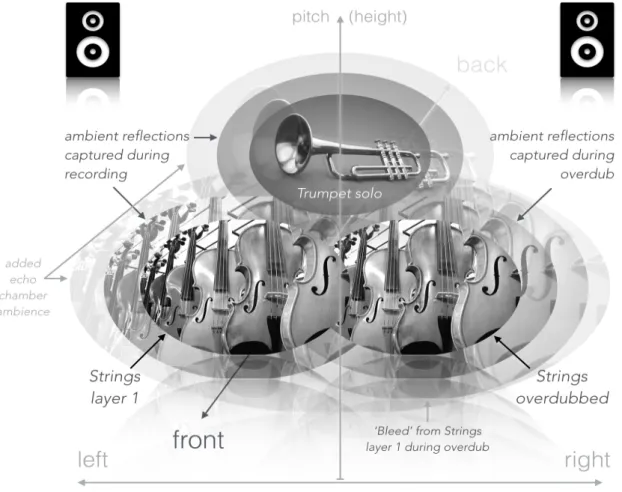
supernaturalism’. The section Marl uses clearly features a high-register trumpet
solo, over a string section ostinato, but we can also hear the trademark Sigma
Sound ambience. The strings are very rich in texture as a result of the overdubbing
approach, occupying a wide stereo image and implied depth (illusion), which is
typical of the Philly sound. Figure 2a below provides a schematic representation of
Figure 2a. A schematic representation of the sonic ‘space’ occupied by the sample from ‘A
Theme for L.A.’s Team’. The visual representation of the sonic objects’ pitch (frequency),
stereo image and depth in the mix is inspired by David Gibson’s (2008) visual
conceptualisation of mix layers, but also Moore and Dockwray’s (2010) ‘sound-box’
Although Marl does not excessively manipulate or chop the original sample,
the frequency content sounds higher than on the original track due to pitch-shifting
(he could have achieved this by raising the cycles on a turntable prior to sampling
the section or tuning the sample higher within a sampler), but potentially also due to
additional equalisation. Hip-hop producers will often manipulate the spectrum of a
whole phonographic sample in order to make ‘space’ for the new elements they
bring to the mix (including the rapper’s voice). It is difficult to discern whether Marl
has added any further reverberation to the sample, therefore superimposing yet
another space upon the 1979 spatial illusions, but this—again—is common
sample-based hip-hop practice aiming to ‘glue’ all the borrowed elements within a new
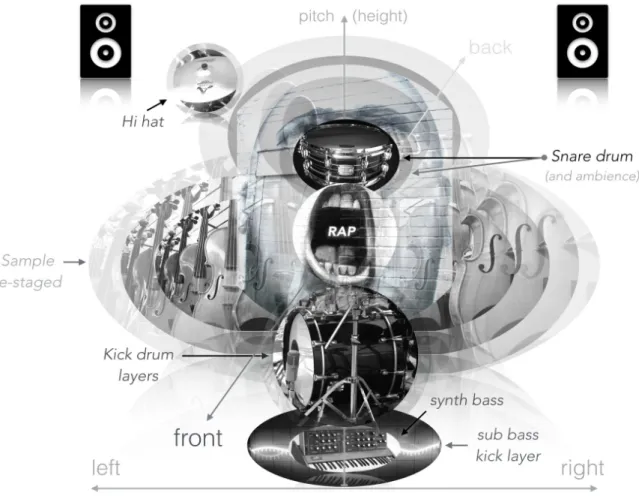
implied ‘stage’. The low-frequency sounds (kick drum, sub-bass and bass
synthesiser) come across as completely ‘dry’ (i.e. not carrying any substantial
ambience) in the hip-hop mix, which places them rather ‘forward’ in the staging
illusion. The drum sounds (gathered from a multitude of sources) typically feature
the characteristics of both 1970s drum sources and 1980-1990s hip-hop drum
layers, but their truncation and any dynamic envelope-shaping pack the contained
ambiences into unnaturally abrupt durations. Figure 2b below provides a schematic
The example illustrates that what may sound motivically quite repetitive and
simple on the surface, represents, in fact, a complex, multidimensional and rich
sonic construct. What is noteworthy here is that the juxtaposition of the plethora of
timbral, dynamic and spatial illusions creates an exponential one, which is, however,
held together by the sample-based producer’s craft (control). The producer is drawn
to the phonographic sources because of the rich sonic phenomena they contain, but
also because the origins of the art form predispose the samplist to ‘jamming’ with
the past. The ‘sample collage’ as a ‘musical event that never happened’ may indeed
be ‘the musical art of ghost co-ordination and ghost arrangement’ (Reynolds 2012,
pp. 313-14), but unlike Reynolds’ dissatisfaction with the art form, the listener of
sample-based hip- hop remains engaged and entertained; and this is due to a
stylistic contract that presumes suspended disbelief conditioned by the evolution of
record production. The ‘alchemy’ or command that the producer demonstrates over
the multiple sonic dimensions may rightfully sound ‘magical’, but it is exercised
through the craft of rhythmic, dynamic and timbral organisation having first tamed
the tools of the trade—the relevant sampling technology.
Impossibility, motion and the ecology of
alief
In his article ‘The experience of magic’, Jason Leddington (2016, p. 254) sets
out ‘to initiate a philosophical investigation of the experience of magic with a focus
on its cognitive dimension’ and he sees his work as ‘a first step toward a general
aesthetics of the impossible’. His examples for ‘impossible music’ include Risset
rhythms and Shepard tones (ibid.), which ‘can be constructed to give the perception
of continuous acceleration’ (Stowell 2011, p. 1) or pitch oscillation, respectively. But
this kind of ‘fractal self-similarity’ (ibid.)—entertaining and extreme as it is—is not
the only kind of sonified ‘impossibility’ we may get exposed to as we have seen.
comparable to Reutersvärd’s ‘Impossible Triangle’ or Escher’s ‘Irrational Cube’ (see
Figure 3 below), to use two of Leddington’s visual examples. We can clearly see
these shapes on two-dimensional paper (and they would not be too difficult—and
certainly not impossible—to recreate by drawing), but if we try to imagine them in
3D space, our perception reaches a moment of cognitive dissonance: the shapes can
be drawn, but what they represent in three dimensions cannot exist in physical
Similarly, the exponential supernaturalism of the sample-based music collage
presents not only spatial but also temporal impossibilities—musicians and sonics
from different eras co-existing on multiple spatial planes. Here, we perhaps reach an
irrefutable analogy between recorded music and magic. ‘Magic is ... about
creating ... the illusion of impossibility’ (Ortiz 2006, cited in Leddington 2016, p.
254), just as it is for the drawings above, for phonographic records following the
advent of multitracking, and—exponentially so—for hip-hop productions making use
of sample-based practices. There appears to be a universal magnetism drawing
humanity toward experiences of awe that cannot be (easily) explained. On the
surface, this seems like an oxymoron—being drawn to self-inflicted illusions of
impossibility and moments of cognitive dissonance, or choosing to be entertained by
the ‘bafflement of (our) intellect’ (Leddington 2016, p. 259). Could this be a form of
acknowledgement of other modes of knowledge, or of the limits of the current state
of affairs in rational and scientific thought? Leddington (2016, p. 264) reminds us
that ‘Socrates’s “human wisdom,” which consists in his knowing only that he does
not know, is a form of sustained aporia’ (my emphasis) and ‘maintaining the belief
that there is a correct account of piety (or virtue, or justice, . . . ) in the face of
aporia is of paramount ethical importance’ (emphasis in original). This is echoed
across the scientific world, but also in studies investigating the evolutionary purpose
of music. In his investigation of the overlap between magic and science, Reinhart
(2015, p. 34) draws our attention to the fact that ‘Einstein is aware that a pure
positivist view can’t possibly cover the full extent of what is comprehensible by the
human mind’. Perlovsky traces this conflict down to the cognitive mechanisms of
differentiation and synthesis, championed respectively by the development of
language and music:
psyche, music restores its unity. We come to understanding why music has such power over us: we live in the ocean of grief created by cognitive
dissonances...; and music helps us alleviate this pain. (Perlovsky 2017, pp. 28- 31)
Leddington’s theorising leads him to a further powerful argument. The
commonly used notion of (willing or unwilling) suspended disbelief cannot
sufficiently explain the enjoyment we experience from engaging with illusions of
impossibility. If it were so how could we actually be amazed (entertained)? He
believes, instead, that the necessary condition must be to experience—even to
maximise—‘cognitive dissonance that is not a matter of conflicting beliefs’
(Leddington 2016, p. 257). To explain the cognitive mechanism, Leddington borrows
the notion of alief from Szabó Gendler, which she defines as follows:
A paradigmatic alief is a mental state with associatively linked content that is representational, affective and behavioral, and that is activated—consciously or nonconsciously— by features of the subject’s internal or ambient
environment. (Szabó Gendler 2008, cited in Leddington 2016, p. 257)
Gendler (ibid.) goes on to explain how a conflicting experience such as
walking on the transparent Grand Canyon Skywalk bridge would involve a clash of
an intellectual belief in presumed safety ‘and a more primitive, nondoxastic,
representational mental state she calls alief’. Anyone with a fear of heights would
have experienced a similar conflict between, on the one hand, the intellectual
reassurance of a situation as safe and, conversely, an irrational fear about
approaching a barrier or looking down. Ortiz (1955/2011, cited in Leddington 2016,
p. 258) pins down the recipe for successful magic in this very tension, expressed as
the victory of emotional over intellectual belief. He offers a telling 19th century
anecdote to illustrate their difference: ‘Madam De Duffand was asked whether she
believed in ghosts. She responded, “No. But I am afraid of them”’ (ibid.) If we take a
(produced by No I.D. and featuring samples of Nina Simone’s ‘Four Women’ (1966)),
the equivalent exchange between two fans might sound something like this:
Fan A—Do you believe Jay and Nina performed on this together?
Fan B—No. But their interactions move me.
In his theory of an ecological approach to the perception of musical meaning,
Clarke (2005) echoes Gendler’s notion of alief as a state activated by features of the
environment. He suggests that ‘perception must be understood as a relationship
between environmentally avail- able information and the capacities, sensitivities and
interests of a perceiver (Clarke 2005, p. 91):
An important component of that subjective engagement with music is its corporeal, proprioceptive, and motional quality, which may on occasion provide listeners with experiences of “impossible worlds” that have some of the same attractions as do other forms of virtual reality. (ibid., p. 90)
Levitin, furthermore, supports a primordial rationale behind our instinctive,
embodied response (motion) to strong rhythmical content present in a musical
track, which is congruent with a notion of being coerced to move (dance, nod, tap
our foot) by the (recorded) commands of a mu- sic producer, despite any intellectual
identification of temporal or spatial sonic ‘impossibilities’:
Our response to groove is largely pre– or unconscious because it goes through the cerebellum rather than the frontal lobes ... (Your brain) involves a precision choreography of neurochemical release and uptake between logical prediction systems and emotional reward systems. (Levitin 2006, p. 192)
No I.D.’s highly rhythmical chopping of Nina Simone’s ‘Four Women’ against
his programmed beats on ‘The Story of O.J.’ therefore move us (emotionally and
arguably physically) despite the impossible (or non-natural) resulting vocal phrases,
the juxtaposition of Nina Simone’s and Jay-Z’s voices, and their different but
characteristic phonographic signatures (signifying both 1960s and 2010s recording
equipment/media used). Interestingly enough, the two characters are brought
together in the song’s music video through animation, concurring with Clarke’s
‘impossible world’ analogies across different art forms (Clarke 2015, p. 86).
Freud’s (1975/2001, p. 90) position then that only in art and magic can
mimetic action be thought to influence recipients and produce emotional effects
‘just as though it were some- thing real' rings true; but it is not the result of blind
confidence in the performer’s power of control, but more so a transference of action
upon artistic materials, themselves in turn communicating ‘instructions’ embedded
in the work. These can psychologically move the recipient, and in the case of
rhythmical transference in music, literally move the listener. Hazrat Inayat Khan
makes a telling leap from the metaphysical to the physical effects of sound:
(E)very sound made or word spoken before an object has charged that object with a certain magnetism ... The whole mechanism, the muscles, the blood circulation, the nerves, are all moved by the power of vibration. As there is resonance for every sound, so the human body is a living resonator for sound ... Sound has an effect on each atom of the body, for each atom resounds. (Khan cited in Godwin 1986, pp. 261-2)
Zagorski-Thomas supports the notion with a more scientific perspective:
A crucial piece of information from neuroscience is that we recognise human gesture by mentally “doing it” ourselves … If our interpretation of the world through first hand experience is schematic in nature, the way we create meaningful, symbolic representations of aspects of our experience through language, gesture, and the manipulation of our environment takes this schematic nature to another level. (Zagorski-Thomas 2018, pp. 5-7)
Because the performer/producer is attempting to create a finely balanced
experience of conditions or, using Clarke’s approach, an environment of engaging
information echoing nature to present to a perceiver (which in Clarke’s
‘world’ or effective illusion is referred to as magical. The inexplicable, the
‘bafflement of the intellect’ and the resulting awe are effects borne out of resonating
with a humanly constructed ‘sublime environment’. And the effect is not just a
perceiver’s gift; the creator can also be mesmerised by their own achievement,
because achieving control over the infinite variables is not a given, but a
harmonious plateau reached when the performer’s level of skill and the
environmental variables meet. It is what externally appears as control, what artists
experience as ‘flow’ (Cikszenmihalyi 1990), the results characterised as ‘sublime’.
In sample-based music creation, the infinite network of sonic possibilities
includes previous phonography. Although, practitioner mastery is a condition, ‘flow’
is reached only when control and environmental challenge reach a balance (ibid.)
The dynamic is perceivable by both makers and recipients, and this is why
consistent practitioners acquire magical characterisations from their community
(peers, fans); why the construction of ‘sublime’ sonic worlds is called magical; and
why practitioners, at times, refer to their own process as if by magic. It can’t be so
but it is. Both real and unreal. Coercing the listener into sympathetic motion through
constructed experiences that trigger the right kind of neural mirroring (Cook et al
2014), as Zagorski-Thomas demonstrates above.
When asked about his favourite creation on his debut mixtape ‘Grisela Ghost’,
mysterious rap critic turned prolific sample-based producer Big Ghost Ltd. (who,
incidentally, never reveals his true identity) attests: ‘My absolute favorite beat even
before they recorded any vocals to ‘em was Fendi Seats. They (rappers Westside
Gunn & Conway) also happened to both snap on that shit. That one came together
like magic, B’ (Shabazz 2015). This is a typical acknowledgement of musical factors
external to the practitioner’s control. The sample-based producer demonstrates a
default humbleness due to their dependance on a field of previous phonography, but
tells us that ‘(b)oth the artist’s expressive gesture and the listener’s interpretation
are infused with an awareness of field that allows minimal, momentary, and
inexplicable allusions, references, and rhetorical gambits to resonate in a frame far
larger than themselves’.This explanation highlights the forces of chaos involved in
record production as a result of the plethora of sonic variables, technological options
and (sub)cultural associations available. And these become exponential in a form of
sample-based phonography that itself interacts with previous phonography. The
phonographic moments that succeed in aligning these ‘inexplicable allusions’
therefore feel magical to both makers and listeners, because they feel rare; because
they feel sublime; because they feel impossible; because we find their illusions of
impossibility not only entertaining, but also healing for our intellect; and because
they provide synthesis.
But how is technology itself capable of leading to further magical
manifestations? Liken- ing the computerised and networked present to a magical
world, Wilcock (2015, pp. 43-44) warns about the ‘ability to take control of
someone’s soul’ with current technology, if soul is defined as ‘all the information
about one’s self, all the information that makes up one’s online presence/self, or
“the algorithm” that summarised all that you are’. The analogy to a stored instance
of someone’s voice within a sample (e.g. Simone’s presence in ‘The Story of O.J.’) is
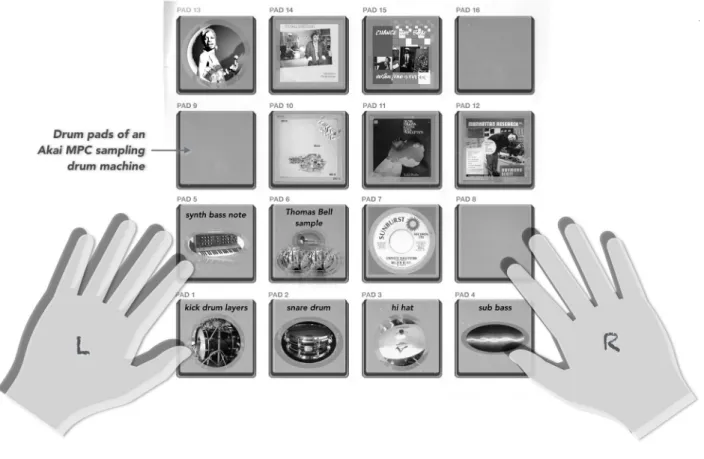
an easy leap to make. The mapping of vocal phrases on the drum pads of a
sampling drum machine leads to rhythmical and textural manipulations enforced
upon past voices/performers/sounds; and these can be seen as a form of
‘phonographic conjuring’ and, in turn, a kinaesthetic (embodied) coercing of the
listener (based on the neural mirroring effects discussed above).
The temporal distance perceived between the percussive actions of the
contemporary producer (No I.D.’s re-imagined patterns triggering Simone’s voice)
further condition for a magical experience. Even though distance between
performers and audiences is counterproductive to magic as Leddington (2016) has
previously shown, distance between user and source is in fact a condition for
successful magic to occur according to the ‘law of contagion’ (Wilcock 2015, p. 40):
‘things which have once been in contact with each other continue to act on each
other at a distance after the physical contact has been severed’ (Frazer cited in
Wilcock 2015, p.49). Hearing the interaction of old and new musical or sonic
utterances is contagion manifested on rap records. Figure 4 below illustrates the
drum pads of an Akai MPC sampling drum machine ‘loaded’ with samples
Figure 4. A schematic representation of the sampled examples discussed in this article on
Conclusion
The mapping of parallels between two art forms can often appear as nothing
more than an intellectual puzzle, entertaining the scholar with fanciful surface
analogies but doing little to uncover any potent aesthetic insights. It is my hope that
by investigating the frequent associations made by practitioners, fans, critics and
academics between magic and sample-based music, the article has demonstrated
the rationale behind such analogies and, furthermore, it has started to uncover a
number of parallel mechanics lying under the surface of the two art forms.
Specifically for hip-hop, the invested interest lies in understanding the appeal of the
sample-based aesthetic in a number of dimensions: the lure of phonographic
samples for practitioners but also the magic of the sample-based aesthetic for
listeners. Furthermore, as the article has discussed, the evolving nature (and
exponential hybridisation) of subgenres promotes new questions about the practices
and emerging aesthetic issues to the forefront, and the essence of ‘magic’ in
sample-based processes acquires increased urgency. Perhaps, by studying the
dynamics of this interaction between raw sonic materials and sampling in the
established practice of utilising phonographic sources, practitioners will be able to
infuse the ‘magical’ qualities necessary into both their sources and process,
Notes
1 The term ‘beat-maker’ will be used interchangeably with ‘producer’ in the context of
(sample-based) hip-hop (see, also, note 3 below).
2 For a complete account on the development of turntable practice—or ‘turntablism’—as
instrumental practice, see Katz (2012, pp. 43-69).
3 In hip-hop terminology ‘beat’ refers to a complete instrumental music production or
backing, not just the organisation of percussive/drum elements, highlighting the genre’s rhythmic priorities. Williams (2014) extends Schloss’s (2014) definition of beat as a sample-based instrumental collage, to also include non-sample-sample-based elements in the instrumental production.
4 Cuts refer to sudden stops of audio, originally performed by DJs using the crossfader of a
mixer connected to a turntable, and later emulated within samplers, computer technology or via the mute buttons and automation on studio mixing consoles. Cuts are often also referred to as the combined performance of scratching and cutting and, in later use, the totality of turntable technique (see, also, note 2 above).
5 This truncation and rhythmical re-organisation of sampled material is referred to as
‘chopping’ in hip-hop terminology, and the style is a trademark of DJ Premier’s production signature. Kajikawa (2015, p. 164) defines chopping as ‘the process of dividing a digital sample into any number of smaller parts and rearranging them to create a new pattern’.
6 Chang (2007, pp. 41-65) provides a historical context for how this necessity—the result of
social engineering, the withdrawal of instrumental funding from New York schools, and a technically-trained but unemployed young generation—brought about hip-hop’s ‘big bang’.
7 Live hip-hop band The Roots have had to deal with this criticism across their
14-studio-album career—a topic discussed in detail by Wayne Marshall (2006).
8 Tricia Rose (1994, p. 79) informs us that: ‘A few years after rap’s recording history began,
pioneering rap producer DJ Marley Marl discovered that real drum sounds could be used in place of simulated drum sounds’.
9 KRS-One published a hip-hop ‘commandments’-style/dogma book in 2009, entitled The
Bibliography
Caldwell, B. 2015. UGK/B.B. King mashup 'The Trill Is Gone' is as awesome as you
think it is.
http://www.houstonpress.com/music/ugk-bb-king-mashup-the-trill-is-gone-is-as-awesome-as-you-think-it-is-7887211 (accessed 23 February 2018)
Chang, J. 2007. Can’t Stop Won’t Stop: A History of the Hip-Hop Generation (London,
Ebury Press)
Chang, V. 2009. ‘Records that play: the present past in sampling practice’, Popular
Music, 28/2, pp. 143-59
Clarke, E.F. 2005. Ways of Listening: An Ecological Approach to the Perception of
Musical Meaning (New York, Oxford University Press)
Cook, R., Bird, G., Catmur, C., Press, C. and Heyes, C., 2014. ‘Mirror neurons: from
origin to function’, Behavioral and Brain Sciences, 37/2, pp. 177-92
Csikszentmihalyi, M. 1990. Flow: The Psychology of Optimal Experience (New York,
HarperPerennial)
D’Errico, M. (2015) ‘Off the grid: instrumental hip-hop and
experimentation after the golden age’, in The Cambridge Companion to
Hip-Hop, ed. J.A. Williams (Cambridge, Cambridge University Press), pp.
280-91
Freud, S. 2001. Totem and Taboo (Oxon, Routledge Classics)
Gibson, D. 2008. The Art of Mixing: A Visual Guide to Recording, Engineering and
Production (2nd edn) (Boston, Course Technology)
Godwin, J. (ed.) 1987. Music, Mysticism and Magic: A Sourcebook (London, Arkana)
Jarrett, M. 2014. Producing Country: The Inside Story of the Great Recordings
Kajikawa, L. 2015. Sounding Race in Rap Songs (Oakland, University of California
Press)
Katz, M. 2010. Capturing Sound: How Technology Has Changed Music (Berkeley, Los
Angeles and London, University of California Press)
Katz, M. 2012. Groove Music: The Art and Culture of the Hip-Hop DJ (New York,
Oxford University Press)
Krims, A. 2000. Rap Music and the Poetics of Identity (Cambridge, Cambridge
University Press)
KRS-One, 2009. The Gospel of Hip Hop: First Instrument (New York, powerHouse
Books)
Kulkarni, N. 2015. The Periodic Table of Hip Hop (London, Ebury Press)
Lacasse, S. 2000. ‘Listen to my voice’, the evocative power of voice in recorded rock
music and other forms of vocal expression. PhD thesis, University of Liverpool.
http://www.mus.ulaval.ca/lacasse/texts/THESIS.pdf (accessed 24 February 2018)
Lamont P. and Wiseman R. 1999. Magic in Theory: An Introduction to the Theoretical
and Psychological Elements of Conjuring (Hatfield, University of Hertfordshire Press)
Landman, T. 2013. ‘Framing performance magic: the role of contract, discourse and
effect’, Journal of Performance Magic, 1/1, pp. 47-68
Leddington, J. 2016. ‘The experience of magic’, The Journal of Aesthetics and Art
Criticism, 74/3, pp. 253-64
Leddington, J. 2017. ‘The enjoyment of negative emotions in the experience of
magic’, Behavioral and Brain Sciences, 40, pp. 34-35
Lehrer, J. 2009. ‘Magic and the brain: Teller reveals the neuroscience of illusion’,
Levitin, D. 2006. This Is Your Brain on Music: Understanding a Human Obsession
(London, Atlantic Books)
Lewis, G.E. 2017. ‘Improvised music after 1950: afrological and eurological
perspectives’, in Audio Culture: Readings in Modern Music (2nd edn), ed. C. Cox and
D. Warner (New York and London, Bloomsbury Academic), pp. 385-98
Liu-Rosenbaum, A. 2012. ‘The meaning in the mix: tracing a sonic narrative in ‘When
The Levee Breaks’’, Journal on the Art of Record Production, 7
Marshall, W. 2006. ‘Giving up hip-hop’s firstborn: a quest for the real after the death
of sampling’, Callaloo, 29/3, pp. 868-92
Miller, E.L. and Zompetti, J.P. 2015. ‘After the prestige: a postmodern analysis of
Penn and Teller’, Journal of Performance Magic, 3/1, pp. 3-24
Moore, A.F. 2002. ‘Authenticity as authentication’, Popular Music, 21/2, pp. 209-23
Moore, A.F. and Dockwray, R. 2008. ‘The establishment of the virtual performance
space in rock’, Twentieth-century Music, 5/2, pp. 219-41
Nelson-Strauss, B. 2017. The Fish that Saved Pittsburgh.
http://blackgrooves.org/the-fish-that-saved-pittsburgh/ (accessed 27
February 2018)
Oxford Dictionaries. 2018. https://en.oxforddictionaries.com/definition/
magic (accessed 4 March 2018)
Perlovsky, L. 2017. Music, Passion, and Cognitive Function (London, Academic Press)
Reinhart, M. 2015. ‘Spirited away’, Journal of Performance Magic, 3/1, pp. 25-35
Reynolds, S. 2012. Retromania: Pop Culture’s Addiction to its Own Past (London,
Rose, T. 1994. Black Noise: Rap Music and Black Culture in Contemporary America
(Middletown, Wesleyan University Press)
Schloss, J.G. 2014. Making Beats: The Art of Sampled-based Hip-Hop (2nd edn)
(Middletown, Wesleyan University Press)
Schmidt-Horning, S. 2013. Chasing Sound: Technology, culture, and the Art of Studio
Recording from Edison to the LP (Baltimore, JHU Press)
Seay, T. 2012. ‘Capturing that Philadelphia sound: a technical exploration of Sigma
Sound Studios’, Journal on the Art of Record Production, 6
Stowell, D. 2011. ‘Scheduling and composing with Risset eternal accelerando
rhythms’, ICMC.
Vendryes, T. 2015. ‘Versions, dubs and riddims: dub and the transient dynamics of
Jamaican music’, Dancecult: Journal of Electronic Dance Music Culture, 7/2, pp. 5-24
Wilcock, S. 2015. ‘The source of magic - rediscovered’, Journal of Performance
Magic, 3/1, pp. 36-56
Williams, J.A. 2011. ‘Historicizing the breakbeat: hip-hop’s origins and authenticity’,
Song and Popular Culture, 56, pp. 133-67
Williams, J.A. 2014. ‘Theoretical approaches to quotation in hip-hop recordings’,
Contemporary Music Review, 33/2, pp. 188-209
Zagorski-Thomas, S. 2010. ‘The stadium in your bedroom: functional staging,
authenticity and the audience-led aesthetic in record production’, Popular Music,
29/2, pp. 251-66
Zagorski-Thomas, S. 2018. ‘The spectromorphology of recorded popular music: the
shaping of sonic cartoons through record production’, in The Relentless Pursuit of
Tone: Timbre in Popular Music, eds. R. Fink, M. Latour and Z. Wallmark (New York,
Zak, A. 2001. The Poetics of Rock: Cutting Tracks, Making Records (Berkeley,
Discography
Beside, ‘Change the Beat (French Rap)’, Change the Beat. Celluloid, CEL
156, 1982
Gang Starr, ‘Code of the Streets’, Hard to Earn. Chrysalis, 7243 8 28435 2 8.
1994
Gang Starr, ‘Deadly Habitz’, The Ownerz. Virgin, 7243 5 80247 0 8. 2003
Jay-Z, ‘The Story of O.J.’, 4:44. Roc Nation, 00857491007458. 2017
J Dilla, ‘Lightworks’, Donuts. Stones Throw Records, STH2126. 2006
KRS-One & Marley Marl, Hip Hop Lives. Koch Records, KOC-CD 4105. 2007
Madlib the Beat Konducta, ‘Filthy (Untouched)’, Vol. 1-2: Movie Scenes.
Stones Throw Records, STH 2133. 2006
Melvin Bliss, ‘Synthetic Substitution’, Reward / Synthetic Substitution. Sunburst
Records, SU-527. 1973
Monk Higgins, ‘Little Green Apples’, Extra Soul Perception. Solid State
Records, SS-18046. 1968
Nina Simone, ‘Four Women’, The Best Of Nina Simone. Philips, SBL 7895.
1969
Raymond Scott, ‘Lightworks’, Manhattan Research Inc. Basta, 30-9078-2.
2000
Stereo Mike, Xli3h. EMI, 50999 513333 2 4. 2007
Steve Gray, ‘Beverly Hills’, Relax. Bruton Music, BRD 10. 1979
The Roots, Organix. Remedy Recordings, Cargo Records, CRGD 81100. 1993.
Thomas Bell Orchestra featuring Doc Severinsen, ‘A Theme for L.A.’s Team’,
Vivien Goldman, ‘Launderette’, Resolutionary (Songs 1979-1982). Window,
WIN 1. 2016
Westside Gunn x Conway, ‘Fendi Seats’, Griselda Ghost. Daupe!, DM-SP-016.