SIMULATION IN THE SUPPLY CHAIN CONTEXT:
MATCHING THE SIMULATION TOOL TO THE PROBLEM
Mr. Chris Owen
PricewaterhouseCoopers LLP 19 Cornwall St Birmingham B3 2DT
Dr. Pavel Albores Dr. Andrew Greasley
Dr. Doug Love
Aston Business School Aston University
Aston Triangle Birmingham B4 7ET
[email protected];[email protected];[email protected]
ABSTRACT:
The supply chain can be a source of competitive advantage for the firm. Simulation is an effective tool for investigating supply chain problems. The three main simulation approaches in the supply chain context are System Dynamics (SD), Discrete Event Simulation (DES) and Agent Based Modelling (ABM). A sample from the literature suggests that whilst SD and ABM have been used to address strategic and planning problems, DES has mainly been used on planning and operational problems., A review of received wisdom suggests that historically, driven by custom and practice, certain simulation techniques have been focused on certain problem types. A theoretical review of the techniques, however, suggests that the scope of their application should be much wider and that supply chain practitioners could benefit from applying them in this broader way.
Keywords: Supply Chain, System Dynamics, Discrete Event Simulation, Agent Based Modelling
1. INTRODUCTION
Effective management of the supply chain can provide businesses with enduring competitive advantage (Christopher, 2005). There are several examples of firms who have done this, for example Wall-Mart, Dell Computer and Seven-Eleven Japan (Chopra and Meindl, 2007).
Simulation has been shown to be very effective at modelling the supply chain with its dynamic nature, complexity and variability (Biswas and Narahari, 2003). There are a number of reviews which have investigated the various ways simulation has been used including Akkermans and Dellaert (2005), Angerhofer and Angelides (2000), Cavalieri and Terzi (2004) and Min and
Zhou (2002).
Given that simulation is an effective approach for tackling supply chain problems, how does the practitioner, faced with a challenge decide which simulation approach to use? It appears that the choice of which simulation approach to use in a given situation owes much to the background of the modeller and the techniques they are more familiar with (Morecroft and Robinson 2005, Lane 2000). In addition, custom and practice has led to the application of particular simulation approaches in certain situations.
2. HOW IS SIMULATION USED IN THE SUPPLY CHAIN CONTEXT?
In order to understand how simulation is being used to analyse the supply chain, a literature search was conducted. The purpose of the search was to identify the main methods being used to simulate the supply chain. The search string “supply chain” AND “simulation” was entered in EBSCO Business Source Premier Search engine, all databases were selected. A total of 517 hits were returned, this reduced to 439 when the option “Scholarly (Peer Reviewed) Journals” was selected. A sample of 100 of these 439 papers were reviewed and classified based on the full paper, not just the abstract.
In order to classify the papers a taxonomy was required. As a starting point, the Association for Computing Machinery (ACM) Special Interest Group (SIG) on SImulation and Modeling (SIM) has a high level classification for simulation approaches, and this was used to classify the papers (http://www.acm-sigsim-mskr.org). A review of other associations, professional groups and textbooks was performed but no more comprehensive taxonomy was discovered. The different types of simulation recognised by ACMSIGSIM are discrete, continuous, Monte Carlo, System Dynamics, Gaming, Agent, Artificial Intelligence, Virtual Reality, Distributed, Web based, Live and In the Loop. Each paper was classified against the approaches listed above. If a method was found which was not on the list then the method was added to the taxonomy. A paper could be classified against more than one method, for example a paper could include both discrete simulation and gaming. If the method could not be identified then the method was classified as ‘not clear’. Using this approach the results in Figure 1 were obtained. A number of additional methods were added during this classification, namely XML, Spreadsheet,
Mathematical Modelling, Java, Bespoke
Software, Matlab, Genetic Algorithm, Petri Net and Not Clear.
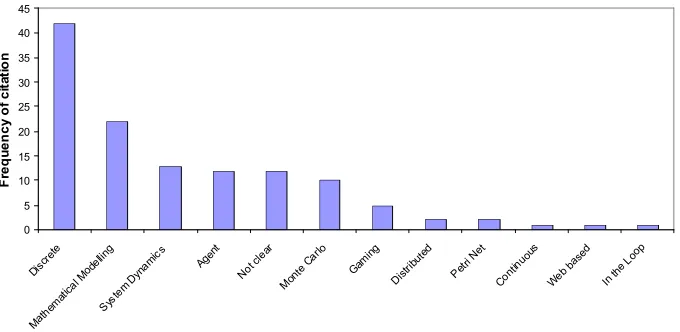
On reflection, it was considered that methods such as Spreadsheet, Bespoke Software, XML, Java and Genetic Algorithm were not true simulation methods like the others and were rather programming methods and so were reclassified as one of the prime methods or ‘not clear’. Methods with no hits have also been removed. The second version of the classification is shown in Figure 2.
The top six methods then are Discrete, Mathematical Modelling, System Dynamics, Agent, Not Clear and Monte Carlo. Mathematical modelling is inherently different from other
methods because it involves modelling the system by developing mathematical equations, which the authors hypothesise represent the system under consideration. Pidd (2004) suggests that mathematical modelling is different in kind because it attempts to analytically identify an optimal solution to the problem under study. He argues that most mathematical models cannot deal with dynamic or transient effects. This means that mathematical modelling is not simulation in the same sense as the methods identified here. For this reason, mathematical modelling is discounted for the purposes of further study and comparison in this paper. Monte Carlo simulation is a method for performing numerical integrations of functions that are impossible with direct analytical approaches. Since this is a fundamentally different problem focus than the other forms of simulation considered here it has been discounted from further review. Gaming is an approach used in particular to explore the impact of human behaviour on the performance of the supply chain. A good example of this is the Beer Game, an interactive simulation developed at MIT to
illustrate the Bullwhip Effect
(http://beergame.mit.edu/guide.htm). Gaming is often used in a training or education context to demonstrate to participants certain principles of supply chain performance. Because of its relatively niche and specialised focus, Gaming is not considered as one of the main methods of simulation for further review. The remaining methods, i.e. distributed, petri net, continuous and web based were cited two or fewer times and so again are not considered as the main methods in use. The main methods, therefore, of supply chain simulation for further consideration are Discrete Event Simulation (DES), System Dynamics (SD) and Agent Based Modelling (ABM).
Interestingly, other authors have identified these three methods for comparison, for example Lorenz and Jost (2006) and Borshchev and Fillipov (2004).
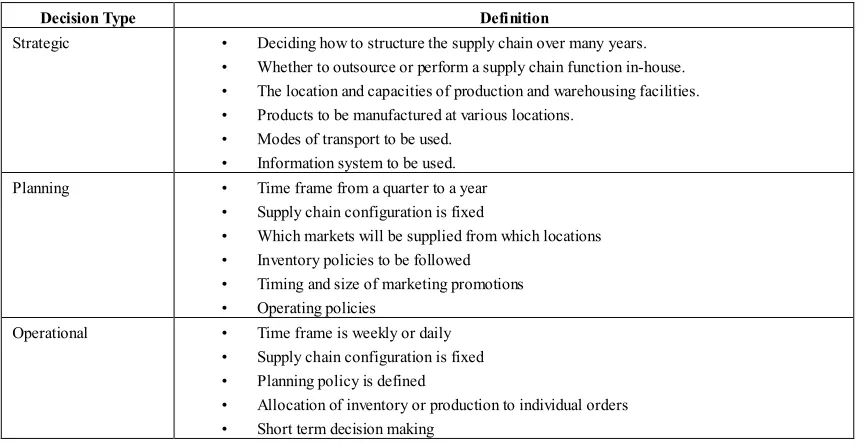
The next stage of the classification was to examine what types of problem the approach was being used to solve. For this purpose, problems have been classified as strategic, planning or
based on which problem type was being addressed. In some cases, it was not clear which problem type was being addressed in which case it was classified as ‘not specified’. The results of this classification are shown in Figure 3 below. As can be seen from the results of this classification, both SD and ABM have been used equally to address strategic and planning problem types in an equal 50% distribution. DES by contrast, is more heavily weighted towards planning problem types and is also the only approach to have been used to address operational problems.
3. WHAT IS THE RECEIVED WISDOM ON THE RELATIVE STRENGTHS AND WEAKNESSES OF THESE APPROACHES?
As has been stated, the choice of simulation approach is often influenced by the background of the modeller and custom and practice. It is therefore informative to review each method and identify the received wisdom of where each approach is considered to have its strengths and weaknesses.
System Dynamics
Despite the potential range of application domains, the SD method is often considered to be better suited to tackling macro policy type problems (Schierritz and Milling, 2003), (Pidd,
2004), (Lane, 2000). Conversely, SD is
considered poor at modelling more detailed micro problems such as queuing and job sequencing (Riddalls et al, 2000). Some authors, for example (Homer, 1999) argue that System Dynamics may need support from micro modelling techniques, such as OR to build convincing, credible models of more detailed aspects of the system being modelled. The papers from the literature search which cited System Dynamics as an approach dealt with a wide range of supply chain themes:
• Impact of demand amplification on
transport cost • Reverse supply chain
• Impact of batching on bullwhip • Efficient blood supply
• Quality perception • E-collaboration • Performance metrics
• Using a CONWIP (Constant Work in
Progress) system • Agility
• Supply chain dynamics • Cycle time compression • Supply chain redesign • Demand amplification
Based on a more extensive review of the literature, as well as their own experience, the
authors have distilled out a set of claims which appear to be the received wisdom associated with SD (see Table 5). From its earliest days (Forrester, 1958, 1961) feedback has been a central feature of SD and the approach has been used to investigate problems where feedback has been a core theme. Secondly, SD is a continuous method where entities are aggregated together rather than modelled as discrete. This suggests that the method may be less suited to problems where the behaviour of individual heterogeneous entities is the key area of interest. Next and associated with this, SD is inherently not suited to problems where the movement in space of individual entities is the focus of interest, because as a continuous modelling technique, it cannot model the movement of individual entities. Fourthly, and supported by the literature, SD is often considered best suited to modelling strategic or policy level problems rather than those at the operational or tactical level. Next, there are features of ABM which will be described later, which it assumed cannot be represented using other methods. Finally, SD is often used to study problems with a long time frame. For example, at the UK SD Chapter Conference in 2009, all the case studies were on problems with timeframes in years or decades, rather than days, weeks or months. Having identified these claims, the theoretical review will test which can be supported and which contradicted.
Discrete Event Simulation
The application of DES has been mainly in the operational and planning areas rather than the strategic and policy levels (Brailsford and Hilton, 2001 and Sweetser, 1999). Received wisdom suggests that the Discrete Event Simulation (DES) is particularly strong for investigating detail complexity (Lane, 2000), is generally 'open loop' in design (Coyle, 1985) and is not well suited to policy level modelling. Of course in reality, problems under study will be somewhere on a continuum from operational to planning to strategic, but many authors suggest that DES is more useful in the operational to planning level, where SD is more applicable to strategic level problems (Borshchev and Fillipov, 2004).
Discrete Event Simulation is by far the most cited approach with a frequency of 42 compared with 13 for System Dynamics and 12 for Agent Based Modelling.
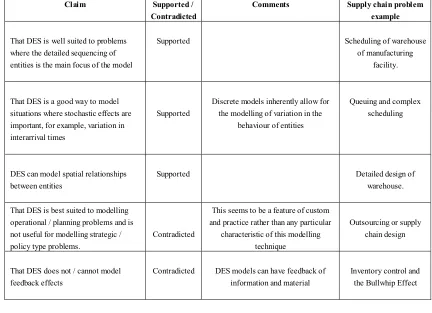
Again, based on a review of the literature and experience, a number of key claims have been distilled for DES. Firstly, that DES is well suited to problems where the detailed sequencing of entities is the main focus of the model. Secondly, that DES is a good way to model situations where stochastic effects are important, for example, variation in interarrival times. Next, that DES can model spatial relationships between entities. DES has often been considered best suited to modelling operational / planning problems and not useful for modelling strategic / policy type problems. Finally, that DES does not / cannot model feedback effects (Coyle, 1985).
Agent Based Modelling
Although early in its development, a range of application areas are claimed “..from diverse business processes and organisations , to the demands on the healthcare system from aging
populations…” (North and Macal, 2007).
Borshchev and Fillipov (2004) consider Agent Based Modelling as a technique capable of being applied throughout the range from the operational to strategic level.
The papers from the literature search which cited Agent Based Modelling as an approach dealt with a wide range of supply chain themes:
• Information sharing • Human behaviour and trust • Supply chain optimisation • Distributed supply chain
• Collective customer collaboration • Cooperation
• E-manufacturing optimisation • Human behaviour on bullwhip effect • Supply chain dynamics
• Modelling control elements • Market dynamics
As an emerging field, a number of claims have been made for ABM. For example, that agent based simulation can model detailed entity behaviour where spatial relationships are important. Secondly, that agent based modelling can be used to model the behaviour of individual entities. Next, that Agent Based Modelling is the
only approach that can model certain
characteristics such as “proactiveness / purposefulness, situatedness, reactiveness / responsiveness, autonomy, social ability, anthromorphity, learning, continuity, mobility, specific purpose” and others identified by authors (North and Macal, 2007). Further claims are that Agent models are micro, bottom up models; that Agent models are most useful for analysing planning, operational models rather than strategic models. Finally, that agent models will always
give you a better, richer model than other approaches.
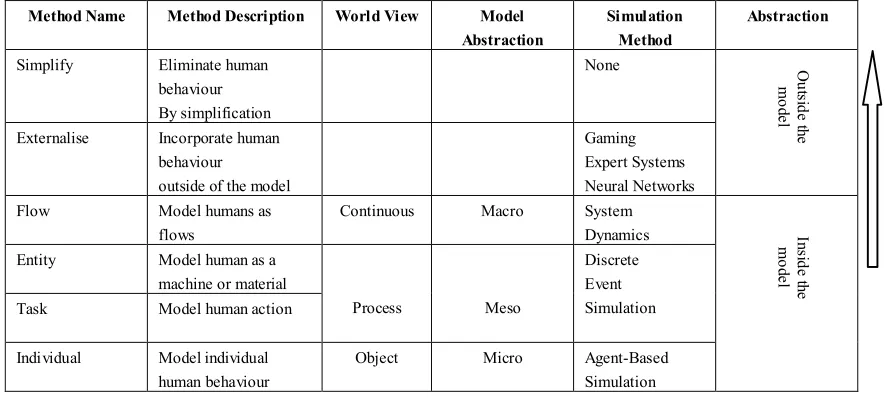
Potential users of simulation software may be less interested in the mechanics of the methodology they are considering and more interested in matching its capabilities to the problem they are solving. For example, Greasley (2007) considers the World View as being either continuous, process or object. The other perspective he considers as important from the user view is the level of model abstraction being either macro, meso or micro. He aligns the three major simulation approaches to these two criteria,
namely; continuous and macro (System
Dynamics), process and meso (Discrete Event Simulation) and object and micro (Agent Based
Simulation), see Table 3. Another user
perspective is given by Lorenz and Jost (2007) who suggest that the selection of method should be based on the fit between purpose, i.e. the motivation of the intended modelling effort,
object which refers to the real world context under investigation andmethodologywhich refers to the integrated set of tools and techniques applied to a problem. They conclude by giving a tentative suggestion as to the type and features of problems the three approaches are likely to be suited to (see Table 4).
4. THEORETICAL REVIEW
Each of the three approaches to simulation (SD, DES and ABM) is based upon certain theoretical foundations and assumptions. It is useful to review the approaches from a theoretical perspective in order to determine if this will yield any insights as to their likely strengths and weaknesses and applicability in different problem domains. This section reviews the approaches from two perspectives, namely the paradigm view and the world view. These insights are then used to challenge the results of the received wisdom review to see what conclusions can be drawn.
4.1 The Paradigm View
the time of its first appearance. Paradigms gain their status because they are more successful than their competitors in solving a few problems that the practitioner has come to recognise as acute.” To some extent, then, a paradigm can occur through a group of proponents coming together who believe that they have a set of ideas, theories and practices which may be more useful than others in solving certain types of problems. To this extent, it is possible to see that all three of these approaches can be considered separate paradigms. They each have groups of adherents, separate journals and academic conferences which support their activities. Discrete event simulation, for example, came into existence in the early days of computing, as a way to apply the power of computing to building models of real world systems so that they could be analysed more efficiently than previously using more conventional methods. Later, System Dynamics emerged through applying feedback and control theory to management problems. This ability to model the interaction of information and material flows, and in particular to model feedback effects, provided a method that gave insights beyond previous approaches. This meant that new theoretical models could be constructed which then explained real life problems, a good example of this is the bull whip theory first proposed by Forrester (1961). Finally, ABM has emerged in response to the view that the complexity of system behaviour can only truly be understood when considered from the perspective of modelling the proactive individual and their response to the situation that they find themselves in. The system level response is then found to be the ‘emergent’ property of the individual level responses. This has led to a separate grouping of like minded practitioners who are developing models and tools based around the concept of the pro-active individual entity or ‘agent’.
4.2 The World View
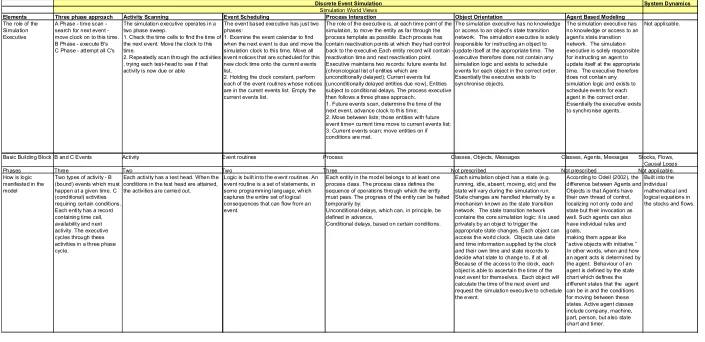
In order to compare these different approaches to simulation, it is useful to review how each approach tackles the core aspects of how a simulation operates. In this case the following aspects have been selected, namely; the role of the simulation executive, the basic building blocks used, the phases in the approach and how logic is manifested in the model. In order to carry out this comparison, Discrete Event Simulation is separated into the three accepted ‘world views’ of event scheduling, activity scanning and process interaction which emerged from the work of Lackner (1962) and Kiviat (1969). The three phase approach is defined in detail in Tocher (1963) and Pidd (2004). The next major change in simulation thinking came about with the
advent of object orientation. There are significant differences in approach both in terms of the role of the simulation executive, but also how logic is manifest in the model. One of the key features of object orientation is the way that the logic is encapsulated within the object. The key features of object orientation are described by Ball (1994). When reviewed against this framework, it is striking how ABM seems to build on the attributes and characteristics of object orientation, but taking it further. As described in Figure 4, the key difference between agents and objects is that agents have their own thread of control, localising not only code and state but their invocation as well (Odell, 2002). From this perspective, it can be argued that ABM, far from being a completely new approach, is in fact an extension to object oriented thinking, with the autonomy of the objects being taken to a new level. Finally, if SD is examined against this framework, it is clear that it is completely different to all the other approaches in that the way that the model is constructed is fundamentally different from the others. The basic building blocks of the model and the way that logic is built into the model is also very different, being built into the logical equations, the stocks and flows.
5. DISCUSSION
When these three approaches: SD, DES and ABM are examined through the perspective of these lenses, namely the paradigm and the world view we are provided with some interesting insights. From a paradigm perspective, we can see that all three approaches can lay claim to being separate paradigms. From this perspective, each approach would claim to be able to bring insights and problem solving ability to all problem domains from operational, through planning to strategic. This can be observed in the fact that there are examples of application of each technique across this range. This suggests that pigeon holing the techniques as being suitable at one level on this spectrum may be limiting their usefulness. There may in fact be less difference between these approaches than the received wisdom suggests. Interestingly, in the first empirical comparison between SD and DES (Tako and Robinson, 2009) the authors concluded that there was little perceived difference between them when first time users used both to model the same problem.
modelling. This suggests that where there are differences in applicability, they are likely to be most marked between DES, ABM on the one hand and SD on the other. The most obvious example of this is likely to be in terms of disaggregation and heterogeneity. Where the problem requires the modelling of many entities which are heterogeneous then ABM or DES is likely to be more appropriate than SD. The differences between DES and ABM are more to do with the degree of intelligence or autonomy the modeller wishes (or needs) to embody within the entity. If this requirement is high, then ABM is likely to be more suitable. The other striking thing about the ‘world view’ lens is that there seems little evidence to support the idea that ABM and DES are really that different in terms of the applicability along the operational, planning, strategic spectrum and that perhaps differences as those suggested by Borshchev and Fillipov (2004) and Greasley (2007) may be more to do with custom and practice than real applicability. The user view brings into focus the ‘fit’ between the methodology and the purpose of the modelling with the object of the modelling. The authors make various recommendations around the likely areas where these approaches are most useful. There appears to be some disagreement between authors as to where the approaches best fit. Borschev and Fillipov (2004), for example, consider ABM to be applicable across the range from operational to strategic, whereas Lorenz and Jost (2007) suggest ABM as being suitable for strategic problems.
The next stage of this analysis is to review the claims identified earlier in the received wisdom in the light of this theoretical analysis. The most interesting areas are those where the received wisdom appears to be contradicted, so these will now be described. Regarding System Dynamics, there are three claims which appear to be contradicted. The first two are linked, namely that SD should be used to study strategic or policy level problems and problems with a long time frame. The theoretical review suggests that SD should also be applicable to more operational, short time frame problems. The other claim found to be challenged is that SD cannot model certain
aspects associated with agents such as
proactivity, memory and adaptiveness. The theoretical review suggests that SD should be able to model such characteristics and indeed examples of such models are present in the literature (Schieritz and Grosler, 2002). In terms of DES, there are two claims found to be contradicted. The first concerns the common practice of using this technique to tackle mainly operational and planning problems rather than strategic or policy problems. Again, the
theoretical analysis suggests no reason why DES could not be used fruitfully in this domain. Finally, regarding DES, that it cannot be used to
model feedback effects. This has been
contradicted, and in fact the authors have built DES models incorporating both material and information feedback features. Regarding ABM, there are three claims which are not supported by the theoretical review. Firstly, that ABM is the
only technique that can model certain
characteristics i.e. “proactiveness/purposefulness, situatedness, reactiveness/responsiveness, autonomy, social ability, anthromorphity, learning, continuity, mobility, specific purpose”. This claim is found to be contradicted in that many and arguably all these features can be represented using the other techniques. The authors have built several models using SD, DES and spreadsheets that incorporate many of these features. Secondly, that ABM is more useful for analysing planning and operational rather than
strategic problems. From a theoretical
perspective, ABM appears to have characteristics which lend itself well to modelling strategic and policy type problems, for example modelling the dynamics of supplier competition and selection. Finally, with ABM, that this approach, being detailed and bottom up, will always give a richer picture of the problem under investigation. From the theoretical perspective, what matters more is that the appropriate level of detail for modelling is chosen. Thus in all cases, we find that some of the claims for these techniques based on custom and practice are contradicted. This provides a potentially fruitful line of further research, taking the techniques into areas in which they are not commonly applied.
6. CONCLUSIONS
question. These problems will be modelled by all three approaches to examine whether what has been suggested by theoretical analysis is backed up in practice. Whilst these conclusions have been drawn in the context of the supply chain and supply chain examples have been given in each case, it could be argued that the conclusions of
this analysis could be drawn more widely to a more general class of system problem and that the conclusions on applicability of these three approaches would still hold.
Figure 1– Classification of Papers by Simulation Method
0 5 10 15 20 25 30 35 40 45 Disc rete
Mathe mati
cal M odel ling Syst emD ynam ics Agen t Mon teC arlo Spre adsh eet Not c
lear Gam ing Besp oke softw are XML
Distr ib uted Java
Petri Net Cont inuou s Web base d Inth eLo op MAT LAB Gen eticA l
gorit hm
Artif icial
Intellig ence
Virtu alRe
ality Live
F re q u e n c y o fM e th o d
Figure 2 -Classification of Papers by Simulation Method following reclassification
0 5 10 15 20 25 30 35 40 45 Disc rete Math emat
ical M odell ing Syst emDy nam ics Agen t
Not c lear Mon teCa rlo Gam ing Distr ibute d Petri Net Cont inuou s Web base d Inth e Loo
p F re q u e n c y o f c it at io n
Figure 3 -Classification of Problem Types addressed by SD, DES and ABM
0 5 10 15 20 25 30 35 40 45
Agent Based Sys tem Dynamics Discrete Event
Strategic Planning Operational Not spec ified Count of Problem Type
Approach
Figure 4 –Simulation World Views
System Dynamics
Elements Three phase approach Activity Scanning Event Scheduling Process Interaction Object Orientation Agent Based Modeling
The role of the Simulation Executive
A Phase time scan search for next event -move clock on to this time. B Phase - execute B's C Phase - attempt all C's
The simulation executive operates in a two phase sweep.
1. Check the time cells to find the time of the next event. Move the clock to this time.
2. Repeatedly scan through the activities , trying each test-head to see if that activity is now due or able
The event based executive has just two phases:
1. Examine the event calendar to find when the next event is due and move the simulation clock to this time. Move all event notices that are scheduled for this new clock time onto the current events list.
2. Holding the clock constant, perform each of the event routines whose notices are in the curent events list. Empty the current events list.
The role of the executive is, at each time point of the simulation, to move the entity as far through the process template as possible. Each process has contain reactivation points at which they had control back to the executive.Each entity record will contain -reactivation time and next -reactivation point. Executive maintains two records: future events list (chronological list of entities which are unconditionally delayed); Current events list (unconditionally delayed entities due now), Entities subject to conditional delays. The process executive then follows a three phase approach:.
1. Future events scan, determine the time of the next event, advance clock to this time; 2. Move between lists; those entities with future event time= current time move to current events list; 3. Current events scan; move entities on if conditions are met.
The simulation executive has no knowledge or access to an object’s state transition network. The simulation executive is solely responsible for instructing an object to update itself at the appropriate time. The executive therefore does not contain any simulation logic and exists to schedule events for each object in the correct order. Essentially the executive exists to synchronise objects.
The simulation executive has no knowledge or access to an agent’s state transition network. The simulation executive is solely responsible for instructing an agent to update itself at the appropriate time. The executive therefore does not contain any simulation logic and exists to schedule events for each agent in the correct order. Essentially the executive exists to synchronise agents.
Not applicable.
Basic Building Block B and C Events Activity Event routines Process Classes, Objects, Messages Classes, Agents, Messages Stocks, Flows, Causal Loops
Phases Three Two Two Three Not prescribed Not prescribed Not applicable.
How is logic manifested in the model
Two types of activity - B (bound) events which must happen at a given time. C (conditional) activities requiring certain conditions. Each entity has a record containing time cell, availability and next activity. The executive cycles through these activities in a three phase cycle.
Each activity has a test head. When the conditions in the test head are attained, the activities are carried out.
Logic is built into the event routines. An event routine is a set of statements, in some programming language, which captures the entire set of logical consequences that can flow from an event.
Each entity in the model belongs to at least one process class. The process class defines the sequence of operations through which the entty must pass. The progress of the entity can be halted temporarily by:
Unconditional delays, which can, in principle, be defined in advance,
Conditional delays, based on certain conditions.
Each simulation object has a state (e.g. running, idle, absent, moving, etc) and the state will vary during the simulation run. State changes are handled internally by a mechanism known as the state transition network. The state transition network contains the core simulation logic: it is used privately by an object to trigger the appropriate state changes. Each object can access the world clock. Objects use date and time information supplied by the clock and their own time and state records to decide what state to change to, if at all. Because of the access to the clock, each object is able to ascertain the time of the next event for themselves. Each object will calculate the time of the next event and request the simulation executive to schedule the event.
According to Odell (2002), the difference between Agents and Objects is that Agents have their own thread of control, localizing not only code and state but their invocation as well. Such agents can also have individual rules and goals,
making them appear like “active objects with initiative.” In other words, when and how an agent acts is determined by the agent. Behaviour of an agent is defined by the state chart which defines the different states that the agent can be in and the conditions for moving between these states. Active agent classes include company, machine, part, person, but also state chart and timer.
Built into the individual mathematical and logical equations in the stocks and flows.
Discrete Event Simulation
Table 1 –Supply Chain Problem Types (Chopra and Meindl, 2007)
Decision Type Definition
Strategic • Deciding how to structure the supply chain over many years.
• Whether to outsource or perform a supply chain function in-house. • The location and capacities of production and warehousing facilities. • Products to be manufactured at various locations.
• Modes of transport to be used.
• Information system to be used.
Planning • Time frame from a quarter to a year
• Supply chain configuration is fixed
• Which markets will be supplied from which locations
• Inventory policies to be followed
• Timing and size of marketing promotions
• Operating policies
Operational • Time frame is weekly or daily
• Supply chain configuration is fixed
• Planning policy is defined
• Allocation of inventory or production to individual orders
• Short term decision making
Table 2 –Supply Chain Problem Types tackled by DES in the literature search
• Logistics
• Modular supply chain
modelling
• CONWIP (Constant Work in
Progress) versus Kanban
• High volume semi conductor
manufacture
• Container terminal
simulation
• Coordinating bid prices
• Cost effective blood supply
• Backordering policy
• Supply chain optimisation
• Information sharing
• Web service supply chain
• Balancing inventory and
capacity
• Improving despatch bay
performance
• Logistics planning of a
terminal
• Base stock model
• Integrated product and
process
• Distributed constraint
satisfaction problem
• Supply chain simulation
• JIT (Just in Time) versus JIC
(Just in Case)
• Distributed modelling
• Automotive supply chain
• Supplier selection
• Material flow
• Coordination
• Reducing construction lead
times
• Retail clothing supply
• Modelling returns
• Reducing cycle times
• Decision making
• Internet product fulfilment
• Defining an inventory policy
• Performance metrics
• Process management
• Modelling different levels of detail
• Theory of constraints
• Supply chain dynamics
• Food supply chains
• Logistics
• Modelling control elements
Table 3 –Modelling humans in simulation, Greasley (2007)
Method Name Method Description World View Model
Abstraction
Simulation Method
Abstraction
Simplify Eliminate human
behaviour By simplification
None
Externalise Incorporate human
behaviour
outside of the model
Gaming Expert Systems Neural Networks
Flow Model humans as
flows
Continuous Macro System
Dynamics
Entity Model human as a
machine or material
Process Meso
Discrete Event Simulation
Task Model human action
Individual Model individual
human behaviour
Object Micro Agent-Based
Simulation
Table 4 –Matching approach to problem type, Lorenz and Jost (2007)
Approach Features Problem Type
Agent Based Modelling Spatial distribution
Heterogeneity
Strategic
System Dynamics Feedback non-linearities Strategic
Long term policy deployment Aggregate perspectives
Discrete Event Simulation Stochastic variety
Linear relationships
Logistic
Quantitative optimisation
Table 5 –System Dynamics
Claim Supported /
Contradicted
Comments Supply chain problem
example
That System Dynamics would be better suited to studying problems where feedback is a significant feature of the problem being studied.
Supported
Note that the theoretical analysis, plus some model building has established that feedback can be built into both DES and ABM models and so the extent to which this ‘advantage’ exists is open to question.
Good example of feedback is inventory planning and control and the response of the system to sudden changes in demand, as in the Bullwhip Effect. That System Dynamics is suited to
problems / situations where the entities are aggregated together and is less suited to problems where the problem involves heterogeneous entities and the behaviour of interest is at the individual entity level.
Supported
System Dynamics is an efficient approach to modelling where the
entities can be aggregated
Higher level planning and control of supply chain. Capacity planning
of factories.
That System Dynamics is not useful in modelling situations where the physical movement of entities in space is a significant aspect of the problem being modelled.
Supported
System Dynamics cannot model
entities moving in space. Detailed design of
warehouse.
That SD is more suited to policy level strategic problem types.
Nothing in the theoretical analysis
supports this other than perhaps that Detailed scheduling or
O
uts
id
e
th
e
m
od
el
In
sid
e
th
e
m
od
Contradicted certain micro queuing and scheduling problems may be more difficult to model using SD. Otherwise, it appears that SD could be used effectively at all levels of problem from strategic to
operational.
queuing problems.
That SD cannot model characteristics associated with ABM such as proactivity, memory, adaptiveness.
Contradicted
SD models have been built in which
the ‘agents’ are themselves SD models. Modelling human
decision making in a supply chain.
That SD should be used to study
problems with a long time frame. Contradicted
No reason why SD could not be used to study problems with a short time
frame?
Agility, quick response systems.
Table 6 –Discrete Event Simulation
Claim Supported /
Contradicted
Comments Supply chain problem
example
That DES is well suited to problems where the detailed sequencing of entities is the main focus of the model
Supported Scheduling of warehouse
of manufacturing facility.
That DES is a good way to model situations where stochastic effects are important, for example, variation in interarrival times
Supported
Discrete models inherently allow for the modelling of variation in the
behaviour of entities
Queuing and complex scheduling
DES can model spatial relationships between entities
Supported Detailed design of
warehouse.
That DES is best suited to modelling operational / planning problems and is not useful for modelling strategic / policy type problems.
Contradicted
This seems to be a feature of custom and practice rather than any particular
characteristic of this modelling technique
Outsourcing or supply chain design
That DES does not / cannot model feedback effects
Contradicted DES models can have feedback of
information and material
Inventory control and the Bullwhip Effect
Table 7 –Agent Based Modelling
Claim Supported /
Contradicted
Comments Supply chain problem
example
Agent based simulation can model detailed entity behaviour where spatial relationships are important
Supported Spatial positioning of agents is
commonly done in Agent Based Modelling packages
Warehouse logistics modelling
Agent based modelling can be used to model the behaviour of individual entities
Supported
Detailed scheduling problems, warehouses
and factories
characteristics such as “proactiveness/purposefulness, situatedness,
reactiveness/responsiveness, autonomy, social ability, anthromorphity, learning, continuity, mobility, specific purpose” and others identified by authors.
Contradicted
It can be shown that other techniques, including object oriented programming
can achieve the same.
Modelling human decision making in
supply systems, inventory control,
supplier selection
That Agent models are micro, bottom up models. That Agent models are most useful for analysing planning, operational models rather than strategic models.
Contradicted Why can’t ABM be used effectively to
investigate policy / strategic issues?
Sourcing strategy, supplier selection, supply chain design,
make versus buy
That agent models will always give you a better, richer model than other approaches.
Contradicted Is there an appropriate level of detail which gives you the answer ?
REFERENCES
H. A. Akkermans and N. Dellaert (2005). “The rediscovery of industrial dynamics: the contribution of system dynamics to supply chain management in a dynamic and fragmented world” System Dynamics Review, 21, 3: 173-186.
B. Angerhofer and M. Angelides (2000). “System
Dynamics Modeling in supply Chain
Management” Proceedings of the 2000 Winter Simulation Conference.
P. Ball (1994). PhD Thesis, Aston University,
“Design of an expandable manufacturing
simulator through the application of object-oriented principles.”
S. Biswas and Y.Narahari (2003). “Object Oriented Modelling and Decision Support for Supply Chains” European Journal of Operational Research, 153, 3, 704-726.
A. Borshchev and A. Fillipov (2004). “From System Dynamics and Discrete Event to Practical Agent Based Modelling: Reasons, Techniques, Tools” 22nd International Conference of the System Dynamics Society, 2004.
S. Brailsford and N.Hilton (2001). “A comparison of discrete event simulation and system dynamics for modelling healthcare systems”. In: Riley J. (ed). Proceedings of ORAHS 2000. Glasgow: Scotland pp 18–39.
S. Cavalieri and S. Terzi (2004). “Simulation in the supply chain context: a survey” Computers in Industry, 53: 3-16.
M. Christopher (2005), Logistics and Supply Chain Management, Prentice-Hall.
S. Chopra and P. Meindl (2007), Supply Chain Management, Prentice-Hall.
R. Coyle (1985). “Representing discrete events in system dynamics models”, Journal of Operational Research Society, Vol 36, No 4.
J. Forrester (1958). “Industrial Dynamics – A Major Breakthrough for Decision Makers”, Harvard Business Review, 36, 4: 37-66.
J. Forrester (1961). Industrial Dynamics, MIT Press.
A. Greasley (2007). "Approaches to Incorporating
Human Behaviour into a Discrete-Event
Simulation Study", SCMIS 2007.
J. Homer (1999). “Macro and micro modelling of field service dynamics”, System Dynamics Review, Vol 15, No 2.
P. Kiviat (1969). “Digital computer simulation: Computer programming languages”, RAND Memo, RM-5883-PR, RAND Corporation, Santa Monica, California.
T. Kuhn (1996), The Structure of Scientific Revolutions, Chicago University Press.
M. Lackner (1962). “Toward a general simulation capability”, Proceedings of AFIPS Spring Joint Computer Conference, 1-14, San Francisco, California.
D. Lane (2000). “You just don’t understand me: Modes of failure and success in the discourse between system dynamics and discrete event simulation”, LSE Working Paper 00.34.
T. Lorenz and A. Jost (2006). “Towards an orientation framework in multi-paradigm modelling”, 23rd International Conference of the System Dynamics Society, Nijmegen 2006.
H. Min and G Zhou (2002). “Supply chain modeling: past, present and future”, Computers & Industrial Engineering, Volume 43, Issues 1-2.
J. Morecroft and S. Robinson (2005). “Explaining Puzzling Dynamics: Comparing the Use of
System Dynamics and Discrete Event
Simulation” 23rd International Conference of the System Dynamics Society, Boston.
M. North and C. Macal (2007). Managing Business Complexity, Oxford University Press.
J. Odell (2002). “Objects and Agents Compared”, Journal of Object Technology, Vol. 1, No. 1.
M. Pidd (2004). Computer Simulation in
Management Science, 5th Ed. Wiley & Sons, Ltd.
C. Riddalls et al (2000), “Modelling the dynamics of supply chains”, International Journal of Systems Science.
N. Schieritz and A. Grosler (2002). “Emergent Structures in Supply Chains – A Study Integrating Agent-Based and System Dynamics Modeling”, Proceedings of the 36th Hawaii International Conference on System Sciences.
Sweetser A (1999). “A Comparison of System Dynamics and Discrete Event Simulation”. In: Cavana R.Y., Vennix J.A.M., Rouwette E.A.J.A., Stevenson-Wright M. and Candlish J. (eds). Proceedings of 17th International Conference of the System Dynamics Society and 5th Australian & New Zealand Systems Conference: System Dynamics Society. Wellington: New Zealand.
A.A. Tako and S. Robinson (2009). “Comparing discrete-event simulation and system dynamics: users’ perspectives” Journal of Operational Research Society, 60, 296-312.
K. D. Tocher (1963). The Art of Simulation, The English Universities Press, London.
AUTHOR BIOGRAPHIES
CHRIS OWENis a Senior Consultant with PwC and a DBA student in the Operations and Information Management Group at Aston Business School. He holds an MBA from Aston Business School and a BEng in Manufacturing Engineering from Brunel University. He started his career as a manufacturing systems engineer with Lucas Engineering and Systems, designing and implementing manufacturing cells. He has also managed manufacturing and assembly operations in a leading UK aerospace business. His current research focuses on the use of simulation techniques in the supply chain.
PAVEL ALBORESis a Lecturer in Operations Management at Aston Business School. He has acted as consultant in the areas of manufacturing simulation for a number of organisations and on the analysis of emergency response to terrorist attacks for the Fire Service and the Office of the Deputy Prime Minister in the UK. His current research interests are Simulation, Business Processes, Supply Chains and Networked Organizations, and Modelling and Simulation of Emergency Response. He is also a visiting lecturer at the University of Basilicata, Italy
ANDREW GREASLEY joined Aston Business School in 2001 and lectures in Operations
Management, Information Technology and
Simulation Modelling. His research area is the application of business process simulation for process improvement. He is author of the books Building a Simulation Capability in the Organisation published by Springer Verlag Ltd and Simulation Modelling for Business published by Ashgate Ltd.
DOUG LOVE was a lecturer in manufacturing engineering at Aston before moving to the university's Business School in 1995. He has a B.Sc. in mechanical engineering from U.M.I.S.T., a Ph.D. from Aston and is a Chartered Engineer (I.E.T). He worked as a production engineer on the early development of group technology cells and later held senior managerial positions in
production control and manufacturing
management. His research interests reflect the early interest in cellular manufacturing, being
mainly focussed on the development of