1 | P a g e
Expert Problem Solving Practice in Commercial Property
Valuation: An Exploratory Study
Abdul-Rasheed Amidu
Department of Property, The University of Auckland, Auckland, New Zealand Email: [email protected]
David Boyd
School of Engineering and the Built Environment, Birmingham City University, Birmingham, UK
Email: [email protected]
ABSTRACT
Purpose: This study aimed to identify the core dimensions of problem solving of experts in commercial valuation in order to provide a rich stimulus for managing current practice and enabling future development.
.
Design/methodology/approach: The study adopted a cognitive position but emphasised understanding the everyday commercial property valuation practice in a naturalistic context and from the participants’ perspectives. Given this, a grounded theory approach was employed as a research strategy to guide the data collection and surface theoretical interpretations. Data were obtained through in-depth interviews with practicing valuers working in private real estate firms within metropolitan Birmingham, UK
Findings: The interviews uncover 4 dimensions of experts’ problem solving practice in commercial valuation: (1) multidimensional, domain specific knowledge base, (2) cognitive process that is centred on analysis and reflection, (3) collaborative problem solving venture with colleagues, and (4) professional practice issues awareness. A conceptual model is proposed which integrates these dimensions enabling a clearer understanding of the nature of valuation work.
Research limitations: This study was designed to be descriptive and theory generating, thus, the findings cannot be generalised as the sample was confined to one city and consists of a small number of senior practicing valuers. Therefore, the findings may not be fully applicable to other practicing valuers, other geographical locations or more widely to other types of property valuation. Nevertheless, the findings provide an important cognitive framework which can be verified by other researchers seeking to examine the practice of expert valuers.
2 | P a g e
competence to be developed. Further work is needed to expand and refine the model across expert practice in other specialty areas of valuation practice.
Originality/value: This study expands the current understanding of valuation process to areas of expertise that have received less coverage in behavioural valuation literature, that is, the central role of knowledge and cognition and how these are applied for effective valuation problem solving and decision making.
KEYWORDS: Practice competence, Problem solving, Valuation profession, Professional
development, Commercial propertyINTRODUCTION
The concept of expertise has an extensive literature and this continues to be developed (Gobet, 2016; van Winkelen and McDermott, 2010). In every field of human endeavour, there is interest in exploring expertise in order to understand how professionals develop and how knowledge is used to solve problems in practice. The contention here is that knowing more about what experts do, what they know, how they think and how they solve problems in practice is essential for a continued advancement of a profession and development of professionals (Ericsson, 1996; Sternberg and Horvath, 1995; Benner et al., 1996).
Positions on expertise are various and heavily differentiated (Farrington-Darby and Wilson, 2006). They can be roughly split into experiential and cognitive positions. The experiential (Dreyfus and Dreyfus, 1986; Benner et al., 1996) focuses on the outcomes of practice and the context in which it occurs thus emphasising the developmental and contingent aspects of practice. Skills are then learnt in practice and are continually refined in their performance. The cognitive (Hoffman 1998; Gobet, 2016) focuses on knowledge and thinking thus emphasising analysis and problem solving. Skills are then related to understanding and competence, which can be developed formally and can be tested.
3 | P a g e make the choices they do with the view that understanding the way people make decisions on what they do on average ultimately provide decision making guidance (Farrington-Darby and Wilson, 2006). Although empirical studies of expertise from valuation domain seem to have given support to this claim, they do not develop an understanding of how experts practice in commercial property valuation with the knowledge experts hold, how they engage in reasoning and other related behaviours during valuation problem solving.
This paper explores these critical aspects about expertise. The research adopts a cognitive position but recognises that aspects of the experiential are important for practice. It seeks to illuminate the practice of valuation by providing an understanding of how expert valuers see their role in commercial property valuation, how they gather and apply information and how contexts guide their valuation problem solving. Understanding expert practice from these aspects can in the creation of entry-level and continuing educational programs as well as in structuring the valuation practice to facilitate the process of developing expertise.
The paper provides a brief description of the different approaches used to explore expertise and the study of expertise in the field of property valuation. It explains and justifies the empirical study which adopted a grounded theory study of expert valuers. The analysis of the findings surfaced a number of dimensions of experts’ valuation problem solving which are used here to report the findings. A conceptual model of valuation problem solving is presented and used to show interrelationship between the dimensions identified so that conclusions and further implications can be drawn.
UNDERSTANDING VALUATION EXPERTISE
4 | P a g e Brown et al. (1998), for instance, it was demonstrated that there was only a one in five chance of valuers recording value estimates that lie within 10% margin of the eventual sale price of a property. Crosby et al. (1998) also concluded that there is a two in three possibility that different valuers would report value estimates that vary within 10% of each other.
What these and other researchers have shown is that valuations exhibit a relatively high degree of variance and that, consistent with other domains of expertise, valuations are extremely complex human activities. This complexity makes it difficult to judge expertise by reference to the results of a valuation. For instance, in a critical review of the margin of error principle used by courts as a test of negligence in valuations, Crosby et al. (1998), argued that the appropriate margin cannot be identified accurately, and should therefore play no part in the decision regarding a negligent valuation. In other words, Crosby et al. (1998) advocated that valuers be judged purely on the process in which the professional activity has been undertaken, not on the result that has been achieved. This leads to the question of what is a competent process rather than a competent result.
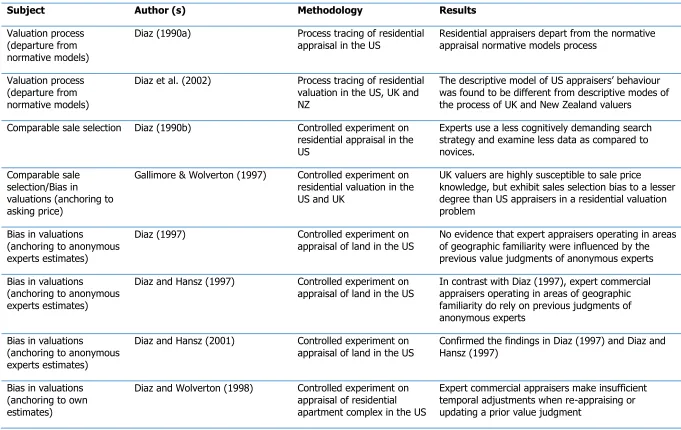
Subsequent studies of expertise in property valuation, as summarised in table 2, then examined the role of valuers and their behaviour within the valuation process in order to have a greater understanding of what causes valuations to be inaccurate or unreliable. Some investigated, for example, the crucial and biasing effect of valuers’ departure from normative models on valuation. Some focused on the role of judgment heuristics in commercial property valuations and the various reference points used by valuers in valuation decision-making.
5 | P a g e
“We must expect to find different systems using quite different strategies to perform the same task. I am not aware that any theorems have been proved about the uniqueness of good, or even best, strategies. Thus, we must expect to find strategy differences not only between systems at different skill levels, but even between experts”.
6 | P a g e Table 2.0 Overview of behavioural literature in property valuation
Subject Author (s) Methodology Results
Valuation process (departure from normative models)
Diaz (1990a) Process tracing of residential appraisal in the US
Residential appraisers depart from the normative appraisal normative models process
Valuation process (departure from normative models)
Diaz et al. (2002) Process tracing of residential valuation in the US, UK and NZ
The descriptive model of US appraisers’ behaviour was found to be different from descriptive modes of the process of UK and New Zealand valuers
Comparable sale selection Diaz (1990b) Controlled experiment on residential appraisal in the US
Experts use a less cognitively demanding search strategy and examine less data as compared to novices.
Comparable sale selection/Bias in
valuations (anchoring to asking price)
Gallimore & Wolverton (1997) Controlled experiment on residential valuation in the US and UK
UK valuers are highly susceptible to sale price
knowledge, but exhibit sales selection bias to a lesser degree than US appraisers in a residential valuation problem
Bias in valuations
(anchoring to anonymous experts estimates)
Diaz (1997) Controlled experiment on
appraisal of land in the US No evidence that expert appraisers operating in areas of geographic familiarity were influenced by the previous value judgments of anonymous experts
Bias in valuations
(anchoring to anonymous experts estimates)
Diaz and Hansz (1997) Controlled experiment on
appraisal of land in the US In contrast with Diaz (1997), expert commercial appraisers operating in areas of geographic familiarity do rely on previous judgments of anonymous experts
Bias in valuations
(anchoring to anonymous experts estimates)
Diaz and Hansz (2001) Controlled experiment on
appraisal of land in the US Confirmed the findings in Diaz (1997) and Diaz and Hansz (1997)
Bias in valuations (anchoring to own estimates)
Diaz and Wolverton (1998) Controlled experiment on appraisal of residential apartment complex in the US
7 | P a g e Bias in valuations
(anchoring to market feedback)
Hansz and Diaz (2001) Experimental study on the effects of market feedback on appraisal prices
Expert receiving transaction feedback indicated that they had been low in previous valuations seem to adjust upward s, their subsequent, unreeled value judgements
Bias in valuations
(anchoring/recency) Gallimore (1994) Questionnaire survey of expert valuers in the UK Evidence of anchoring and recency effects in valuation judgement
Bias in valuations
(anchoring to transaction price)
Havard (2001a) Controlled experiment on valuation of commercial property in the UK
In the first stage, the group with knowledge of the transaction price produced valuations that were biased towards this price. No apparent bias detected to knowledge of the transaction price in the second stage.
Bias in valuations
(anchoring) Havard (2001b) Structured interviews and Verbal Protocol Analysis of a simulated commercial valuation task
Subjects produced valuations that were biased toward a number of potential sources of value anchors, including external sources (for example, knowledge of the transaction price of a subject in a loan security valuation) and internal sources (derived from the valuer’s own experience)
Client influence Kinnard et al. (1997); Worzala et
al. (1997) Questionnaire survey posing hypothetical client pressure to revise a valuation
Majority of of responding appraisers believed that other appraisers would respond to client pressure to change appraisal
Client feedback Gallimore and Wolverton (2000); Wolverton and Gallimore (1999); Amidu et al. (2008)
Questionnaire survey posing different feedback scenarios
Appraisers reframe the valuation task in response to client feedback
Client influence Levy and Schuck (1999); Baum et al. (2000); McAllister et al. (2004); Levy and Schuck (2005)
In-depth interviews with appraisers involved in appraisals for performance measurement
Some clients do exert overt pressure to change valuation and also provide favourable information to appraisers
Client influence on
valuation Crosby et al. (2004) In-depth personal interviews with a set of appraiser focus groups
8 | P a g e It is argued in this research that the differences observed in valuation expertise are due to varied amount of experience and knowledge base underpinning the behaviour of an expert valuer in their particular context. This view of expertise has its root in a second generation of theory where knowledge content and its structure are seen as essential components of expertise. For instance, researchers have argued that relationship exists between expertise and the accumulation of knowledge (Anderson, 1982; Bedard, 1989; Black et al, 2004; Frensch and Sternberg, 1989; Prietula and Simon, 1989; Shanteau, 1992); the expert is, therefore, considered as someone who has stockpiled more knowledge. Feldon (2007) maintained that a fundamental component of expertise is the quantity of knowledge that is readily made available for application in practice. Others have postulated that the difference between experts and novices lays primarily on their use of different knowledge types during problem-solving (Johnson et al., 1981; Norman et al., 2006; Mitchell and Unsworth, 2005). Authors such as Simon and Simon (1978) and Chi et al. (1981) have also argued that differences in the way that mental processes are used when solving problems is crucial to understanding expert-novice differ.
In valuation, the question of knowledge used in valuation practice has only been superficially examined. In the early 90s, Scott and Gronow (1990) produced a conceptual paper which identified the various components of valuation expertise as applied to the domain of valuation of a residential property for the purpose of setting up a mortgage. With reference to existing cognitive psychology literature, the authors’ identified and described five areas of valuation expertise based on an explication of the knowledge involved. Since Scott and Gronow’s study, very little efforts have been made in providing a deeper understanding of the nature and structure of knowledge, reasoning and other related dimensions underlying valuation problem solving, thus this present study explores expertise from these perspectives.
THE EMPIRICAL RESEARCH DESIGN
9 | P a g e research strategy to guide the data collection and surface theoretical interpretations. According to Chenitz and Swanson (1986: 3), grounded theory is a “highly systematic research approach for the collection and analysis of qualitative data for the purpose of generating explanatory theory that furthers the understanding of social and psychological phenomenon”. In grounded theory research, the analysis of data follows each data collection episode primarily through an inductive process and, from that, theory can be extrapolated.
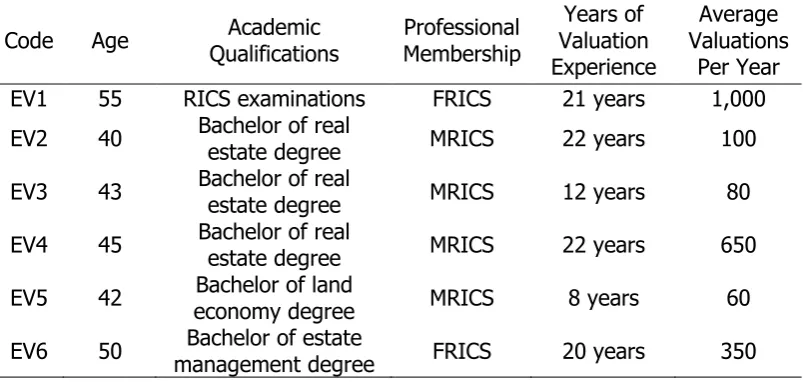
The subjects for the study were 6 chartered valuation surveyors working in private real estate firms. Table 10 presents the background information on each participant as at the time of data collection.
Table 1.01 Participants relevant background information at the time of data collection
Code Age Qualifications Academic Professional Membership Valuation Years of Experience
Average Valuations
Per Year EV1 55 RICS examinations FRICS 21 years 1,000 EV2 40 Bachelor of real estate degree MRICS 22 years 100 EV3 43 Bachelor of real estate degree MRICS 12 years 80 EV4 45 Bachelor of real estate degree MRICS 22 years 650 EV5 42 economy degree Bachelor of land MRICS 8 years 60 EV6 50 management degree Bachelor of estate FRICS 20 years 350
10 | P a g e All the expert valuers were recruited from large, private-equity partnership real-estate firms in metropolitan Birmingham, the largest city in Britain outside London. Birmingham is situated in the heart of the West Midlands conurbation, and is a metropolitan hub with an ever growing range of opportunities in the commercial property market and, as such, it is also well represented with real estate firms. Thus, a city such as Birmingham reflects the various aspects of UK commercial valuation practice (firm type, size, and role) within a relatively contained geographical context. Birmingham is therefore seen as suitable location context for an exploratory study of the phenomenon under study. Participants working in private firms were chosen because they had many more commercial property valuation encounters compared to their colleagues working in the public sector.
The use of small sample size is supported by Morse’s (1994) recommendation that at least six participants are involved in a qualitative research. Also, following Ritchie et al.’s (2003) observation, where vast amounts of information are to be collected for each participant, then the sample should be kept to a reasonably small size to allow in-depth analysis of the data. Thus, in order to select information-rich cases for detailed investigation (Denzin and Lincoln, 2000; Patton, 2002), only surveyors who were also head of valuation department of their respective firms were selected and invited for interviews and were selected using purposive- or criterion-referenced sampling.
11 | P a g e solving. There were no predetermined categories to classify these themes, rather, data extracts capturing a distinct thought were identified and coded into a theme based on commonality of meaning. Next, the researchers then organised and combined common themes into core categories which then formed the basis for developing a conceptual model of commercial-valuation reasoning and problem solving (see Amidu, 2016). The themes and core categories that emerged from the analysis were compared and contrasted until there were no further themes to be identified and the data was fully accounted for (Patton, 2002).
Four dimensions of expert valuers’ problem-solving emerged (1) knowledge, (2) cognition, (3) collaboration, and (4) professional practice. These dimensions are taken to represent the expert valuers’ perspective of what it means to practice commercial property valuation. The ‘knowledge’ and ‘cognition’ aspects are common place concepts; however, they are given more practical meaning here by enhancing them with the personal experiential descriptions. The ‘professional practice’ and ‘collaboration’ aspects form a context of individual practice and again their meaning is enhanced by experiential descriptions. To make this meaning more apparent, the findings are reported against the dimensions. There were few instances of responses that were less frequently articulated, their reporting enhances the ability to create a fuller description of valuers’ practice. A discussion of each dimension, supported by extracts from responses to interview questions, is provided to illustrate how these conceptions are constructed.
In addition, the development of this expertise was inquired into during the interviews and in a similar way two themes emerged: the development of valuation problem solving skills is embedded and refined in practice; and influenced by professional attributes. Also, these are demonstrated by quotes from the interviews. It is noted that these themes related well to the dimensions of problem solving and this directed attention at creating an explanatory model of valuers’ practice. This model was derived to present a holistic view of practitioners to enable it to be use by practitioners to describe and analyse their practice and for new practitioners to develop in practice.
12 | P a g e
Dimensions of Valuation Problem-Solving
In exploring expert property valuers’ responses to the interview questions and reflective exercise, four key dimensions were identified and contextualised as an explanatory model (shown in the following section) of the expert valuers’ conception of the key processes that occur and are central to valuation problem solving (interaction between the valuer and valuation task (s)). The four dimensions are presented below with the interview evidence to support them.
(i) Multidimensional, domain specific knowledge base
Respondents had a deeper understanding of their valuation domain knowledge which was multidimensional and perceived as the basis for valuation problem solving. Although knowledge gained from traditional academic content areas, such as valuation concepts and principles, provide the beginning point for problem solving, it was not sufficient. Such knowledge needs to be applied with the knowledge which is obtained in practice in order to make judgment on how valuation tasks may be dealt with. For example, the quote below indicates the application process of the use of basic traditional valuation knowledge and judgment in valuation problem solving.
“I think the kind of four processes that I do [in reasoning through challenging valuation tasks] is really to go back to first principles...you know those fundamental principles and, I find myself of more and more thinking of, very basic things like the difference between value, price and worth and things like that…basic kind of valuation concepts, and actually build it up from first principles and doing that in a quite analytical and logical way, really with the view to looking at how you can do something or whether you can do something…”
(EV1, Episode 3, Interview).
Other forms of knowledge were also considered vital for valuation problem solving as was the ability to draw on this knowledge. Knowledge of judgement made from previous valuations was reported as informing subsequent valuation problem solving particularly in ensuring that one arrives at the right conclusion or valuation opinion. Respondents also reported reasoning based on own instinct and confidence; suggesting the use of tacit knowledge in valuation problem solving.
13 | P a g e
“...there’s always a first time to do a particular valuation – there’s always the first time you do an industrial unit and the first time you do an office building and the first time that you measure a building that hasn’t got straight walls, and the first time you come across a building where it’s empty and there are potential issues regarding the structural deficiencies of the building, the property which is leased and the lease doesn’t make sense – every time you’ve got one you’ve got that experience within yourself to help address the challenges of the next one, but it’s all about experience at the end of the day” (EV4, Episode 4, Interview).
“…but there is a lot more; experience brings with it a degree of instinct that something isn’t right at that level which you don’t get out of books but by doing valuation day in and day out. Which bit of the brain tells me that, I am not quite sure?” (EV5, Episode 5, Interview).
The nature of knowledge, particularly the experiential knowledge, was perceived as dynamic and constantly changing; requiring updating through learning. Respondents almost always reported improvement in their experience as more and more valuations are undertaken and are aware of their responsibilities to develop knowledge for and from practice. One of the mandatory requirements for valuation practice is for professionals to commit to lifelong learning so it is valuable that valuers recognise the need to update their knowledge regularly. Respondents reported refining their reasoning with increased knowledge of practice.
“Well, you’ve got to rely on experience to date [in valuation problem solving] but your experience is constantly changing isn’t it, your experience is constantly growing because you’re valuing more and more property” (EV4, Episode 3, Interview).
“The main difference [between the way I reason now as compared to when I was less competent] is building up knowledge and being aware of the fact that just because you’ve been doing it the same for 20 years doesn’t always make it right because you might be missing out on new technology or whatever. So you’ve got to keep your knowledge up to date” (EV3, Episode 5, Interview).
14 | P a g e in regards to the level of involvement and engagement with the task and the extent to which third party information would be relied on.
It never does any harm to get a second opinion from another valuer if you’ve got something that you are really struggling with just to make sure that you are not missing something obvious so that you are going down… the right line.” (EV3, Episode 3, Interview).
(ii) Cognitive process centred on analysis and reflection
Once the task(s) are identified and the context of decision making understood, different approaches to thinking are then employed by respondents in problem solving, ranging from integrating different types of knowledge (as demonstrated earlier) to weighting up the quality of different chunks of data to support valuation opinion. Overall, respondents’ approaches to valuation problem solving as identified in the analysis of the results of the interviews, resembled analytical and reflective thinking processes, the goal of which varies from determining the quality of evidence to support valuation opinion to understanding the property being valued and making sure that the outcome of the valuation is right.
“It’s [valuation problem solving is] a data collection exercise, so we are as trained folks collecting data on the property, collecting data on the market in which the property relates, umm, getting all the evidence that comes to us and weighting up the quality of that evidence to come to the opinion.” (EV2, Episode 3, Interview).
“…you do, you very much stand back and look, you know you take stock of what property you are valuing, you take stock of the issues that are faced and you reason them through, either on your own given the experience that you’ve got, you liken it to a similar valuation that you’ve done in a different location – the building issues are exactly the same, it’s just in a different location.” (EV4, Episode 5, Interview).
(iii) Collaborative problem solving venture with colleague
15 | P a g e to widen up their scope of data search and determine appropriate valuation technique to adopt in dealing with valuation task problems
“Speaking with as many people as possible, …. so it is not just doing a valuation in isolation but would involve colleagues in the investment teams, in the occupational teams etc. So widening the network of the data is helpful.” (EV2, Episode 4, Interview).
“You’ve got to rely on the experience that your colleagues have got and also the working relationships that you have got with your colleagues to make sure that you can address or throw questions to them and get them to help you address a difficult question and it’s not just a valuation technique, it’s also on construction details.” (EV4, Episode 3, Interview).
Respondents also reported instances where they have used collaborative decision making as means of helping colleagues who are less competent and also as a means of learning and gaining more experience from other colleagues who are more competent.
“...we have a kind of big idea that, you know… no valuation should ever be one person’s work. It should always involve more than one person. You know really it should have kind of different views and just choose the fact out of the best and is that process of actually discussing it, I think it tends to pass on the reasoning and decision making skills.” (EV1, Episode 6, Interview).
“When I was less competent obviously I relied on other people telling me their experiences in order to provide answers to the questions I’d got in my property. I’m now asking, I’m now being asked by my colleagues to give them help when they are trying to answer difficult questions to their own properties. So it’s all about learning and holding that information really, and you can’t take that away from me.” (EV4, Episode 5, Interview).
Thus, expert valuers continually increase their knowledge base, not only by thinking critically about their practice but also, by engaging in collaborative problem solving with their colleagues. This often takes the form of asking questions from colleagues who are perceived to be more knowledgeable and relying on the views and experiences of other colleagues.
(iv) Professional practice issues awareness
16 | P a g e their valuation problem solving needs to be guided not only by the limit of their own knowledge but also by the scope of their professional practice. Valuation problem solving was also reported as being influenced by the ability to recognise the consequences of their action(s) or inaction(s).
“So I think people get frightened – oh I’ve got to do a valuation and they want me to answer that particular question, well you answer it as far as you are limited to within your capacity as a chartered surveyor.” (EV4, Episode 3, Interview).
“You are probably more aware of the issues behind the decisions now, what could go wrong if it is not looking quite right, you sort of understand the grey area in between more.” (EV2, Episode 5, Interview).
In their valuation problem solving process, respondents are quite innovative and sometime adopt the use of computer; although this was less frequently articulated. One respondent, in relation to commercial property valuation, identified where the use of information technology may support valuation analysis and problem solving.
“We use, depending on the type of valuation that you are doing, and if we assume commercial investment property valuation, we then normally do on the computer using a standard package, just for capitalization here, but there are other similar packages that would do the cash flow for the valuation.” (EV2, Episode 3, Interview)
Development of Valuation Problem Solving Practice
Expert valuers develop valuation problem solving in the context of practice and the two aspects that were emphasised in the course of the interviews are presented with supporting quotations.
Embedded and refined in practice
17 | P a g e clients. Teaching valuation problem solving was also reported as an effective way to develop reasoning.
“I think for me this develops over time, by having to go through the process of first undertaking valuation and more and more checking other people’s valuations. And I think that the two probably biggest influences in developing that skills I’ve had is really client challenging valuations and there is a bit of old adage that the best way to learn is to teach it and I think you have to keep talking through to the client this is how we have arrived at. “
(EV1, Episode 4, Interview).
Also, the desire to take on new and challenging aspects of valuation practice was found to promote the development of reasoning; although this was less frequently articulated. One expert valuer reported, as indicated in the quote below, having to consider doing something outside their scope of professional practice and to look at it and research into it.
“...I think that, probably, one of the thing that I’ve always done a period of time is being happy to tackle new areas, to look at it and research and go into it to try and do something that I’ve never done before because I know that a number of valuers don’t do that..” (EV1, Episode 5, Interview).
Influenced by professional attributes
Confidence and understanding emerged as significant professional attributes that drive experts’ ability to develop reasoning and valuation solving practice. As respondents become more experienced, they perceived an improvement in their level of confidence which reinforces correct reasoning. In the quotes below, expert valuers likened the development of reasoning to becoming more confident in practice and having an understanding of the various sources of information and issues that may affect the reliability of the use of such information.
“I think is becoming more confident...and then the confidence comes from almost when they start to ask what you think as opposed to ask what they think.” (EV3, Episode 4. Interview).
It “[Developing valuation problem solving] is an experience-based thing…, making sure that you have got a selection of data that hopefully are saying similar thing. That is giving you confidence. Understanding where your information is coming from and the issues that could go behind it…helps.” (EV2, Episode 4, Interview).
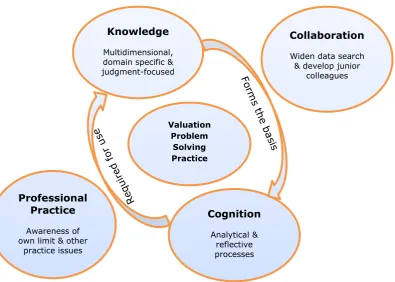
18 | P a g e This study has identified dimensions of expert problem solving practice in commercial property valuation and shown how this is developed. The use of grounded theory approach allowed the building on previous work into the development of valuation expertise and to generate a conceptual model on expert problem solving practice. This model is shown in Figure 1. At the centre of the model is the valuer’s conception of valuation problem solving practice which emerges from the four dimensions. The first part of the model shows that valuation problem solving is context dependent; it is always supported by knowledge and cognition. Thus, knowledge and cognition are the two main attributes that are inherent in valuation problem solving. These two components have also been established as central to reasoning and problem solving in many domains of expertise such as in the health professions (Higgs et al., 2008). The link between knowledge and cognition is the expert valuers’ conception of the nature and development of valuation problem solving, with collaboration and professional practice providing some of the context in which the link takes place in the second part of the model.
Figure 1 Conceptual model connecting the dimensions of expert valuation problem-solving
Knowledge
Multidimensional, domain specific & judgment-focused
Cognition
Analytical & reflective processes Valuation
Problem Solving Practice
Collaboration
Widen data search & develop junior
colleagues
Professional Practice
Awareness of own limit & other
19 | P a g e Experts’ ability to solve problems is due, in part, to their extensive domain knowledge which they are able to quickly recall and deploy (Ericsson and Lehmann, 1996; Feltovich et al., 2006; Glaser and Chi, 1988). In solving a valuation problem, valuers use their knowledge which is multidimensional and dynamic. The knowledge valuers use, in common with other experts, can be considered as being of three distinctive types: theoretical knowledge (general knowledge on valuation including valuation-based concepts, principles and methods), experiential knowledge (knowledge gained from practice including experience of past cases and methods) and personal knowledge (knowledge intrinsic to individual valuers which are rarely discussed or written down). These classifications bear some similarity to those given by Anderson (1982) and Eraut (1994). The use of knowledge, as evidenced in the analysis provided in this study, is oriented towards judgment (e.g. Kirkebøen, 2009). Thus, in solving valuation problems, valuers use their knowledge to form a judgement which in turn is used as the basis of making decisions about appropriate action to deal with a valuation problem. In comparable evaluation, for instance, valuers use the knowledge of the local market to identify appropriate comparable properties to compare against the subject property. The judgment formed by the valuer is used to weight up the quality of the comparable evidence to support valuation opinion.
Although experts require the use of a multidimensional knowledge base in practice, cognitive processes (as shown in Figure 1) are essential for knowledge to be effectively utilised in valuation problem solving. Experts usually exhibit more efficient and different methods of cognitive processes as compared to novices (e.g. Cannon-Bowers and Bell, 1997; Etringer et al., 1995; Hoffman, 1998). Lynton (1990, p. 18) argued that critical thinking and other aspects of higher order procedures enable experts to:
“recognise the many different factors which affect a given situation, to discover what the real problems are, to identify available options and trade-offs involved in each, to recognise the limits of what can be accomplished, and finally to make choices and compromises”
20 | P a g e professional expertise (e.g. Eraut, 1994; Harris, 1993). Experts use the metacognitive processes to identify inconsistencies or connections between information gathered, recall knowledge from experience and critique their own thinking (Harris, 1993; Sternberg, 1995).
The second part of the model revolves around the understanding that valuation problem-solving is further supported by collaborative processes and professional practice. Collaboration with colleagues was emphasised as a vital process of obtaining and sharing professional knowledge and skills required for effective valuation problem solving. In other domains of expertise such as in auditing, there has been intense debate about the use of collaborative decision making and approach. In response to the recent global financial crisis, the European Commission (EC)has taken a lead on this debate and to this end issued the Green Paper ‘Audit Policy, Lessons from the Crisis’, 2010; as cited in Ratzinger-Sakel et al., 2012) that suggested various institutional mechanisms including joint audit. Following consultation on the EC joint audit proposal, a draft report on regulatory proposal was published by the European Parliament in 2012. In addition, a recent study by Baldauf et al (2012) has provided empirical evidence suggesting that auditors who use a joint audit approach achieve higher consensus and greater accuracy. Similarly, under the Professional Standard 2 of the 2014 edition of the Red Book, the RICS acknowledges that other members or valuers could have input to a valuation; although the resultant valuation still remains the responsibility of the named valuer (RICS, 2014). While this is not equivalent to the concept of joint decision making, it is important that an investigation is carried out on whether a joint valuation contributes to valuation quality and hence valuation reports.
21 | P a g e
CONCLUSION
Using detailed interview data, this study has investigated the problem solving practice of experts in commercial property valuation. It presents four dimensions of expert problem solving practice viz: knowledge, cognition, collaboration and professional practice. The study also shows how practitioners develop these dimensions of expert problem solving and places them within a conceptual model. The first two dimensions (knowledge and cognition) interplay and form individual personal skills in the conception of expert problem solving practice. The remaining two dimensions (collaboration and professional practice) represent the social skills that provide further support in valuation problem solving. Although these dimensions appear as discrete elements in the conceptual model of expert problem solving practice, the narratives of the expert valuers indicate that they are generally complementary - it is the operation of all four dimensions that is critical for successful judgment. The identification of these dimensions expands the current understanding of valuation process to areas of expertise that have received less coverage in behavioural valuation literature, that is, the central role of knowledge and cognition and how these are integrated for effective valuation problem solving and decision making. This thus begs the question of whether valuation practice and education can be designed in a manner to address these dimensions of professional competence.
The valuation practice environments need to develop mechanisms to provide time that would enable these multi-dimensions of professional competence to be developed. In particular, valuers need time to practice, time with their colleagues, time for reflection, and time to return to literature in order to develop the knowledge-in-practice, which enables them to become better and more competent. It is suggested that managers of valuation firms should consider allocating a high value to time for learning as an integral part of practice. Expert valuers should be required to review the literature and to serve as role models and mentors for novices and upcoming generation of valuers.
22 | P a g e novices through to experts. Practice by expert valuers also suggests the following strategies are vital when teaching students: (1) providing students with a wide spectrum of sources of knowledge and an environment to integrate this new knowledge to solve valuation problems, (2) working with inadequate and uncertain information and being able to explain their judgement and the choices informing such judgements, and (3) developing cognitive skills to enable students identify and solve real valuation problems within which they can self-monitor their thought processes by checking with colleagues within collaborative contexts. It is noted that the development of these practical skills require practice with focus, intensity and continuity. Additionally, there is the need for students to observe valuation instructors “thinking aloud” as they identify and solve valuation problems.
The findings of this research also have immediate implications for continued research. The conceptual model of expert problem solving practice in commercial valuation employed in this study was extrapolated from existing theory of expertise and the data from our sample of valuers using grounded theory approach. Although this approach allows us to describe the complex nature of commercial valuation practice and its broader contexts, there is a need for more in-depth investigations in targeted areas. In particular, further work is needed to expand and refine the model across expert practice in other specialty areas of valuation practice. Also, it is possible there are many valuers who demonstrate the dimensions of expert problem solving practice presented in this study but who have different criteria than used in this sample. Therefore, further research needs to study representative sample of these valuers to determine the relevance of these four dimensions of expert problem solving practice to their style of practice. Finally, research is also needed to determine whether expert valuers have better knowledge and cognitive structures than other valuers and what factors may explain those structures.
REFERENCES
Adair, A., Berry, J. and McGreal, S., 1996. Valuation of residential property: Analysis of participant behaviour. Journal of Property Valuation and Investment, 14(1), pp.20-35.
Amidu, A.R., Tajudeen Aluko, B. and Andrew Hansz, J., 2008. Client feedback pressure and
the role of estate surveyors and valuers. Journal of Property Research, 25(2),
pp.89-106.
23 | P a g e
Baldauf, J. and Steckel, R., 2012. Joint audit and accuracy of the Auditor's report: An
empirical study. International Journal of Economic Sciences and Applied Research,
5(2), pp.7-42.
Bedard, J., 1989. Expertise in auditing: Myth or reality? Accounting, Organizations and
Society, 14(1-2), pp.113-131.
Benner, P., Tanner, C., Chesla, C.A., Dreyfus, S.E. and Rubin. J., 1996. Expertise in nursing practice: Caring, clinical judgement and ethics. New York: Springer.
Black, L.J., Carlile, P.R. and Repenning, N.P., 2004. A dynamic theory of expertise and occupational boundaries in new technology implementation: Building on Barley's
study of CT scanning. Administrative Science Quarterly, 49(4), pp.572-607.
Boyd, D. 2013, Using events to connect thinking and doing in knowledge management, Construction Management and Economics, 31:11, 1144-1159
Brown, G.R., 1985. Property investment and performance measurement: A reply. Journal of Property Valuation and Investment, 4(1), pp.33-44
Brown, G.R., Matysiak, G.A. and Shepherd, M., 1998. Valuation uncertainty and the
Mallinson Report. Journal of Property Research, 15(1), pp.1-13.
Cannon-Bowers, J.A. and Bell, H.H., 1997. Training decision makers for complex environments: implications of the naturalistic decision making perspective. In C.E. Zsambok and G. Klein (Eds.), Naturalistic decision making (pp.99-110). Hillsdale, NJ: Lawrence Erlbaum Publishers.
Chenitz, W.C. and Swanson, J.M., 1986. From practice to grounded theory. Menlo Park, Calif: Addison-Wesley Publishing Co Inc.
Chi, M.T.H., Feltovich, P.J. and Glaser, R., 1981. Categorization and representation of physics problems by experts and novices. Cognitive Science, 5, pp.121-152.
Crosby, N., Hughes, C. and Murdoch, J., 2004. Influences on secured lending property valuations in the UK, Working Papers in Real Estate & Planning, University of Reading.
Crosby, N., Lavers, A. and Murdoch, J., 1998. Property Valuation variation and the ‘margin’ of error in the UK. Journal of Property Research, 15(4), pp.305-330.
Crosby, N., Lizieri, C. and McAllister, P., 2010. Means, motive and opportunity?
Disentangling client influence on performance measurement appraisals. Journal of
Property Research, 27(2), pp.181-201.
Denzin, N.K. and Lincoln, Y.S., 2000. Introduction: the discipline and practice of qualitative research. In N.K. Denzin and Y.S. Lincoln (Eds.), Handbook of qualitative research
(2nd ed., pp.1-29). Thousand Oaks, CA: Sage.
Diaz, J. and Hansz, J.A., 1997. How valuers use the value opinions of others. Journal of
Property Valuation and Investment, 15(3), pp.256-260.
Diaz, J. and Hansz, J.A., 2001. The use of reference points in valuation judgment. Journal of Property Research, 18(2), pp.141-148.
Diaz, J. and Wolverton, M.L., 1998. A longitudinal examination of the appraisal smoothing
hypothesis. Real Estate Economics, 26(2), pp.349-358.
Diaz, J., 1990a. How appraisers do their work: A test of the appraisal process and the development of a descriptive modelconceptual model. Journal of Real Estate Research, 5(1) pp.1-15.
Diaz, J., 1990b. 'The process of selecting comparable sales. The Appraisal Journal, 58(4), pp.533-540.
Diaz, J., Gallimore, P. and Levy D., 2002. Residential valuation behaviour in the United State, the United Kingdom and New Zealand. Journal of Property Research, 19(4), pp.313-326.
24 | P a g e EC. 2010. Green Paper: Audit policy: Lessons from the crisis. Brussels: European
Commission Publication, pp. 1-21.
Eraut, M., 1994. Developing professional knowledge and competence. London: Falmer Press.
Ericsson, K.A. and Lehmann, A.C., 1996. Expert and exceptional performance: Evidence of
maximal adaptation to task constraints. Annual Review of Psychology, 47(1),
pp.273-305.
Ericsson, K.A., 1996. The acquisition of expert performance: An introduction to some of the issues. In K.A Ericsson (Ed.), The road to excellence: The acquisition of expert performance in the arts and sciences, sports and games (pp.1-50). Manwah, NJ: Lawrence Erlbaum.
Etringer, B.D., Hillerbrand, E. and Claiborn, C.D., 1995. The transition from novice to expert
counselor. Counselor Education and Supervision. 35(1), pp.4-18.
Farrington-Darby, T. and Wilson, J.R., 2006. The nature of expertise: A review. Applied
Ergonomics, 37(1), pp.17-32.
Feldon, D.F., 2007. The implications of research on expertise for curriculum and pedagogy.
Educational Psychology Review, 19(2), pp.91-110.
Feltovich P.J., Prietula M.J. and Ericsson K.A., 2006. Studies of expertise from psychological perspectives. In K.A. Ericsson, N. Charness, P.J. Feltovich, R.R. Hoffman (Eds.) The Cambridge handbook of expertise and expert performance., Cambridge: Cambridge University Press.
Frensch, P.A. and Sternberg, R.J., 1989. Expertise and intelligent thinking: when is it worse to know better? In Sternber, R.J. (ed.), Advances in the Psychology of Human Intelligence, (Vol. 5, pp. 157-188). Hillsdale, NJ: Lawrence Erlbaum Publishers.
Gallimore, P. and Gray, A., 2002. The role of investor sentiment in property investment
decisions. Journal of Property Research, 19(2), pp.111-120.
Gallimore, P. and Wolverton, M., 2000. The objective in valuation: a study of the influence
of client feedback. Journal of Property Research, 17(1), pp.47-57.
Gallimore, P. and Wolverton, M.L., 1997. Price knowledge induced bias: A cross-cultural comparison. Journal of Property Valuation and Investment, 15(3), pp.261-73.
Gallimore, P., 1994. Aspects of information processing in valuation judgement and choice.
Journal of Property Research, 11(2), pp.97-110
Glaser, R. and Chi, M.T.H., 1988. Overview. In M.T.H. Chi, R. Glaser, and M.J. Farr (Eds.),
The nature of expertise (pp. xv–xxviii). Hillsdale, NJ: Lawrence Erlbaum Publishers.
Gobet, F., 2016. Understanding Expertise: A Multi-disciplinary Approach. Palgrave Macmillan.
Hager, D.P. and Lord, D.J., 1985. The property market, property valuations and property
performance measurement. Journal of the Institute of Actuaries, 112(01), pp.19-60.
Harris, I. 1993. New expectations for professional competence. In L. Curry, J. Wergin and Associates (Eds.) Educating professionals: Responding to new expectations for competence and accountability (pp.17–52). San Francisco, Calif: Jossey-Bass Inc Publishers.
Havard, T.M., 2001a. An experimental evaluation of the effect of data presentation on
heuristic bias in commercial valuation. Journal of Property Research, 18(1), pp.51-67.
Havard, T.M., 2001b. Valuation reliability and valuation behaviour', RICS Foundation Research Paper Series, 4(1)
Higgs, J., Jones, M.A., Loftus, S. and Christensen, N., 2008. Clinical Reasoning in the Health
Professions. Boston, Mass: Butterworth-Heinemann.
25 | P a g e Holyoak D. 1991. Symbolic connectionism: toward third-generation theories of expertise. In:
K.A. Ericsson, J. Smith (Eds.) Toward a general theory of expertise (pp.301–335). New York: Cambridge University Press.
Hutchison, N., Macgregor, B. and Nanthakumaran, N., 1995. Variations in the capital
valuations of UK commercial property: Do valuers get it right. In RICS 1995 Cutting
Edge Conference, Aberdeen, September.
Johnson, P.E., Duran, A.S., Hassebrock, F., Moller, J., Prietula, M., Feltovich, P.J. and
Swanson, D.B., 1981. Expertise and Error in Diagnostic Reasoning*. Cognitive
Science, 5(3), pp.235-283.
Kinnard, W.N., Lenk, M.M. and Worzala, E.M., 1997. Client pressure in the commercial
appraisal industry: how prevalent is it?. Journal of Property Valuation and
Investment, 15(3), pp.233-244.
Kirkebøen G., 2009, Decision Behaviour- Improving Expert Judgement, in Williams, T.,
Samset, K., Sunnevåg, K. (Eds.) Making Essential Choices with Scant Information:
Front-End Decision Making in Major Projects, Palgrave Macmillan, UK
Levy, D. and Schuck, E., 1999. The influence of clients on valuations. Journal of Property
Investment & Finance, 17(4), pp.380-400.
Levy, D. and Schuck, E., 2005. The influence of clients on valuations: the clients'
perspective. Journal of Property Investment & Finance, 23(2), pp.182-201.
Lynton, E., 1990. New concepts of professional expertise: liberal learning as part of career-oriented education. Boston: New England Resource Centre for Higher Education
McAllister, P., Baum, A., Crosby, N., Gallimore, P. and Gray, A., 2003. Appraiser behaviour
and appraisal smoothing: some qualitative and quantitative evidence. Journal of
Property Research, 20(3), pp.261-280.
Mitchell, R. and Unsworth, C.A., 2005. Clinical reasoning during community health home
visits: Expert and novice differences. The British Journal of Occupational Therapy,
68(5), pp.215-223.
Morse, J.M., 1994. Designing funded qualitative research. In N.K. Denzin and Y.S. Lincoln (Eds.), Handbook of qualitative research, (pp.220-233). Thousand Oaks, CA: Sage. Newell, A. and Simon, H.A., 1972. Human problem solving. Englewood Cliffs, NJ:
Prentice-Hall.
Norman, G., Eva, K., Brooks, L. and Hamstra, S., 2006. Expertise in medicine and surgery. In R.R. Hoffmann (Ed.), The Cambridge handbook of expertise and expert performance (pp. 339-354). New York: Cambridge University Press
Northcraft, G. and Neale, M., 1987. Experts, amateurs, and real estate: an anchoring and adjustment perspective on property pricing decisions”, Organisational Behaviour and Human Decision Processes, 39(1), pp.84-97.
Patton, M.Q., 2002. Qualitative research and evaluation methods (3rd ed.). Thousand Oaks,
CA: Sage.
Prietula, M.J. and Simon, H.A., 1989. The experts in your midst. Harvard Business Review, 67(1), pp.120-124.
Ratzinger-Sakel, N., Audousset-Coulier, S., Kettunen, J. and Lesage, C., 2012. What do we
know about joint audit? Edinburgh: ICAS publication.
RICS, UK., 1994. The Mallinson Report: Report of the President's Working Party on
Commercial Property Valuations. UK, London: Royal Institution of Chartered Surveyors.
RICS, UK., 2012. RICS Valuation-Professional Standards. March 2012. UK, London: Royal
Institution of Chartered Surveyors.
26 | P a g e
Scott, I. and Gronow, S., 1990. Valuation expertise: its nature and application. Journal of
Valuation, 8(4), pp.362-375.
Shanteau, J., 1992. The psychology of experts: An alternative view. In: G. Wright and F. Bolger (Eds.). Expertise and decision support (pp.11–23). New York: Plenum
Simon, D.P. and Simon, H.A., 1978. Individual differences in solving physics problems. In R.S. Siegler (Ed.), Children's thinking: What develops? (pp. 323-348). Hillsdale, N.J: Lawrence Erlbaum Publishers
Simon, H.A., 1979. Models of thought (Vol. 1). New Haven, CT: Yale University Press
Sternberg, R.J. and Horvath, J.A., 1995. A prototype view of expert teaching. Educational Researcher, 24(6), pp.9-17.
Strauss, A. and Corbin. J., 1994. Grounded theory methodology: An overview. In N.K. Denzin, Y.S. Lincoln (Eds.) Handbook of Qualitative Research (pp.271–285).
Newbury Park, Calif: Sage Publications Inc.
van Winkelen, C. and McDermott, R., 2010. Learning expert thinking processes: using KM to
structure the development of expertise. Journal of Knowledge Management, 14 (4),
pp.557-572.
Weiss, D.J. and Shanteau, J., 2001. Do judgments alone provide sufficient information to determine the expertise of the judge who made them? Paper Presented at the 11th
International Symposium on Aviation Psychology; March 2001, Columbus, OH.
Wolverton, M. and Gallimore, P., 1999. Client Feedback and the Role of the Appraiser.
Journal of Real Estate Research, 18(3), pp.415-432.
Worzala, E.M., Lenk, M.M. and Kinnard, W.N., 1998. How client pressure affects the