Volume 2010, Article ID 694797,11pages doi:10.1155/2010/694797
Research Article
On the Implementation of Spread Spectrum Fingerprinting in
Asymmetric Cryptographic Protocol
Minoru Kuribayashi (EURASIP Member)
Graduate School of Engineering, Kobe University, 1-1, Rokkodai, Nada, Kobe, Hyogo 657-8501, Japan
Correspondence should be addressed to Minoru Kuribayashi,[email protected]
Received 14 October 2009; Accepted 28 January 2010
Academic Editor: Stefan Katzenbeisser
Copyright © 2010 Minoru Kuribayashi. This is an open access article distributed under the Creative Commons Attribution License, which permits unrestricted use, distribution, and reproduction in any medium, provided the original work is properly cited.
Digital fingerprinting of multimedia contents involves the generation of a fingerprint, the embedding operation, and the realization of traceability from redistributed contents. Considering a buyer’s right, the asymmetric property in the transaction between a buyer and a seller must be achieved using a cryptographic protocol. In the conventional schemes, the implementation of a watermarking algorithm into the cryptographic protocol is not deeply discussed. In this paper, we propose the method for implementing the spread spectrum watermarking technique in the fingerprinting protocol based on the homomorphic encryption scheme. We first develop a rounding operation which converts real values into integer and its compensation, and then explore the tradeoffbetween the robustness and communication overhead. Experimental results show that our system can simulate Cox’s spread spectrum watermarking method into asymmetric fingerprinting protocol.
1. Introduction
Due to the recent advances in broad-band network and multimedia technologies, the distribution and sharing of digital multimedia contents are increasing. It also helps a malicious party to duplicate and redistribute the contents, hence the protection of the ownership is strongly required. Encryption of the content cannot solve the problem because it must be ultimately decrypted at legitimate users who are the potential traitors in the future. Therefore, additional pro-tection mechanisms are needed to discourage unauthorized redistribution. One of the mechanisms is the fingerprinting of multimedia which enables a seller to trace illegal users by embedding identification information into the content prior to distribution [1].
The research on fingerprinting techniques is classified into two studies: collusion resistant fingerprinting systems and cryptographic protocol. Since each user purchases a content containing his own fingerprint, each content is slightly different. If users collect some of them, they try to find the difference and delete/change the embedded information. In order to tolerate such an attack, designing
collusion resistant fingerprint codes [2,3] and orthogonal fingerprinting schemes like the spread spectrum watermark-ing technique [4] had been proposed. In a cryptographic protocol, the goal is to achieve the asymmetric property between a buyer and a seller such that only the buyer can obtain a uniquely watermarked content because of the threat of dispute. If both of the parties know the content, the buyer may redistribute a pirated copy but later repudiate it by insisting that the copy come from the seller.
group signature schemes for the solution of the unbinding problem. In both schemes, bit commitment schemes are exploited at the embedding protocol using zero-knowledge proof because the protocol is performed only by a buyer and seller. For the realization of two-party protocol, their scheme sacrifices the selection of embedding information, namely a fingerprint. In their protocol, a fingerprint is a randomly selected integer by a buyer, and each bit of the fingerprint is committed to a seller for the security reason. In such a case, the encoding of the fingerprint by a collusion secure code [2, 3, 11] is difficult because the seller cannot check that the committed data is the codeword, and the exploitation of the spread spectrum watermarking technique is also difficult. In addition, the protocol of the zero-knowledge proof consumes much communicational resources for the transaction. These characteristics greatly degrade the practicality of the fingerprinting protocol.
The fingerprinting protocol in [10] introduced a trusted authority who generates a robust fingerprint when valid items of a certain transaction between a buyer and a seller are transmitted from the seller. Furthermore, the enciphering rate of the two-party protocol applied in the conventional schemes [6,7] must be less than 1/103 for the security of
commitment schemes. If the data size of a content is 1 MB, the amount of communication data is more than 1 GB, which is extremely inefficient. In [9], the enciphering rate is drastically improved using a public-key cryptosystem with an additive homomorphism. Although the homomorphic prop-erty is effective for constructing asymmetric fingerprinting, there are still problems in its implementation.
In this paper, we propose the method for implementing the spread spectrum watermarking technique by carefully designing parameters for rounding operation. The prelimi-nary version of this paper was presented in EUSIPCO2008 [12]. If frequency components of digital contents are used for the embedding of fingerprint information, they must be quantized in order to truncate real value to integer. Then, the precision of the frequency components should be considered in order not to degrade a watermarked image. When the spread spectrum watermarking technique in [4] is applied, the precision of the representing watermark signal is sensitive for the implementation. By scaling up the parameters by multiplying a constant factor, the precision is increased in our scheme. Then, the tradeoffbetween the scaling factor and the amount of data to be transmitted must be considered. In addition, for the characteristic of the fingerprinting protocol, frequency components and the watermark signal must be separately encrypted after quantization. In such a case, the consistency of the precision is a sensitive issue. Since an embedding operation is performed by addition of frequency components and a spread spectrum sequence, the additive homomorphic property of public-key cryptosystems [13,14] can be directly exploited for the embedding. Then, the sepa-rate rounding operation causes interference terms in a deci-phered data at a buyer side. Without loss of secrecy of an orig-inal content, the interference term is removed after decryp-tion. The performance of our proposed method is evaluated by comparing it with the conventional scheme [4], which confirms the similar identification capability of illegal buyers.
2. Related Works
2.1. Asymmetric Property. If both a buyer and a seller obtain a watermarked content in a fingerprinting protocol, the seller cannot prove the illegal distribution by the buyer to a third party, even if the buyer’s fingerprint is extracted. This is because the seller may distribute it himself in order to frame an innocent buyer. Hence, it is desirable that only a buyer is able to obtain his own fingerprinted content in the protocol. Such a protocol is called asymmetric fingerprinting protocol which concept was presented by Pfitzmann and Schunter [15]. In order to achieve such an asymmetric property, the homomorphic property of public-key cryptosystems is introduced in the fingerprinting protocols [8,9,16].
LetE(M) be a ciphertext of a messageM. The homomor-phic property satisfies the following equation:
g(E(M1),E(M2))=E
f(M1,M2)
, (1)
where g(·) and f(·) is one of the operations, addition, multiplication, XOR, and so forth, which is related to the applied cryptosystem and the embedding algorithm (Most public-key cryptosystems select multiplication for
g(·)). If M1 is regarded as a digital content and M2 as
a fingerprint, the fingerprint can be embedded in the content without decryption by multiplying those ciphertexts. Since they are calculated using a buyer’s public encryption-key, the watermarked content is decrypted only by the buyer, hence the asymmetric property is satisfied. The embedding operation based on the homomorphic property is basically performed for each element of fingerprint information which will be composed of bit-sequence or spread spectrum sequence, hence each element is separately embedded in its corresponding position. Thus, M1 is not
the entire content, but one of the components like the frequency elements to be fingerprinted by a watermarking technique. When the vector representation of M1 is given
by{m1,1,m1,2,m1,3,. . .}, the ciphertext is also represented as E(M1) = {E(m1,1),E(m1,2),E(m1,3),. . .}. As a consequence,
the detail of (1) is given by
gEm1,i
,Em2,i
=Efm1,i,m2,i
, (i=1, 2, 3,. . .).
(2) Memon and Wong [8] apply multiplicative property of RSA scheme [17] to embed the fingerprint, and Pfitzmann and Sadeghi [5,6] exploit bit commitment schemes based on the quadratic residues [18]. Kuribayashi and Tanaka [9] apply the additive homomorphic property of public-key cryptosystem such as Okamoto Uchiyama encryption scheme [13] and Paillier cryptosystem [14].
In watermarking techniques [1] for digital images, it is advisable to embed information in the frequency com-ponents for both the robustness and perceptual quality. However, as the frequency components are generally repre-sented by real value, there is a difficult problem to apply cryptographic techniques directly because they are based on the algebraic property of integers. Many schemes [8,
merely showed the validity of the cryptographic protocols which ensure the asymmetric property and the anonymity of buyers.
Considering the adaption of watermarking techniques for cryptographic fingerprinting protocol, a quantization method is useful as a fingerprint that can be embedded when the coefficients are quantized. In [9], the quantization index modulation based watermarking technique (QIM) [19] is applied for the embedding procedure because it rounds the values of frequency components in integers. Prins et al. [20] adapted three kinds of dithering modulations, which can improve the robustness of the QIM method, to the fingerprinting scheme, and implemented the method using a sufficiently large scaling factor. However, the enciphering rate is neglected. We assume that the bit-length of the message space isMand that of each watermarked frequency compo-nents ism. Generally,Mis much larger thanm. In order to exploit the message space effectively, dozens of watermarked frequency components are packed in one message in [9], hence, the enciphering rate is almost equivalent to that of an applied cryptosystem by suitably designing the message space of a ciphertext. It is remarkable that a negative number must be avoided because it is represented by much longer bit-sequence under the finite field of applied cryptosystem, which affects the other packed ones.
Although the capacity of embeddable information is large, considering the robustness against collusion attacks the spread spectrum watermarking technique is superior to QIM and its variants. In [8], the adaption of Cox’s spread spectrum watermarking scheme [4] is discussed. Regretfully, there is a problem in the implementation because the rounding-offoperation is not deeply considered for the spread spectrum watermarking algorithm.
2.2. Collusion Resilience. It is important to generate finger-prints that can identify colluders. In a fingerprinting scheme, each fingerprinted copy is slightly different, hence, malicious users will collect some copies with respective watermark in order to remove/alter the watermark. A number of works on designing fingerprints that are resistant against the collusion attack have been proposed. Many of them can be categorized into two approaches. One is to exploit the Spread Spectrum (SS) technique [4,21,22], and the other approach is to devise an exclusive code, known as collusion-secure code [2,3,11], which has traceability of colluders.
In the former approach, spread spectrum sequences which follow a normal distribution are assigned to users as fingerprints. The origin of the spread spectrum water-marking scheme is Cox’s method [4] that embeds the sequence into frequency components of digital image and detects it using a correlator. Since normally distributed values allow the theoretical and statistical analysis of the method, modeling of a variety of attacks have been studied. Studies in [21] have shown that a number of nonlinear collusions such as interleaving attack can be well approximated by averaging collusion plus additive noise. So far, many variants of the spread spectrum watermarking scheme are based on the Cox’s method.
Since the QIM watermarking technique [9] and its variants [20] are aiming at the extraction of a watermark bit-sequence, the latter approach is suitable to implement. The practicality of the latter approach is, however, restricted because of the long code length. In [23], the capability of QIM for the latter approach has been explored. The results show that one variant, which is called the spread transform dither modulation (STDM), retains an advantage under the blind detection. Under the non-blind detection, which is a reasonable assumption in a fingerprinting system, there is still a performance gap with the spread spectrum method. Moreover, in [24], the traceability is further improved by combining a spread spectrum embedding like Cox’s method. Hereafter, we focus on the implementation of Cox’s method in a fingerprinting protocol.
Let W be a watermark signal composed ofLelements
wi ∈ N(0, 1), (1 ≤ i ≤ L) and each of them is embedded into selected DCT coefficient xi, (1 ≤ i ≤ L) based on the following equation:
xi=xi(1 +αwi), (3)
where N(0, 1) is a normal distribution with mean 0 and variance 1, andαis an embedding strength. At the detector side, we determine which SS sequence is present in a test image by evaluating the similarity of sequences. From the suspicious copy, a sequenceWis detected by calculating the difference from the original image, and its similarity withW
is obtained as follows:
simW,W=W·W
W·W
. (4)
If the value exceeds a threshold, the embedded sequence is regarded as W. When an original image is available, the above similarity measurement is valid because the main interference term, which is the frequency components of the original image, can be completely removed at the detection. However, under the blind detection, the removal of the interference term becomes a serious problem for an optimum detection. There are some related works [25,26] concerning to the problem. Since our scope is to implement the spread spectrum method on the encrypted domain in the asymmetric protocol, the detail of the related works is omitted in this paper. Furthermore, in a fingerprinting, it is assumed that an original image is available at the detection because the operation is performed by the author or his agent. Hence, at the detection, DCT coefficients of a test image are subtracted from those of the original image, and then the correlations with every candidates of watermark signal are computed. Thus, non-blind and informed watermarking scheme can be applied.
2.3. Unbinding Problem. In the elementary fingerprinting protocol [8] involving a trusted authority, fingerprint infor-mation to be embedded is not well considered, which is merely related to user’s information such as name, address, phone number, e-mail address, and so forth. When a seller finds an illegal copy and detects the corresponding buyer by extracting the fingerprint, he will go to court with the collected proofs. A malicious seller, however, frames the detected buyer by embedding the obtained fingerprint into other contents which are more expensive than the detected one that he really sold to the buyer. Therefore, once a seller obtains a fingerprint, it is possible for him to transplant it into another more expensive contents so that he can get compensated more.
In [10], a fingerprint is binded with a common agree-ment (ARG) by producing the signature of a trusted watermark certification authority (WCA), and the transaction of digital contents is uniquely associated with a log file. For anonymity of buyers, a digital certification authority (CA) is introduced in the fingerprinting protocol. A buyerBfirst randomly selects a key pair (pkB,skB), where pkB andskB
are the public and secret keys of public-key cryptosystem, respectively. He sendspkB, which is a pseudonym associated
with B, to CA in order to get an anonymous certificate CertCA(pkB). WhenBmakes an order to a sellerS, he checks
the validity of CertCA(pkB). Then S asks WCA to generate
a unique watermarkWfor the current transaction between
BandS. The protocol between the buyer Band sellerSis summarized below (the detail is referred to [10]).
(1)B selects one-time key pair (pk,sk) and generates its certificate CertpkB(pk) using the public key pkB.
After making a common agreement ARG, B calcu-lates a digital signature Signpk(ARG) using the one-time public key pk. Bsends pkB, pk, CertCA(pkB),
CertpkB(pk), ARG, and Signpk(ARG) toS.
(2) If the validity of the received items is verified, S generates a watermarkVand embeds it into contents
X. The watermarked one is denoted by X(V). The
watermark is reference information to retrieve this sale record from illegally distributed copy; hence it could be omitted if the seller wants to avoid the degradation of quality. Then, S send CertpkB(pk), ARG, Signpk(ARG), andX(V)toWCA.
(3) Upon receiving the items, WCAverifies the validity of the certificate and signature, and reject the trans-action if any of them is invalid. Otherwise, using
X(V) it generates an unique and robust watermark Was fingerprint information which is specific to this transaction. Then, it computesEpk(W),EpkWCA(W),
and SignWCA(Epk(W),pk, Signpk(ARG)), and sends
them back toS.
(4) WhenSreceives the response, the embedding opera-tion in encrypted domain is performed by computing
Epk
X(W,V)=E
pk
X(V)⊕Epk(W), (5)
CertCA(pkB), CertpkB(pk),
ARG, Signpk(ARG)
Epk(X(W,V))
CertpkB(pk), ARG
Signpk(ARG),X(V)
Epk(W),EpkWCA(W),
SignWCA(Epk(W),pk, Signpk(ARG))
B S WCA
Figure1: The transaction of the fingerprinting protocol.
where ⊕ implies the embedding operation based on the homomorphic property. Then, S delivers
Epk(X(W,V)) toB.
(5) After decrypting the receivedEpk(X(W,V)),Bobtains the watermarked contentX(W,V),
whereEpk(·) is an enciphering function using a public key
pk. The flow of the transaction is summarized inFigure 1.
3. Implementation for
Watermarking Algorithm
In this section, we show how to implement the spread spectrum watermarking technique [4] in the fingerprinting protocol based on the homomorphic property of public-key cryptosystem. Hereafter, for simplicity, the embedding of the reference information V is omitted in the protocol, and we assume that an original image is composed ofM×N
pixels and is represented by the DCT selected coefficients
xi, (1≤i≤L) and the remaining onesxi, (L+1≤i≤MN).
3.1. Embedding. The embedding operation in (3) can be easily performed using the additive homomorphic property of public-key cryptosystems such as the Okamoto-Uchiyama encryption scheme [13] and the Paillier cryptosystem [14]. Remember that (3) is composed of two operations; multi-plication and addition forg(·) and f(·), respectively. Since the multiplication is realized by the iteration of addition, the embedding operation is represented by the multiplication and exponentiation as follows:
Epk(xi(1 +αwi))=Epk(xi)·Epk(wi)αxi. (6)
The above operation can be directly applied for the operation
At first, we show the operation concerning to a water-mark signalW= {w1,w2,w3,. . .,wL}. Since the ciphertext of
W is computed by a watermark certification authorityWCA, the enciphering operation is performed previously sent to a sellerS. A constant positive integer valuepwis added to each element of watermark signal wi, (1 ≤ i ≤ L) to make the value positive. Then, it is scaled by a factor ofswin order to keep the degree of precision, and it is quantized towi. Such operations are formalized by the following one equation:
wi=int
sw
wi+pw
=sw
wi+pw
+wi, 1≤i≤L,
(7)
where int(a) outputs the nearest integer from a real value a, and wi is the quantization error of wi. After the operation, WCA encrypts W = {w1,w2,w3,. . .,wL} using a public key pk, and the ciphertexts Epk(W) =
{Epk(w1),Epk(w2),Epk(w3),. . .,Epk(wL)},pwandsware sent to S. It is noted that Epk(W) corresponds to Epk(W) in
Figure 1, and the corresponding ciphertext ofEpkWCA(W) is
also sent toS.
Next, S performs the rounding operation to DCT coefficientsxi, (1≤i≤L) as follows. A positive integer value
pxis added to each DCT coefficient, and then scaled byswsx. By quantizing it, the rounded DCT coefficientxiis obtained:
xi=int
swsx
xi+px
=swsx
xi+px
+xi, 1≤i≤L,
(8)
wherexi is the quantization error ofxi. For the control of rounding operation of each DCT coefficient, the watermark strengthαis modified toαi;
αi=int(sxα|xi|)
=sxα|xi|+αi, 1≤i≤L,
(9)
where αi is the quantization error of αi. Using the above items,Sembedswiintoxifor 1≤i≤Lbased on the additive homomorphic property of public cryptosystem as follows:
Epk(xi)·Epk(wi)αi=Epk(xi+αiwi). (10) Since the plain value of the ciphertextEpk(xi+αiwi) is
xi+αiwi=int
swsx
xi+px
+ intsxα|xi|sw
wi+pw
=swsx
xi+αwi|xi|+
px+α|xi|pw
+sxα|xi|wi+sw
wi+pw
αi+xi+αiwi. (11) The scaling factor s = swsx and the adjustment factor
p = int(px+α|xi|pw) are necessary to calculate the actual watermarked DCT coefficientsxi+αwi|xi|. The reason whyp is rounded to an integer is explained inSection 3.4Therefore, these two parameterssandpare sent toBas well asEpk(xi+
αiwi). It is noticed that the remaining DCT coefficients
xi, (L+ 1 ≤ i ≤ MN) should be sent to B. In order to keep the secrecy of the embedding position, they must be encrypted before delivery. Without loss of generality, the rounding operation for those coefficients are given by
xi=int
sxsw
xi+p
=sxsw
xi+p
+xi, L+ 1≤i≤MN,
(12)
and the ciphertexts Epk(xi) are sent with Epk(xi + αiwi) to B. Namely, the ciphertexts of a watermarked image
Epk(XW), which is corresponding toEpk(X(W,V)) inFigure 1,
is composed of those ones.
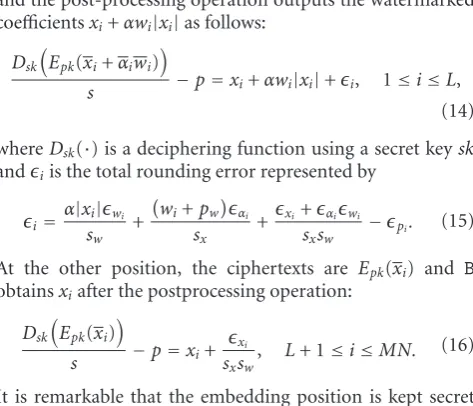
3.2. Decryption and Post-Processing. After the decryption of the received ciphertexts Epk(XW), Bdivides the results by a factor of s, and then subtracts p as the post-processing operation. It is noticed that the adjustment factorpcontains a rounding errorpi, so it is rewritten by
p=px+α|xi|pw+pi. (13)
At the embedding position, the ciphertexts areEpk(xi+αiwi) and the post-processing operation outputs the watermarked coefficientsxi+αwi|xi|as follows:
Dsk
Epk(xi+αiwi)
s −p=xi+αwi|xi|+i, 1≤i≤L,
(14) whereDsk(·) is a deciphering function using a secret keysk
andiis the total rounding error represented by
i= α|xi|wi
sw +
wi+pw
αi
sx
+xi+αiwi
sxsw −pi. (15)
At the other position, the ciphertexts are Epk(xi) and B obtainsxiafter the postprocessing operation:
Dsk
Epk(xi)
s −p=xi+
xi
sxsw
, L+ 1≤i≤MN. (16)
It is remarkable that the embedding position is kept secret fromB, the classification of the above operations is difficult.
3.3. Amount of Quantization Error. If an original image is available at the detection, the embedded watermark signal is extracted by calculating the differences of pirated copy’s DCT coefficients from the original ones. The extracted signal wi must contain the quantization error caused by the rounding operation at embedding, and it is represented by
wi=
(xi+αwi|xi|+i)−xi
α|xi|
=wi+ i
α|xi|, 1≤i≤L.
(17)
The amount of quantization errori/α|xi|depends on the parameterssw,sx,pw, andpx:
i
α|xi| =
wi
sw +
wi+pw
αi
α|xi|sx
+xi+αiwi
α|xi|sxsw −
pi
It is noted that the values of the quantization errors wi,
xi, αi and pi is uniformly distributed within the range [−0.5, 0.5). So, if the scaling parameter sw is small, the termwi/sw remains as a dominant factor in i/α|xi|, and the quantization error is almost uniformly distributed in the range.
The energy of the quantization error in a watermarked copy is
η=
L
i=1
i
α|xi| 2
. (19)
Suppose that each watermarked copy contains a quantization error with energyηandccolluders average their copies. As the value of each copy’s i/α|xi| becomes 1/c, the energy becomesη/c2. The averaged copy contains the sum of such
attenuated quantization error, hence the total energy of the quantization error in the averaged copy is estimated to be
η/c. With the increase ofc, the energy of the quantization error is to be dropped to 1/cof its original value.
3.4. Consideration. In Cox’s method, a watermark W is selected from Gaussian distribution N(0, 1). From the sta-tistical property, when a parameter pw is given, the error probability thatwi+pwis less than 0 is obtained as follows:
Prwi+pw<0
=1
2erfc p
w
√
2
, (20)
where erfc() stands for the complementary error function. In other words, if the error probability is fixed, we can calculate the smallest integer pw. For example, when pw = 5, the error probability is Pr(wi+pw < 0) = 2.87×10⁻⁷. Under a certain probability, whenwi+pwis less than 0, such a value is rounded to 0 in order to avoid the underflow. Considering the amount of the quantization error in (18), it is desirable to selectpwas small as possible.
In (3), the watermarked coefficient xi is composed of two terms;xiandαwixi. Sincewiis encrypted at the center
WCAprior to the embedding operation at S, xi andwi are rounded separately. Considering the post-processing at B, the scaling factors sw, sx, and the compensation factor p
should be constant. Here, we assume that a constant value is uniformly added to real values which arewiandxito make it positive. Then,Bmust subtract the interference term related to bothxiandwi, which requires additional communication costs. If the adjustment factor pis varied with respect toxi, the amount of information to be sent toBfromSbecomes very large. In order to avoid it, we setpa constant value by controlling the valuepx. Even ifpandαis known andpwis fixed, to obtainxiis still informationally difficult because of two unknown parameterspxandxifor a given one equation
p = int(px + α|xi|pw). As a consequence, the secrecy of the original DCT coefficients is assured. If the value of pis sufficiently large, that of the parameter px is also large and hence the value ofxi+pxis positive.
3.5. Concatenation. Notice that if the values of scaling factors
sw aresx are increased, the proposed scheme can simulate the original Cox method more precisely. From the viewpoint of enciphering rate, however, these factors should be small. Referring to [9], the bit-length of a watermarked coefficient
xi = xi + αiwi, which is represented by a constant bit-length x, is much smaller than that of message space in cryptosystems such as the Okamoto-Uchiyama encryption scheme [13] and the Paillier cryptosystem [14], and some of
xiare packed in one messageM:
M=xixi+1· · · ||xi+δ−1, (21)
where denotes a concatenation and δ is the number of packed coefficients which is dependent onswandsx. Such a packing operation is easily performed by computing the 2xt th power ofEpk(xi+t):
Epk
M=
δ−1
t=0
Epk
xi+t 2x t
. (22)
The appropriate size of sw and sx are explored by implementing them on a computer and evaluating the simulated performance. It is worth mentioning that the enciphering rate of the Paillier cryptosystem approaches asymptotically 1 using the extension of the cryptosystem [27] and then more data can be packed in one ciphertext. Although the works in [28,29] can encode rational numbers by a limited precision, they are not suitable for the packing operation.
4. Experimental Results
We have implemented our algorithm presented in Sect.3 and compared the performance with the original spread spec-trum watermarking technique [4]. Since the basic algorithm of our scheme is Cox’s scheme with a limited precision, we evaluate the degradation of an image by PSNR and the detected correlation values because it directly reflects the amount of changes between our fingerprinted image and the original fingerprinted one. If the results are similar, we regard that the performance of our simulated scheme is not degraded from that of the original one. In our simulation, a standard gray-scaled image “lenna” of 256×256 pixels is used, and the constant values are setpw=5 andp=10000 (pxis calculated by (13)). Even ifpwandpxare added, the values of wi and xi might be negative. In such a case, the values are simply rounded to 0. In the following simulation, the number of simulation is 103times, and the results are the
averaged values.
A quantization error is caused by the rounding oper-ation after orthogonal transformoper-ation which converts the frequency domain into the spatial domain as well as the rounding operation at the embedding of signal. For the evaluation of the quantization error i/α|xi| shown in (18), the differences of watermarked images are calculated with respect to the scaling parameters sw and sx, and the probability density function (p.d.f.) is depicted in Figure 2
0 1 2 P robabilit y d ensit y 3 4
(25, 20)
(24, 20)
(23, 20)
(22, 20)
(21, 20)
(20, 20)
5 6
−1 −0.5 0 0.5 1 Size of noise
(a)sx=20
0 0.2 0.4
P robabilit y d ensit y
0.6 0.8 1 1.2
−1 −0.5 0
(20, 25)
(20, 23)
(20, 20)
0.5 1 Size of noise
(b)sw=20
0 5 P robabilit y d ensit y 10 15 20
−1 −0.5 0 0.5 1 Size of noise
(25, 25)
(24, 24)
(23, 23)
(22, 22)
(21, 21)
(20, 20)
(c)sw=sx
Figure2: The probability density function of the quantization error whenL=1000 andα=0.1, where the parenthetic numbers stands for the scaling parameters (sw,sx).
0 0.5 1 P robabilit y d ensit y
1.5 2
L=1000,α=0.1 L=2000,α=0.1 L=1000,α=0.05 L=2000,α=0.05 2.5
3 3.5 4 4.5
−1 −0.5 0 0.5 1 Size of noise
(a) (23, 20)
0 0.2 0.4
P robabilit y d ensit y
0.6 0.8
L=1000,α=0.1 L=2000,α=0.1 L=1000,α=0.05 L=2000,α=0.05 1
1.2
−1 −0.5 0 0.5 1 Size of noise
(b) (20, 23)
0 1 2 P robabilit y d ensit y 3 4
L=1000,α=0.1 L=2000,α=0.1 L=1000,α=0.05 L=2000,α=0.05 5
6 7 8
−1 −0.5 0 0.5 1 Size of noise
(c) (23, 23)
Figure3: The probability density function of the quantization error for differentLandαusing the scaling parameters (sw,sx).
0 0.5 1 P robabilit y d ensit y
1.5 2
c=10 c=5 c=1 2.5
3 3.5 4 4.5 5
−1 −0.5 0 0.5 1 Size of noise
(a) (23, 20)
0 0.5 1 P robabilit y d ensit y
1.5
c=10 c=5 c=1 2
2.5 3 3.5 4
−1 −0.5 0 0.5 1 Size of noise
(b) (20, 23)
0 2 4 P robabilit y d ensit y 6 8 10 12 14 16
−1 −0.5 0 0.5 1 Size of noise
c=10 c=5 c=1 (20, 20)
c=10 c=5 c=1 (23, 23)
(c) (20, 20) and (23, 23)
34.5 34.7 34.9 35.1
25 24 23 22 21 20
22 2 4 20 C o rr elation value sw sx
(a)c=1
41 41.4 41.8
25 24 23 22 21 20 22 24 20 C o rr elation value sw s x
(b)c=5
43.5 44.1 44.7
25 24 23 22 21 20 22 24 20 C o rr elation value sw sx
(c)c=10
Figure5: The image quality for the scaling valuesswandsxwhenL=1000 andα=0.1.
30.2 31 31.8
25 24 23 22 21 20
22 2 4 20 C o rr elation value sw sx
(a)c=1
13.2 13.6 14
25
24
23 22
21
20
22 2 4 20 C o rr elation value sw sx
(b)c=5
9 9.4 9.8
25
24
23 22
21 20
22 2 4 C o rr elation value sw sx 20
(c)c=10
Figure6: The average correlation value after averaging collusion attack for the scaling valuesswandsx.
5 10 15 C o rr elation value 20 25 30 35
1 2 3 4 5 6 7 8 9 10
Number of colluders Original proposed
(20, 20)
(22, 22)
(23, 23)
(21, 21)
Figure7: The average correlation value after averaging collusion attack for the number of colluders when (sw,sw)=(23, 23).
swandsx.Figure 2(a)shows the quantization error by fixing one scaling parametersx =20. We can see that the shape of the p.d.f. is sharpened centering on zero with the increase of sw. It is because of the decrease of the first termwi/sw in (18). Figure 2(b)shows the quantization error by fixing the other scaling factorsw = 20. It confirms that the value of the quantization error is almost uniformly distributed whenswis small because the first termwi/swis not changed and it distributes uniformly in the range [−0.5, 0.5]. It is also noticed that the other terms in (18) is attenuated by the increase ofsx.Figure 2(c)confirms that the variance of
Table1: The distribution of non-colluders’ correlation values when
L=1000,α=0.1, and (sw,sx)=(23, 23).
mean variance max
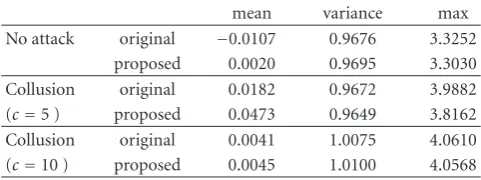
No attack original −0.0107 0.9676 3.3252 proposed 0.0020 0.9695 3.3030 Collusion original 0.0182 0.9672 3.9882 (c=5 ) proposed 0.0473 0.9649 3.8162 Collusion original 0.0041 1.0075 4.0610 (c=10 ) proposed 0.0045 1.0100 4.0568
the quantization error is decreased when bothswandsxare increased. Since the performance of Cox’s scheme depends on the parameters Landα, the comparison of the p.d.f. is shown inFigure 3using different values. We can see that the variance of the p.d.f. becomes large whenLis increased and
αis decreased. It is because the magnitude of selected DCT coefficients xi becomes small when L is increased, hence, the value of the corresponding quantization error i/α|xi| becomes large. It is remarked that the embedded signal energy as a watermark becomes smaller whenαis decreased. In the following simulation, we use the parametersL=1000 andα=0.1 for the evaluation.
It is important to evaluate the quantization error when a collusion attack is performed. Considering the studies in [21], we perform the averaging as the collusion attack. The changes in the quantization error are depicted in Figure 4
using several combination of sw and sx. We can see that there is a big changes of p.d.f. when (sw,sw)=(20, 23) from
Figure 4(b). It is because the first termwi/swin (18) follows Gaussian distribution considering the statistical property ifc
Table2: The degradation of the watermarked image when (sw,sx)=(23, 23).
aerial baboon barbala f16 girl lenna peppers
Original 36.344 36.664 34.784 35.979 36.003 35.035 34.621
Proposed 36.338 36.659 34.779 35.974 35.997 35.030 34.615
Table3: The degradation of the correlation values when (sw,sx)=(23, 23).
aerial baboon barbala f16 girl lenna peppers
No attack original 31.681 31.678 31.680 31.681 31.615 31.680 31.679
proposed 31.657 31.645 31.651 31.653 31.579 31.650 31.650
Collusion original 14.148 14.130 14.137 14.143 14.071 14.134 14.139
(c=5 ) proposed 14.129 14.093 14.109 14.117 14.030 14.104 14.112
Collusion original 9.989 9.946 9.960 9.975 9.863 9.954 9.966
(c=10 ) proposed 9.969 9.901 9.928 9.946 9.813 9.920 9.935
For the comparison of the image quality, the degradation of watermarked images and averaged copies is shown in
Figure 5. We can see that the PSNR of our method is approaching to the original one according to the increase of scaling parameterssw andsx, and the degradation of the PSNR is mainly dependent onsx. It is because the first term
wi/sw in (18) becomes small with the increase ofsw. From the results, we can say that our watermarked images are very close to the original ones ifsw≥22andsx≥23.
For the evaluation of correlation values, we embed a watermark signal using the original Cox’s scheme and our scheme. The comparison of correlation values for the watermark images is shown in Figure 6(a), where that of the original scheme is 31.680 depicted by black line on the top of the graph. The correlation values of averaged copies are also shown in Figures6(b)and6(c), where the original values are 14.134 and 9.954, respectively. We can see that the performance is asymptotically reaching the original value according to the increase of the scaling factors sw and sx. Different from the results of PSNR, the correlation values becomes very close to the original value if sw ≥ 23 and
sx≥23. This means that the quantization error degrades the correlation value much more than the value of PSNR. The results indicate that the correlation value is more sensitive to the noise injected to a watermarked image. The degradation of the correlation values is also compared by changing the number of colluders, which results are shown in Figure 7. From the results, we can say that the correlation values of our scheme usingsw =sw =23are almost coincident with the original values.
The error (false-positive) probability is an important factor to evaluate the performance of fingerprinting scheme, and the probability is dependent on the design of the threshold for a correlation value to determine guilty. If our method uses the same design of the threshold as the original one, the changes of the probability can be evaluated by the distribution of non-colluders’ correlation values. Using 104watermark signals assigned for non-colluders, the
correlation values are calculated. The mean and variance of the correlation values and the maximum values are shown
Table 1. From the results, we can say that the distribution of our method is very similar to that of original one. It is remarkable that the maximum value of our method is slightly smaller than that of original one. This means that the error probability of our method is slightly improved.
From the above results, the degradation of performance from the original scheme is very slight, and it does not affect the robustness against attacks. It is noted that the scaling factorsswandsxis closely related to the degradation of performance. It is better to increase the value of these parameters, for example sw ≥ 23 and sx ≥ 23, but we have to consider the communication costs because the bit-length to represent the watermarked DCT coefficient
xi + αiwi is increased according to the size of sw and sx, which degrades the coding rate of such information. For other images, “aerial”, “baboon”, “barbala”, “f16”, “girl”, and “peppers”, the similar results are derived with the above parameters as shown in Tables 2 and 3. The attenuation of PSNR value from the original one is at most 0.016%, that of the correlation value is at most 0.1%, and under the averaging collusion the attenuation is less than 0.39%. As a consequence, recommended parameters aresw=23andsx= 23from our simulation results. It is expected that other kinds
of spread spectrum watermarking schemes will be simulated with the similar precision, and the implementation is our future work.
When we use the above recommended parameters, the value of xi can be represented by 20 bits (the range must be within [0, 220] ifs
w = sx = 23 and p = 10000). For the security reason, the bit-length of a composite n = pq
128 MB. Therefore, the proposed method efficiently imple-ments the Cox’s spread spectrum watermarking scheme in the asymmetric fingerprinting protocol.
5. Conclusion
In this paper, we discuss about the implementation of the fingerprinting protocol based on the additive homomor-phic property of public-key cryptosystems. The effects of rounding operation which maps a real value into a positive integer are formulated, and an auxiliary operation to obtain a watermarked content is presented. From our simulation results, the identification capability of our algorithm is quite similar to the Cox’s algorithm, hence we can simulate the scheme on the cryptographic protocol with a limited precision.
Acknowledgment
This research was partially supported by the Ministry of Education, Culture, Sports Science and Technology, Grant-in-Aid for Young Scientists (B) (21760291), 2009.
References
[1] S. Katzenbeisser and F. A. P. Petitcolas,Information Hiding Techniques for Steganography and Digital Water-Marking, Artech House, Boston, Mass, USA, 2000.
[2] D. Boneh and J. Shaw, “Collusion-secure fingerprinting for digital data,”IEEE Transactions on Information Theory, vol. 44, no. 5, pp. 1897–1905, 1998.
[3] W. Trappe, M. Wu, Z. J. Wang, and K. J. R. Liu, “Anti-collusion fingerprinting for multimedia,” IEEE Transactions on Signal Processing, vol. 51, no. 4, pp. 1069–1087, 2003.
[4] I. J. Cox, J. Kilian, F. T. Leighton, and T. Shamoon, “Secure spread spectrum watermarking for multimedia,”IEEE Trans-actions on Image Processing, vol. 6, no. 12, pp. 1673–1687, 1997. [5] B. Pfitzmann and A. Sadeghi, “Coin-based anonymous finger-printing,” inProceedings of the Advances in Cryptology (EURO-CRYPT ’99), vol. 1592 ofLecture Notes in Computer Science, pp. 150–164, Springer, 1999.
[6] B. Pfitzmann and A. Sadeghi, “Anonymous fingerprinting with direct non-repudiation,” inProceedings of the Advances in Cryptology (ASIACRYPT ’00), vol. 1976 ofLecture Notes in Computer Science, pp. 401–414, Springer, 2000.
[7] J. Camenisch, “Efficient anonymous fingerprinting with group signatures,” in Proceedings of the Advances in Cryptology (ASIACRYPT ’00), vol. 1976 of Lecture Notes in Computer Science, pp. 415–428, Springer, 2000.
[8] N. Memon and P. W. Wong, “A buyer-seller watermarking protocol,”IEEE Transactions on Image Processing, vol. 10, no. 4, pp. 643–649, 2001.
[9] M. Kuribayashi and H. Tanaka, “Fingerprinting protocol for images based on additive homomorphic property,”IEEE Transactions on Image Processing, vol. 14, no. 12, pp. 2129– 2139, 2005.
[10] C.-L. Lei, P.-L. Yu, P.-L. Tsai, and M.-H. Chan, “An efficient and anonymous buyer-seller watermarking protocol,” IEEE Transactions on Image Processing, vol. 13, no. 12, pp. 1618– 1626, 2004.
[11] Y. Zhu, D. Feng, and W. Zou, “Collusion secure convolutional spread spectrum fingerprinting,” in Proceedings of the 4th International Workshop on Digital Watermarking (IWDW ’05), vol. 3710 ofLecture Notes in Computer Science, pp. 67–83, Springer, 2005.
[12] M. Kuribayashi and M. Morii, “On the implementation of asymmetric fingerprinting protocol,” in Proceedings of the European Signal Processing Conference (EUSIPCO ’08), 2008, SS7-1.
[13] T. Okamoto and S. Uchiyama, “A new public-key cryptosys-tem as secure as factoring,” inProceedings of the Advances in Crypgology (EUROCRYPT ’98), vol. 1403 ofLecture Notes in Computer Science, pp. 308–318, Springer, 1998.
[14] P. Paillier, “Public-key cryptosystems based on composite degree residuosity classes,” inProceedings of the Advances in Crypgology (EUROCRYPT ’99), vol. 1592 ofLecture Notes in Computer Science, pp. 223–238, Springer, 1999.
[15] B. Pfitzmann and M. Schunter, “Asymmetric fingerprinting,” inProceedings of the Advances in Crypgology (EUROCRYPT ’96), vol. 1070 ofLecture Notes in Computer Science, pp. 84– 95, Springer, 1996.
[16] B. Pfitzmann and M. Waidner, “Anonymous fingerprinting,” inProceedings of the Advances in Crypgology (EUROCRYPT ’97), vol. 1070 ofLecture Notes in Computer Science, pp. 88– 102, Springer, 1997.
[17] R. L. Rivest, A. Shamir, and L. Adleman, “A method for obtaining digital signatures and public key cryptosystems,”
Communications of the ACM, vol. 21, no. 2, pp. 120–126, 1978. [18] G. Brassard, D. Chaum, and C. Cr´epeau, “Minimum disclo-sure proofs of knowledge,”Journal of Computer and System Sciences, vol. 37, no. 2, pp. 156–189, 1988.
[19] B. Chen and G. W. Wornell, “Quantization index modulation: a class of provably good methods for digital watermarking and information embedding,”IEEE Transactions on Information Theory, vol. 47, no. 4, pp. 1423–1443, 2001.
[20] J. P. Prins, Z. Erkin, and R. L. Lagendijk, “Anonymous fingerprinting with robust QIM watermarking techniques,”
EURASIP Journal on Information Security, vol. 2007, Article ID 31340, 13 pages, 2007.
[21] H. V. Zhao, M. Wu, Z. J. Wang, and K. J. R. Liu, “Forensic analysis of nonlinear collusion attacks for multimedia finger-printing,”IEEE Transactions on Image Processing, vol. 14, no. 5, pp. 646–661, 2005.
[22] Z. J. Wang, M. Wu, H. V. Zhao, W. Trappe, and K. J. R. Liu, “Anti-collusion forensics of multimedia fingerprinting using orthogonal modulation,”IEEE Transactions on Image Processing, vol. 14, no. 6, pp. 804–821, 2005.
[23] A. Swaminathan, S. He, and M. Wu, “Exploring QIM based anti-collusion fingerprinting for multimedia,” in Security, Steganography, and Watermarking of Multimedia Contents VIII, vol. 6072, article 60721T ofProceedings of SPIE, San Jose, Calif, USA, 2006.
[24] Y. Yacobi, “Improved boneh-shaw content fingerprinting,” in
Proceedings of Topics in Cryptology (CT-RSA ’01), vol. 2020 ofLecture Notes in Computer Science, pp. 378–391, Springer, 2001.
[25] Q. Cheng and T. S. Huang, “Robust optimum detection of transform domain multiplicative watermarks,”IEEE Transac-tions on Signal Processing, vol. 51, no. 4, pp. 906–924, 2003. [26] M. Barni, F. Bartolini, A. de Rosa, and A. Piva, “Optimum
[27] I. Damg˚ard and M. Jurik, “A generalisation, a simplification and some applications of paillier’s probabilistic public-key system,” inProceedings of the 4th International Workshop on Practice and Theory in Public Key Cryptography (PKC ’01), vol. 1992 ofLecture Notes in Computer Science, pp. 119–136, Springer, 2001.
[28] P. A. Fouque, J. Stern, and G. J. Wackers, “Cryptocomputing with rationals,” inProceedings of the Financial Cryptography, vol. 2357 ofLecture Notes in Computer Science, pp. 136–146, Springer, 2003.