R E S E A R C H
Open Access
Fast colorization based image coding
algorithm using multiple resolution images
Kazunori Uruma
1*†, Katsumi Konishi
2†, Tomohiro Takahashi
1and Toshihiro Furukawa
1Abstract
This paper proposes a representative pixel (RP) extraction algorithm and chrominance image recovery algorithm for the colorization-based digital image coding. The colorization-based coding methods reduce the color information of an image and achieve higher compression ratio than JPEG coding; however, they take much more computing time. In order to achieve low computational cost, this paper proposes the algorithm using the set of multiple-resolution images obtained by colorization error minimizing method. This algorithm extracts RPs from each resolution image and colorizes each resolution image utilizing a lower resolution color image, which leads to the reduction of the number of RPs and computing time. Numerical examples show that the proposed algorithm extracts the RPs and recovers the color image fast and effectively.
Keywords: Image colorization, Image coding, Representative pixel, Multiple-resolution images
1 Introduction
The image colorization technique can recover a full-color image from a luminance image and several representa-tive pixels (RPs) which have the chrominance values and their positions [1–4]. Levin et al. proposes a well known colorization algorithm, which achieves a high coloriza-tion performance using appropriately given RPs. However, this algorithm requires high computing cost and fails to colorize a whole image if only a few RPs are given. The authors have proposed the colorization algorithm, which can restore a color image from only a few RPs and takes a low computational cost [4].
The development of the colorization technique has led to the generation of a new color image coding method called colorization-based color image coding [5–12]. Because the luminance image can be compressed by stan-dard coding methods such as JPEG coding and because the chrominance information is represented by a small number of RPs, the colorization-based image coding can compress full-color images more than these methods. The colorization-based image coding algorithms proposed in
*Correspondence: [email protected] †Equal contributors
1Tokyo University of Science, 162-8677 Tokyo, Japan
Full list of author information is available at the end of the article
[10, 12] have achieved higher coding performance than JPEG2000, which is a highly optimized standard using many entropy coding techniques together. Therefore, the colorization-based image coding has potential to become standard image coding for the next generation. The per-formance of the colorization based coding is evaluated based on the number of RPs and the quality of a restore image, and therefore, the objective of this paper is to pro-pose a new coding method which requires less RPs and gives more accurate chrominance information. In order to reduce the amount of information to represent the RPs, the method [5] assumes that all pixels in a line segment have only one color and proposes the algorithm where the RPs are described as a set of color line segments. In [9], the algorithm finds a set of two RPs which give the similar effect for colorization result, and the redun-dant RPs are deleted. In [12], under the assumption that the chrominance image is given as a sparse linear com-bination of the basis constructed from the luminance image, the algorithm achieves a high compression perfor-mance using the theory of compressed sensing [13, 14]. However, these algorithms require a high computing time depending on the image size. To reduce computing time, the method [5] proposes an algorithm to extract RPs from a single low-resolution image. This paper takes the same approach to reduce the computational costs and
Fig. 1Outline of the proposed colorization-based image coding
provides an RPs extraction algorithm using multiple low-resolution images. Though a low low-resolution image used in [5] is obtained by a simple downsampling, this paper gives low resolution images which are optimized such that a good color image is recovered in the colorization phase.
This paper proposes a new colorization-based image coding algorithm consisting of the extraction RPs phase (coding) and the colorization phase (decoding). In the phase of extracting RPs, the algorithm extracts
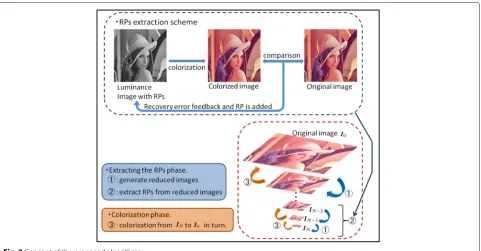
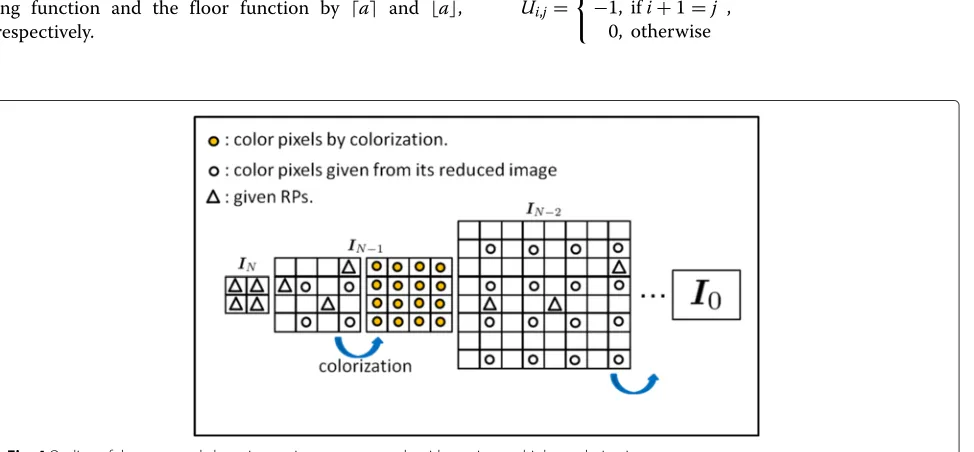
RPs using error feedback between the original image and the colorized image similar to [15]. In order to achieve a low computational cost and to reduce the amount of information to represent RPs, the algorithm extracts RPs from a set of multiple resolution images obtained by multiple downsampling and colorization error minimizing. In the phase of colorization, the col-orization algorithm colorizes multiple-resolution images. Performance of the colorization algorithm affects the performance of the colorization-based image coding, that is, the colorization using a few color pixels leads to a high coding performance. To propose a fast and precise coding algorithm, this paper modifies the col-orization algorithm proposed in [4] and introduces a multiple resolution scheme to reduce the computational cost. Figures 1 and 2 show the outline and concept of the proposed algorithm, respectively. The major contribution of this paper is to propose a colorization-based image coding algorithm which requires less computational time and achieves a high coding performance.
This paper is organized as follows. In Section 2.2, we give a colorization algorithm based on the algo-rithm proposed in [4]. Section 2.3 proposes the RPs extraction algorithm which uses recovery error feed-back, and it is applied to multiple resolution images. In Section 2.4, a multi-resolution color image recovery algorithm is proposed. We consider the implementation of saving images with RPs in Section 2.5. Numerical
Fig. 3Outline of the proposed RP extraction algorithm using multiple resolution images
examples show that the proposed algorithm extracts the RPs and recovers the color image fast and effectively in Section 3.
2 Main works
2.1 Notation
We provide here a brief summary of the notations used throughout the paper. (A)i,j and (a)i denote the (i,j) -element of a matrix A and the ith element of a vec-tor a. · 2 and · F denote the l2 norm of a
vec-tor and the Frobenius norm of a matrix, respectively. 0k ∈ Rk is denoted as a k-dimension zero vector. We use diag(A1,. . .,Am) to denote a block diagonal matrix consisting of A1, . . . , Am and |S| to denote the number of elements in a set S. We denote the ceil-ing function and the floor function by a and a, respectively.
2.2 Colorization algorithm
In order to provide a colorization-based image coding, this paper applies the colorization algorithm proposed in [4] because it can recover a full color image from a lumi-nance image using only a few color pixels. The algorithm restores chrominance imagesCbandCrindependently to obtain a color image, and this subsection gives a chromi-nance image restoration method.
Let vectors x ∈ Rmn andy ∈ Rmn denote a desired chrominance image and a rasterized-given luminance image, respectively, where m and n denote height and width of the image. Define U ∈ R(m−1)×m, V ∈
Rm(n−1)×mn,U¯ ∈R(m−1)n×mnandD∈R(2mn−m−n)×mnas
Ui,j= ⎧ ⎨ ⎩
1, ifi=j −1, ifi+1=j
0, otherwise ,
Table 1Correspondence table (bit unit is 3)
Length Sign
9 111001
8 111000
7 110
· · · ·
2 010
1 001
0 000
Vi,j= ⎧ ⎨ ⎩
1, ifi=j −1, ifi+M=j
0, otherwise ,
¯
U=diag(U,. . .,U),
and
D=
¯ UTVT
T
, (1)
respectively. The matrices U¯ andV denote vertical and horizontal difference operators. ThenDxdenotes the dif-ferences between the neighbor pixels of a whole image. Let
us consider the following2 norm minimizing
coloriza-tion problem,
Minimize
x Dx
2 2
Subject to (x)i=ci,∀i∈C,
(2)
where ci is a constant corresponding to a given color value, and the index set C denotes a given set of vec-tor indices of given color pixels. This problem recovers a color image by minimizing the sum of differences between neighbor pixels. In order to colorize an image more appro-priately, [4] assumes that the differences between neigh-bor pixels of a chrominance image have relationship with those of a color image, which is defined by the following equality,
(Dx)i=αf((Dy)i), (3)
whereαis an unknown constant, andf :R→Ris a given function. Then, we obtain the following problem from (2) under the assumption (3),
Minimize
x FDx
2 2
Subject to (x)i=ci,∀i∈C,
(4)
whereFis a diagonal matrix whoseith diagonal element is 1/f((Dy)i). The details are described in [4]. While the problem (4) is a convex quadratic programming and can
be solved exactly, [4] applies Lagrangian relaxation to reduce the computational cost. This paper provides an exact analytical solution of (4) which can be implemented simply.
Let us define H ∈ R(2mn−m−n)×mn by FD. Then, we defineH∗∈R(2mn−m−n)×(mn−p)andH´∗ ∈R(2mn−m−n)×p as submatrices of H composed of columns correspond-ing to unknown color pixels and given color pixels, respectively. Let x∗ ∈ Rmn−p and x´∗ ∈ Rp denote unknown color vectors and given color vectors, respec-tively, where pdenotes the number of given color pix-els. Then the objective function of (4) is rewritten as follows,
FDx=Hx=H∗x∗+ ´H∗x´∗. (5)
Because all entries of x´∗ are given byci, that is, they satisfy the constraint of (4), the problem (4) is equal to the following nonconstrained convex quadratic program-ming,
Minimize
x∗ H
∗x∗+ ´H∗c´∗2
2, (6)
where vectorc´∗ ∈ Rp is a given vector consisting ofci. IfH∗TH∗is nonsingular, we obtain the solution of (6) as follows,
x∗= −
H∗TH∗−1H∗TH´∗c´∗. (7) Now we move onto discuss the singularity of H∗TH∗. For an imagea =[a1,a2,. . .,amn]T∈ Rmn, the following lemma is provided.
Lemma 1.It holds that Ha = 02mn−m−n if and only if a1=a2= · · · =amn.
Proof.Because F is an invertible matrix, Ha = 02mn−m−n if and only if Da = 02mn−m−n. Since D is the difference operator defined by (1),Dais a zero vec-tor if and only if all pixels have the same values, that is, a1=a2= · · · =amn.
Let a(i) ∈ Rmn−1 denotes a subvector of a and be composed by deleting an ith element of a, and H(i) ∈ R(2mn−m−n)×(mn−1) is denoted as a submatrix ofH and is composed by deleting theith column of H. Then the Lemma 1 leads to the following lemma:
Lemma 2.For all i ∈ {1, 2,. . .,mn}, it holds that H(i)a(i)=02mn−m−nif and only ifa(i)=0mn−1.
Proof.We have that
H(i)a(i)=Ha−Ha´=H(a− ´a), (8)
where a´ =[0,. . ., 0,ai, 0,. . ., 0]T∈ Rmn. Therefore, we obtain followings from Lemma 1,
H(i)a(i)=02mn−m−n⇔H(a− ´a)=02mn−m−n
⇔a1=a2=. . .=ai−ai=. . .=amn ⇔a1=a2= · · · =0=. . .=amn ⇔a(i)=0mn−1. (9)
Theorem 1.H∗TH∗is a nonsingular matrix
Proof.Lemma 2 guarantees that the subspace of the col-umn space ofHis linear independent, that is, the column space ofH∗is linear independent.
From this theorem, there exists the inverse ofH∗TH∗, and therefore we can obtain the exact solution of (4) by (7).
2.3 RPs extraction algorithm
This subsection proposes an algorithm to extract the RPs from an original image utilizing the error feedback between the original image and the colorized image. Let Y ∈ Rm×n, Cb ∈ Rm×n and Cr ∈ Rm×n denote a given luminance image and two given chrominance images, respectively. First we provide the following RPs extraction scheme for a given color image, its luminance image, a given initial set of RPs and a small constant ε >0,
Step 1. Recover two chrominance images Cb¯ and Cr¯ using (7) with the luminance image and current RPs.
Step 2. Calculate the error between the original image and the colorized image obtained in Step 1 at each pixel as follows,
(E)i,j= |(Cb− ¯Cb)i,j| + |(Cr− ¯Cr)i,j|. (10) Step 3. Terminate if (E)i,j ≤ ε for all(i,j), else go to Step 4.
Step 4.Add the pixel with the largest errorEi,jto the set of RPs.
Step 5.Terminate if the number of iterations is larger than a given threshold, else go to Step 1.
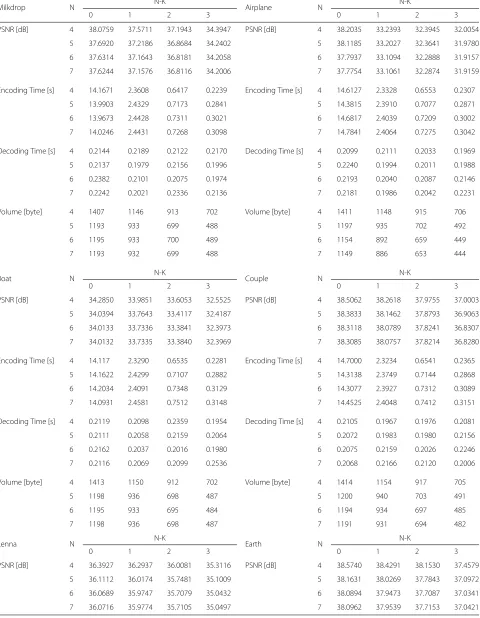
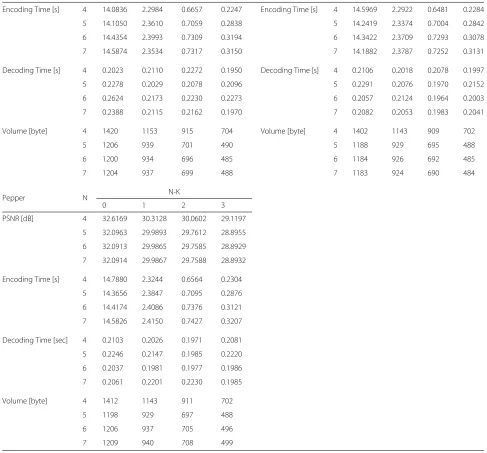
Table 2Numerical results for several(N,K)s
Milkdrop N N-K Airplane N N-K
0 1 2 3 0 1 2 3
PSNR [dB] 4 38.0759 37.5711 37.1943 34.3947 PSNR [dB] 4 38.2035 33.2393 32.3945 32.0054
5 37.6920 37.2186 36.8684 34.2402 5 38.1185 33.2027 32.3641 31.9780
6 37.6314 37.1643 36.8181 34.2058 6 37.7937 33.1094 32.2888 31.9157
7 37.6244 37.1576 36.8116 34.2006 7 37.7754 33.1061 32.2874 31.9159
Encoding Time [s] 4 14.1671 2.3608 0.6417 0.2239 Encoding Time [s] 4 14.6127 2.3328 0.6553 0.2307
5 13.9903 2.4329 0.7173 0.2841 5 14.3815 2.3910 0.7077 0.2871
6 13.9673 2.4428 0.7311 0.3021 6 14.6817 2.4039 0.7209 0.3002
7 14.0246 2.4431 0.7268 0.3098 7 14.7841 2.4064 0.7275 0.3042
Decoding Time [s] 4 0.2144 0.2189 0.2122 0.2170 Decoding Time [s] 4 0.2099 0.2111 0.2033 0.1969
5 0.2137 0.1979 0.2156 0.1996 5 0.2240 0.1994 0.2011 0.1988
6 0.2382 0.2101 0.2075 0.1974 6 0.2193 0.2040 0.2087 0.2146
7 0.2242 0.2021 0.2336 0.2136 7 0.2181 0.1986 0.2042 0.2231
Volume [byte] 4 1407 1146 913 702 Volume [byte] 4 1411 1148 915 706
5 1193 933 699 488 5 1197 935 702 492
6 1195 933 700 489 6 1154 892 659 449
7 1193 932 699 488 7 1149 886 653 444
Boat N N-K Couple N N-K
0 1 2 3 0 1 2 3
PSNR [dB] 4 34.2850 33.9851 33.6053 32.5525 PSNR [dB] 4 38.5062 38.2618 37.9755 37.0003
5 34.0394 33.7643 33.4117 32.4187 5 38.3833 38.1462 37.8793 36.9063
6 34.0133 33.7336 33.3841 32.3973 6 38.3118 38.0789 37.8241 36.8307
7 34.0132 33.7335 33.3840 32.3969 7 38.3085 38.0757 37.8214 36.8280
Encoding Time [s] 4 14.117 2.3290 0.6535 0.2281 Encoding Time [s] 4 14.7000 2.3234 0.6541 0.2365
5 14.1622 2.4299 0.7107 0.2882 5 14.3138 2.3749 0.7144 0.2868
6 14.2034 2.4091 0.7348 0.3129 6 14.3077 2.3927 0.7312 0.3089
7 14.0931 2.4581 0.7512 0.3148 7 14.4525 2.4048 0.7412 0.3151
Decoding Time [s] 4 0.2119 0.2098 0.2359 0.1954 Decoding Time [s] 4 0.2105 0.1967 0.1976 0.2081
5 0.2111 0.2058 0.2159 0.2064 5 0.2072 0.1983 0.1980 0.2156
6 0.2162 0.2037 0.2016 0.1980 6 0.2075 0.2159 0.2026 0.2246
7 0.2116 0.2069 0.2099 0.2536 7 0.2068 0.2166 0.2120 0.2006
Volume [byte] 4 1413 1150 912 702 Volume [byte] 4 1414 1154 917 705
5 1198 936 698 487 5 1200 940 703 491
6 1195 933 695 484 6 1194 934 697 485
7 1198 936 698 487 7 1191 931 694 482
Lenna N N-K Earth N N-K
0 1 2 3 0 1 2 3
PSNR [dB] 4 36.3927 36.2937 36.0081 35.3116 PSNR [dB] 4 38.5740 38.4291 38.1530 37.4579
5 36.1112 36.0174 35.7481 35.1009 5 38.1631 38.0269 37.7843 37.0972
6 36.0689 35.9747 35.7079 35.0432 6 38.0894 37.9473 37.7087 37.0341
Table 2Numerical results for several(N,K)s(Continued)
Encoding Time [s] 4 14.0836 2.2984 0.6657 0.2247 Encoding Time [s] 4 14.5969 2.2922 0.6481 0.2284
5 14.1050 2.3610 0.7059 0.2838 5 14.2419 2.3374 0.7004 0.2842
6 14.4354 2.3993 0.7309 0.3194 6 14.3422 2.3709 0.7293 0.3078
7 14.5874 2.3534 0.7317 0.3150 7 14.1882 2.3787 0.7252 0.3131
Decoding Time [s] 4 0.2023 0.2110 0.2272 0.1950 Decoding Time [s] 4 0.2106 0.2018 0.2078 0.1997
5 0.2278 0.2029 0.2078 0.2096 5 0.2291 0.2076 0.1970 0.2152
6 0.2624 0.2173 0.2230 0.2273 6 0.2057 0.2124 0.1964 0.2003
7 0.2388 0.2115 0.2162 0.1970 7 0.2082 0.2053 0.1983 0.2041
Volume [byte] 4 1420 1153 915 704 Volume [byte] 4 1402 1143 909 702
5 1206 939 701 490 5 1188 929 695 488
6 1200 934 696 485 6 1184 926 692 485
7 1204 937 699 488 7 1183 924 690 484
Pepper N N-K
0 1 2 3
PSNR [dB] 4 32.6169 30.3128 30.0602 29.1197
5 32.0963 29.9893 29.7612 28.8955
6 32.0913 29.9865 29.7585 28.8929
7 32.0914 29.9867 29.7588 28.8932
Encoding Time [s] 4 14.7880 2.3244 0.6564 0.2304
5 14.3656 2.3847 0.7095 0.2876
6 14.4174 2.4086 0.7376 0.3121
7 14.5826 2.4150 0.7427 0.3207
Decoding Time [sec] 4 0.2103 0.2026 0.1971 0.2081
5 0.2246 0.2147 0.1985 0.2220
6 0.2037 0.1981 0.1977 0.1986
7 0.2061 0.2201 0.2230 0.1985
Volume [byte] 4 1412 1143 911 702
5 1198 929 697 488
6 1206 937 705 496
7 1209 940 708 499
LetI0=[Y0Cb0Cr0]∈ Rm×3nandIk =[Yk CbkCrk]∈ Rmk×3nk (k = 1, 2,· · ·,N)denote the original image and kth reduced image, respectively, andN≥1 is a given con-stant.Yk is obtained by simply multiple downsampling as follows,
(Yk)i,j=(Yk−1)2i,2j, i=1,· · ·,mk−1
2 ,j=1,· · ·, nk−1
2 ,
(11)
where mk and nk denote horizontal and vertical sizes of the kth reduced image. Next, we consider a way to generate Cbk and Crk. Since Cbk and Crk are com-posed by the same method, this paper gives a way to
make the reduced imageCbk. The chrominance images of the kth reduced image are generated so that the (k − 1)th chrominance image Cbk−1 can be restored
preciously using Yk−1 and Cbk. Let c´∗k−1 ∈ Rmknk and c∗k−1 ∈ Rmk−1nk−1−mknk denote vectors formed by pixels of even numbered columns and rows, that is, they do not include pixels of odd numbered columns nor rows. Then, this paper proposes the chrominance image recovery problem of the kth reduced image as follows,
Minimize xk
c∗k−1+
H∗TH∗
−1
H∗TH´∗xk22+λc´∗k−1−xk22,
Algorithm 1RP extraction algorithm. Require: Y0,Cb0,Cr0,N,K,ε,tmax
GenerateYkk=1, 2,. . .,Naccording to (11).
CalculateCbk,Crkfork=1, 2,. . .,Naccording to (14). Set RPN ← {(i,j,cb,cr)| i ∈ {1, 2,. . .,mN}, j ∈ {1, 2,. . .,nN},cb=(CbN)i,j,cr=(CrN)i,j}.
fork = N-1,N-2,. . . , N-Kdo
ini
k ← {(i,j)| i ∈ {2, 4,. . ., 2mk+1}, j ∈ {2, 4,. . ., 2nk+1}}.
k←inik . t←1. repeat
CalculateCb¯ kandCr¯ kfromYkand(i,j)-elements ofCbkandCrkfor all(i,j)∈kusing (7).
for all(i,j)do
(E)i,j← |(Cbk− ¯Cbk)i,j| + |(Crk− ¯Crk)i,j|. end for
(iRP,jRP)←arg max(i,j)(Ei,j). k←k∪ iRP,jRP
. t←t+1.
untilt=tmaxor max(Ei,j)≤ε k←k\inik .
RP
k = {(i,j,cb,cr)|(i,j) ∈ k,cb = (Cbk)i,j,cr = (Crk)i,j}.
end for
Ensure: RPk k=N,N−1,. . .,N−K
where λ > 0 is a given constant. Because the chromi-nance images Cbk−1 and Crk−1 are recovered using (7)
withYk−1,Cbk andCrkin the colorization phase as writ-ten Section 2.4, this problem givesCbkto achieve a good colorization of the(k−1)th image. However, problem (12) requires high computational cost to obtain the optimal
solution since it takes high cost to calculate
H∗TH∗ −1
. Therefore this paper provides its relaxed problem to obtain an approximate solution with low computational cost. LetJdenote the first term of the objective function in (12). Then, we have that
J= c∗k−1+H∗TH∗−1H∗TH´∗xk22
= H∗TH∗ −1
H∗T
H∗c∗k−1+ ´H∗xk
2 2
≤ H∗TH∗ −1
H∗T2FH∗ck∗−1+ ´H∗xk22.
(13)
SinceJ is bounded byH∗c∗k−1+ ´H∗xk22, we consider
the following problem to reduceJinstead of (12),
Minimize
xk
H∗c∗k−1+ ´H∗xk22+λ´c∗k−1−xk22. (14)
Utilizing (11) and (14) to obtain a set of multiple res-olution images, this paper provides the RPs extraction
method as shown in Algorithm 1, where Cb¯ k and Cr¯ k denote the colorized chrominance images ofIk. This algo-rithm extracts RPs from IN to IN−K in turn for given constantK ≥ 1, and the even numbered pixels ofIk are used as initial RPs at each iteration. The performance of Algorithm 1 depends heavily on the value of K. If the value ofKis large, lots of RPs are extracted, that is, theK determines the number of RPs, the calculation time and the volume of information to store RPs. The numerical examples in Section 3 show the effects ofK.
Note that the chrominance values of these even num-bered pixels are deleted inRPk at the end of each iteration. They are restored as Cbk+1 and Crk+1 in the previous
iteration and are reused as RPs for recoveringIk. There-fore Algorithm 1 does not store them in RPk to reduce the amount of information about RPs. All pixels of the Nth reduced image are members ofRPN . Figure 3 shows outline of the algorithm.
Algorithm 2Colorization algorithm.
Require: Y0,RPk (k=N,N−1,. . .,N−K)
GenerateYkfork=1, 2,. . .,Nby (11). RP
k ← {φ}fork=N−K−1,. . ., 0. GenerateCbNandCrNfromRPN . fork=N−1,N−2,. . . ,0do
RPeven
k = {(2i, 2j,cb,cr)|i ∈ {1, 2,. . .,mk+1}, j ∈ {1, 2,. . .,nk+1},cb=(Cbk+1)i,j,cr =(Crk+1)i,j}. RP
k ←RPk ∪ RPeven
k .
Recover the chrominance imagesCbk andCrk with RP
k by (7). end for
Ensure: colorized image.
2.4 Color image recovery
This subsection provides the chrominance image recov-ery algorithm. Now we consider a way to recover an image I0=[Y0Cb0Cr0]∈Rm×3nfrom the stored RPsRPk (k =
N,. . .N −K). First, IN is completely obtained by RPN . Next, we focus onto recover the imageIk(k=N−1,N− 2,. . ., 0). SinceRPk includes RPs without the even num-bered pixels, imageIk+1is used asRPk corresponding to
the even numbered pixels. Then the color images Ik is restored by (7) usingRPk andIk+1. Finally we obtain the
colorization algorithm with multiple resolution images as shown in Algorithm 2, and Fig. 4 shows its outline.
The calculation cost of the colorization proposed in sub-section 2.2 mostly depends on the calculating of inverse
Fig. 6The value ofN−Kvs. PSNR and coding time foramilkdrop,bboat,clenna,dpepper,eairplane,fcouple, andgearth
N−1
k=0
mk×nk−mk+1×nk+1− |RPk |
=m0×n0−mN×nN− N−1
k=0
RP k
=m0×n0−
N
k=0
RP k .
(15)
This implies that the calculation cost does not depend on N. Numerical examples in Section 3 show that the computing time is independent ofN.
2.5 Volume of information of RPs
This subsection gives an encoding method of RPs. Let us consider the case that anm×n24-bit image is compressed with p RPs. If the information of RPs is com-posed of their coodinates and two chrominance values,
p(2×8+ log2mn) [bits] are required to represent all RPs because 2×8 [bits] andlog2mn[bits] are required to represent their chrominance values and coordinates, respectively. The proposed algorithm extracts RPs based on multiple resolution images and requires less informa-tion to represent them.
We consider encoding of the coordinates of RPs RP
k (k=N,N−1,. . .N−K). In Algorithm 1,RPN is given as the reduced imageIN, theRPN are given as the reduced imageIN, that is, all pixels ofIN are RPs. Therefore, the coordinates ofRPN are not required, and only the value of Nis coded to representRPN . Next, we consider coding of the coordinates of RPs inRPk (k=N−1,. . .,N−K). For m×nimage, we store the coordinates of RPs as a raster-ized vector of a binary matrix of sizem×nwhose entries are 1 if corresponding pixels are RPs and 0 if otherwise. Hence, this vector is sparse, and it is coded by run length encoding (RLE), which stores the length of consecutive 0s.
Empirical results show that the length of consecutive 0s on the imageRPN−kis less thanzkdefined by
zN−k =
mN−knN−k−mN−k+1nN−k+1
tmax
. (16)
Therefore, this paper proposes to encode the coordinate by RLE per following bit,
bitunitN−k=max
log2(zN−k)
, 2. (17)
Table 1 shows the coding table ofbitunitN−k = 3. This decoding method requires the run length data ofRPk (k= N−1,. . .,N−K)and the values ofNandtmaxto decode the coordinates of RPs.
3 Numerical examples
This section presents numerical examples to show the efficiency of the proposed algorithm. We use the test
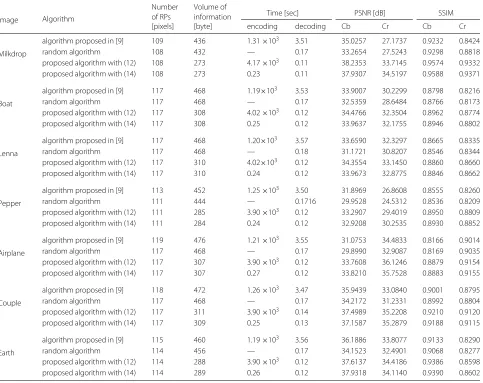
Table 3Numerical results of comparison with other colorization based image coding algorithms
Image Algorithm
Number Volume of
Time [sec] PSNR [dB] SSIM
of RPs information
[pixels] [byte] encoding decoding Cb Cr Cb Cr
Milkdrop
algorithm proposed in [9] 109 436 1.31×10³ 3.51 35.0257 27.1737 0.9232 0.8424
random algorithm 108 432 — 0.17 33.2654 27.5243 0.9298 0.8818
proposed algorithm with (12) 108 273 4.17×10³ 0.11 38.2353 33.7145 0.9574 0.9332 proposed algorithm with (14) 108 273 0.23 0.11 37.9307 34.5197 0.9588 0.9371
Boat
algorithm proposed in [9] 117 468 1.19×10³ 3.53 33.9007 30.2299 0.8798 0.8216
random algorithm 117 468 — 0.17 32.5359 28.6484 0.8766 0.8173
proposed algorithm with (12) 117 308 4.02×10³ 0.12 34.4766 32.3504 0.8962 0.8774 proposed algorithm with (14) 117 308 0.25 0.12 33.9637 32.1755 0.8946 0.8802
Lenna
algorithm proposed in [9] 117 468 1.20×10³ 3.57 33.6590 32.3297 0.8665 0.8335
random algorithm 117 468 — 0.18 31.1721 30.8207 0.8546 0.8344
proposed algorithm with (12) 117 310 4.02×10³ 0.12 34.3554 33.1450 0.8860 0.8660 proposed algorithm with (14) 117 310 0.24 0.12 33.9673 32.8775 0.8846 0.8662
Pepper
algorithm proposed in [9] 113 452 1.25×10³ 3.50 31.8969 26.8608 0.8555 0.8260
random algorithm 111 444 — 0.1716 29.9528 24.5312 0.8536 0.8209
proposed algorithm with (12) 111 285 3.90×10³ 0.12 33.2907 29.4019 0.8950 0.8809 proposed algorithm with (14) 111 284 0.24 0.12 32.9208 30.2535 0.8930 0.8852
Airplane
algorithm proposed in [9] 119 476 1.21×10³ 3.55 31.0753 34.4833 0.8166 0.9014
random algorithm 117 468 — 0.17 29.8990 32.9087 0.8169 0.9035
proposed algorithm with (12) 117 307 3.90×10³ 0.12 33.7608 36.1246 0.8879 0.9154 proposed algorithm with (14) 117 307 0.27 0.12 33.8210 35.7528 0.8883 0.9155
Couple
algorithm proposed in [9] 118 472 1.26×10³ 3.47 35.9439 33.0840 0.9001 0.8795
random algorithm 117 468 — 0.17 34.2172 31.2331 0.8992 0.8804
proposed algorithm with (12) 117 311 3.90×10³ 0.14 37.4989 35.2208 0.9210 0.9120 proposed algorithm with (14) 117 309 0.25 0.13 37.1587 35.2879 0.9188 0.9115
Earth
algorithm proposed in [9] 115 460 1.19×10³ 3.56 36.1886 33.8077 0.9133 0.8290
random algorithm 114 456 — 0.17 34.1523 32.4901 0.9068 0.8277
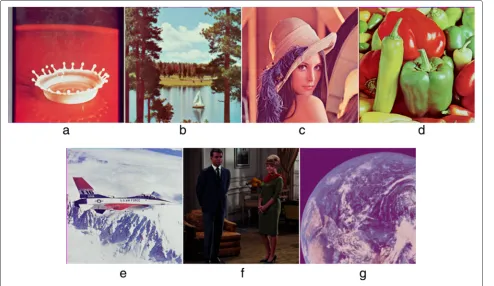
images as shown in Fig. 5. In order to evaluate the quality of image compression, we measure the differ-ences between the original image and the recovered image using the peak signal to noise ratio (PNSR) and the structural similarity (SSIM) [16]. In order to cal-culate these evaluates, we use the MATLAB functions psnr and ssim. In all experiments we use ε = 2 and λ = 0.3, which are selected empirically from ε ∈[0, 10] and λ ∈[0.1, 1] to achieve the best per-formance. We use tmax = 70 except for the second experiment.
First we examine the effect of the parameters N and Kusing uncompressed luminance images. Table 2 shows PSNR, the computing time of Algorithm 1, the comput-ing time of Algorithm 2 and the volume of information to store RPs. PSNR is obtained by averaging those of Cb and Cr. As can be seen, the results ofN ≥ 5 are almost the same. Figure 6 shows the PSNR and the computing time of Algorithm 1 withN =5 forN−K ∈ {0, 1, 2, 3, 4}. We can see that the algorithm with(N,K) = (5, 3)achieves the best tradeoff between calculation time and PSNR, and therefore we use(N,K) = (5, 3)in the rest of this section.
Next this paper shows the coding performance of the proposed algorithm comparing with the algorithm pro-posed in [9] and the random algorithm which selects RPs randomly. We chose λ = 5 in (12), which is selected empirically fromλ ∈[ 1, 10] to achieve the best performance. To evaluate the performance of the relaxed problem (14) in RPs extraction scheme, we also examine Algorithm 1 with (12) instead of (14). Because we cannot fix the number of RPs exactly in the algorithm proposed in [9], we adjust the parametertmaxof Algorithm 1 such that the number of RPs is nearly equal to that of [9]. The random algorithm selects RPs randomly and gives the same number of RPs as the proposed algorithm, and we use colorization algorithm (7). In order to see the performance of colorization based coding method, these algorithms use uncompressed luminance images. Because the algorithm proposed in [9] and the proposed algorithm with (12) use a large amount of memory and take a high computational cost, they cannot be applied to a whole image of the test images. Therefore, we use their partial images as shown in Fig. 7. Table 3 shows the number of RPs, the volume of information to restore the RPs, SSIM, PSNR, the computing time to extract the RPs (encoding
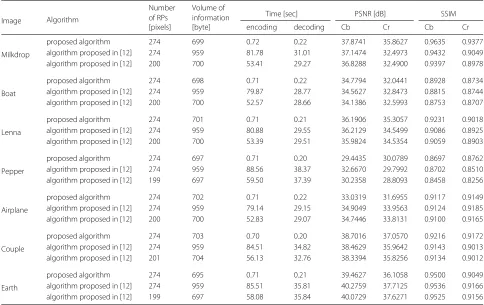
Table 4Numerical results of comparison with Lee’s algorithm
Image Algorithm
Number Volume of
Time [sec] PSNR [dB] SSIM
of RPs information
[pixels] [byte] encoding decoding Cb Cr Cb Cr
Milkdrop
proposed algorithm 274 699 0.72 0.22 37.8741 35.8627 0.9635 0.9377
algorithm proposed in [12] 274 959 81.78 31.01 37.1474 32.4973 0.9432 0.9049 algorithm proposed in [12] 200 700 53.41 29.27 36.8288 32.4900 0.9397 0.8978
Boat
proposed algorithm 274 698 0.71 0.22 34.7794 32.0441 0.8928 0.8734
algorithm proposed in [12] 274 959 79.87 28.77 34.5627 32.8473 0.8815 0.8744 algorithm proposed in [12] 200 700 52.57 28.66 34.1386 32.5993 0.8753 0.8707
Lenna
proposed algorithm 274 701 0.71 0.21 36.1906 35.3057 0.9231 0.9018
algorithm proposed in [12] 274 959 80.88 29.55 36.2129 34.5499 0.9086 0.8925 algorithm proposed in [12] 200 700 53.39 29.51 35.9824 34.5354 0.9059 0.8903
Pepper
proposed algorithm 274 697 0.71 0.20 29.4435 30.0789 0.8697 0.8762
algorithm proposed in [12] 274 959 88.56 38.37 32.6670 29.7992 0.8702 0.8510 algorithm proposed in [12] 199 697 59.50 37.39 30.2358 28.8093 0.8458 0.8256
Airplane
proposed algorithm 274 702 0.71 0.22 33.0319 31.6955 0.9117 0.9149
algorithm proposed in [12] 274 959 79.14 29.15 34.9049 33.9563 0.9124 0.9185 algorithm proposed in [12] 200 700 52.83 29.07 34.7446 33.8131 0.9100 0.9165
Couple
proposed algorithm 274 703 0.70 0.20 38.7016 37.0570 0.9216 0.9172
algorithm proposed in [12] 274 959 84.51 34.82 38.4629 35.9642 0.9143 0.9013 algorithm proposed in [12] 201 704 56.13 32.76 38.3394 35.8256 0.9134 0.9012
Earth
proposed algorithm 274 695 0.71 0.21 39.4627 36.1058 0.9500 0.9049
time), and to colorize the images (decoding time). As can be seen, the proposed algorithm with (14) works faster and achieves better performance than the other algorithms.
Thirdly, the proposed algorithm is compared with the algorithm proposed in [12] using the test images as shown in Fig. 5. In [12], Lee et al. have proposed the colorization-based image coding algorithm, which achieves a high coding performance. In order to see the performance of colorization-based coding method, these algorithms use uncompressed luminance images. Since an arbitrary number of RPs can be used in Lee’s algo-rithm, we examine the algorithm in two ways by using (1) the same number of RPs as those of the proposed algorithm and (2) RPs whose volume of information to be represented is equal to that of the proposed algorithm.
Table 4 shows the number of RPs, the volume of information to restore the RPs, SSIM, PSNR, the
computing time to extract the RPs (encoding time) and to colorize the images (decoding time). We can see that the proposed algorithm achieves similar performance to Lee’s algorithm and requires less computational.
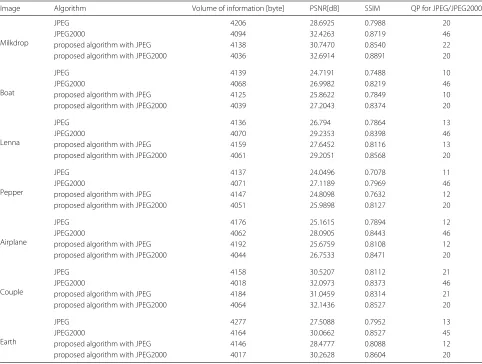
Finally, we compare the proposed algorithm with JPEG and JPEG2000 coding method. Luminance images are compressed using JPEG/JPEG2000 coding where the qual-ity parameter (QP) is selected such that the volume of information is equal to about 4000 bytes.
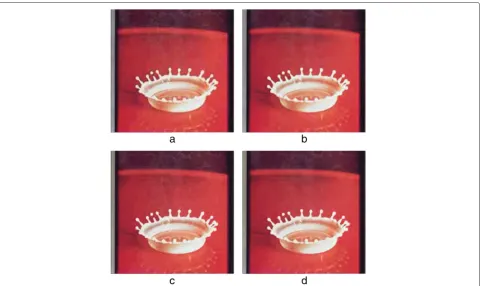
Table 5 shows the volume of information [byte] to repre-sent each color image, SSIM, PSNR and quality parameter (QP) for JPEG/JPEG2000, Figs. 8, 9 and 10 show the recov-ery images, and Fig. 11 shows zoomed images of Fig. 8. SSIM and PSNR are obtained by averaging those of red, green, and blue images. As can be seen, the proposed algorithm with JPEG2000 can compress color images the best of all while the qualities of compressed images are equal or better than other coding methods. The proposed
Table 5Numerical results of comparison with JPEG and JPEG2000
Image Algorithm Volume of information [byte] PSNR[dB] SSIM QP for JPEG/JPEG2000
Milkdrop
JPEG 4206 28.6925 0.7988 20
JPEG2000 4094 32.4263 0.8719 46
proposed algorithm with JPEG 4138 30.7470 0.8540 22
proposed algorithm with JPEG2000 4036 32.6914 0.8891 20
Boat
JPEG 4139 24.7191 0.7488 10
JPEG2000 4068 26.9982 0.8219 46
proposed algorithm with JPEG 4125 25.8622 0.7849 10
proposed algorithm with JPEG2000 4039 27.2043 0.8374 20
Lenna
JPEG 4136 26.794 0.7864 13
JPEG2000 4070 29.2353 0.8398 46
proposed algorithm with JPEG 4159 27.6452 0.8116 13
proposed algorithm with JPEG2000 4061 29.2051 0.8568 20
Pepper
JPEG 4137 24.0496 0.7078 11
JPEG2000 4071 27.1189 0.7969 46
proposed algorithm with JPEG 4147 24.8098 0.7632 12
proposed algorithm with JPEG2000 4051 25.9898 0.8127 20
Airplane
JPEG 4176 25.1615 0.7894 12
JPEG2000 4062 28.0905 0.8443 46
proposed algorithm with JPEG 4192 25.6759 0.8108 12
proposed algorithm with JPEG2000 4044 26.7533 0.8471 20
Couple
JPEG 4158 30.5207 0.8112 21
JPEG2000 4018 32.0973 0.8373 46
proposed algorithm with JPEG 4184 31.0459 0.8314 21
proposed algorithm with JPEG2000 4064 32.1436 0.8527 20
Earth
JPEG 4277 27.5088 0.7952 13
JPEG2000 4164 30.0662 0.8527 45
proposed algorithm with JPEG 4146 28.4777 0.8088 12
Fig. 8Image results (milkdrop) ofaJPEG,bJPEG2000,cproposed algorithm with JPEG, anddproposed algorithm with JPEG2000
Fig. 10Image results (lenna) ofaJPEG,bJPEG2000,cproposed algorithm with JPEG, anddproposed algorithm with JPEG2000
algorithm requires 0.7–0.8 [s] for encoding and 0.2–0.3 [s] for decoding in MATLAB 2014a on a PC with an Intel Core i7 3.4 GHz CPU, 8 GB of RAM memory.
4 Conclusions
This paper proposes a representative pixel (RP) extraction and colorization algorithm for the colorization-based
digital image coding. In order to achieve low com-puting cost and high image coding performance, multiple reduced images are generated by coloriza-tion error minimizing method, and the RPs are extracted from these reduced images. Numerical exam-ples show that the proposed algorithm can extract RPs and recover a color image fast and effectively
comparing with other colorization-based algorithms, and numerical results show that the proposed algo-rithm achieves higher coding performance than JPEG/JPEG2000.
Competing interests
The authors declare that they have no competing interests.
Acknowledgements
We are grateful to Sukho Lee and his co-authors for providing the source code of the colorization-based coding proposed in [12].
This work was supported by JSPS KAKENHI Grant Numbers 26·6546.
Author details
1Tokyo University of Science, 162-8677 Tokyo, Japan.2Kogakuin University, Tokyo, Japan.
Received: 9 January 2015 Accepted: 1 February 2016
References
1. A Levin, D Lischinski, Y Weiss, Colorization using optimization. ACM Trans. Graph.23(3), 689–694 (2004)
2. L Yatziv, G Sapiro, Fast image and video colorization using chrominance blending. IEEE Trans. Image Process.15(5), 1120–1129 (2006)
3. J Pang, OC Au, K Tang, Y Guo, inProc. IEEE Int. Conf. Acoust., Speech, Signal Process. (ICASSP). Image colorization using sparse representation, (2013), pp. 1578–1582
4. K Uruma, K Konishi, T Takahashi, T Furukawa, inProc. IEEE Int. Conf. Acoust., Speech, Signal Process. (ICASSP). Image colorization algorithm using series approximated sparse function, (2013), pp. 1215–1219
5. T Miyata, Y Komiyama, Y Inazumi, Y Sakai, inProc. Picture Coding Symp. Novel inverse colorization for image compression, (2009), pp. 1–4 6. H Noda, N Takao, M Niimi, inProc. IEEE Int. Conf. Image Process. (ICIP).
Colorization in YCbCr space and its application to improve quality of JPEG Color Images, (2007), pp. 385–388
7. L Cheng, S Vishwanathan, inProc. Int. Conf. Mach. Learn. (ICML). Learning to compress images and videos, (2007), pp. 161–168
8. X He, M Ji, H Bao, inProc. IEEE Int. Conf. Comput. Vis. Pattern Recognit. (CVPR). A unified active and semi-supervised learning framework for image Compression, (2009), pp. 65–72
9. S Ono, T Miyata, Y Sakai, inProc. Picture Coding Symp. Colorization-based coding by focusing on characteristics of colorization bases, (2010), pp. 230–233
10. Y Inoue, T Miyata, Y Sakai, Colorization based image coding by using local correlation between luminance and chrominance. IEICE Trans. Inf. Syst. 95(1), 247–255 (2012)
11. T Ueno, T Yoshida, M Ikehara,Color image coding based on the colorization, Asia-Pacific Signal and Information Processing Association Annual Summit and Conference (APSIPA ASC), (2012), pp. 1–4
12. S Lee, S Park, P Oh, M Kang, Colorization-based compression using optimization. IEEE Trans. Image Proc.22(7), 2627–2636 (2013) 13. EJ Candes, J Romberg, T Tao, Stable signal recovery for incomplete and
inaccurate measurements. Commun. Pure Appl. Math.59(3), 1207–1223 (2013)
14. DL Donoho, Compressed sensing. IEEE Trans. Inf. Theory.52, 1289–1306 (2006)
15. C Rusu, SA Tsaftaris, inProc. Int. Symp. Image and Signal Processing and Analysis (ISPA). Estimation of scribble placement for painting colorization, (2013), pp. 564–569
16. Z Wang, AC Bovik, HR Sheikh, EP Simoncelli, Image quality assessment: from error visibility to structural similarity. IEEE Trans. Image Proc.13(4), 600–612 (2004)
Submit your manuscript to a
journal and benefi t from:
7Convenient online submission
7 Rigorous peer review
7Immediate publication on acceptance
7 Open access: articles freely available online
7High visibility within the fi eld
7 Retaining the copyright to your article