Volume 2008, Article ID 317278,14pages doi:10.1155/2008/317278
Research Article
Track and Cut: Simultaneous Tracking and Segmentation
of Multiple Objects with Graph Cuts
Aur ´elie Bugeau and Patrick P ´erez
Centre Rennes-Bretagne Atlantique, INRIA, Campus de Beaulieu, 35 042 Rennes Cedex, France
Correspondence should be addressed to Aur´elie Bugeau,[email protected]
Received 24 October 2007; Revised 26 March 2008; Accepted 14 May 2008
Recommended by Andrea Cavallaro
This paper presents a new method to both track and segment multiple objects in videos using min-cut/max-flow optimizations. We introduce objective functions that combine low-level pixel wise measures (color, motion), high-level observations obtained via an independent detection module, motion prediction, and contrast-sensitive contextual regularization. One novelty is that external observations are used without adding any association step. The observations are image regions (pixel sets) that can be provided by any kind of detector. The minimization of appropriate cost functions simultaneously allows “detection-before-track” tracking (track-to-observation assignment and automatic initialization of new tracks) and segmentation of tracked objects. When several tracked objects get mixed up by the detection module (e.g., a single foreground detection mask is obtained for several objects close to each other), a second stage of minimization allows the proper tracking and segmentation of these individual entities despite the confusion of the external detection module.
Copyright © 2008 A. Bugeau and P. P´erez. This is an open access article distributed under the Creative Commons Attribution License, which permits unrestricted use, distribution, and reproduction in any medium, provided the original work is properly cited.
1. INTRODUCTION
Visual tracking is an important and challenging problem in computer vision. Depending on applicative context under concern, it comes into various forms (automatic or manual initialization, single or multiple objects, still or moving camera, etc.), each of which being associated with an abundant literature. In a recent review on visual tracking [1], tracking methods are divided into three categories: point tracking, silhouette tracking, and kernel tracking. These three categories can be recast as “detect-before-track” tracking, dynamic segmentation and tracking based on distributions (color in particular). They are briefly described inSection 2.
In this paper, we address the problem of multiple objects tracking and segmentation by combining the advantages of the three classes of approaches. We suppose that, at each instant, the moving objects are approximately known thanks to some preprocessing algorithm. These moving objects form what we will refer to as the observations(as explained in Section 3). As possible instances of this detection module, we first use a simple background subtraction (the connected components of the detected foreground mask serve as
high-level observations) and then resort to a more complex approach [2] dedicated to the detection of moving objects in complex dynamic scenes. An important novelty of our method is that the use of external observations does not require the addition of a preliminary association step. The association between the tracked objects and the observations is conducted jointly with the segmentation and the tracking within the proposed minimization method.
When multiple objects trigger a single detection due to their spatial vicinity, the proposed method, as most detect-before-track approaches, can get confused. To circumvent this problem, we propose to minimize a secondary multilabel energy function, which allows the individual segmentation of concerned objects.
This article is an extended version of the work pre-sented in [3]. They are however several noticeable improve-ments, which we now briefly summarize. The most impor-tant change concerns the description of the observations (Section 3.2). In [3], the observations were simply charac-terized by the mean value of their colors and motions. Here, as the object, they are described with mixtures of Gaussians, which obviously offers better modeling capabilities. Due to this new description, the energy function (whose minimiza-tion provides the mask of the tracked object) is different from the one in [3]. Also, we provide a more detailed justification of the various ingredients of the approach. In particular, we explain inSection 4.1why each object has to be tracked independently, which was not discussed in [3]. Finally, we applied our method with the sophisticated multifeature detector we introduced in [2], while in [3] only a very simple background subtraction method was used as the source of object-based detection. This new detector can handle much more complex dynamic scenes but outputs only sparse clusters of moving points, not precise segmentation masks as background subtraction does. The use of this new detector demonstrates not only the genericity of our segmentation and tracking system, but also its ability to handle rough and inaccurate input measurements to produce good tracking.
The paper is organized as follows. InSection 2, a review of existing methods is presented. InSection 3, the notations are introduced and the objects and the observations are described. InSection 4, an overview of the method is given. The primary energy function associated to each tracked object is introduced in Section 5. The introduction of new objects is also explained in this section. The secondary energy function permitting the separation of objects wrongly merged in the first stage is presented in Section 6. Exper-imental results are finally reported in Section 7, where we demonstrate the ability of the method to detect, track, and correctly segment objects, possibly with partial occlusions and missing observations. The experiments also demonstrate that the second stage of minimization allows the segmenta-tion of individual objects, when proximity in space (but also in terms of color and motion in case of more sophisticated detection) makes them merge at the object detection level.
2. EXISTING METHODS
In this section, we briefly describe the three categories (“detect-before-track,” dynamic segmentation, and “kernel tracking”) of existing tracking methods.
2.1. “Detect-before-track” methods
The principle of “detect-before-track” methods is to match the tracked objects with observations provided by an
inde-pendent detection module. Such a tracking can be performed with either deterministic or probabilistic methods.
Deterministic methods amount to matching by mini-mizing a distance between the object and the observations based on certain descriptors (position and/or appearance) of the object. The appearance—which can be, for example, the shape, the photometry, or the motion of the object— is often captured via empirical distributions. In this case, the histograms of the object and of a candidate observation are compared using an appropriate similarity measure, such as correlation, Bhattacharya coefficient, or Kullback-Leibler divergence.
The observations provided by a detection algorithm are often corrupted by noise. Moreover, the appearance (motion, photometry, shape) of an object can vary between two consecutive frames. Probabilistic methods provide means to take measurement uncertainties into account. They are often based on a state space model of the object properties and the tracking of one object is performed using a Bayesian filter (Kalman filtering [4], particle filtering [5]). Extension to multiple object tracking is also possible with such techniques, but a step of association between the objects and the observa-tions must be added. The most popular methods for multiple object tracking in a “detect-before-track” framework are the multiple hypotheses tracking (MHT) and its probabilistic version (PMHT) [6, 7], and the joint probability data association filtering (JPDAF) [8,9].
2.2. Dynamic segmentation
Dynamic segmentation aims at extracting successive seg-mentations over time. A detailed silhouette of the target object is thus sought in each frame. This is often done by making evolve the silhouette obtained in the previous frame toward a new configuration in current frame. The silhouette can either be represented by a set of parameters or by an energy function. In the first case, the set of parameters can be embedded into a state space model, which permits to track the contour with a filtering method. For example, in [10], several control points are positioned along the contour and tracked using a Kalman filter. In [11], the authors proposed to model the state with a set of splines and a few motion parameters. The tracking is then achieved with a particle filter. This technique was extended to multiple objects in [12].
order to successively segment an object through time using a motion information.
2.3. “Kernel tracking”
The last group of methods aims at tracking a region of simple shape (often a rectangle or an ellipse) based on the conservation of its visual appearance. The best location of the region in the current frame is the one for which some feature distributions (e.g., color) are the closest to the reference ones for the tracked object. Two approaches can be distinguished: the ones that assume a short-term conservation of the appearance of the object and the ones that assume this conservation to last in time. The most popular method based on short-term appearance conservation is the so-called KLT approach [23], which is well suited to the tracking of small image patches. Among approaches based on long-term conservation, a very popular approach has been proposed by Comaniciu et al. [24,25], where approximate “mean shift” iterations are used to conduct the iterative search. Graph cuts have also been used for illumination invariant kernel tracking in [26].
Advantages and limits of previous approaches
These three types of tracking techniques have different advantages and limitations and can serve different purposes. The “detect-before-track” approaches can deal with the entrance of new objects in the scene or the exit of existing ones. They use external observations that, if they are of good quality, might allow robust tracking. On the contrary, if they are of low quality the tracking can be deteriorated. Therefore, “detect-before-track” methods highly depend on the quality of the detection process. Furthermore, the restrictive assumption that one object can only be associated to at most one observation at a given instant is often made. Finally, this kind of tracking usually outputs bounding boxes only.
By contrast, silhouette tracking has the advantage of directly providing the segmentation of the tracked object. Representing the contour by a small set of parameters allows the tracking of an object with a relatively small computational time. On the other hand, these approaches do not deal with topology changes. Tracking by minimizing an energy functional allows the handling of topology changes but not always of occlusions (it depends on the dynamics used.) It can also be computationally inefficient and the minimization can converge to local minima of the energy. With the use of recent graph cuts techniques, convergence to the global minima is obtained at a modest computational cost. However, a limit of most silhouette tracking approaches is that they do not deal with the entrance of new objects in the scene or the exit of existing ones.
Finally, kernel tracking methods based on [24], thanks to their simple modeling of the global color distribution of target object, allow robust tracking at low cost in a wide range of color videos. However, they do not deal naturally with objects entering and exiting the field of view, and they do not
provide a detailed segmentation of the objects. Furthermore, they are not well adapted to the tracking of small objects.
3. OBJECTS AND OBSERVATIONS
We start the presentation of our approach by a formal definition of tracked objects and of observations.
3.1. Description of the objects
LetP denote the set ofNpixels of a frame from an input image sequence. To each pixels∈P of the image at timetis associated a feature vector:
zt(s)=z(tC)(s),z(tM)(s)
, (1)
where z(tC)(s) is a 3-dimensional vector in the color space andz(tM)(s) is a 2-dimensional vector measuring the apparent motion (optical flow). We consider a chrominance color space (here we use the YUV space, where Y is the luminance, U and V the chrominances) as the objects that we track often contain skin, which is better characterized in such a space [27, 28]. Furthermore, a chrominance space has the advantage of having the three channels, Y, U, and V, uncorrelated. The optical flow vectors are computed using an incremental multiscale implementation of Lucas and Kanade algorithm [29]. This method does not hold for pixels with insufficiently contrasted surroundings. For these pixels, the motion is not computed and color constitutes the only low-level feature. Therefore, although not always explicit in the notation for the sake of conciseness, one should bear in mind that we only consider a sparse motion field. The set of pixels with an available motion vector will be denoted asΩ⊂P.
We assume that, at timet,ktobjects are tracked. Theith object at timet,i=1. . . kt, is denoted asOt(i)and is defined as a set of pixels,Ot(i)⊂P. The pixels of a frame that do not belong to the objectOt(i)constitute its “background.” Both the objects and the backgrounds will be represented by a distribution that combines motion and color information. Each distribution is a mixture of Gaussians—All mixtures of Gaussians in this work are fitted using the expectation-maximization (EM) algorithm. For objectiat instantt, this distribution, denoted as p(ti), is fitted to the set of values
{zt(s)}s∈O(i)
t . This means that the mixture of Gaussians of
objectiis recomputed at each time instant, which allows our approach to be robust to progressive illumination changes. For computational cost reasons, one could instead use a fixed reference distribution or a progressive update of the distribution (which is not always a trivial task [30,31]).
We consider that motion and color information is inde-pendent. Hence, the distributionp(ti)is the product of a color distribution, pt(i,C)(fitted to the set of values{zt(C)(s)}s∈O(i)
t )
and a motion distribution p(ti,M)(fitted to the set of values
{z(M)
t (s)}s∈O(i)
t ∩Ω). Under this independence assumption for
color and motion, the likelihood of individual pixel feature
zt(s) according to previous joint model is
pt(i)
zt(s)=pt(i,C)
z(tC)(s)
p(ti,M)
z(tM)(s)
(a) (b) (c)
Figure 1: Observations obtained with background subtraction: (a) reference frame, (b) current frame, and (c) result of background subtraction (pixels in black are labeled as foreground) and derived object detections (indicated with red bounding boxes).
(a) (b)
Figure2: Observations obtained with [2] on a water skier sequence shot by a moving camera: (a) detected moving clusters superposed on the current frame and (b) mask of pixels characterizing the observation.
whens∈Ot(i)∩Ω. As we only consider a sparse motion field, color distribution only is taken into account for pixels with no motion vector:p(ti)(zt(s))=p(ti,C)(z(tC)(s)) ifs∈Ot(i)\Ω.
The background distributions are computed in the same way. The distribution of the background of objectiat time t, denoted asqt(i), is a mixture of Gaussians fitted to the set of values{zt(s)}s∈P\O(i)
t . It also combines motion and color
information:
q(ti)
zt(s)=q(ti,C)
z(tC)(s)
q(ti,M)
z(tM)(s)
. (3)
3.2. Description of the observations
Our goal is to perform both segmentation and tracking to get the objectOt(i)corresponding to the objectOt(−i)1of previous frame. Contrary to sequential segmentation techniques [13, 32,33], we bring in object-level “observations.” We assume that, at each time t, there are mt observations. The jth, i =1. . . mt, observation at timetis denoted asM(tj)and is defined as a set of pixels,M(tj)⊂P.
As objects and backgrounds, observation j at time t is represented by a distribution, denoted as ρ(tj), which is a mixture of Gaussians combining color and motion information. The mixture is fitted to the set{zt(s)}s∈M(j)
t and
is defined as
ρt(j)
zt(s)=ρ(tj,C)
z(tC)(s)
ρ(tj,M)
z(tM)(s)
. (4)
The observations may be of various kinds (e.g., obtained by a class-specific object detector, or motion/color detec-tors). Here, we will consider two different types of observa-tions.
3.2.1. Background subtraction
The first type of observations comes from a preprocessing step of background subtraction. Each observation amounts to a connected component of the foreground detection map obtained by thresholding the difference between a reference frame and the current frame and by removing small regions (Figure 1). The connected components are obtained using the “gap/mountain” method described in [34].
In the first frame, the tracked objects are initialized as the observations themselves.
3.2.2. Moving objects detection in complex scenes
In order to be able to track objects in more complex sequences, we will use a second type of objects detector. The method considered is the one from [2] that can be decomposed in three main steps. First, a gridGof moving pixels having valid motion vectors is selected. Each point is described by its position, its color, and its motion. Then these points are partitioned based on a mean shift algorithm [35], leading to several moving clusters. Finally, segmentation of the objects are obtained from the moving clusters by minimizing appropriate energy functions with graph cuts. This last step can be avoided here. Indeed, as we here propose a method that simultaneously track and segment objects, the observations do not need to be fully segmented objects. Therefore, the observations will simply be the detected clusters of moving points (Figure 2).
The segmentation part of the detection preprocessing will only be used when initializing new objects to be tracked. When the system declares that a new tracker should be created from a given observation, the tracker is initialized with the corresponding segmented detected object.
Instantt−1 Instantt 1st example
2nd example
Object 1 Object 2 Object 1
Object 1
Figure3: Example illustrating why the objects are tracked indepen-dently.
4. PRINCIPLES OF THE TRACK AND CUT SYSTEM
Before getting to the details of our approach, we start by pre-senting its main principles. In particular, we explain why it is decomposed into two steps (first a segmentation/tracking method and then, when necessary, a further segmentation step) and why each object is tracked independently.
4.1. Tracking each object independently
We propose in this work a tracking method that is based on energy minimizations. Minimizing an energy with min-cut/max-flow in capacity graphs [36] permits to assign a label to each pixel of an image. As in [37], the labeling of one pixel will here depend both on the agreement between the appearance at this pixel and the objects appearances and on the similarity between this pixel and its neighbors. Indeed, a binary smoothness term that encourages two neighboring pixels with similar appearances to get the same label is added to the energy function.
In our tracking scheme, we wish to assign a label corre-sponding to one of the tracked objects or to the background to each pixel of the image. By using a multilabel energy function (each label corresponding to one object), all objects would be directly tracked simultaneously by minimizing a single energy function. However, we prefer not to use such a multilabel energy in general, and track each object independently. Such a choice comes from an attempt to dis-tinguish the merging of several objects from the occlusions of some objects by another one, which cannot be done using a multilabel energy function. Let us illustrate this problem on an example. Assume two objects having similar appearances are tracked. We are going to analyze and compare the two following scenarios (described inFigure 3).
On the one hand, we suppose that the two objects become connected in the image plane at timetand, on the other hand, that one of the objects occludes the second one at timet.
First, suppose that these two objects are tracked using a multilabel energy function. Since the appearances of the objects are similar, when they get side by side (first case), the minimization will tend to label all the pixels in the same way (due to the smoothness term). Hence, each pixel will probably be assigned the same label, corresponding to
only one of the tracked objects. In the second case, when one object occludes the other one, the energy minimization leads to the same result: all the pixels have the same label. Therefore, it is possible for these two scenarios to be confused.
Assume now that each object is tracked independently by defining one energy function per object (each pixel is then associated tokt−1 labels). For each object, the final label of a pixel is either “object” or “background.” For the first case, each pixel of the two objects will be, at the end of the two minimizations, labeled as “object.” For the second case, the pixels will be labeled as “object” when the minimization is done for the occluding object and as “background” for the occluded one. Therefore, by defining one energy function per object, we are able to differentiate the two cases. Of course, for the first case, the obtained result is not the wanted one: the pixels get the same label which means that the two objects have merged. In order to keep distinguishing the two objects, we equip our tracking system with an additional separation step in case objects get merged.
The principles of the tracking, including the separation of merged objects, are explained in next subsections.
4.2. Principle of the tracking method
The principle of our algorithm is as follows. A prediction Ot(|it)−1⊂P is made for each objectiof timet−1. We denote asd(ti−)1the mean, over all pixels of the object at timet−1, of optical flow values:
d(ti−)1=
s∈O(i)
t−1∩Ωz (M) t−1(s)
Ot(−i)1∩Ω . (5)
The prediction is obtained by translating each pixel belong-ing toOt(−i)1by this average optical flow:
Ot(|i)t−1=s+d(ti−)1,s∈O (i)
t−1 . (6)
Using this prediction, the new observations and the distribution p(ti) of O(
i)
t−1, an energy function is built. This energy is minimized using min-cut/max-flow algorithm [36], which gives the new segmented object at timet,O(ti). The minimization also provides the correspondences of the object with all the available observations, which simply leads to the creation of new trackers when one or several obser-vations at current instant remain unassociated. Our tracking algorithm is diagrammatically summarized inFigure 4.
4.3. Separating merged objects
At the end of the tracking step, several objects can be merged, that is, the segmentations for different objects overlap:
∃(i,j) :Ot(i)∩O (j)
5. ENERGY FUNCTIONS
We define one tracker per object. To each tracker corre-sponds, for each frame, one graph and one energy function that is minimized using the min-cut/max-flow algorithm [36]. Nodes and edges of the graph can be seen inFigure 5. This figure will be further explained inSection 5.1. In all our work, we consider an 8-neighborhood system. However, for the sake of clarity, only a 4-neighborhood is used in all the figures representing a graph.
5.1. Graph
The undirected graphGt = (Vt,Et) at timet is defined as a set of nodesVt and a set of edgesEt. The set of nodes is composed of two subsets. The first subset is the set of theN pixels of the image gridP. The second subset corresponds to the observations: to each observation maskMt(j)is associated a noden(tj). We call these nodes “observation nodes.” The set of nodes thus readsVt=P ∪ {n
(j)
t ,j=1. . . mt}. The set of edges is decomposed as follows:Et=EP∪mj=t1EM(tj), whereEP
is the set of all unordered pairs{s,r}of neighboring elements ofP, andEM(j)
t is the set of unordered pairs{s,n
(j) t }, with
s∈Mt(j).
Segmenting the objectOt(i)amounts to assigning a label l(s,it), either background, ”bg,” or object, “fg,” to each pixel node s of the graph. Associating observations to tracked objects amounts to assigning a binary labell(ji,)t
“bg” or “fg”)
to each observation node n(tj) (for the sake of clarity, the notation l(ji,)t has been preferred tol
(i) n(tj),t
. The set of all the
node labels is denoted asL(ti).
5.2. Energy
An energy function is defined for each objectiat each instant t. It is composed of data termsR(si,)t and binary smoothness termsBs(i,r),t:
Et(i)
L(ti)
=
s∈Vt
R(si,t)
l(s,it)
+
{s,r}∈Et
B({is),r},t
1−δls(,it),lr(,it)
,
(7)
whereδis the characteristic function defined as
δls,lr
=
⎧ ⎨ ⎩
1 ifls=lr,
0 else. (8)
In order to simplify the notations, we omit object indexiin the rest of this section.
5.2.1. Data term
The data term only concerns the pixel nodes lying in the predicted regions and the observation nodes. For all the other pixel nodes, labeling will only be controlled by the neighbors
Prediction
Observations
O(ti−)1
Ot(|it)−1
Ot(i)
Creation of new objects Distributions computation Construction of the graph Energy minimization (graph cuts)
Correspondences betweenOt(−i)1
and the observations
Figure4: Principle of the algorithm.
Objectiat timet−1 (a)
Graph for objectiat timet n(1)t
n(2)t
O(t|i)t−1
(b)
Figure5: Description of the graph. The left figure is the result of the energy minimization at timet−1. White nodes are labeled as object and black nodes as background. The optical flow vectors for the object are shown in blue. The right figure shows the graph at timet. Two observations are available, each of which giving rise to a special “observation” node. The pixel nodes circled in red correspond to the masks of these two observations. The dashed box indicates the predicted mask.
via binary terms. More precisely, the first part of energy in (7) reads
s∈Vt
Rs,t
ls,t
=α1
s∈Ot|t−1
−lnp1s,ls,t
+α2 mt
j=1
d2n(tj),lj,t
.
(9)
Segmented object at timetshould be similar, in terms of motion and color, to the preceding instance of this object at time t−1. To exploit this consistency assumption, the distribution of the object, pt−1(2), and of the background, qt−1(3), from previous image, is used to define the likelihood p1, within predicted region as
p1(s,l)=
⎧ ⎨ ⎩
pt−1
zt(s) ifl=“fg,”
qt−1
zt(s) ifl=“bg.” (10)
andρ(tj)(4) and betweenqt−1andρ( j)
t must be performed through the computation of a distance measure. A classical distance to compare two mixtures of Gaussians,G1andG2, is the Kullback-Leibler divergence [38], defined as
KLG1,G2=
G1(x) logG1(x)
G2(x)dx. (11)
This asymmetric function measures how well distribution G2 mimics the variations of distributionG1. Here, we want to know if the observations belongs to the object or to the background but not the opposite, and therefore we will measure if one or several observations belong to one object. The data termd2is then
d2(s,l)=
⎧ ⎪ ⎨ ⎪ ⎩
KLρ(tj),pt−1
ifl=“fg,”
KLρ(tj),qt−1
ifl=“bg.”
(12)
Two constantsα1andα2are included in the data term in (9) to give more or less influence to the observations. In our experiments, they were both fixed to 1.
5.2.2. Binary term
Following [37], the binary term between neighboring pairs of pixels{s,r}ofP is based on color gradients and has the form
B{s,r},t=λ1 1 dist(s,r)e
−(z(tC)(s)−zt(C)(r)2)/σT2. (13)
As in [39], the parameter σT is set to σT = 4·(z(tC)(s)−
z(tC)(r))2 , where · denotes expectation over a box sur-rounding the object.
For graph edges between one pixel node and one observation node, the binary term depends on the distance between the color of the observation and the pixel color. More precisely, this term discourages the cut of an edge linking one pixel to an observation node, if this pixel has a high probability (through its color and motion) to belong to the corresponding observation. This binary term is then computed as
B{s,n(j)
t },t=λ2ρ
(j) t
z(tC)(s)
. (14)
Parametersλ1andλ2are discussed in the experiments.
5.2.3. Energy minimization
The final labeling of pixels is obtained by minimizing, with the min-cut/max-flow algorithm proposed in [40], the energy defined above:
Lt(i)=arg min L(ti)
E(ti)
L(ti)
. (15)
This labeling finally gives the segmentation of theith object at timetas
Ot(i)=
s∈P :ls(,it)=“fg” . (16)
(a) Result of the tracking algorithm. 3 objects have merged
(b) Corresponding graph
Figure6: Graph example for the segmentation of merged objects.
5.3. Creation of new objects
One advantage of our approach lies in its ability to jointly manipulate pixel labels and track-to-detection assignment labels. This allows the system to track and segment the objects at time t, while establishing the correspondences between an object currently tracked and all the approxima-tive candidate objects obtained by detection in the current frame. If, after the energy minimization for an objecti, an observation noden(tj)is labeled as “fg” (lt(,ij)=“fg”) it means that there is a correspondence between theith object and the jth observation. Conversely, if the node is labeled as “bg,” the object and the observation are not associated.
If for all the objects (i=1,. . .,kt−1), an observation node is labeled as “bg” (∀i,lt(,ij) =“bg”), then the corresponding observation does not match any object. In this case, a new object is created and initialized with this observation. The number of tracked objects becomeskt = kt−1+ 1, and the new object is initialized as
O(kt)
t =M (j)
t . (17)
In practice, the creation of a new object will be only validated, if the new object is associated to at least one observation at timet+ 1, that is, if∃j ∈ {1,. . .,mt+1}such thatl(kt)
j,t+1=“fg.”
6. SEGMENTING MERGED OBJECTS
Assume now that the results of the segmentations for diff er-ent objects overlap, that is to say
∃(i,j),Ot(i)∩O (j)
t =/ ∅. (18)
In this case, we propose an additional step to determine whether these segmentation masks truly correspond to the same object or if they should be separated. At the end of this step, each pixel must belong to only one object.
Let us introduce the notation
F =i∈1,. . .,kt
| ∃j /=isuch thatOt(i)∩O (j) t =/ ∅
. (19)
(a) (b) (c)
The goal is then to assign to each nodes ofVt a label ψs∈F. DefiningL = {ψs,s∈Vt}the labeling ofVt , a new energy is defined as
Et(L) =
s∈Vt
−lnp3s,ψs
+λ3
{s,r}∈Et
1 dist(s,r)e
−(z(sC)−z(rC)2)/σ321−δψs,ψ r
.
(20)
The parameterσ3is here set asσ3=4·(zt(s)(i,C)−zt(r)(i,C))2 with the averaging being over i ∈ F and{s,r} ∈ E. The fact that several objects have been merged shows that their respective feature distributions at previous instant did not permit to distinguish them. A way to separate them is then to increase the role of the prediction. This is achieved by choosing functionp3as
p3(s,ψ)=
⎧ ⎨ ⎩
p(t−ψ)1
zt(s)
ifs /∈Ot(|ψt−)1,
1 otherwise. (21)
This multilabel energy function is minimized using the expansion move algorithm [36, 41]. The convergence to the global optimal solution with this algorithm cannot be proved. Only the convergence to a locally optimal solution is guaranteed. Still, in all our experiments, this method gave satisfactory results. After this minimization, the objects Ot(i), i∈F are updated.
7. EXPERIMENTAL RESULTS
This section presents various results of joint tracking/seg-mentation, including cases, where merged objects have to be separated in a second step. First, we will consider a relatively simple sequence, with static background, in which the observations are obtained by background subtraction (Section 3.2.1). Next, the tracking method will be com-bined to the moving objects detector introduced in [2] (Section 3.2.2).
7.1. Tracking objects detected with background subtraction
In this section, tracking results obtained on a sequence from the PETS 2006 data corpus (sequence 1 camera 4) are presented. They are followed by an experimental analysis of the first energy function (7). More precisely, the influence of each of its four terms (two for the data part and two for the smoothness part) is shown in the same image.
7.1.1. A first tracking result
We start by demonstrating the validity of the approach, including its robustness to partial occlusions and its ability to segment individually objects that were initially merged.
Following [39], the parameterλ3was set to 20. However, parametersλ1andλ2had to be tuned by hand to get better
results (λ1 =10,λ2=2). Also, the number of classes for the Gaussian mixture models was set to 10.
First results (Figure 7) demonstrate the good behavior of our algorithm even in the presence of partial occlusions and of object fusion. Observations, obtained by subtracting a reference frame (frame 10 shown in Figure 1(a)) to the current one, are visible in the second column of Figure 7, the third column contains the segmentation of the objects with the subsequent use of the second energy function. In frame 81, two objects are initialized using the observations. Note that the connected component extracted with the “gap/mountain” method misses the legs for the person in the upper right corner. While this has an impact on the initial segmentation, the legs are recovered in the final segmentation as soon as the following frame.
Let us also underline the fact that the proposed method easily deals with the entrance of new objects in the scene. This result also shows the robustness of our method to partial occlusions. For example, partial occlusions occur when the person at the top passes behind the three other ones (frames 176 and 206). Despite the similar color of all the objects, this is well handled by the method, as the person is still tracked when the occlusion stops (frame 248).
Finally note that even if from frame 102, the two persons at the bottom correspond to only one observation and have a similar appearance (color and motion), our algorithm tracks each person separately (frames 116, 146) thanks to the second energy function. InFigure 8, we show in more details the influence of the second energy function by comparing the results obtained with and without it. Before frame 102, the three persons at the bottom generate three distinct observations, while, passed this instant, they correspond to only one or two observations. Even if the motions and colors of the three persons are very close, the use of the second multilabel energy function allows their separation.
7.1.2. A qualitative analysis of the first energy function
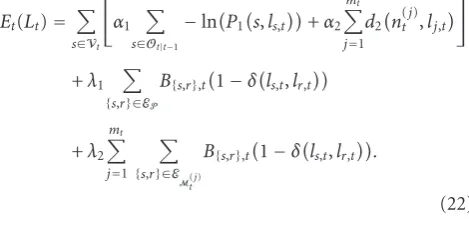
We now propose an analysis of the influence on the results of each of the four terms of the energy defined in (7). The weight of each of these terms is controlled by a parameter. Indeed, we remind that the complete energy function has been defined as
Et(Lt)=
s∈Vt
α1
s∈Ot|t−1
−lnP1s,ls,t
+α2 mt
j=1
d2n(tj),lj,t
+λ1
{s,r}∈EP B{s,r},t
1−δls,t,lr,t
+λ2 mt
j=1
{s,r}∈EM(j)
t
B{s,r},t
1−δls,t,lr,t
.
(22)
(a) (b) (c)
Figure8: Separating merged objects with the secondary minimization (frames 101 and 102): (a) result of simple background subtraction and extracted observations, (b) segmentations with the first energy functions only, and (c) segmentation after postprocessing with the secondary energy function.
(a) Original image (b) Extracted observations (c) Tracked object (d) Tracked object ifλ1=0
(e) Tracked object ifλ2=0 (f) Tracked object ifα1=0 (g) Tracked object ifα2=0
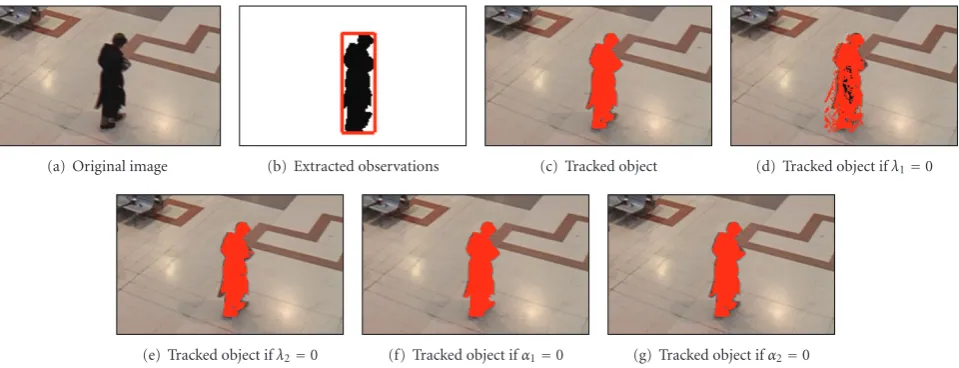
Figure9: Influence of each term of the first energy function on the frame 820 of the PETS sequence.
Figure 9(c) presents the tracked object when using the complete energy equation (22) withλ1=10,λ2=2,α1=1, andα2=2.
If the parameter λ1 is equal to zero, it means that no spatial regularization is applied to the segmentation. The final mask of the object then only depends on the probability of each pixel to belong to the object, the background, and the observations. That is the reason why the object is not well segmented in Figure 9(d). If λ2 =
0, the observations do not influence the segmentation of the object. As can been seen in Figure 9(e), it can lead to a slight undersegmentation of the object. In the case that α2 = 0, the labeling of an observation node only depends on the labels of the pixels belonging to this observation. Therefore, this term mainly influences the association between the observations and the tracked objects. Nevertheless, as can be seen in Figure 9(g), it also slightly modifies the mask of a tracked object, and switching it off might produce an undersegmentation of the object. Finally, whenα1 =0, the energy minimization yields to the spatial regularization of the observation mask thanks to the binary
smoothness term. The mask of the object then stops on the strong contours but does not take into account the color and motion of the pixels belonging to the prediction. In Figure 9(f), this leads to an oversegmentation of the object compared to the segmentation of the object at previous time instants.
This experiment illustrates that each term of the energy function plays a role of its own on the final segmentation of the tracked objects.
7.2. Tracking objects in complex scenes
We are now showing the behavior of our tracking algo-rithm when the sequences are more complex (dynamic background, moving camera, etc.). For each sequence, the observations are the moving clusters detected with the method of [2]. In all this subsection, the parameterλ3was set to 20,λ1to 10, andλ2to 1.
t=80 t=58 t=51 t=31
(a)
t=243 t=225 t=215 t=177
(b)
Figure10: Results on a water skier sequence. The observations are moving clusters detected with the method in [2]. At each time instant, the observations are shown in the left image, while the masks of the tracked objects are shown in the right image.
image. The proposed tracking method permits to correctly track the water skier (or more precisely his wet suit) all along the sequence, despite fast trajectory changes, drastic deformations, and moving surroundings. As can be seen in the figure (e.g., at time 58), the detector sometimes fails to detect the skier. No observations are available in these cases. However, by using the prediction of the object, our method handles well such situations and keeps tracking and segmenting correctly the skier. This shows the robustness of the algorithm to missing observations. However, if some observations are missing for several consecutive frames, the segmentation can get deteriorated. Conversely, this means that the incorporation of the obser-vations produced by the detection module enables to get better segmentations than when using only predictions. On several frames, moving clusters are detected in the water. Nevertheless, no objects are created in concerned areas. The reason is that the creation of a new object is only validated, if the new object is associated to at least one observation in the following frame. This never happened in the sequence.
We end by showing results on a driver sequence (Figure 11). The first object detected and tracked is the face. Once again, tracking this object shows the robustness of our method to missing observations. Indeed, even if from frame 19, the face does not move and therefore is not detected, the algorithm keeps tracking and segmenting it correctly until the driver starts turning it. The most important result on this sequence is the tracking of the hands. In image 39, the masks of the two hands are merged: they have a few pixels in common. The step of segmentation of merged objects is then applied and allows the correct separation of the two masks, which permits to keep tracking these two objects separately. Finally, as can been seen on frame 57, our method deals well with the exit of an object from the scene.
8. CONCLUSION
t=35 t=29 t=16 t=13
(a)
t=63 t=57 t=43 t=39
(b)
Figure11: Results on a driver sequence. The observations are moving clusters detected with the method in [2]. At each time instant, the observations are shown in the left image, while the masks of the tracked objects are shown in the right image.
is minimized with graph cuts. The use of graph cuts permits the segmentation of the objects at a modest computational cost, leaving the computational bottleneck at the level of the detection of objects and of the computation of GMMs.
An important novelty is the use of observation nodes in the graph which gives better segmentations but also enables the direct association of the tracked objects to the observations (without adding any association procedure). The observations used in this paper are obtained firstly by a simple background subtraction based on a single reference frame and secondly by a more sophisticated moving object detector. Note however that any object detection method could be used as well, with no change to the approach, as soon as the observations can be represented by a set of pixels. The proposed method combines the main advantages of each of the three categories of existing methods presented in Section 2. It deals with the entrance of new objects in the scene and the exit of existing ones, as “detect-before-track” methods do; as silhouette tracking methods, the energy minimization directly outputs the segmentation mask of the objects; it allows robust tracking in a wide range of color
videos thanks to the use of global distributions, as with other kernel tracking algorithms.
As shown in the experiments, the algorithm is robust to partial occlusions and to missing observations and does not require accurate observations to provide good segmentations. Also, several observations can correspond to one object (water skier sequence) and several objects can correspond to one observation (PETS sequence). Thanks to the use of a second multilabel energy function, our method allows individual tracking and segmentation of objects which were not distinguished from each other in the first stage.
As we use feature distributions of objects at previous time to define current energy functions, our method handles progressive illumination changes but breaks down in extreme cases of abrupt illumination changes. However, by adding an external detector of such changes, we could circumvent this problem by keeping only the prediction and by updating the reference frame when the abrupt change occurs.
As it turns out, it is difficult to add a global term in an energy function that is minimized by graph cuts. Another solution could be to select a compact characterization of the shape (e.g., pose parameters [42], ellipse parameters [43], normalized central moments [44], or some top-down knowledge [45]) and to add a term such as the face energy term proposed in [43] into the energy function.
Apart from these rather specific problems, several research directions are open. One of them concerns the design of an unifying energy framework that would allow segmentation and tracking of multiple objects, while pre-cluding the incorrect merging of similar objects getting close to each other in the image plane. Another direction of research concerns the automatic tuning of the parameters, which remains an open problem in the recent literature on image labeling (e.g., figure/ground segmentation) with graph cuts.
REFERENCES
[1] A. Yilmaz, O. Javed, and M. Shah, “Object tracking: a survey,”
ACM Computing Surveys, vol. 38, no. 4, p. 13, 2006.
[2] A. Bugeau and P. P´erez, “Detection and segmentation of moving objects in highly dynamic scenes,” inProceedings of the IEEE Computer Society Conference on Computer Vision and Pattern Recognition (CVPR ’07), pp. 1–8, Minneapolis, Minn, USA, June 2007.
[3] A. Bugeau and P. P´erez, “Track and cut: simultaneous tracking and segmentation of multiple objects with graph cuts,” in Proceedings of the 3rd International Conference on Computer Vision Theory and Applications (VISAPP ’08), pp. 1–8, Madeira, Portugal, January 2008.
[4] R. Kalman, “A new approach to linear filtering and prediction problems,” Journal of Basic Engineering, vol. 82, pp. 35–45, 1960.
[5] N. J. Gordon, D. J. Salmond, and A. F. M. Smith, “Novel approach to nonlinear/non-Gaussian Bayesian state estima-tion,”IEE Proceedings F: Radar and Signal Processing, vol. 140, no. 2, pp. 107–113, 1993.
[6] D. Reid, “An algorithm for tracking multiple targets,”IEEE Transactions on Automatic Control, vol. 24, no. 6, pp. 843–854, 1979.
[7] I. J. Cox, “A review of statistical data association techniques for
motion correspondence,” International Journal of Computer
Vision, vol. 10, no. 1, pp. 53–66, 1993.
[8] Y. Bar-Shalom and X. Li,Estimation and Tracking: Principles, Techniques, and Software, Artech House, Boston, Mass, USA, 1993.
[9] Y. Bar-Shalom and X. Li, Multisensor-Multitarget Tracking:
Principles and Techniques, YBS Publishing, Storrs, Conn, USA, 1995.
[10] D. Terzopoulos and R. Szeliski, “Tracking with Kalman snakes,” inActive Vision, pp. 3–20, MIT Press, Cambridge, Mass, USA, 1993.
[11] M. Isard and A. Blake, “Condensation—conditional density
propagation for visual tracking,” International Journal of
Computer Vision, vol. 29, no. 1, pp. 5–28, 1998.
[12] J. MacCormick and A. Blake, “A probabilistic exclusion principle for tracking multiple objects,”International Journal of Computer Vision, vol. 39, no. 1, pp. 57–71, 2000.
[13] N. Paragios and R. Deriche, “Geodesic active regions for
motion estimation and tracking,” in Proceedings of the 7th
IEEE International Conference on Computer Vision (ICCV ’99), vol. 1, pp. 688–694, Kerkyra, Greece, September 1999. [14] A. Criminisi, G. Cross, A. Blake, and V. Kolmogorov, “Bilayer
segmentation of live video,” in Proceedings of the IEEE
Computer Society Conference on Computer Vision and Pattern Recognition (CVPR ’06), vol. 1, pp. 53–60, New York, NY, USA, June 2006.
[15] N. Paragios and G. Tziritas, “Adaptive detection and localiza-tion of moving objects in image sequences,”Signal Processing: Image Communication, vol. 14, no. 4, pp. 277–296, 1999. [16] Y. Shi and W. C. Karl, “Real-time tracking using level sets,”
in Proceedings of the IEEE Computer Society Conference on Computer Vision and Pattern Recognition (CVPR ’05), vol. 2, pp. 34–41, San Diego, Calif, USA, June 2005.
[17] M. Bertalmio, G. Sapiro, and G. Randall, “Morphing active contours,”IEEE Transactions on Pattern Analysis and Machine Intelligence, vol. 22, no. 7, pp. 733–737, 2000.
[18] D. Cremers and C. Schn¨orr, “Statistical shape knowledge in
variational motion segmentation,”Image and Vision
Comput-ing, vol. 21, no. 1, pp. 77–86, 2003.
[19] A.-R. Mansouri, “Region tracking via level set PDEs without
motion computation,”IEEE Transactions on Pattern Analysis
and Machine Intelligence, vol. 24, no. 7, pp. 947–961, 2002. [20] R. Ronfard, “Region-based strategies for active contour
mod-els,”International Journal of Computer Vision, vol. 13, no. 2, pp. 229–251, 1994.
[21] A. Yilmaz, X. Li, and M. Shah, “Contour-based object tracking with occlusion handling in video acquired using mobile cameras,”IEEE Transactions on Pattern Analysis and Machine Intelligence, vol. 26, no. 11, pp. 1531–1536, 2004.
[22] N. Xu and N. Ahuja, “Object contour tracking using graph
cuts based active contours,” in Proceedings of the IEEE
International Conference on Image Processing (ICIP ’02), vol. 3, pp. 277–280, Rochester, NY, USA, September 2002. [23] J. Shi and C. Tomasi, “Good features to track,” inProceedings
of the IEEE Conference on Computer Vision and Pattern Recognition (CVPR ’94), pp. 593–600, Seattle, Wash, USA, June 1994.
[24] D. Comaniciu, V. Ramesh, and P. Meer, “Real-time tracking of non-rigid objects using mean shift,” inProceedings of the IEEE Computer Society Conference on Computer Vision and Pattern Recognition (CVPR ’00), vol. 2, pp. 142–149, Hilton Head Island, SC, USA, June 2000.
[25] D. Comaniciu, V. Ramesh, and P. Meer, “Kernel-based optical tracking,”IEEE Transactions on Pattern Analysis and Machine Intelligence, vol. 25, no. 5, pp. 564–577, 2003.
[26] D. Freedman and M. W. Turek, “Illumination-invariant tracking via graph cuts,” inProceedings of the IEEE Computer Society Conference on Computer Vision and Pattern Recognition (CVPR ’05), vol. 2, pp. 10–17, San Diego, Calif, USA, June 2005.
[27] R. Kjeldsen and J. Kender, “Finding skin in color images,” in
Proceedings of the 2nd International Conference on Automatic Face and Gesture Recognition (FG ’96), pp. 312–317, Killington, Vt, USA, October 1996.
[29] B. D. Lucas and T. Kanade, “An iterative technique of image registration and its application to stereo,” inProceedings of the 7th International Joint Conference on Artificial Intelligence (IJCAI ’81), Vancouver, Canada, August 1981.
[30] A. D. Jepson, D. J. Fleet, and T. F. El-Maraghi, “Robust online appearance models for visual tracking,”IEEE Transactions on Pattern Analysis and Machine Intelligence, vol. 25, no. 10, pp. 1296–1311, 2003.
[31] H. T. Nguyen and A. W. M. Smeulders, “Fast occluded object tracking by a robust appearance filter,”IEEE Transactions on Pattern Analysis and Machine Intelligence, vol. 26, no. 8, pp. 1099–1104, 2004.
[32] O. Juan and Y. Boykov, “Active graph cuts,” inProceedings of the IEEE Computer Society Conference on Computer Vision and Pattern Recognition (CVPR ’06), vol. 1, pp. 1023–1029, New York, NY, USA, June 2006.
[33] P. Kohli and P. Torr, “Effciently solving dynamic markov
random fields using graph cuts,” inProceedings of the 10th IEEE International Conference on Computer Vision (ICCV ’05), pp. 922–929, Beijing, China, October 2005.
[34] Y. Wang, J. F. Doherty, and R. E. Van Dyck, “Moving object tracking in video,” inProceedings of the 29th Applied Imagery Pattern Recognition Workshop (AIPR ’00), p. 95, Washington, DC, USA, October 2000.
[35] D. Comaniciu and P. Meer, “Mean shift: a robust approach toward feature space analysis,”IEEE Transactions on Pattern Analysis and Machine Intelligence, vol. 24, no. 5, pp. 603–619, 2002.
[36] Y. Boykov, O. Veksler, and R. Zabih, “Fast approximate energy
minimization via graph cuts,” IEEE Transactions on Pattern
Analysis and Machine Intelligence, vol. 23, no. 11, pp. 1222– 1239, 2001.
[37] Y. Boykov and M.-P. Jolly, “Interactive graph cuts for optimal boundary & region segmentation of objects in N-D images,” in Proceedings of the 8th IEEE International Conference on Computer Vision (ICCV ’01), vol. 1, pp. 105–112, Vancouver, Canada, July 2001.
[38] S. Kullback and R. A. Leibler, “On information and suffi
-ciency,”Annals of Mathematical Statistics, vol. 22, no. 1, pp. 79–86, 1951.
[39] A. Blake, C. Rother, M. Brown, P. P´erez, and P. Torr, “Interactive image segmentation using an adaptive GMMRF
model,” in Proceedings of the 8th European Conference on
Computer Vision (ECCV ’04), pp. 428–441, Prague, Czech Republic, May 2004.
[40] Y. Boykov and V. Kolmogorov, “An experimental comparison of min-cut/max-flow algorithms for energy minimization in
vision,” IEEE Transactions on Pattern Analysis and Machine
Intelligence, vol. 26, no. 9, pp. 1124–1137, 2004.
[41] Y. Boykov, O. Veksler, and R. Zabih, “Markov random fields
with efficient approximations,” in Proceedings of the IEEE
Computer Society Conference on Computer Vision and Pattern Recognition (CVPR ’98), pp. 648–655, Santa Barbara, Calif, USA, June 1998.
[42] M. Bray, P. Kohli, and P. Torr, “PoseCut: simultaneous seg-mentation and 3D pose estimation of humans using dynamic graph-cuts,” inProceedings of the 9th European Conference on Computer Vision (ECCV ’06), pp. 642–655, Graz, Austria, May 2006.
[43] J. Rihan, P. Kohli, and P. Torr, “Objcut for face detection,” in
Proceedings of the 4th Indian Conference on Computer Vision, Graphics and Image Processing (ICVGIP ’06), pp. 861–871, Madurai, India, December 2006.
[44] L. Zhao and L. S. Davis, “Closely coupled object detection and segmentation,” inProceedings of the 10th IEEE International Conference on Computer Vision (ICCV ’05), vol. 1, pp. 454– 461, Beijing, China, October 2005.